The Iron Line: How One Veteran Drew a Line in Steel and Defeated a Suburban Empire
CHAPTER 1: THE WEIGHT OF IRON
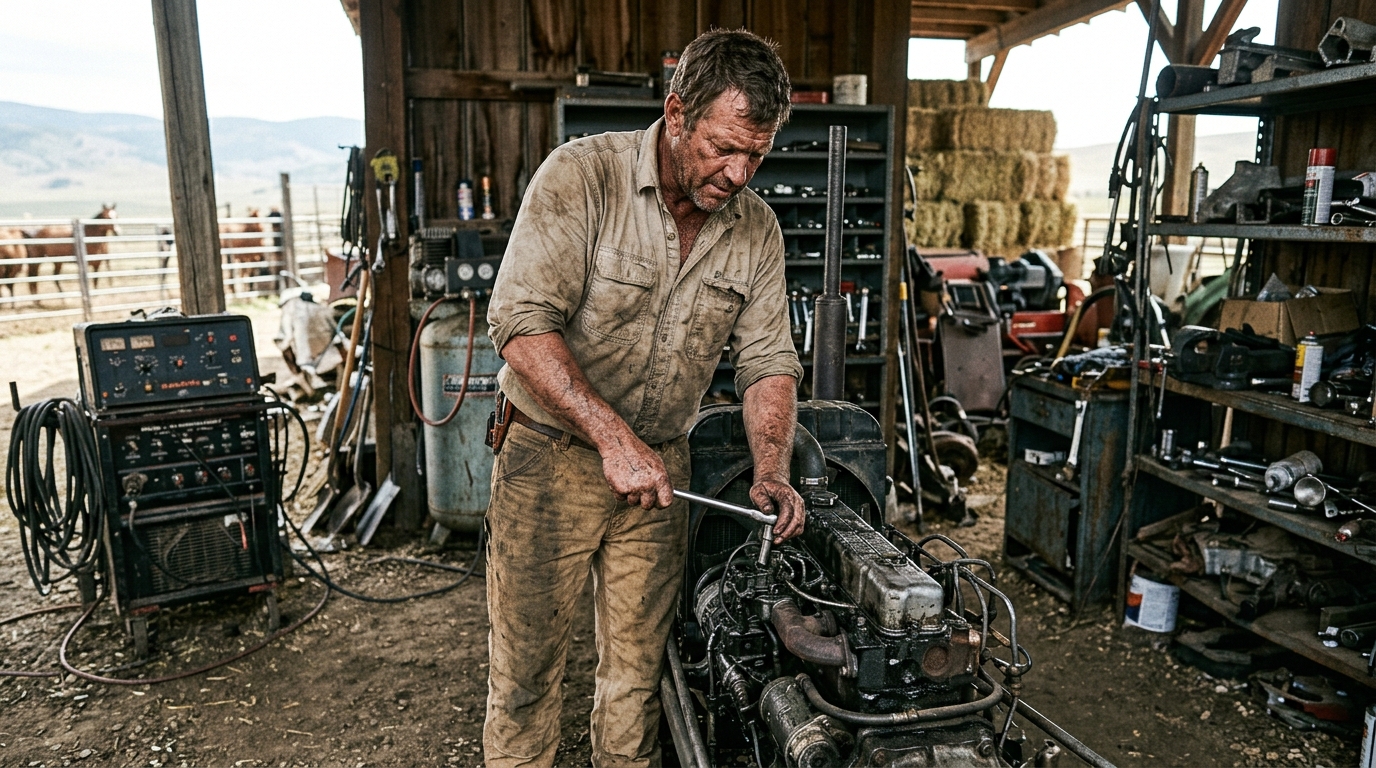
The welding rod sputtered, showering a constellation of white-hot sparks across the damp earth before the arc caught and bit deep into the cold steel. I kept my hand steady, my eyes shaded behind the darkened green glass, watching the molten puddle fuse the heavy anchor plate to the vertical support. It was a clean bead, heavy and deliberate. A quarter-century in the Army Corps of Engineers teaches you that anything built without margin for error is just waiting for gravity to finish the job.
Footsteps crunched on the gravel shoulder behind me, sharp and rhythmic, entirely out of place against the quiet hum of the open pasture.
“That hideous metal contraption is a lawsuit waiting to happen, and you will remove it by Friday, or we will.”
I didn’t cut the torch. I let the high-pitched hiss whine for three seconds longer, feeding the puddle until the steel glowed a dull cherry red, before flicking the toggle and lifting the mask onto my forehead. The late afternoon sun hit my eyes like a hammer, flat and blinding over the Texas hills.
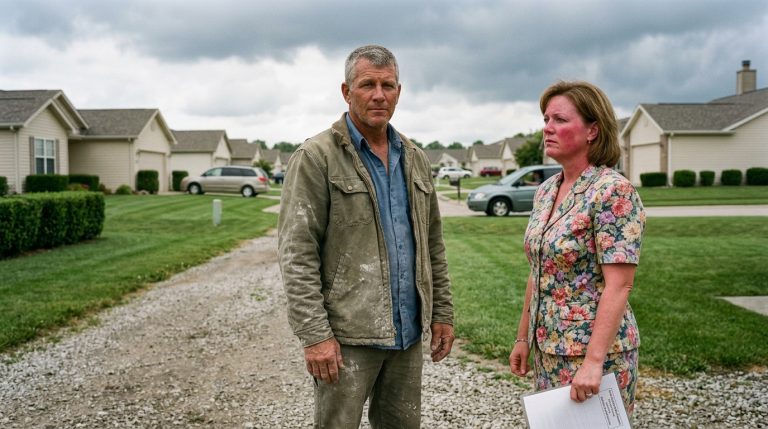
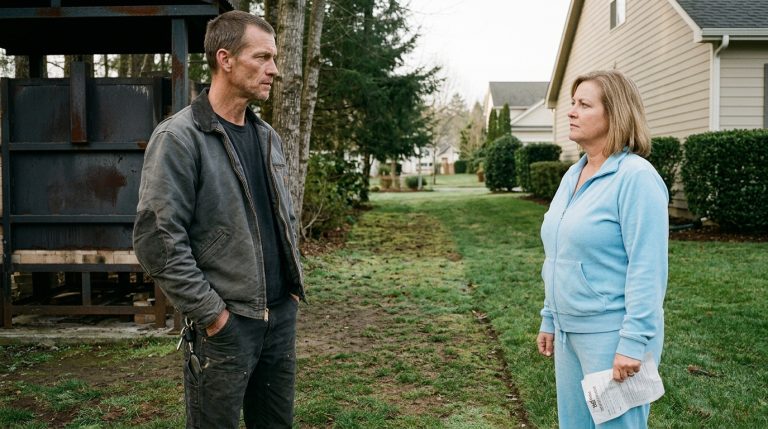
She stood twenty feet away, her floral-print dress a riot of aggressive pastels against the muted browns of my ranch. Karen Thompson, president of the Willow Creek Estates Homeowners Association, carried herself with the severe, practiced posture of someone who believed the universe had been mapped out in a three-ring binder and handed to her for safekeeping. Her chin was lifted at an angle designed to look down on a man standing six feet two inches tall on his own dirt.
Beside her, a pale man with thin, slicked-back hair clutched a leather-bound clipboard like a shield. Gary, the permanent shadow.
I wiped a bead of sweat from my brow with the back of a calloused, grease-stained glove and tapped the newly installed cattle guard with the toe of my boot. The steel grid rang out with a deep, solid resonance. It was anchored three feet deep in concrete, designed to stop a four-thousand-pound steer dead in its tracks.
“Ma’am,” I said, my voice low and level, dropping into the register I used when briefing battalion commanders who thought they knew more about bridge-building than an engineer. “This is a cattle guard. It’s here to keep my livestock from wandering onto the county road.”
Karen scoffed, a dry, sharp sound like air escaping a punctured tire. She didn’t look at the steel, nor at the hundred acres of live oaks stretching out behind me. Her gaze was locked entirely on the boundary line where my access road met the manicured, uniform stucco of her subdivision.
“I don’t care if it’s a portal to another dimension,” she snapped, stepping closer, though stopping short of the gravel dust. “It is an unapproved, unsightly, and dangerous modification to a shared access point. The covenants are perfectly clear. Section 7, subsection B. All alterations to common or semicommon areas must receive prior written approval from the architectural review committee. You received no such approval.”
She tapped a manicured nail against Gary’s clipboard. The minion dutifully angled the papers toward her, trembling slightly in the dry wind.
I looked past her, down the long track that cut through the edge of their development. When Sarah and I bought this place after twenty years of moving wherever the service pointed us—from dusty FOBs to disaster zones—we weren’t looking for a war. We were looking for silence. We found it in a forgotten parcel of land bordered by a multi-million-dollar development that had paved over everything else for ten miles in either direction. Our easement was recorded in county ledgers when the land belonged to men who spoke little and worked much.
Karen crossed her arms, her lips thinning into a hard white line. “Friday, Mr. McGregor. Or my next call won’t be a warning. It will be to our legal counsel.”
I slid the welding mask back over my face, the world instantly plunging into a cool, shadowed green.
“You’re standing on private property,” I said, my voice muffled through the dark lens. “The easement gives you right of passage, not the right to issue orders on my ground. Turn around and walk back to your side of the fence before I call the sheriff.”
I struck the arc. A brilliant, blinding flare of white light erupted from the tip of the rod, casting dancing, jagged shadows across her horrified face as she and her paper-pushing shadow stumbled backward down the road. But as the glare filled my mask, a cold knot tightened in my chest—because I knew as well as she did that a piece of paper in a county office seventy years old wouldn’t stop a machine built on pure, unadulterated neighborhood panic.
CHAPTER 2: THE CHAIN OF TITLES
The garage was quiet once the hum of the generator died down. The air tasted of copper and cooling scale, a familiar grit that coated the back of my throat. I stood there for a long moment in the gathering twilight, listening to the crickets start up in the tall Johnson grass beyond the fence line. Karen Thompson’s parting threat hadn’t left a mark on the steel, but it had left a residue in the room—an irritating, persistent grit like fine sand in a gear box.
I wiped my hands on an old rag, unbuckled the heavy leather work belt, and walked inside the house.
Sarah was in the kitchen, slicing tomatoes from the garden. The light from the single overhead pendant caught the edge of the knife as it met the wooden board, a rhythmic, steady tap that usually grounded me. Tonight, though, her shoulders were held too tight, the fabric of her shirt taut across her back. She didn’t turn around when the screen door latched, but she knew the weight of my boots on the linoleum.
“She called the county clerk’s office twenty minutes ago,” Sarah said softly, setting the knife down. “The neighbor two doors up—Mark—sent a text. He heard her talking in the HOA mail kiosk. She’s pulling the plat maps.”
“Let her pull them,” I said, washing the grease and metal dust from my knuckles under the cold tap. The water turned gray down the drain. “A plat map won’t rewrite a century of real estate.”
“Mac, it’s not about the map anymore. It’s about what she thinks she owns.” Sarah turned, her eyes searching my face for the kind of weariness she knew from twenty years of deployment delays and bureaucratic wall-hitting. “She’s used to people folding the second she prints letterhead on heavy cardstock.”
“They picked the wrong address for a folding drill.”
I dried my hands on a paper towel and walked past her into the study. The room smelled of old oak, dry leather, and the faint, sweet scent of cedar shavings from the baseboards. It was the only room in the house that still felt half-unpacked, even after two years. Boxes of service records, engineering blueprints from my final civilian contract in Houston, and property plats were stacked against the far wall like sandbags.
I dropped into the antique swivel chair, the springs groaning under my weight, and pulled the laptop toward me. But my gaze drifted past the screen to the top right drawer of the desk. Inside sat the original survey map we’d received at closing—the one the title company had certified, the one stamped with the seal of a surveyor who had likely been dead since the Eisenhower administration.
A sudden, sharp memory flared behind my eyes—not of Texas, but of a dry wadi outside Mosul, kneeling in the dirt with a frayed strip map spread across the hood of a battered Humvee while mortar concussions rattled the distant concrete blast walls. Back then, the danger had a clear vector. You looked for the high ground, you secured your flanks, and you trusted the grid coordinates. This war was smaller, pettier, and wrapped in pastel-colored covenants, but the mechanics were identical. If you didn’t control the baseline data, the enemy would redraw the map while you slept.
I slid the drawer open. The wood stuck in its runners, dry and swollen from the dry Texas heat, before giving way with a sharp thwack.
I didn’t pull out the modern survey. I reached past it, feeling for the thick, crinkling linen-backed folio that held the historical chain of title. When we bought the hundred acres, our real estate agent had warned us that old Texas land always carried ghosts—unrecorded cemetery plots, forgotten family squabbles, and overlapping grants that dated back to the Republic. But our lawyer had insisted on tracing the access road back to its legal root.
I unrolled the stiff paper on the mahogany surface, weighing down the corners with a brass stapler and a heavy pocketknife. The ink was faded to a deep sepia, written in a cramped, elegant copperplate script that looked more like art than law.
Volume 12, Page 45. Travis County Records, April 17, 1928.
I traced the lines with the edge of a thumbnail. Jedadiah Miller. A man who cleared this brush with a mule team and a Spencer rifle, long before suburban developers ever dreamed of beige stucco and mandatory roof pitches. The text was dense, packed with legal terminology designed to survive depressions, world wars, and changing generations of politicians.
My finger stopped at the granting clause.
…together with the perpetual, unhindered right of ingress and egress over and across said thirty-foot strip, for man, beast, wagon, and motor transport, including specifically the maintenance of fences, gates, and cattle-guards…
There it was. Not implied. Not interpreted. Written down in black ink on paper that had outlived the men who signed it by nearly a century.
The Willow Creek Estates subdivision didn’t exist in 1928. When their developers bought the surrounding pastureland in 2005 to carve out two hundred identical lots with pocket-sized backyards, they took the land subject to that existing easement. They bought it with the burden already baked into the title insurance policy. Karen Thompson and her board weren’t defending their neighborhood’s integrity; they were suffering from a collective amnesia, assuming that the world began the day their first homeowner signed a purchase agreement.
My phone buzzed against the wood, a short, sharp vibration.
An email from David Chen, my old JAG buddy who now ran a ruthless property law practice down in Houston. The subject line was blank, but the attachment was a preliminary title search report he’d run on the Willow Creek HOA’s corporate filing.
I opened it. The data didn’t just confirm our position; it exposed the structural rot underneath their entire operation. The HOA board hadn’t even properly recorded their latest amendment concerning common-area modifications. They were operating on a set of internal guidelines that hadn’t been filed with the county clerk in four years, making their architectural enforcement powers about as legally binding as a restaurant napkin manifesto.
I leaned back, letting the chair creak, and stared at the glowing monitor.
Karen thought she was fighting a dispute over an unsightly piece of metal on a shared dirt track. She didn’t realize she had just stepped onto a minefield with a live pin. If we pushed back through official channels now, we wouldn’t just defend the cattle guard; we would strip away the legal pretense behind every arbitrary fine she had levied against her own residents for the past three years.
Footsteps padded softly in the hallway. Sarah appeared in the doorway, holding a mug of coffee, her eyes reflecting the pale glow of the desk lamp.
“You found something,” she said quietly, leaning her shoulder against the doorframe.
“Yeah,” I said, looking up from the sepia-toned deed to meet her gaze. “Found out why she’s panicking. She doesn’t just want the cattle guard gone. If that easement stands as written, it proves her entire board has been operating outside the county code for years.”
Sarah took a slow sip of her coffee, her expression settling into a cool, steady resolve that reminded me precisely why we made such a good team. “Then I guess we shouldn’t disappoint her.”
“No,” I said, closing the laptop with a soft click that echoed in the quiet room. “We give her exactly what she’s asking for—all the way to the courthouse steps.”
CHAPTER 3: THE COUNTY LEDGER
The morning sun over Austin didn’t warm the air so much as it baked the limestone dust into a fine, blinding haze. I left the ranch house before the dew had burned off the live oaks, the gearshift of my Ford truck clicking into low range with a familiar, metallic resistance. The certified copy of the 1928 deed sat in a heavy manila envelope on the passenger seat, held down by a box of .45 cartridges and a grease-stained notebook.
There were no shortcuts to the Travis County Records Office. You took the county roads, past the sprawling skeletal frames of new subdivision framing packages going up like matchsticks, until the open pasture gave way to asphalt, curb cuts, and parking garages.
The building itself smelled of damp concrete, old floor wax, and the dry, chemical breath of massive microform machines running twenty-four hours a day. It was a place designed to outlast the people who built it, much like the laws tucked away in its steel filing cabinets.
I checked in at the front counter, my boots clicking hard against the polished linoleum floor, a sound that drew a sharp, sideways glance from a young clerk buried behind a bank of glowing monitors. I didn’t mind the noise. In a world built on vinyl siding and hollow-core doors, solid rubber soles on hard stone were an honest sound.
The clerk directed me down a long, fluorescent-lit corridor to the archival section where the older tract indices were kept. David had already flagged the specific microfilm reel numbers over the phone the night before, but holding the physical chain of title required walking the line from the present owner backward, verifying every signature, every stamp, and every notary seal.
I spent two hours in a cramped, chilled booth with the microfilm reader humming a low, steady drone beside my right ear. The gray screen flickered with inverted text, white words crawling across a dark field. Deed by deed, I walked backward through time.
I watched the land change hands through the decades. In the 1970s, it had belonged to an elderly widow who sold off twenty acres to pay for medical bills. In the 1950s, a cattle syndicate had held it, trading parcels between droughts and cattle booms. Every transaction was meticulously indexed, bound by the iron chain of property law that governed Texas real estate since the days of the Republic. And every single deed—without exception—carried the exact same restrictive covenant language granting the thirty-foot agricultural right-of-way and the explicit authorization for cattle guards.
When I finally printed out the certified verification page with the county seal embossed in heavy purple ink, my thumb traced the raised paper edge. It was solid proof. Not an interpretation. Not a policy handbook printed on glossy cardstock by a neighbourhood committee.
I walked out of the records building into the blinding noon glare, sliding the packet into my jacket pocket. My truck was parked three rows back under the sparse shade of a stunted cedar elm. As I reached for the door handle, a sharp pop-bang echoed across the asphalt—a rusted pickup truck two lanes over backfiring as it dropped into gear, sending a cloud of blue exhaust into the stagnant air. I didn’t flinch, but the sudden vibration of the sound set my teeth on edge, a reminder that the mechanical world outside these air-conditioned walls was constantly grinding away, wearing down whatever stood in its path.
I climbed behind the wheel, cranked the ignition, and pointed the hood back toward the ranch.
The drive home took forty minutes, the rolling hills flattening out as the suburban sprawl gradually receded, replaced once again by cedar brakes, dry creeks, and rusted barbed-wire fences. By the time I turned onto the gravel access road leading to my front gate, the sun was sitting heavy and amber over the western ridge.
I slowed the truck down as I approached the cattle guard.
The steel bars gleamed dully in the fading light, solid and uncompromising between the cedar posts. Nothing had moved. The Santa Gertrudas heifers were clustered under the shade of a live oak fifty yards off, their dark coats blending into the deep evening shadows.
As I killed the engine and stepped out onto the gravel, the silence of the ranch rushed back in to fill the void—no traffic hum, no lawnmowers, no distant sound of HOA compliance officers inspecting trash cans. Just the dry rustle of oak leaves in the evening wind and the heavy, rhythmic thud of a cow shifting its weight in the brush.
I walked over to the cattle guard, crouching down to inspect the concrete anchors. Everything was tight. Not a single bolt had shifted.
Karen Thompson thought she could manage this land with a rule book and a threat of fines, but she was fighting a machine that had been running long before her subdivision was a blueprint. I stood up, dusting the limestone grit from my knees, and looked down the long, dusty track toward where the beige stucco roofs of Willow Creek Estates began.
The first salvo had been fired, and the paperwork was locked in my pocket. Now, it was just a matter of waiting for them to make their next move.
CHAPTER 4: THE WHITE ENVELOPE
The twilight hadn’t even finished bleeding out the purple streaks over the western tree line when the wind shifted, carrying the dry, rattling sound of heavy bond paper snapping against iron.
I didn’t rush. When you spend two decades moving through country where every shadow has a potential vector, you learn that panic is just an inefficient expenditure of adrenaline. I set my coffee mug down on the porch railing, the ceramic clicking against the weathered cedar, and stepped off the wooden planks into the gravel drive.
The air smelled of heated limestone and dry dust. Fifty yards away, where the caliche track met the perimeter of the Willow Creek development, something bright and rectangular fluttered against the dark grid of the cattle guard.
A white envelope, pinned squarely between two parallel steel bars with a rusted utility bracket.
As I walked down the long driveway, my boots crunching a steady, rhythmic measure into the dirt, the details sharpened. It wasn’t just a letter. It was an escalation wrapped in corporate stationery, weighted down with a self-important seal embossed in dark blue ink.
When I reached the guard, I didn’t rip it down immediately. I stood there for a beat, letting my eyes scan the tree line and the rear boundaries of the suburban backyards fifty yards off. A motion-activated floodlight flickered on prematurely behind a beige stucco patio, casting a pale, washed-out yellow glow across the manicured St. Augustine grass before dying back down into shadow.
I reached out, hooked a calloused finger beneath the flap, and pulled. The metal bracket gave way with a dry squeak, leaving a streak of orange rust across the clean paper.
I unfolded the heavy sheet under the fading evening light. David hadn’t even needed to brief me on what the text would say; the legal mechanics of a neighborhood bully backed into a corner were as predictable as gravity.
Notice of Enforcement and Assessment of Additional Penalties.
The fine had jumped from a thousand dollars to seventeen hundred, bloated by arbitrary administrative fees and unauthorized legal retainers. But it was the final paragraph that carried the real weight—the formal declaration that the board had voted to record a formal mechanic’s and materialman’s lien against the entirety of my hundred-acre parcel, clouding the title with a fraudulent debt to force compliance.
They weren’t just arguing about aesthetics anymore. They were trying to throw a legal anchor into my deed.
A low, guttural snort broke the quiet from the pasture behind me. One of the Santa Gertrudas heifers, a heavy-bodied two-year-old with a deep red coat, stepped out from the shade of a live oak, her ears flicking as she caught my scent. She ambled toward the access road, her heavy hooves striking the earth with a dull, muffled thud, heading straight for the steel grid.
She didn’t hesitate. Her front left hoof hit the parallel bars, found solid footing on the open air between them, and carried her across without a break in her stride. The cattle guard did exactly what Jedadiah Miller’s 1928 deed said it would do—it kept the stock where they belonged while allowing the land to breathe.
I folded the letter, sliding it deliberately into the breast pocket of my work shirt, right over my heart. The fabric was stiff with dried sweat and iron dust.
Back in the study, the desk lamp threw a sharp circle of light across the open ledger. I didn’t bother turning on the overhead light. I picked up the landline receiver, dialing a number I knew by heart—not because I called it every day, but because some frequencies get burned into your memory during the long nights in the desert.
David answered on the second ring, his voice crisp and fast, devoid of any sleepy hesitation.
“Mac,” he said. “Tell me you’re calling to say the concrete finally cured.”
“She filed it,” I said, leaning my hip against the edge of the oak desk. “The lien went down on the county rolls at four o’clock today.”
There was a brief pause on the line, the kind of silence where a sharp legal mind calculates vectors, exposure, and timing. When David spoke again, the professional amusement in his tone had hardened into something cold and analytical.
“A fraudulent lien filed after formal notice of a senior recorded easement,” he murmured, half to himself. “That crosses the line from civil overreach straight into a statutory misdemeanor, Mac. She didn’t just step off the porch; she jumped off the roof.”
“She thinks the board’s vote covers her,” I replied, my eyes fixed on the reflection of the desk lamp in the dark windowpane. “She thinks a three-ring binder is bulletproof.”
“Well, her board members are about to find out how expensive their signatures are,” David said, the sound of a keyboard clacking softly in the background as he pulled up his files. “We don’t just clear the title now. We hit them with an injunction that stops any physical interference cold, and we subpoena every single text, email, and meeting minute from that HOA server before they have a chance to scrub the drives. Let her try to staple a lien to a federal injunction.”
“Do it,” I said.
“Consider it done. I’ll have the emergency filing on the judge’s desk by morning call.”
I clicked the receiver down, cutting the line with a sharp, definitive click. The room went dead silent again, save for the faint, rhythmic hum of the refrigerator in the kitchen down the hall.
Karen Thompson wanted a war of attrition, believing her paperwork could starve out a man who had spent twenty years building roads across hostile terrain. She didn’t understand the basic physics of what she was pushing against. Every stroke of her pen, every fraudulent filing, and every illegal vote was just another brick in the wall we were building around her—a wall that was about to collapse inward under its own weight.
CHAPTER 5: THE IRON GATE
The siren didn’t wail with the frantic panic of city emergency vehicles; it cut through the heavy Texas night with a low, rhythmic pulse, bouncing off the cedar breaks and dying against the rolling hills.
I didn’t turn back toward the house. I set the phone down on the cedar post by the edge of the access road, listening to the crunch of heavy rubber tires turning off the asphalt onto the caliche track. Two Travis County patrol cars crested the rise, their light bars throwing sweeping, erratic ribbons of crimson and blue across the dark trunks of the live oaks and the solid, unmoving steel of the cattle guard.
The lead cruiser slowed, its suspension groaning as it dropped into the rutted approach, before stopping ten yards short of my boundary.
The passenger door swung open, and Deputy Miller stepped out into the dry dust. He didn’t wear the jittery posture of a man walking into an unknown domestic dispute. He moved with the slow, deliberate tread of someone who had read the file, checked the coordinates, and knew exactly where the lines were drawn on the ground.
Behind him, a white luxury SUV came rolling up in a panic-driven blur, its high-beam headlights blindingly bright against the dark pasture before slamming to a halt just inches from the rear bumper of the second patrol car.
Karen Thompson didn’t wait for the engine to settle. She threw her door open, the metal creaking in protest, and marched out into the blinding wash of the cruiser lights. Her face was a distorted mask of absolute fury, her floral print dress fluttering in the hot draft of the idling exhaust.
“Deputy! Thank God you’re here!” she shouted, her voice shrill and vibrating with an unhinged desperation. “That man has illegally fortified a public right-of-way! He’s threatening community safety, and I demand you clear that obstruction immediately!”
I didn’t move. I stood beside the cattle guard, my hands resting loosely in the pockets of my canvas jacket, watching the friction play out against the rusted iron bars.
Deputy Miller didn’t even look at her at first. He walked past the front of his cruiser, his boots crunching in the limestone gravel, and stopped five feet from where I stood. He cast a brief, analytical glance down at the heavy steel grid anchored in concrete, then looked up to meet my eyes.
“Evening, Major,” he said, his tone flat and level.
“Evening, Sergeant,” I replied.
Karen slammed her palm down onto the hood of the deputy’s patrol car, the sharp thwack echoing in the open night air. “Are you deaf? I am the president of the Willow Creek Homeowners Association! I gave him formal notice under section seven of our covenants! That metal monstrosity is a violation of community standards, and under our corporate authority—”
“Ma’am,” Deputy Miller interrupted, turning his head slowly to fix her with a stare that had stopped being patient five miles back. “Step away from the vehicle.”
“You don’t understand!” Karen’s voice cracked, the thin veneer of her corporate authority finally splintering under the weight of actual, unyielding law. “We filed a lien against his title this afternoon! He has no legal standing! That land belongs to the association’s common access framework!”
The deputy reached into his breast pocket, pulled out a folded packet of heavy bond paper bearing the purple embossed seal of the Travis County clerk, and unfolded it just enough to catch the light of the cruiser’s dashboard.
“Mrs. Thompson,” Miller said, his voice dropping an octave into that dangerous register reserved for people who thought their paperwork outweighed a judge’s signature. “Earlier today, a Travis County district judge issued a temporary restraining order barring the Willow Creek HOA from any further enforcement actions, harassment, or administrative filings against this property. Furthermore, my office received a formal criminal complaint regarding a fraudulent lien filed against a senior recorded easement dating back to 1928.”
Karen froze. The manicured hand that had been jabbing the air hovered halfway between her face and the patrol car, trembling slightly in the strobe light.
“That… that’s impossible,” she whispered, her voice dropping into a dry rattle. “We have the binding covenants. We approved the architectural review—”
“Your covenants are junior by seventy-seven years, ma’am,” Miller said, sliding a carbon-copy citation from his belt clip and snapping a ballpoint pen with a sharp click. “Right now, you’re standing on private property after being formally served notice to vacate. And if those contractors you called show up to touch a single bolt on this structure, they’re going to share a cell with you.”
She looked from the deputy to me, her eyes wide and bloodshot, searching desperately for the familiar look of submission she was used to extracting from suburban homeowners over trash cans and paint colors. But she found nothing here. Just the cold, steady glare of a man standing on ground he had earned, protected by laws older than the concrete they had poured over the county.
She turned on her heel, stumbling slightly in her heels on the uneven gravel, and hauled herself back into her SUV. The door slammed shut with a sickening, hollow thud, and the vehicle reversed in a spray of loose dirt, its tires spinning wildly before catching traction and tearing back down the access road toward the glowing safety of the subdivision.
The red and blue strobes clicked off, leaving only the steady amber glow of the patrol car’s hazard lights reflecting off the dew-slicked grass.
Deputy Miller tucked the pen back into his pocket, let out a long, slow breath into the cool night air, and shook his head.
“Some folks,” he muttered quietly, “just don’t know when the math doesn’t add up.”
“Appreciate you coming out, Sergeant,” I said.
“Just keeping the peace, Major.” He turned back toward his cruiser. “Though I’d keep an eye on your perimeter tomorrow. People like that don’t quit until they hit a concrete wall.”
“They just hit it,” I said.
He climbed back behind the wheel, pulled a U-turn across the caliche, and followed the tail-lights of his partner back toward the highway, leaving the ranch to the silence of the hills.
I walked over to the cattle guard, knelt down, and ran a bare hand across the cold, solid iron bars. The metal didn’t care about a three-ring binder, and it didn’t care about a fraudulent lien. It was locked deep into the earth, holding the line against everything rushing out of the dark.
CHAPTER 6: THE SETTLED DUST
The annual meeting of the Willow Creek Estates Homeowners Association was held in the community clubhouse, a sterile room of beige drywall, acoustic tile ceilings, and folding chairs that smelled faintly of industrial carpet cleaner and lukewarm coffee. Usually, these gatherings drew a half-dozen residents arguing over pool hours or mulch budgets. Tonight, every chair was filled, and people stood shoulder-to-shoulder along the perimeter walls, their faces lit by the harsh glare of overhead fluorescent tubes.
I sat near the back beside Sarah, our coats laid across our knees. Up front at the long folding table, the atmosphere was thick with a heavy, suffocating panic. Karen Thompson sat near the center, her posture rigid, her hands locked tightly together over a leather portfolio as if bracing against an incoming gale.
Susan, the board’s accountant, stood up with a single sheet of paper in her hand. She didn’t wait for Karen to call the meeting to order.
“We need to address the pending litigation and the state of our administrative record,” Susan said, her voice cutting cleanly through the murmur of the room. “The board has received the final discovery packet from counsel regarding the McGregor injunction and the fraudulent lien.”
A collective murmur rolled through the rows of folding chairs. Karen jerked upward, her face flushing to a dark, mottled crimson.
“You have no authority to discuss ongoing executive session matters without a formal vote!” Karen snapped, her voice cracking slightly at the edges. “We are protecting the community’s asset valuation against an unapproved industrial hazard!”
“Karen, sit down,” an elderly man near the front said.
Arthur Henderson turned slowly in his seat, his lined face steady and unblinking. “Some things are older and stronger than your binder full of rules.”
The silence that followed was absolute. It was the sound of a structural pillar cracking under too much weight.
David Chen, who had been sitting quietly three rows ahead of us, stepped forward and laid a slim manila folder on the edge of the board table. He didn’t raise his voice. He didn’t need to. He simply recited the core mechanics of what the discovery process had uncovered—the emails where Karen had explicitly instructed the board to ignore legal warnings, the deliberate evasion of county code, and the weaponization of corporate funds to file an illegal lien against a senior recorded easement.
“The cost of this vanity project,” David concluded quietly, “has already exceeded thirty thousand dollars in legal defense fees, payable from operating reserves. And the liability rests entirely on the individual decisions of those who chose to ignore clear title law.”
The fallout was swift and brutal. There was no dramatic shouting match, no prolonged debate. Susan moved for an immediate vote of no confidence and the full rescission of all punitive measures against my property. When the hands went up across the room, over ninety percent of the residents voted in favor. Karen sat frozen in her chair, her gaze fixed straight ahead, stripped of the title and the perceived authority that had sustained her little kingdom.
She gathered her portfolio, stood without a word, and walked out of the clubhouse doors into the parking lot. She did not look back.
Two weeks later, the physical and emotional climate of the valley had entirely reset.
Sarah and I sat on the front porch as the afternoon sun dipped low behind the western hills, painting the live oaks in long, amber strokes. Down in the front pasture, the Santa Gertrudas heifers moved slowly through the tall grass, led by the heavy-bodied Brahman bull. They ambled toward the access road, their hooves striking the earth with a steady, muffled rhythm.
They crossed the cattle guard without hesitation, the heavy steel bars humming faintly under their weight before settling back into stillness. It was a functional, necessary part of a working ranch—no longer a symbol of conflict, but a permanent fixture of law and permanence.
My phone buzzed on the cedar side table. I picked it up and saw Susan’s name flashing on the screen. I swiped to answer.
“Mac,” Susan’s voice came through, light and relaxed. “The bylaws committee is meeting next Tuesday. Mr. Henderson insisted we bring you in to help rewrite the architectural review section. We figured a little engineering background and some common sense wouldn’t hurt.”
I glanced over at Sarah, who was smiling softly into her coffee mug.
“I’d be happy to help, Susan,” I said.
We talked for a few minutes about drainage easements and fence lines—an easy, practical conversation between neighbors who understood the weight of the land they shared. When I hung up, I laid the phone back down on the wood.
The war was over, but the iron remained. The boundary lines had been tested, the foundation had held, and the dust had finally settled over the Texas hills, leaving nothing behind but the quiet, unyielding truth of the earth.