The Weight of Iron and Paper: Dismantling a Suburban Tyranny Through Cold, Calculated Ledger Warfare
CHAPTER 1: THE WEIGHT OF THE LAWN
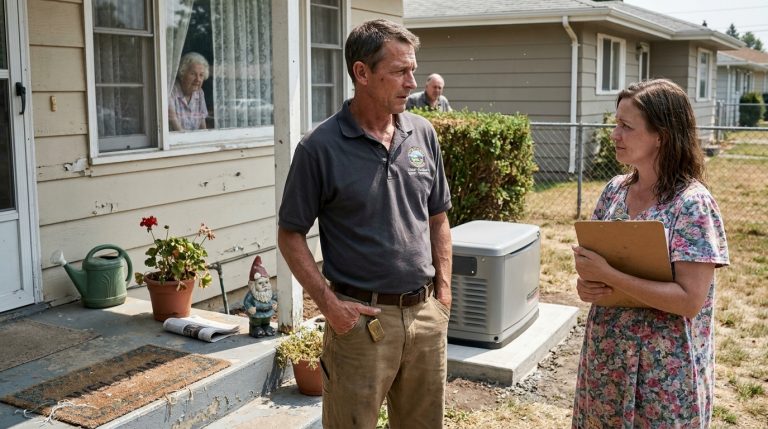
The voice belonged to Karen Vance, wrapped in a floral pantsuit that seemed at war with the dry Texas heat. Her arms were locked across her chest, a posture engineered to signal total dominion over the five-foot strip of municipal earth separating my property from the paved asphalt. She was not looking at me. Her gaze was fixed upward, past the edge of the roofline where a mature pin oak partially swallowed the dark composite curve of the VSAT dish.
“That ugly thing is a blight on this community,” she said, her tone flat, rehearsed, and absolute. “You have exactly seven days to remove it, or the fines will start at five hundred dollars a day.”
The heat radiating off the newly mowed lawn smelled of crushed green blades and dry dirt, a heavy, familiar scent that tugged momentarily at twenty years of military muscle memory. In the Signal Corps, problems were solved through redundancy, encrypted channels, and calculated logistics. You did not argue with an incoming mortar round; you traced its trajectory, calculated the windage, and prepared the counter-battery fire.
I looked down at her shoes—pristine, white-soled tennis shoes that had never touched anything harsher than a suburban driveway. Then I looked past her shoulder toward the northern horizon, where the exurban fringe met the scrub oak and cable monopolies refused to lay copper.
“It’s a professional-grade high-throughput link,” I said, my voice level, stripped of any inflection that might invite debate. “It provides the low-latency connection required for remote network architecture analysis. Without it, my consulting work stops.”
“We have standards here, Mr. Garrison,” she replied, turning her chin up with the calculated precision of someone reciting bylaws written by people who had never worked a twelve-hour shift.
She didn’t know about the guard shack at the community entrance. She didn’t know that the automated gates, the visitor logs, and the security cameras relied entirely on a wireless bridge tethered directly to the router sitting in my office. She viewed the world as a tidy spreadsheet of compliance, where irregularities were sanded down with yellow warning slips and certified mail.
She turned on her heel, the thick soles of her shoes grinding into the dry dirt, and walked back toward her boat-sized white SUV idling by the curb. She did not wait for a counter-argument because she had never encountered a target capable of mounting one.
When the white vehicle pulled away, leaving a faint cloud of blue exhaust suspended in the humid air, I did not curse. Anger was a thermal leak; it wasted energy. Instead, I walked over to the side of the house, placed my palm against the cool metal casing of the exterior junction box, and felt the faint, steady vibration of the data flow.
Inside the kitchen, Sarah was standing by the granite counter, looking through the narrow window blinds with a crease between her eyebrows. I walked in, washed the grass dust from my hands, and pulled the thick binder of covenants, conditions, and restrictions from the shelf by the pantry.
“She dropped the notice,” Sarah said, her voice tight. “Five hundred a day, Jack? Can she actually do that?”
I laid the heavy leather-bound volume flat on the dark stone surface, the pages falling open to the dog-eared section on architectural controls. The paper was stiff and yellowed at the edges, redolent of old glue and bureaucratic permanence.
“She thinks she can,” I said quietly, running my thumb down the margin of Clause 4.2. “That is what we are going to find out.”
CHAPTER 2: THE TACTICAL AUDIT
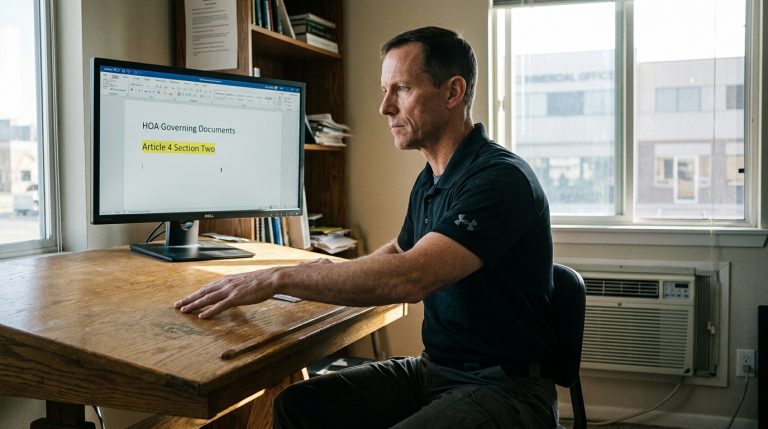
The pages of the Oakidge Estates covenants smelled of old glue and sulfur-bleached wood pulp. Beneath the harsh glare of the kitchen pendant light, the legal text looked less like a set of community guidelines and more like a poorly engineered trench system—full of blind spots, redundant language, and structural misalignments built by developers who had long since vanished.
I sat with a yellow legal pad to my left and a red ballpoint pen held steady in my right hand, methodically breaking down every clause Karen Vance had weaponized. The five-hundred-dollar-a-day penalty she had brandished like a broadsword rested on a foundation of shifting legal sand.
“She skipped the board hearings entirely,” Sarah said quietly, walking over from the refrigerator with a fresh glass of iced tea. She placed it on the granite counter without interrupting the rhythm of my work. “The letter came straight from her desk. Doesn’t the charter require a formal grievance period before any fine can be levied?”
“It does,” I murmured, my eyes scanning the dense columns of paragraph twelve. “Section fourteen, subsection three. A homeowner must be served with a written statement of infraction and given a minimum of fourteen calendar days to request an arbitration hearing before the full board. Karen didn’t issue an infraction. She issued a royal decree.”
I drew a sharp, clean red line under the paragraph and jotted down the corresponding state property code in the margin. The military taught you early that a superior officer operating outside established rules is no longer a commander; they are a liability. When an adversary abandons doctrine, they leave their flanks exposed to anyone disciplined enough to map the terrain.
Beside the covenants lay the printed copy of my initial architectural submission form, pulled from my digital archives. The metadata showed a time stamp from six months prior, complete with a digital receipt acknowledging upload to the community’s management portal.
Clause eight, section two was explicit: If the architectural review committee fails to render a written decision regarding a modification request within thirty days of formal submission, the request shall be deemed tacitly approved.
Five months had passed without a single keystroke of rejection from Karen’s office. By the letter of their own poorly drafted code, the VSAT dish on my roof was not an illegal attachment. It was a legally sanctioned installation, armored by their own administrative silence.
I turned the page, shifting focus from defense to logistics. If Karen wanted a war of attrition, she would find that my endurance was calibrated for longer campaigns than a suburban HOA president could comprehend. The guard shack at the entrance—the automated gates, the security cameras, the visitor logs—was entirely dependent on the high-throughput wireless link tethered to my router. George, the retired accountant and board treasurer, had admitted during our brief mailbox conversation that the association had no secondary data line.
They had traded infrastructural competence for administrative theater.
“What are you looking for now?” Sarah asked, leaning against the doorframe, her arms crossed lightly over her chest.
“The structural load,” I said, tapping the pen against the pad. “A system like this doesn’t run on rules alone; it runs on cash flow. To maintain control over a five-hundred-lot development without pushback, you need an obedient board, a compliant management company, and a thick insulation of petty fees that keep residents too poor and too exhausted to look at the ledger.”
I reached for the binder containing the last three years of annual budget summaries—documents picked up during our closing and tossed into the filing cabinet as standard closing clutter. As I flipped past the routine line items for landscaping, pool maintenance, and insurance, a recurring entry caught my eye.
Vance Services.
The name appeared twice every quarter, listed under general maintenance and common area upkeep. The amounts were remarkably consistent, hovering just below the two-thousand-five-hundred-dollar threshold that triggered mandatory competitive bidding under the association bylaws. Two thousand four hundred and fifty dollars. Two thousand four hundred and ninety dollars.
In a military logistics chain, transactions that consistently skirted authorization limits were classic indicators of administrative leakage. They were engineered to bypass oversight while keeping the machine running just well enough to avoid a systemic collapse.
I picked up my phone, opened the state business registry database, and typed the name into the search bar. The screen blinked, loading public corporate filings from the county clerk’s office. Vance Services was registered as a sole proprietorship. The filing date was precisely fourteen months prior—coinciding directly with Karen Vance’s election to the presidency.
The registered owner’s name scrolled onto the screen in neat, unyielding digital black text: Harold Vance.
The room grew very quiet. Outside the window, the evening cicadas began their rhythmic, grating drone against the fading Texas light. The dry smell of iron and sun-baked dust drifted in through the HVAC vents, a reminder of the harsh, unyielding landscape just beyond our property line.
I stared at the screen, watching the cursor blink rhythmically at the end of the line. The satellite dish on the roof was no longer just a technical necessity for my consulting work or an irritating target for a suburban tyrant’s ego. It was the friction point against a much larger, darker piece of machinery.
Karen hadn’t sent that notice because my equipment violated architectural harmony. She had sent it because anyone who brought high-speed, independent infrastructure into the neighborhood was a potential threat to an ecosystem built on isolation and control.
I picked up the red pen, drew a clean, hard circle around the name Harold Vance, and wrote a single word across the margin of the legal pad.
Exposed.
“Jack?” Sarah said softly, reading the tension in my posture.
“She picked the wrong target,” I said, my voice as level and cold as the granite beneath my hands. “Get me the mailing address for the state property tax assessor. We are going to trace every dollar she’s squeezed out of this community.”
CHAPTER 3: THE FIELD RECONNAISSANCE
The morning sun did not rise over Oakidge Estates so much as it hammered down, turning the asphalt of the winding suburban cul-de-sacs into a shimmering mirror of heat haze. The air smelled of baked dust and dry Bermuda grass. I stepped off my front porch, sliding a pair of polarized sunglasses over my eyes to cut the blinding glare bouncing off the white stucco facades across the street.
In a standard deployment, intelligence gathering was never about passive observation; it was about noting the anomalies—the broken fence boards, the uncollected mail, the tactical blind spots where authority broke down under its own weight.
My boots crunched softly against the gravel shoulder as I walked down the perimeter of our five-acre lot toward the main subdivision artery. The instructions were simple: map the selective enforcement. Karen Vance had weaponized aesthetic standards, but a weaponized rulebook only worked when applied unevenly. If the laws were enforced universally, the system would grind to a halt under its own administrative weight. The tyranny relied entirely on double standards.
A hundred yards down, past a cluster of drooping crape myrtles, stood a single-story brick home with a faded political sign planted squarely in the middle of its dying lawn. The bylaws explicitly prohibited political displays older than thirty days. This particular placard had faded to a washed-out pink and gray over the course of eight months, yet it remained untouched, casting a long shadow over the neatly edged sidewalk.
A few doors further down, a rusted, non-operational sedan sat propped up on wooden blocks behind a waist-high cedar fence, its front bumper missing entirely—a direct violation of clause six regarding unregistered vehicular storage.
I pulled my phone from my pocket, framing each violation in the center of the screen with a precise, timestamped capture. The physical texture of the neighborhood was rotting from the inside out, masked by a thin veneer of manicured front lawns and aggressive compliance letters. The system wasn’t designed to maintain beauty; it was designed to isolate dissenters.
As I rounded the corner onto Elm Street, the heavy drone of a diesel engine idling against the curb caught my attention. A boat-sized white SUV—Karen’s vehicle—was parked squarely across the driveway of a modest, single-story home belonging to Arthur and Eleanor Miller.
I slowed my pace, keeping to the shade of an overgrown cedar elm.
The front door of the Miller house stood half open. Even from twenty paces away, the sharp, authoritative cadence of Karen’s voice cut through the heavy afternoon stillness. She stood on the threshold, her floral pantsuit rigid, looking down with a mask of calculated disappointment at an elderly woman holding a crumpled white tissue.
“The bylaws are unambiguous, Mrs. Miller,” Karen was saying, her tone dripping with the condescending patience one might reserve for a slow-witted child. “Those rose bushes violate the sightline clearance along the property easement. Furthermore, they are a documented hazard for stinging insects. The board cannot make exceptions just because you’ve sentimentally attached yourself to a bunch of overgrown weeds.”
Mrs. Miller’s shoulders shook slightly, her frail hand coming up to press against the wooden doorframe for support. “We’ve had those bushes since we moved in twenty years ago,” she whispered, her voice cracking under the weight of an exhaustion that had nothing to do with gardening. “Nobody ever said a word until last month.”
“Last month, the board elected to enforce standards that have been neglected for far too long,” Karen replied crisply, turning on her heel without waiting for a rebuttal.
She marched down the concrete steps, her expression one of supreme self-satisfaction, and climbed into her white SUV. She did not look at the windows of the neighboring homes. She pulled away from the curb with a sharp acceleration that kicked up a cloud of dry dust, leaving the Millers’ front porch empty and exposed under the merciless sun.
I waited until the taillights vanished around the bend before walking up the driveway. The air near the porch carried the faint, sweet scent of crushed rose petals from the thicket lining the foundation—thickets that showed clean, deliberate pruning cuts where someone had clearly hacked away at the healthy stems to manufacture a violation.
I knocked softly on the door frame.
Eleanor Miller looked up, her eyes red-rimmed and startled, before recognizing me through the screen. She pulled the door open a few inches, her hands trembling around the crumpled tissue.
“Jack,” she breathed, her voice tight with embarrassment. “I didn’t see you out there.”
“Are you all right, Eleanor?” I asked, keeping my tone low, steady, and devoid of pity. Pity was unhelpful; clarity was what mattered.
“It’s just… it’s always something,” she said, looking back over her shoulder toward the quiet, sunlit interior of her living room where Arthur sat silently in his armchair, staring blankly at the floor. “First it was the birdbath. Then the paint color on the window trim. Now the roses. She says we owe another hundred dollars in administrative fees because we haven’t dug them up by Friday.”
I stepped across the threshold into the cool, dim interior of the house, letting the heavy oak door latch shut behind me. The floorboards groaned softly under my boots—a sound of old, enduring construction that contrasted sharply with the hollow, plastic veneer of the association’s modern mandates.
“You aren’t going to dig them up,” I said quietly, pulling out a small notepad from my breast pocket.
Eleanor blinked, her watery eyes searching my face for a joke that wasn’t there. “She’ll fine us, Jack. She’ll put a lien on the house. Arthur’s pension can’t cover these constant penalties anymore. We’ve paid over two thousand dollars in fines just in the last two years.”
The numbers clicked into place with the precision of a combination lock sliding home. Two thousand dollars here, two thousand five hundred dollars there—funneled through vague maintenance invoices, backed by manufactured infractions, and sustained by the sheer terror of administrative ruin.
“Let her try,” I said, my gaze holding hers with the absolute, unyielding calm of a soldier locking down a defensive line. “She’s been running this neighborhood like a fiefdom because everyone thought they were fighting alone. But supply lines cut both ways.”
I pulled a small pen from the loop in my notepad and handed it to Arthur, who looked up from his chair, a sudden, sharp glint of old resilience flickering in his tired eyes.
“Tell me about every single notice she’s sent you,” I said, leaning against the edge of their living room table. “Every fee, every threat, every signature. We are going to build a proper dossier. And then, we are going to serve notice.”
CHAPTER 4: THE PAPER OFFENSIVE
The dining room table had ceased to be a place for meals; it was now an forward operating base littered with legal pads, certified mail receipts, and carbon copies of administrative demands. The air smelled of paper dust and dry ink. Outside, the afternoon sun cast long, thin shadows across the grass, but inside the focus was narrow, rhythmic, and cold.
In institutional warfare, a single poorly structured sentence could neutralize a counter-offensive. That was why every line of the document I was drafting required meticulous calibration. I didn’t need emotion; I needed procedural leverage.
Sarah walked in carrying a mug of black coffee, setting it down next to the stack of state property code statutes. Her eyes flicked over the dense typewritten lines of the formal records request.
“The post office confirmed delivery of the first batch to the management company’s box,” she said, leaning against the edge of the sideboard. “They signed for it at nine-fifteen this morning. Karen’s lawyer has ten days to respond before we escalate to the state regulatory board.”
“Ten days is an eternity in administrative compliance,” I said, not looking up from the page. “She’ll try to stonewall. Most people back down when they see a formal letterhead because they assume the institution holds all the cards. But an institution is only as strong as its paper trail. And right now, their paper trail is anchored to a ghost company.”
I reached for a fresh sheet of white paper and began drafting the second wave of demands. This wasn’t just about my satellite dish anymore. The satellite dish was merely the tripwire. The true objective was the financial records of Vance Services—the shell company Harold Vance had registered to syphon funds out of the association’s maintenance budget.
Under the state property code, homeowners possessed an absolute right to review detailed vendor invoices, canceled checks, and board meeting minutes. When an association tried to block that access by hiding behind administrative fees or intimidating paralegals, they committed a statutory violation that turned a local dispute into a systemic compliance failure.
I laid out the parameters precisely. I cited statute numbers, referenced specific docket sections, and attached a blank check for fifty dollars to cover photocopying costs, eliminating any excuse that the request was “burdensomely broad.”
When the letter was finished, I folded it crisp and clean, slipped it into a heavy-stock envelope, and stamped the corner with the certification tracking number.
In the adjacent room, my phone buzzed against the wooden surface of the side table—a short, sharp vibration. I picked it up. A text message from George, the board’s treasurer, flashed on the screen: She knows about the records request. She’s trying to get the association lawyer to block it on an emergency motion. Be careful, Jack. She’s panicking.
I stared at the screen for a three-beat count, watching the digital blue light fade against the dimming light of the room. Panic in an adversary was a predictable variable. It meant the pressure was hitting structural load-bearing walls.
“Who was that?” Sarah asked quietly.
“George,” I said, setting the phone face down on the table. “The pressure is working. She’s trying to rally the legal counsel.”
“Do you think they’ll fold?”
“People like that don’t fold easily,” I replied, standing up to stretch the stiffness out of my lower back. “They double down. They assume that if they make the process expensive and miserable enough, you’ll simply pack up and walk away. But they don’t understand the logistics of a war of attrition.”
I walked over to the window, looking out past the manicured front lawn toward the quiet street where Karen’s white SUV usually passed during its afternoon rounds. The pavement was empty, silent under the gathering dusk. The air felt heavy, charged with the quiet stillness before a weather front breaks.
We had laid the groundwork. The legal notices were moving through the postal system like slow-moving rounds toward a fortified position. Now, it was time to build the coalition that would hold the ground once the walls came down.
CHAPTER 5: THE UNDERGROUND COALITION
The dining room table no longer held legal pads alone; it held people.
By seven o’clock that evening, the air inside our house was thick with the quiet, nervous energy of five residents who had spent months navigating the suffocating rules of Oakidge Estates in total isolation. They sat wherever space permitted—Arthur and Eleanor Miller occupying the velvet-upholstered chairs near the sideboard, Dr. Emily Chen leaning against the bookshelf with a notebook gripped in her hand, and Mr. Rodriguez sitting stiffly by the window, his fingers laced together over his knees.
Outside, a sudden gust of humid evening wind rattled the dry branches of the pin oak against the siding, bringing with it the faint smell of dust and coming rain.
In tactical operations, coalition-building was never about making friends; it was about aligning vectors of pressure. A single point of friction could be crushed by an established administration, but multiple points distributed across an entire perimeter created structural fatigue.
“She called the management company an hour ago,” Dr. Chen said, her voice low and analytical. She adjusted her glasses, the lenses catching the sharp glare of the overhead light. “My neighbor across the cul-de-sac heard her on the phone in the clubhouse parking lot. She’s demanding that our records request be thrown out on procedural technicalities.”
“Let her demand,” Arthur Miller muttered, leaning forward with his elbows planted on his knees. His weathered hands were scarred from decades of union organizing on shop floors where management played the exact same game with different titles. “A technicality only works if the other side stops pushing. We didn’t stop.”
I walked over to the sideboard, picked up a manila folder, and laid it flat on the center of the table. The cardboard was worn at the edges, stuffed with photocopies of the state business registry and the recurring quarterly invoices from Vance Services.
“She can argue procedure all she wants,” I said, meeting the eyes of everyone gathered around the table. “But procedure cuts both ways. The bylaws require a fourteen-day grievance period before any fine can be levied. They require architectural committee responses within thirty days. And most importantly, they require transparent allocation of association funds.”
I flipped open the folder, revealing the state corporate filing listing Harold Vance as the proprietor of Vance Services.
Mr. Rodriguez leaned forward, his dark eyes narrowing as he scanned the typed lines. “Vance Services? That’s her husband’s shell company? The same outfit that supposedly repaired the playground swings we had to pay out of pocket to fix last year?”
“The same one,” I replied. “Over forty thousand dollars in disbursements over the last three years, structured neatly in increments just beneath the threshold that triggers mandatory competitive bidding. Every invoice is deliberately vague. General maintenance. Common area upkeep. Ground remediation.”
The room fell dead silent. The wind outside groaned against the eaves, a long, hollow sound that seemed to punctuate the sudden realization settling over the table. The tyranny wasn’t random cruelty; it was an extraction engine. The petty fines for rose bushes, basketball hoops, and window trim were never about aesthetics. They were smoke meant to keep the residents distracted, poor, and compliant while the machinery drained the foundation.
Eleanor Miller let out a slow, ragged breath, her fingers tightening around the cloth of her skirt. “For two years, Arthur and I paid those fines out of our retirement savings because we were afraid they’d put a lien on our home. We thought we were just bad neighbors.”
“You weren’t bad neighbors, Eleanor,” I said quietly. “You were targets of an administration that needed compliance to keep its books hidden.”
Arthur straightened up, his shoulders squaring as the old fire returned to his posture. “So what’s our vector? We can’t just hand these papers to the management company; they’re in her pocket. If we go to the district attorney today, it’ll take six months of paperwork while she buries the rest of the trail.”
“We don’t go to the DA yet,” I said, tapping my pen against the edge of the table. “We use her own system to strip her of her footing. We launch a formal recall petition under section nine of the bylaws. We do it publicly, with this evidence stapled to the header, distributed to every household in the development before she even realizes her defenses are breached.”
Dr. Chen nodded slowly, a thin, sharp smile touching the corner of her mouth. “If we hit every household simultaneously over a weekend, the board won’t have time to spin a narrative. The facts will outrun their PR.”
“And the satellite dish?” Sarah asked from the doorway, her arms crossed as she watched the group coalesce around the strategy.
“The satellite dish remains where it is,” I said, looking toward the dark window where the small, professional-grade VSAT link sat mounted to the side of the roof, silently routing the data that kept the front gate operating. “She thinks it’s a vulnerability. We are going to treat it as a tripwire. When she trips it, the whole structure comes down.”
CHAPTER 6: THE SETUP
The ink on the draft letter was still slightly tacky when I slid the pages across the wood-grained surface of my desk. Outside, the evening air had cooled, leaving a thin film of condensation on the glass of the windowpanes.
In tactical engineering, a trap is never about aggression; it is about geometry. You design a structure so rigid that your adversary’s own momentum forces them through the only available door—which happens to lead directly into an enclosed perimeter. Karen Vance was currently operating under the absolute conviction that she held the initiative. Her letters were mailed with certified weight; her threats were backed by institutional letterheads. She assumed dissenters were lone units easily isolated and silenced.
She did not know about the coalition meeting in my dining room, and she certainly did not understand the physical architecture of the network she governed.
My phone sat beside the keyboard, silent but active. I opened a clean document file and began compiling the technical addendum that would accompany the legal draft. Every router, switch, and gateway connected to the community’s front gate infrastructure required a stable upstream data feed. Without the VSAT dish mounted to the side of my roof, the automated gate system reverted instantly to a default offline state—a static barrier of iron and electric motors incapable of processing visitor credentials or remote diagnostic commands.
The legal draft, structured with the sharp, unyielding guidance of my former JAG colleague Dave Riley, was a masterpiece of passive compliance. It did not argue, protest, or threaten litigation. It simply agreed to terms.
Please be advised, the text read, that in full accordance with the final notice issued by the Oakidge Estates Homeowners Association, the satellite equipment mounted on the western exterior wall will not be defended or protected against the association’s contracted removal crew on the designated date.
It was a total surrender on paper. But down in the fine print—specifically under the operational dependency disclosures—the document mapped out every single circuit, camera, and digital log that relied on that exact piece of hardware. It itemized the gate controllers, the IP cameras, the visitor database, and the dedicated VIP line used by the night guard.
We trust that the board has a fully vetted structural contingency plan in place, the closing paragraph noted, to ensure the seamless continuity of community security operations following the permanent disconnection of this signal feed.
I pressed print. The laser printer hummed, drawing the heavy sheets through its rollers with a rhythmic, mechanical whisper that smelled faintly of warm ozone and toner.
Sarah walked into the office, holding a mug of tea, and watched the paper slide into the output tray. She picked up the top sheet, her eyes scanning the precise, clinical paragraphs.
“If she reads this carefully, she’ll see the trap,” Sarah said quietly, setting the mug down.
“She won’t read it carefully,” I replied, standing up and sliding the sheets into a manila folder. “Arrogance creates blind spots. When an administrator is convinced they are dealing with a subordinate, they skim the warnings and look exclusively for the surrender. She will see this letter as complete victory. She will sign the work order without a second thought.”
“And the contractor?”
“The contractor will do what he’s paid to do. He will climb the ladder, cut the coaxial cable, and unbolt the dish.” I walked over to the window, looking out into the dark, silent yard where the pale metal curve of the antenna caught the moonlight. “And five minutes later, the front gate will freeze halfway open.”
The escalation was no longer theoretical. We had crossed the line from defense to active positioning. The paperwork was logged, the coalition was synchronized, and the trap was set with mathematical precision. All that remained was to let the adversary walk into the kill zone.
CHAPTER 7: THE BLACKOUT
The morning sun had barely cleared the horizon when the white utility van pulled up to the curb, its diesel engine ticking in the quiet air of the cul-de-sac.
I stood at the second-story window of my home office, my gaze fixed on the asphalt below through the narrow gap between the blinds. In tactical engagements, timing is everything. You do not force an adversary to move; you construct an inescapable corridor and wait for their own momentum to carry them into the drop zone.
A man in grease-stained overalls stepped out of the driver’s side, holding a clipboard with an official association work order clamped to the front. He looked up at the western wall of the house where the VSAT dish was mounted, his brow furrowed in a brief, uncertain frown before he walked around the perimeter to retrieve a metal extension ladder from the rack.
My phone rested silently on the desk, linked to a secure cloud server recording the timestamped feed from the perimeter cameras. Downstairs, Sarah stood near the kitchen counter, her posture stiff, her eyes fixed on the empty hallway.
The handyman propped the ladder against the siding, testing its footing against the dry earth with a heavy boot. He didn’t look like a professional telecommunications technician; he looked like a general handyman—the cheapest contractor Karen could find on short notice to execute a royal decree.
He climbed the rungs, pulled a pair of heavy-duty cable cutters from his tool belt, and positioned the jaws around the thick black coaxial line running from the dish into the attic junction box.
There was a distinct, sharp snap—a metallic twang that resonated through the wooden framing of the house even through the double-pane glass. The cable fell away, dangling uselessly against the cream-colored stucco like a severed nerve. The contractor unbolted the mounting bracket, unhooked the compact dish, and tossed it unceremoniously into the bed of his van before packing his ladder away and driving off without a backward glance.
The time on my desk monitor read 10:17 a.m.
I picked up the phone, unlocked the screen, and tapped out two short messages. The first went to Dave Riley, confirming the trigger. The second went to Arthur Miller, signaling the immediate opening of the petition tables at the front gate. Then, I leaned back in my chair and waited for the physics of the system to take effect.
It took precisely five minutes.
The phone on my desk buzzed with a sharp, insistent vibration. The caller ID displayed an unknown local number, but I already knew the voice on the other end. I slid the answer toggle and brought the phone to my ear.
“Mr. Garrison?” a frantic voice barked over a background chorus of blaring car horns and shouting voices. “This is Steve down at the guard shack. Something is completely wrong. All the security monitors just went black. The visitor database crashed, and the main gate is stuck half open across the inbound lane. There’s a line of traffic backing out onto the highway.”
I kept my voice entirely level, infusing it with a tone of calm, professional detachment. “That sounds difficult, Steve. Did you lose commercial power?”
“No, the lights are on!” the guard sputtered, his voice cracking with panic. “It’s the network! Everything is dead. I tried calling the management company, but nobody’s picking up. I remember you set this whole network up. Do you have any idea what’s happening?”
“As a matter of fact, I do,” I replied smoothly. “The association president, Karen Vance, ordered the satellite equipment on my house—the equipment providing the data feed to your guard shack—to be forcibly removed this morning. A contractor completed the removal about five minutes ago.”
A stunned silence hung over the line, broken only by the tinny echo of a car horn blaring in the distance.
“She… she what?” the guard whispered. “The whole system runs off your house?”
“It did,” I corrected him. “The association was formally notified of this exact outcome last week via certified mail, but they chose to proceed with the removal anyway. I suggest you contact Mrs. Vance directly. It was her decision, and it is her problem to solve.”
I gave him her personal cell number, listened to another beat of stunned disbelief, and ended the call.
I opened my email client, pulled up the pre-drafted notification package containing the legal letter, the signed work order, and a thirty-second clip of the cable being cut, and hit send to the entire Oakidge Estates distribution list.
Within minutes, the digital shockwave hit. Sarah’s phone began buzzing with screenshots from the neighborhood Facebook group as residents trapped in the morning traffic jam connected the gate failure to Karen’s administrative tyranny. The narrative collapsed around the association president in real time. The local news trucks were already rolling toward the entrance before noon, cameras panning across the jammed delivery trucks and the frozen iron gates.
Arthur Miller and his team of coalition volunteers didn’t wait. Stationed directly at the choked entrance, clipboard in hand, Arthur began signing up residents by the dozen as they idled in their cars, turning morning frustration into an organized rebellion.
Karen’s frantic, typo-ridden email response arrived two hours later—a desperate, unhinged tirade accusing me of sabotage and harassment. It was a fatal tactical error. By screaming conspiracy instead of acknowledging reality, she exposed the raw, frantic panic of a cornered tyrant. George, the treasurer, resigned within the hour. By evening, the recall petition had crossed one hundred and fifty signatures, turning a local dispute into an undeniable institutional collapse.
CHAPTER 8: THE TRIBUNAL AND THE DUST
The middle school auditorium smelled of floor wax, old paper, and the collective body heat of four hundred people who had spent years operating under a shared, unacknowledged fear. Outside, the dusk settled over the parking lot like a heavy woolen blanket, muting the harsh angles of the brick building under a soft, indigo twilight.
In the center of the stage, beneath the glare of fluorescent fixtures, Karen Vance sat behind a long folding table. Her severe black blazer looked less like a symbol of executive authority and more like an ill-fitting shroud. Beside her, the two remaining board members stared blankly at their water glasses, refusing to look out toward the rows of folding chairs where the neighborhood had gathered in absolute, unbroken silence.
Arthur Miller stood at the podium near the edge of the stage, his voice steady and resonant as he read the final tally of the audit report.
“Forty-eight thousand, nine hundred and twenty dollars,” Arthur stated, his words echoing softly off the acoustic tiles of the ceiling. He did not yell; he did not need to. The figures projected onto the screen behind him—scanned copies of the Vance Services invoices, signed off by Karen alone, matching the exact threshold required to bypass competitive bidding—spoke with the cold, unyielding weight of mathematics. “That is not administrative error. That is systematic extraction.”
Karen stood up abruptly, her chair scraping against the linoleum floor with a sharp, abrasive screech. Her face was flushed, her voice cracking as she pointed a shaking finger toward the front row.
“I dedicated years of my life to this association!” she shouted, her composure finally shattering under the relentless, mounting pressure of the evidence. “I maintained property values! I kept this place safe while all of you sat back and complained! You have no right—”
“Sit down, Karen,” a voice called out from the back row—clear, flat, and absolute.
The silence that followed was total. Karen looked out into the crowd, her mouth opening and closing as she realized there was no gavel to slam, no rulebook to twist, and no compliant board left to shield her. Her power had never been real; it was a ghost built entirely on the compliance of people who had forgotten they had a choice.
The neutral attorney who moderated the vote stepped forward, adjusting his microphone. “The results of the recall vote are certified. Four hundred and twelve in favor, seven opposed. The board is dissolved.”
A quiet, collective exhalation swept through the auditorium—not a roar of triumph, but the deep, settling sigh of a community laying down a heavy burden.
Two weeks later, the physical and administrative architecture of Oakidge Estates began to re-align. The forensic audit report, delivered with uncompromised clarity, left the Vances with a simple, transactional reality: repay the fifty thousand dollars within sixty days, or hand the complete dossier over to the district attorney’s office for a felony indictment. There was no courtroom drama, no protracted legal battle. Faced with the absolute geometry of the evidence, the cashier’s check arrived by certified mail in twenty-one days.
By late spring, a forced-sale sign stood stark and white on the front lawn of Karen’s house. We stood on the sidewalk and watched the professional movers load her dark mahogany furniture into the back of a massive semi-trailer, the hydraulic lift gate whining rhythmically against the dry afternoon air. No one cheered. No one waved. She was simply unpacked, loaded, and driven away into the dusty distance, leaving behind an empty driveway and a quiet street.
On a warm Saturday afternoon a month later, the community held a barbecue at the clubhouse. The new interim board—Arthur, Dr. Chen, and myself—had spent the previous weeks rewriting the covenants from the ground up. The subjective aesthetic clauses were stripped out and replaced with objective, clear standards. The architectural review committee was expanded to three members with strict term limits. Fines were reduced to absolute last resorts, preceded by mandatory in-person hearings.
I stood near the brick patio, turning a row of thick beef patties on the heavy steel grates of the grill. The rising smoke carried the rich, savory smell of charred fat and wood ash into the damp spring air.
Arthur walked up beside me, holding a cold bottle of beer, and leaned against the brick partition. He gestured with his chin toward the center of the lawn where Eleanor Miller was showing a smartphone photograph of her prize-winning rose bushes to the Rodriguez family, while Dr. Chen laughed softly with a group of new homeowners near the freshly resurfaced tennis courts.
“Look at this,” Arthur murmured, a genuine, unhurried smile touching the corners of his eyes. “This is what it was supposed to look like all along.”
“It takes maintenance,” I said, flipping a burger with the metal spatula and watching the grease flare up against the coals before dying down into a steady, blue-red glow. “Every system does. You leave the gate unattended, and people start building walls.”
“Well,” Arthur said, clinking his bottle lightly against the side of the grill. “The gate’s closing just fine these days.”
I looked past the patio toward the western edge of the property, where the compact VSAT dish was mounted securely to the side of my roof. The coaxial cable ran clean and unbroken into the junction box, silently pulsing data back and forth to the front gate. The ugly thing was no longer a blight; it was simply part of the infrastructure—a quiet reminder that freedom was never a given condition, but something that had to be engineered, maintained, and defended with cold, unyielding resolve.
I flipped the final burger, the rhythmic sizzle blending into the low, contented murmur of the neighborhood settling gracefully into the evening.