The Dusty Yard Where Silence Broke: How a Common-Sense Carpenter Dismantled a Suburban Empire Brick by Bureaucratic Brick
CHAPTER 1: THE FENCE LINE NOTICE
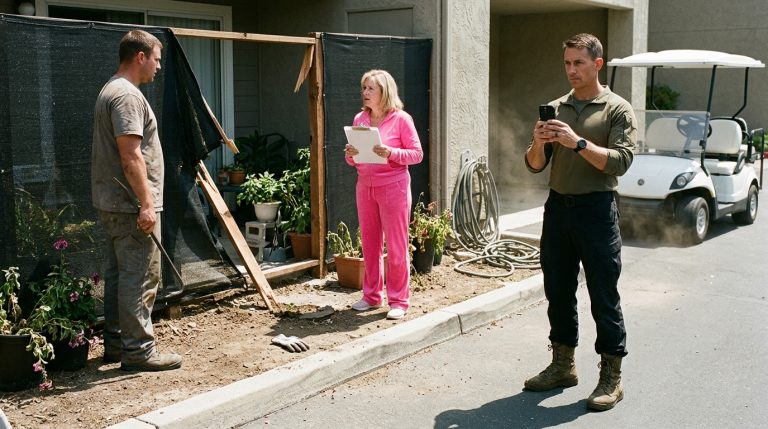
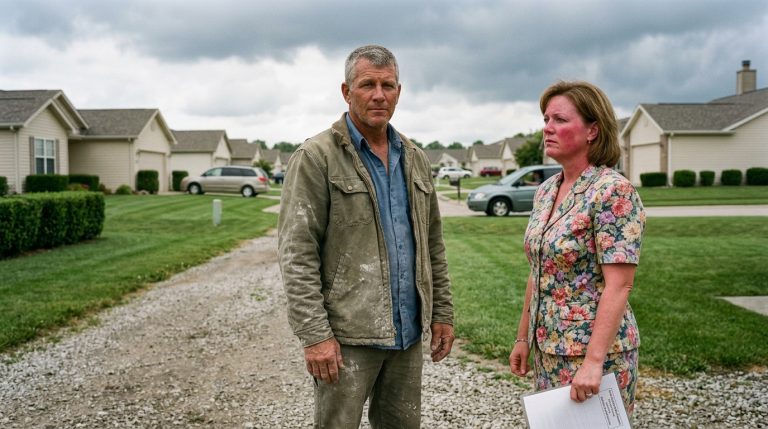
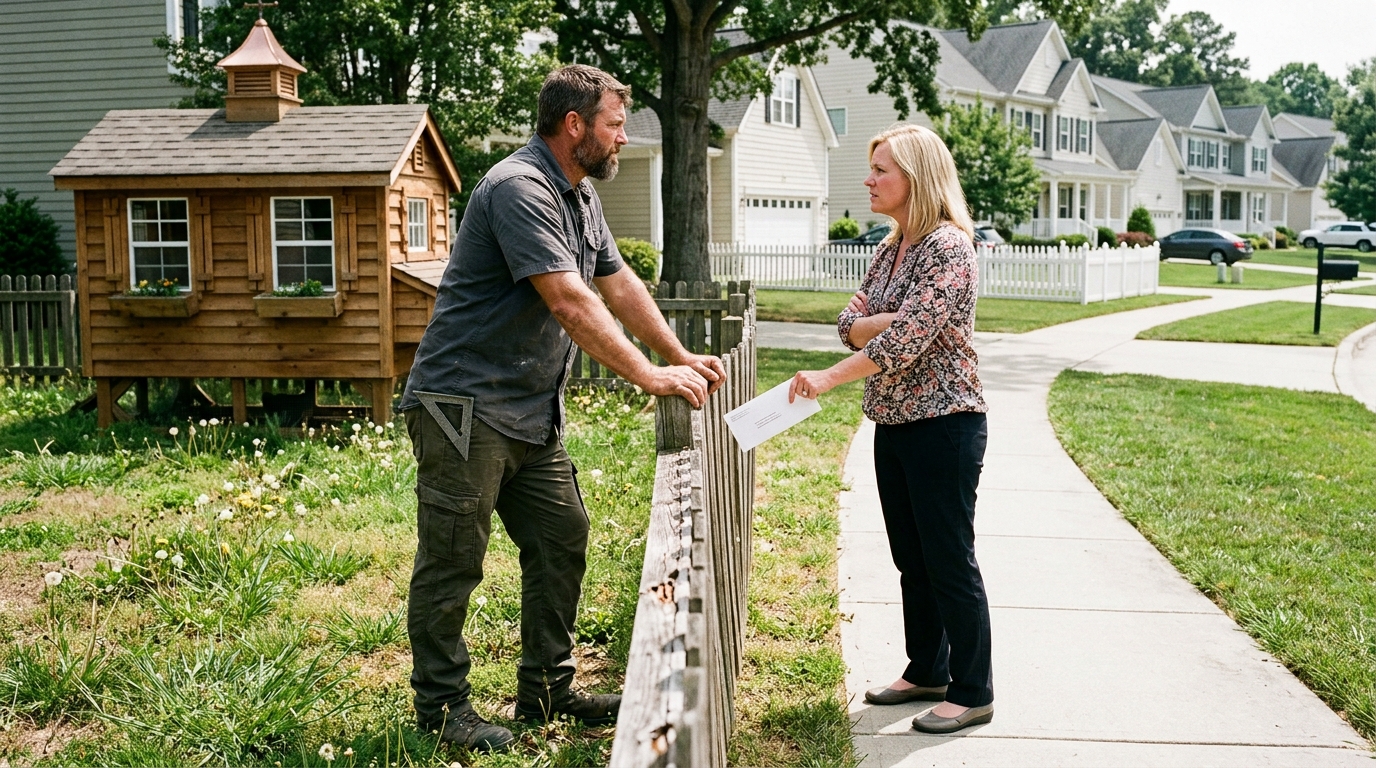
The words hung in the humid afternoon air, thick with the scent of cut grass and self-righteous indignation. Karen, the president of the Oakwood Preserve Homeowners Association, stood on the perfectly manicured public sidewalk, her arms crossed over a floral print blouse that strained against her frame.
She was a woman built like a filing cabinet, full of rules and misplaced authority. In her hand, she held a crisp white envelope which she brandished not like a piece of mail, but like a weapon. My eyes drifted from her furious, puffy face down to the object of her scorn: my chicken coop.
It wasn’t a shack. It was a piece of craftsmanship, a miniature barn built from reclaimed cedar with a copper-topped cupola and tiny functional window boxes. I designed and built every joint mortised and tenoned myself as a gift for my eight-year-old daughter, Emily.
It was also apparently a declaration of war. I held her gaze, my hands resting on the top rail of my own fence, the physical and symbolic line she dared not cross. My thumb brushed against the cold, notched edge of the steel framing square in my back pocket, a familiar weight that kept my temper steady.
“It’s going to cost you what exactly, Karen?” I asked, my voice flat and even.
She took a triumphant step forward, planting her sensible walking shoes just inches from my property line. “Two hundred and fifty dollars for an unapproved structure,” she announced, her voice dripping with smug satisfaction. “And an additional fifty dollars per day until this eyesore is removed. It violates section C, paragraph 12 of the aesthetic covenants.”
She thrust the envelope through the gap in my fence. I didn’t take it. I just looked at it, feeling the grit of the dusty gravel beneath my work boots.
After twenty years of service and three years of trying to build a quiet life for Emily since my wife passed, I had learned that the loudest voice in the room usually carried the hollowest leverage. Karen turned with a huff and marched away, her mission of suburban tyranny complete for the day.
I picked up the envelope from the dirt, the gears already turning in my head. She saw a quiet veteran who kept to himself. She had no idea how heavy the friction was about to get.
CHAPTER 2: THE BUREAUCRATIC PAPER TRAIL
I didn’t let anger sit in my chest. In the army, heat made men reckless, and recklessness got people broken.
Instead, I pulled a fresh manila folder from the desk drawer, capped a black marker, and wrote two words on the tab: HOA ENGAGEMENT.
I smoothed Karen’s paper flat against the wood, right next to my notched steel framing square. The numbers were stark—a two-hundred-and-fifty-dollar initial penalty, backed by a fifty-dollar daily meter that would start running tomorrow.
I logged the entry with meticulous precision: date, time, distance from my front fence, and her exact verbal phrasing. Documentation is the only real ammunition in a war fought with paper.
The next morning, I dialed the administrative number printed at the bottom of the letterhead.
The line clicked open to the sound of keyboard clatter and a tired sigh. “Oakwood Preserve Management, this is Brenda.”
“Good morning, Brenda. My name is Mark Evans, 112 Willow Creek Lane,” I said, keeping my voice level and dry. “I’m calling to log a formal dispute for fine number 743B.”
There was a pause, followed by the heavy rustle of a physical file being pulled. “Mr. Evans… yes. Section C, Paragraph 12. Lack of architectural harmony for an unapproved exterior structure.”
“I’m looking at that section right now,” I said, leaning back in my chair. “Can you read me the written technical criteria for ‘architectural harmony’?”
Silence stretched over the line. “It… well, it means it has to harmonize with the overall neighborhood aesthetic.”
“That’s an opinion, Brenda, not a measurement,” I replied softly. “I need the dimensional limits, approved siding materials, and color swatches defined by the board.”
“The board determines harmony on a case-by-case basis,” she stammered, clearly reading off a standard script. “If you wish to appeal, you must submit a written statement to the Architectural Review Committee before their monthly meeting.”
“Send the form to my email,” I said. “And add a formal request for the ARC meeting minutes from the last twenty-four months—specifically every permit approval or denial for garden sheds, playhouses, and detached storage.”
“That’s… a lot of records, Mr. Evans.”
“It is,” I agreed. “And under state property statutes, as a lot owner in good standing, I’m entitled to inspect them.”
After hanging up, I pulled out the original thick binder of community covenants given to me when I bought the lot three years ago. I flipped past the generic land descriptions until I reached the payment slip section at the back.
That was when my eyes caught something off.
The monthly dues were routed to a commercial bank downtown, but the fine collection slip Karen had dropped had a completely different destination listed in the fine print at the bottom: a post office box in the next county over, registered to an entity named Suburban Maintenance Solutions.
It wasn’t the management company’s name. It wasn’t the HOA’s legal title.
I rotated the steel square slowly between my thumbs, feeling the sharp, cold notches against my skin. Karen hadn’t just made a mistake by picking a fight over a coop built for an eight-year-old girl. She had handed me the first loose thread on her sweater.
I slipped my signed, typed appeal into a stamped certified envelope, walked it out to the mailbox, and dropped the flag.
She wanted a fight over rules. I was going to give her so many rules she’d choke on them.
CHAPTER 3: THE SECRET GRIFT UNCOVERED
I traced a line from a five-thousand-dollar common-area landscaping fee straight to a twelve-thousand-dollar ledger entry under a different heading.
The money wasn’t vanishing into thin air; it was being funneled directly through an entity with no active phone line or physical office.
A quick public registry search on my laptop revealed the registered agent for Suburban Maintenance Solutions was a man named Gerald Finny—Karen’s own brother-in-law.
It was a classic, arrogant grift wrapped up in floral community newsletters and polite committee meetings.
“You thought nobody would look past the cover page,” I muttered, tapping the screen with the back of a calloused knuckle.
The spreadsheet also highlighted a pattern of selective enforcement that stretched back over two years.
While honest neighbors like George were forced to tear down quiet memorial gardens, Karen’s inner circle received retroactive approvals and waved fines without a single question asked.
The chicken coop wasn’t an aesthetic violation at all. It was simply the first time an outsider had refused to bow to her manufactured authority.
I printed out the cross-referenced payment logs, organizing the pages into crisp, numbered piles.
The paper trail was no longer circumstantial; it was a blueprint of systemic abuse.
I reached for my phone and sent a short, encrypted message to George and Maria, setting the stage for what came next.
They thought they were dealing with a lone resident fighting a petty fee.
They were about to find out how hard concrete hits when the foundation cracks.
CHAPTER 4: THE NEIGHBORHOOD ALLIANCE
The doorbell rang precisely at seven, cutting through the silence of the room.
I opened the door to find George standing on the porch, clutching a small plate of homemade cookies with a stiff, nervous posture.
“Thought these might help steady the nerves,” George murmured, stepping past the threshold into the warmth of the hallway.
A few minutes later, headlights flared in the driveway again as the Garcías arrived, walking briskly with their coats pulled tight against the damp evening chill.
Finally, Maria pulled her work van up to the curb, her heavy boots clicking with sharp rhythm against the front walk as she marched straight to the door with her jaw set hard.
We gathered in the living room around the coffee table, the dense folders of financial evidence resting in the center like unexploded ordnance.
“She’s been running this neighborhood like a private fiefdom for four years,” I said, sliding the printed ledger sheets across the wood.
George looked down at the paper detailing his forced memorial garden removal, his fingers trembling slightly as he touched the margin.
“I thought I was just getting old, that my property was out of compliance,” George whispered, his voice cracking with a lifetime of suppressed frustration.
“It wasn’t compliance,” Maria interjected, leaning forward with her arms crossed tightly over her chest. “It was target practice for her ego.”
I laid out the next stack of documents—the bank records, the inflated common-area maintenance costs, and the undeniable routing of funds to her brother-in-law’s P.O. box entity.
The room fell completely silent as the true scale of the corruption sank into their minds.
They weren’t isolated victims of random bureaucratic bad luck; they were targets of a systematic extortion machine.
“We don’t fight her with shouting,” I said, tapping a finger against the paper trail. “We trap her with her own paperwork.”
George looked up from the table, the old fatigue in his eyes replaced by a cold, steady resolve.
“Tell us what you need us to do,” George said.
CHAPTER 5: THE COMMUNITY CENTER TRIBUNAL
The room buzzed with an anxious, restless energy unlike anything the Oakwood Preserve association had ever seen.
Every folding chair was occupied, and a dozen residents lined the back walls under the harsh overhead glare.
Karen tapped a wooden gavel sharply against the table, her face flushed with absolute confidence as she prepared to deliver her opening remarks.
“We are here tonight to address rogue elements attempting to sabotage our community standards,” Karen announced, her voice booming through the PA system.
She pointed a rigid finger toward the back of the room, spinning a tale of an uncooperative resident and a hostile vendor holding their grand entryway project hostage.
Murmurs rippled through the crowd, many neighbors nodding along with her rehearsed narrative.
I waited until she reached the crescendo of her speech, asking the room if they would stand for such blatant extortion.
“I can answer that,” I said, my voice cutting through the humid air without a single raised decibel.
I stepped out from the shadows of the back corner into the center aisle, every eye turning toward me.
Karen’s expression tightened into a sharp, dismissive sneer as she recognized the man who owned the disputed chicken coop.
“Mr. Evans, you are out of order,” Karen snapped, gripping the edges of her binder. “Take a seat or leave.”
“I’m not leaving,” I replied, pulling the printed financial ledgers from my side pocket and holding them up for the room to see. “Because the vendor you’re complaining about is my company—and the extortion isn’t coming from me.”
Gasps echoed through the rows of folding chairs as the reality of the double life hit the room all at once.
Karen turned pale, her mouth opening and closing as she searched the faces of her fellow board members for backup.
“She has been funneling community funds through a shell company registered to her own brother-in-law,” I said, placing the certified bank records directly onto the front table.
George stood up from the second row, his voice steady and carrying a lifetime of quiet hurt.
“She forced me to tear down my wife’s memorial garden over a fake violation,” George declared, pointing a shaking hand straight at the board president.
One by one, Maria and the Garcías stood up to add their own documented grievances, turning the room into an unyielding wall of truth.
Karen slammed her gavel down twice, her face purple with furious desperation as she tried to shout over the mounting uproar.
“This is slander! You have no proof!” Karen shrieked, her hands trembling violently against the laminate table.
“The proof is signed by your own treasurer,” Arthur Wembley stammered, standing up from his chair and backing away from her in absolute terror.
CHAPTER 6: THE DUSTY AFTERMATH
The black sedan with government plates had come and gone down Willow Creek Lane three days ago, taking the former board president away under a cloud of federal indictments and wire fraud charges.
The neighborhood had already begun the heavy, necessary work of rewriting its own rules under George’s steady leadership.
The vague aesthetic covenants that had once served as weapons of petty tyranny were replaced with clear, common-sense guidelines voted on by the families who actually lived here.
There were no more surprise fines, no more manufactured violations, and no more secret P.O. box shell companies draining community funds.
The liens on local properties had been permanently expunged, and the atmosphere on the street felt lighter, grounded in a quiet, mutual respect.
I set my gardening trowel down on the grass and wiped my palms on my jeans.
Across the street, the sun caught the copper-topped cupola of the cedar coop, gleaming brightly against the morning blue.
My eight-year-old daughter, Emily, came running down the front path in her pajamas, her face alive with excitement as she cupped her hands carefully around a fragile object.
“Look, Daddy,” she said, stopping right beside my knee and opening her palms. “Esther laid a brand-new one. Isn’t it perfect?”
I looked down into her small hands at the smooth, warm brown shell, feeling the deep, enduring weight of absolute peace settle into my chest.
“Yes, sweetie,” I said, gently closing my hand over hers and guiding the warm egg toward the kitchen. “It’s absolutely perfect.”