How a Veteran’s Quiet Country Sanctuary Became the Battleground Against an Unhinged HOA President
CHAPTER 1: THE CRUNCH OF GRAVEL
My thumb pressed hard against the ceramic rim of the mug, feeling the sharp bite of the rough clay.
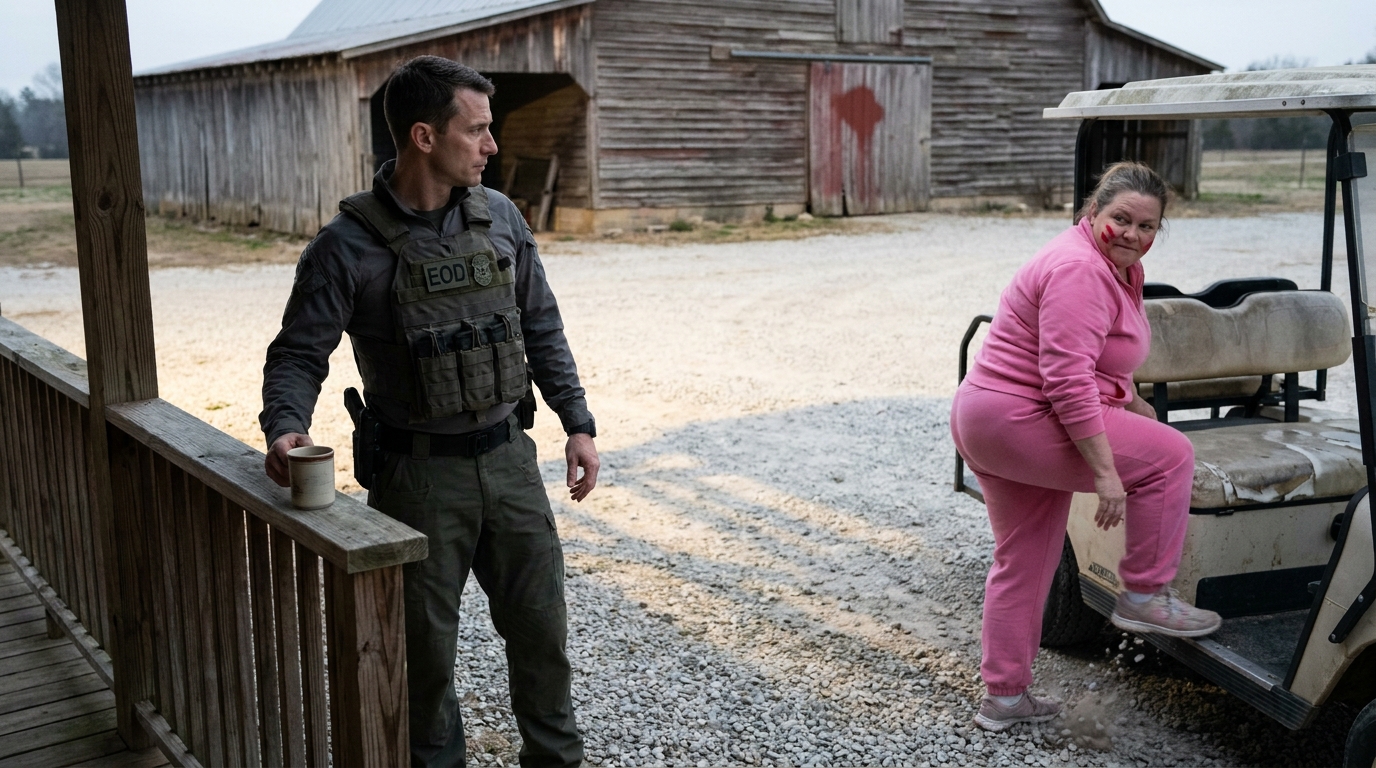
Across the thirty feet of open gravel separating the porch from the barn, the crimson paint was still glistening in the pale pre-dawn light.
It wasn’t just a mark; it was a greasy, weeping wound slashed across a century of quiet history.
Karen stood there with her heels planted in the dirt, her pink sweat-suit straining around her midsection as she gave the Rustoleum can one final, gratuitous shake.
“The community guidelines clearly state all outbuildings must have trim and doors in an approved color palette,” she announced, her voice rattling with that smug, self-satisfied wheeze. “Your front door is red. Now your barn matches. You should be thanking me.”
The sheer audacity of it hit me not as anger, but as a dull, heavy pressure behind my temples.
Twelve years of explosive ordnance disposal trained a man for many things, but it didn’t prepare you for a suburban tyrant weaponizing a can of spray paint at six in the morning.
My knuckles turned white around the mug, but my breathing stayed slow, measured, and deliberate.
“You have thirty seconds to get off my property,” I said, keeping my voice dropped into that low, flat register that usually made green recruits take a step back.
Karen scoffed, tossing her head back so that a smear of the same glossy red paint caught the early sun on her cheek.
“This is a warning, Mr. Miller,” she barked, taking an aggressive step forward. “You veterans think you’re so special that the rules don’t apply to you. But this is my neighborhood.”
That was the line.
I didn’t yell, and I didn’t reach for anything; I simply set the coffee mug down on the wooden porch railing with deliberate, mathematical precision.
The ceramic made a sharp clack against the worn paint.
She blinked, the smugness in her eyes flickering for a fraction of a second as she realized the noise wasn’t a threat, but the sound of a countdown hitting zero.
She turned her back with a huff, waddling back toward her idling golf cart with its bedazzled mud flaps and pink steering wheel cover.
I watched her climb in, the chassis groaning under her weight, before she kicked it into gear and tore down the gravel drive with a spray of loose stones.
I didn’t chase her.
I turned around, the screen door whispering shut behind me, and walked straight to the kitchen table where Sarah was standing by the window, her hands gripping the edge of the counter until her fingers were bloodless.
“Jack,” she whispered, her voice tight with a fear she had tried to swallow for weeks. “What was that?”
“That was her mistake,” I said, walking past her toward the desk without breaking stride.
My fingers found the heavy steel latch of the black 4-inch binder sitting next to the laptop, feeling the cold, familiar heft of our defense.
I didn’t look back out the window at the bleeding barn door because I already knew what needed to be done.
The paper war was over, and the real one had just begun.
CHAPTER 2: THE DEPUTYS KITCHEN TABLE
The screen flickered to life, bathing the worn wood of the kitchen table in a harsh, pale glow.
Deputy Peterson sat motionless across from me, his coffee mug hovering inches from his lips as the timestamp in the corner ticked toward dawn.
The low-angle camera mounted on the oak tree didn’t miss a single detail.
It captured the heavy, lumbering roll of the pink golf cart braking to a halt near the edge of the gravel drive.
It showed Karen shifting her weight with practiced irritation, hoisting herself out of the vinyl seat, and retrieving the spray can from the floorboard.
“HOA dispute?” the deputy had asked earlier, his pen hovering with casual indifference.
He wasn’t indifferent anymore.
On the screen, Karen raised the Rustoleum can, her face twisting into that grotesque mask of self-satisfied authority before she depressed the nozzle.
The crimson mist bloomed across the antique chestnut timber in high definition.
Every shake of her wrist, every stubborn puff of her breath, played out with cold, clinical clarity.
Peterson lowered his mug down onto the table without taking a sip.
The ceramic made a dull, heavy thud against the wood.
“That’s not just a petty property squabble,” he muttered, his eyes locked onto the screen as the video looped back to the beginning. “That’s deliberate destruction of property on a recorded timestamp.”
I reached over and closed the laptop lid with a soft click, cutting off the motion before leaning back in my chair.
“She’s done it to others,” I said, my voice dropping into a steady, even register. “For years. Fining families out of their homes over bird baths and garden gnomes.”
I pulled the heavy, black 4-inch binder toward him, sliding it across the grain.
The metal rings clicked as he flipped the cover open, revealing the meticulously organized rows of certified letters, time-stamped photographs, and archived forum printouts.
He didn’t speak for a long time, the only sound in the room being the slow, deliberate turning of plastic page protectors.
His fingers traced the columns of fabricated fines piling up month after month—seven hundred, fourteen hundred, three thousand dollars.
“She’s been running a municipal shakedown out of a suburban clubhouse,” Peterson whispered, shaking his head. “If I bring this to the prosecutor’s office like this, they aren’t going to look at it as a neighborhood feud.”
He looked up from the binder, his professional detachment entirely replaced by a hard, critical focus.
“They’re going to look at it as an open-and-shut criminal case.”
CHAPTER 3: THE ALLIANCE OF THE WRONGED
George stood on the porch with a white pastry box balanced on his palms, his shoulders slightly rounded with the heavy weight of old fatigue.
His wife Eleanor lingered a step behind him, her hands nervously smoothing down the fabric of her floral apron.
“We saw the cruiser leave,” George said, his voice carrying through the mesh wire. “And we know what she did to your barn.”
I unlatched the screen door and pulled it wide, letting the scent of warm apples and cinnamon cut through the faint chemical tang of the morning.
They didn’t come in like triumphant heroes; they stepped across the threshold like people who had spent years walking on eggshells.
Eleanor placed the bakery box gently onto the edge of the kitchen counter before looking toward the hallway.
“She made us rip out my mother’s rose garden two summers ago,” Eleanor whispered, her fingers nervously twisting a loose thread on her sleeve. “Claimed the red blooms clashed with the community aesthetic. We fought her for months, but we were too tired to keep up.”
George dropped his heavy palm onto the table, right next to the closed black binder.
“She rules through exhaustion,” George added, his jaw tightening into a hard line of accumulated resentment. “Everyone’s too afraid of the fines or the harassment to push back. But you’ve got the records now.”
From the doorway behind them, the soft patter of sneakers announced the arrival of Mr. Garcia, holding a thick folder bursting with printed emails and faded photographs of a dismantled children’s playset.
“I heard the sheriff was here,” Garcia said, stepping inside with a sharp, determined look in his eyes. “If you’re building a real case against her tyranny, count us in. We have every threatening notice she ever left in our box.”
The kitchen table filled up quickly with papers, folders, and quiet testimonies of a neighborhood held hostage by a tyrant in a pink sweatsuit.
I didn’t offer grand speeches or false reassurances; I simply opened the binder back up and slid blank index cards across the wood for them to write down their dates and fines.
Every name added to the ledger was another crack in the facade of untouchable authority Karen had built around the estate.
By the time the sun climbed high enough to bake the front lawn, we had more than just a stack of grievances.
We had an organized front line.
CHAPTER 4: THE FORENSIC WEAPON
The FedEx delivery driver didn’t wait for a signature; he simply dropped a thick, overnight cardboard parcel onto the porch mat and hurried back down the gravel drive.
I hauled the package inside, sliding my pocket knife down the taped seam with a clean, fluid motion.
Inside lay a fifty-page spiral-bound document bearing the letterhead of a private forensic laboratory run by an old army buddy.
The title page stared back with cold clinical precision: Forensic Analysis of Vandalized Wooden Artifact, Case Number FM77B-4.
I flipped the pages past the gas chromatography charts until my eyes locked onto the chemical breakdown of the paint.
It wasn’t just a generic match to Rustoleum Colonial Red; the mass spectrometry identified the exact batch propellant numbers linked to local retail inventory within a six-month window.
The next section analyzed the wood substrate itself using electron microscopy.
Microscopic photographs revealed how the acetone and xylene solvents had soaked deep into the ancient grain, dissolving the natural resins that had preserved the timber for a century.
Then came the final section, written in an unsparing scientific register.
Radiocarbon dating confirmed the timber was Castanea dentata—pre-blight American chestnut felled between 1890 and 1910, a species functionally extinct in the wild today.
Because the chemical solvents had penetrated past the surface fibers, any attempt at sanding or chemical stripping would cause catastrophic structural collapse.
The antique door was entirely unrestorable.
The valuation assessment at the back of the report factored in specialized master carpentry and scarce salvaged timber inventory.
The total estimated cost to commission an identical replacement reached two hundred sixty-seven thousand dollars.
I picked up the landline phone and dialed Jessica Riley’s office number without hesitation.
When she answered on the second ring, I didn’t bother with pleasantries.
“I have the lab results,” I said, my voice flat and steady. “And she didn’t just ruin a painted board.”
“Tell me,” Jessica replied, her tone instantly sharpening into a predator’s focus.
“It’s pre-blight American chestnut,” I told her. “And the total replacement valuation comes out to two hundred sixty-seven thousand dollars.”
A sharp, gleeful laugh echoed through the earpiece.
“Oh, you magnificent bastard,” she cackled. “That’s not just a vandalism claim anymore. That’s a total financial obliteration.”
CHAPTER 5: THE BOARDROOM AMBUSH
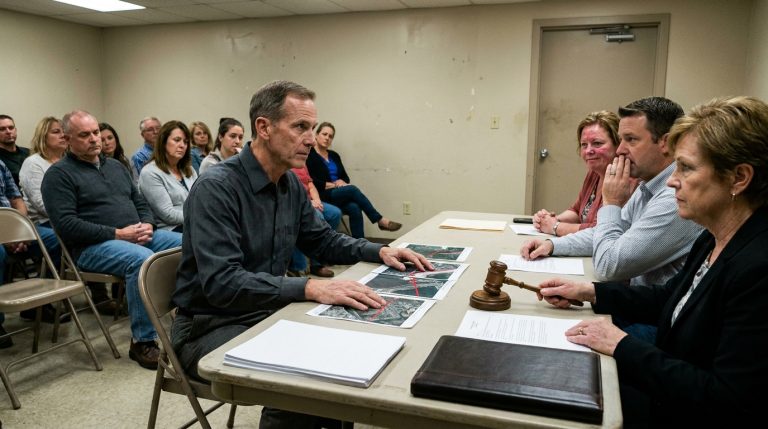
The fluorescent lighting of the community clubhouse hummed with a sterile, suffocating heat as folding chairs scraped against the linoleum floor.
George and Eleanor sat quietly in the front row, while the Garcia family held their ground near the back exit.
At the head table, Karen sat flanked by her two intimidated board cronies, resplendent in a stiff purple pantsuit as she banged her gavel with performative authority.
“Let’s bring this meeting to order,” she boomed, her eyes scanning the crowded room before locking with malicious triumph directly onto me.
She rattled off budget reports for community mulch and pool deck maintenance, completely unaware of the trap that had just closed around her.
As she launched into a fresh tirade about the sanctity of architectural guidelines, the heavy double doors at the back of the room swung open.
A tall, impassive man in a dark suit strode down the center aisle, holding a thick manila envelope with absolute unhurried purpose.
Karen stopped mid-sentence, her mouth hanging open as the man stopped directly in front of the head table and dropped the packet onto her paperwork.
“Karen Peters, you have been served,” he said clearly before turning on his heel and walking out.
The collective gasp from the room sucked the air right out of the space.
With trembling fingers, Karen tore open the cover, her face rapidly losing its color as her eyes scanned the figures printed on the first page—two hundred sixty-seven thousand dollars for the destroyed artifact, plus punitive damages.
She started to sputter, a string of high-pitched noises escaping her throat as she tried to shout down the reality unfolding before her.
That was when Jessica Riley stepped through the back doors, her razor-sharp charcoal suit cutting through the tension like a blade.
“My name is Jessica Riley, counsel for Mr. Jack Miller,” she announced, her voice ringing off the walls as she stepped up to the front. “For years, this board has stood by while Ms. Peters ran a campaign of extortion and harassment against this neighborhood.”
A phone speaker suddenly crackled to life on the table, broadcasting the panicked voice of the HOA insurance representative.
“Ms. Peters, what is going on? We have a clause for intentional criminal acts—we will not cover this liability!”
The room erupted into absolute chaos as the board members stared at Karen with open, undisguised horror.
George stood up from his folding chair, his voice steady and commanding over the noise.
“I move for an immediate vote of no confidence and the removal of Karen Peters as president.”
Eleanor seconded it instantly, and a dozen hands shot up across the room before Karen could even draw another breath.
Her reign of intimidation collapsed under the weight of her own overreach, leaving her screaming empty threats to an empty room as the community voted her out unanimously.
CHAPTER 6: THE INLAID SCAR
The sun dipped low behind the rolling Virginia hills, casting long, peaceful shadows across the wide planks of the newly hung barn door.
Master artisan Elias Vance stepped back, wiping a smudge of sawdust from his thumb before resting his hand against the honeyed grain of the pre-blight chestnut.
It wasn’t a replica of the old door; it was a continuation of its history.
Right at eye level, set neatly into the center of the fresh timber framework, sat a small, perfectly framed rectangular section of the original wood.
Elias had spent weeks under a microscope, working fiber by fiber with specialized solvents to lift the red paint without fracturing the ancient cells underneath.
The result was a dark, distinct scar—a permanent physical reminder of the battle we had fought and won.
Down by the pasture fence, George and Eleanor leaned against the wooden rails, sharing a paper cup of lemonade while the Garcia children chased each other through the tall grass near their approved playset.
Sarah stood beside me on the gravel, her fingers looping naturally through mine as the distant hum of traffic felt a million miles away.
From inside the cavernous interior of the post-and-beam structure, the soft rustle of straw announced Buster settling down for the night, followed closely by Lily’s light laughter echoing against the rafters.
The insurance settlement had covered the legal fees and structural repairs, while Karen’s personal assets had dissolved under the weight of her court judgments and forced home sale.
Her pink golf cart and loud voice were gone from the estate forever, replaced by an interim board rewriting the bylaws to ensure no single person could ever weaponize petty authority again.
I reached out and brushed my knuckles lightly over the dark, inlaid wood panel at the center of the door.
The surface was as smooth as silk, anchored by history and secured by a quiet, immovable boundary.
The world out there remained as loud and unpredictable as ever, but inside these ten acres, the silence had finally returned.
It was deep, unbroken, and entirely earned.