How a Retired Army Engineer Dismantled a Corrupt Neighborhood Tyrant Using Ironclad Permits and Cold Logic
CHAPTER 1: THE FIRST LINE
The words, thick with a syrupy, self-satisfied authority, hung in the humid afternoon air, seeming to curdle the very sunlight that fell across my backyard.
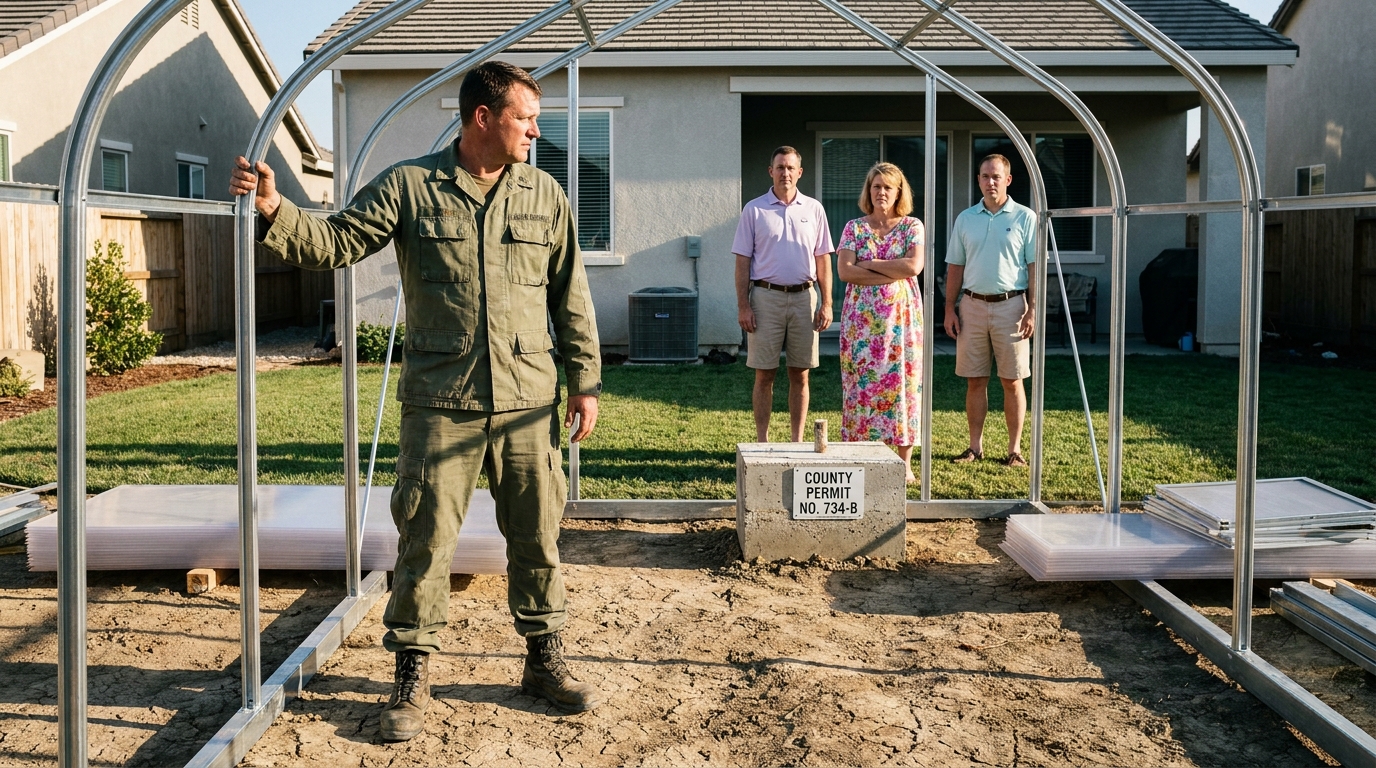
“That pile of junk is a violation, Mr. Davis,” Karen Miller announced. “As of this moment, you are fined $5,000 for an abandoned structure, and you have 72 hours to remove it. Or we will.”
I turned slowly from the half-assembled frame of my greenhouse, my hand still gripping the cold steel of my torque wrench, and faced the source of the decree.
She stood on the edge of my property line, her arms crossed over a vast floral mumu, her face a mask of pinched indignation.
Her two silent, golf-shirted board cronies flanked her like gargoyles on a crumbling cathedral of suburban mediocrity.
My property, my greenhouse—a project I had poured hundreds of hours and thousands of dollars into as a sanctuary for my wife—had just been sentenced to death by a board queen.
The shock was a cold spike in my gut.
But 25 years in the Army Corps of Engineers teaches you to compartmentalize shock and move directly to analysis.
My gaze flickered from her smug face to the structure behind me: the gleaming galvanized steel ribs, the stacks of polycarbonate panels, and the fresh concrete footings I had poured myself just last week.
“Abandoned?” I repeated, my voice dropping into a dangerous, measured calm. “Ma’am, I was working on it ten seconds before you started shouting at me. The materials were delivered yesterday. How exactly do you define abandoned?”
She sniffed, a sound like a leaky balloon.
“It’s an unfinished eyesore and it’s been like this for weeks,” she snapped. “It violates the aesthetic harmony of our community. The board has voted. The fine stands. Seventy-two hours.”
The sheer audacity of it was breathtaking.
This wasn’t a discussion; it was a declaration of war by someone who had no idea she was entirely out of her depth.
I adjusted my grip on the heavy tool, letting the mundane weight of the metal ground my temper.
“My name is Mark Davis,” I said quietly, stepping forward past the property line marker. “And I don’t respond well to threats built on imaginary rules.”
She blinked, momentarily thrown by my lack of subservience, before doubling down with an impatient wave of her hand.
“You’ll comply or you’ll lose your home, Mr. Davis,” she sneered, turning on her heel.
As she and her silent cronies marched back toward the pavement, I didn’t yell or chase after them.
Instead, I walked back inside to where Elena was waiting, her gentle eyes reflecting the quiet worry she tried so hard to hide.
“Let them play their game,” I told her, setting the torque wrench down on the kitchen counter with a dull, heavy thud. “We play by the law of the land, not the law of Karen.”
CHAPTER 2: THE PAPER TRAIL
The cold steel counter surface of my home office supported the weight of county permit number 734-B, a document stamped with a raised seal that represented my absolute legal insulation.
I picked up the certified mail receipt, its bright green paper contrasting sharply with the stark white pages of the Serenity Meadows HOA bylaws.
Bylaw 17.4 relied entirely on vague, subjective phrases about aesthetic harmony, yet it completely lacked any specific prohibitions against county-approved outbuildings.
Worse for Karen, bylaw 8.2 explicitly exempted any structure holding a formal municipal permit from arbitrary architectural review.
She had weaponized a rulebook she clearly had never bothered to read beyond her own powers of intimidation.
My fingers traced the edges of the high-resolution photographs she had appended to her initial notice, images captured from an upper-story window that constituted a clear invasion of domestic privacy.
I began drafting the formal response, keeping the language clinical, methodical, and devoid of emotional escalation.
“The structure is not abandoned,” I wrote, attaching timestamped material delivery receipts alongside digital logs of ongoing construction progress.
I cited the municipal permit directly, quoted her own bylaws back to her like an unyielding code compliance officer, and formally demanded the immediate recession of the $6,400 in accumulated fines.
To ensure the message carried absolute weight, I added a concluding warning demanding the immediate cessation of her unauthorized surveillance photography.
I sealed the envelope with a firm press of my thumb, the glue tasting dry and bitter against my tongue.
The physical act of dropping it into the mail slot felt less like an appeal and more like laying down the first tripwire in a heavily mined corridor.
Karen expected a panicked resident begging for mercy; instead, she was about to receive a precision-engineered legal blockade.
I walked back out to the porch, leaning against the wooden railing as the late afternoon heat began to bake the asphalt of the cul-de-sac.
A shadow shifted across the neighboring driveway, catching my eye—a fleeting discrepancy in the neighborhood’s usual rhythm that did not belong.
One of the upper windows of Karen’s house featured a slight parting of the blinds, the faint glint of camera glass reflecting the harsh sun before disappearing into darkness.
She was still watching, still documenting every movement like a petty warden patrolling an imaginary cell block.
Let her watch.
The paperwork was already airborne, and the rules she thought she controlled were about to become the very mechanism of her undoing.
CHAPTER 3: THE WAR ROOM
The wooden fence slat was cool under my palm as Tom the firefighter stepped into my backyard, his jaw tight with the memory of a lost basketball hoop and a pile of unjust fines.
“The aesthetic harmony clause is just a club she uses to keep people in line,” Tom said, setting a heavy toolbox down by the patio.
I nodded, gesturing toward the dining room table where I had spread out hundreds of pages of public state records downloaded from the Secretary of State website.
The Patels followed closely behind, carrying a folder of notices detailing penalties over the wrong shade of white trim on their window frames.
Even Mrs. Gable, the elderly widow from two streets over, arrived with her hands trembling slightly as she clutched a photograph of the Japanese maple tree she had been forced to dig up.
“She made me destroy my late husband’s memorial,” Mrs. Gable whispered, her eyes shining with suppressed tears.
“She relies on isolation,” I said, pointing to the whiteboard diagram at the center of the room.
I mapped out Karen’s eight-year self-perpetuating presidency alongside Bob and Linda, showing how the board functioned less as a community service and more as an insular dictatorship.
Then I laid down the financial statements, sliding the public budget reports across the wood grain.
“Look at the line item for landscaping,” I told them, tapping the paper with my finger. “Sixty thousand dollars a year going to Greenscape Solutions.”
Tom leaned in closer, squinting at the business registry printout resting beside it.
“That’s Gary Miller,” Tom muttered. “Karen’s brother-in-law.”
“Exactly,” I said. “She’s funneling community funds directly into her family’s pockets for substandard work.”
The room fell into a heavy, suffocating silence as the full scale of the corruption settled over them.
David, the quiet corporate lawyer who had recently moved onto the block, adjusted his glasses and studied the balance sheets with a practiced eye.
“This goes far beyond simple bullying,” David said, his voice measured and deadly serious. “This is a direct breach of fiduciary duty and illegal self-dealing under state corporation law.”
The atmosphere in the room shifted instantly from weary resignation to cold, structured defiance.
We weren’t just a collection of bullied neighbors anymore; we were an organized coalition armed with undeniable proof.
David immediately began drafting formal legal demands for a comprehensive five-year financial audit and complete transparency records.
My gaze shifted back to the whiteboard, my mind locking onto the pool maintenance line item and the name attached to it.
The landscaping graft was dirty, but the pool operations represented something far more dangerous.
CHAPTER 4: THE POOL DOSSIER
The manila folder corner was sharp against my thumb as I pulled the county health department records from the envelope, spreading the multi-year history of the community pool across the desk.
The documents outlined a terrifying pattern of recurring safety infractions that Karen and her board had systematically buried.
Violation number one involved improper storage of chlorine gas and muriatic acid packed together in an unventilated pump room, creating a lethal hazard for anyone nearby.
Violation number two exposed a non-compliant VGB main drain cover, leaving a powerful suction trap capable of catastrophic underwater entrapment.
“She knew,” I whispered to the empty room, tracing the inspector’s handwritten signature on a notice stamped three years prior.
The reports showed that every time an inspector threatened closure, Karen played a deceptive shell game, closing the facility temporarily for phantom maintenance while pocketing hefty maintenance fees alongside Bob Jenkins.
Bob operated Crystal Clear Pool Services, making him both the vendor and the board member approving his own paychecks.
They had gambled with the safety of neighborhood children, including Tom’s kids and the Patel toddlers, treating human lives as an acceptable sacrifice for a corrupt slush fund.
My hand moved to the phone, our tactical pivot locked in place.
I bypassed local channels entirely, dialing the county health department’s anonymous tip line with cold, methodical precision.
“I am calling to report an imminent public health threat at the Serenity Meadows community pool,” I stated, reading directly from the old violation numbers.
The official on the other end went silent before clacking keys echoed through the receiver.
“We take imminent threats very seriously,” the voice replied.
The fuse was lit, and the institutional weight of the county was already shifting toward the neighborhood gates.
CHAPTER 5: THE CHIEFS DECREE
The metallic hum of the Ford Explorer vibrated through the air as Chief Inspector Evans stepped out onto the asphalt with clipboard in hand.
He didn’t hesitate or look for permission; he marched straight through the perimeter gate, his boots crunching against the concrete deck where families and teenagers crowded the water.
Karen Miller sat beneath a large umbrella in her floral mumu, holding court with an iced tea before her expression twisted into irritated bewilderment as the inspector loomed over her.
“Are you the responsible party for this facility?” Evans demanded, his voice cutting through the neighborhood chatter.
“I am the president of the homeowners association,” Karen snapped, struggling to rise from her lounge chair. “Who do you think you are? We are fully compliant.”
Evans ignored her protest, turning his sharp gaze toward the pump room door and unlocking it with a swift motion.
“That’s a class one critical violation,” Evans called out, pointing directly at the stacks of improper chemicals. “You’re lucky you haven’t gassed your entire neighborhood.”
He strode to the edge of the deep end, knelt down, and pointed a finger at the water’s murky depths.
“And that is the same non-compliant drain cover this facility was cited for three years ago,” Evans stated, his voice ringing with absolute authority. “A direct violation of federal law written in blood.”
Karen’s face flushed a blotchy, furious red as she scrambled out of her seat, pointing an accusing finger across the pavement.
“This is harassment!” she shrieked, her voice cracking under public scrutiny. “It’s because of that man, Mark Davis! He’s been making vexatious complaints!”
Evans turned back to face her, his expression like granite as he pulled his violation pad free.
“Ma’am, I don’t care about neighborhood squabbles,” Evans said flatly. “Your repeated willful refusal to comply constitutes gross negligence.”
He tore a crisp sheet from his clipboard and pressed it into her trembling hand, delivering the final blow.
“I am ordering this pool closed indefinitely,” Evans announced to the stunned crowd. “Furthermore, the Serenity Meadows Homeowners Association is assessed an immediate penalty of $85,000 for long-term willful non-compliance.”
A collective gasp echoed across the pool deck as Karen stared blankly at the paper, her absolute authority shattering into dust under the weight of her own overreach.
CHAPTER 6: THE FINAL RESTORATION
The auditorium was filled past capacity, over two hundred homeowners standing shoulder to shoulder under the harsh fluorescent lights as the emergency tribunal commenced.
Karen, Bob, and Linda sat rigid at the front table, stripped of their usual arrogance as David laid out the undeniable legal framework of their gross negligence and fraudulent self-dealing.
When I stepped up to the microphone, I didn’t shout or posture; I simply projected the forensic audit findings and the county health violation records onto the screen behind us.
“For eight years, we were told our dues were spent wisely while over four hundred thousand dollars vanished into family-owned vendor contracts,” I told the silent crowd. “Worse still, they gambled with our children’s lives.”
A low, furious growl rose from the audience, echoing the collective betrayal of every resident who had trusted their leadership.
Karen attempted one final, desperate counter-move, standing up to shriek accusations of harassment and procedural illegitimacy, but her voice cracked and dissolved into empty air against an immovable wall of collective proof.
David formally moved for a vote of no confidence and the immediate removal of the entire board of directors.
A sea of hands shot up instantly across the auditorium, leaving only three isolated votes against us from the corner table.
The reign of entitlement was over, dismantled not by fury, but by unyielding facts and common sense.
Within weeks, the new interim board rescinded every predatory fine, froze the corrupted accounts, and turned the forensic audit over to the district attorney for criminal prosecution.
The moving trucks arrived at Karen’s house on a quiet Tuesday morning, and no one came out to wave goodbye.
Back at my own property line, the heavy steel ribs of the greenhouse stood tall and complete in the warm afternoon sun.
I walked inside the humid, fragrant air, watching Elena smile softly as she tended to her rare orchids without a single shadow of stress hanging over her.
Outside the clear polycarbonate panels, neighborhood children played safely by the freshly repaired pool, and Mrs. Gable’s new dogwood tree swayed gently in the breeze.
The mission was complete, and the quiet peace of the neighborhood had finally been restored.