The Cost of Concrete Ambition: How Forty Acres of Northern California Orchard Stood Firm Against Corporate Encroachment
CHAPTER 1: THE LONG DISTANCE PHOTOGRAPH
The hotel room in Lisbon smelled faintly of stale carpet and old rain. I stared at the blinking screen of my laptop, the dull consulting meeting finally over, and thumbed the edge of my heavy brass pocket compass. The metal was cold against my thumb, worn smooth by twenty years of carrying it through dry orchard dust and early morning irrigation checks.
My phone buzzed against the nightstand, a sharp, jarring rattle that knocked a plastic water bottle sideways. I picked it up, expecting another delayed invoice from the Sacramento supply house. Instead, it was an image from Carl, who ran the vineyard sharing my western fence line.
The file loaded slowly, line by gray line, through the agonizingly thin hotel Wi-Fi. First came the dry dirt of the access road, then deep, churned tire tracks, then a tangle of twisted red steel where my water tower used to sit. Carl had added a single, flat sentence underneath: Hey, wasn’t there supposed to be a tower here?
I didn’t yell, and I didn’t throw the phone. Anger was a luxury for people with time to waste, and forty acres of almonds and apricots didn’t care about a loud voice. My thumb simply slowed its rhythmic circle over the compass casing, pressing down hard enough to whiten the skin at the joint.
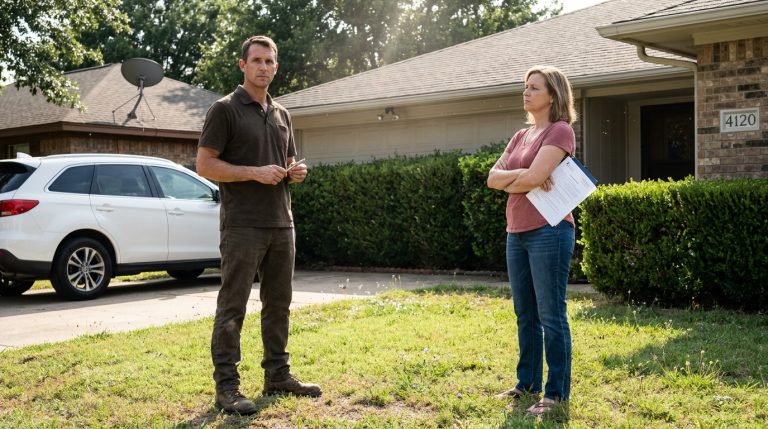
The developer’s site office back home had been getting bolder for six months, eyeing my corner property like hungry wolves circling a fenced pasture. Their shiny new subdivision of two hundred identical beige houses had crept right up to my boundary, and their foremen had already hinted more than once that my rusty farm equipment ruined their community aesthetic. Now, while I was six thousand miles away, they had decided to solve their aesthetic problem with a bulldozer.
I set the phone face down on the scarred wooden desk and opened a blank spreadsheet. If they wanted a quiet property grab while the owner was out of the country, they had picked the wrong orchard.
CHAPTER 2: THE PAPER TRAIL
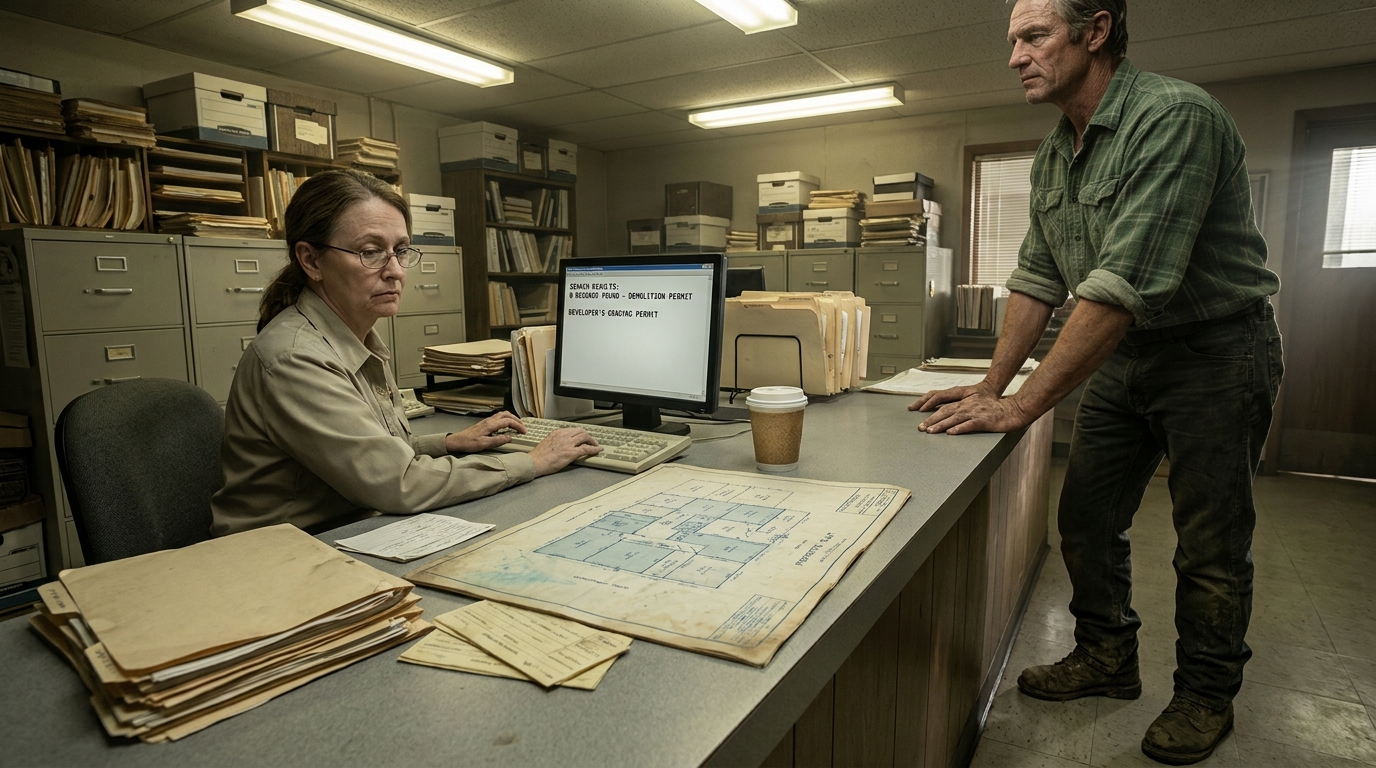
The county planning department office smelled like damp carpet and stale municipal coffee. I laid the old property plat flat against the laminate counter, the heavy brass compass still cold in my pocket.
—You won’t find a demolition record for that parcel, the clerk said without looking up from her stacked permit slips.
—Try looking again under the developer’s grading permit, I said, keeping my voice low and level.
She tapped her keyboard, the plastic keys clacking like dry teeth in an empty room. Her screen flickered with blue light against her glasses, mirroring the sterile fluorescent tubes overhead.
—Nothing, she muttered after a minute. No demo order, no safety variance. Just a blanket grading clearance filed three months ago for the back twenty acres.
That confirmed it. They hadn’t made a clerical error or filed a mistaken paperwork request. They had deliberately rolled heavy machinery across my property line and flattened a load-bearing structure because they assumed an absentee owner wouldn’t check the municipal files until the dirt had settled.
I pulled out my phone and dialed Mark’s office number, letting it ring twice before hanging up. I didn’t need to argue with an operations manager who thought confidence was a substitute for a deed.
Instead, I sent an email to Marcus Holloway with the county clerk’s empty search results attached. The response came back in under ten minutes. Get the survey crew out there tomorrow morning, Marcus wrote. If the county has no record, their easement is just an expensive piece of fiction.
CHAPTER 3: THE COLD SURVEY
The morning air smelled of crushed almond leaves and heavy tractor exhaust from the developer’s grading line just twenty feet away. Daniel adjusted the yellow lens of his instrument, his face tight and unsmiling against the glare of the low California sun.
—They didn’t just clip the edge, Daniel muttered, tapping a data collector against his thigh. They drove a thirty-ton excavator six full feet inside your legal boundary.
—And the easement width? I asked, rolling the heavy brass compass between my fingers in my pocket.
—Nowhere near this far over. The county plat puts your corner post right where these fresh tracks end.
Beside us, Laura Chan unfolded a laminated blueprint across the hood of my truck, her pen tracing the precise stress requirements of old agricultural piping. She didn’t look up when a construction loader rumbled past us on the adjacent haul road, kicking up a thick wall of tan dust.
—If they smashed a load-bearing reservoir built to seventies code, current municipal rules don’t let you patch it with scrap, Laura said over the engine noise. You have to replace it with modern galvanized steel, seismic wind bracing, and digital pressure monitoring.
—Meaning what for the bill? I asked.
—Meaning it’s going to cost them five times what they budgeted for landscaping mulch, she said, capping her pen with a sharp snap.
I looked past the surveyor’s tripod toward the sea of identical beige houses rising behind my trees. They had wanted a clean view, but what they were about to get was a very expensive lesson in property lines.
CHAPTER 4: THE SUBCONTRACTOR SLIP
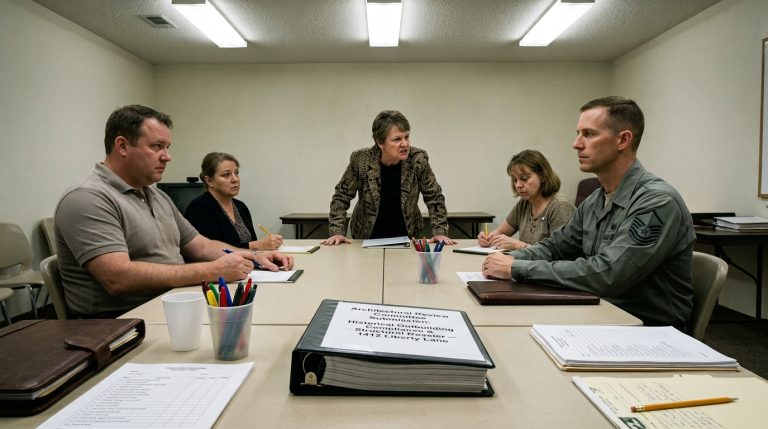
Marcus slid a thick binder across the scarred wooden surface, his pen tapping lightly against a photocopied sheet of daily instructions. The office was quiet, save for the steady hum of a desktop printer and the distant sound of freeway traffic outside.
—They didn’t make a legal calculation, Marcus said, his voice dropping into a dry, flat register. They gave a blanket order to a subcontractor.
—Look at the wording, I replied, sliding my thumb down the highlighted margin.
The instruction sheet was brutally simple: Clear vertical obstructions in grading corridor. There was no mention of boundary checks, no request for land titles, and zero verification of neighboring parcels.
—The grading crew just flattened whatever was standing in their way because someone higher up told them to move fast, Marcus said. That’s not a misunderstanding. That’s gross negligence wrapped in corporate stationery.
I set the heavy brass compass down on top of the binder, the metal clicking against the paper. The developer thought distance and my absence would buy them immunity, but these internal logs turned their casual destruction into a documented paper trail of liability.
—Package it up with Laura’s engineering numbers and Daniel’s survey, I said, leaning back in my chair. Send it straight to their insurance carrier.
CHAPTER 5: THE ESCROW SETTLEMENT
The letterhead from the insurance carrier was crisp, heavy bond paper that felt entirely out of place on my kitchen table. I set the heavy brass compass directly over their formal payout clause, pinning down the figures like a specimen under glass.
—They accepted the engineering estimate without a fight, Marcus said over the phone speaker, his voice crackling with dry satisfaction. Full escrow. No courtroom delays.
—And the grading crew logs? I asked, watching dust motes drift through the afternoon sunlight slanting across the floorboards.
—Buried them completely. The carrier realized their insured didn’t just make a mistake; they gave a reckless directive and crossed a documented boundary line.
Outside my kitchen window, heavy flatbed trucks rolled onto the property, their air brakes hissing a sharp, metallic rhythm against the quiet evening air. Workers in bright orange vests began unloading fresh galvanized steel beams and concrete forms right where the old red tower used to stand. The developer’s gamble on my absence had backfired into an inescapable, fully funded reconstruction order.
—Let them pay for the upgrade, I said, clicking the phone shut.
CHAPTER 6: THE BRASS MARKER
The sun dipped low behind the foothills, casting long shadows across forty acres of quiet orchard rows. A few yards away, surveyor Daniel Rey’s permanent brass boundary markers gleamed dull yellow in the fading light, driven deep into concrete footings at the exact corner of my land.
—Nobody’s going to mistake where this line sits again, Daniel said, wiping grease from his hands with a rag.
—They already learned their lesson, I said.
Beside the newly bolted foundation, the replacement structure rose sixty feet into the air—taller, heavier, and braced with galvanized steel that laughed at seasonal wind loads. The irrigation pumps hummed a steady, deep-throated rhythm underground, pushing clean pressure through the apricot lines without a single shudder or strain.
Across the boundary line, the developer’s grading crews had quietly packed up their heavy machinery and rerouted their access road five feet further back, leaving my perimeter completely untouched. No one came back to my porch to complain about community aesthetics.
I rolled the heavy brass pocket compass in my hand one last time, then slipped it back into my coat pocket. Authority without paperwork is just noise, and forty acres of stubborn orchard land didn’t need noise to hold its ground.