The Hydraulic Calculus of Retribution: How a Retired Army Engineer Dismantled a Suburban Tyranny Through Cold, Calculated Law
CHAPTER 1: THE WEIGHT OF A WET SUBURB
The kitchen was quiet except for the steady, rhythmic drip of the refrigerator seal and the faint hum of the heating vent. Sarah was still upstairs, her footsteps a muffled ghost-walk across the ceiling. Mark sat at the edge of the butcher-block island, the single sheet of cream-colored cardstock held between thumb and forefinger.
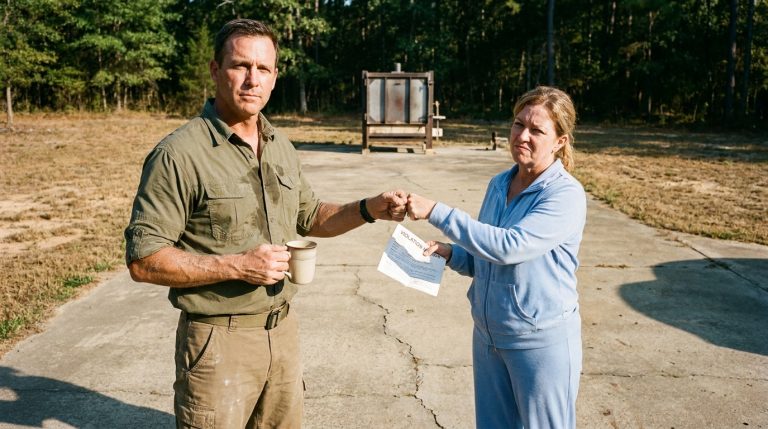
A penalty of $1,200 has been assessed for persistent and egregious violation of aesthetic standards.
He did not blink. His eyes tracked the precise alignment of the typography, noting the slight bleed of the toner on the heavy bond paper—cheap equipment trying to look expensive. Twenty-five years in the Corps of Engineers taught him to look past the surface noise of a presentation and search for the structural load-bearing points. This letter was weak at the joints. It assumed guilt by proximity. It assumed the recipient was a civilian accustomed to bowing before a clipboard.
“Twelve hundred dollars,” he whispered. The sound died instantly in the warm, dry air of the room.
Outside, the five-acre property sloped gently toward the eastern tree line, a wide, dark expanse of saturated earth that smelled powerfully of rotting pine needles and turned clay. The storm had blown through twelve hours prior, dropping eight inches of water in a furious, biblical rush that had turned half the county into a temporary swamp. Every driveway on the ridge was coated in silt. Every gravel track bore the scars of runoff. Yet his was the only one bearing an itemized bill.
Mark stood up, his joints making a dry, clicking pop that he ignored. He walked to the back door, sliding it open just enough to let a knife-edge of damp morning air cut across the room. The gravel of the drive outside caught the weak, watery light of dawn, glistening with a brown, viscous layer of fine-grained sediment.
A lesser man would have grabbed a push broom or fired up the pressure washer, angry at the mess, eager to pay the toll and erase the humiliation. But Mark did not feel humiliation. He felt a cold, metallic clarity settling into the base of his skull—the exact sensation he used to get fifty miles south of the Euphrates when a bridge foundation showed micro-fractures under load. You didn’t yell at the concrete. You didn’t curse the rain. You traced the stress back to the anchor bolts.
The sediment pattern on the drive was wrong. It didn’t fan out from the crown of the road where the municipal drainage spilled over. It fanned out from the side, angling sharply across the lower corner of his fence line, carrying coarse reddish clay that didn’t match the gray granite aggregate of the subdivision’s common grading. That clay came from further up. It came from the high common ground near the seasonal creek.
He folded the letter twice, sliding it neatly into his back pocket with mechanical precision. Sarah’s soft tread sounded on the stairs behind him, accompanied by the rich, dark aroma of freshly brewed coffee.
“You’re up early,” she said, her voice carrying a trace of sleep as she walked into the kitchen and set two mugs on the counter. She paused, catching the stillness in his shoulders, the flat, unblinking set of his jaw. “Mark? What is it?”
He didn’t turn around immediately. He kept his eyes locked on the brownish-gray smudge staining the pristine edge of his gravel drive, where the water had carved a miniature delta through the stones.
“Karen Bishop just declared war,” he said, his voice entirely devoid of heat. “She just doesn’t know who she’s handing the blueprints to.”
CHAPTER 2: THE WALKING SURVEY OF THE WEAPONIZED WATERWAY
The air down by the eastern boundary line tasted of crushed pine and damp silt, heavy with the unmistakable odor of freshly disturbed earth. Mark walked with a measured, rhythmic stride, his heels biting into the saturated sod of his five-acre plot. His eyes scanned the terrain not with the casual annoyance of a homeowner stepping in a puddle, but with the cold, systematic precision of an engineer checking load failures on a compromised bridge deck.
The natural gradient of the land was simple: a gentle, sloping fall from the western ridge down toward the small seasonal creek that marked the eastern perimeter. For two years, he had respected this boundary, maintaining the natural brush and keeping the drainage clear. But as he drew closer to the low point of the property, the topography told a story of violence.
Riblets of reddish-brown clay cut across the green turf like fresh surgical incisions, all of them pointing away from the creek and angling directly toward the lower corner of his gravel drive. It was an alluvial fan in miniature, carved by a high-volume sheet of water that had no business spilling over this side of the bank.
He stopped twelve paces short of the woodline, his boots sinking a quarter-inch into the spongy, waterlogged soil. The grass here was flattened, swept clean of debris in a wide, sweeping arc that pointed like an arrow toward his house. Nature did not carve straight lines through heavy clay. Nature meandered; it settled; it absorbed. This geometry was man-made.
Without breaking his stride, he pushed through a dense thicket of elderberry and briars, stepping across the invisible legal boundary onto the HOA common land. The ground gave way beneath him with a sickening squelch.
The seasonal creek—a modest, sluggish drainage ditch during nine months of the year—had been transformed. The banks were raw, stripped bare of their protective root systems and native vegetation, exposing a jagged gash of dark red subsoil to the damp morning air. The channel was wider, deeper, and ruthlessly straight.
Mark crouched down, resting his hand against the exposed root of an uprooted oak. The wood was fresh, the sap still tacky against his fingertips. He could see the faint, ghostly impressions of heavy machinery treads pressed deep into the mud of the bank, partially smeared by the receding floodwaters but entirely unmistakable to anyone who had spent a career reading the signatures of earthmovers and backhoes. Someone had brought heavy tracked equipment onto common land, breached the natural contour of the watershed, and re-engineered the flow.
He stood up slowly, wiping his fingers on his trousers, and followed the newly excavated channel upstream. Two hundred yards north, hidden behind a dense screen of second-growth cedar, he found the source.
A crude, heavy-handed dam of boulders, packed earth, and sod had been shoved across the natural curve of the creek bed. The makeshift barrier choked the original waterway, forcing the accumulated runoff of the entire upper neighborhood to divert sharply to the west. Right down a newly cut, unlined drainage trench that aimed like a fire hose straight along his property line.
They hadn’t just neglected the drainage; they had weaponized it. They had sacrificed his land to keep a patch of common ground dry for whatever vanity project sat on the other side of that cedar line.
Mark pulled his phone from his shirt pocket, activating the camera with a firm tap of his thumb. His hand was completely steady as he framed the first wide shot of the earthen dam, capturing the raw, bleeding scars of the excavator tracks in the foreground. He didn’t curse. He didn’t raise his voice to the empty trees. He simply documented the crime, framing every angle with clinical detachment, recording the exact coordinates where administrative arrogance met physical reality.
CHAPTER 3: THE CLUBHOUSE COURTROOM AND THE FIRST SLIDE
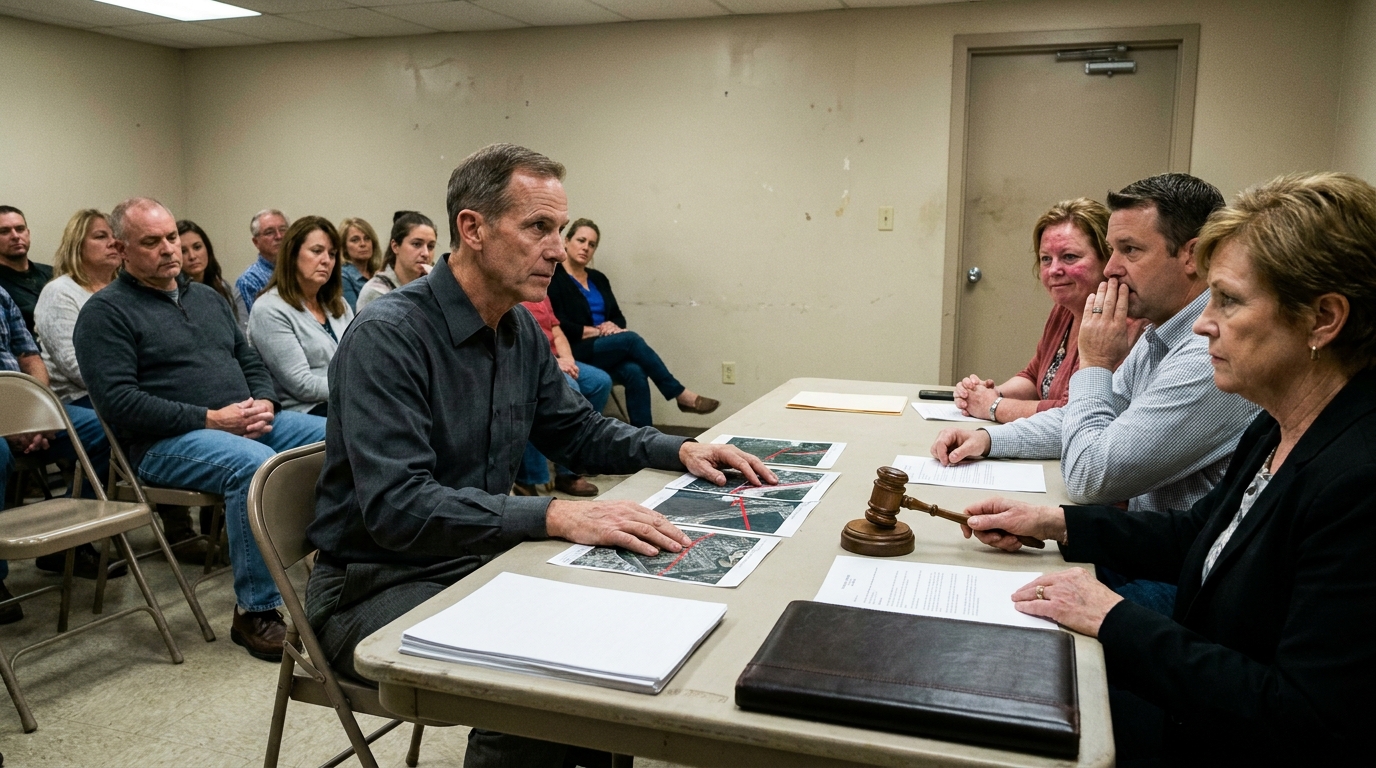
The Oakidge Meadows clubhouse smelled faintly of commercial lemon cleaner and low-level desperation. It was a sterile, windowless room dominated by rows of folding chairs that faced a long laminate table at the front. Karen Bishop presided over this minor domain from the center seat, flanked by Gary—a man whose nervous twitch had become a permanent fixture of his facial muscles—and Brenda, whose jaw was set with the unyielding rigidity of someone who practiced looking severe in front of the mirror.
Mark arrived precisely at seven o’clock. He did not rush, nor did he linger at the threshold. His stride was measured, his boots clicking evenly against the polished linoleum floor. He wore a pressed charcoal button-down and wool slacks, a quiet sartorial rejection of the casual golf-shirt uniform worn by the rest of the assembly. He took a seat in the front row, directly in the center of Karen’s field of vision, and placed a slim, dark leather portfolio flat across his knees.
Karen’s gaze flicked toward him like a striking adder, registering his presence with a sharp, involuntary tightening of her lips. She cleared her throat, tapping a small wooden gavel against the laminate surface with a dry, hollow sound that lacked genuine authority.
“We have several routine matters to address tonight,” Karen announced, her voice carrying that practiced, brittle cadence designed to project unearned absolute power. “First up on the agenda of covenant infractions, we have the outstanding assessment regarding Mr. Henderson’s property. Twelve hundred dollars for severe, persistent neglect of driveway standards.”
A ripple of uncomfortable shifting moved through the dozen homeowners seated behind Mark. No one looked at him; eyes stayed glued to the backs of heads or folded hands.
Karen turned her gaze downward, fixing Mark with a cold, triumphant smirk. “Mr. Henderson. Since you’ve chosen to grace us with your presence, would you like to explain why your gravel drive resembles a river delta, or are you prepared to settle the balance tonight?”
Mark did not flinch. He did not raise his voice. He stood up slowly, deliberately, giving the movement the weight of a tactical deployment. He picked up his portfolio, walked past the front row of chairs, and stopped four paces from the board’s table.
“I’m not here to discuss a cosmetic fine, Karen,” Mark said, his tone low, even, and projecting cleanly to the back corners of the room. “I’m here to discuss the structural origin of the sediment.”
Karen’s smirk faltered for a fraction of a second, replaced by a flash of annoyance. “The board’s assessment is final under section 7.4 of the bylaws. Your driveway is a public eyesore. Pay the fee or face a lien.”
“Section 7.4 assumes natural weathering,” Mark replied. He unzipped the portfolio, withdrew a glossy, high-resolution satellite printout from two years prior, and laid it flat on the table, anchoring the corners with his fingertips. “This is the topographical baseline of the common land bordering the eastern ridge. Notice the natural curve of the seasonal creek. It flows away from private property, discharging safely into the county basin.”
He slid a second, identical-sized print over the first, aligning the grid lines with mechanical precision. “This is the creek as it exists today. Straightened by approximately two hundred yards. Armored with an unengineered earthen berm placed directly on HOA common land.”
A low murmur rippled through the seated residents. Gary’s hand twitched, his fingers instantly shuffling a stack of blank papers as if trying to bury the imagery beneath a snowdrift of white bond. Brenda’s chin tilted up, her eyes narrowing into cold slits, but she remained silent.
“You didn’t engage in routine maintenance,” Mark continued, his voice dropping an octave, turning flat and technical. “You engaged in an unpermitted, high-velocity water diversion. You created a hydraulic channel that directed an artificial flood straight onto my boundary line, washing away two acres of topsoil and dumping the resulting silt onto my drive. You fined me for the direct consequences of your own unauthorized engineering failure.”
Karen slammed her small wooden gavel down, the wood cracking sharply against the table. Her face had mottled into an ugly, blotchy crimson. “That is completely preposterous! The board authorized a simple landscaping improvement to keep the new common area picnic site from retaining standing water! We do not need your permission, and we certainly do not need a lecture from a disgruntled resident!”
“Did you pull a county environmental permit?” Mark asked, stepping fractionally closer, his eyes locked onto hers with the unblinking intensity of an apex predator studying a compromised flank. “Did you conduct a hydraulic impact study? Did you notify downstream property owners before altering a state-regulated watershed?”
Gary swallowed hard, his Adam’s apple bobbing violently. He reached out, his hand trembling as he touched Karen’s sleeve, whispering something too low for the room to catch. Karen jerked her arm away, her chest heaving beneath her blouse.
“We are the board!” she snapped, her voice breaking slightly on the high note of panic. “The rules apply to you, Mr. Henderson, not to the administration of this community! Pay the fine, or we will strip your access and file the lien by Friday morning. This meeting is adjourned.”
She struck the table once more, turned on her heel, and retreated toward the side office door before anyone in the room could draw a breath.
Mark stood still in the center of the silent room, looking down at the stark, red-lined satellite imagery spread across the board’s table. He did not gloat. He did not shout after her. He simply reached down, picked up his photographs, and slid them back into the leather portfolio. The first line of defense had shattered under direct light; the real work was just beginning.
CHAPTER 4: THE BUREAUCRATIC SIEGE AND THE FOIA HARVEST
The dining room table had been cleared of all domestic pretense, converted entirely into an operational staging area for state and county inquiries. Stacks of yellow legal pads, printed topographical grids, and heavy ring binders lined the perimeter like sandbags. The overhead chandelier cast a sharp, unfiltered light downward, illuminating the fine dust motes drifting lazily through the air.
Mark sat squarely in the center chair, his forearms resting flat against the wood, a cold cup of black coffee growing forgotten at his elbow. He did not look like a man defending himself against a minor civic fine; he looked like an officer preparing a comprehensive artillery barrage. The clubhouse confrontation had served its tactical purpose—it had mapped Karen Bishop’s panic threshold and forced her into a public, documented denial. Now, the battle moved from the emotional theater of the neighborhood to the unyielding machinery of public record.
The county courier had arrived earlier that afternoon, dropping off three thick, tape-sealed cardboard boxes containing the raw yield of Mark’s Freedom of Information Act requests. Two years of Oakidge Meadows Homeowners Association records, meeting transcripts, email servers, and financial ledger summaries.
He reached out, his calloused fingers slicing cleanly through the packing tape of the topmost box with a utility knife. The smell of toner-heavy paper and industrial pulp rose instantly into the cool evening air. He did not dive into the pile with blind enthusiasm. Systematic analysis required rhythm.
“Start with the correspondence logs,” Mark murmured to himself, pulling a thick wedge of printed email threads toward him.
The first hour passed in absolute silence, broken only by the rhythmic rustle of turning pages and the occasional scratch of a red ballpoint pen marking a date or a discrepancy. He tracked the administrative paper trail backward from the recent storm. He scanned past routine arguments over architectural color palettes, missed trash bin collections, and passive-aggressive notices regarding mailbox heights. These were the smoke screens—the administrative noise designed to keep residents looking downward while structural power was consolidated at the top.
Then, halfway through a folder labeled Common Area Maintenance 2024, his thumb stopped on a printed email chain dated six months prior.
The sender was an anonymous resident living near the eastern ridge, complaining about a sudden, heavy accumulation of standing water and an ugly, unauthorized trench being cut across the common easement behind his property line. The query was straightforward, demanding to know what work was being performed and who had authorized it.
Mark leaned closer, his eyes narrowing as he read Karen Bishop’s reply. The text was short, dismissive, and dripping with institutional arrogance. It is a fully approved and necessary drainage improvement for the benefit of the entire community. No further inquiries are necessary.
No mention of a county permit. No mention of an engineering assessment. Just an executive decree wrapped in official stationery.
He flipped the page, cross-referencing the email timestamp against the board’s official meeting minutes for that same quarter. The entry for the project approval was remarkably vague: Motion passed for common area beautification and moisture mitigation. The cost was listed as a lump sum expenditure, but the name of the contractor executing the work had been meticulously scrubbed from the public-facing record.
A shadow moved across the doorway as Sarah stepped quietly into the room, holding a fresh mug of steaming coffee. She set it down softly beside his notes, her eyes scanning the sprawling mosaic of paper covering the table.
“You’re finding the gaps,” she said quietly, her voice steady.
“I’m finding the omission,” Mark corrected, not lifting his gaze from the text. “When a board scrubs a contractor’s name from an approved expenditure, they aren’t protecting community aesthetics. They’re protecting a conflict of interest. They’re hiding who got paid.”
He reached for the next file folder—the financial transactions and bank routing summaries pulled directly from the HOA’s public disclosure archive. The administrative trap was tightening. Karen had assumed her paperwork was safe inside the ironclad walls of a private suburban association, forgetting entirely that public easements, state watersheds, and county drainage jurisdictions intersected her little empire at every turn.
Mark picked up his pen, circled the redacted invoice number on the margin of the printed email, and drew a clean, unyielding line straight toward the next box of records. The investigation was no longer about a twelve-hundred-dollar fine. It was about exposing the rot holding the entire administrative structure together.
CHAPTER 5: THE MIDNIGHT DISCOVERY AT THE DINING ROOM TABLE
The clock on the wall hummed past midnight, its slow, mechanical ticks swallowed entirely by the dense quiet of the house. Sarah had retired hours ago, leaving behind an empty mug and a single handwritten note beside the coffee maker. Mark remained at the center of the dining room command center, his shoulders locked, his eyes tracking columns of numbers with the relentless focus of a battery commander reading firing tables.
The box containing the HOA’s financial disclosures for the past twenty-four months sat open before him, its contents sorted into neat, overlapping piles. He reached into the stack labeled Vendor Disbursements and pulled out a stapled packet bearing a logo that looked like it had been printed on a home inkjet machine: K&G Landscaping and Excavation.
The proposal attached to the invoice was crude—a half-page estimate riddled with spelling errors and structural omissions. Yet the line items were stark and unforgiving. Reroute Pesky Creek to improve drainage for new sod, $4,500. There was no engineering seal, no state-approved hydrology stamp, only a hand-drawn arrow scrawled on the back of the sheet indicating where natural flow was to be forced into an artificial channel. Four thousand five hundred dollars of community funds paid out for an unpermitted felony against the watershed.
Mark’s fingers traced the signature line at the bottom of the authorization check. Karen Bishop’s signature was sharp, angular, and authoritative, countersigned by Gary’s nervous, cramped hand. But it was the corporate registry cross-reference lying beneath the check that transformed a simple municipal grievance into a structural fracture.
He pulled a state business entity printout toward him, his thumb tracking down the ownership registry of K&G Landscaping. The registered agent was listed as Kevin Gable.
He leaned back, the wooden chair legs groaning slightly against the floorboards. The architectural pattern clicked into place with the chilling precision of a dropped bolt finding its seating. Karen Bishop hadn’t merely hired an incompetent contractor out of administrative laziness; she had funneled common funds directly into the hands of her brother-in-law, bypassing competitive bidding, ignoring disclosure laws, and shielding the operation behind a wall of manufactured neighborhood rules.
The twelve-hundred-dollar fine levied against his driveway wasn’t an isolated act of tyranny. It was a defensive reflex. It was a debt collection mechanism designed to punish the only resident who looked past the surface finish and saw the raw, rotting timber underneath the board’s authority.
He picked up a red pencil, his hand steady, and drew a thick, unbroken line connecting the contractor’s registry name directly to the memo line of the canceled check. The paper could not lie. The numbers did not care about executive titles or small-town political bullying.
The evidence was complete. The perimeter walls of Karen’s petty kingdom were built on sand, and the tide was already rising against the foundation. Mark closed the folder with a sharp, dry snap that echoed through the silent room, setting the stage to turn the collected paperwork into a unified coalition.
CHAPTER 6: FORGING THE COALITION AND THE NEIGHBORHOOD AWAKENING
The transition from solitary document review to community organizing required a different kind of calculation. A lone engineer armed with satellite maps and bank routing numbers could dismantle a board’s legal standing on paper, but an individual lawsuit remained vulnerable to quiet settlements or institutional stonewalling. Real structural change demanded weight—a collective voice heavy enough to crush any attempt at administrative suppression.
Mark did not wait for daylight. The morning light filtered through the eastern windows, casting pale, geometric beams across a living room that had quickly transformed into a briefing center. The leather portfolio rested on the coffee table, bulging with the compiled evidence: the unpermitted excavation estimates, the canceled check bearing Kevin Gable’s corporate registry, and the trail of dismissed homeowner complaints.
His first visit was three doors down, to the home of Mr. and Mrs. Miller. The elderly couple answered the door with cautious hesitation, their expressions tightening at the sight of an outsider before recognizing Mark’s face.
“Mark,” Mr. Miller said, his voice carrying the weary resignation of someone who had spent twenty years quietly complying with every minor decree issued from the clubhouse. “Is something wrong with the common area?”
“Not the common area, Mr. Miller,” Mark replied, stepping past the threshold into the quiet, sunlit hallway. “Your trim.”
The conversation was brief, precise, and devastatingly effective. Mark did not offer sympathy; he offered structural context. He placed copies of the drainage maps and the contractor proposals onto their coffee table, laying out how the board’s financial self-dealing directly intersected with the arbitrary fines imposed on their household. The fifty-dollar-a-day penalties levied over the shade of white painted on their trim suddenly stopped looking like erratic governance and started looking like a cash-flow diversion scheme.
Mrs. Miller stared at the contractor’s check, her hand trembling slightly as she touched the edge of the paper. “She fined us nearly a thousand dollars just to make us shut up… while her own family was digging trenches behind our property.”
“She relied on isolation,” Mark said, his tone flat and unyielding. “She kept every household convinced their grievance was unique, a private failure of compliance.”
By late afternoon, the list had grown. The Youngs, threatened with pool access revocation over a temporary basketball hoop, joined without hesitation. Maria, fighting a bureaucratic war over a modest backyard vegetable garden visible from the walking path, added her signature to the ledger. Each household was not merely a victim of arbitrary enforcement; they were foundational nodes of a shared network that had finally discovered the true source of its friction.
That evening, the living room filled beyond its seating capacity. Nearly thirty residents packed into the space, their coats draped over chairs, their eyes fixed on the makeshift projector screen set up at the far end of the room. The air was thick with the nervous tension of people who had spent years avoiding eye contact with the board president, now crossing a legal and psychological Rubicon.
Mark stood beside the projector, his posture straight, his voice carrying the calm, measured authority of a field briefing. He did not yell. He walked them through the evidence slide by slide—the before-and-after topographical grids, the unpermitted channel diversion, the suppressed contractor invoices, and the bloodline connection linking Karen Bishop directly to K&G Landscaping.
A sharp silence settled over the room when the final slide went dark. It was the heavy, breathless quiet of realization.
“She didn’t just break the rules,” a voice murmured from the back row. “She made a business out of breaking them.”
“And she billed us for the damage she caused,” Mark added, his gaze sweeping across the crowded room. “Individually, our complaints are nuisances she can ignore or crush with legal threats. Together, we are a systemic failure she cannot outrun. My lawyer, David Miller, is prepared to file a comprehensive multi-party action. We don’t need to shout at her in a clubhouse anymore. We just need to hand her the bill.”
A collective murmur of grim agreement rose from the gathered residents. A sign-up sheet circulated from hand to hand, every line filling instantly with names and addresses. The quiet, beige tyranny of Oakidge Meadows was about to face an institutional counter-offensive built on irrefutable evidence and unyielding momentum.
CHAPTER 7: THE TWELVEPAGE NUCLEAR ACCORD
The document sitting on the edge of the dining room table did not resemble a standard legal notice. Bound by a heavy black binder clip and printed on twelve sheets of crisp linen bond paper, it was an administrative indictment designed to strip away every layer of procedural armor Karen Bishop had constructed around her office. David Miller had spent three uninterrupted days refining its clauses, turning raw FOIA disclosures, environmental codes, and breach-of-fiduciary precedents into an unyielding financial weapon.
Mark stood beside the table, his fingers resting on the cover page. The document was addressed formally to Karen Bishop, copied to the remaining compliant board members, and delivered via certified mail requiring a direct signature upon receipt.
The first page systematically demolished the twelve-hundred-dollar fine levied against his driveway, categorizing it not as an administrative penalty, but as an act of bad-faith retaliation engineered to mask the board’s own unlawful conduct. From there, the text expanded into a relentless accounting of structural liabilities. It detailed the unpermitted alteration of the seasonal creek, citing state watershed ordinances and county environmental protection codes. It laid out the exact corporate registry trail linking K&G Landscaping directly to Kevin Gable, exposing the undisclosed familial nepotism that had funneled forty-five thousand dollars of public association funds into private pockets without a competitive bid or an engineering seal.
The final sections of the accord transitioned from regulatory infractions to hard financial calculations. It itemized the professional remediation estimates required to dismantle the earthen dam, restore the natural meander of the watershed, and repair the topsoil erosion across two acres of Mark’s property—a total baseline figure of eighty-seven thousand five hundred dollars. Layered on top of that was an itemized consulting invoice for Mark’s own professional engineering assessments, billed at standard expert witness rates for hours logged in investigative fieldwork and document verification.
The total demand package approached six figures. It was a complete inversion of power. The petty twelve-hundred-dollar trap Karen had set for a single resident had transformed into a multi-faceted legal bear trap that now enclosed her entire administration.
Mark picked up the heavy packet, feeling the dense weight of the paper against his palm, and walked it out to the mailbox at the head of the drive, raising the red metal flag with a sharp, metallic click. There would be no shouting matches, no emotional confrontations in a beige clubhouse. The paperwork was in motion, and the gears of institutional consequence were turning with absolute, irreversible momentum.
CHAPTER 8: THE FINAL SETTLEMENT AND THE MEANDERING RESTORATION
The collapse of Karen Bishop’s administrative empire did not arrive with a dramatic explosion, but with the steady, heavy rumble of heavy excavators rolling onto common land. Weeks had passed since the delivery of the twelve-page accord, weeks defined by the quiet, panicked implosion of the board. Gary had resigned first, sliding a brief, shaken note under the management office door before fleeing into administrative silence. Brenda had held out for seven days before her resolve cracked, leaving Karen utterly isolated at the center of a disgraced and defunct regime.
By the time the county environmental protection department finalized its fifty-thousand-dollar citation against the Oakidge Meadows HOA, Karen was no longer a board president; she was a political pariah. A special recall election, organized by the newly formed Concerned Citizens Committee, had swept through the neighborhood with over sixty percent voter turnout in a single weekend.
Now, standing on the edge of his back deck with a warm ceramic mug of coffee cradled in his palms, Mark watched the heavy machinery at work. Under the supervision of a licensed, bonded engineering firm—independent professionals vetted by the new interim board—tracked excavators carefully dismantled the crude earthen berm that had weaponized the watershed.
The process was slow, deliberate, and entirely faithful to the natural physics of the land. The straight, brutalized drainage trench was filled in, regraded, and naturalized. The seasonal creek was coaxed back into its original, gentle meander, its banks reinforced with native riverstone and deep-rooting riparian vegetation. Every bucket of dirt moved by the contractors was an erasure of the arrogance that had carved a scar across the earth.
The restoration extended outward to his own property. Truckloads of rich, dark topsoil arrived to replace what the artificial flood had stripped away. The lower boundary turf was re-seeded, and the gravel drive—the very origin point of the conflict—was resurfaced with clean, uniform aggregate that drained true and steady toward the municipal road.
The neighborhood itself had undergone a profound structural shift. In a special community meeting held in the clubhouse—now stripped of its oppressive atmosphere of petty intimidation—Mr. Miller, the newly elected board president, had formally read a public apology into the official record, voiding all retaliatory fines and unanimously adopting the terms of the settlement. The labyrinth of vindictive rules regarding trim shades, basketball hoops, and vegetable gardens had been permanently dismantled, replaced by a transparent, community-focused administration. Maria’s garden flourished undisturbed near the walking path, and children played without the looming shadow of arbitrary enforcement.
A soft knock sounded at the front door, pulling Mark away from the glass. He walked through the quiet, sunlit hallway and pulled the heavy wood open. There was no desperate, pleading neighbor standing on the threshold this time, no imperious clipboard-wielding tyrant demanding submission.
The mail carrier had left a small bundle of letters on the porch table. Mark picked them up, stepping back inside. Among the standard circulars and utility bills rested a crisp, white envelope bearing the management company’s corporate seal. He slit the edge open with his thumb and slid out a check covering the exact, itemized amount of his professional consulting hours, accompanied by a handwritten note from Mr. Miller: Mark, thank you for saving this neighborhood from itself.
Mark set the check down on the butcher-block kitchen island next to his old field notes. He walked back to the sliding glass door, looking out over the pristine, stone-lined curve of the creek as it caught the bright autumn sunlight, flowing smoothly and naturally away from his land. The system, when subjected to relentless, methodical competence, had held true. The bully had fallen not to rage, but to the unyielding weight of truth. The landscape was healed, the accounts were settled, and the community was at last whole again.