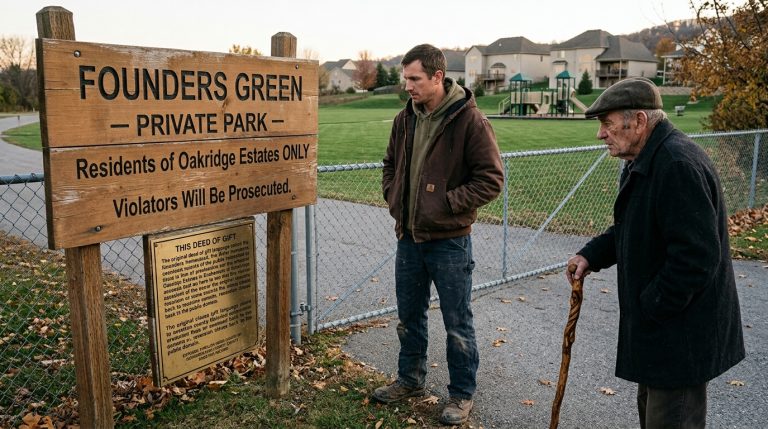
The Iron Boundary: A Master Sergeant’s Silent Campaign to Preserve the Sacred Soil of Heritage
CHAPTER 1: THE LINE IN THE RED CLAY
The North Carolina heat didn’t just sit on you; it pressed against your chest, heavy with the scent of pine resin and the dry, metallic tang of baked earth. I didn’t move. My hands were shoved deep into the pockets of my work trousers, knuckles grazing the rough edge of a utility knife. I watched the woman—Karen—her bright pink suit a jarring, artificial wound against the deep, verdant sprawl of my grandfather’s timberland.
She was holding a clipboard like it was a holy relic, her knuckles white, her eyes darting over the dense brush of Miller’s Creek as if she were trying to claim it through sheer force of will.
“You’ll need to submit a landscaping plan, Mr. Thorne,” she said, her voice thin and sharp, slicing through the rhythmic gurgle of the water. “The community beautification committee requires uniformity. This buffer zone is an eyesore. It’s a liability.”
I took a slow breath, the kind I’d practiced in the desert when the hum of incoming mortars turned the air thick and electric. I let the silence stretch. I didn’t look at her; I looked at the creek. The water was dark, clear, and utterly indifferent to the woman’s existence. It had been here long before her vinyl-sided mushrooms sprouted on the ridge, and it would be here long after she faded into the beige fog of her own making.
“Karen,” I said. My voice sounded gravelly, like dry leaves skittering over pavement. “You’re standing on private property. You aren’t in a community common area. You’re in my backyard.”
She didn’t flinch. Instead, she stepped forward, the heel of her shoe sinking into the soft, iron-rich red clay of the bank. She thrust the clipboard toward me. “Check the plat maps filed with the county. The buffer is ours. The developer assured the board this area was a natural amenity for our residents. It’s part of the Whispering Pines master plan.”
I felt the shift in my gut—the cold, tactical click of a lock falling into place. She wasn’t just confused; she was an asset, a pawn in a game of legal theft she didn’t even understand. My gaze shifted from her face to the spot where the old survey stake should have been. I hadn’t looked at that marker in months. I walked three paces to the left, kicking aside a pile of rotting hemlock needles. The ground was flat, undisturbed.
The marker was gone.
A phantom-like realization settled in. They hadn’t just made a mistake. They had physically removed the boundary indicators, replacing historical truth with a convenient, modern fiction.
“You’ve been sold a story, Karen,” I said, my tone flat, stripped of all aggression. It was a cold warning, though she was too caught up in her own script to hear it. “And you’re about to find out that a binder of rules is a very flimsy shield when you’re standing on someone else’s ground.”
I didn’t argue further. I tipped my hat, turned my back on her, and began the long walk back to the farmhouse. My mind was already moving, stripping the scene down to its components: the missing stake, the sudden appearance of the development team, the paper trail I needed to exhume from the county vault. The war hadn’t started with the bulldozers. It had started the moment they decided that history was something they could simply bulldoze over.
I reached the porch. Sarah was standing there, the screen door vibrating slightly in the wind. She saw my face—the stillness, the lack of heat—and her hand tightened around the porch railing. She knew that look. It was the look of a man who had already stopped acting and started executing.
“She crossed the line,” Sarah whispered, a question and a statement all at once.
“She did,” I said, stepping past her into the cool, shadowed hallway of the house. “And tomorrow, I’m going to town to see exactly how much of it she managed to steal on paper.”
CHAPTER 2: THE ARCHIVE OF BURIED TRUTHS
The farmhouse felt different tonight. The shadows in the hallway seemed to hold more weight, the air thicker with the scent of old paper and the lingering, copper-tang of the red clay I’d tracked in on my boots. I sat at my desk, the single lamp throwing a focused, clinical cone of light over the stack of folders. My grandfather’s deed was at the bottom—a heavy, brittle promise from 1952—and resting on top of it was the empty, mocking space where a metal survey stake should have been.
I didn’t reach for a drink. I reached for my notebook. In the Marine Corps, the difference between a successful mission and a catastrophic failure was rarely firepower; it was logistics. It was knowing exactly what the enemy had, where they kept it, and how they intended to move it.
My mind drifted, unbidden, back to the dusty, sun-bleached maps of the Al-Anbar province. I remembered the sensation of tracing a route on a topography chart, feeling the sharp, agonizing friction of a pencil lead against vellum as I accounted for every elevation change, every dry wadi, every potential ambush point. The memory was an intrusive phantom, pressing against my temples. I wasn’t in the desert anymore. I was in a town called Pinehurst, facing a woman in a pastel suit who thought she could redraw history with a printer and a bribe. But the logic was identical.
I began to draft the list. Register of Deeds. Zoning Department. County Planning. Each location was a node in the network I needed to untangle. If Karen and her developer, Harris, were rewriting the boundaries, they had to have left a paper trail. Fraud, by its very nature, required a signature.
I stood up, the chair scraping sharply against the hardwood—a sound like a weapon being racked. My legs felt restless, heavy with the need for forward motion. I walked to the kitchen window, looking out toward the dark, jagged treeline that bordered Whispering Pines. The streetlights of the new development glowed like an artificial, sickly horizon, a neon bruise on the night sky. It was a sterile, manufactured glow, lacking the raw, organic depth of the forest. They were trying to overlay their grid onto my heritage, a digital illusion meant to scrub away the reality of the land itself.
Sarah appeared in the doorway, her silhouette framed by the dim light of the kitchen. She didn’t speak, but her eyes held a steady, quiet resolve that anchored the erratic pull of my own thoughts. She didn’t need to ask if I was still running the logic. She could see it in the way I held my shoulders, the way I watched the ridge.
“They’re not just taking the creek,” I said, my voice barely above a whisper, yet the words felt hard as stone. “They’re trying to erase the baseline. If they can move the line, they can eventually claim the timber, the workshop, the house itself. They aren’t building a neighborhood, Sarah. They’re conducting an annexation.”
“Then we find the original plat,” she said, her voice soft but uncompromising. “Not the one they filed. The one that was there before the surveyors touched a blade of grass.”
“I’m going to the register’s office at dawn,” I replied. “I need to see every sub-file, every amendment attached to the property transfer for the last ten years. Harris didn’t work alone. He had to have a surveyor on the ground, someone who looked at the markers, knew they were wrong, and signed off on it anyway.”
I turned away from the window, the image of the missing stake still burned into my mind. The lack of that stake was a tactical error on their part—it was a confession. It meant they couldn’t risk having an independent surveyor verify the ground truth. It meant they were terrified of an objective measurement.
I sat back down, the light of the lamp catching the dust motes dancing in the air. I opened the file for the Whispering Pines development application. The sheer volume of it was designed to intimidate, to bury any opposition under a mountain of environmental impact jargon. But underneath the legalese, there was always a rhythm—a pattern of deliberate, calculated action.
I picked up my pen. I wasn’t going to fight their jargon. I was going to map their lies. Every discrepancy in their plat map was a breach, and by the time I was finished at the county office tomorrow, I’d have the coordinates for every single one. The, for a second, I felt the familiar, cold flicker of the old sergeant surfacing—the one who knew how to turn a map into a kill box.
I wasn’t just a farmer fighting for his land. I was a man who knew how to wait, how to observe, and how to strike at the exact moment the enemy’s overconfidence left them exposed. And tomorrow, at the register of deeds, I was going to start turning the soil of their deceit, one public record at a time. The silence of the house settled over me, no longer heavy, but sharp and focused, like the edge of a blade waiting to be drawn.
CHAPTER 3: THE PAPER TRAIL OF GHOSTS
The county register’s office didn’t smell like history; it smelled like slow, agonizing decay. It was a basement-level labyrinth of steel shelving and high-density file cabinets that hummed with the electric tension of a server room. I walked through the main vestibule, my boots clicking too loudly on the polished linoleum, an unwelcome intrusion into a temple of silence.
The clerk behind the counter, a man with skin the color of old parchment and spectacles that seemed to be held together by sheer willpower, barely looked up. He pushed a sign-in sheet toward me. I signed my name, the pen scratching against the paper, and asked for the Whispering Pines master files.
“The development application is in the back archives,” he muttered, pointing toward a set of double doors that looked like they hadn’t been opened since the mid-nineties. “You’ll need to put on gloves. The humidity control down there has been acting up.”
I took the gloves, the latex snapping against my skin like a muffled gunshot, and stepped through the threshold. The air down here was different—colder, sharper, and thick with the smell of dust and stagnant time. I navigated the rows of cabinets, my fingers brushing against the cold, industrial paint, until I found the section labeled: HARRIS DEVELOPMENT – 2018 – PINEHURST SECTOR.
I pulled the main binder. It was heavier than I expected, a dense, leather-bound tomb of civic ambition. I carried it to a small, isolated table under a buzzing fluorescent light that flickered with a rhythmic, hypnotic frequency.
I started with the index. Everything looked pristine, stamped and filed with bureaucratic precision. But I didn’t care about the stamps. I cared about the sequence. I turned to the property survey section, my eyes scanning the technical descriptions, the metes and bounds, the references to historical corner markers.
Then, I hit the first glitch.
The archive numbering was slightly off. The plat map filed in October was labeled as File 402-B, but the supplemental survey—the one covering the creek buffer—was labeled 405-A. There were no 403 or 404 files listed in the supplemental sub-index. It was a small discrepancy, the kind a casual reader would ignore, but my mind had been trained to look for gaps in the perimeter. A missing sequence in a bureaucratic filing system was just as revealing as a missing patrol log in a combat zone.
I pulled out my phone and began to photograph the pages, moving methodically, ensuring the light caught the texture of the signatures and the subtle indentations of the stamps. My movements were calculated, slow. I was a ghost in their machine. I wasn’t just reading documents; I was looking for the seams where the fraud had been stitched into the record.
Halfway through the sub-file, I found it: a revision request form, dated two weeks before the final approval, signed by a firm I barely recognized—Sterling & Associates. The request cited a “field adjustment” due to “topographical inaccuracies.” It was signed by a junior surveyor named Elias Thorne—no relation—who, according to the timestamp, had filed this amendment at 4:45 PM on a Friday.
The logic was cold and clear. A late-Friday filing, a “field adjustment,” and a convenient absence of the subsequent filing numbers. It was a classic administrative feint, designed to avoid scrutiny by slipping through the system at the very moment the department was shutting down.
I leaned back, the flickering light casting long, jagged shadows against the wall. The silence of the archive room was no longer oppressive; it was informative. I had found the seam. Sterling & Associates hadn’t made a mistake; they had performed an extraction, slicing out the reality of my land and grafting in a manufactured amenity for Harris’s exclusive gated community.
I stood up, the chair pushing back with a sharp, dissonant grate that echoed down the long, narrow aisle. My heart rate hadn’t spiked, but there was a new, hard rhythm to my pulse. I had the coordinates of their deception now. I didn’t need to shout, and I didn’t need to storm into their office. I just needed to verify the surveyor’s credentials and see if I could find a trace of that Friday afternoon filing in the secondary logs.
As I walked back toward the main desk, the heavy binder tucked under my arm, I felt the weight of the paper against my ribs—a physical manifestation of their arrogance. They thought that by burying their lies in a basement, they had made them permanent. They hadn’t realized that the deeper you bury a truth, the more explosive it becomes when it finally hits the light.
I stopped at the counter. The clerk looked up, his spectacles catching the harsh glare of the ceiling lights. “Find what you were looking for, Mr. Thorne?”
“I think I’m getting close,” I said, my voice steady, the cold, pragmatic resolve settling into my chest. “I’m just beginning to see how the landscape was changed.”
I stepped out into the bright, blinding glare of the afternoon sun. The air felt thin and clean compared to the stagnant dust of the archives. I pulled my phone out and dialed Arthur Abernathy’s number. It was time to pull the first thread.
CHAPTER 4: THE ARCHITECTURE OF RESISTANCE
The diner was a relic of an era before gated communities and beige stucco. It smelled of burnt coffee and fried onions, the vinyl booths cracked and patched with silver duct tape. I spotted Dave sitting in the back, his back against the wall, eyes scanning the room with the practiced habit of a man who’d spent his life looking for exits. He didn’t wave. He just tapped the edge of the Formica table as I slid into the seat opposite him.
I didn’t lead with the documents. I led with the silence. I watched the way he held his coffee mug—fingers wrapped tight, shoulders square. He wasn’t just a neighbor; he was a tactical asset, and he needed to know I was ready to lead, not just complain.
“You look like you’ve been digging in the dirt,” Dave said, his voice a low, steady rumble.
“I’ve been digging in the county records,” I replied, pulling the folder from under my jacket and sliding it across the scarred table. “They didn’t just move the boundary, Dave. They manufactured a legal fiction to justify it. There’s a missing sequence in the filing numbers—a ghost amendment signed on a Friday afternoon by a firm that isn’t even local.”
Dave flipped through the pages, his eyes narrowing as he recognized the forged plat. He wasn’t a surveyor, but he understood the concept of ‘authorized intent.’ He traced the red-lined deviation with his thumb, the same way I had under the flickering lights of the archive.
“This isn’t a mistake,” he murmured. “This is an engineering project. They didn’t just want the creek; they wanted the deed history to look like it had always been theirs. That way, if anyone challenged them, the paperwork would back them up as the original owners.”
“Exactly,” I said. “And Karen is the spearhead. She’s the one who gets to play the enforcer, which keeps Harris and his legal team clean until they’re ready to finalize the land grab. But she’s also their biggest liability. She’s arrogant, she’s impatient, and she’s already started overstepping her authority with the rest of you.”
I leaned in, lowering my voice. The diner was empty, but the walls felt thin. “I need to know how deep the resentment goes in Whispering Pines. I’m not talking about annoyance over flower colors. I need to know who has been threatened, who has had their property rights violated, and who is willing to stand up once we file the Lis Pendens.”
Dave pulled a small notebook from his jacket pocket. It was a list—a ledger of petty tyrannies. He began to read off names, cross-referencing them with the types of grievances: The young couple with the playground equipment. The elderly widow with the bird feeder. It was a list of small, jagged edges—the very things that turn into a landslide if you push at the right angle.
“They’re not just angry,” Dave said, looking up. “They’re scared. They bought into that place because they thought it was safe, and now they feel like they’re living under a regime. If you show them this—” he tapped the forged plat map “—they’ll realize it was never about the ‘community standards.’ It was about control.”
“Then we start the coalition,” I said. “I’m not looking to start a riot. I’m looking to document. I want every single notice, every threatening email, and every interaction with Karen logged. We’re going to build a case that isn’t just about my creek. It’s about the culture of fraud they’ve built from the ground up.”
The waitress swung by, dropping the check on the table with a clatter. The moment felt fragile, like a gear turning in a lock that had been rusted shut for years. I saw Dave’s expression change—from cautious curiosity to a hard, cold resolve. He wasn’t just a retired officer looking for a cause; he was a man who hated seeing someone get bullied.
“I’ll get the emails moving,” Dave said, standing up and sliding his chair back. “We’ll call a meeting, not in the clubhouse, but in someone’s backyard. Keep it private. Keep it offline until we’re ready to go public.”
“Do it,” I said. “And Dave? Don’t tell them everything yet. Just tell them we’ve found the smoking gun.”
He nodded once, sharp and precise, and walked out of the diner. I watched him go, then turned my attention back to the folder. I had the map, I had the signatures, and now I had the support. I wasn’t just fighting an individual anymore; I was building the structure of a counter-offensive. I finished my coffee, the bitter taste settling on my tongue, and stared out the window at the distant, manicured ridge of the development.
They thought they were the architects of the future. They didn’t realize they were just the demolition crew, and I was the one who had finally read the blueprints.
CHAPTER 5: THE PINSIR MOVE
I pulled into the courthouse lot, the tires crunching over loose gravel, and killed the engine. The silence that followed was immediate, but it didn’t feel peaceful. It felt like a held breath. I watched the courthouse entrance, a brutalist structure of concrete and glass that looked less like a temple of justice and more like a fortress. Today, it was the front line.
I reached for the manila envelope on the passenger seat—the Lis Pendens filing that Abernathy had drafted. It was a dense, intimidating stack of legal reality, a financial stake driven directly into the heart of Harris Development’s next phase. If I filed this, the title to every unsold lot in Whispering Pines would be clouded. The sales would stop, the banks would freeze the credit lines, and Harris would be forced to the table.
My door opened with a heavy, metallic groan. The air outside was thick, smelling of hot asphalt and the impending humidity of a North Carolina afternoon. I hadn’t taken three steps toward the courthouse when a sleek, black sedan pulled into the adjacent space, blocking my path. The driver’s window rolled down with a smooth, expensive hum.
A man in a charcoal suit looked out. He wasn’t Harris. He was someone cleaner—a corporate litigator. He didn’t look angry; he looked bored, which was, in many ways, more dangerous.
“Mr. Thorne,” he said, not asking, but stating. “I’m with Sterling & Associates. My client, Mr. Harris, has been made aware of your… extracurricular research.”
I didn’t stop. I kept my pace rhythmic, controlled. “Then he’s aware that his research into property boundaries is about to get a lot more thorough,” I replied, my eyes fixed on the courthouse steps.
The man didn’t move. He leaned across the passenger seat, his expression sharpening. “We have a motion for a temporary restraining order being prepared as we speak. If you file that document, you’re looking at a multi-million dollar lawsuit for tortious interference. My client is a reasonable man, Mr. Thorne. He’s prepared to offer a ‘fair market’ buyout of your entire property just to clear the title and avoid the unpleasantness of a protracted legal battle.”
I stopped. The friction of the asphalt beneath my boots felt solid, grounding. He was trying to pivot, to change the terrain of the battle before I reached the courthouse. It was a classic misdirection—an attempt to turn a public legal challenge into a private, negotiable transaction.
“Fair market value doesn’t account for seventy years of history,” I said, my voice low. “And it certainly doesn’t account for fraud.”
The man smiled, but it didn’t touch his eyes. “Fraud is a heavy word to throw around without a judge’s approval. And judges in this county tend to prefer development over ‘history.’ Don’t be the man who bankrupts his own family fighting for a patch of mud.”
He rolled the window up. The sleek sedan pulled away with a soft, predatory acceleration, leaving me standing in the center of the parking lot. I stared at the envelope in my hand. He hadn’t just threatened me; he had revealed the depth of their desperation. They weren’t fighting for the creek anymore—they were fighting to save the entire development from collapse.
I walked up the courthouse steps, the concrete cool and smooth under my palms. My pulse was a steady, rhythmic thrum against my ribs—the same rhythm I’d felt a thousand times before when I’d stood at the edge of a map, looking into the dark. They had tried to push me into a box of their making, to trade my legacy for a check.
I handed the envelope to the clerk at the window, watching as she stamped the top page with a heavy, rhythmic thud. The sound was final. The Lis Pendens was now part of the public record.
I stepped back out into the bright, harsh glare of the afternoon, the weight of the envelope gone from my hand, but the weight of the war now fully settled into my bones. Harris had promised a lawsuit, and he had promised me ruin. I adjusted my jacket, looked toward the horizon, and felt not fear, but a cold, clear clarity. They had played their move, and I had blocked it. Now, they were going to have to do something desperate. And desperate men, as I’d learned long ago, always leave the widest openings for a counter-attack.
CHAPTER 6: THE CLUBHOUSE RECKONING
The clubhouse was too quiet. It was the kind of artificial, staged silence that precedes an earthquake. I crossed the threshold, the soles of my boots clicking against the pristine, polished oak of the foyer. The room was a monument to the aesthetic of “Whispering Pines”—a sprawling, vaulted space filled with designer leather chairs and light fixtures that cost more than a year’s worth of my Marine Corps pension.
Harris stood at the far end of the room near a mahogany desk, his back to me. He was flanked by two lawyers in suits so sharp they looked like they could draw blood. As I approached, one of the lawyers stepped forward, his face a mask of practiced, glacial annoyance.
“Mr. Thorne, this is a private settlement conference. You are—”
“I’m the reason you’re all here,” I said, my voice cutting through his rehearsed indignation like a dull blade. I didn’t stop until I was five feet from them. I didn’t look at the lawyers. I looked at Harris. “The Lis Pendens is filed. Your lots are frozen. Every bank in the county has been notified of the title discrepancy. You’re done.”
Harris finally turned. The confident, golf-course tan was gone, replaced by a sallow, sickly pallor. He looked older, tired, and deeply, viscerally afraid. He started to speak, but his voice cracked, a dry, pathetic sound that withered in the cavernous room.
“We have a motion to dismiss,” the lead lawyer snapped, his fingers tightening on his briefcase handle. “You have no grounds for this action. The survey is verified, the county records are—”
“The county records are a crime scene,” I interrupted. I reached into my coat and pulled out the folder containing the copies of the Friday afternoon ‘field adjustment’ and the forged Sterling & Associates plat. I tossed it onto the mahogany desk. It landed with a heavy, final thud. “I’ve spent the last twenty-four hours mapping the sequence of your ‘field adjustments.’ You didn’t just move a boundary, Harris. You engineered a fraud. And the surveyor you hired to sign off on it? He’s already been contacted.”
The silence that followed was suffocating. I watched the two lawyers look down at the folder, then at each other. The mask of ‘corporate authority’ began to fray at the edges, revealing the raw, panicked desperation beneath.
“That’s… that’s circumstantial,” the lawyer stammered, his eyes darting toward the door as if he were looking for a route of escape.
“It’s a record,” I said, my voice rising just enough to fill the space. “And it’s headed to the State Attorney General’s office, along with the affidavit from the surveyor who’s ready to talk about exactly how much you paid him to overlook reality.”
Harris slumped. The air seemed to leak out of him, his posture collapsing until he looked like nothing more than a small, greedy man caught in the act of theft. He reached out and grabbed the edge of the mahogany desk to steady himself, a crystal paperweight sliding across the surface with a harsh, jarring screech before tumbling over the edge. It hit the marble floor, shattering into a thousand crystalline teeth.
“How much?” Harris whispered. The question was absurd, a final, reflexive grasp at the only language he knew. “Name a number. Just… name it.”
“You don’t understand,” I said, taking a step toward him. He flinched. “You thought this was about money. You thought if you squeezed me hard enough, I’d eventually just fold and sell my history for a profit. You never understood the geography of the fight. I’m not defending property, Harris. I’m defending the only thing that actually exists in this world—the truth of who owns the land.”
He looked at me, really looked at me, and for the first time, he saw something that wasn’t a farmer or a pushover. He saw the cold, hard, military-grade resolve that had sustained me through the worst of the desert, a resolve that had no price tag.
“We’re going to dismantle this development,” I said, my voice steady. “Piece by piece. And you’re going to be the one to sign the papers to authorize it.”
He didn’t move. He just stared at the broken glass on the floor, his world—the perfectly planned, perfectly manicured, perfectly fraudulent world he’d built—collapsing in real-time. I turned away, the heavy double doors of the clubhouse looming before me. I’d said what I needed to say. I didn’t need to stay to watch the fallout; I knew the process had already begun. The system he’d used to steal my land was now the system that was going to strip him of everything.
CHAPTER 7: THE FINAL DEMARCATION
The fence was a black, jagged silhouette against the bruised purple of the twilight. It didn’t just mark a boundary; it cut through the landscape like a scalpel, separating the manicured, artificial quiet of Whispering Pines from the wild, damp hum of my grandfather’s timber. I ran my hand along the top rail—powder-coated, cold, and impossibly smooth. It was the physical manifestation of months of legal warfare, a wall of logic that had finally turned back the tide of a corporate land grab.
The installation crew had finished hours ago, their truck’s taillights fading into the gloom like a dying spark. I was alone now. The silence of the woods, usually a comforting, familiar hum, felt different tonight. It felt protected.
I heard the crunch of gravel behind me—a hesitant, uneven sound. I didn’t turn around. I knew the weight of that walk. It was Dave. He’d been the one to coordinate the neighborhood’s push, the one who’d turned the petty grievances of a dozen families into a collective, immovable wall of resistance.
“It looks smaller than I thought it would,” Dave said, stopping a few feet away. He wasn’t looking at the fence; he was looking at the creek beyond it. “But it feels… permanent. That’s the difference.”
“It is permanent,” I said, my voice steady. “They can’t touch this line again. Abernathy’s filing guarantees that the boundary is officially recognized by the county and the state. Even if Harris goes under, this fence stays.”
Dave let out a breath, a long, ragged sound that seemed to carry the tension of the last few months. “He’s gone, Mark. Harris filed for Chapter 11 this morning. The rumors started in the clubhouse before the lawyers even left the building. The investors are pulling out. They’re liquidating the remaining assets, but this section—the creek and the buffer—it’s been signed over to the conservation trust, just like you wanted.”
I felt a sudden, sharp memory: my grandfather’s hand resting on my shoulder, his grip rough with the calluses of a man who’d spent his life working this exact soil. He hadn’t talked much about land ownership; he’d talked about stewardship. He hadn’t fought for an investment; he’d fought for a root system. The memory was an intrusive, vivid phantom, washing over me with the smell of damp pine and the honest, heavy exhaustion of a day’s labor.
It was a sharp contrast to the cold, industrial aluminum under my palm. My grandfather hadn’t needed a fence to know where he stood, but the world had changed. The world now required barriers to keep the greed from leaching into the soil.
“They thought they could trade memory for a paycheck,” I said, my gaze tracking the line of the fence as it disappeared into the dark treeline. “They thought the history of this place was something they could negotiate away because it wasn’t profitable.”
“They were wrong,” Dave replied. He stepped closer, his boots kicking at a loose piece of gravel. “You showed them that some things aren’t for sale. That’s why people are starting to talk to each other again. The community isn’t just a place to sleep anymore. It feels like… it feels like we actually live here.”
I looked at the fence one last time, the cold metal biting into my skin, a reminder of the cost of the fight. The legal fees, the time, the constant, grinding pressure—it had all been a toll, but standing here, watching the shadows lengthen over the creek, I knew it had been worth it. The land was safe. The line was held.
“I’m going to head back,” I said, turning to face him. “The porch light is on. Sarah’s got dinner waiting.”
“Go,” Dave said, offering a curt, respectful nod. “I’ll see you tomorrow.”
I started toward the farmhouse, my pace long and deliberate. The air was turning sharp, the first frost of the season clinging to the edges of the leaves. I didn’t look back at the development. I didn’t think about Harris, or the bankruptcy, or the lawyers. I just walked toward the house, the path under my feet worn smooth by generations of my own family. The boundary was marked, the legal storm had passed, and for the first time in a long time, the silence of the woods felt exactly the way it was meant to—undisturbed, sovereign, and entirely mine.
CHAPTER 8: THE DENOUEMENT OF DUST
The morning sun crested the ridge, bleeding gold across the forest floor and illuminating the dust motes dancing in the air of my workshop. I wasn’t reaching for a file or a survey map today. I was reaching for a rusted, long-neglected iron post-hole digger, its handle smoothed by the friction of my father’s palms years before mine.
The battle in the clubhouse was a fading echo, a chapter closed by the cold, unyielding ink of legal settlement. But the land required something more than law. It required the tactile affirmation of repair.
I walked to the edge of the creek, where the boundary line had been violated by the developer’s temporary markers. The ground here was scarred—pockmarked by the heavy boots of the construction crew and the invasive scrape of the stakes that had been driven into the bank to ‘claim’ the space. I dropped the iron tool. The thud was dull, earthbound, and entirely real.
I began to work, the rhythm of the digger becoming a meditation. One lift, one strike, one lift, one strike. I was resetting the soil, removing the debris left behind by the occupation. With every shovelful of dirt, I felt the tension of the last several months leaching out of me, absorbed into the ground that had weathered worse than this.
Sarah appeared on the bank, carrying a thermos and two mugs. She didn’t say anything, just watched as I cleared the final pile of disturbed earth. She had been the one to maintain the sanctuary of our home when the world outside was threatening to tear it down. She knew, perhaps better than I did, that the legal win was just the clearing of the path; the real restoration was the quiet, day-to-day existence we had fought to maintain.
I put the digger aside and knelt, pressing my hands into the cool, damp earth. I pulled a small, native fern—one I’d transplanted from a deeper, untouched section of the woods—from the container I’d brought. I set it into the fresh, aerated soil, patting the ground around it. It was a small act, a symbolic stitch in the fabric of the land that had been torn.
“It’s done, isn’t it?” she asked, her voice barely rising above the rhythmic gurgle of Miller’s Creek.
“The line is held,” I said, looking up at her. The anger that had been my fuel was gone, replaced by a profound, quiet clarity. The developer’s bankruptcy, the public humiliation of the HOA, the legal precedent—it was all just noise now. The only thing that mattered was this: the water, the trees, and the fact that we were still standing on the ground our family had built.
I stood up, wiping the red clay from my palms. The fear that had fueled Harris—the fear that history was a liability to be erased—had been proven wrong. He hadn’t understood that history isn’t something you own; it’s something you inherit, and it demands to be defended with the same care you’d give a living thing.
We walked back toward the farmhouse, the path familiar beneath our boots. I stopped at the back porch, where a loose wooden step had been bothering me for weeks—a minor, nagging detail I’d ignored in the heat of the litigation. I picked up a hammer and a handful of nails from the bench. With a few sharp, decisive strikes, the board was set, the rattle silenced.
Symbolic closure. It was the same rhythm as the survey stakes, the same mechanical necessity as the fence. The house was solid again.
Inside, the kitchen was filled with the smell of brewing coffee. The world outside remained complex, filled with other developers and other boundaries, but here, the narrative had reached its final cadence. There were no more secrets to uncover, no more hidden files in county basements. The truth was as plain as the daylight hitting the tabletop.
I sat down, the warmth of the coffee mug seeping into my skin. For the first time in months, I didn’t look at the files or the phone. I looked at the window, watching the sunlight move across the fields. The land was still. The conflict had been a fire, and like all fires, it had burned away the deadwood, leaving the foundation stronger, cleaner, and more resilient.
The story had moved from the loud, arrogant clamor of corporate greed to the quiet, dignified persistence of the earth itself. I had fought to keep my life the way it was, but in doing so, I had forged a new version of it—one that was ready for whatever the next season brought.
I set the mug down and watched Sarah move about the kitchen, the light catching the fraying edges of her apron—a texture of life, not of commerce. We were home. The boundary was marked, the legal storm was a ghost, and the creek continued its ancient, indifferent journey through the woods. The resolve I had carried was now a quiet strength, a permanent fixture of my character. I was a guardian, a steward, and for the first time, I felt the full weight of that duty. And it was enough. It was more than enough.