The Midnight Vandal of Oakmont Estates: How a Retired Veteran Outsmarted a Tyrant HOA President
CHAPTER 1: THE PERIMETER BREACH
The red LED on the monitor flickered once, casting a harsh, crimson glow across my home office. On screen, the low-light camera disguised as a landscape rock showed movement near the property line.
I didn’t reach for a weapon or rush to the door. I picked up my coffee mug from the previous evening, felt the heavy, cold ceramic against my palm, and watched the grainy infrared feed resolve into a lurid gray sweatsuit.
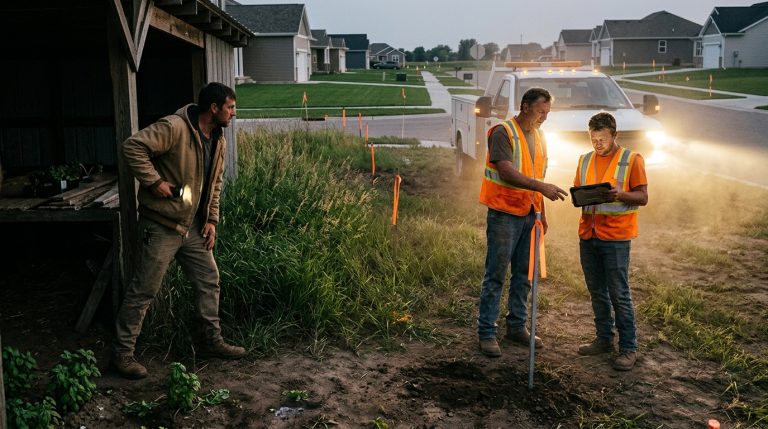
Karen Thompson was putting her entire weight into a post-puller clamped around the base of my cedar fence. Her husband Gary hovered nearby, his flashlight beam trembling like a dying candle against the damp Carolina air.
With a sickening crunch of tearing wood and sucking mud, the first post gave way. She stumbled back, breathing hard, her face contorted into a malicious grin of absolute triumph.
She thought she was destroying an unauthorized structure under the cover of darkness. She had no idea my seismic sensors had logged her entry down to the millisecond.
I tapped the screen, saving the high-definition footage straight to the cloud before she could even catch her breath. Karen wanted a war over a fence, but she had just handed me the match.
CHAPTER 2: THE MORNING AFTER AND THE FIRST OFFICIAL MOVE
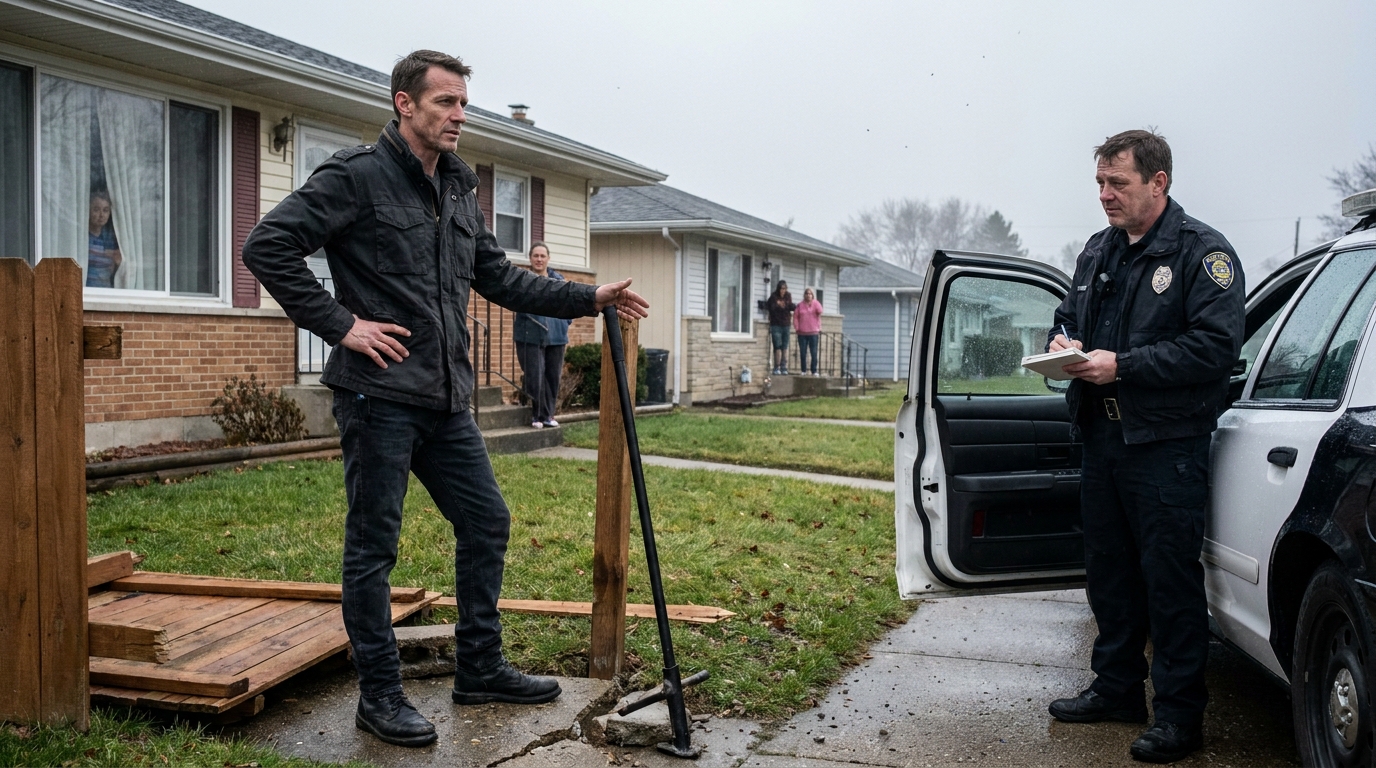
Officer Miller stood by the driver-side door of his patrol cruiser, his boots crunching lightly over the scattered wood splinters and hardened chunks of gray concrete littering my lawn. He surveyed the four jagged holes left in the Carolina clay with a weary, practiced tilt of his head.
“You’ve got a mess here, Mr. Roads,” Miller said, pulling a standard black pen from his front pocket and flipping open his notepad to a crisp, blank page.
I didn’t offer up the video footage right away. A tactical mind doesn’t expose its entire arsenal on the first engagement, and dealing with institutional bureaucracy required an airtight chain of custody.
“Over a thousand dollars in materials and labor vanished overnight,” I replied, keeping my voice entirely even as I gestured toward the ruined boundary line. “Someone came onto private property with heavy equipment and tore down what your own town’s permit office authorized.”
Miller’s pencil paused against the paper. A flicker of genuine interest cut through the bored expression of a cop counting down the months to his pension.
“Any suspects in mind for a nighttime operation like this?” he asked, looking up directly.
“I have a very strong idea,” I said, sliding the small business card back across the wooden porch railing. “Let me confer with my legal counsel to ensure the digital evidence package is formatted correctly, and I will hand over the full high-definition recording directly to your precinct.”
The officer gave a slow, respectful nod, tucking his pen away. “Call me when you’re ready, Mr. Roads. We’ll take a look at what you’ve got.”
With a low rumble of the cruiser’s engine, Miller backed out of the driveway, leaving me alone with the morning air and a growing paper trail.
I walked straight back inside to the dining room table, picking up my phone to dial a man who knew how to turn bureaucratic arrogance into a fatal liability.
Ben Carter answered on the second ring, his voice carrying the sharp, crisp energy of a former military lawyer who had spent decades tearing bad orders to pieces.
“Roads,” Ben barked through the speaker. “Tell me you didn’t go down the street and punch an HOA president.”
“Worse,” I said, leaning my hip against the edge of the table next to the expanding black binder. “I let her commit a felony on a 4K wide-angle sensor, and now I want to know how hard we drop the hammer.”
CHAPTER 3: MAPPING THE PATTERN OF PETTY TYRANNY
With Ben locked onto the legal flank, my next logical step required moving beyond my own property line.
A single vandalism complaint could easily be dismissed by local authorities as an isolated neighborhood squabble, but a clear, documented pattern of abuse was an entirely different animal.
I clipped a fresh notepad into my grip and started walking the neighborhood during morning patrol with General, keeping my eyes fixed on front lawns and architectural violations.
Mrs. Gable was out weeding her petunias two doors down, her frail hands moving slowly over the damp dirt where her beloved collection of garden gnomes used to stand.
“Morning, Mrs. Gable,” I said, stopping by her low brick border. “I haven’t seen your little ceramic crew out lately.”
The elderly woman dropped her garden trowel against a flat stone, her face clouding over with a bitter mix of shame and frustration.
“President Thompson forced me to pack them away,” she whispered, her voice trembling slightly as she looked around to make sure no one else was listening. “She sent fines starting at twenty-five dollars and doubled them every week until I couldn’t afford my groceries.”
I jotted the details down without missing a beat, noting the exact section of the bylaws Karen had weaponized against a pensioner on a fixed income.
The pattern was unmistakable: rules weren’t meant to preserve community value; they were instruments of psychological extortion designed to keep residents too broke and broken down to fight back.
Across the street, the young couple with the newborn were busy scraping paint off their front door for the third time because the forest-green shade clashed with an arbitrary radius rule.
When I asked about Karen’s own yard, I walked past the oversized, gaudy lighthouse mailbox glowing with a blinking solar light—a blatant violation of standard black post-mounted box requirements.
Every single rule she enforced on others was casually ignored on her own turf, creating a mountain of hypocrisy ready to collapse under its own weight.
CHAPTER 4: THE ILLEGITIMATE WORK ORDER AND THE DIRECT WARNING
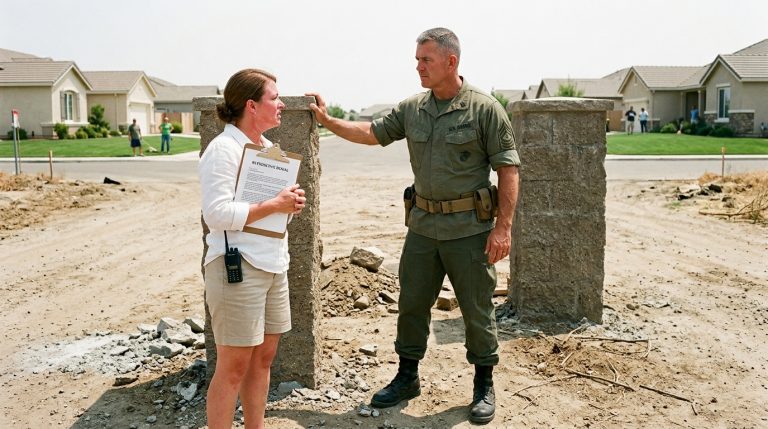
The heavy diesel idle of a commercial flatbed rattled the glass panes of the front door.
I stepped out onto the porch just as a young crew foreman in a high-visibility vest jumped out of the cab, clipboard in hand, looking around at my property line with evident confusion.
“Mr. Roads?” the young man asked, wiping sweat from his forehead with the back of a dirty work glove. “We’ve got a work order from the Oakmont Estates Board to pull up and haul away four non-compliant timber posts along this perimeter.”
He held out the sheet of paper.
I took the clip, my thumb running over the crisp paper where Karen Thompson’s signature sat looped at the bottom, authorizing three hundred dollars of HOA funds for immediate demolition.
“Son,” I said, keeping my posture relaxed but my eyes locked straight onto his. “This is private property. That piece of paper is an internal document, not a court-issued writ or a legal permit.”
The foreman blinked, taking a step back toward his truck as he caught the tone in my voice.
“If you or your crew cross that sidewalk boundary with tools,” I continued smoothly, “I will have local law enforcement arrest every single man here for criminal trespass. And I will personally sue your employer into receivership before the sun sets.”
The kid didn’t argue. He took the clipboard back with a slight tremble in his fingers, hopped back into the cab, and cranked the wheel hard toward the main road.
He left the official work order behind in my hand—a signed, physical paper trail proving Karen was using community funds to attempt illegal destruction of private property.
I tapped the paper against my leg, watching the truck disappear around the corner, before slipping the document into my black binder right behind the police card.
Karen had stopped hiding behind petty letters; she was now actively spending other people’s money to wage her personal campaign.
CHAPTER 5: THE NEIGHBORHOOD ALLIANCE TAKES SHAPE
Mrs. Gable sat upright on the aluminum chair, her fingers nervously pleating the fabric of her floral dress as she looked at the growing black binder between us.
“She has taken hundreds of dollars from me in arbitrary fines over garden decorations,” Mrs. Gable said, her voice dropping to an angry whisper. “And she acts like she owns the very air we breathe.”
Mr. Cheng bounced his infant daughter gently on his knee across the table, shaking his head with a grimace.
“We had to repaint our front door three different times just because the shade matched someone else’s radius,” he added, his jaw tightening. “It was never about community standards; it was about control.”
I opened the front cover of the binder, sliding the signed work order and the police report copy across the table for them to see.
“Karen relies on keeping everyone isolated and exhausted so nobody dares look too closely at how things are run,” I said, leaning forward. “That stops tonight.”
David, a retired forensic accountant who lived on the next block, adjusted his reading glasses and picked up the documents with a sharp, calculating gleam in his eye.
“If she’s issuing work orders using association funds for personal vendettas, her bookkeeping will be a complete mess,” David muttered, a slow grin spreading across his face. “Let me look at the financial records. I’ll find where the numbers don’t add up.”
Maria, the parallegal sitting beside him, nodded in agreement, pulling out a legal pad to map out a formal recall petition.
“We need twenty-five percent of the neighborhood signatures to force a special meeting,” Maria said, her tone absolute. “We have the grievances, we have the witnesses, and we have the momentum.”
I placed my hand flat on the table, feeling the solid wood anchor the room as the scattered pockets of neighborhood resistance finally fused into a single, organized force.
Karen thought she was running an empire with her petty rules, but she had just handed us every tool we needed to tear it down from the foundation.
CHAPTER 6: THE BAITED HOOK AND THE WRITTEN CONFESSION
The thick envelope arrived by certified mail early Tuesday morning, bearing the official letterhead of the Oakmont Estates legal counsel.
I sat at the dining room table, unfolding the stiff pages while Ben’s earlier warning echoed clearly in my mind: let them make the next move.
Karen had clearly dictated every single sentence of the response, her signature arrogance bleeding through the formal legal jargon as she attempted to turn my legitimate property damage claim into an extortion attempt.
Then my eyes hit paragraph three.
“Furthermore, the structures in question were not vandalized,” the text read in bold, unyielding print. “They were removed by the association in accordance with the bylaws as they constituted an unauthorized and non-compliant installation.”
I stopped breathing for a fraction of a second, staring down at the paper as the full weight of her mistake registered.
She had just confessed.
In a formal legal document signed by her own counsel, she had officially admitted that the HOA was behind the midnight destruction of my fence posts.
She thought she was being clever by reframing her criminal trespass as an administrative remedy, completely blind to the fact that she had just handed us a written confession on a silver platter.
To top it all off, the letter included an itemized bill demanding five hundred dollars from me to cover the “removal service” for my own property.
I grabbed my phone, scanned the document into a high-resolution PDF, and attached it directly to an email addressed to Ben.
The reply came back in less than three minutes, containing a single, lethal sentence that confirmed our victory was absolute.
Checkmate in three moves.
CHAPTER 7: THE COMMUNITY CENTER CONFRONTATION AND THE SCREEN
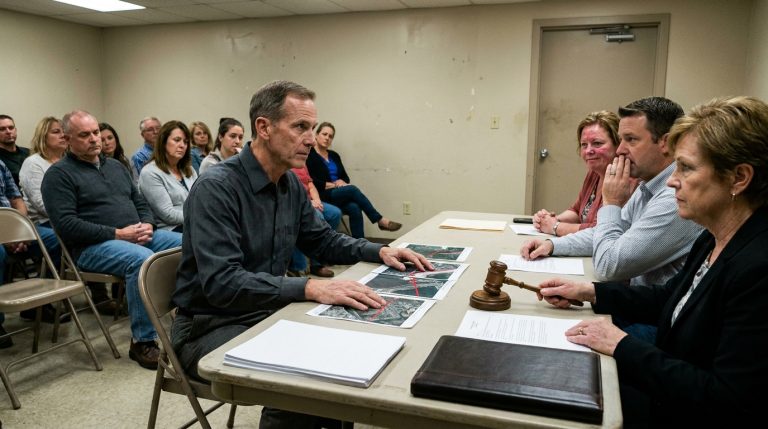
Karen sat at the head of the folding table in her royal blue pantsuit, presiding over the packed room with her customary practiced smile before the agenda even began.
“The board has voted to file a lawsuit against Mr. Mark Roads for his continued defiance of community standards,” Karen announced, her voice booming proudly through the microphone as she brandished a stack of legal papers.
A heavy murmur rippled through the hundreds of packed seats, but I didn’t flinch or raise my voice in a shouting match.
I stood up slowly from my seat near the middle aisle, holding my heavy black binder in one hand while giving a sharp, subtle nod toward the back of the room.
“You want evidence of fraud and vandalism, Karen?” I asked, my voice cutting cleanly across the sudden silence of the hall. “Let’s look at what happened at twenty-one hundred hours on your little midnight excursion.”
The projector hummed to life, and the glowing green-and-black infrared footage of the front yard flooded the giant screen.
The entire community center watched in absolute shock as their self-righteous HOA president appeared on screen, wrestling with a post-puller alongside her panicked husband Gary.
The room erupted into total chaos as the audio played out every whispered curse and the sickening crack of my cedar posts being ripped from the ground.
Karen went completely pale, her mouth dropping open in sheer horror as she tried to shriek that the video was a deep-fake created by a computer expert.
Officer Miller stepped forward from the doorway in full uniform, his arms crossed over his chest in silent, undeniable confirmation of the police report’s legitimacy.
Before Karen could recover from the blow, David stood up at the side table and opened his audit folder.
“And while we are addressing leadership integrity,” David announced, his voice ringing out across the roaring room, “let’s look at thirty thousand dollars in association funds spent on family vacations and landscaping for your personal property.”
CHAPTER 8: THE NEW NORMAL AND THE CAPTAIN OF THE GUARD
The cedar posts stood straight and true along the property line, anchored deep in fresh concrete that had cured under a peaceful Carolina sun.
Down the street, the for-sale sign planted firmly in Karen’s front yard served as a quiet reminder of what happened when unearned entitlement collided with an immovable boundary.
Mrs. Gable walked past the fence line on her morning stroll, pausing to adjust the small ceramic captain of the guard perched atop the end post.
“He’s keeping watch over your perimeter, Mark,” she said with a bright, genuine smile that carried none of the old neighborhood’s heavy tension.
“He’s doing a fine job, Mrs. Gable,” I replied, leaning my weight against the solid wood rail.
Inside the backyard, General didn’t trot or hesitate; he bolted full tilt across the open grass, a blur of black and tan fur kicking up bits of clover as he chased a red rubber ball.
His three-legged stride carried him forward with effortless agility, free from leash restrictions, arbitrary fines, or the oppressive shadow of a petty tyrant.
Sarah stepped out onto the back porch, her hand sliding naturally into mine as we watched the dog run without a care in the world.
The legal battles were over, the embezzled funds were locked in recovery, and the neighborhood had finally taken its common sense back.
We had our sanctuary, and the quiet rhythm of the morning was no longer broken by manufactured outrage.