The Weight of Roots: A Cold Reckoning Beneath the Suburb’s Sterile Sky
CHAPTER 1: THE FIRST CUT
The air above the lawn tasted of oil and torn cambium.
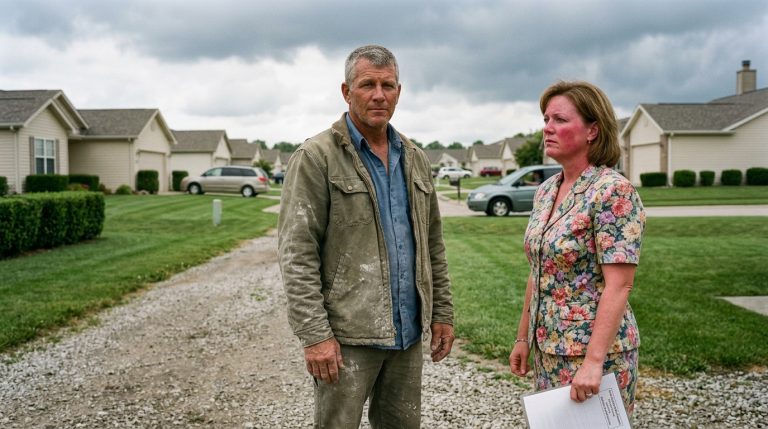
Marcus stood with his boots planted on the perimeter of his own property, the crushed turf beneath his heels damp with morning dew. Twenty paces away, the three ancient oaks that had anchored his family’s history for a century were no longer trees. They were blunt, jagged pillars of raw white wood, their crowns sheared off flat against the second-story eaves of the house as if decapitated by a giant’s scythe.
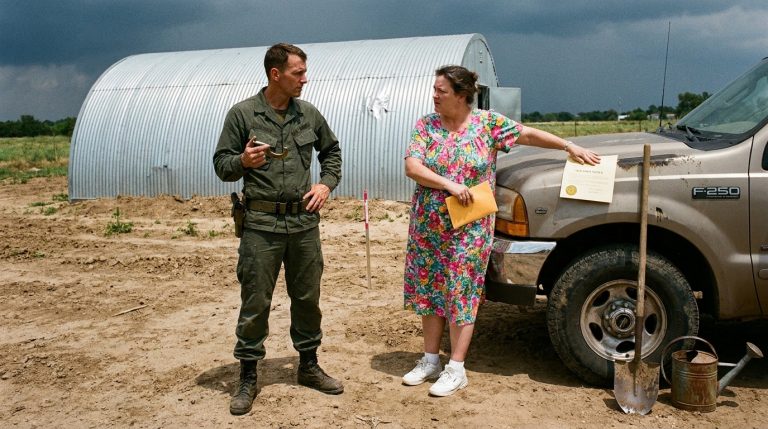
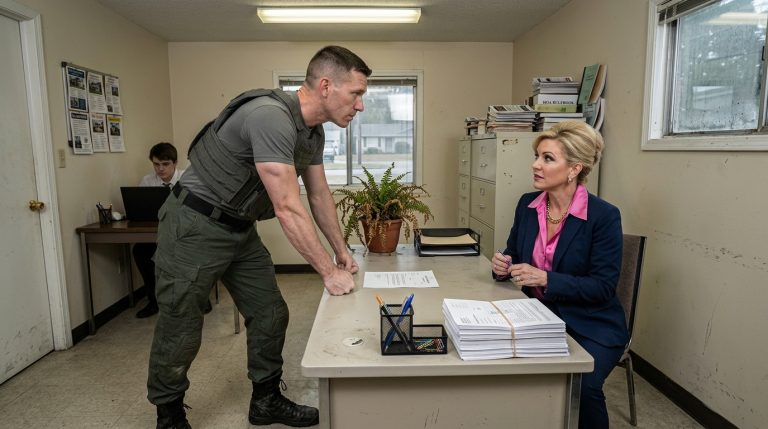
Karen did not look back immediately. She stood near the curb, her polyester blazer immaculate, clutching a laminated clipboard to her chest like a breastplate. Behind her, men in high-visibility orange vests were shoving thick, living limbs into the iron maw of a wood chipper. The machine roared, a violent, rhythmic grinding that shook the loose gravel of the cul-de-sac.
“Your trees were a violation of section 14, subsection C, paragraph 2, Mr. Thorne,” Karen said, her voice cutting cleanly through the mechanical din without a waver of doubt. “I had them brought into compliance.”
Marcus didn’t blink. His pulse didn’t spike; it locked into the slow, rhythmic cadence he had learned in the dust of long deployments twenty years ago. The world narrowed to sharp edges—the glint of the clipboard’s metal clip, the precise distance between his boots and her posture, the sickening green mulch spraying from the chipper’s chute. A lesser man would have shouted, thrown a punch, or demanded answers. Marcus knew better. You never scream at a sentinel when you are calculating the blind spots in their perimeter.
“Compliance,” Marcus murmured, testing the word on his tongue. It tasted like ash.
He didn’t look at the mutilated canopy. He looked at Karen’s left hand. Her fingers were curled tightly around the edge of the clipboard, the knuckles faintly pale beneath an immaculate French manicure. A microscopic tremor—pure, unadmitted adrenaline—flickered in the tendon of her thumb. She was braced for an explosion. She wanted him to roar. She needed him to play the out-of-control veteran so her binder of rules could validate her authority.
Marcus took one slow step forward, his boot grinding into a scatter of fresh sawdust.
“You didn’t trim anything, Karen,” he said softly, keeping his tone level, devoid of heat, stripped of all human warmth. “You left an open vector for fungal rot right before the autumn rains. You didn’t protect the neighborhood line-of-sight. You committed a structural amputation.”
She stiffened, turning to face him fully now, her chin rising as she searched his eyes for the fury she expected to find. Instead, she found only a flat, grey calculation that made her breath hitch for a fraction of a second before her administrative armor slammed back into place.
“The board approved the remediation,” she snapped, tapping the clipboard with a manicured nail. “You were properly notified via the portal. If you choose to ignore your responsibilities as a homeowner, the association will act. And you will be billed for the privilege.”
She turned on her heel, signaling the crew to pack their gear, fully confident that she had successfully re-established the boundary line of her small, fragile kingdom.
Marcus watched her walk toward her sedan. The silence she left behind wasn’t peace; it was the heavy, pressurized quiet before a pressure vessel blows its seams. As he turned back toward the house, his gaze caught the raw, weeping center of the nearest oak stump—and right beside it, half-buried in the woodchips, a small, crushed plastic nesting box belonging to a family of chickadees that had lived in the upper boughs since spring.
CHAPTER 2: THE MASTER APPRAISER
The screen door clicked shut with a muffled, aluminum rattle.
Marcus stepped into the kitchen, the scent of crushed green cambium and two-stroke exhaust clinging stubbornly to the fabric of his jacket. The house was cool, dim, and mercifully insulated from the sterile suburban glare outside. Sarah was standing by the counter, her hands wrapped around a ceramic mug of coffee that she wasn’t drinking. Her eyes were red-rimmed, fixed on the patch of lawn visible through the double-paned window where the hundred-year-old canopy used to diffuse the harsh midday sun. Now, the room was exposed, naked under a harsh, unfiltered light.
“She’s going to fine us again, isn’t she?” Sarah’s voice was quiet, stripped of surprise, carrying only the flat exhaustion of someone who knew the rules of a game she never agreed to play.
“She thinks she’s closed the perimeter,” Marcus said. He pulled out a wooden chair, the legs scraping against the tile with a dry, sharp protest. He didn’t sit down immediately; instead, he rested his palms flat on the surface of the maple table, feeling its solid, unyielding grain. “She dropped the clipboard, tapped her badge, and walked away because she expects a tantrum. A shouting match justifies her paperwork. It validates her binder.”
“And you’re not going to give it to her?”
“A soldier doesn’t fire blind into a woodline when he doesn’t know where the command post is,” Marcus said, his voice dropping an octave, steady and rhythmic. “We map the grid first. Then we find out who authorized the logistics.”
He pulled his phone from his pocket, his thumb swiping past a stack of unopened mail—utility bills, circulars, automated neighborhood notices—and tapped a contact saved under a secure initials code. BC.
Ben Carter picked up on the second ring. There was no casual greeting, only the faint, background hiss of wind through pine and the clatter of a heavy metal wrench hitting a concrete floor.
“Thorne,” Ben’s voice came through the speaker, gruff and weathered. “You sound like a man who just lost a flank. Let me guess—remediation squad?”
“They didn’t trim, Ben. They topped them. Flat cut at the second-story line. Open cambium, shredded bark, zero structural consideration.”
A sharp intake of breath hissed through the phone’s receiver, followed by a low, profanity-laced growl that vibrated with professional insult. “Topping? On century-old hardwoods? What kind of back-alley landscaping outfit uses a butcher’s saw on a living historical asset? That’s not maintenance, Marcus. That’s a slow execution.”
“I need a full technical assessment,” Marcus said, his eyes locking onto a speck of dried mud on his boot. “The kind that holds up under cross-examination. I need appraisal, structural risk analysis, and a forensic breakdown of the cuts. Can you be at my gate at 0800 tomorrow?”
“I’ll bring the trunk formula tables, the digital scope, and the historical county overlay maps,” Ben replied without a moment’s hesitation. “Keep everyone off the lawn. Don’t let them sweep up the debris. I want to inspect every single wood chip they left behind.”
“Understood. See you at dawn.”
Marcus cut the connection and tossed the phone onto the table. As he looked back up, a sudden, intrusive memory seized him—not of the trees, but of a dusty outpost three provinces away from home, where an insurgent commander had tried to mask a supply depot behind an innocuous civilian facade. The patterns were always identical. Small people given small authorities inevitably built paper kingdoms, and paper kingdoms always burned the moment someone checked the ledgers.
Sarah walked over, her fingers brushing his sleeve. The warmth of her touch broke the tactical trance, pulling him back to the kitchen, to the blinding sunlight reflecting off the neighbor’s roof, and to the bitter reality of what had been stolen from their yard.
“A million views on anger won’t bring them back, Marcus,” she whispered, her gaze searching his face for any sign of reckless heat.
“I’m not angry, Sarah,” Marcus said, his mouth curving into a thin, unyielding line that lacked any trace of humor. “Anger makes mistakes. This is geometry. And right now, Karen just handed us the first coordinate.”
CHAPTER 3: UNEARTHING THE ENEMY
The coordinate was logged, but coordinates were useless without a map.
Marcus remained at the kitchen table long after the coffee in Sarah’s abandoned mug had gone cold. He moved with a slow, deliberate precision, clearing away the morning’s detritus—the mug, the salt shaker, a stray napkin—until the scarred maple surface was completely bare. It was a physical reset, a clearing of the deck.
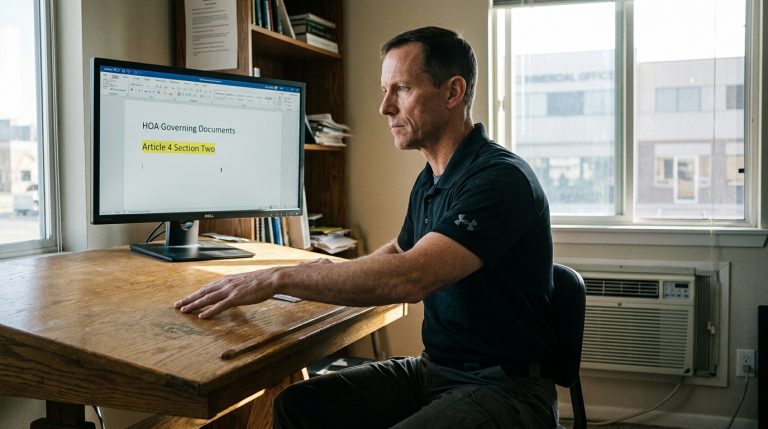
He walked into the small home office off the hallway, the air in the narrow room still holding the faint, dry scent of printer toner and old paper. From the bottom drawer of his filing cabinet, he pulled a thick, three-ring binder. The plastic cover was a dull, institutional blue, embossed with the gold-leaf seal of the Oak Haven Estates Homeowners Association. It was heavy, dense with a decade of accumulated addendums, restrictions, and neighborhood covenants.
He carried it back to the kitchen like a piece of unexploded ordnance and dropped it onto the center of the table. The heavy thud seemed to vibrate up through his forearms.
“The CC&Rs,” Marcus muttered to the empty room. Covenants, Conditions, and Restrictions. The rules of engagement.
He didn’t open it immediately. He went to the drawer near the sink and pulled out three highlighters—yellow, pink, and green—and a black fine-point pen. He arranged them parallel to the spine of the binder, meticulously aligning the caps. It was an old habit, a ritual of organization that preceded the chaos of analysis. You don’t read a manual like this to understand it; you read it to dismantle it. You look for the weak joints, the contradictory clauses, the subjective phrasing that a desperate commander leaves behind when they try to over-fortify their position.
He flipped the heavy plastic cover open. The first page was a master index, dense blocks of eight-point font detailing everything from permissible paint colors to the exact angle a satellite dish could protrude from a roofline.
Yellow for procedure. Pink for penalties. Green for subjective definitions.
He began to read. He didn’t skim. He tracked every line with the tip of his pen, feeling the slight drag of the ballpoint against the cheap paper. Section 1, Article II. Article IV, Section 3. He pushed through the dense legalese, ignoring the sections on fence height and driveway paving, hunting for the specific caliber of weapon Karen had used that morning.
It took him forty-five minutes to find the exact wording she had parroted on the lawn.
Section 14, Subsection C, Paragraph 2.
Marcus uncapped the green highlighter. He drew a slow, deliberate line over the text. “…no tree, shrub, or planting may unreasonably obstruct engineered sightlines for telecommunications reception or cast excessive shade upon a neighboring property to the detriment of general aesthetic uniformity.”
He stared at the highlighted text, the neon green ink bleeding slightly through the page. Unreasonably. Excessive. General aesthetic uniformity.
He tapped the pen against his teeth. The words were a fortress built on sand. They were entirely subjective, devoid of objective metrics. There was no height limit specified in inches. There was no defined angle of obstruction. It was a catch-all clause, designed to be weaponized at the discretion of the enforcer. It was exactly the kind of sloppy, arrogant drafting he expected from a board that assumed its authority would never be stress-tested.
But subjective clauses were a double-edged sword. They gave the enforcer power, but they also created a massive vulnerability in court. A judge requires definitions, not opinions.
He flipped the page, cross-referencing the enforcement mechanism. If Section 14 was the weapon, he needed to find the safety catch. How was the board authorized to pull the trigger?
He found it twenty pages later, buried deep in Article VIII: Architectural Control and Property Alterations.
He switched to the yellow highlighter, tracking a block of text near the bottom margin. “Any alteration to the exterior appearance of a privately deeded property, including significant landscaping modifications, requires a formal architectural review application, submitted and signed by the deed-holding homeowner.”
Marcus stopped. He read the sentence again, his pulse finally beginning to quicken, a low, steady thrum against his collarbone.
He hadn’t signed an application. He hadn’t even been presented with one. Karen had bypassed the required procedure entirely, relying on the vague authority of the “nuisance” clause in Section 14 to authorize the destruction.
He dug deeper, his eyes scanning the fine print of an amendment dated three years prior. Article XII, Section 4: Emergency Remediation.
He highlighted it in pink. “In the event a property condition poses an immediate threat to life, safety, or common infrastructure, the Association may execute emergency remediation without prior homeowner consent. In all other non-emergency remediations executed on deeded private property, the Association must secure a signed Hold Harmless agreement indemnifying the Association from damages prior to the commencement of work.”
Marcus sat back, the plastic chair creaking under his weight. He looked at the brightly colored page, the rigid legal structure suddenly looking frail and porous.
She had no architectural review form. She had no signed hold-harmless agreement. She had authorized the amputation of a century-old asset based on a subjective complaint about satellite reception, framing it as a routine compliance issue to bypass the emergency protocols she clearly couldn’t meet.
She hadn’t just overstepped her authority; she had breached her own fiduciary duty to the association. She had broken the very rules she wore like armor.
He closed the binder, the snap of the rings echoing sharply in the quiet kitchen. He had the coordinate. He had the structural weakness in her perimeter.
Now, he needed artillery heavy enough to exploit it. He needed a lawyer who specialized in dismantling paper kingdoms.
CHAPTER 4: THE SHARKS DESK
The air in the downtown office smelled of old paper, leather polish, and filtered municipal air.
Marcus sat in a high-backed chair upholstered in charcoal-colored leather that seemed to swallow his weight. Across the polished mahogany desk sat David Miller. Miller was a litigator who looked like he spent his weekends dissecting corporations and his evenings sleeping very soundly. He didn’t wear a flashy tie, and his sleeves were rolled up just enough to reveal forearms corded with tension. He wasn’t reading the pages in front of him; he was absorbing them, his eyes tracking lines of text with predatory familiarity.
Between them lay Ben Carter’s formal appraisal report—a bound document thick as a city phone book, its spine crisp and unbroken.
“One million, two hundred and forty-seven thousand, five hundred and fifty dollars,” Miller said, his voice smooth and measured, like water running over river stones. He didn’t look up from the open page. “For five trees. In a suburban tract where most people think a potted geranium constitutes a landscaping budget.”
“They aren’t just trees,” Marcus said, keeping his hands flat and still on the edge of the mahogany. “They were planted by a veteran of the First World War. They served as structural landmarks for a century.”
“A sentimental argument, Mr. Thorne. A jury will love it, but judges require math.” Miller finally lifted his head, a thin, sharp smile touching the corners of his mouth. He tapped a finger against a dense table of figures compiled by the arborist. “And Carter gave us the math. Trunk formula method, cross-referenced with the Council of Tree and Landscape Appraisers. He didn’t just guess; he proved structural loss of amenity, environmental impact, and historical provenance.”
Miller leaned back, the leather creaking under his shift in weight. He steepled his fingers, resting his chin against his thumbs as he studied Marcus with calculating interest.
“Let’s talk about the mechanics,” Miller continued, his tone shifting from professional appraisal to tactical deployment. “Under state law, we have a clear path. This isn’t just a simple property damage claim. We’re looking at a textbook case of trespass, intentional destruction of private property, and a severe breach of fiduciary duty by an HOA board operating outside its authorized bylaws.”
Marcus didn’t blink. “She bypassed the architectural review process. She didn’t secure a signed hold-harmless agreement as mandated by Article Twelve. She used a vague subjective clause about satellite sightlines to execute a personal vendetta.”
Miller’s eyebrows rose slightly, a flicker of genuine appreciation crossing his features. “You read the CC&Rs.”
“Cover to cover.”
“Good. Because Karen is going to assume you’re just another frustrated homeowner who will eventually run out of stamina or money.” Miller reached across the desk and tapped a blank legal pad. “She’s a classic micro-tyrant. She thinks a laminated clipboard and a binder full of arbitrary rules make her a sovereign. When people push back, she doubles down on the fines because it’s worked every single time before.”
“She already issued a secondary fine for our failure to clear the remaining stumps,” Marcus noted quietly.
“Of course she did. She’s predictable.” Miller pulled a silver fountain pen from his pocket, clicking the cap off with a crisp, metallic snap. “Which is why we aren’t going to storm into the next open meeting with a bullhorn. Amateurs fight battles on the enemy’s chosen ground. Professionals rewrite the logistics.”
He began to write on the pad, his hand moving with swift, authoritative strokes.
“Here is our operational plan,” Miller said, looking up. “We don’t file suit immediately. We serve a formal demand letter. We attach Ben’s complete appraisal. We quote her own bylaws back to her—highlighting every single procedural violation, right down to the missing architectural review forms and the lack of a hold-harmless agreement.”
He slid a preliminary draft across the polished wood toward Marcus.
“We offer her a clean, mathematically sound out,” Miller continued. “We demand the full appraised value of one million, two hundred and fifty thousand dollars, payable directly to you, coupled with the immediate, unconditional resignation of the entire board. It’s generous. It’s legally grounded. And she will reject it.”
Marcus looked down at the paper. The figures were stark, black ink against white legal bond. “She won’t negotiate.”
“Exactly,” Miller purred, his grin widening just enough to show teeth. “Karen’s ego won’t allow her to look weak in front of a neighborhood she’s terrorized for years. She’ll see a settlement offer as a sign of fear. She’ll take that letter, wave it around like a banner, rally her board, and walk straight into the perimeter wire we’re laying out.”
Marcus traced the edge of the paper with his thumb. He thought of the raw, bleeding stumps on his lawn, of the crushed chickadee nest, and of the rigid, untouchable posture Karen had held while the wood chipper roared behind her. She thought she was running an empire. She had no idea she had just signed her own deployment orders into a minefield.
“Send the demand,” Marcus said.
Miller clicked his pen shut, the sound sharp and final in the quiet office. “It goes out via certified mail tomorrow morning. Let’s see how much she likes the smell of her own paperwork.”
CHAPTER 5: THE CLUBHOUSE AMBUSH
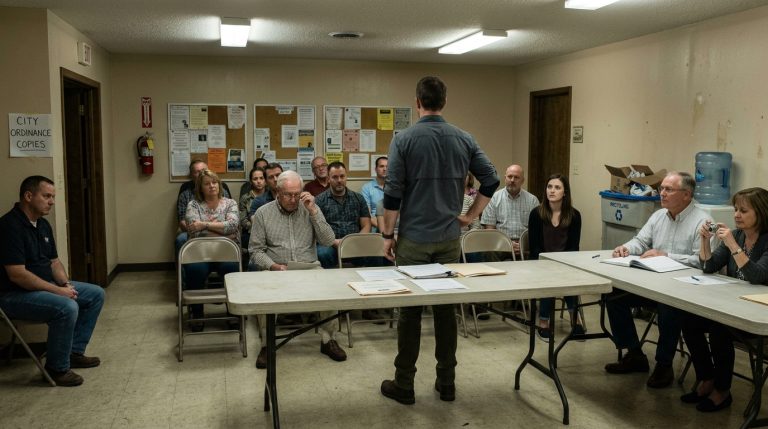
The air in the Oak Haven community room smelled of stale coffee, industrial floor wax, and the quiet, collective anxiety of forty people conditioned to tread lightly.
Marcus stepped through the double doors with Sarah half a step behind him, her presence solid and unyielding. They didn’t take seats in the back rows where the late arrivals lingered. Marcus walked straight down the center aisle, his boots clicking rhythmically against the low-pile commercial carpet, and took two seats in the front row directly facing the head table.
At the center of that table sat Karen.
She wore a tailored navy jacket over a cream blouse, her posture stiff and immaculate. A small, laminated nameplate bearing her title sat to the right of her water glass. To her left sat Glenn, the retired insurance salesman who acted as her enforcer, his thick arms crossed over his chest like defensive bulkheads. Next to him was Martha, the secretary, whose fingers hovered nervously over the keys of an open laptop, her eyes darting constantly around the room.
The monthly meeting was already dragging through its standard ritual of minor grievances. A woman three rows back was complaining about unauthorized mulch colors, her voice thin and defensive. Karen listened with the practiced, bored indulgence of a monarch swatting at flies, her pen poised over a yellow legal pad.
She hadn’t received the demand letter yet—it was currently processing through certified mail sorting facilities—but the rigid tilt of her chin suggested she could smell dissent in the air.
Marcus kept his hands resting quietly on his knees. He didn’t look at Karen. Instead, he scanned the perimeter of the room, cataloging exits, sightlines, and the precise expressions of the neighbors sitting around him. He felt the phantom pressure of an old tactical briefing room, the kind where everyone nods, everyone complies, and everyone waits for someone else to ask the dangerous question.
“Moving on to new business,” Karen announced, her voice cutting through the room with the dry rattle of a dry-erase marker. She didn’t look up from her notes. “We have the ongoing compliance status regarding twelve Patriot Way.”
The air in the room instantly thinned. Several people in the middle rows shifted uncomfortably, avoiding eye contact.
Karen finally raised her eyes, fixing them dead on Marcus with a thin, triumphant smile that didn’t reach her eyes.
“As the board has previously communicated to Mr. Thorne,” Karen continued, projecting her voice to fill every corner of the beige hall, “the unauthorized and hazardous state of his property remains a liability to the community. Consequently, the board has formally voted to impose a daily fifty-dollar non-compliance fine until the remaining stumps are completely excavated and removed at the homeowner’s expense.”
She paused, letting the penalty hang in the stagnant air like a dropped gauntlet. She was waiting for him to snap. She expected him to stand up, raise his voice, and demand justice, giving her the public spectacle she needed to brand him as volatile and unmanageable.
Marcus didn’t move a muscle. His pulse remained slow, steady, locked in the rhythm of a deliberate counter-attack.
“Are there any comments from the floor regarding this enforcement action?” Karen asked, scanning the room with calculated innocence. “Or does Mr. Thorne wish to make a formal statement before the board records the assessment?”
Silence blanketed the room. Even the woman who had complained about the mulch earlier shrank back into her seat.
Marcus slowly rose to his feet. He didn’t rush. He stood to his full height, smoothing the front of his jacket with deliberate care.
“Madame President,” Marcus said, his voice carrying an even, conversational weight that easily filled the small room without a hint of heat.
Karen’s eyes narrowed slightly, a microscopic flicker of disappointment crossing her features when she heard the absence of rage in his tone. “You have sixty seconds, Mr. Thorne. Keep it brief.”
“Thank you,” Marcus replied, ignoring the arbitrary time limit entirely. “Before the board issued its recent orders regarding my property, a landscaping crew was dispatched under your direct authorization to modify my land. I have a very simple procedural question for the record.”
Glenn shifted in his seat, his face flushing a dull red. “That’s internal board business, Thorne. You don’t have the right to—”
“Quiet, Glenn,” Karen cut him off with a sharp, dismissive wave of her hand, her confidence surging back as she assumed control of the narrative. She looked down at Marcus with undisguised contempt. “The decision to execute remediation was unanimous among the board members present. It was a proper, necessary action to maintain community standards. The matter is closed.”
“Unanimous,” Marcus repeated, tasting the word. He let the silence stretch for three deliberate seconds, long enough for the tension in the room to tighten like a wire under load. “So, for the official record, Karen Peters, Glenn Albright, and Martha Finch all formally voted in favor of deploying a work crew onto private property without the homeowner’s consent.”
Martha’s head snapped up from her laptop, her fingers freezing over the keyboard. Her eyes widened with sudden, unadulterated panic as she stared at Marcus.
Across the table, Karen’s face stiffened, the thin smile evaporating entirely. “Sit down, Mr. Thorne. The meeting is—”
“I just wanted to make sure the names matched the logistics,” Marcus said softly, cutting her off before she could gavel him down. He gave her a slow, deliberate nod, then sat back down in his chair, leaving a heavy, suffocating silence in his wake.
Karen stared at him across the rows of folding chairs, her fingers tightening around her pen until her knuckles turned white. She had won the procedural exchange, but beneath the surface of her polished exterior, the first hairline fracture had just appeared in her wall.
CHAPTER 6: THE WAR ROOM CONVERGENCE
The dining room table had shed its legal binders and highlighters, replaced instead by a steaming ceramic pot of coffee, a porcelain plate piled high with Sarah’s cinnamon cookies, and an assembly of faces that carried the identical, worn look of people who had spent too many nights staring at ceiling fans.
Marcus stood by the sideboard, his hands wrapped around a heavy ceramic mug. He didn’t sit. In a briefing, the one who stands retains the operational view of the room.
Around the table sat seven families. Mrs. Diaz was there, her thin hands cradling her cup as if it were fragile glass. Further down sat Tom Miller, his broad shoulders tense beneath a plaid work shirt, his gaze fixed on a scratch in the polished wood. Next to him was Chloe, a young paralegal whose apartment window boxes had become the subject of three separate certified warning notices in as many months.
“She doubled down at the podium tonight,” Marcus said, his voice cutting cleanly through the low murmur of the room. He set his mug down, the ceramic clicking softly against the wood. “She thinks naming the board on the official record was just a procedural nuisance. She still believes her binder is bulletproof.”
“Because it’s always worked,” Tom Miller said, his jaw tightening as he stared into his coffee. “She isolates you. You get a fine for an unapproved color or a cedar swing set, and you feel like you’re the only lunatic on the street fighting a ghost. She makes you feel small so you just pay the extortion to make her go away.”
“Isolation is a tactical deployment,” Marcus said. “A perimeter only holds if the targets remain separated. She keeps everyone in individual sectors so she can manage the pressure gradient.”
Chloe leaned forward, pushing her glasses up the bridge of her nose. Her eyes flashed with sharp, professional clarity. “Which means our counter-offensive has to do the exact opposite. We don’t fight her individually. We establish a unified front. Legally and logistically.”
She reached into a canvas tote bag resting on the floor and pulled out a thick stack of manila folders, sliding them across the table toward Marcus.
“I pulled every public record, previous filing, and minor infraction notice I could legally access over the last seventy-two hours,” Chloe continued, tapping the edge of the folders. “Under state property statutes, association members have an absolute right to inspect financial ledgers, meeting minutes, and third-party vendor contracts. We don’t need her permission. We just need to trigger the administrative mechanism.”
Marcus picked up the top folder, flipping the cover back. Inside were rows of photocopied invoices, checks issued from the HOA operating account, and vendor profiles. He ran his thumb down the line of a recurring corporate name that appeared month after month: Compliance Solutions LLC.
“Her husband’s company,” Marcus noted quietly, his voice dropping an octave as the pieces clicked into alignment.
“Every single time she levies a punitive fine for a non-compliant fence, a missed trash day, or excessive shade,” Chloe said, her voice tight with vindication, “the money flows straight from the association’s general reserve fund into maintenance contracts awarded without open bidding to Frank Peters. She isn’t just enforcing rules, Marcus. She’s running a closed-loop collection agency that funnels neighborhood dues directly into her household bank account.”
A heavy silence dropped over the dining room. Mrs. Diaz set her cup down slowly, her fingers trembling slightly against the ceramic. “She ripped out my husband’s roses,” the elderly woman whispered, her voice cracking with suppressed grief. “She told me they were a hazard. And all the while… she was charging us for the privilege.”
Marcus looked around the table. He saw the shift in their postures—the way Tom Miller’s shoulders squared, the way Chloe’s jaw set into an unyielding line. The fear that Karen had cultivated for years wasn’t gone, but it had transformed. It had crystallized into something far more dangerous: cold, methodical resolve.
“A single demand letter from my lawyer caught her off guard,” Marcus said, looking from face to face. “When the formal records requests hit the management company tomorrow morning, she’s going to realize the perimeter has been breached.”
“She’ll stonewall,” Chloe warned. “Her management company will claim the requests are burdensome. They’ll try to bury us in administrative delays.”
“Let them try,” Marcus said, a faint, humorless smile touching his lips. “An army that tries to hide its supply lines only leaves tracks in the mud. We don’t just ask for the records. We demand them simultaneously across eight distinct households. We don’t give her room to maneuver.”
Sarah walked in from the kitchen carrying a fresh tray of cookies, setting them quietly in the center of the table. She paused beside Marcus, her hand resting briefly against his forearm—a silent anchor of human warmth in a room built for war.
“We’re not just defending our property anymore,” Marcus said, looking down at the stack of financial invoices bearing Frank Peters’ name. “We are opening a multi-front advance. Let’s see how well her binder holds up against an entire street pushing back.”
CHAPTER 7: THE COURTHOUSE WALL
The county courtroom smelled of floor wax, old binding glue, and dry recycled air.
Marcus sat on a hard oak bench in the gallery, his shoulders back and his hands resting flat on his knees. Two rows ahead, Karen sat alone at the petitioner’s table. She hadn’t hired outside counsel to save money—a decision born of both arrogance and parsimony—and she wore her navy blazer like a suit of armor, her spine straight as a ramrod. When she turned her head slightly to scan the gallery, her eyes flicked past Marcus without a flicker of recognition, treating him as a minor administrative obstruction rather than the commander of the perimeter closing in around her.
At the defense table, David Miller’s junior associate adjusted a stack of red-flagged files, his movements calm and practiced.
A sharp rap of a wooden gavel cut through the low murmur of the room.
“Case number twenty-four-CV-eighty-one,” the judge announced, a woman with tired eyes and a no-nonsense mouth who didn’t bother looking up from her docket sheet. “Petition to compel production of association records under state statute. Proceed.”
Miller’s associate stood up smoothly, buttoning his jacket. “Your honor, my clients, eight resident homeowners of Oak Haven Estates, submitted formal, legally compliant requests for financial ledgers, meeting minutes, and third-party vendor contracts over two weeks ago. The management company, acting on behalf of the board led by Ms. Peters, issued a blanket denial, claiming the requests were overly broad and burdensome.”
The judge looked over her reading glasses, fixing her gaze on Karen. “Ma’am? What is the board’s legal exemption for withholding statutory records?”
Karen rose swiftly, smoothing the lapels of her jacket. She projected her voice with the practiced authority she usually reserved for the community clubhouse. “Your honor, we are a small volunteer board. Fulfilling these voluminous, uncoordinated requests from a handful of disgruntled residents would completely paralyze our daily operations. It’s a targeted fishing expedition designed to harass elected officials.”
“It’s not a fishing expedition when you can already smell the rot from the shoreline,” Miller’s associate countered smoothly, stepping forward to place a single document on the partition. “The statute does not recognize ‘inconvenience’ as a legal exemption. Furthermore, the association failed to provide the mandatory statutory justification within the ten-day window.”
The judge scanned the petition, her expression flattening into a dry mask of judicial exhaustion. She looked back at Karen. “Ma’am, are you telling this court that the association does not possess or maintain its own financial records and vendor contracts?”
“Of course we possess them, but—”
“Then you produce them,” the judge said, her tone absolute. She didn’t raise her voice, but the weight of the mandate filled the small courtroom like lead. “Statutory compliance is not optional because a board finds administration tedious. Petition granted. The association will deliver all requested records for full inspection within five business days. Furthermore, pursuant to state statute, the association will cover the petitioners’ reasonable legal fees for this action. Next case.”
The gavel fell once—a sharp, final crack that echoed off the white walls.
Karen stood frozen for a fraction of a second, her mouth slightly open as the reality of the ruling hit her. She had operated inside her paper kingdom for so long that she had genuinely believed her word superseded the statute. She turned around, her face pale, looking toward the gallery as if searching for someone to back her up.
Marcus didn’t move. He simply held her gaze across the empty rows of oak benches—a silent, unblinking wall of absolute resolve.
Karen snatched her leather portfolio off the table, her hands trembling as she jammed her papers inside. She turned and marched out of the courtroom, her heels clicking a frantic, hollow rhythm against the linoleum floor. She had tried to hide behind a procedural stonewall, and the law had just stripped away her last line of defense.
CHAPTER 8: THE PAPER TRAIL
The garage door was pulled halfway down, sealing out the harsh afternoon glare and locking in the dim, focused illumination of two portable work lamps.
Marcus stood over a folding utility table stacked high with heavy cardboard boxes. The air smelled of stale cardboard, ozone from the high-speed scanner humming near the corner, and the dry, powdery musk of five years of municipal paper. Chloe stood across from him, her sleeves rolled to her elbows, her fingers rapidly sorting through a dense sheaf of invoices pulled from box number four.
There was no preamble, no conversation. This was the exploitation phase. The court order had cracked the gate; now they had to map the enemy’s logistical network before the command post realized the perimeter was compromised.
Marcus reached into an open folder labeled Vendor Services & General Reserve Outlays (2021–2025). He pulled out a stapled set of invoices from a company called Compliance Solutions LLC. The line items were intentionally vague: Perimeter brush remediation, sub-grade clearing, surface grading mitigation.
He laid them side by side with the bank deposit receipts pulled from the association’s general operating ledger.
“Look at the routing numbers,” Marcus said, his voice flat and hard as a paving stone.
Chloe stepped closer, resting her knuckles on the edge of the table as she leaned over the papers. Her eyes scanned the columns of figures, tracking the transfer of funds from the HOA reserve account—money collected through mandatory monthly dues and arbitrary non-compliance fines levied against residents like the Millers and Mrs. Diaz—straight into an external commercial account.
“Every single dollar collected from a fine,” Chloe murmured, her breath catching slightly as a pattern emerged from the columns of numbers, “goes straight into a holding account managed by Compliance Solutions.”
Marcus didn’t answer immediately. He reached into his pocket and pulled out a state business registry printout he had pulled the previous evening. He placed it directly over the invoice header.
Registered Agent: Frank Peters.
The paper trail wasn’t just messy; it was a closed economic loop designed to bleed the neighborhood dry. Karen wasn’t enforcing neighborhood standards. She was operating a private tollbooth disguised as a community board, extracting capital through manufactured infractions and funneling the proceeds directly into her household’s commercial registry.
“She didn’t just overstep her authority,” Chloe whispered, her gaze locked on the corporate filing. “She’s been systematically looting the association reserve fund to subsidize her husband’s contracting firm. It’s direct financial embezzlement.”
Before Marcus could reply, a sharp clatter echoed from the corner of the garage where the digital backup drives were sorting through the association’s raw server exports. A secondary USB drive, recovered from an unattended cabinet during the management company’s forced compliance dump, sat plugged into a dedicated laptop.
Chloe walked over, tapped the trackpad, and opened an unedited digital folder labeled Board Minutes – Archive Master (Raw).
“Wait,” Chloe said, her voice dropping an octave. “Look at this file date. Two days before they authorized the trimming on your property.”
Marcus walked over, his boots heavy on the concrete floor. He looked down at the screen. Martha, the board secretary, had meticulously uploaded sanitized, polished minutes for public consumption to the community portal. But buried deep within the raw digital directory was an autosaved backup containing her original, unedited stenographic notes.
Marcus read the highlighted text on the screen line by line.
Karen: We need to make an example of Mr. Thorne. He thinks because he’s a veteran, the rules don’t apply to him. It’s time he was brought into line like everyone else. Glenn seconds. Martha notes objection regarding lack of statutory hazard, overruled by chair.
The screen cast a cold, pale light across Marcus’s face. The physical evidence of malice was absolute. The trimming of the century-old oaks had nothing to do with satellite sightlines or petunias. It was a targeted, premeditated act of institutional vandalism driven by personal animus.
Marcus reached out, his thumb hitting the export key to back up the file to an encrypted drive in his pocket. The final piece of ammunition was secured.
“The civil lawsuit for the neighborhood class action is already substantial,” Marcus said, his voice cold and steady. “With these unedited minutes and the bank routing records, we aren’t just looking at breach of fiduciary duty anymore.”
Chloe straightened up, looking at Marcus with a mixture of awe and grim satisfaction. “We have the proof of willful, malicious intent. David Miller is going to tear their defense apart.”
“No,” Marcus corrected, his eyes narrowing as he stared at the glowing screen. “We don’t hand it to Miller yet. We give Rick Valente a front-row seat to the next board meeting. Let’s see how well her corporate armor holds up when the cameras start rolling.”
CHAPTER 9: THE PUBLIC EXECUTION
The air in the Oak Haven community room was thick with the scent of floor wax and stale breath, vibrating with an uncharacteristic, electric tension.
Marcus stepped through the double doors, Sarah moving quietly at his side, and took a seat in the front row. The room was packed to capacity; every metal folding chair was occupied, and a dozen residents stood shoulder-to-shoulder along the back and side walls. Word of the court order and the unfolding investigation had rippled through the neighborhood like static charge before a storm.
At the head table, Karen sat under the harsh glare of the recessed ceiling fixtures. Her navy blazer was immaculate, but her jaw was set so tight the muscles in her cheeks twitched rhythmically. To her left, Glenn’s thick arms were crossed defensively over his chest, his eyes darting restlessly across the crowd. Martha sat beside her laptop, her fingers trembling above the keys like a trapped bird.
Then Marcus heard the subtle scrape of equipment near the rear entrance.
Two men slipped quietly through the side doors. One carried a heavy broadcast camera mounted on an articulated rig, its red tally light winking in the gloom. The second man held a boom microphone aloft. Leading them was Rick Valente, the investigative reporter, looking sharp in an open-collared blazer, his eyes sharp and assessing as he scanned the room.
Karen stopped mid-sentence, her pen freezing over her legal pad. She looked up, her gaze locking onto the camera lens as it swung smoothly in her direction.
“Excuse me,” Karen snapped, her voice cutting through the room with a sharp, brittle edge. She stood up, her palms slamming flat against the table. “This is a private meeting of the Oak Haven Estates Homeowners Association. No press is permitted on these premises. Turn that camera off immediately.”
Valente didn’t flinch. He offered a thin, predatory smile, stepping forward and holding up a small piece of blue paper. “Actually, ma’am, under state sunshine laws governing residential community associations, your open sessions are public forums. Furthermore, Mrs. Diaz has legally designated me as her official proxy for tonight’s proceedings. I am, for all intents and purposes, a resident.”
He gestured toward Mrs. Diaz in the third row. The elderly woman raised her hand, her chin tilted up with quiet defiance.
Karen’s face cycled rapidly from pale to a dangerous, mottled purple. She was trapped by the very statutory framework she had spent years weaponizing against others. She looked wildly toward Glenn for backup, but her enforcer was staring fixedly at his own hands, his posture collapsing inward.
“Proceed with the agenda, Glenn,” Karen choked out, her voice straining against the sudden constriction in her throat.
Glenn cleared his throat nervously, attempting to read from a sheet of notes, but the room had already broken away from them. The performance was over.
Marcus stood up.
He didn’t wait to be recognized. He didn’t ask for permission. He stood to his full height, his voice carrying an even, iron weight that filled the small hall effortlessly.
“Madame President,” Marcus said, the title dripping with cold formality.
Karen turned her glare on him, her eyes burning with pure venom. “You are out of order, Mr. Thorne. Sit down or I will have you removed.”
“A few weeks ago,” Marcus continued, ignoring her threat entirely as he took one slow step forward into the aisle, “you stood on my property and declared that my family’s century-old trees had to be destroyed to bring them into compliance. You then billed me for the execution.”
He pulled a single sheet of paper from his jacket pocket—a printout of Martha’s unedited, raw stenographic notes.
“I have here the original, unedited digital minutes from your board’s closed session,” Marcus said, his voice ringing clearly across the silent room. “The notes where you stated, and I quote: ‘We need to make an example of Mr. Thorne. He thinks because he’s a veteran, the rules don’t apply to him.’ You didn’t enforce a community standard, Karen. You executed a personal vendetta.”
Gasps rippled through the rows of folding chairs. Martha buried her face in her hands, her shoulders shaking.
“And it wasn’t just my property,” Marcus pressed on, turning his gaze to the stunned crowd. “Look at the financial ledgers. Tens of thousands of dollars in arbitrary fines levied against families like the Millers and Mrs. Diaz—money funneled directly into Compliance Solutions LLC, a private contracting firm owned by your husband, Frank Peters.”
The room erupted. Shouts of disbelief and anger bounced off the low ceiling. Glenn leaped to his feet, yelling for order, but his voice was completely drowned out by the roar of a neighborhood that had finally broken its chains.
Karen stood rigid at the head table, completely cornered, humiliated, and exposed on live broadcast tape. With a final, desperate gasp of crumbling authority, she swept her gavel off the desk, hurled it against the wall where it shattered into pieces, and shrieked, “This meeting is adjourned!”
Before she could reach for her phone, the side door clicked open again. A quiet, nondescript man in a polo shirt walked steadily down the center aisle, ignoring the chaos, and placed a thick manila envelope directly onto the center of her desk.
“Karen Peters?” the man asked calmly.
She stared down at the document. Boldly printed across the top of the first page was David Miller’s formal heading, accompanied by a figure that made her breath stop entirely: Three Million, Seven Hundred and Forty-Two Thousand, Six Hundred and Fifty Dollars.
Karen’s mouth opened in a silent, soundless scream as her administrative empire collapsed into dust.
CHAPTER 10: THE DOMINO COLLAPSE
The office phone on Marcus’s desk didn’t ring with a polite chime; it emitted a harsh, electronic bleep that cut sharply through the morning quiet.
Marcus reached out and lifted the receiver before the second ring could finish. He didn’t speak. In the field, silence on an open line was a test of initiative.
“Mr. Thorne?” a voice rasped through the speaker. It sounded like someone gargling coarse gravel and breathing through a soot-clogged filter. “My name is Arthur Vance. I handle liability assessment claims for the regional underwriters representing Oak Haven Estates.”
Marcus kept his expression flat, his eyes fixed on the scarred edge of his desk. “I’m listening.”
“I received the class-action packet and the evidentiary addendum forwarded by Mr. Miller’s office yesterday afternoon,” Vance continued, the line hissing softly with long-distance static. “We’ve reviewed the underlying board resolutions, the financial flowcharts linking Compliance Solutions to the president’s household registry, and the unedited meeting transcripts regarding your property.”
A brief pause hung on the line—the deliberate hesitation of a professional whose job was to calculate risk and pull the plug before the hull went under.
“And?” Marcus prompted quietly.
“And our policy contains a strict, non-negotiable exclusion clause regarding intentional malfeasance, fraudulent self-dealing, and malicious property damage,” Vance said, his tone dry as bone. “The underwriters have formally voided liability coverage for the board members acting in their individual and collective capacities. In plain English, Mr. Thorne: the insurance fund is closed. Whatever judgment Mr.Miller secures is coming directly out of the personal assets, savings accounts, and residential equity of the individuals who voted for that resolution.”
A cold, precise satisfaction settled in Marcus’s chest. The outer walls were down. The structural insurance that shielded corporate bullies from personal consequence had just dissolved into air.
“Make sure you file that disclaimer in writing to the board’s legal counsel,” Marcus said.
“It was sent thirty minutes ago,” Vance replied with a dry, humorless click of his tongue. “Good day, Mr. Thorne.”
The line went dead. Marcus dropped the receiver back onto its cradle. He didn’t have to wait long for the shockwave to hit the street.
Barely two hours later, his mobile phone buzzed against the wooden tabletop. The caller ID displayed a local residential prefix: Glenn Albright.
Marcus let it ring twice, watching the digital numbers blink against the dark screen, before sliding his thumb across to accept the call. He didn’t say a hello.
“Thorne?” Glenn’s voice wasn’t booming or aggressive anymore; it was thin, cracked, and soaked in a frantic, unhinged panic. The blustering enforcer had vanished, replaced by a terrified man staring down the barrel of financial ruin. “Thorne, you there? Look, we need to talk. Man-to-man.”
“I’m listening, Glenn,” Marcus said, his tone an unyielding wall of ice.
“I was just following the administrative flow,” Glenn stammered, his words tumbling over each other in a desperate rush. “Karen said it was all vetted by the management company. I didn’t know a thing about her husband’s contracting firm or the account routing. I swear to you, Marcus. I was just a vote on a sheet of paper. Is—is there a way we can get my name carved out of this civil filing before it hits the title office?”
“You voted to authorize a work crew to cross my property line without consent,” Marcus reminded him, his voice drop-forged and steady. “You stood in the clubhouse and shouted down every resident who questioned the ledger.”
“I’ll sign an affidavit!” Glenn shouted, his voice cracking on the high note. “I’ll give Miller everything. Every conversation, every directive Karen pushed through behind closed doors. Just… don’t take my home, Marcus. My wife and I, we’ve lived in this house for twenty years.”
“Talk to David Miller,” Marcus said simply. “He handles the logistics now.”
The line went dead with a frantic click.
Marcus tossed the phone onto the desk. Across town, Martha had already broken ranks, providing Rick Valente’s investigative team with a secondary cache of emails that effectively sealed the board’s doom. The coalition of control was fracturing from the inside out. Karen was entirely isolated now—surrounded by the ruins of her own paperwork, abandoned by her enforcers, stripped of her insurance, and facing a war she had neither the discipline nor the capital to win.
CHAPTER 11: THE DEPOSITIONS DEMOLITION
The room smelled of stale coffee, photocopy toner, and the dry, lifeless scent of recycled carpet.
Marcus sat quietly in the corner of the small conference room, his back straight against the hard wooden backrest of his chair. Across the long mahogany table, Karen sat under the unfiltered glare of fluorescent tubes recessed into the drop ceiling. Her navy blazer, once a pristine symbol of administrative armor, now looked rumpled, the fabric creased at the elbows. Her hair was pulled back into a severe knot, but a few stray strands clung damply to her temples.
To her right, a weary-looking defense attorney shuffled a stack of papers, his expression that of a man who realized he was trying to bail out a sinking tanker with a slotted spoon.
At the opposite end of the table sat David Miller. He didn’t raise his voice. He didn’t pace. He simply turned a single page of a deposition transcript, his movements calm and rhythmic.
“Let’s direct our attention back to exhibit four-b, Mrs. Peters,” Miller said, his voice smooth and transactional. “These are the transaction summaries from the association reserve account spanning the third quarter of last year. I want you to look at the transfer destination listed on line item twelve.”
Karen didn’t look down at the binder. Her eyes remained fixed on Miller, burning with a cold, desperate hostility. “I have already explained that the board authorized all routine maintenance expenditures in accordance with standard community operational guidelines.”
“Standard guidelines,” Miller repeated, a faint, razor-thin smile touching his lips. He slid a certified bank ledger across the polished wood until it stopped directly in front of her. “Mrs. Peters, this is a direct wire transfer of fourteen thousand two hundred dollars drawn from the community landscaping fund. The recipient is Compliance Solutions LLC. State business registries confirm that the sole registered agent of Compliance Solutions is your husband, Frank Peters.”
Her attorney cleared his throat, leaning over to mutter something low in her ear. Karen brushed his hand aside with a sharp, violent jerk of her elbow.
“The association required sub-grade mitigation,” Karen snapped, her voice rising, losing its polished edge and cracking slightly under the strain. “The board voted. It was a legitimate vendor contract.”
“Except for one administrative oversight,” Miller replied smoothly, turning another page. “According to Article Nine of the association bylaws—bylaws you personally enforced with absolute rigidity—any board member having a direct or indirect financial interest in a contracting entity must recuse themselves from the vote and publicly disclose the relationship on the public record. Did you disclose your marital relationship with the vendor before voting to award these contracts?”
The silence in the deposition room dropped like a lead weight.
Karen’s mouth opened, but no sound came out. Her gaze flicked frantically toward her attorney, but the lawyer simply lowered his eyes, staring down at his legal pad as he quietly closed his pen. The absence of an answer was absolute. The ledger didn’t lie, and the missing disclosure form was a permanent, unalterable void in the official record.
“You didn’t disclose it,” Miller said softly, leaning forward over the table. “You used the authority of your office to manufacture infractions, levy punitive fines against your neighbors, and funnel their money directly into your household accounts. You didn’t build an orderly community, Mrs. Peters. You ran a private tollbooth.”
Karen’s hands, resting flat on the mahogany surface, began to tremble. The strict, unyielding posture she had maintained for years began to fracture from the inside out, the illusion of absolute sovereign control evaporating under the relentless weight of the evidence.
Marcus watched her silently from the corner. There was no triumph in his chest, only the quiet, heavy realization of a perimeter secured and an enemy neutralized not by rage, but by the cold, unyielding friction of accountability.
“We are adjourned for the day,” Miller said, standing up and snapping his briefcase shut with a crisp, final click.
Karen remained seated at the table long after everyone else had stood. She stared down at the blank pages of her legal pad, her fingers twitching uselessly against the empty wood, a solitary figure stranded in the middle of a room built entirely out of her own rules.
CHAPTER 12: THE NEW CANOPY
The settlement check rested on the corner of the kitchen counter upstairs, but Marcus didn’t look at it. The numbers were ink on paper, cold and weightless. True closure didn’t arrive in an envelope from a downtown law firm; it arrived with the slow, deliberate friction of labor under an open sky.
Outside, the morning air carried the crisp, earthy scent of turned loam and approaching autumn. A flatbed trailer idled by the curb, its diesel engine humming with a low, steady vibration. Resting on its hydraulic lift was a twenty-foot-tall red oak, its root ball wrapped tightly in burlap and steel wire mesh, accompanied by a pair of graceful maples and a flowering dogwood.
Ben Carter stood near the edge of the lawn, his weathered hands resting on his hips as he directed the crane operator with crisp, precise hand signals. Around them, the neighborhood looked different. It wasn’t the sterile, tense corridor it had been months ago. Down the block, Mrs. Diaz stood by her fence, watching a landscaping crew carefully transplanting mature, prize-winning rose bushes into her freshly amended beds. Farther down, the sound of children laughing rang out from around a cedar swing set that no longer carried the shadow of an arbitrary fine.
Marcus walked out to the edge of the lawn, his boots crunching over the woodchips that still marked the perimeter of the old, scarred stumps. He didn’t dig them out. Ben had advised leaving them anchored deep in the earth—a historical marker of the ground that had been defended.
“Easy on the swing, steady on the winch,” Ben called out as the crane’s steel cable tightened with a metallic groan. The massive red oak swayed gently in the morning breeze, suspended in mid-air before being guided with absolute precision toward the gaping crater left beside the old stumps.
Marcus stepped forward, grabbing the wooden handle of a shovel. He thrust the blade deep into the dark, damp earth, feeling the sharp resistance of the soil before it yielded to his weight. He tossed a heavy spadeful of dirt into the excavated pit around the root ball, packing it down with the heavy tread of his boot.
The underlying reality was no longer hidden behind binders and subjective bylaws. Karen’s empire had not collapsed because of an ordinary paperwork dispute; it had imploded because beneath the laminated badges and the manufactured authority lay a profound, hollow terror of a world she could neither govern nor comprehend. When faced with a reality that refused to bend to her rules, she had resorted to looting and petty tyranny to protect her fragile sense of dominion, only to be crushed by the very mechanism she thought she commanded.
A familiar rumble broke through the crisp morning air.
A beaten-down sedan rolled slowly around the corner of the cul-de-sac, followed closely by a high-profile moving truck packed to the roof with cardboard boxes and taped bins. It was Karen and Frank, leaving their home for good, forced to liquidate every asset to satisfy the final judgments and personal liabilities that the insurance underwriters had abandoned.
The car passed slowly by the front of the property. Marcus didn’t stop shoveling. He lifted another heavy spade of earth, his muscles working in a smooth, rhythmic cadence, and dumped it firmly against the base of the new red oak.
Through the descending branches of the young tree, his eyes met Karen’s for a fleeting second through the passenger-side window. Her face was a blank, hollow slate, stripped of all arrogance, defiance, and noise. She stared straight ahead as the car drifted past the property line and turned the corner, disappearing from the neighborhood forever.
Marcus didn’t watch them turn. He planted the blade of the shovel into the earth, leaning his weight against the sturdy steel handle.
Beside him, Sarah walked out from the porch, carrying a small ceramic mug of coffee. She didn’t say anything; she simply stepped close, her shoulder brushing against his jacket, her hand reaching out to steady the rim of the shovel alongside his own calloused fingers.
A short distance away, Mrs. Diaz walked over, holding a freshly cut rose from her newly restored garden, placing it gently against the scarred bark of the old oak stump like a quiet offering. Down the street, Tom Miller waved from his driveway as his young son soared high on the cedar swing set, the laughter carrying clearly through the crisp air.
Marcus looked up at the canopy of the young red oak. Its leaves rustled softly in the morning wind—a clean, vibrant sound of a community that had finally found its balance. The war was over. The ground had been reclaimed, and beneath the open sky, the roots were holding fast.