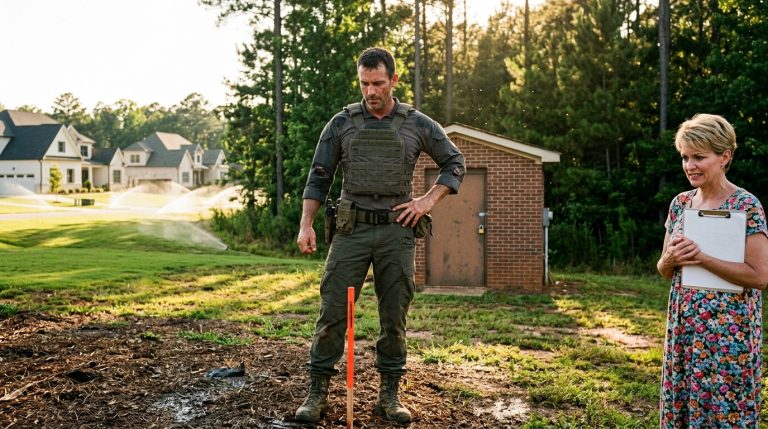
The Architecture of Retribution: How a Quiet Veteran Systematically Dismantled a Suburban Tyrant’s Empire of Beige
CHAPTER 1: The Anatomy of a Wound
The house was too quiet. Without the colossal canopies of the four black walnuts to catch the wind, the morning silence was sterile, hollowed out like a rotted trunk. I stood on the porch, my boots planted firmly on the worn boards, my eyes tracking the path of the sun as it hit the four jagged stumps. They were raw, pale, and weeping sap—a viscous, amber fluid that looked far too much like blood in the early light.
I didn’t move. I didn’t reach for my phone to call the board, and I didn’t rush out to the lawn to scream at the empty street. I let the cold spread through my limbs, the old Marine Master Gunnery Sergeant discipline locking every fiber of my being into a state of absolute, surgical stillness. My pulse was a slow, steady rhythm, the beat of a heart that had long ago learned how to survive.
Karen Bishop would be inside, drinking coffee, her floral muumuu undoubtedly stretched across her frame as she sat at her kitchen table, plotting the next aesthetic violation. She was a petty tyrant of lawn height and trash can brands, and she had decided that these hundred-year-old titans were a nuisance to her sterile vision of Oakridge Estates. She had called them a hazard. She had used a bylaw, a thin piece of paper, to authorize the slaughter.
I focused on the texture of the air. It was heavy with the sharp, chemical tang of sawdust and the metallic scent of chainsaws. I took a breath, holding it deep in my lungs, letting the scent anchor me in the present reality of the damage. My hand, resting on the railing, curled inward until the edge of the wood bit into my palm, a deliberate pressure to sharpen my senses.
Then I saw it. At the base of the nearest stump, discarded in the dirt, sat a single, partially shredded piece of yellow caution tape—a careless remnant of the work crew’s haste. It didn’t belong in the manicured perfection of my garden. It was an anomaly, a tiny, synthetic discrepancy in the natural cycle of my yard. I stared at it, calculating the distance, the angle, the path I would need to take to retrieve it without disturbing the integrity of the crime scene.
A flicker of movement caught my eye from across the street. The curtain in Karen’s bay window twitched. She was watching, waiting for the reaction. She wanted the loud, explosive outburst; she wanted the veteran to break his own composure so she could label him the aggressor, the unstable element that needed to be removed.
I didn’t give her the satisfaction. I turned, my movements slow and deliberate, and walked back into the study. I didn’t slam the door. I closed it with a soft, final click. I walked to the desk, pulled out my logbook, and opened it to a fresh page. The pen felt heavy in my hand, a tool as vital as any rifle.
7:15 A.M. The site is secure, I wrote, my handwriting precise and unwavering. The destruction is complete. The enemy is watching.
I set the pen down and looked at the wall, at the framed photo of Sarah. The silence of the house seemed to press against my skin, a physical weight. I knew what this was now. It wasn’t just about trees, and it wasn’t just about bylaws. It was a war, and she had just committed the first fatal error of an opening engagement. She had left me a motive, and she had left me a battlefield. I reached for the camera. The reconnaissance phase had begun.
CHAPTER 2: The Deputys Wall
The ink in the logbook was barely dry when the silence of the cul-de-sac was shattered. A heavy, air-braked hiss tore through the morning, followed by the low rumble of a delivery truck turning into the street. I didn’t look up from the desk, but my body tightened, every muscle shifting into a state of heightened, sensory awareness. The truck wasn’t stopping at my house. It was slowing down two doors down, in front of the Miller residence.
I stood up, the chair scraping almost silently against the rug, and moved to the window. I didn’t pull back the curtain. I stood in the shadow of the doorframe, angling my vision so I could see the street without being seen. The driver hopped out—a young man in a tan uniform—and heaving a heavy box onto a dolly, he navigated the sidewalk toward the Millers’ front door.
My gaze shifted further down. Karen’s beige McMansion sat silent and imposing, the curtains pulled tight. She was in there, tucked away behind her fortress of architectural compliance, and for the first time, I felt the sharp, cold reality of what I was up against. This wasn’t just a dispute; it was a siege.
I checked my watch. 8:10 A.M. The deputy should have been turning onto the street by now. I walked back to the front door, stepping onto the porch just as a cruiser rolled slowly into view. It was a local sheriff’s deputy—not the man I knew, but a younger face, eyes fixed on the devastation of the front yard. He slowed to a crawl, then pulled into my driveway, the gravel crunching under the tires with a sound that felt unnecessarily loud.
He stepped out, his posture weary. He was young, maybe mid-twenties, the kind of cop who still thought the uniform meant he could fix the world, but whose shoulders already carried the fatigue of someone who had seen how often that wasn’t the case. He walked the perimeter of the lawn, his boots sinking into the churned earth where the heavy machinery had tracked in during the night.
“Morning,” he said, his voice flat as he approached the porch. He didn’t look at me, but at the four stumps. “Dispatch got a call about property destruction.”
“I made the call,” I said, my voice steady, stripped of the raw rage I felt. I kept my posture relaxed, hands visible, the deliberate calm of a man who had been trained to de-escalate. “Karen Bishop, the HOA president, authorized this. Four century-old black walnuts. Gone in the dark.”
He looked up then, his eyes scanning the yard, then meeting mine. He saw the camera around my neck, the tripod in the corner, and the meticulous state of the lawn. He saw that this wasn’t a hysterical homeowner; it was a calculated one. He took out a small, spiral-bound notepad.
“She admitted it?” he asked, his pen poised.
“Boasted about it,” I corrected. “Cited bylaw 7.4. Nuisance vegetation. She acted like she was doing me a favor.”
The deputy sighed, a long, hollow sound that seemed to pull the energy right out of the morning. He stepped closer to one of the stumps, running a gloved hand over the fresh, jagged grain. “Sir, I understand your frustration. I really do. These are… they’re beautiful specimens. But if she’s claiming she did this under the authority of the HOA—even if she’s dead wrong—this is going to fall under a civil matter.”
The word hit me like a physical barrier. “Civil matter.”
“We can’t arrest someone for a bylaw dispute,” he continued, his voice softer, almost apologetic. “I can file a report. I will document every bit of this. I’ll go over there, get her statement, and file it with the office. But my sergeant is going to tell you the same thing I’m telling you: this is for the lawyers to sort out.”
I watched him as he spoke, noting the way he shifted his weight, his eyes refusing to lock onto the blatant destruction of property. He wasn’t malicious, but he was bound by the system. He was a cog, and the system’s primary function was to avoid trouble, not to deliver justice.
“So, you’re not going to cite her for destruction of property? For trespassing?” I kept the question clinical.
He closed the notepad. “For what, sir? She’s claiming an HOA-granted right. Until a court tells me she’s wrong, as far as the law is concerned, this is a contractual dispute. I’m sorry, Mr. Davis. I wish I could do more.”
He didn’t wait for a response. He walked across the street, his shadow stretching long and thin over the pristine, untouched grass of Karen’s lawn. I watched him approach her front door. The door opened before he even had a chance to knock—a sudden, expectant motion—and she stepped out, her floral muumuu bright against the neutral siding of her home. She puffed out her chest, her posture radiating that insufferable, petty entitlement.
I didn’t turn away. I stood on the porch, my arms crossed, watching them exchange words. She gestured toward my house, a broad, dismissive motion of her hand, and then she handed him a piece of paper—a printed bylaw, no doubt. The deputy took it, gave a stiff, formal nod, and retreated to his cruiser.
He drove away without stopping back by to talk to me. He had done his job. He had filed his report. He had checked his boxes. I looked from the empty space where the trees had been to her house, and a cold, sharp clarity settled into my gut. The system was designed to protect the process, not the victim. That was fine. If the law wanted process, I would give them process. I would give them so much process it would bury them.
I went back inside, retrieved my logbook, and wrote down the deputy’s name, the time, and the refusal to intervene. I didn’t feel angry anymore. I felt cold. A machine, once primed, doesn’t feel anger—it simply functions. And I was now a function of justice.
CHAPTER 3: The Evidence of Silence
The logbook lay open on the desk, the ink of the last entry still looking wet in the low light of the study. I stared at the words—a function of justice—until they blurred. The house felt too large, the silence amplified by the absence of the walnut trees outside. For twenty-five years, they had been the lungs of this property, filtering the air, softening the wind, providing the only backdrop Sarah had ever asked for. Now, there was just the open, violated expanse of the front yard, and the smug, curtained silence of Karen Bishop’s house across the street.
I stood up, the chair’s wood-on-wood rasp sounding like a gunshot in the quiet room. I didn’t need to be loud, but I needed to be thorough. I walked to the hallway closet and pulled out the gear I hadn’t touched since my retirement: a heavy-duty tactical flashlight, a high-resolution digital camera with a macro lens, and a box of evidence bags I’d kept from my years in the field. They were relics of a different life, a different kind of combat, but the principles of the operation remained identical: gather the intelligence, map the enemy’s perimeter, and do not leave a single trace of your presence.
Stepping out onto the porch, I felt the morning air—dry, stale, and lacking the familiar, earthy perfume of the walnut leaves. I descended the steps. My boots hit the churned, muddy soil where the heavy truck had sat. The treads were deep, ugly gouges in what had been a meticulously kept lawn. I crouched by the first stump—a massive, pale circle that looked like a scar on the earth. The chainsaw cuts were erratic, jagged, and aggressive. This wasn’t the work of a professional arborist. This was the work of someone who didn’t care about the wood, only the speed of the removal.
I pulled the camera from my satchel, the weight of it familiar and grounding. I began to move. Every angle was a data point. I took wide shots first—the stumps in relation to the property lines, the street, and the sightlines from Karen’s house. Then, I moved in. I set the macro lens to its tightest focus, capturing the splintered grain of the stumps, the specific, jagged tear marks left by the chainsaw teeth, and the way the sap had pooled in the grooves of the cuts. I moved with a slow, mechanical precision. My breath was rhythmic, steady—the same discipline I’d used to check an IED site in a desert a world away.
As I worked, I noticed something that didn’t align with the chaos of the scene. Near the base of the third stump, partially buried in a pile of displaced wood chips, was a small, plastic fluid cap. I knelt, my movements fluid and practiced, and retrieved a pair of tweezers from my kit. I held it up to the light. It was a standard industrial-grade oil cap, the kind used on heavy-duty commercial chainsaws. It wasn’t just a stray piece of trash; it was a mark. It was evidence that the equipment used wasn’t just rented; it had been maintained, or perhaps, poorly maintained, by the operator.
I sealed it in an evidence bag, labeling it with the location and time. It was the first physical link, the first thread in the web I was spinning.
I moved to the garage, intending to stow the gear, but as I stepped across the threshold, a scent hit me—sharp, biting, and distinctly out of place. It was the smell of industrial solvent, faint but unmistakable, clinging to the air around my workbench. I paused, my hand hovering over the light switch. I didn’t keep solvents here. I kept tools, hardware, and the scattered, dusty memories of a life built with Sarah.
I swept the garage with my flashlight. Everything looked normal. My workbench was organized, my tools aligned, the air filled with the scent of pine and old grease. But the solvent smell remained, hovering near the concrete floor. I bent down, tracing the area with the beam of the light. There, near the foundation wall, was a faint, wet stain on the concrete, evaporating rapidly in the morning heat.
My tactical sense surged. This wasn’t from me. Someone had been here.
I didn’t panic. I didn’t reach for a weapon, because I didn’t need one; I needed an answer. I scanned the perimeter of the garage again, checking the locks. They were secure. I checked the small window that faced the side yard. It was latched. But as I leaned in, I noticed a smudge on the glass—not from the inside, but from the outside.
Karen. Or someone acting on her behalf. She wasn’t just playing the petty tyrant; she was scouting. She was testing the perimeter. She was trying to see if I was actually going to fold, or if I had the stomach for the fight.
A grim, humorless smile touched my lips. She thought she was the predator, circling a wounded animal. She didn’t realize that in my experience, the moment a predator begins to circle, they’ve already exposed their flank. I finished cataloging the evidence, my movements even more deliberate than before. The stakes had shifted. The war wasn’t just on the lawn anymore; it had crossed the threshold of my home. And I was going to make sure that the next time they tried to scout my position, they would find exactly what they were looking for—and a great deal more.
CHAPTER 4: The Valuation of Grief
I stood by the workbench, the phone cold and heavy in my hand. The smell of solvent had dissipated, but the psychological grit remained, a fine layer of dust over every thought. I dialed the number for Legacy Tree Consultants, my movements precise, stripping away any hesitation. This wasn’t about the trees anymore; it was about the math of the crime.
“Legacy Tree, this is Dr. Evans,” the voice on the other end was clipped, professional, and entirely devoid of the suburban pleasantries that usually clogged the atmosphere of Oakridge Estates.
“Dr. Evans, this is John Davis,” I said, keeping my tone flat and stripped of the exhaustion I felt. “I need an appraisal. Formal. Legal-standard documentation.”
There was a pause, a brief silence that allowed the gravity of the situation to settle. “I remember the case, Mr. Davis. Those black walnuts. Eighty feet, clear trunks, veneer quality.”
“I have the site prepared. The stumps are marked, the site is secured, and I have photographic evidence of the pre-felling condition,” I said.
“I’ll clear my afternoon,” Evans replied. “Two P.M. I’ll need full access to the debris and the surrounding soil.”
“You’ll have it,” I promised. I hung up, the phone clicking back into its cradle with a finality that signaled the transition from reconnaissance to action.
I didn’t head straight back to the house. I walked to the edge of the yard, where the four saplings used to form a canopy. The grass was flattened, crushed by the weight of the equipment. I looked down at the earth and, for a heartbeat, I heard Sarah—not a phantom, but a memory so vivid it felt like a physical presence. She was kneeling there, hands deep in the soil, her laugh light and unrestrained, the way it used to be before the world narrowed.
Don’t let the gray take this, John, she had whispered in the quiet of a dozen years ago.
The phantom of her voice hit me with the force of a blow, a sudden, piercing reminder of what this battle was actually about. It wasn’t about the money. It was about the fact that Karen Bishop had looked at that shared history—at the tangible roots of our life—and decided they were a nuisance to be erased. She had tried to prune away a human legacy. The thought didn’t make me weep; it made the ice in my veins solidify. It turned the grief into a tool, a precision instrument that I would now use to carve the ground out from under her.
At exactly 2:00 P.M., a modest pickup truck turned onto the cul-de-sac. It was a well-maintained vehicle, a tool of a trade, not a statement of status. Dr. Alistair Evans stepped out. He was a man of sixty, tall and spare, his features crinkled by a lifetime of staring into canopies. We shook hands—a dry, firm grip, like bark. He didn’t offer sympathy. He offered competence.
He went to work immediately. He didn’t ask questions; he didn’t need to. He moved with a practiced, rhythmic grace, his leather satchel clicking open to reveal tools that looked more like surgical instruments than forestry equipment. He knelt at the first stump, his hands moving over the jagged surface of the cut wood as if he were reading Braille.
“Healthy,” he murmured, pulling out a core-bore. The tool bit into the wood with a sharp, whining friction. He extracted a cylinder, held it up to the sun, and squinted. “Consistent growth, no rot, no pest infestation. These were titans, Davis. They had another fifty years in them.”
I watched him, my hands in my pockets, my focus absolute. He moved from stump to stump, his pace methodical. He measured diameters, cross-referenced the log with his digital mapping tool, and took soil samples that he sealed in glass vials with clinical care. He was counting rings, measuring the width of the heartwood, calculating the precise economic value of the life that had been severed.
When he reached the fourth stump, he stopped. He stood for a long time, looking at the pattern of the cuts, then back at Karen’s house. He didn’t speak. He just looked, his eyes sharp and analytical.
“The work was rushed,” he finally said, turning back to me. “They didn’t just cut them; they tore them. It’s consistent with heavy, uncalibrated equipment. Whoever did this didn’t have the training to handle hardwood of this grade. They were operating for velocity, not value.”
“What does that mean for the appraisal?” I asked.
“It means they destroyed the logs,” he said, his voice dropping an octave. “If they had been felled properly, these trees would have commanded a premium on the high-end veneer market. By butchering them, they’ve reduced the value to pulp-grade in some places, while leaving the core intact. It’s an act of vandalism, not just removal.”
He walked back to his truck and pulled out a clipboard, his face grim. “Mr. Davis, I’ll need 48 hours for the full analysis. But my preliminary field assessment? You are looking at a loss of sixty-five thousand per tree. Minimum. And that’s before the courts calculate the timber trespass multiplier.”
Sixty-five thousand. The number was abstract, yet it hit me with the weight of a physical object. It was a quarter of a million dollars in equity, liquidated in an afternoon because a woman in a floral muumuu wanted a uniform horizon.
“I’ll have the report by Wednesday,” Evans said, his hand on the door of his truck. He looked at me, a brief, penetrating glance. “You’re not just a homeowner anymore, Gunnery Sergeant. You’re a plaintiff in a grand larceny case. Keep the site secure. Don’t let anyone touch those stumps until my report is finalized.”
“Understood,” I said.
As his truck pulled away, I turned back to the yard. The empty space felt different now. It was no longer just a graveyard of stumps; it was a dossier of evidence. Every measurement Evans had taken, every ring count he had logged, was a stone in the foundation of the case I was building. I went inside and walked to the study, the scent of the evening air trailing in with me. I sat at the desk and opened the logbook. I had the value of the loss. Now, I needed the identity of the cost. The investigation was widening, and for the first time, I could see the shape of the trap I was building—not just a legal one, but a financial cage that would eventually hold Karen Bishop’s entire existence.
CHAPTER 5: The Fixers Calculus
I didn’t turn back to the house immediately. I stood in the driveway, the gravel crunching under my boots, and watched the taillights of the arborist’s truck fade into the late afternoon haze. The neighborhood was quiet, but it was a heavy, suffocating silence. It felt as though every window on this street had eyes, and behind every curtain, a neighbor was holding their breath, waiting to see what the veteran would do next.
I turned and walked back inside, the door latching with a soft, final click. The study was dark. I didn’t reach for the light. I sat in the leather chair, the leather cool against my back, and stared at the dark screen of my laptop. The logbook sat open before me—a ledger of grievances and, now, a map of the coming war.
I pulled out my phone. The contact was saved under a single, sharp designation: Fixer. Marcus Thorne. He was a man who understood the geometry of conflict—how to apply pressure to a joint until the entire structure collapsed. I didn’t hesitate. I dialed.
The phone rang three times. “Gunny,” he answered. His voice was precise, as if he were still standing in a courtroom, even at this hour. “It’s been a long time. Don’t tell me you finally decided to sue the VA.”
“Something better, Marcus,” I said, my voice as flat as a blade. “I’m going to need you to dismantle an HOA.”
There was a pause on the other end, then a low, resonant chuckle—the kind of sound that came from someone who had spent their career dissecting lies and finding the exact structural defect in an opponent’s argument. “An HOA? You’re joking. That’s not a war, that’s a bureaucratic skirmish.”
“It’s a war, Marcus,” I interrupted, the cold fury resurfacing, steady and controlled. “They took my trees. They took the memorial to my wife. They did it in the dark, under the guise of an aesthetic bylaw, and now they’re trying to bury me in fines.”
He didn’t laugh this time. The silence that followed was different—it was analytical. “Give me the details.”
I laid it out for him. I didn’t stutter, and I didn’t indulge in emotional theatrics. I told him about the midnight demolition, the citation of bylaw 7.4, the refusal of the deputy to intervene, and the documentation I had already secured. I told him about the arborist’s preliminary estimate—two hundred and sixty thousand dollars in timber value—and the strange, chemical smell of solvent I’d found in my garage after they’d finished their work.
When I finished, the silence on the line felt heavy. “You’ve done the reconnaissance yourself,” Marcus said, his voice now stripped of its humor. “You’ve got the photos, the arborist’s validation, and you’ve got a clear indication of a procedural breach. If she didn’t provide the fourteen-day notice required by the CC and Rs, she’s in a legal vacuum. But an HOA isn’t just one person, John. It’s a board. You have to prove she led them into this, or you’re fighting the whole association.”
“She acted unilaterally,” I said. “She controlled the agenda, she used the reserve fund without a vote, and she hired family members. It’s embezzlement, Marcus. It’s self-dealing.”
“Embezzlement.” The word hung in the air, a lethal charge. “If you can prove that, it changes everything. It strips away their directors and officers liability protection. You don’t just sue the association; you sue her personally. You take her house, you take her savings, and you take her credibility. You make sure she never sits on a board, a committee, or a PTA for the rest of her life.”
“How fast?”
“I’ll be in Raleigh by tomorrow morning,” he said. “I’ll need everything—every photo, every log entry, the arborist’s report the moment you get it. But there’s one more thing. You said the neighborhood is watching. Do not engage. Do not argue with her at the board meetings. Let her think she’s winning. Let her keep filing those bogus fines. Every piece of paper she sends you is another count of bad faith, another nail in her coffin. You’re going to be the quiet, aggrieved veteran, and I’m going to be the wall she runs into.”
I hung up, feeling a strange, hollow sense of peace. The transition was complete. I was no longer a victim of a suburban power-trip; I was a component in a legal machine that had already been programmed for destruction.
I stood and walked to the window, peering out into the twilight. A car was idling at the curb, its headlights dimmed. It sat there for a long moment, then slowly pulled away, its tires crunching faintly on the asphalt. Was it her? Or was it just a neighbor trying to see if I was still there? It didn’t matter. They were all part of the same structure now, a structure that was about to experience a fundamental, structural failure.
I returned to the desk and closed the logbook. I had laid the groundwork. Tomorrow, the escalation would begin, and by the time I was finished, there wouldn’t be a single beige siding or uniform lawn height in Oakridge Estates that wouldn’t serve as a reminder of the day Karen Bishop had decided to cut down the wrong man’s history. The, “Inhale” of the planning was over. The “Exhale” of the consequences was about to hit them, and I was going to watch it all from the quiet, detached distance of the high ground.
CHAPTER 6: The Neighborhood Pulse
The air in the cul-de-sac felt different as I stepped off the porch—charged, like the static before a thunderstorm. I knew the neighbors were watching. My peripheral vision caught the slight movement of a curtain at the house next door, the quick retraction of a silhouette. They knew what I had done, and they knew what Karen had done. The line had been drawn, and now, I was walking across it.
My destination was two doors down. Tom Miller’s yard was clean, almost excessively so, a sign of the immense pressure he and his family had been under to conform. As I approached, I saw Tom in the backyard, hunched over a workbench, his hands moving with the practiced, precise motions of a man who found sanctuary in the grain of wood.
He didn’t see me until I was ten feet away. When he looked up, his expression flickered—a mixture of surprise and a sudden, sharp fear. He wiped his hands on a rag, glancing nervously toward the street where Karen’s house stood, silent and imposing.
“John,” he said, his voice dropping to a low, tight frequency. “What are you doing here?”
“I need to talk, Tom.” I kept my voice neutral, my body language open but alert. I didn’t stop in the middle of the yard; I moved to the side, positioning myself so that the fence blocked the direct line of sight from Karen’s windows. “I know about the swing set.”
Tom stiffened. He glanced back toward the back door of his house, where a soft light glowed. “That… that was a while ago. It’s over. We already took it down. There’s no point in dragging that up again.”
“It’s not over,” I said, my voice cutting through his anxiety. “She didn’t just take that swing set because it violated a bylaw. She took it because she knew you couldn’t afford the legal fees to fight her. She operates on a pattern, Tom. She tests the boundaries, breaks the spirit, and moves on to the next one.”
“She’s the president,” Tom whispered, his eyes darting toward the street again. “She has the board. She has the rules. You fight her, you don’t just lose money—you lose your peace. Look what she did to your trees.”
“Exactly,” I said, leaning in. “She took my trees because she thought I was the last one left who wouldn’t bend. But I’m not alone. And neither are you.”
I watched his face as I spoke, noting the way his jaw tightened. He wasn’t afraid of the rules anymore; he was afraid of the consequences of challenging a power that seemed absolute. I pulled a small, folded piece of paper from my pocket—a summary of the procedural violations Marcus had identified. I didn’t push it on him; I just held it between us.
“She didn’t follow the 14-day notice requirement for your swing set, did she?” I asked.
Tom stared at the paper. “No. She sent a notice that gave us seventy-two hours. We tried to argue, but the board just… they didn’t even listen.”
“Because the board isn’t a board. It’s a mechanism. And we’re going to break it.”
Before Tom could respond, the silence was pierced by the sharp, metallic sound of a car door closing up the street. I glanced over. Karen’s sedan was pulling out of her driveway. She was heading toward the main road, probably toward the HOA’s management office. I watched her go, the engine note fading, and I saw the way Tom’s entire frame slumped in relief.
“She’s gone for now,” he muttered. He looked at me, a flicker of something new appearing in his eyes—not fear, but a cold, burning resentment. “If we do this… if we actually challenge her… she’ll come for everything.”
“Let her come,” I said. “Because by the time she reaches for anything else, she won’t have the position to hold it.”
I left the summary on the workbench and turned to walk away, my footsteps steady on the pavement. I had planted the seed. The Miller family had been the test case, the evidence of a cruelty that had crossed the line from petty to pathological. As I walked back toward my house, the neighborhood felt different. It was no longer a place of silent, beige conformity. It was a pressure cooker, and I was holding the match.
My next move was the most critical one. I needed the treasurer. If Karen was using the HOA funds as her own personal piggy bank, the breadcrumbs would be in the financial records. David Chen was the only one who had the knowledge, and as I looked up the street, I realized that my reconnaissance hadn’t just uncovered a bully—it had uncovered the blueprint of an entire enterprise built on fear, and I was going to dismantle it, one brick at a time.
CHAPTER 7: The Emergency Trap
I didn’t turn on the lights in the study. I didn’t need them. The amber glow of the streetlamp outside filtered through the blinds, casting long, sharp-edged shadows across the desk. I sat in the darkness, the logbook open before me, the pages filled with the meticulous documentation of a crime.
The meeting was two days away. Karen had sent out the email—an emergency call for a special session to discuss the “financial stability” of the association. It was a flimsy, transparent lie. She was going to use the threat of my lawsuit to push through an assessment that would fund her legal defense, and she was going to use the cover of the meeting to retroactively sanitize the records of the tree removal. She wanted to amend the CC&Rs to grant herself unilateral authority over “nuisance” vegetation. It was an admission of guilt, written in the language of bureaucratic procedure.
My phone vibrated on the desk. A text from David Chen: She’s moving fast. The agenda is set. She’s counting on the fear of the legal bill to get the votes.
I looked at the screen, the blue light reflecting in the window glass. She was walking straight into the center of the kill zone. Marcus had advised me to stay away—to let her commit the final, fatal procedural errors on her own. If I were there, she would focus her vitriol on me, distracting the board and the homeowners from the reality of her malfeasance. If I stayed away, she would be left alone with the document she was trying to force through, and the record of her hubris would be absolute.
I picked up the phone and typed back: Let her. Don’t show your hand until the vote is called.
I stood up and walked to the window, pulling back the blind just enough to see the street. Karen’s house was a beacon of artificial light in the cul-de-sac. She was working late. I could see her silhouette moving past the windows, sharp and urgent. She felt the pressure—she could smell the change in the air—and her response was to tighten her grip. That was her flaw: she didn’t know how to do anything else. She believed that control was a matter of force, not a matter of trust.
I thought about the trees. I thought about Sarah’s hands in the dirt. The rage was gone, replaced by a cold, surgical detachment. This wasn’t about the trees anymore; it was about the fundamental requirement of justice—that the person who breaks the law must be held to account by the very rules they claimed to protect.
I spent the next forty-eight hours in a state of quiet, disciplined preparation. I didn’t reach out to the neighbors. I didn’t check the neighborhood forums. I let the pressure build. I let Karen stew in her own mounting desperation. Every hour that passed without me fighting back was an hour she spent committing herself deeper to the trap.
When the evening of the meeting arrived, the neighborhood seemed to hold its breath. I watched from the darkened study as the cars began to pull into the community clubhouse parking lot. They were hesitant, slow. The residents were afraid, but they were also curious. They had seen the news reports; they had heard the rumors. They were beginning to understand that the “peace” of the neighborhood had been bought at the cost of their own dignity.
I didn’t go. I stayed in the study, the silence of the house providing a sharp contrast to the chaotic, forced-consensus environment I knew was playing out at the clubhouse. David Chen would be there. He would watch, he would record, and he would ensure that every procedural violation was noted.
I paced the room, my movements rhythmic, a soldier pacing a perimeter. The clock on the wall ticked—slow, methodical, inescapable. The meeting would be a farce. It would be a performance of authority that had already lost its legitimacy. And when it was over, when the final vote was cast and the assessment passed, Karen would believe she had secured her reign.
She wouldn’t realize that in those few hours, she had created the final, insurmountable mountain of evidence required for the RICO filing. She had made the destruction of my trees a formal, recorded board action, and in doing so, she had linked every board member and every dollar of the HOA’s reserve fund to the crime.
I stopped at the window one last time. A lone car drove slowly down the cul-de-sac, its headlights cutting through the dark. It was David, returning from the clubhouse. He slowed as he passed my house, then continued on. I waited for the text. A moment later, the phone buzzed.
It’s done. She pushed the amendment through. She’s celebrating.
I stared at the screen, a grim satisfaction settling in my chest. She was celebrating her own destruction. The trap was sprung. The next time she would be holding a meeting, it wouldn’t be in the clubhouse, and she wouldn’t be the one holding the gavel.
I turned back to the room, the shadows lengthening around me. The preparation was over. The reconnaissance was done. The legal machine was primed. Tomorrow, Marcus and I would take everything she had left.
CHAPTER 8: The Price of the Kingdom
The morning of the final settlement was crisp, the air carrying the metallic tang of an approaching autumn. I stood on the porch of the community clubhouse, my posture relaxed, my breathing steady. Inside, the board sat behind the long, mahogany-veneered table, but the power dynamic had shifted irrevocably. The representative from North State Mutual, a man in a charcoal suit named Mr. Heler, sat beside the interim board members. Karen Bishop, meanwhile, sat in the front row of the folding chairs—a private citizen in a room that had once been her throne.
She looked small. The floral muumuu was gone, replaced by a dark, severe suit that did nothing to hide the frantic, hollowed-out look in her eyes. She hadn’t expected the insurance company to pivot. She hadn’t expected them to treat her not as an insured client, but as a liability to be excised.
“The evidence is incontrovertible,” Heler said, his voice a dry, emotionless monotone that carried to every corner of the room. He didn’t look at Karen. He looked at the board—at Gary, at Brenda, at the men and women who had spent years as her silent enablers. “The invoices from Bishop Property Services, the lack of board minutes, the unauthorized expenditure of reserve funds—it is a textbook case of bad-faith mismanagement. Under the terms of the D&O policy, the association is protected, but the individual acting outside the scope of her authority is not.”
Karen’s breath hitched, a sharp, ragged sound. She stood up, her face a mask of trembling, incandescent rage. “You can’t do this!” she hissed, her voice cracking. “I was protecting the community! I was the one who made the hard decisions! I was the one who kept this place from falling apart!”
“You were the one who broke the rules to satisfy your own ego, Karen,” David Chen said from the head of the table. His voice was calm, devoid of the petty animosity she had used to govern for so long. “And in doing so, you didn’t just break the association—you broke the law.”
The room went silent. The neighbors, the people who had watched in fear for years, were watching now with a collective, hard-edged clarity. There was no pity left. Just the recognition of a tyrant who had finally run out of subjects.
Marcus stood up, his suit immaculate, his presence commanding. He walked toward the center of the room, holding a single, notarized document—the final settlement agreement. “The association is paying the settlement amount, but the judgment includes a clause for joint liability,” he announced, his gaze sweeping the room before settling on Karen. “Which means, Miss Bishop, that your personal assets are now the target for the remaining balance.”
Karen looked around the room, desperately seeking an ally, a nod, a whisper of support. But there was nothing. Just the cold, indifferent faces of the people she had bullied for years. She realized then that her kingdom hadn’t fallen because of me, or Marcus, or the insurance company. It had fallen because it was never a community to begin with; it was a cage she had built for herself.
She turned and walked out of the room, her footsteps echoing on the hard floor. She didn’t look back. She was a woman who had lost her title, her assets, and her entire sense of identity in the space of a single hour.
The denouement was quiet. The settlement was finalized, the legal fees were paid, and by the end of the month, a ‘For Sale’ sign sat in her front yard. The house—her fortress of beige—was emptied of her presence. It was a sterile, hollow shell.
I spent the next year in the quiet of the Sarah Davis Memorial Grove. The saplings had taken root, their leaves vibrant and green, stretching upward toward the sun in the space where the titans had once stood. I often sat on the bench, the stone cool against my hands, watching the children run along the winding path. Lily Miller, her smile radiant as she pushed her chair, was a constant presence in the park. The adaptive swing Tom had built was a testament not to the rules, but to the resilience of a neighborhood that had learned how to rebuild itself after a disaster.
One afternoon, I sat in the grove with a piece of sandpaper and a block of walnut wood I’d salvaged from the wreckage of the old trees. I was smoothing the surface, my movements slow and deliberate, the friction a grounding, physical reality. I wasn’t fighting anymore. The war was over. The tyranny was a memory, a cautionary tale whispered in the cul-de-sacs of a community that now knew the true cost of silence.
I placed the finished block on the bench, a smooth, dark surface that glowed with the oil of my own touch. It was a small thing—a piece of a history I had reclaimed, a fragment of the life Sarah and I had built. I stood up, my back straight, the weight of the past finally settled into a place where it could support me rather than anchor me. I walked out of the grove, leaving the quiet behind, stepping into a life that was finally, unequivocally my own.