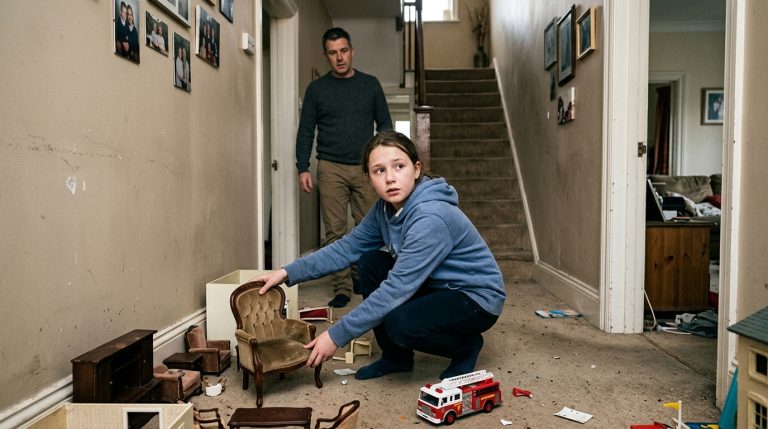
The Concrete Ledger of Pembroke Lane: A Story of Common Sense Over White-Collar Cruelty
CHAPTER 1: THE MIDNIGHT COFFEE
The kitchen smelled of chicory and thirty years of grease baked deep into the pine cabinets. Dolores didn’t look ninety-three under the yellow glare of the stove light, just small, her fingers hooked around the handle of a blue ceramic mug that had survived three deployments and two moves. Between them lay three pages of heavy bond paper, the corners crisp, the signature at the bottom written in the aggressive, looping ink of someone who bought her pens in bulk.
Garrett didn’t touch the paper yet. He watched the steam rise from his own cup, his thumb tracing the worn satin finish of a stainless-steel Zippo inside his pocket. Clink. The lid snapped shut against his thigh, low and rhythmic. Outside, the steady, rhythmic hiss-click of a neighbor’s lawn sprinkler cut through the hot North Carolina midnight, a sound so regular it felt like a countdown.
“She didn’t knock, Garrett,” Dolores said, her voice dropping into that flat, dry register she used when she was determined not to let her joints ache in public. “A young man in a gray suit walked up the steps, slid it under the weather-stripping, and took a picture of the door with his phone before I could even get my walker around the kitchen island.”
Garrett reached out, his thick, calloused thumb pinning the first page down against the Formica. The letterhead was embossed—Pembroke Lane Homeowners Association—and the words Notice to Vacate were bolded in a font meant to mimic a court order. His eyes skimmed the dense, legal fog, bypassing the citations of Section 4, Paragraph B, until they hit the core numbers. Seven days.
“The roses are four feet, four inches,” she murmured, looking out the dark window toward the side fence where the shadows of the trellis hung like iron bars. “Your father and I put those roots in the ground the year the Gulf War ended. They’ve always been that high.”
“They aren’t looking at the bushes, Mom,” Garrett said, his voice level, stripped of the grit he felt rising in his throat. He turned to the second page, noting the lack of a notary stamp, the missing signatures of the secretary or the treasurer. Just Beverly Renee Trout, printed clear and solitary at the base of the threat. “This isn’t a lawsuit. It’s an eviction notice written by a woman who thinks she owns the dirt under your slippers.”
Dolores reached across the table, her thin skin cool against his knuckles, her grip surprisingly firm for a woman who spent her afternoons reading large-print history books. “Don’t go tearing down her fence, son. I don’t want the police in this yard. Not after everything.”
“Nobody’s tearing anything down,” Garrett said, his eyes locking onto the specific dates of the prior resolved violations listed as justification—a garden hose from three autumns ago, a Christmas wreath left out until January fourth. The Zippo gave one more silent clink inside his jeans. “We’re just going to look at the ledger.”
CHAPTER 2: THE SILENT VAULT
The smell of moldering paper and floor wax was thick enough to chew. The county clerk, a woman named Martha with reading glasses chained to her neck, didn’t even look up from her solitaire game as Garrett hauled the third ledger onto the scarred oak table. The basement of the Wake County records office didn’t care about neighborhood property values or the pristine paint on a Cadillac SUV. It only cared about what was signed, stamped, and filed in ink.
Garrett flipped through the yellowed pages of the Pembroke Lane subdivision charter, his thumb resting against the cool metal of the Zippo in his pocket. Clink. He released the pressure, letting the lid snap back in the darkness of his denim.
His eyes scanned the 1993 incorporation papers until they locked onto Article VI, Section 3: Habitation Restrictions and Repeat Offenders. The language was plain, typed on an old IBM Selectric. Any action to remove a homeowner required a seventy-two hour public notice, a full quorum of five board members, and a recorded majority vote entered into the official county registry within forty-eight hours of the decision.
Garrett turned to the active filings for the current year. There was the notice served to his mother, bearing the official HOA seal, stamped three days ago. But the attachment page—the mandatory certified copy of the meeting minutes showing the board’s vote—was completely blank.
He pulled the document closer, the harsh fluorescent light overhead humming a low, irritating B-flat. There was only one signature on the entire authorization block. Beverly Renee Trout. No secretary’s counter-signature. No treasurer’s seal.
“Looking for something specific, honey?” Martha asked, her voice dry as she cracked a knuckle without looking up from her monitor.
“An authorization that doesn’t exist,” Garrett said.
He took his phone out, framing the signature block cleanly in the lens, and took a high-resolution snapshot. Without Thatcher to draft a formal subpoena, these raw public records were the only shield his mother had against the seven-day clock ticking down on her front porch.
The charter was clear: filing a habitation restriction without a board quorum wasn’t just a procedural error. It was a breach of fiduciary duty that stripped the president of their institutional immunity. Beverly hadn’t just overstepped; she had put her own name on a legal landmine.
Garrett closed the heavy leather ledger, the dust puffing up in a small gray cloud under the yellow light. He had the lever. Now he just needed to find where to place it to break her leverage.
CHAPTER 3: THE BROKEN LINE
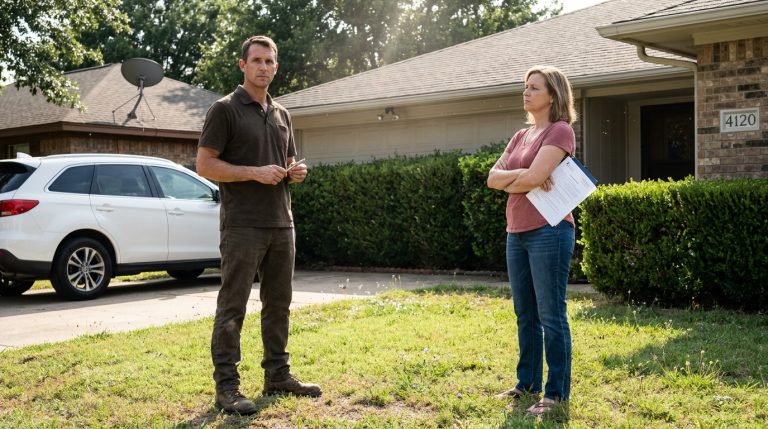
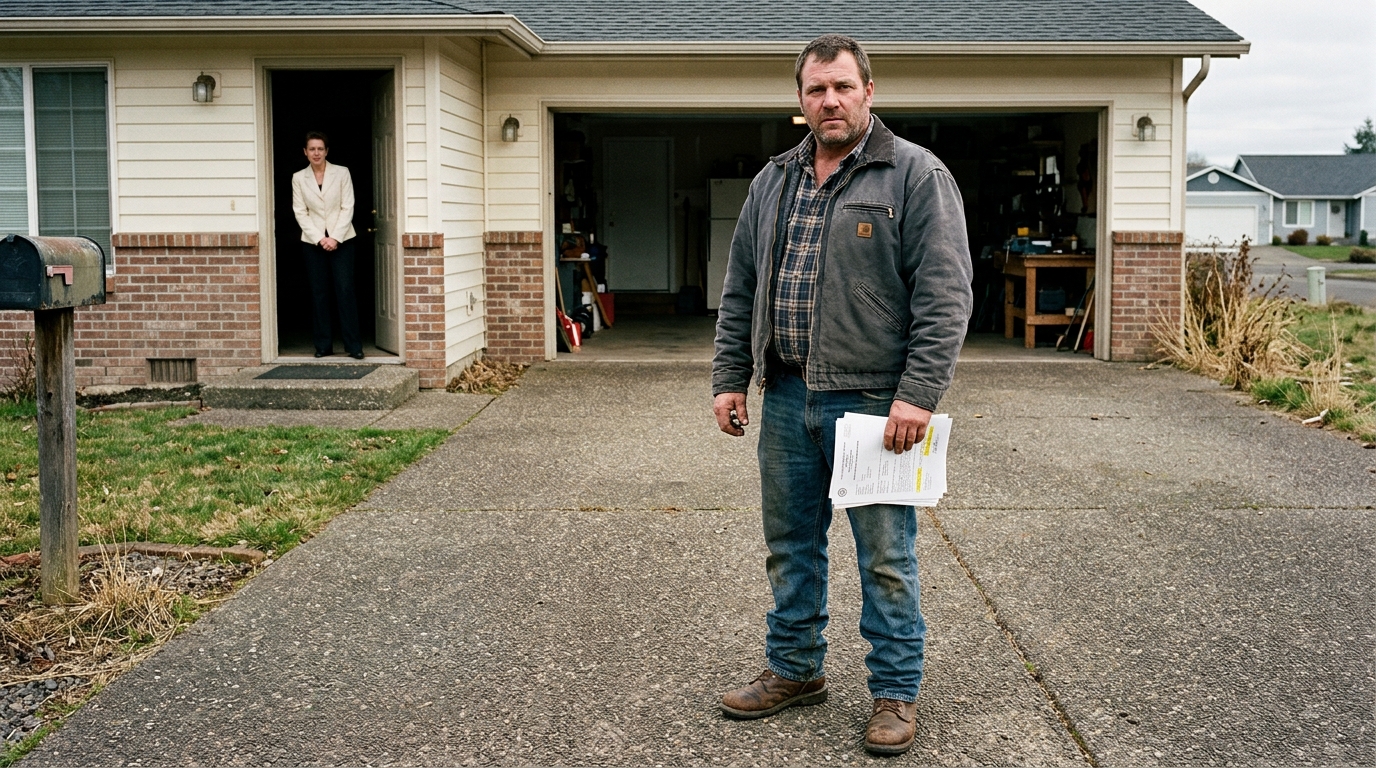
The concrete was aggregate, bleached white, and sealed so perfectly the mid-morning heat shimmered off the surface like gasoline. Garrett adjusted his grip on the printed copy of the county registry records, his boots crunching softly on the neat line of red mulch bordering the driveway. The house loomed large, a double-garage brick model that looked exactly like twenty others on the street, except the mailbox was brass and polished daily.
Garrett didn’t ring the bell. He stood on the porch, his thumb flicking the cold steel casing of the Zippo inside his pocket. Clink. The heavy oak front door swung inward before he could reach for the knocker.
Beverly Trout stood in the doorway, her cream blazer pressed down to the millimeter, her hair frozen in a precise shell of lacquer. A slight twitch pulled at the corner of her left eye, the tiny movement betraying the absolute stillness of her expression.
“If this is about the Wolfson property, Mr. Wolfson, you are violating the neighborhood peace guidelines regarding unannounced visitors,” she said, her voice dropping into a tight, practiced cadence that sounded like an insurance recording.
“What was the date of the board meeting where the quorum voted on my mother’s notice?” Garrett asked, his arm remaining stationary at his side, the paper held flat against his leg.
Beverly’s chin lifted, her gaze sliding down to the digital camera lens on Garrett’s phone peeking from his shirt pocket. “The executive committee handles administrative compliance internally. We don’t require town halls to pull weeds.”
“The charter requires five signatures for a habitation restriction,” Garrett said, his voice dropping into a level, functional drone. He held up the page, the single ink loop of her signature filling the center of the frame. “You signed it alone on Monday morning. The county has no record of a vote.”
The door didn’t slam, but the gap narrowed by three inches, the brass latch clicking against the strike plate. “The legal firm in Raleigh handles our enforcement, Mr. Wolfson. If you have an issue with the filing, you can file a written grievance at the quarterly assembly in September.”
Garrett turned his back before the lock turned, walking down the aggregate slope toward the street where a low electric hum broke the quiet.
Renwick, the neighborhood compliance officer, was rumbling up the curb in a green golf cart, a heavy aluminum clipboard resting across his knees. A fresh white paper invoice from Pristine Aquatic Solutions was clamped to the very top of his stack, the ink looking dark and wet under the bright sun.
“Mr. Wolfson,” Renwick said, stopping the cart with a squeal of the brake pad. He didn’t look mean, just tired, his skin weathered by decades of checking fence heights and measuring garbage can placement. “I’m supposed to log the stone path today. Beverly said it violates the total allowable surface area for the front lot.”
Garrett stepped directly into the path of the cart, his boots planted on the asphalt. “Where’s the forty-eight hour written notice of inspection for an occupied residence?”
Renwick blinked, his fingers tapping the edge of the aluminum board. “Beverly called me twenty minutes ago. Said it was an emergency follow-up.”
“The bylaws say forty-eight hours, written and delivered to the resident, or it’s criminal trespass,” Garrett said, pointing at the fresh invoice on the clipboard. “Write down that the inspection was attempted without notice. Do it now.”
Renwick looked at the house up the hill, then back at Garrett’s face, his shoulders dropping three inches as he pulled a black ballpoint pen from his pocket.
CHAPTER 4: THE SHARED BURDEN
The cardboard was soft at the corners, smelling faintly of lavender and decades of dust. Insidelay dozens of pink carbon copies, each one a separate citation stamped with the same bolded signature Garrett had photographed at the courthouse. Netty’s kitchen smelled of old tea leaves and damp plaster, the wallpaper peeling slightly around the baseboards where a leaky pipe had been ignored because the contractor fees were too high.
Garrett pulled the top paper out, his thumb resting against the smooth metal casing of the Zippo inside his denim pocket. Clink. He rolled the lighter over twice without sparking the flint, his eyes running down the columns of numbers. Three thousand two hundred dollars in cumulative assessments.
“Two hundred for the lawn height in July,” Netty said, her voice a thin, dry whistle as she adjusted her knitted cardigan. “Then four hundred because the trash bin stayed out two hours past the Monday morning collection. I told her the knee fluid was bad that week, but she just told me the rules don’t check a person’s pulse.”
Garrett laid the pink slips out on the linoleum in a neat grid, matching them chronologically against his own notes from the county ledger. The pattern didn’t look like code enforcement; it looked like a systematic harvesting of small bank accounts.
“Did she ever give you an invoice from Pristine Aquatics?” Garrett asked, his voice low, matching the quiet of the small room.
Netty shook her head, a stray tear catching in the deep wrinkles beside her nose before she wiped it with the sleeve of her sweater. “She said the pool repair assessment was mandatory for everyone on the lower loop. Twelve hundred dollars flat. When I asked to see the itemized bill, she told me that kind of paperwork stayed with the executive board.”
Garrett picked up his pen, his mind calculating the sheer math of the cul-de-sac. Twelve homes on the lower loop, all occupied by residents who had lived on Pembroke Lane long enough to remember when the asphalt was fresh. Over thirty thousand dollars pulled from one street alone, under the guise of a pool repair that county records valued at a fraction of the total cost.
He pulled a fresh legal pad toward him, sliding it across the Formica table toward the elderly woman. “Sign the bottom of this statement, Netty. Just write exactly what you told me about the assessment notice.”
She hesitated for a single second, her fingers tight around the ballpoint pen Garrett provided. “Is this going to stop the letters, Garrett? I can’t keep opening the mailbox if every envelope is a threat.”
“It’s going to stop,” Garrett said, his thumb pressing down on the edge of the cardboard box to stabilize it as she signed. “The paper leaves tracks, and she’s running out of room to hide them.”
CHAPTER 5: THE CHECKMATE TRAP
The handle of the glass door felt cold against Garrett’s palm as he pushed it inward. The community center basement hummed with the low, collective drone of forty neighbors squeezed into folding chairs, their eyes locked on the long folding table at the front.
Beverly Trout sat in the center seat, her cream blazer immaculate, though a drop of sweat had smudged the heavy foundation near her jawline. Beside her, a man named Dorance—one of the other four board members—sat with his arms crossed, his eyes trained heavily on the folder Garrett had delivered to his porch an hour prior.
Garrett walked down the center aisle, his boots striking the linoleum with a heavy, deliberate thud, his fingers resting inside his pocket on the worn satin of his Zippo. Clink. The silent metal click stayed muffled inside the denim. He laid the packet of twelve signed neighbor statements and the certified copies of the county registry records directly on the table.
“Dorance,” Garrett said, his voice carrying clearly to the back row where Renwick stood gripping his aluminum board. “The registry shows no vote occurred for the habitation restriction served to my mother. It was filed under a single signature.”
Beverly didn’t flinch, but her fingers tightened around the expensive gold pen in her hand until her knuckles turned the color of chalk. “Mr. Wolfson, this is an administrative review regarding code compliance, not a public forum for non-members.”
—”It’s a board meeting, Beverly,” Dorance hijacked her smoothly, his voice gravelly as he flipped open the folder Garrett had provided. “And according to these public ledger receipts, the HOA reserve fund paid three hundred and eighty thousand dollars last year to an entity named Pristine Aquatic Solutions.”
A murmur broke out across the folding chairs, Netty leaning forward from the second row, her thin hands gripping her purse.
Beverly’s chin snapped up, her eyes wide as she stared at the projector screen where Garrett had already connected his phone to the wall monitor. The screen displayed the official state business registry listing the owner of Pristine Aquatic Solutions LLC: Beverly Renee Trout.
“This is a manufactured conflict of interest,” Beverly hissed, her voice rising into a sharp, defensive screech that echoed off the cinderblock walls. “The pool resurfacing was vetted by the compliance committee, and the board signed off on the infrastructure emergency allocation.”
“There is no committee signature,” Garrett said, his finger pointing to the screen where the final page of the contract showed only one name. “The county assessor recorded the actual permit value at thirty-one thousand five hundred dollars. The rest went into an account you own.”
Beverly stood up so fast her folding chair scraped violently against the floor, her face flushed dark crimson under the lacquered shell of her hair. “You don’t understand the liability of running a development like this! You have no authority here!”
CHAPTER 6: THE DUSTY COLLAPSE
Dorance didn’t look back at the audience as he raised his right hand. The other three board members followed instantly, their arms snapping upward like iron brackets in the harsh fluorescent glare.
Beverly’s fingers twitched violently against the gold pen, leaving a jagged blue streak across her clean agenda sheet before the plastic casing snapped completely between her knuckles. She scanned the front row, looking for an ally, an excuse, or a procedural loophole, but the silence in the basement was absolute and heavy.
—”The motion carries,” Dorance said, his gravelly voice dropping like a lead weight onto the table. “Effective immediately, the notice to vacate against Dolores Wolfson is rescinded, and the accounts are frozen pending a full forensic audit by the state regulatory office.”
Beverly didn’t offer a dramatic confession, nor did she speak to the neighbors who had spent years paying her inflated maintenance assessments. She simply grabbed her leather planner, her expensive leather heels clicking erratically on the linoleum as she strode toward the double exit doors without looking back.
Outside in the humid evening air, the distant sound of a Cadillac engine cranked over once, the tires squealing softly against the concrete curb as the headlights cut through the dark oaks of Pembroke Lane.
Garrett didn’t follow the sound. He adjusted the strap of his shoulder bag, his thumb settling against the warm, smooth surface of the Zippo tucked inside his pocket. Clink. The lid snapped closed one final time, a quiet punctuation mark to a three-year kingdom that had collapsed under the weight of its own signed paperwork.
The kitchen on Pembroke Lane was quiet the next afternoon, the scent of fresh chicory filtering through the open screen door. Dolores sat by the window, her thin fingers carefully tying a green jute twine around the main stalk of the heavy red rose bush near the porch rail.
Garrett set his coffee mug down on the Formica table, watching the steady, deliberate motion of her hands as she snipped the excess string with a pair of rusted kitchen shears. The handpainted wooden sign near the mailbox stood straight in the grass, the afternoon sun highlighting the faded white letters that read The Wolfson Place.
“The registry updated the compliance log this morning, Mom,” Garrett said, his voice level and relaxed. “The ledger is clear.”
Dolores wiped a smudge of damp North Carolina topsoil from her apron, her eyes resting on the neat, green grid of the yard. “Good. The soil is just right this week, and the hydrangeas are going to need the extra room.”
Garrett took a slow sip from his mug, the metal lighter sitting still and cold at the bottom of his pocket, completely devoid of tension.