How a Veteran Outwitted an Arrogant HOA President Using Only an Ancestral Deed and Cold, Hard Truth
CHAPTER 1: THE FENCE LINE AMBUSH
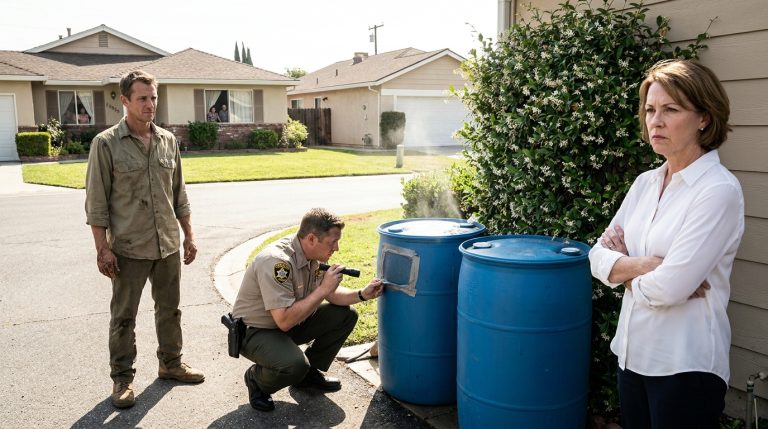
The words hung in the crisp autumn air, colder than the wind rustling the last of the oak leaves across my driveway. I stood there, hands deep in the pockets of my worn Carhartt jacket, staring at the woman who had just uttered them. Her name was Karen Thorne, and she wore the rigid, self-righteous armor of an HOA president whose authority stopped precisely where my property line began.
“Your grandfather’s legacy is a public nuisance, Mr. Miller,” Karen snapped, gesturing wildly toward the sprawling hundred acres of woods and fields stretching behind my house.
I didn’t blink. I simply let the hunting knife in my sheath rest against my thigh, using its familiar, cold weight to anchor my rising irritation. She was standing on the pristine asphalt of the community road, flanked by her silent electric golf cart, treating my ancestral soil like an offensive billboard that ruined the sterile beige aesthetic of her subdivision.
She spat out her grievance about my intention to lease a section of my land to a small group of responsible bow hunters for the upcoming deer season—a fifty-year family tradition. To her, a man in camouflage tracking game fifty yards from her property line was a direct assault on her suburban peace. She didn’t see a working, living piece of rural history; she saw an untidy backyard that needed a binder of bylaws to fix it.
“My land isn’t in your association, Karen,” I said, my voice steady, stripped of any wasted anger.
She only doubled down, her face tightening into a bloodless line as she issued her ultimatum to dismantle my grandfather’s work piece by piece. She thought she was laying down the law, leaning heavily on the sheer audacity of her assumed jurisdiction. She turned her golf cart around with a sharp crunch of gravel and sped back toward her sanitized enclave, leaving behind an ominous silence.
I stood there for a long moment, listening to the wind move through the pines my grandfather planted. The initial flash of heat in my chest cooled instantly into something much sharper and heavier. She had declared a war of paperwork and petty tyranny, but she had fundamentally miscalculated the terrain.
CHAPTER 2: THE PAPER TRAIL
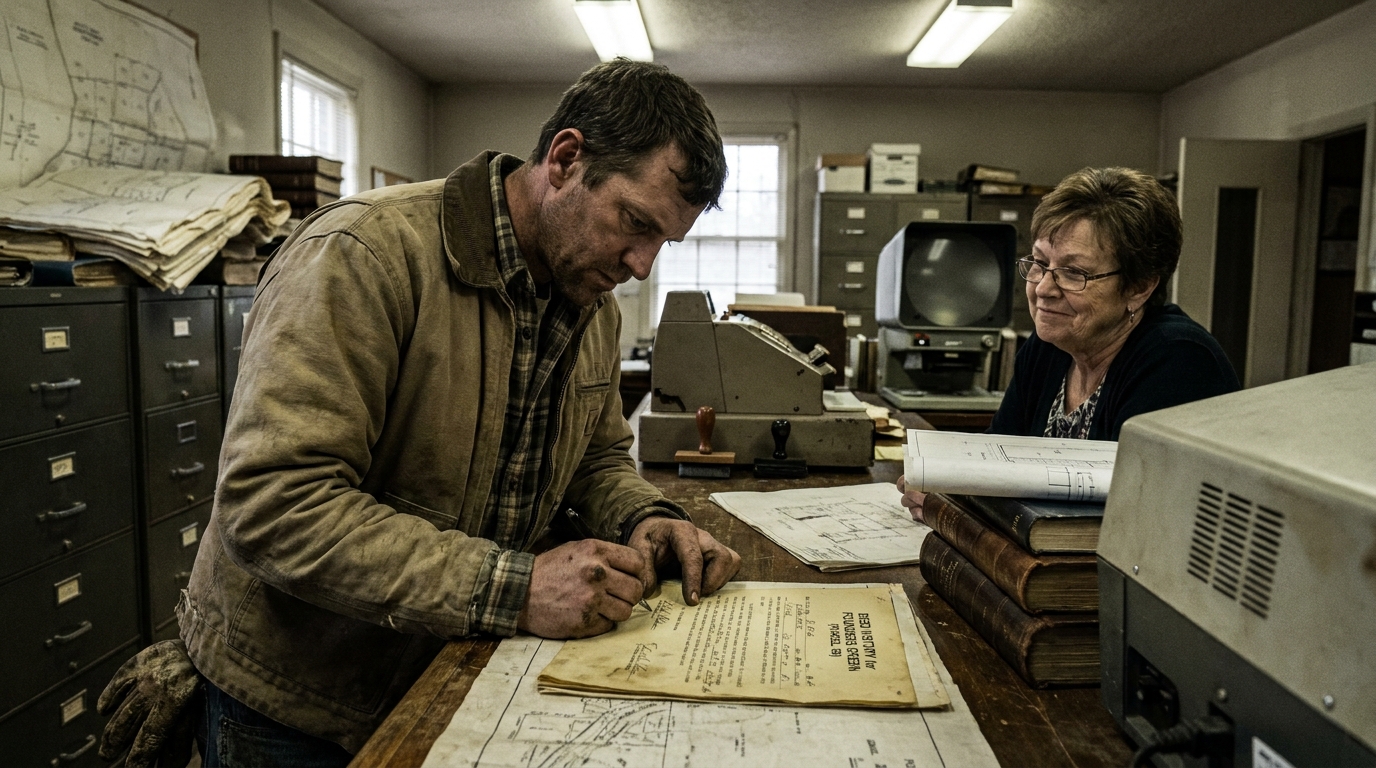
The county records office smelled exactly as I remembered it from twenty years ago—a thick blend of decomposing wood pulp, fine dust, and the steady, low-frequency hum of microfilm machines. Marge sat behind the high counter, her glasses perched halfway down her nose, offering a familiar, knowing grin as I approached.
“Don’t tell me you’re selling off the old homestead, Jack,” she said, her voice a friendly, gravelly scrape that cut right through the quiet of the room.
“Not a chance,” I replied, leaning my forearms against the scarred wooden surface. “Just the opposite. I’m defending it.”
I laid out the situation in stark, unembellished terms, telling her about Karen Thorne and her attempt to weaponize an HOA bylaw against land that didn’t belong to her. Marge’s smile tightened into a thin, hard line as she slid a thick request form across the counter toward my hands.
“Oak Ridge Estates,” she muttered, shaking her head. “They think their little rulebook is federal law around here.”
For the next four hours, I buried myself in heavy leather-bound books, unrolling massive, crinkling plat maps that smelled of history and ink. My fingers traced the familiar boundaries of Parcel 4A, noting the precise surveyor’s note in the margin explicitly excluding my family’s land from their jurisdiction.
I pulled out my phone and snapped a high-resolution photo of the map, capturing the exact lines that rendered Karen’s violation notice entirely fraudulent. But as I flipped through the subdivision’s articles of incorporation, a strange entry caught my eye—a five-acre parcel carved out of our eastern border called Founders Green.
“Marge,” I said, tapping the glass of her terminal screen. “I need the title history for the park right next to my property.”
She squinted at the monitor, her fingers clacking against the mechanical keys before she looked up with a sharp gleam in her eye. “Why, it was deeded over to the county twenty years ago,” she said slowly. “And the grantor was none other than your grandfather, John Miller.”
CHAPTER 3: THE HIDDEN CLAUSE
I stood there at the tall oak counter, my thumb tracing the dark lines of my grandfather’s signature at the bottom of the final page. John A. Miller. A man who measured a promise not by how loud it was spoken, but by how deep its roots ran into the dirt.
My eyes scanned past the legal jargon and the property bounds of Parcel 5B until they locked onto the section titled Conditions of Use.
The language was simple, direct, and entirely unyielding. It stated that the five acres were donated to Madison County to be used in perpetuity as a public park, open for the quiet enjoyment of all residents of the county without exception or fee. The Oak Ridge HOA had no legal right to post rules, restrict entry, or treat those woods as their personal backyard amenity.
Then my eyes hit the very next paragraph, and my pulse slowed into a cold, dangerous rhythm.
It was a reversionary clause.
“Should the grantee or any third party restrict public access, alter the public intent, or attempt to claim exclusive private authority over Parcel 5B,” the text read, “full legal title shall automatically revert to the grantor or his rightful living heirs.”
A memory flashed unbidden into my mind—my grandfather sitting on the porch of the hunting cabin twenty years ago, whittling a scrap of cedar while the first bulldozers tore up the neighboring pasture. Jackie, he’d told me, his voice rough as sandpaper, a developer will promise you the moon to get what he wants, but he’ll try to fence off the sky the second you turn your back. You write the terms so the dirt remembers who owns it.
I stared at the page until the black ink burned into my retinas. Karen Thorne hadn’t just overplayed her hand by fining me five hundred dollars over a nonexistent violation; she had built her neighborhood’s prized park on a legal trapdoor. By erecting private signs and chasing out county residents, her association was actively breaching the donation covenant.
She was threatening to dismantle my grandfather’s legacy, completely blind to the fact that her own arrogance was about to cost her entire neighborhood their playground.
“Find what you were looking for, Jack?” Marge asked, leaning her elbows against the counter.
“More than I expected, Marge,” I said, folding the warm pages neatly and sliding them into the Project Nightingale folder. “Turns out Karen Thorne built her empire on borrowed ground, and she just handed me the shovel.”
CHAPTER 4: THE RECONNAISSANCE
The carved wood sign gleamed in the pale morning light, proudly proclaiming Founders Green: A Private Park for the Residents of Oak Ridge Estates. Below it, a neatly painted list of restrictions barred anyone without an HOA address from entering.
I tapped the screen of my phone, capturing multiple angles with the public asphalt clearly visible in the foreground. This wasn’t just an aesthetic nuisance; it was physical proof of a breached covenant carved right into cedar.
I turned away from the subdivision and walked down the road toward Arthur Henderson’s farm. The eighty-five-year-old was sitting bundled in a heavy flannel jacket on his porch swing, his eyes fixed on the distant tree line as the creak of the chains measured the passing seconds.
“Jack,” Arthur grumbled, spitting a speck of tobacco into the grass as I walked up the steps. “You look like a man carrying a loaded gun with the safety off.”
“Karen’s association locked down my grandfather’s park, Arthur,” I said, leaning against the weathered porch post. “They put up signs and started running off county residents.”
Arthur’s swing slammed to a halt with a sharp screech of metal. His face darkened into a leathery map of pure indignation.
“They ran off my own granddaughter and her kids last summer,” Arthur barked, his hands gripping the wooden armrests so hard his knuckles turned white. “Told her she didn’t belong in a public space because she didn’t live in their sterile little box. I was ready to go down there with a chain saw.”
“I don’t need a chainsaw, Arthur,” I said quietly, tapping the folder under my arm. “I just need your signature. Will you testify that they locked your family out?”
“Sign it?” Arthur stood up, his frame shaking with a lifetime of stubborn pride. “Heck, I’ll stand in the middle of their clubhouse and read it to them myself. Your granddad didn’t give that land away so a pack of carpetbaggers could play lord of the manor.”
CHAPTER 5: THE LEGAL MASTERSTROKE
Sarah pulled the deed of gift toward her, her fingers flicking past the plat maps and Arthur’s notarized statement in absolute silence.
“Mr. Miller,” she murmured, a bright, predatory gleam replacing her professional caution as she hit the reversionary clause. “This isn’t just a defense against their bogus fine. This is a tactical nuke.”
She didn’t waste time with empty outrage or petty threats. Within two days, she drafted a letter that read less like a legal brief and more like an unyielding wall of solid iron.
It mapped out the boundary exclusion, dismantled their fraudulent fine, and laid out the hard reality of Parcel 5B. It quoted my grandfather’s exact words on public access and dropped the reversionary clause right into their laps like a ticking clock.
“We don’t scream, Jack,” Sarah said, sliding the final draft across the table with a clean pen. “We give them thirty days to remove their private signs, issue a public apology, and restore the park’s true status—or you take the title back.”
I signed the bottom line without hesitation. The trap was set, and the fuse was burning.
CHAPTER 6: THE CLUBHOUSE RECKONING
Karen spun around, her face instantly turning a blotchy, panicked red as my grandfather’s signature stared her down in ten-foot-tall letters.
“This is a private meeting,” she shrieked into the microphone, her voice cracking under the weight of sudden exposure. “You have no right to project—”
“My grandfather had every right when he deeded this land to the county twenty years ago,” I said, my voice carrying cleanly across the tense silence of the room.
I clicked the remote, advancing the slide to the reversionary clause. The room erupted into an uneasy murmur as the homeowners realized their precious park wasn’t protected by their association fees at all; it was dangling over a legal precipice created by their leader’s unbridled arrogance.
Karen tried one final desperate counter-move, screaming that I was a greedy outsider trying to bulldoze their playground for profit. But her own people didn’t flinch. The HOA treasurer stood up in the front row, his hands shaking slightly as he looked straight at her.
“Karen,” he demanded, his voice tight with betrayal. “Did you know about this clause before you attacked his property?”
She stood there, trapped in the harsh projector light, completely speechless. In that heavy silence, the dam broke, and her entire manufactured authority collapsed under the sheer weight of the truth.
Weeks later, the private signs were gone, replaced by a permanent county plaque bearing my grandfather’s name. Karen was stripped of her title, her neighborhood was finally breathing free air, and the invisible wall between our properties had dissolved into quiet, mutual respect.
I stood on the porch of the old hunting cabin at dusk, holding a small bouquet of wild dandelions a neighbor’s little girl had handed me by the fence line. The woods were quiet, the air was clean, and my grandfather’s legacy stood stronger than ever.