The Architecture of Retribution: How a Quiet Sapper Laid a Digital Minefield to Dethrone a Suburban Tyrant
CHAPTER 1: THE PERIMETER BREACH
The digital readout on the nightstand didn’t flash red—it pulsed with a cold, monochromatic amber that cut through the absolute dark of the bedroom.
I didn’t bolt upright. Fifteen years of laying combat paths and reading seismic tripwires in places maps refused to label had trained the panic out of my reflexes long before I ever bought a modest brick ranch in Oakmont Estates. Beside me, Sarah’s breathing remained shallow and steady, the soft rise and fall of her chest the only fragile thing in the world worth protecting. Her autoimmune flare-up had finally subsided into a fragile truce; she needed this quiet sanctuary more than she needed oxygen.
The notification on the encrypted screen was a Zone One perimeter alert.
I swung my legs over the edge of the mattress, the hardwood floor biting cool against my bare soles. Moving with the silent economy of a shadow, I padded down the hallway toward the home office, my eyes already adjusting to the shifting angles of moonlight against drywall.
On the primary monitor, the low-light camera disguised as a jagged landscape boulder across the drive was already feeding crisp, infrared-assisted frames into the local hard drive.
And there she was.
Karen Thompson, president of the Oakmont Estates Homeowners Association, looked absurd in the stark green-and-black contrast of the night vision feed. Her heavy frame was swallowed by a dark gray sweatsuit that strained against the midnight air, her face slick with the ugly sheen of exertion. She wasn’t strolling; she was laboring, her boots sinking half an inch into the damp Carolina clay as she wrestled a commercial-grade post-puller—a rusted, mechanical vice—around the base of the very first Western red cedar post I had spent my Saturday sinking into eighty pounds of high-grade concrete.
A few feet away, her husband Gary hopped from foot to foot like a man standing on hot coals, casting jittery, panicked glances down the sleeping, tree-lined street.
On the audio channel, picked up by the high-gain directional mic embedded in the guttering, Karen’s ragged breathing sounded like a bellows. A low, guttural grunt ripped from her throat as she threw her entire body weight onto the puller’s steel lever.
The wood didn’t just snap; it screamed. A wet, tearing shriek of fibers and suctioned earth broke the suburban silence as the concrete anchor tore free from the ground with the sound of a breaking bone. Karen stumbled backward, catching herself on her palms, her chest heaving. Then, in the ghostly illumination of the lens, her lips parted into a wide, triumphant, predatory smirk.
She thought she was operating under the cloak of night. She thought she was erasing an eyesore and punishing a defiant homeowner who refused to bow to her bylaws.
She had no idea she was standing dead-center on a digital stage, performing for an audience of one who had spent a career studying how to dismantle systems from the inside out.
I reached out, my finger hovering over the interface, and locked down the high-definition recording. The red indicator light blinked once, twice, three times—saving every gasping breath, every illegal heave, every shred of evidence directly to the fireproof vault.
Karen had just drawn first blood. But as I watched her fumble with the heavy timber, dragging it toward the shadows of her own property line, my heart rate stayed locked in its icy, deliberate rhythm.
She had declared a war of attrition in the dark.
She just didn’t know I owned the night.
CHAPTER 2: THE MORNING AFTER
The digital chime of the security vault sealing itself off in the office carried down the hall as a faint, muffled click. I stood in the dim corridor for a three-beat count, listening to Sarah’s breathing. It remained even, shallow, the fragile rhythm of a body that had spent years waging internal wars against its own tissue. She didn’t stir.
I didn’t turn back toward the bed. There was no sleep left to be salvaged tonight.
When the first thin, gray edge of dawn bled over the eastern treeline, staining the horizon a bruised lavender, I walked out the back door and stepped directly onto the dew-soaked lawn. The air smelled of wet Carolina clay and crushed pine needles—a heavy, earthy dampness that clung to the wool of my sweater.
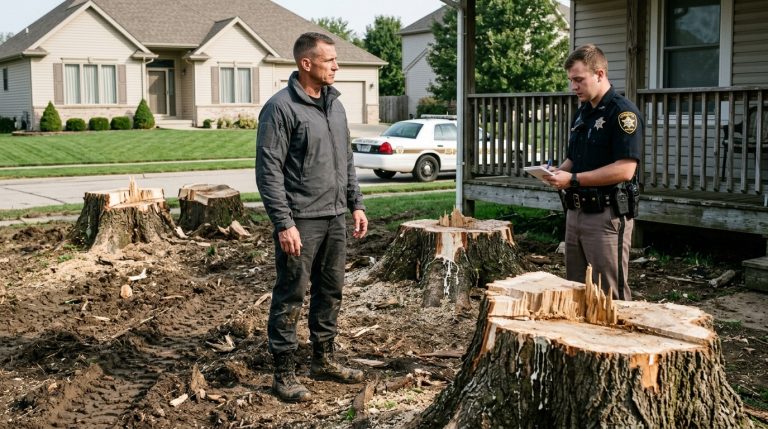
Four gaping black mouths scarred the grass where the boundary had stood.
The Western red cedar posts I had spent my Saturday sinking eighty pounds of high-strength concrete into were gone, replaced by jagged craters of churned mud. Shards of splintered timber and gray flakes of cured concrete lay scattered across the turf like bone fragments after a skirmish. The remaining posts, untouched at the far end of the property line, stood rigid and lonely, like silent sentinels questioning why their comrades had been pulled from the earth.
I crouched beside the nearest hole, my fingers pressing into the damp lip of the excavation. The soil was still freshly disturbed, bearing the sharp, crescent-shaped impression of heavy boot treads and the biting pinch of a mechanical clamp.
Memory didn’t ask for permission; it simply surfaced. I was staring at a cratered supply road outside Kandahar, checking the clearance of a cleared lane after an improvised charge had blown the berm. The rules of engagement back then were written in blood and ordinance. You didn’t argue with an insurgent over property lines or aesthetic harmony; you mapped their vectors, secured your perimeter, and waited for them to overextend.
Karen Thompson had overextended at 2:17 a.m. in a gray sweatsuit.
A sharp, metallic clatter broke the morning stillness. Across the intervening green strip, two houses down, a side garage door slid open with a rusted screech. A plastic bin rattled as it was dragged across concrete.
I didn’t look up immediately. I let my fingers trace the torn fibers of cedar left clinging to the dry clay.
When I finally raised my eyes, Karen stood in her open doorway. She had changed into a bright yellow cardigan over stiff black slacks, her blonde hair shellacked into an impenetrable helmet of hairspray. She looked across the damp yards, her gaze locking onto me kneeling beside the mud-choked hole.
For a single micro-second, her posture stiffened—a microscopic hitch in her shoulders, the involuntary flinch of a woman who remembered the heavy weight of the post-puller and the shadows of the night before. But the hesitation vanished almost instantly, overwritten by the rigid, practiced sneer of an HOA president preparing her morning docket.
She lifted her chin, smoothed the front of her cardigan with manicured fingers, and gave me a sharp, dismissive nod—not of greeting, but of ownership. Then she turned back inside, letting the service door slam shut with a heavy, final thud.
The sound echoed off the brick exterior of my house, vibrating across the wet grass.
I stood up slowly, wiping the damp clay from my palms onto the thighs of my jeans. My pulse didn’t spike; it maintained that cold, mechanical cadence. She still thought she was holding the high ground. She thought the rules of this suburban micro-state were a shield forged just for her.
I turned away from the ruined holes and walked back toward the kitchen, where the coffee maker was beginning to spit its first dark drops into the carafe. The trap was set. Now it was time to let her walk into the light.
CHAPTER 3: THE POLICE REPORT AND THE DIGITAL ACE
The coffee machine finished its final hiss, spitting a dark, bitter stream into the glass carafe. I poured a single mug, black, and carried it back to the desk without looking at the screen. The evidence was secured on the local drive and backed up to an encrypted cloud node, but physical friction required a physical response. A military engineer doesn’t leave an unexploded ordinance sitting in the dirt just because it’s recorded on a map; you call Explosive Ordnance Disposal and you establish a formal chain of custody.
The non-emergency line of the local police precinct picked up on the third ring.
“Oakmont Department, Officer Miller speaking. What can I do for you?” The voice was flat, tired, the unmistakable cadence of a man counting down the remaining months to a pension he had earned twice over.
“I need to report a case of intentional property destruction and criminal trespass,” I said, keeping my tone measured, devoid of emotional spikes. “Occurred sometime between 2:00 a.m. and sunrise at 424 Elmridge Lane.”
There was a dry rustle of paper on the other end, followed by the dull scratch of a ballpoint pen. “Looks like you’ve got an HOA dispute, sir,” Miller sighed, the weariness deepening in his throat. “These things get heated. People get territorial over grass lines.”
“This isn’t a dispute about grass, Officer,” I replied, my fingers tapping a slow, rhythmic cadence against the edge of the wooden desktop. “Four heavy-duty Western red cedar posts, set in eighty pounds of concrete on private property, were ripped out by force. Material and labor replacement value is in excess of twelve hundred dollars.”
Miller grunted softly. “Any suspects?”
“I might,” I said, pausing deliberately to let the silence stretch. “However, I don’t care to make an unsubstantiated accusation. But I do have the entire incident captured on a professional-grade low-light security system. High-definition infrared video, complete with clear audio of the perpetrators, the tools they used, and the act itself from start to finish.”
The scratching of the pen stopped instantly.
The silence that replaced it had a different weight—the sharp, sudden focus of a professional who just realized a routine call had turned into an open-and-shut case file.
“You have video?” Miller’s voice lost its bored drag, sharpening into a clean, authoritative register.
“Clear as day,” I said. “Every movement, every word spoken. I want to log a formal incident report and establish a case number before I hand the digital files over to my legal counsel.”
“Mr. Roads, right?” Miller asked, reading ahead. “Mark Roads.”
“That’s correct.”
“I’ll be at your property in twenty minutes,” Miller said. “Keep the digital evidence contained. Don’t touch the site until I look at the extraction points.”
The line clicked dead.
I set the phone down and took a slow sip of the black coffee. The bitter heat burned the back of my throat, anchoring me to the room. Across the street, through the slats of the venetian blinds, I could see Karen’s lighthouse mailbox blinking its solar-powered LED in the morning sun, completely oblivious to the fact that its owner had just written her own indictment.
True to his word, twenty-two minutes later, a marked cruiser rolled quietly down Elmridge Lane, its tires crunching softly against the asphalt before stopping at the curb. Officer Miller stepped out, adjusting his duty belt over a frame that had seen too many decades of municipal bureaucracy. He walked up the driveway, his eyes scanning the gaping holes in the lawn with renewed professional interest.
“Morning, Mr. Roads,” Miller said, nodding as I met him at the edge of the disturbed turf.
“Morning, Officer. Let’s walk the perimeter.”
We spent the next forty minutes pacing the damage. Miller took precise notes, measuring the distance from the property line, documenting the splintered wood fibers, and examining the deep, crescent-shaped gouges the post-puller left in the Carolina clay. He didn’t ask me to play the video yet; he was building his own physical foundation, securing the ground truth before introducing the digital weapon.
When he finished snapping his own series of photographs, he tucked his notepad into his breast pocket and looked at me with a faint, grim smile.
“You said you had this on a hard drive?”
“Secured and backed up,” I said. “Along with a complete paper trail of the fines and notices the board has been sending.”
Miller pulled a card from his pocket and pressed it into my palm. “File the formal complaint with this case number, Mark. Get your attorney to draw up the formal request for evidence transfer. When you’re ready to hand over that footage, call me directly. We’ll make it official.”
He turned back toward his cruiser, the gravel crunching under his boots. I stood by the edge of the ruined earth, watching the taillights fade around the corner. The first phase was complete. The police report was logged, the physical damage cataloged, and the state’s machinery officially set in motion.
Karen thought she was playing an isolated game of suburban chess. She didn’t realize the board had just been tilted.
CHAPTER 4: THE BLACK BINDER AND THE FIRST ALLIED WHISPER
The cruiser’s engine hum faded completely into the morning traffic of Elmridge Lane, leaving me standing alone beside the scarred patches of turf. I didn’t head back inside immediately. Instead, I walked the perimeter of the property line, my boots crunching over the fragments of gray concrete that Karen’s late-night extraction had left behind.
In my office, the desk was already converted into a tactical staging ground.
I sat down, pulled a thick, heavy-gauge binder with a stark black cover toward me, and slid a blank spine label into its plastic sleeve. With a black permanent marker, I wrote a single, capitalised word: KAREN.
This was where the loose threads would be pulled tight. The police report gave us an official state case number, but a single complaint could easily be filed away as a petty neighbor dispute—a localized friction between two incompatible homeowners. To break an entrenched system like the Oakmont Estates Homeowners Association, you had to prove a pattern of systemic abuse. You had to show that the tyrant wasn’t just targeting one defiant sapper; she was systematically squeezing the entire community.
I opened the binder to the first plastic sheet protector. Inside lay the certified mail receipts, the formal notices of violation, and the escalating fine letters—$50 for unauthorized construction, $100 for failure to cease and desist. Bureaucratic paper cuts designed to bleed a homeowner’s resolve until they yielded out of pure exhaustion.
My phone buzzed on the blotter, a soft, muted vibration. It was a text reminder I had set for 9:00 a.m.: General’s morning patrol.
I closed the black binder, slipped into a lightweight canvas jacket, and walked back out to the foyer where our three-legged German Shepherd was waiting. General gave a low, happy thump of his tail against the floorboards, his single hind leg twitching with anticipation as I clipped the leash to his collar. He didn’t care about HOA bylaws, property lines, or midnight raids; his universe was defined by open grass, familiar scents, and the steady rhythm of our morning walks.
We stepped out into the crisp mid-morning air, heading down the concrete sidewalk away from Karen’s house.
Two doors down, Mrs. Gable was out in her front garden. Her movements were slow, deliberate, her knees cushioned by a worn blue kneeling pad as she coaxed weeds from around a cluster of pale petunias. According to the HOA covenants Karen so zealously enforced, lawn ornaments were restricted to two small seasonal items. Six months ago, Mrs. Gable’s garden had hosted a cheerful, eccentric brigade of ceramic gnomes—a colorful collection that had vanished almost overnight after a barrage of compounding fines.
As General and I approached her property edge, I slowed my pace.
Mrs. Gable looked up, her worn gardening gloves smudged with dark earth. She offered a tired, fragile smile, her eyes squinting against the bright sunlight.
“Good morning, Mark,” she said, her voice carrying the dry rattle of age. “How are the flowers holding up after last night’s chill?”
“Morning, Mrs. Gable,” I replied, bringing General to a calm halt at the edge of her sod. “They’re resilient. Same as the soil.”
Her smile faltered slightly, her gaze drifting momentarily toward the gaping holes visible two houses down the block. A quiet shadow crossed her face, a mix of lingering embarrassment and suppressed frustration. She lowered her trowel, resting her gloved hands on her knees.
“I saw the police car parked by your drive earlier,” she said, her voice dropping to a cautious whisper, as if the very air between the suburban lawns had ears. “And I saw what happened to your fence posts. That woman… she has no sense of boundary. None at all.”
I kept my expression neutral, my eyes scanning the quiet street to ensure no other eyes were watching us from behind tinted windows. “Karen operates under the assumption that the rules apply exclusively to everyone else.”
“She fined me nearly three hundred dollars for my little stone figures,” Mrs. Gable murmured, her head shaking slowly. “A woman on a fixed income doesn’t have three hundred dollars to spare on municipal bullying. I had to box them up and put them in a dark attic just so I could afford groceries.”
The weight of her words clicked into place, slotting seamlessly into the expanding framework inside the black binder. It wasn’t about aesthetics; it was about subjugation.
“Mrs. Gable,” I said quietly, leaning down slightly so my voice reached only her ears. “Some of us are starting to look very closely at how those bylaws are being enforced. If someone were to compile a formal record of those fines—to ask the board for an accounting—would you be willing to share what happened to your garden?”
She looked up at me, her cloudy eyes suddenly sharp, illuminated by a sudden, fierce spark of long-suppressed defiance. She didn’t hesitate.
“Yes,” she whispered, her chin lifting with a fragile, hard-earned dignity. “Yes, I would. It’s past time someone stopped her.”
I nodded once, a crisp acknowledgment of an alliance forged in silence. “Keep your records handy. I’ll be in touch.”
We resumed our walk, General trotting steadily beside me, his three legs carrying him forward with smooth, balanced momentum. The first allied whisper had broken the surface. The foundation of Karen’s little empire was beginning to fracture, and she was still too arrogant to hear the crack.
CHAPTER 5: THE LANDSCAPE FOREMANS CONFESSION
The kitchen clock ticked past eleven when the heavy wood of the front door rattled under a sharp, uneven knock.
I didn’t rush. Movement when unprovoked looks like panic; calm movement looks like leverage. I walked down the short corridor, my hand resting casually on the doorframe before throwing the deadbolt.
Standing on the porch was a kid who couldn’t have been a day past twenty-two. He wore a faded green polo bearing the embroidered logo of a regional landscaping company, his baseball cap pulled low over a forehead slick with nervous sweat. In his right hand, he clutched a clipboard as if it were a shield against oncoming traffic.
“Mr. Roads?” he asked, his voice cracking slightly on the second syllable before he cleared his throat.
“I am,” I said, my voice dropping into that neutral, flat register that forces people to fill the silence.
The kid swallowed hard, his eyes darting from my face down to the scarred patches of earth visible across the driveway where the fence posts had been ripped out. A flicker of sheer terror crossed his features.
“I’m Tyler,” he said, shifting his weight from one work-boot to the other. “I’m the crew foreman for GreenLeaf Commercial. Look… I shouldn’t be here. My boss told me to stay away from this address, but I found this left behind in the glove box of our primary flatbed truck after yesterday’s shift, and… well, man, I didn’t sign up for this kind of trouble.”
He extended a crumpled, multi-part paper work order toward me.
I took it slowly, my fingers brushing against the slick carbon-copy paper. I didn’t need to invite him inside to know what was written there. My eyes scanned the text immediately: Authorized by Oakmont Estates HOA — President Karen Thompson. Scope of work: Removal and disposal of unauthorized barrier structures at 424 Elmridge Lane. Direct billing to association account.
At the bottom, scrawled in an arrogant, sprawling script, was Karen’s signature.
“She handed this to me directly two days ago,” Tyler stammered, his words tumbling over one another now that the valve was open. “She told me it was an official municipal abatement order. Said you were illegally squatting on common property and that my company was contracted to clear it out. But when I saw the police cruiser parked out here this morning, and then I heard about the fence posts getting ripped out in the middle of the night… I checked the parcel plat maps. That strip of grass is private deeded property, not common easement.”
He paused, wiping his sweaty palm against his green uniform trousers.
“She was trying to use my company as a battering ram, Mr. Roads. And she billed the association for it. If my boss finds out I brought this to you, I’ll lose my job by noon. But I’m not going to be the guy who takes the fall for a felony property destruction charge.”
I looked the kid dead in the eye, holding his frantic gaze until his breathing slowed down.
“Son,” I said quietly, the tone reassuring but iron-clad. “You just did the smartest thing of your entire career. Step inside for sixty seconds.”
I led him into the office, slid the document onto the glass bed of the flatbed scanner, and pressed the green button. The harsh white light swept back and forth across the paper twice, burning the physical confession into the encrypted black binder file before sliding the original copy into a clean manila folder.
When I handed the paper back to him, Tyler clutched it against his chest like a life raft.
“What are you going to do with that?” he whispered.
“Nothing yet,” I said, walking him back to the front door and opening it to the sunlit street. “Let her keep thinking she’s holding all the cards. Every time she writes a check or signs an order, she’s just tightening the knot.”
The kid nodded rapidly, turned on his heel, and practically sprinted down the driveway toward a battered white pickup idling at the curb. I watched him pull away, his tires kicking up a light spray of dust against the pavement.
I closed the door, locked it twice, and walked back to the desk. I opened the black folder on my monitor. The puzzle pieces were falling into strict, geometric alignment. The police report was logged; the neighbor alliances were forming; and now we had the physical paper trail proving she was attempting to weaponize corporate funds for criminal vandalism.
Karen wanted a war of attrition. She was about to find out what happens when you fight an engineer who builds his perimeter out of absolute, unyielding proof.
CHAPTER 6: GATHERING THE WOUNDED
The binder grew heavier with every hour, expanding like a dossier compiled in a forward operating base.
I didn’t wait for the sun to drop before taking the next operational step. A single frontline confirmation from Tyler proved the corporate machinery was compromised, but isolated friction could still be dismissed as local noise. To build an impenetrable perimeter, I needed structural reinforcement from the flanks.
I stepped out onto the front porch, the late afternoon sun casting long, sharp shadows across the battered lawn. General trotted out behind me, his three-legged gait steady and purposeful, clicking softly against the concrete path as we navigated down Elmridge Lane.
Two blocks away, tucked behind a thick hedge of overgrown boxwoods, lived the Chang family. Six months prior, they had moved into a modest split-level home, bringing with them the quiet exhaustion of new parenthood and an optimistic coat of dark red paint for their front door.
As I approached their property, the front door swung open a fraction of an inch before swinging wide. Mr. Chang stood in the threshold, bouncing a heavy-eyed infant against his left shoulder while his right hand gripped the edge of the screen door with white-knuckled tension.
“Mark,” he said, his voice dropping below a normal conversational level. “I saw you walking down the block. Look… my wife is sleeping and the baby finally settled down, but… are you okay? We heard about your fence posts.”
“The fence is manageable, David,” I replied, keeping my voice level, cutting through the anxiety radiating from his posture. “I’m more interested in the paint on your front door.”
David winced, a flicker of raw exhaustion crossing his features. He glanced back over his shoulder into the dim hallway before stepping slightly outside, letting the screen latch shut behind him.
“We got three separate fines for that door,” he muttered, adjusting the baby’s blanket. “First it was red because it wasn’t on the pre-approved list. Then we bought the manual, picked forest green straight off their approved ledger, and painted it again within forty-eight hours. Two days later, another fine arrived in the mailbox.”
“On what grounds?” I asked, though I already knew the architecture of her logic.
“Because the neighbor two houses down already had a forest green door,” Mrs. Chang chimed in, slipping quietly out the door to join her husband, her face tight with lingering resentment. She pointed a slender finger toward the fine print of a crumpled paper she held in her palm. “Page forty-four, section twelve. No two houses within a five-lot radius can share a primary hue. It was buried under paragraphs of zoning clauses we didn’t have time to cross-reference while changing diapers around the clock.”
“They forced us to repaint it a third time,” David added, his jaw tightening. “A dead, uninspired beige. Unique enough to satisfy her arbitrary standards. We just paid it and stayed quiet because we didn’t have the bandwidth to fight a bureaucratic war while trying to keep an infant alive.”
I pulled a small notebook from my jacket pocket, turning a blank page. “Did you keep the notices? The certified letters demanding payment?”
Mrs. Chang exchanged a quick, sharp look with her husband. She reached behind her, sliding a thick manila envelope out from the screen door ledge. “Every single one of them. Complete with the postmarked envelopes and her signature at the bottom.”
I slid the envelope into my inner coat pocket, the crisp paper whispering against the fabric. “Keep your records close. The ground is shifting.”
As General and I turned back toward the house, the neighborhood felt different under the fading light. The quiet suburban street wasn’t a sanctuary anymore; it was a contested zone held under siege by a petty tyrant whose administrative armor was finally beginning to crack. Every allied whisper, every filed fine, and every hidden document was another strand of wire tightening around the perimeter.
Karen thought she was insulated by her title. She had no idea the perimeter had already been breached from within.
CHAPTER 7: THE BACK PATIO WAR ROOM
The sun dipped low behind the treeline, casting long, bruised shadows across the back patio. The iron frame of the table felt cold under my palms as I cleared away the remnants of the evening meal. This wasn’t a family dinner anymore; it was an operational debriefing.
Within twenty minutes, the designated members of the nascent neighborhood alliance arrived one by one through the side gate, moving with the quiet, guarded caution of operatives entering a safe house. Mrs. Gable came first, leaning lightly on a polished wooden cane, followed closely by David the forensic accountant, Maria the paralegal, and the Changs, who had managed to trade childcare duties for the evening.
There were no pleasantries exchanged about the weather. People who have lived under the heel of a petty tyrant don’t waste breath on small talk.
David pulled out a metal folding chair, sat down heavily, and placed a thick leather briefcase on the slate table. He popped the latches with two crisp snaps. “The financial trail is wider than we initially thought,” he began, his voice dry and analytical. “I’ve pulled five years of public HOA filings. The math doesn’t just show sloppy bookkeeping; it shows a consistent, engineered drain of community reserves.”
Maria unzipped a sleek canvas portfolio, sliding several printed spreadsheets across the table toward me. Her eyes were sharp, professionally energized. “And the bylaws are ironclad on procedure. If we trigger a special meeting for a recall petition, we only need twenty-five percent of homeowner signatures to force a binding vote. We are already sitting at nearly forty percent.”
I listened from the head of the table, letting them establish the momentum. Every cog was turning exactly where it needed to be. But an administrative recall was only half the battlefield; Karen still held the high ground of institutional denial.
“Paperwork and petitions will bog us down in endless legal delays if she decides to contest the signatures,” I said, my voice cutting cleanly through the murmur of the group. “She needs to see that her defense doesn’t just have administrative holes—it has physical proof.”
I reached down beside my chair, lifted the black binder onto the center of the table, and flipped the heavy plastic cover open. I didn’t say a word. I simply reached into the back pocket, pulled out the sleek thumb drive containing the encrypted master file, and set it beside the display screen of my portable tablet.
“What is that?” David asked, leaning forward, his glasses catching the amber glow of the patio light.
“Exhibit A,” I replied.
I tapped the screen, waking the display. I didn’t queue the audio or the wide-angle sweep; I went straight to the 2:17 a.m. infrared capture of the night of the raid.
The screen flared to life with the crisp, monochromatic glow of the security feed. On the glass surface, the silent, bulky figure of Karen Thompson materialized in her dark gray sweatsuit, her face contorted in the ugly grimace of physical exertion as she wrestled the heavy post-puller around the base of my cedar post. Beside her, Gary hopped like a panicked shadow, casting frantic glances down the street.
A sharp, collective intake of breath hissed around the table.
Mrs. Gable covered her mouth with a trembling, age-spotted hand. David’s eyes narrowed into dangerous slits, a slow, predatory smirk spreading across his thin lips as he watched the HOA president strain against the Carolina clay. Maria sat completely motionless, her professional detachment instantly replaced by wide-eyed awe.
The audio track kicked in softly through the built-in speaker, carrying the heavy panting, the splintering wood, and Karen’s raspy, vindictive snarl across the patio: Shut up, Gary. Let them see. They need to know who’s in charge.
The video played for a full, unbroken two minutes, concluding with the clumsy retreat of the HOA president dragging the stolen timber back toward her own yard.
When the screen faded back to black, the silence on the patio was absolute. It wasn’t the comfortable quiet of a suburban evening; it was the heavy, electrified vacuum that follows the detonation of a charge.
David let out a long, slow whistle through his teeth. “She recorded her own felony. On a dedicated security grid.”
“She didn’t know it was there,” I said quietly. “Arrogance always leaves a blind spot.”
Maria leaned back in her chair, a fierce light burning in her eyes as her paralegal mind immediately mapped out the trajectory. “We don’t just use this for the civil suit,” she whispered, her voice tight with suppressed triumph. “We couple this video with David’s financial audit, tie it to the fake landscaping work order Tyler brought us, and drop it directly onto the projection screen at the annual community meeting next week.”
“She won’t have anywhere to hide,” David added, tapping a finger against the table. “The board members will abandon her the second they realize they’re exposed to joint liability.”
I closed the black binder with a dull, satisfying thud that echoed off the brick wall of the house. The alignment was complete. The alliance was forged, the evidence was cataloged, and the trap was fully baited. Karen thought she was operating in the dark. She was about to be dragged into the brightest light Elmridge Lane had ever seen.
CHAPTER 8: THE BAITED HOOK
The desk lamp cast a harsh, circular beam across the blotter as I slid the black binder back into its slot on the shelf. The alliance was formed, the evidence locked in the digital vault, but the next vector required a formal, institutional weapon. A sapper does not rely solely on local defense; you draft the blueprint that forces the enemy to trigger their own tripwire.
I picked up the desk phone and dialed a direct, encrypted extension that hadn’t rung in three years.
“Carter Law,” a crisp, low voice answered on the second ring. “State your identification.”
“Mark Roads,” I said, leaning back into the leather chair. “Ben, it’s been a while since we talked about tactical topography.”
A short, dry chuckle rasped through the receiver. “Mark. Good to hear your voice, man. Don’t tell me you’ve finally found a corner of suburbia rough enough to require an old JAG officer’s intervention.”
“You could say that,” I replied, my eyes fixed on the window overlooking the darkened street. “I need a formal legal instrument drafted. A precision strike wrapped in professional restraint.”
I spent the next twenty minutes laying out the entire coordinate map for Ben Carter: the initial written approval from the architectural review committee, the retaliatory fines, the landscaping work order Tyler had recovered, and the physical parameters of the midnight raid. I kept my voice devoid of personal animosity, treating the facts like coordinates on an artillery grid. When I described the evidence logs and the police report logged by Officer Miller, the tone on the other end of the line shifted entirely. The humor vanished, replaced by the sharp, calculating focus of a predator catching a fresh scent.
“She put it on official documentation,” Ben murmured, a dark, pleased edge creeping into his timbre. “And she tried to weaponize association funds to clean up her own trespass.”
“She thinks she’s untouchable,” I said. “She thinks the bylaws are a personal shield.”
“Then we don’t sue for the fence posts,” Ben said decisively. “We draft a formal demand letter from the firm, addressing the board of directors directly, with certified copies dispatched to every single member’s home address. We list the damages, cite the police report, and formally demand that the HOA’s insurance policy cover the structural restoration because the incident occurred on common easement turf.”
“We leave out the video,” I noted.
“We leave out the video entirely,” Ben confirmed. “We dangle the hook in the water and let the shark bite down on its own arrogance. If she’s as unhinged as you say, she won’t consult a real attorney before responding; she’ll draft the rebuttal herself or bully their proxy counsel into signing a denial that exposes her criminal intent.”
“Make it airtight,” I instructed.
“It’ll be in your inbox by sunrise,” Ben said before the line clicked dead.
I set the receiver back on the cradle. The trap was engineered down to the millimeter. We weren’t rushing the climax; we were setting the pressure plate and waiting for the target to step directly onto the center. Every move she made from this point forward would only wrap the wire tighter around her own throat.
CHAPTER 9: THE WRITTEN CONFESSION
Four days elapsed before the institutional machinery ground its gears into motion.
I sat at the office desk, my eyes tracking the cursor across the monitor while the morning light cut sharp lines across the hardwood floor. The demand letter Ben Carter had drafted had been delivered via certified mail to Karen and every member of the board of directors sixty hours prior. We had laid the bait: a calculated, professional inquiry into the property damage, demanding insurance remediation from the HOA common easement without ever mentioning the digital footage secured on the local drive.
An email notification flashed in the lower right corner of the screen.
Subject: URGENT – Legal Correspondence Re: Elmridge Lane Incidents.
I clicked it open. The response was not from an independent corporate defense attorney; it was transmitted directly on association letterhead, bearing the digital signature of the HOA’s proxy counsel, though the syntactic signature—aggressive, typoridden, and dripping with defensive arrogance—belonged entirely to Karen Thompson.
I scrolled down to paragraph three, my pulse holding its steady, cold cadence.
Furthermore, the structures in question were not vandalized or unlawfully damaged, the text declared in stark digital ink. They were removed directly by the association in strict accordance with our established bylaws, as they constituted an unauthorized and non-compliant installation. The homeowner was notified repeatedly to remove the offending posts and refused to comply. Therefore, the association exercised its legitimate administrative right to remedy the violation.
I leaned back in the leather chair, staring at the screen.
She had done it. With a few furious keystrokes, wrapped in the comforting illusion of bureaucratic authority, she had walked straight into the kill zone. Instead of denying association involvement or claiming ignorance, she had formally confessed in writing that the HOA was directly responsible for the midnight extraction. She had reframed her criminal act of property destruction as an official administrative enforcement, completely blind to the fact that her own signature on the landscaping work order and the municipal plat maps proved the ground was private deeded property, not common easement.
My phone buzzed instantly on the blotter. It was Ben Carter.
I picked up the handset on the first ring.
“Did you read it?” Ben’s voice was sharp, humming with a predator’s quiet satisfaction.
“I’m looking at paragraph three right now,” I said. “She signed her own confession.”
“She didn’t just sign it, Mark—she authenticated it on official association letterhead,” Ben laughed softly on the other end. “She thought she was being clever, reasserting her dominance over the neighborhood. What she actually did was eliminate the ‘he-said,-she-said’ defense entirely. We don’t even need to argue about who was holding the post-puller yet; she’s legally admitted that the board ordered the destruction of your private property under a false pretext.”
“What’s our vector?”
“We attach this letter to the police report, combine it with Tyler’s work order, and file the formal motion for civil damages and criminal conversion,” Ben instructed, his tone snapping into absolute operational clarity. “And we time the delivery to coincide directly with the annual community meeting next week. Let her stand up in front of the entire neighborhood and try to defend this on the floor.”
“Understood,” I said.
I clicked reply, saved the document directly into the black binder digital archive, and locked the file. The trap had snapped shut. Karen believed her administrative title gave her absolute immunity. She had no idea she had just handed us the exact rope required to hoist her entirely out of power.
CHAPTER 10: THE COMMUNITY CENTER CORONATION
The fluorescent lights of the Oakmont Estates community center hummed with a harsh, institutional glare, smelling faintly of stale instant coffee and decades of cheap floor wax. It was the exact room where Karen Thompson traditionally held her yearly coronation, presiding over folding tables with the secure arrogance of an unchallenged monarch.
Tonight, the air felt dense, charged with a low, unyielding tension.
I walked through the double doors carrying a heavy canvas zip case housing the high-lumen projector, stepping past rows of plastic chairs packed tighter than any meeting in the neighborhood’s history. Over a hundred residents filled the space—spilling into the aisles, leaning against the pale concrete-block walls, their faces tight with a quiet, restless expectation.
At the head of the long folding table sat Karen, resplendent in a royal blue pantsuit designed to project undisputed authority. Flanked by her compliant board members, she wore a tight, practiced smile as she tapped a plastic gavel against the wood to signal the start of proceedings.
“Welcome, everyone,” Karen announced, her voice booming through the cheap PA system with rehearsed grace. “It is wonderful to see so many active participants taking an interest in preserving our community standards…”
She breezed through old business, moving with calculated speed toward her primary objective: framing the evening’s agenda to denounce dissenters. When she reached the item concerning the recall petition Maria had filed, her smile curdled into a sharp sneer.
“It seems a vocal minority, led by an individual who refuses to abide by basic aesthetic regulations, has attempted to waste our time with a frivolous petition,” Karen said, her gaze locking onto me where I stood near the back of the room by the projector screen. “Furthermore, the board has formally filed legal action against Mr. Mark Roads for continued covenant defiance and fraudulent claims regarding property maintenance.”
A murmur rippled through the packed rows. Karen lifted a sheath of papers, waving them like a banner of victory.
“We will not be intimidated by arrogance,” she declared, her voice rising. “We will protect our property values.”
I didn’t shout. I didn’t lose my footing. I stepped forward out of the shadow of the back wall, my voice carrying cleanly across the room without needing the microphone’s amplification.
“An accusation of fraud is a heavy burden, Karen,” I said, every syllable dropping with cold precision. “And a lawsuit requires actual evidence.”
I walked down the central aisle, unzipping the canvas case and setting the portable projector onto a sturdy folding table near the middle row. My friend from the AV rental service nodded from the back, plugging the master feed line directly into the console.
Karen’s face twitched, a sudden flash of blotchy red breaking through her composure. “You have no right to interrupt the floor, Mr. Roads—”
“You opened the floor when you claimed fraud,” I interrupted, my tone flat, unyielding. “You demanded evidence. Let’s look at the record together.”
With a subtle nod, the projector hummed to life. A blinding white square snapped onto the large screen at the front of the room, instantly plunging into the dark, grainy, infrared-assisted reality of 2:17 a.m.
The silence that hit the community center was absolute—a sudden, suffocating vacuum.
On the screen, the unmistakable silhouette of Karen Thompson in her dark gray sweatsuit flickered into motion, struggling against the heavy post-puller with frantic, desperate energy. The directional microphone picked up every strained breath, every splintering fiber of cedar wood, and her raspy, commanding snarl: Shut up, Gary. Let them see. They need to know who’s in charge.
The room erupted.
The collective gasp of a hundred people instantly fractured into a roar of overlapping shouts, disbelief, and cold anger. Mrs. Gable sat near the front, her hands trembling over her cane as she stared at the screen with absolute vindication. The board members sitting beside Karen physically recoiled, sliding their chairs away from her in a desperate scramble to distance themselves from the wreckage.
Karen leaped to her feet, her voice cracking into a frantic, shrill shriek as she pointed toward the projection screen.
“It’s fake!” she screamed, her face drained of all color, her royal blue pantsuit suddenly looking like a cheap costume on a broken figure. “It’s a deep fake! He’s a computer expert, he faked the footage!”
I raised a single hand, letting the chaos settle just enough for the truth to land. I turned toward the side exit where Officer Miller stood framed in uniform, his arms crossed over his chest, his presence serving as the silent, unmovable seal of authenticity.
“It’s not fake, Karen,” I said quietly, the words cutting through the weeping panic of the disgraced president. “And the officer who took the official police report for your criminal trespass is standing right over there.”
Before Karen could draw another breath to scream, David the forensic accountant stood up at the center row, holding a crisp stack of audited financial statements.
“And while we’re reviewing the records of President Thompson’s leadership,” David announced, his voice booming over the chaos, “let’s talk about where the association’s reserve funds actually went.”
The trap had closed completely. Karen stood frozen at the head of the table, staring at the screen, staring at the crowd, staring at the absolute ruin of her own making.
CHAPTER 11: THE UNRAVELING
The fluorescent hum of the community center overhead lights felt suddenly piercing as David stepped forward, his crisp, organized folders sliding onto the long table where Karen sat paralyzed. The room had shifted from an angry mob to a silent, attentive jury hanging on every calculated metric.
“While President Thompson was busy managing landscaping aesthetics and midnight extractions,” David announced, his voice carrying a dry, surgical authority, “she appears to have overlooked a fundamental detail of fiduciary accountability. Over the past five years, the association reserve fund has experienced a systematic, unexplainable drain totaling over thirty thousand dollars.”
Karen tried to push herself up from her chair, her face a mottled mask of panic and defensive rage, but her voice cracked into a dry rasp. “That’s a lie… you fabricated those statements—”
“I didn’t fabricate anything, Karen,” David replied calmly, opening a ledger to a marked page. “These are public banking records cross-referenced with official vendor invoices. Here is a three-thousand-dollar reimbursement for a national HOA leadership conference in Orlando held during the exact week you and your husband posted public vacation photos at a theme park. Here are repeated disbursements to a landscaping firm owned by your brother-in-law for services rendered exclusively to your personal property line.”
The silence in the room deepened, thickening into something heavy and suffocating. The board members seated beside Karen shrank back further, their expressions turning from shock to active self-preservation. Arthur, the longest-serving board member besides Karen, raised a trembling hand.
“I had no knowledge of this,” Arthur stammered, his eyes darting frantically toward the crowd. “Karen handled all the financials directly. She told the board every line item had been verified.”
It was a weak, pathetic defense, but it was the exact crack the structure needed.
Maria stepped forward from the side aisle, holding a fresh set of papers. “Under state statutes governing homeowner associations, deliberate misappropriation of reserve funds and unauthorized personal billing constitutes direct financial malfeasance. The interim board has already filed the preliminary audit with the district attorney’s office.”
The mention of the district attorney seemed to physically deflate Karen. The royal blue pantsuit that had projected such unyielding authority only an hour ago now hung loose and defeated around her slumped shoulders. Across the room, the side door clicked open quietly; Gary had already slipped out into the parking lot minutes prior, abandoning her entirely to the wreckage.
Officer Miller stepped forward from the back wall, his boots striking the linoleum with measured, deliberate thuds. He stopped right beside Karen’s chair, looking down at her with a neutral, professional mask.
“Mrs. Thompson,” Miller said quietly, his voice carrying just enough to reach the front rows. “You can hand over the association checkbooks, digital passcodes, and master keys voluntarily right now, or we can transition this immediately into a formal seizure under an active criminal warrant.”
Karen looked up at the officer, her eyes wide, darting from the uniform to the sea of cold, unblinking faces staring at her from the folding chairs. The power had vanished. The rules she had weaponized against every neighbor on Elmridge Lane had finally folded back inward to consume her.
With a trembling hand, she opened her leather handbag, dumped a heavy cluster of brass keys, plastic bank cards, and ledger books onto the formica table, and turned on her heel. She fled down the center aisle, her head down, chased only by the heavy, silent condemnation of a community that had finally taken its freedom back.
CHAPTER 12: THE REBUILT FENCE AND THE CAPTAIN OF THE GUARD
The final weeks unspooled with the quiet, methodical precision of an engineering project reaching its punch list.
Karen’s downfall was not marked by a dramatic trial, but by the slow, grinding machinery of administrative reality. Facing the full weight of the forensic audit, the signed work orders, and the high-definition security logs, her legal counsel advised an immediate, unconditioned settlement. Her homeowners insurance covered the physical damage to the property, but the punitive judgments and legal fees stripped away her remaining reserves, forcing a bright orange “For Sale” sign into the manicured front lawn of her property.
One afternoon, standing on the edge of my driveway, I watched a commercial moving van idle by her curb. Karen directed the movers with a stiff, diminished posture, her royal blue pantsuit permanently replaced by a drab, shapeless dress. She did not look across the street. She climbed into the passenger seat of a faded sedan driven by a silent, defeated Gary, and the vehicle rolled away down Elmridge Lane, disappearing into the midday traffic.
The neighborhood did not celebrate with fireworks; it simply exhaled.
The interim board, led by our new interim president and guided by Maria and David, declared an immediate moratorium on arbitrary fines. The bylaws restricting front door colors were struck from the ledger, and the caps on seasonal decorations were abolished in favor of a simple standard of common-sense neighborhood respect.
It was time to finish the work that had started it all.
I walked out to the edge of the front lawn where the four gaping black holes still scarred the turf. The soil was firm again, packed down by the spring rains. I had ordered new Western red cedar posts—heavier stock, rich with the deep grain of mature timber—and hauled bags of high-strength concrete from the supply yard.
Working methodically, without rush, I dropped each timber into its excavation, checking the plumb with a magnetic level until the bubble floated dead center in the glass vial. I mixed the concrete in a steel trough, shoveling the wet gray slurry into the post holes, tamping it down layer by layer until the anchors locked into the dense Carolina clay.
By late afternoon, the line was complete. The cedar posts stood taller, denser, and more rigid than before, casting sharp, clean shadows across the grass.
As I wiped the sweat from my brow with a shop rag, soft footsteps crunched against the gravel path behind me. I turned to see Mrs. Gable standing at the edge of the property line. She held a small, tissue-wrapped parcel in her hands, her expression warm and steady.
“Afternoon, Mark,” she said, her voice carrying a bright, clear note that had been missing for months.
“Afternoon, Mrs. Gable,” I replied, leaning against the handle of my shovel. “The fence is secured. Won’t be moving anytime soon.”
She smiled, carefully unwrapping the paper to reveal a small, painted ceramic figure—a cheerful little garden gnome outfitted in a tiny blue raincoat, holding a miniature fishing rod.
“This is the captain of the guard,” she said softly, setting the figurine securely on the flat top of the corner cedar post. “To keep watch over the perimeter.”
I looked down at the small sentinel standing firm against the afternoon light, then out across the street where Mrs. Gable’s full collection of gnomes had returned to her garden, their colorful hats flashing brightly in the sun.
Behind me, the back patio gate clicked open, and General came bounding out into the yard. Our three-legged German Shepherd didn’t just trot; he launched himself into a full-tilt sprint, a blur of black and tan fur cutting across the green turf. He ran without a leash, without hesitation, propelled by pure, unadulterated canine joy within the safe boundaries of his own home.
Sarah stepped out onto the back porch, her hand resting gently on the wooden railing as she watched the dog chase an imaginary line across the grass. She caught my eye, and a quiet, profound peace settled across her features—the soft, unhurried smile of someone finally resting inside a true sanctuary.
I walked over, stepped up onto the porch, and slipped my hand into hers. The perimeter was held. The noise was gone. The ground was ours.