The Silent Signal: How a Retired Veteran and a Hidden Tower Dismantled a Suburban Tyrant’s Empire
CHAPTER 1: The Weight of Iron
The sound was like dry gravel crushed beneath a heavy boot. It was a calculated, abrasive noise designed to demand submission before a single word had even formed in the throat.
Jack Callahan did not drop his arm. The head of the framing hammer remained poised two inches above the galvanized staple biting into cedar, his muscles locked in a static, rhythmic tension. He drew a slow breath through his nose, letting the scent of treated pine and dry summer dust settle at the back of his palate before he turned.
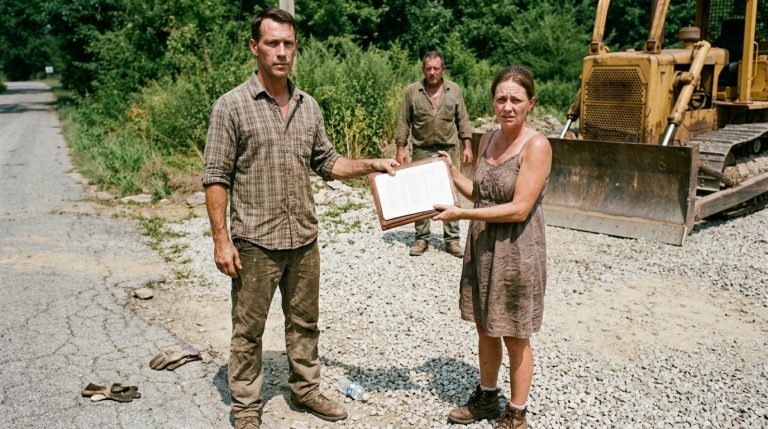
Karen stood four paces back, her floral mumu straining over a rigid frame like canvas stretched across a bursting sail. Her face was flushed the color of a bruised plum, her eyes pinched into narrow slots of calculated outrage. Between her sausage-like fingers, a thick, cream-colored envelope shook with a fine, rhythmic tremor.
“Thirty days, Mr. Callahan,” she spat, her voice climbing an octave as she thrust the envelope forward. The paper struck his chest with a dull, papery thud, a physical punctuation mark to a sentence written entirely in bylaws and petty malice. “This is a planned community. We have standards. That rusted monument to your stubbornness comes down, or the fines will swallow your land whole.”
Jack did نہیں flinch. He looked down at the envelope resting against his flannel shirt, then past her shoulder toward the far corner of his ten-acre parcel. There, rising above the dense canopy of ancient pines, sat the silhouette of the silo—sleek, muted, and entirely functional beneath its rustic facade. It did not look like a piece of critical federal infrastructure from down here. It looked like an old relic left behind by time.
“You’re trespassing, Karen,” Jack said. His voice was flat, pitched low to force her to lean in just an inch to catch it.
“I am the president of the North Ridge Meadows Homeowners Association,” she countered, her chest heaving as she inflated herself with the imagined authority of a thousand binder rings. “And that means my jurisdiction doesn’t stop at your property line when your ugliness offends the neighborhood’s eyes.”
She turned on her heel with surprising velocity, her beige golf cart idling a few yards away like an oversized plastic beetle. With a sharp whine of an overworked electric motor, she wheeled around and sped down the gravel path, kicking up a rooster tail of dust that hung suspended in the afternoon glare.
Jack watched her go. He did not chase her with shouts, nor did he ball his fists. Instead, he reached down, picked up the envelope, and slid his thumb beneath the heavy wax-sealed flap. He peeled it open with methodical precision, his eyes scanning the bolded, capitalized threats within: ten thousand dollars initial penalty, five hundred dollars daily accumulation, and a formal demand for immediate architectural surrender.
He folded the letter neatly, sliding it into his back pocket alongside his folding knife, and turned back to the fence post. He drove the staple home with a single, deafening blow of the hammer.
The silence that followed was heavy, but it was interrupted by the faint, rhythmic chirp of a digital notification vibrating deep within his pocket—a text from a number he hadn’t saved, carrying a preview line from the county records office that listed the recent property transfers of the board’s newest treasurer.
CHAPTER 2: The Assessment and the Call to Omnilink
The digital chime had barely died away when the heavy heat of the afternoon seemed to press down with renewed weight, settling over the dry oak leaves like a damp wool blanket. Jack did not check his phone immediately. In the communications battalions, reacting to a ping without establishing the perimeter first was a fast track to an ambush. Instead, he drove the final staple into the cedar post, tested the tension of the galvanized wire with a firm yank of his calloused thumb, and only then reached into his pocket.
The screen lit his face with a pale, cold glare. It was an automated alert from the county clerk’s database, cross-referencing recent property encumbrances and corporate filings in the North Ridge Meadows district. Attached was a brief public ledger snippet showing that the newly appointed treasurer, Todd, had recently transferred title interest in a secondary vehicle to an LLC registered out of state—a neat little shuffle of assets designed to insulate personal holdings before a major administrative push.
Jack let out a low, slow breath through his nose, his gaze shifting past the mended fence toward the northern boundary where the access road wound upward through the pine stand. The silo stood silent, its muted metal skin absorbing the amber glare of the declining sun. To anyone driving past on the public asphalt, it was just an ugly relic of an old farmstead, a rusted cylinder of corrugated steel that ruined the manicured uniformity of the developers’ vision. They didn’t see the heavy-duty cabling anchored deep into bedrock. They didn’t hear the whisper of fiber-optic data humming through underground conduits straight to his basement workshop.
He walked back toward the house, his boots crunching rhythmically across the sun-baked gravel. The smell of cedar sawdust and machine oil drifted out from the open door of his workshop, a familiar, grounding contrast to the cloying, synthetic perfume Karen had left lingering in the air like a bad chemical spill.
Inside, the workbench was a landscape of disciplined clutter. A disassembled two-way radio lay spread across a mat of static-resistant rubber, its tiny screws arranged in precise, concentric circles. Beside it sat the thick, cream-colored envelope Karen had thrust into his chest, its aggressive lettering mocking the quiet order of the room. Jack didn’t tear it open with rage. He picked up a pair of precision tweezers, slid them beneath the upper edge, and laid the document flat next to a heavy steel stapler to keep it from curling in the dry air.
The numbers were staggering on paper: ten thousand dollars base penalty, five hundred dollars daily compounding, backed by a formal notice of intent to lean. It was a textbook shock-and-awe campaign, designed to overwhelm a civilian homeowner who had never faced a bureaucratic machine before. But Jack wasn’t a civilian. For twenty years, he had managed complex, redundant communication relays across volatile sectors where a single dropped signal could compromise an entire logistics chain. He knew how systems broke down, and more importantly, he knew where the structural stress fractures lay hidden beneath the neat paint of municipal authority.
He sat down at his desk, sliding his laptop forward. The machine hummed to life instantly, the fan spinning up with a soft, clean whir. He didn’t check his email first. Instead, he opened a secure, encrypted client portal and dialed a direct extension that hadn’t seen heavy use in nearly three years.
The line rang twice before a crisp, professional voice cut through the static. “Omnilink Network Operations. Chen speaking.”
“David,” Jack said, his voice level and steady. “It’s Jack Callahan.”
A brief pause crackled across the receiver, followed by the faint sound of a keyboard clacking in the background. “Jack. Didn’t expect to hear from you before the scheduled autumn maintenance sweep. Everything operational at Tower 734?”
“The hardware’s fine, David. It’s the ecosystem around it that’s starting to rot.” Jack leaned back in his chair, his eyes fixed on the small status indicator blinking green on his router. “We’ve got a local homeowners association out here. Brand new development, pristine lawns, high-stress management. The president just served me a formal notice to tear down the relay within thirty days or face compounding daily fines and a property lien.”
Another pause on the other end, sharper this time. David let out a sound that was half-sigh, half-snort. “One of those. Let me guess, a self-appointed commissar with a binder full of illegal bylaws?”
“Worse. She thinks the municipal code outranks federal infrastructure acts because her subdivision has a gate and a painted curb.” Jack opened the scanned PDF of Karen’s letter on his screen, scrolling down to the itemized list of violations. “They’re threatening a lien on the parcel, David. They want to force a legal precedent through local courts.”
“They can try,” David said, his tone shifting instantly from casual to corporate-defensive. “Section 74 of the Telecommunications Act of 1996 protects that site explicitly. If they try to force a structural removal or place an unauthorized lien on a federally registered relay easement, our legal department won’t just slap them down—they’ll chew through their operating budget before the end of the quarter. Want me to have legal dispatch a formal cease-and-desist tonight? We can shut this down before it even reaches the local magistrate.”
Jack stared at the blinking green light on his router. The memory of Karen’s flushed, arrogant face flashed behind his eyelids—the absolute certainty of a petty tyrant who had never faced a mirror that didn’t flatter her. A quick legal letter from a corporate telecom giant would make her back down today, yes. But it wouldn’t teach her anything. It would just force her to retreat behind her desk, lick her wounds, and find some softer, more vulnerable target in the neighborhood to vent her thwarted control upon. A bully who is merely silenced does not stop being a bully; she simply learns to strike from a darker corner.
“Hold off on the legal letter for now, David,” Jack said softly.
A sharp intake of breath hissed through the receiver. “Hold off? Jack, they’re threatening a lien on your land. Once a municipal body initiates formal encumbrance proceedings, untangling the paperwork can turn into a bureaucratic nightmare, even if we have federal backing.”
“I know,” Jack replied, his fingers tapping a slow, even rhythm against the edge of the wooden desk. “I want to give her room to move. Let her commit the resources. Let her schedule the public hearings, loop in their bumbling local counsel, and get her entire board publicly invested in the fight.”
David was silent for a long moment, the hum of the network switching station filling the quiet space between them. When he spoke again, there was a reluctant, appreciative edge to his tone. “You’re giving her enough rope to build a scaffold.”
“I’m giving her an education,” Jack corrected. “Just keep your legal team on standby. Have the preemption briefs and the easement documentation polished and sitting on your desk. When I give the signal, I want you to drop the hammer so hard the shockwave rattles the county courthouse.”
“All right, Jack. It’s your property and your lease,” David said, a dry chuckle breaking through. “Just keep me posted. If they do anything physical to compromise the perimeter fencing or try to interfere with the maintenance access corridors, call me immediately. People high on local power tend to do very stupid things when they realize they aren’t the biggest fish in the pond.”
“I’ll keep an eye on them,” Jack said. “Talk to you soon.”
He hung up the phone and sat in the deepening quiet of the workshop. The sun was dipping lower now, casting long, razor-sharp shadows across the floorboards through the open door. The first phase of the engagement was set. Karen had fired her loud, emotional volley, confident in her tiny kingdom of rules and rubber stamps. But the infrastructure of the valley didn’t belong to her binder; it belonged to the quiet ground beneath her feet, and the wires running silently through the dark.
Jack stood up, walked to the window, and looked out toward the distant silhouette of the silo. A faint breeze stirred the pine boughs, rustling the needles with a dry, whispering hiss. On the horizon, the lights of the North Ridge Meadows subdivision were just beginning to blink on, uniform and bright, completely unaware of the circuit that was slowly closing beneath them.
CHAPTER 3: The Public Bulletin and the First Infiltration
The dusk over North Ridge Meadows did not arrive with soft gradients; it dropped like a heavy, charcoal-grey curtain pulled across the horizon by an unseen hand. The uniform roofs of the subdivision—each pitched to the exact same pitch, each painted in a pre-approved shade of earth-tone beige—bled into the deepening shadows until the entire development looked less like a neighborhood and more like an architectural ghost town built for compliance.
Jack kept his truck idling for a fraction of a second before shifting it into park near the main community bulletin board. The vehicle’s tires crunched sharply against the fresh asphalt of the entry circle. Through the windshield, illuminated by the harsh white glare of a high-pressure sodium streetlamp, stood the target: a massive, laminated notice pinned beneath a locking glass door, screaming in aggressive crimson font across the top edge.
He did not rush. Hurrying in an environment engineered for surveillance was a tactical error. He switched off the engine, let the diesel engine shudder to a quiet stop, and stepped down onto the asphalt. The night air carried the faint, synthetic scent of manicured lawns drenched in automated sprinkler water—a sterile, manufactured freshness that smelled entirely of chemicals and control.
Walking up to the glass enclosure, Jack didn’t need to squint to read the text. The headline was a blunt instrument: COMMUNITY ALERT: PROPERTY VIOLATION AT 141 OAK RIDGE TRAIL. Below it, in slightly smaller, meticulously kerned type, the notice detailed his refusal to comply with regional architectural mandates regarding an unapproved agricultural structure. It didn’t print his name in full, but it didn’t have to. In a place where everyone’s mailboxes were identical and everyone’s trash cans had to be wheeled in by precisely 7:00 PM, an outlier was as conspicuous as a flare in a coal mine.
He pulled his smartphone from his pocket, angled the lens to catch the glare without throwing a shadow, and snapped three high-resolution frames of the placard. Documentation. In a war fought with paper and bureaucracy, a timestamped photograph was worth more than a dozen angry arguments.
As the shutter clicked for the final time, the soft crunch of gravel announced an arrival behind him. Jack didn’t spin around; he turned slowly, his weight balanced evenly on the balls of his boots, maintaining the unhurried composure of a man who owned his ground.
A sleek white SUV had pulled up beside his truck, its headlights cutting twin beams through the gathering gloom. The driver’s side window hummed downward with a faint electronic whir, revealing the slicked-back hair and tight-lipped grin of Todd, the neighborhood treasurer. Todd’s polo shirt was buttoned to the top, stretched taut across a chest that radiated the nervous energy of a man who practiced authority in front of a mirror.
“See they finally posted that, did they?” Todd said, his voice dripping with a condescending neighborly warmth that didn’t reach his eyes. He rested his forearm casually along the open window frame, letting his gaze drift deliberately toward Jack’s older, dust-covered Ford F-150. “Real shame it had to come to this, Jack. We’re all just trying to protect our property values, you know. Some of us actually take pride in what this community looks like from the main road.”
Jack didn’t blink. He slid his phone back into his pocket with a quiet, deliberate motion and looked straight at the treasurer. He didn’t offer a defense, a complaint, or a curse. He simply let the silence expand between them, stretching the seconds thin until the hum of the SUV’s engine sounded entirely too loud in the empty cul-de-sac.
Todd’s smug smile flickered, the edges tightening into a defensive grimace as the silence pressed back against him. He had been braced for a shout, an indignant denial, or an argument he could log in his little mental ledger of civil infractions. Instead, he found himself staring into a flat, unreadable wall of absolute stillness.
“You’d… you’d be wise to just take the thing down,” Todd stammered slightly, his fingers tapping an anxious little tattoo against the car door. “Karen’s not one to back down when she sets her mind to an enforcement order. The legal fees are only going to start compounding from here.”
“Good evening, Todd,” Jack said finally, his voice smooth and devoid of heat.
The treasurer blinked, momentarily thrown off balance by the greeting. He opened his mouth to reply, thought better of it, and clamped his jaw shut. With a sharp jerk of his wrist, he shifted the SUV into drive, stomped the accelerator, and sped down the residential street, leaving behind a faint wake of exhaust and cheap cologne.
Jack watched the tail-lights vanish around the bend, a cold, analytical satisfaction settling into his chest. Todd was the accountant, the rubber stamp, the man who held the ledger. If Karen was the noisy vanguard of the board, Todd was the vault keeper. And vaults, Jack knew from years of managing secure installations, were only as secure as the weakest lock on the back door.
He climbed back into his truck, but instead of turning toward the winding exit that led home, he pointed the nose deeper into the subdivision’s labyrinth of identical streets. It was time to stop looking at the walls Karen had built and start finding the people trapped behind them.
The night was quiet, but beneath the manicured lawns and the rows of shuttered windows, the first real cracks in the foundation were beginning to show.
CHAPTER 4: The Coalition in the Workshop
The tail-lights of Todd’s white SUV had barely flickered out of sight around the curved asphalt of Oak Ridge Trail when Jack turned his truck back toward the gravel drive leading to his property. The night air was dry and smelled faintly of sun-baked dust and pine resin. Behind him, the uniform sprawl of North Ridge Meadows retreated into darkness, its rows of identical rooftops swallowed by the deep, jagged shadows of the ridge line.
Driving down his long, unpaved lane, Jack kept his speed low, his headlights sweeping across the dark trunks of the oaks flanking the road. He wasn’t rushing. In tactical staging, speed without security invited exposure. When he parked beside his weathered workshop, the building stood dark and solid, a stark counterpoint to the fragile, plastic-sided architecture of the subdivision below.
The heavy wooden door grated softly against the concrete floor as he pushed it open. Inside, the space smelled of iron filings, gun oil, and the dry, sweet scent of cedar sawdust. The workbench remained exactly as he had left it: the disassembled two-way radio array laid out in precise geometric rows, the red-inked legal notices clipped neatly beneath a steel machinist’s square.
He didn’t turn on the overhead fluorescents immediately. Instead, he snapped on the small desk lamp near the corner, casting a concentrated pool of amber light across the scarred oak surface. He pulled out a yellow legal pad and reached for a heavy brass pen.
The meeting at his house tomorrow night couldn’t be a loose gathering of complaining neighbors. If they were going to counter an institutionalized administrative board backed by a local law firm, they needed a framework. They needed an operational roster, an objective breakdown of grievances, and a clear legal wedge.
Jack began to list names, drawing precise vertical lines down the margin of the paper.
Henderson — Rose garden, arbitrary spacing fines.
Garcia — Children’s play equipment, color palette demands.
Marcus — Flagpole altitude infractions.
Each name represented a fracture point in Karen’s perimeter of control. She had spent two years treating the neighborhood like her personal fiefdom, relying on isolation to keep dissent from organizing. By making every homeowner feel like an isolated offender, she had prevented them from realizing a simple, devastating truth: the board’s authority was entirely dependent on compliance. Once compliance became optional, the illusion of absolute rule began to flake away like dry paint on cheap metal.
A sharp, double rap against the exterior workshop door broke the quiet rhythm of his pen.
Jack didn’t flinch. He laid the pen down beside the legal pad, walked across the concrete floor with steady, measured strides, and slid the iron bolt back. He swung the heavy door inward just enough to clear the threshold.
Marcus stood in the dim light of the overhang. The retired Marine gunnery sergeant wore a dark canvas jacket zipped to the collar, his hands tucked casually into his pockets, though his shoulders carried the upright, coiled posture of a man scanning a perimeter.
“Thought you might be up late,” Marcus said, his voice a low gravel rasp that cut cleanly through the night air. “Saw your truck come off the main road ten minutes ago.”
“Come on in, Marcus,” Jack said, stepping back to clear the entrance.
Marcus stepped over the threshold, his eyes sweeping the interior of the workshop with the practiced efficiency of someone assessing cover, exits, and choke points. When he spotted the neatly arranged electronics and the legal pad on the desk, a faint, dry smile touched the corners of his mouth. “Looks like a forward operating base.”
“It’s a logistics check,” Jack replied, closing the heavy wooden door and sliding the iron bolt back into place. “Karen’s legal team is escalating. They’ve filed formal notice of intent to place a lien on the parcel. If we don’t consolidate our intelligence before the special board meeting next week, she’s going to use the threat of foreclosure to intimidate the rest of the neighborhood into silence.”
Marcus pulled up a metal folding stool and sat down beside the workbench, resting his forearms on his knees. “Let her file the lien,” the former Marine said, his eyes hard and bright in the amber lamplight. “Every official piece of paper her lawyers stamp adds another exhibit to our ledger. But paperwork takes time, and people get spooked when they see the word ‘foreclosure’ on official letterhead. We need more than just a list of complaints, Jack. We need a lever that pries open the vault.”
Jack leaned back against the edge of the workbench, crossing his arms over his chest. “We have the vault,” he said quietly. “We just need to know what she’s hiding inside it.”
Marcus raised a graying eyebrow. “Meaning?”
“The HOA’s financial disclosures,” Jack said, his voice dropping an octave. “When we requested the books last week, what did they send back?”
“A stack of photocopied bank statements covered in so many Sharpie redactions it looked like a classified intelligence brief from the Cold War,” Marcus muttered, a dry chuckle escaping his throat. “They blacked out every vendor payment, every debit card transaction, and the entire balance sheet for the community reserve fund.”
“Exactly,” Jack said. “People who run clean books don’t use magic markers on public records. Todd is the treasurer, but Karen is the one steering the checks. If we want to break her hold on the board before the meeting, we don’t argue about birdbaths or flagpole heights. We follow the money.”
Marcus went still, his gaze locking onto Jack’s face. The humor vanished from his eyes, replaced by the sharp, analytical focus of a veteran strategist recognizing a decisive flank attack. “You think she’s skimming the reserves.”
“I think someone who is that obsessed with controlling every blade of grass in the valley usually has a financial incentive to keep outsiders from looking at the ledger,” Jack said. He reached down, picked up a printed business registry sheet from beneath the legal pad, and slid it across the wooden surface toward the sergeant.
Marcus picked it up under the amber light. His eyes scanned the registry details for Lush Greenscapes LLC, noting the incorporation date, the registered address, and the name of the sole managing officer listed at the bottom.
A slow, hard grin spread across the Marine’s face. “The brother-in-law,” Marcus murmured, shaking his head. “She’s awarding no-bid maintenance contracts to her own family at a fifty percent markup, and funding the difference out of the residents’ fines account.”
“It’s clean, it’s documented, and it’s entirely illegal under state nonprofit corporation statutes,” Jack said. “But we can’t just drop it in an email. If we present it too early, they’ll scrub the digital ledgers, lock the accounts, and claim it’s a clerical error.”
“So when do we spring it?” Marcus asked, his knuckles rapping a slow, deliberate tattoo against the edge of the stool.
“At the public board meeting,” Jack said, his voice as cold and sharp as the edge of a steel blade. “We let her schedule the hearing. We let her stand up in front of the entire neighborhood and wave her liens around. And then, right when she thinks she’s holding all the cards, we turn the lights on.”
Marcus stood up slowly, the metal stool scraping softly against the concrete floor. He buttoned his canvas jacket and nodded once, a crisp, definitive motion. “I’ll coordinate with the Hendersons and the GarcAs. Everyone stays quiet. No leaks, no premature warnings. Let her keep building her scaffold.”
“Keep your phone encrypted,” Jack added as Marcus slid the iron bolt back and opened the door to the cool night air. “And check your perimeter on the way out. Karen’s lieutenants are starting to get nervous.”
Marcus stepped out into the darkness, pulling the heavy wooden door shut behind him with a solid, reassuring thud. Jack listened to the crunch of his boots fading down the gravel driveway until the night reclaimed its absolute, unbroken silence. He turned back to the desk, picked up his pen, and began writing the final names on the roster. The trap was set; all that remained was for the quarry to walk into the light.
CHAPTER 5: The Redacted Ledger and the Discovery of Lush Greenscapes
The quiet hum of the desk lamp cast deep, razor-sharp shadows across the wooden surface of the workbench. Jack did not immediately turn back to his legal pad. He sat motionless for several seconds, his fingers resting lightly on the cold grain of the wood, listening to the steady, rhythmic ticking of a wall clock that kept time with absolute, unfeeling precision.
The documents Marcus had dropped off earlier—copies of the HOA’s partial financial disclosure—lay scattered across the back corner of the desk like a puzzle missing half its pieces. They were technical artifacts of institutional evasion. Every line item involving maintenance expenditures, contractor retainers, or emergency repairs had been aggressively masked behind thick blocks of black ink applied by a wide-tip permanent marker.
Jack reached out, picked up one of the photocopied pages, and tilted it toward the light. The cheap paper felt thin and brittle beneath his calloused fingertips. On a surface level, a casual observer would look at the redactions and assume the board was simply protecting sensitive vendor pricing or private commercial data. But to anyone trained in communications security and signal intercepts, redactions were never about protection; they were about concealment. They were the blank spaces left behind when someone tried to erase an impossible-to-explain frequency from the logbook.
He pulled his laptop forward, the screen flickering to life with a soft, cool glow that chased away the amber shadows. He opened a secure local spreadsheet database and began cross-referencing the few unredacted fragments visible along the margins of the photocopies—a partial vendor name here, a transaction code there, a routing number partially exposed by a sloppy photocopy feed.
The state’s business registry portal loaded with a sluggish hiss of data packets over his direct fiber-optic line. Jack typed in the fragmentary string of characters he had salvaged from the margin of the landscaping ledger: L-U-S-H G-R-E-E-N.
The database whirred for a fraction of a second before spitting out the corporate profile.
Lush Greenscapes LLC.
Registered Agent: Barry Vance.
Filing Date: Eighteen months prior—coinciding almost to the exact week with Karen’s ascension to the presidency of the North Ridge Meadows Homeowners Association.
Principal Business Address: A residential parcel located three blocks away from Karen’s own meticulously manicured lawn.
Jack leaned back in his chair, his eyes narrowing as he cross-referenced Barry Vance’s surname with public property records. A quick lineage check confirmed what his tactical instincts had already predicted: Barry Vance was Karen’s brother-in-law.
The pieces clicked together with the mechanical finality of a well-oiled breech-block. The community’s common areas—the patchy, weed-choked patches of grass flanking the entrance signs—were maintained by a phantom landscaping company that existed solely on paper and bank statements. The contract had never been put out to competitive bidding. It had never been voted on by the general membership. It was a closed loop of financial extraction, funneled directly from the residents’ monthly dues and punitive fines into a family bank account, masked by layers of administrative secrecy and enforced by threats of legal retaliation.
The air in the workshop felt heavier now, charged with the quiet, dangerous static before a lightning strike. Karen hadn’t just built an authoritarian regime of birdbaths and color palettes; she had built a tollbooth, and every neighbor caught in her bureaucratic crosshairs was paying the toll straight into her family’s pocket.
Jack didn’t reach for the phone to call Sarah Jenkins right away. Legal fire was a precision instrument; it required exact targeting. He opened a clean document window, pasted the business registry details alongside the redacted financial photocopies, and arranged them into a clear, chronological dossier. Every transaction was timestamped, every family connection mapped out in clean, undeniable text.
A sudden gust of wind rattled the corrugated metal roof of the workshop, a sharp, metallic ping that broke the heavy silence. Jack looked up toward the narrow window facing the north ridge. Beyond the glass, the silhouette of the silo stood tall and steady against the starless sky, its internal relays blinking a quiet, rhythmic green in the dark.
The trap was fully loaded now. The financial paper trail was secure, the coalition was organized, and the legal briefs were resting safely in reserve. Karen had wanted a war of attrition, believing her binder of rules made her invincible. She had no idea she had just handed her opponents the exact crowbar needed to pry open her entire vault.
Jack saved the file, closed the laptop lid with a soft click, and stood up from the desk. The preliminary skirmishes were over. Tomorrow night, the assembly doors would open, and the real work would begin.
CHAPTER 6: The Digital Darkness at the Community Center
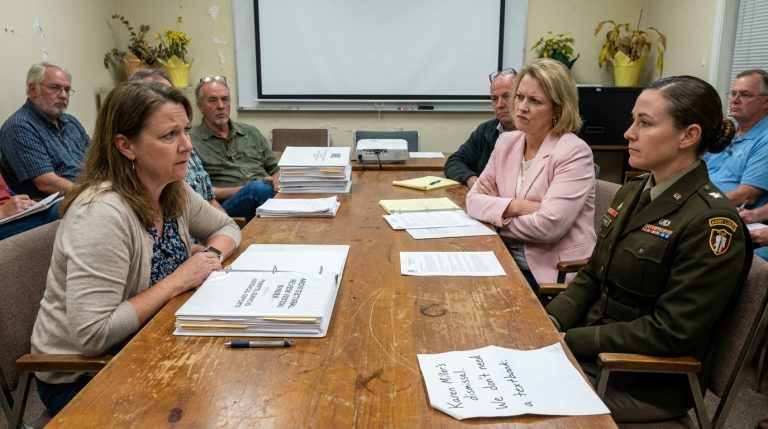
The air inside the North Ridge Meadows community center smelled of stale coffee, industrial floor wax, and the quiet, nervous perspiration of a hundred trapped residents. Fluorescent tubes hummed overhead with a high-pitched, electric whine, casting a pale, clinical light across the rows of folding chairs. At the front of the room, perched behind an elevated riser on a folding table, Karen presided over her kingdom in a garish magenta pantsuit that seemed to vibrate under the glare.
Jack stepped through the double doors, his boots making a dry, deliberate scrape against the linoleum. Marcus flanked him on his right, moving with the silent, rhythmic poise of an old soldier taking up a defensive position. Behind them, streaming into the hall like a rising tide, came the Hendersons, the GarcAs, and half a dozen other families who had spent the last year living beneath the shadow of Karen’s arbitrary fines. They didn’t march as an angry mob; they moved with the quiet, cold precision of a jury walking back into a courtroom.
Karen spotted them immediately. Her face flushed a deep, mottled plum, and she struck her wooden gavel against the table with a sharp, echoing crack.
“Order! This is a closed administrative hearing regarding unapproved structural violations,” Karen shrieked, her voice cracking slightly as she pointed a manicured finger directly at Jack. “Mr. Callahan, you are trespassing on agenda items not open to general public debate. Todd, log his defiance for the property lien.”
Todd, seated to her right with a stack of crimson-tagged folders clutched to his chest, nodded frantically, his face pale and slick with sweat.
Jack did not take a seat in the back rows. He walked straight down the center aisle, his stride unhurried, his hands buried deep in the pockets of his jacket. When he reached the front row, just twelve paces from Karen’s riser, he stopped. He didn’t raise his voice. He let the silence do the initial work, waiting until the low murmur of the packed room completely swallowed the hum of the fluorescent lights above.
“There is no unauthorized structure, Karen,” Jack said, his voice level, carrying a quiet, resonant weight that forced every head in the room to turn. “And there are no valid fines.”
Karen’s mouth opened, but before she could launch into her practiced defense of neighborhood aesthetics and property values, Jack reached down, pulled his laptop from his shoulder bag, and placed it squarely on the end of the long folding table, directly beside her gavel. With a swift tap of his thumb, he connected the machine’s display port to the community center’s overhead projector.
A massive, crisp digital image bloomed across the projection screen behind her head: a scanned, unredacted corporate filing from the state business registry, clearly displaying the name Lush Greenscapes LLC, alongside the residential address belonging to Karen’s own brother-in-law.
A sharp gasp rippled through the front rows.
“What… what is this?” Karen stammered, half-rising from her folding chair, her hands gripping the edge of the table as her eyes darted to the screen. “This is a fabrication! An illegal intrusion into private administrative records!”
“It’s a business registry filing, Karen,” Jack replied smoothly, stepping closer to the riser. “Just like the bank statements we requested under state nonprofit statutes—the ones your treasurer tried to bury under heavy black marker. You didn’t redact those vendor payments to protect privacy. You redacted them because you were funneling forty percent markups on sub-standard landscaping straight into your family’s private accounts, using the residents’ fines as your own personal slush fund.”
Todd slumped back into his chair, dropping his folders onto the linoleum with a heavy, humiliating clatter. The crimson-tagged notices spilled across the floor like scattered playing cards.
“Lies! All of it lies!” Karen screeched, her voice pitching into a frantic, hysterical shriek as she banged her gavel repeatedly against the table. “Security! Remove him! Vote on the lien! Authorize the attorneys right now!”
Not a single person in the room moved to help her. The silence of the crowd had transformed into something dense and glacial.
Jack pulled his phone from his pocket, his thumb unlocking the screen with a quiet, practiced motion. “You wanted to talk about aesthetics, Karen? You wanted to talk about what brings value to this valley?” He tapped the screen, opening the direct diagnostic interface linked to the secure communications relay hidden beneath the pines at the edge of his property. “Let’s show everyone what happens when your rules actually take effect.”
He hit the execution command on his screen, routing the signal straight through the regional switching node.
Instantly, every single smartphone, tablet, and digital watch in the community center chimed, buzzed, and died. The screen indicators dropped from five solid bars of high-speed data to a stark, uniform circle with a diagonal slash: No Service.
A collective intake of breath echoed through the hall. A young mother in the second row stared at her blank screen in sheer horror, remembering her child’s medical monitor app. An older man halfway back gripped his armrests as his stock portfolio feed vanished into a blank white void. In less than ten seconds, the entire room was hurled backward into the digital dark ages.
“That,” Jack said, his voice cutting through the rising panic like a razor, “is the cell relay you’ve spent the last month trying to demolish out of pure spite and ignorance. It isn’t an eyesore. It is the literal heartbeat of this community’s safety. And you were willing to cut the throat of the entire valley just to feed your own petty need for control.”
Karen stared at her own dead phone resting on the table, her face entirely drained of color. Her empire of binder rings, color palettes, and coerced compliance had evaporated in the span of thirty seconds, leaving behind only the cold, unyielding weight of the truth.
Marcus stood up from his seat, towering over the front row, his voice booming with the absolute authority of a command briefing. “I call for an immediate vote of no confidence in the president and the entire board.”
“Second!” shouted a dozen voices simultaneously from across the hall.
The vote didn’t need a formal ballot; the roar of agreement shook the ceiling tiles loose. Karen slumped back into her folding chair, her magenta pantsuit suddenly looking like a costume from a play that had just been permanently canceled.
Three days later, the forensic audit report was delivered to the district authority. The unredacted ledgers laid bare every fraudulent dinner, every personal spa weekend funded by community dues, and every inflated contractor invoice. By the end of the month, criminal charges for embezzlement and fraud were filed against both Karen and Todd. Facing mounting legal costs and complete social ostracization, Karen was forced to put her house on the market at a steep loss, packing her remaining belongings into a plain white moving van without once looking up toward the north ridge.
The neighborhood healed with the slow, steady rhythm of a machine returning to factory calibration. The new interim committee—led quietly by Jack, Marcus, and the Hendersons—stripped the covenants down to their structural studs, tossing out the arbitrary color codes, the flagpole height restrictions, and the weaponized fines.
On a bright, clear Saturday afternoon two months after the meeting, Jack stood beside the fence line on his ten-acre parcel. The air smelled of freshly turned earth and dry pine needles. With a steady hand and a heavy framing hammer, he drove the final galvanized staple into a weathered cedar post that Karen’s contractors had once threatened to tear down.
He stepped back, wiped a light film of sawdust from his palms, and looked up. High above the rolling hills, the disguised communications tower stood tall and silent against the endless blue sky, its internal relays blinking a steady, reassuring green. The valley hummed beneath it, alive and connected. Jack walked back toward his workshop, the rhythmic crunch of gravel beneath his boots blending into the quiet, perfect peace of a world restored to its proper weight.