How A Retired Army Engineer Used Gritty Perseverance And Historical Archives To Defeat An Overbearing Suburban HOA
CHAPTER 1: The Pink Line
I kept my thumb pressed firmly against the warm metal casing of the brass pocketknife in my pocket, letting the familiar weight anchor me.
Karen Miller stood right at the edge of my property line, careful not to let the heel of her pristine white sneaker touch the overgrown grass.
“This dirt hole is a public nuisance and a liability,” Karen said, tapping her clipboard with a manicured fingernail.
She stared past me toward the old stone root seller built by my great-great-grandfather a century ago.
“Five thousand dollars,” she continued, her voice sharp enough to cut glass. “Paid to the association by the end of the week, or we bring in the excavators ourselves.”
I wiped a smear of grease off my thumb onto my jeans and didn’t say a word.
After twenty-two years in the Army Corps of Engineers, I knew better than to argue with someone who mistook volume for authority.
Karen wanted a fight, but she had no idea what kind of ground she was standing on.
CHAPTER 2: The Red Tape Wall
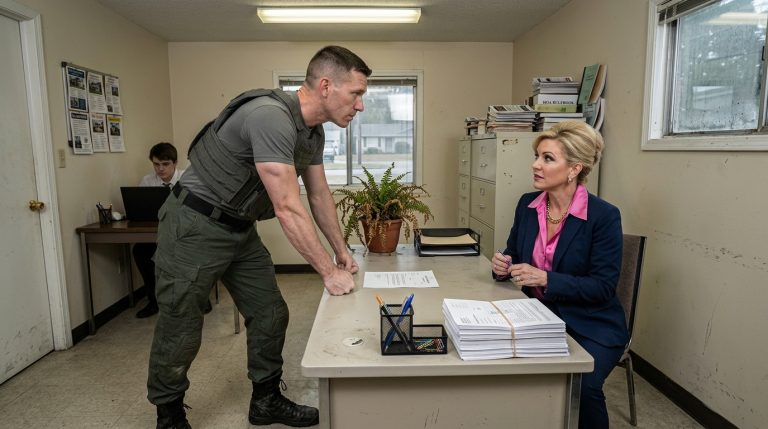
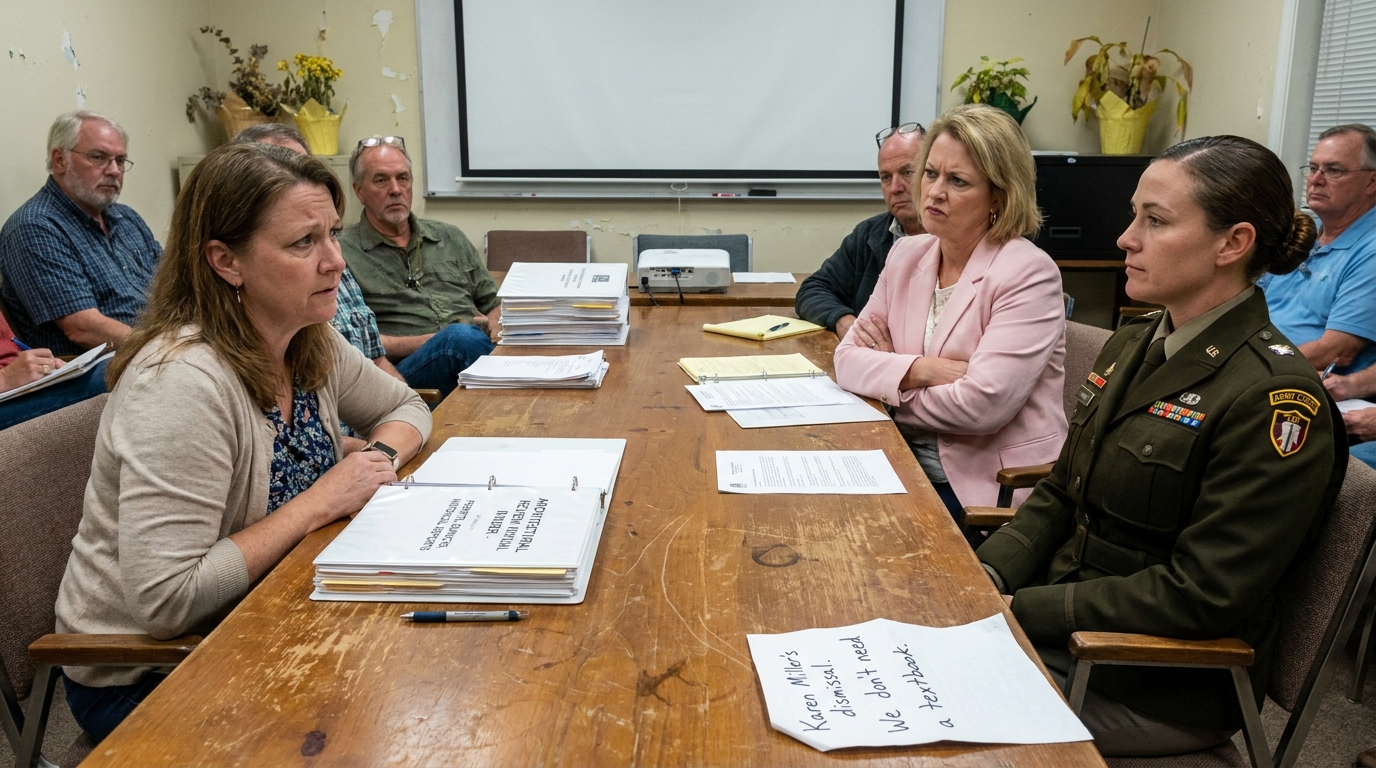
I slid the hundred-page architectural review binder across the scarred wooden table without a word.
Gary, sitting on the committee panel, blinked down at the heavy stack like it was a physical weight.
“What is this?” he asked, his voice tightening.
“Every single permit, structural survey, and historical report required by county code,” I said, leaning back and resting my hand on the table.
Karen Miller scoffed from the head of the table, her pastel pink jacket rustling as she crossed her arms.
“We don’t need a textbook to tell us a pile of dirt and old stone is a blight,” Karen snapped, waving a manicured hand dismissively.
“You haven’t even opened the cover,” I replied, keeping my tone completely flat and level.
Brenda, sitting near the corner, reached out a hesitant hand and tentatively flipped open the cover to the first dense engineering schematics.
“He included pest control reports and soil stability assessments,” Brenda murmured, her brow furrowing as she scanned the margins.
Karen shot a sharp glare across the table at her fellow board member.
“Close that right now, Brenda—we are voting to deny based on neighborhood uniformity.”
“You can’t vote on a review you haven’t legally opened or inspected,” I said, my voice dropping an octave as I watched her panic behind the polished veneer.
CHAPTER 3: Attic Dust and Paper
I ran my thumb over the edge of a cedar box pushed far into the shadowy eaves of the farmhouse attic.
My grandfather had left this space untouched for thirty years, preserving every record of the land long before subdivision developers ever drew lines on a map.
I lifted the heavy lid, disturbing layers of gray lint that settled across my worn work boots.
Inside sat bundles of correspondence tied with faded twine and yellowed ledgers detailing the daily struggles of the homestead.
A sharp smell of old parchment and dried pine filled the cramped space as I sifted through the papers.
Deep at the bottom rested a rigid cardboard folder protected by oilskin wrapping.
I pulled it free and unfolded the heavy paper under the single overhead bulb hanging from the rafters.
The embossed seal of the National Register of Historic Places stared back at me in bold, unyielding print.
My great-grandfather had secured federal protection for the stone cellar back in nineteen-twenty-four with the help of a state historian.
Karen Miller thought she was dealing with an ordinary backyard utility shed she could bulldoze on a whim.
She had no idea what kind of history she was trying to bury under wet concrete.
CHAPTER 4: The Neighborhood Alliance
Arthur tossed his wet woolen cap onto the counter and pulled a folded legal map from his coat pocket.
“More people are dealing with Karen’s notices than we thought,” Arthur said, smoothing the paper flat against the wood.
I crossed my arms, feeling the persistent chill of the room settle into my joints.
“She sent warning letters to three other families on Maple Street this morning alone,” I said, my voice low and steady.
Arthur adjusted his wire-rimmed glasses and tapped a finger against a marked parcel on the map.
“It isn’t just about your property lines anymore—she’s trying to force compliance across the entire sector before anyone can organize.”
We sat across from each other in the dim light, mapping out the growing list of grievances collected from our neighbors.
Every name on that paper represented another household pushed to the breaking point by arbitrary fines and pastel-colored tyranny.
“We need a unified front for the county commissioners’ meeting,” Arthur urged, looking up with a hard glint in his eye.
“I have the federal records from the attic,” I replied, tapping the edge of the cedar box on the shelf.
“Then we let her keep building her case right up until the floor drops out from under her.”
CHAPTER 5: The Legal Foundation
Dave picked up the receiver on the second ring, his eyes fixed on the federal preservation codes spread across his desk.
“I’ve got the state attorney on the line,” Dave said, resting his palm flat against the legal brief.
I leaned closer to the speakerphone, listening to the steady hum of the long-distance connection.
“Destroying a documented Underground Railroad site isn’t just an HOA code violation,” the attorney’s voice crackled through the small speaker. “It’s a federal felony under historic preservation laws.”
Dave nodded slowly, clicking a pen against the wooden desk surface.
“We have the original nineteen-twenty-four registry certificate and the surveyor logs right here,” Dave said.
“File the injunction immediately,” the attorney instructed. “If her contractors touch a single stone of that structure, federal marshals will step in.”
I felt a cold wave of calm wash over the tension in my shoulders.
Karen thought she could hide behind neighborhood fines and intimidation tactics.
She was about to run face-first into a wall of federal statute that no amount of pastel paint could fix.
CHAPTER 6: Concrete and Silence
Karen Miller stepped out of her sedan in her pastel pink jacket, gesturing aggressively for the flatbed driver to back his rig toward the historic cellar.
” Tear it down right now,” Karen shrieked, waving her clipboard toward the stone wall.
I stepped off the porch and walked slowly down the gravel path, keeping my thumb hooked in my pocket against the smooth brass of my pocketknife.
“That truck doesn’t move another inch,” I said, my voice cutting cleanly through the diesel noise.
Karen sneered, tossing her head back with a loud scoff.
“You don’t have a choice in the matter—the association has already condemned this eyesore.”
I pulled the federal preservation certificate from my jacket pocket and unfolded it directly in front of the driver’s window.
“Federal statute protects this site as a documented Underground Railroad sanctuary,” I said, locking my eyes onto Karen’s widening stare.
“That’s a fake piece of paper,” Karen yelled, her face instantly draining of color as she lunged forward to grab the document.
The driver slammed his gearshift into park and killed the engine immediately, staring down at the embossed federal seal with wide eyes.
“I’m not touching a federally protected landmark, ma’am,” the driver said, unbuckling his seatbelt and stepping down out of reach.
Karen spun around, grabbing her phone and screaming into the receiver for county deputies to arrest me for trespassing on her community’s development zone.
Two local sheriff cruisers rolled up the drive within minutes, but they bypassed Karen entirely and walked straight to where I stood.
“We received the injunction from the federal preservation office,” the lead deputy said, nodding to the papers in my hand.
Karen shrieked that she was being victimized, demanding the officers drag me off my own land immediately.
The deputies ignored her completely, standing shoulder-to-shoulder with me as the neighborhood watched from the road.
By evening, the board had dissolved under an avalanche of emergency investigations and audit notices.
I sat back on the front porch with a cold cup of coffee as the sun dipped below the Virginia tree line, listening to the absolute quiet of the restored homestead.