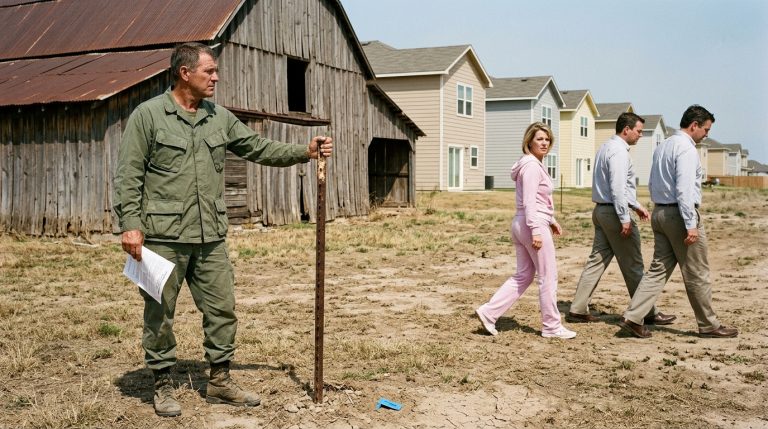
When a Self-Appointed HOA Queen Targeted a Retired Veteran Over a Basement Dig, She Unwittingly Triggers Her Own Total Collapse
CHAPTER 1: THE FIRST SALVO
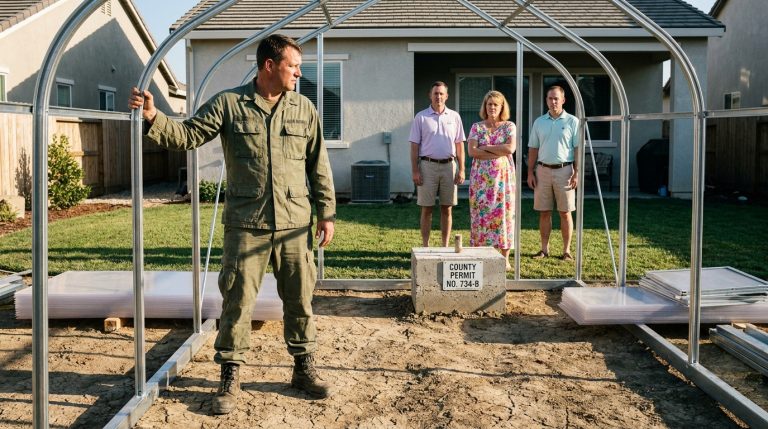
The afternoon heat hung heavy over Willow Creek Estates, baking the manicured lawns into a uniform shade of bleached green. I stood at the edge of the excavation pit in my backyard, watching the excavator bucket scoop another heavy load of dark, damp earth. The smell of turned clay and diesel exhaust filled the air, grounding me in the steady, rhythmic mechanics of the machine.
Then the shadow fell across the trench.
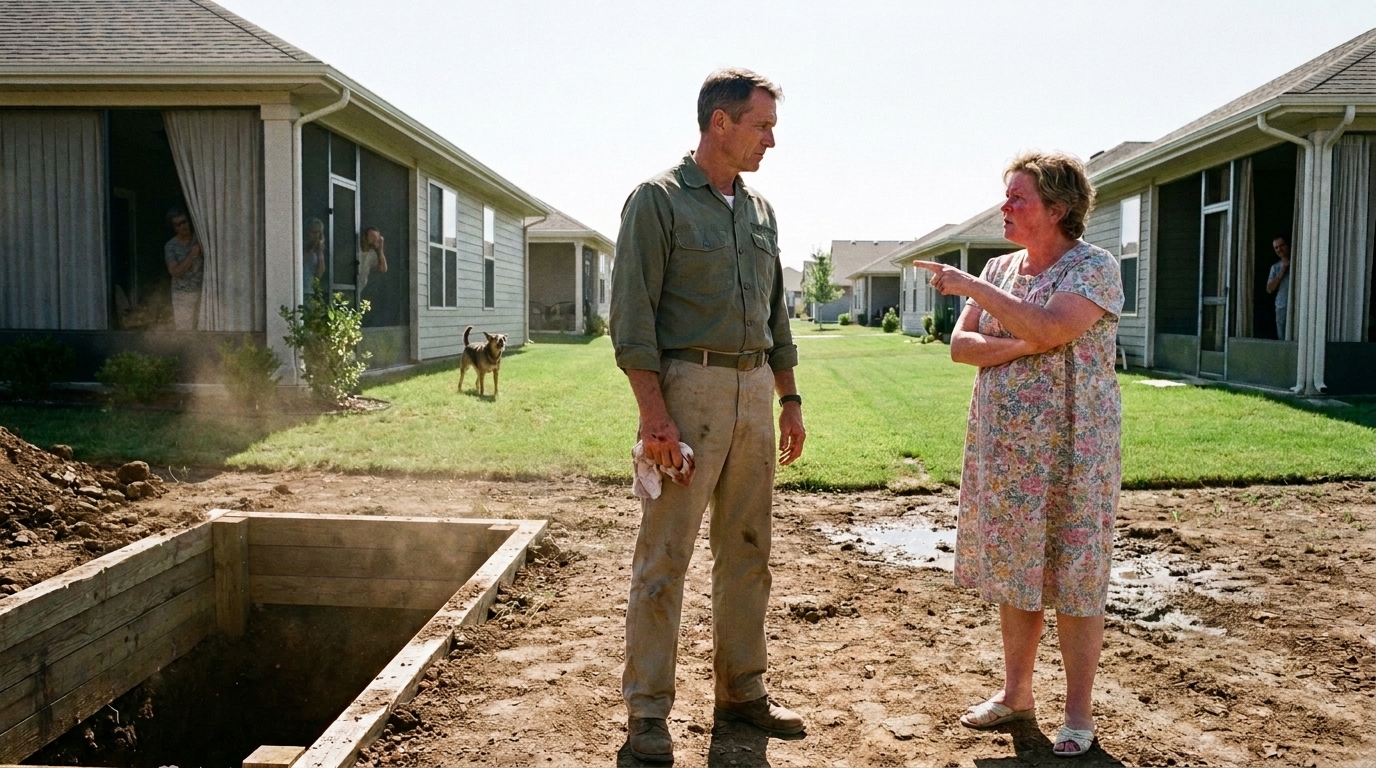
“That little hole in the ground of yours is going to cost you more than this entire house, Mr. Davies.”
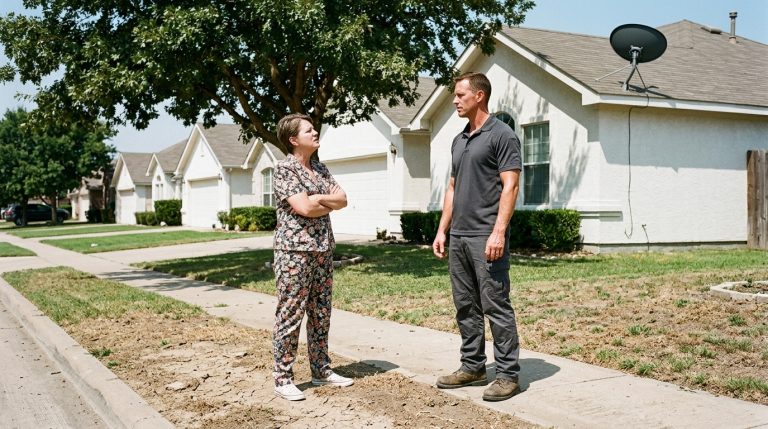
I didn’t rush to turn around. I let the silence stretch for three slow heartbeats, listening to the engine idle down to a low, rattling purr. When I finally turned, Karen stood at the property line wrapped in a floral print mumu that billowed around her frame like a distressed sail. Her arms were locked across her chest so tightly her knuckles looked translucent, and her face bore that familiar, blotchy crimson shade of someone accustomed to getting their way through sheer volume.
“I have the city’s chief building inspector on speed dial,” Karen snapped, jabbing a thick finger toward the freshly shored-up pit where my future wine cellar was taking shape. “And I assure you, he does not appreciate unpermitted doomsday bunkers being dug in my neighborhood.”
I looked from her furious, contorted expression down to the clean, laser-leveled timber supports lining the excavation. I reached into my pocket, pulled out a clean handkerchief, and wiped a smudge of red clay off my thumb. The motions were deliberate, stripped of any hurried anxiety.
“Karen,” I said, keeping my voice entirely flat, pitched at the level I used during twenty-five years of briefings in the Army Corps of Engineers. “It’s a wine cellar. And every single permit was approved and filed with the city three months ago.”
Her jaw tightened, the skin pulling thin and pale over her teeth. She opened her mouth to launch another volley about community harmony and property values, but I cut right through her cadence.
“Your covenants make no mention of subterranean construction,” I continued, stepping slowly toward the edge of the grass. “Which means you have zero jurisdiction here.”
Her face didn’t just turn red; it darkened to an ugly, bruised purple. She took a sharp breath, her eyes bulging with the absolute, unearned conviction of a petty tyrant whose authority had just been questioned in broad daylight.
Before she could spit out her next threat, I turned my back on her and walked back to the excavator, signaling the operator to cut the engine. The sudden silence that filled the yard was heavy, thick with the friction of a war that had only just begun.
CHAPTER 2: THE FORMAL DEFENSE
The aggressive bold font of the letter screamed from the page, demanding an immediate halt to my unapproved major structural modification. It slapped a five-hundred-dollar fine down on my breakfast table with threats of a daily surcharge. Karen clearly expected me to panic, to call her phone in a cold sweat begging for a grace period.
Instead, I pulled my heavy oak-framed reading glasses from my pocket and set them down with a quiet tap.
The weakness in her document was as wide as a breached levy. She cited a broad, toothless catch-all clause about community aesthetic harmony without pointing to a single concrete subsection. It was a smoke screen thrown up by someone who had never read a legal covenant past the title page.
I sat down at the desk, the lingering scent of pine sawdust from my workshop clinging to my flannel sleeves. I didn’t reach for the phone or fire off an angry email. I reached for a thick stack of clean paper and a black ink pen.
Section one of my response mapped out the exact engineering realities of the subterranean storage space. I laid out the depth, the reinforcement schedules, and the waterproof membrane layers with the cold, unyielding mechanics of an after-action report. Every sentence was anchored in physical fact, stripping away her emotional hyperbole piece by piece.
In section two, I dismantled her authority using her own governing text. I quoted Chapter Four directly, exposing the total absence of any language restricting subterranean construction. I slid the entire set of CC and Rs into the packet as Appendix A, highlighting the empty spaces where her rules conveniently failed to exist.
Then came the centerpiece of the counter-offensive. Appendix B held the full-color, city-stamped architectural drawings bearing the signature and seal of the department head, Mr. Miller. Every permit, every geological survey, every engineering stamp was laid out in undeniable clarity.
I finished the final paragraph with a polite, razor-sharp refusal to pay her arbitrary fine. I added a quiet caution regarding harassment and defamation, noting that any future correspondence would route directly through legal counsel. I folded the multi-page report, slipped it into a heavy envelope, and sealed it with a firm press of my thumb.
The certified mail return receipt came back five days later, bearing Karen’s loopy, ostentatious signature in the green box. For two weeks, the neighborhood fell into an eerie, manufactured silence. The construction on the cellar continued without interruption, concrete pouring smooth and true against the forms.
Then Sarah walked through the front door from the community mailboxes, her face flushed with a tight, simmering anger.
“She’s whispering to the neighbors,” Sarah said, tossing her keys onto the counter with a sharp clatter. “She told Carol that our digging is going to destabilize the entire street.”
I walked to the window, watching the afternoon sun gleam off the pristine shingles of the houses across the street. The whispering campaign meant the paper defense had bitten deep. Karen was losing control of her narrative, and a cornered tyrant always reaches for heavier ammunition.
CHAPTER 3: THE INSPECTORS VERDICT
Robert Henderson stepped out of the truck cab, holding a heavy-duty clipboard in one hand and a digital camera in the other.
Before his boots even hit the pavement, a canary-yellow pantsuit came screeching up behind him in a cloud of dust. Karen maneuvered her golf cart onto the grass line with a triumphant smirk plastered across her face.
“Mr. Henderson, thank you for coming so quickly,” Karen called out, waddling past the hood of her cart. “As I told you on the phone, it’s a major safety issue. He’s been digging for months.”
Henderson gave her a brief, unreadable glance, ignoring her outstretched hand as he turned his attention toward me.
“Frank,” he said, shaking my hand with a firm, dry grip. “Let’s take a look.”
I led him straight through the front door, leaving Karen fuming on the porch like an uninvited guest locked out of a banquet. The dining room table was laid out with my complete, city-stamped architectural plans and permit packets, weighted down at the corners by heavy brass bookends.
Henderson spent ten solid minutes tracing the lines with his finger, comparing the rebar schedules to the notes on his clipboard.
“Comprehensive,” he muttered, an unmistakable note of professional respect entering his voice. “Who drew these?”
“I did,” I replied. “Retired Army Corps engineer.”
“That explains it.”
We walked down into the excavation space beneath the house, where the smooth concrete walls and reinforced framing stood stark and dry under the work lights. He ran his hand over the cured surfaces, checked the plumbing conduits for proper grade, and tested the vapor barriers.
When we climbed back up to the porch thirty minutes later, Karen was waiting with her arms tightly crossed and an expression of desperate certainty.
“Well?” she demanded, her voice climbing an octave. “Are you shutting him down?”
Henderson slipped his camera into his jacket pocket and looked at her with flat, institutional indifference.
“Ma’am, Mr. Davies’s project exceeds every applicable building code,” he stated, his voice carrying clearly across the yard. “There are no violations. It’s an exemplary piece of construction. I am closing this complaint as unfounded.”
Karen’s jaw went slack, the color draining entirely from her cheeks as she stammered at the word unfounded.
As Henderson turned to pack his gear, I stepped forward, pitching my voice at a calm, conversational register.
“Robert, before you head back, I noticed a few things on my evening walks near the community center,” I said, gesturing vaguely down the block. “Some step-cracking on the north exterior brickwork and significant heaving at the walkway control joints. Might be worth a quick look for public safety.”
Karen’s head snapped toward me, her eyes bulging with sudden terror. “He’s making things up!” she hissed.
Henderson paused, his eyes narrowing as he looked from Karen’s frantic expression to my steady gaze.
“Since I’m already out here,” Henderson said slowly, a new glint of professional curiosity replacing his weariness. “It probably wouldn’t hurt to take a quick look. Public building, after all.”
He turned and walked down the street toward her precious community center, leaving Karen staring after him like a beached carp.
CHAPTER 4: THE EMERGENCY MEETING
The air inside the main hall was heavy with the stench of stale coffee and rising panic. Karen sat at the folding table up front flanked by two nervous board cronies, opening the emergency session with a somber speech about unexpected maintenance and bad luck.
She framed the sudden requirement for an engineering assessment as an unavoidable act of God. She didn’t mention the inspector, and she certainly didn’t mention my name.
I let two other residents voice their confusion before stepping into the center aisle.
“Frank Davies, 124 Oak Street,” I said, projecting my voice cleanly toward the back row. “Karen, let’s clarify the timeline. You called the inspector for a routine visit on Tuesday, October fifth?”
Karen’s face tightened into a hard, blotchy knot. “He was just in the area.”
“Let me help you,” I continued, sliding a paper from my binder. “He was at my house because you filed a false complaint about my wine cellar. After he found my work to be exemplary construction, I pointed out the structural cracks on this very building as a matter of public safety.”
A sharp murmur rippled through the rows of folding chairs.
“So let’s be entirely clear,” I said, my tone hardening. “This assessment is not bad luck. It is the direct result of you abusing your power to harass a resident, bringing an inspector who then found a massive failure at your own headquarters.”
Dave Martinez stood up near the back, his broad shoulders squared.
“I’ll take one of those timelines, Frank,” he rumbled.
Hands began shooting up across the room. Sarah and Dave started passing out the printed packets while Karen sat frozen behind her folding table, her narrative completely dismantled.
Barry, the sweating treasurer, tried to interrupt, claiming it was all a personal vendetta.
“My grievance isn’t personal,” Dave fired back, cutting him off entirely. “It’s about my tomato plants. And Mrs. Gable’s bird bath. The real problem isn’t Frank’s cellar—it’s the leadership running this neighborhood into the ground.”
The room erupted into a torrent of long-suppressed frustrations, shouting down the board’s excuses with hard, undeniable anger. Karen sat pale and shaking as the residents refused to approve any funding until a complete independent financial audit was launched.
The queen’s empire wasn’t just cracking; it was flatlining in real time.
CHAPTER 5: THE LEGAL COUNTERSTRIKE
Arthur adjusted his reading glasses, his calm, predatory stillness filling the quiet office. He flipped open the pages of the personal lawsuit Karen had filed against me, seeking four hundred and fifty thousand dollars in damages for supposedly diverting groundwater with my wine cellar.
He didn’t blink. He didn’t raise his voice.
“Lieutenant Colonel,” Arthur said, a thin smile touching the corner of his mouth. “This isn’t a lawsuit. This is a gift. She has just handed us the rope to hang her with.”
Within a week, Blackwood Stern and Associates filed a devastating motion to dismiss her frivolous claim while launching a massive countersuit against Karen, Barry, and Linda personally. We weren’t just playing defense anymore. We were demanding every internal email, every bank record, and every hidden meeting minute from the last five years of their regime.
The judge took less than five minutes to throw Karen’s lawsuit out of court with prejudice, publicly rebuking her legal counsel for an egregious abuse of the judicial process.
That was when the discovery boxes started rolling into Arthur’s office.
Inside the digital records lay an unedited, timestamped email chain from two years prior. A former board member had flagged a musty smell and standing water in the community center basement, attaching a handyman’s warning about structural integrity.
Karen’s written reply flashed on my screen like a flare in the dark.
“Let’s not open that can of worms,” she had typed back. “We don’t have it in the budget. Just have him put a fan down there and paint over any stains.”
She had known about the rot for years. She had actively chosen to cover it up, letting the foundation sink and crumble while she spent HOA dues on personal lunches and fine-fined neighbors over bird baths.
When Arthur confronted her with that exact email during her formal deposition, her composure finally shattered. She sat under the harsh fluorescent lights, her hands trembling over the printed pages as her self-righteous facade dissolved into ash.
She stared across the table at me, her eyes burning with raw, venomous hatred.
“He started it,” she whispered, her voice cracking into a ragged wheeze. “He came into my neighborhood and didn’t follow the rules.”
“Whose rules, Mrs. Miller?” Arthur asked quietly. “The community’s rules, or your own?”
She had no answer left. Faced with personal financial ruin and the total collapse of her alliances, the board members scrambled to cut their own deals and abandoned her to the wreckage she had built.
CHAPTER 6: THE NEW NORMAL
The settlement had stripped her of her defense funds, her board seat, and her illusion of absolute authority. Karen and her husband packed their belongings into a moving truck under the watchful gaze of a neighborhood that no longer feared her shadow.
I watched from the front porch as she walked out of her front door for the very last time. Her face was hollow, tight with the bitter weight of a defeat entirely of her own making.
She paused by her car, catching my eye across the manicured lawn. I didn’t smile, and I didn’t gloat. I simply offered a calm, steady nod of finality.
She turned away, climbed behind the wheel, and drove out of Willow Creek Estates without looking back once.
Down the street, the community center sat behind thick plastic caution tape, awaiting the structural remediation funded by a newly restructured board and a transparent loan. Dave Martinez now held the keys as president, bringing the quiet, unyielding discipline of a veteran to a neighborhood finally free of tyranny.
The air outside was crisp, smelling faintly of autumn leaves and damp earth.
I turned back inside and walked down the steps into the cool, dark perfection of the subterranean vault. The redwood racking stood straight and true against the poured concrete walls, every angle square, every joint secure.
Dave walked down the stairs a moment later, holding two crystal glasses. He poured a dark, rich stream of the vintage wine into each, the liquid catching the amber light of the recessed fixtures.
“She tried to break you over this place,” Dave said, swirling his glass with a thoughtful look. “And this place ended up exposing every rotten beam she tried to hide.”
I took a slow sip, letting the complex, balanced notes settle on my tongue.
“She didn’t understand the fundamentals,” I replied, my voice echoing softly against the concrete. “Whether you’re building a cellar or a community, if your foundation is rotten, no amount of paint will save you.”
We touched the rims of our glasses together with a quiet, solid clink. The air was still and cool, stripped of tension, anchored entirely in the heavy, satisfying peace of common sense restored.