The Iron Pulse Beneath the Dust: How an Ignored Veteran Brought a Silent Armor Battalion Back to Life
CHAPTER 1: THE DEAD LINE
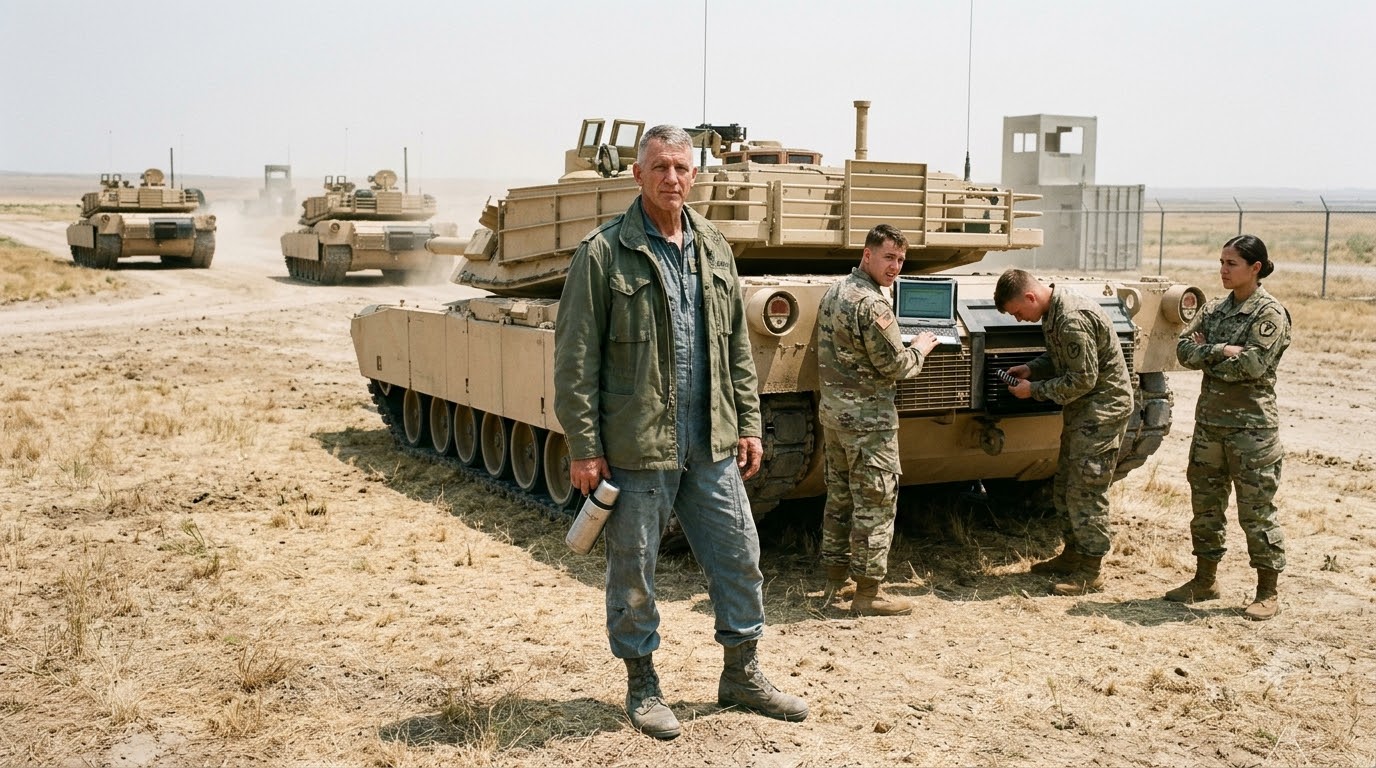
The coffee in the steel thermos had gone lukewarm ten miles back. Arthur held the cup in one calloused hand, his thumb tracking the shallow dent near the rim where it had dropped onto the concrete floor of his garage three winters ago.
Across the county road, the Fort Riley training ground kicked up a fine, choking grit that settled over the dry grass like wood ash. Three M1 Abrams tanks idled in a loose echelon formation, their turbine exhausts shimmering against the July sky.
Then the lead hull coughed. It wasn’t the clean, high-pitched whine of a healthy Honeywell turbine spooling up under load. It was a wet, heavy choke, followed instantly by the flat silence of an electrical relay dropping out.
Thirty yards away, a pair of green utility vehicles swung hard around, kicking up gravel as they raced toward the stalled behemoth. A staff sergeant hopped out before the tires had even stopped rolling, waving a heavy grease rag in one hand and shouting an order that got shredded by the wind.
Arthur unscrewed the thermos lid, took a slow, bitter sip, and watched the young mechanics swarm the rear engine deck. They moved fast, too fast, their boots scrambling over the non-skid plating with the desperate frantic energy of men who knew headquarters was watching the clock.
A digital diagnostic tablet flashed blue in the sunlight as a specialist plugged it directly into the hull’s data port. Arthur watched the boy tap the screen twice, shake his head, and yell something up to the commander’s hatch.
The tank didn’t twitch. The multi-million-dollar machine sat dead in the middle of the dust, a motionless slab of composite armor and steel that had suddenly turned into an eighty-thousand-pound paperweight.
Arthur set the thermos down on the tailgate of his faded pickup truck. His fingers brushed the edge of the worn denim jacket draped over his arm, feeling the coarse cotton weave that still smelled faintly of machine oil and old memories.
The heat was climbing past one hundred degrees on the shoulder, baking the asphalt until it smelled of tar and scorched rubber. Down on the field, the staff sergeant threw his hands up in frustration, kicking the side track guard with a heavy combat boot.
Arthur closed the thermos, the metal threads clicking home with a crisp, clean snap. He stepped off the truck bumper, his boots hitting the dirt with deliberate weight, and started walking toward the fence line.
CHAPTER 2: THE DISMISSAL
The young corporal didn’t look back right away. He was still staring down at the glowing blue screen of the diagnostic tablet, his thumb swiping across a string of error codes that made no mechanical sense.
“Sir, this is a restricted training area,” the corporal said, his voice dropping an octave to match the low whine of the secondary generators. “I appreciate the thought, but this is an M1 Abrams main battle tank. It’s a little more complicated than what you might be used to.”
Arthur didn’t blink. His hand stayed flat against the cold galvanized wire of the fence, feeling the faint, high-frequency hum vibrating through the steel posts from the idling armor three hundred yards away.
“I know what it is,” Arthur said. His voice was dry, carrying the flat, level cadence of a man who had spent three decades explaining why a gear didn’t care about a private’s opinion. “I spent twenty-seven years keeping them running.”
The corporal turned then, his boots crunching on the loose gravel. He looked at the faded red baseball cap, the grease-stained cuffs of the civilian trousers, and the worn denim jacket that had seen better decades.
“Look, mister,” the soldier said, shifting the heavy tool kit to his other hand. “We’ve got a battalion commander standing five miles up the road checking his watch. The diagnostic rig says we’ve got a complete electronic relay failure in the fire control network. A civilian tractor fix isn’t going to clear a digital fault.”
Arthur didn’t raise his voice. He didn’t have to. “Your diagnostic rig is reading what the computer thinks is happening, son. It doesn’t know what the weather’s doing to the metal underneath.”
The corporal stared at him for a long, heavy beat, a flicker of irritation tightening the skin around his eyes. He raised the radio clipped to his web gear, his thumb hovering over the push-to-talk button.
“Stay right there, sir,” the corporal said, turning his back with deliberate stiffness. “Let me get a staff sergeant down here to explain why you can’t stand by the perimeter during a live diagnostic.”
CHAPTER 3: THE AUTHORIZED GATE
Rodriguez didn’t look at the corporal. His eyes stayed locked on Arthur through the galvanized diamond mesh, sizing up the faded denim jacket and the quiet posture of a man who wasn’t shifting his weight.
“You said it’s a solenoid valve,” Rodriguez stated, his voice tight with the flat friction of a supervisor running out of runway before headquarters called down. “That’s not what the tablet’s spitting out.”
“The tablet’s reading an electronic fault because the computer doesn’t know what heat expansion does to a physical spring,” Arthur replied, his thumb brushing the smooth metal rim of the thermos in his grip.
The sergeant let out a sharp breath that stirred the dust on his collar. He reached down, keyed his radio twice, and spoke four words into the grid before turning toward the checkpoint gate.
“Open the south vehicle access,” Rodriguez commanded over the squawk.
Ten minutes later, a military police humvee rolled up to the service road, escorting Arthur through the barrier under the steady, curious gaze of three separate mechanics leaning over the dead hull.
Captain Torres stood by the rear deck with his arms crossed hard over his chest, his jaw set like a vise.
“Master Sergeant Dalton?” the captain asked, using the rank Rodriguez had relayed through the radio channel.
“Retired,” Arthur said, stepping out onto the sun-baked training ground without looking back at the gate.
CHAPTER 4: THE TACTILE DECK
The residual heat radiating off the composite armor plate hit him like an open oven door, baking the salt into the corners of his eyes.
Arthur ignored the stiffness in his knees, keeping his center of gravity low as he climbed onto the rear deck where the Honeywell turbine sat dead and silent under its armored shroud.
Four mechanics stood in a tight circle below the track guard, watching his every movement with the wary, cross-armed posture of men waiting for a civilian to fail.
“Master Sergeant,” Captain Torres called out from the edge of the dust circle, his voice tight with administrative anxiety. “We are operating under strict safety bounds here. If you need special equipment, tell Sergeant Rodriguez.”
Arthur didn’t turn around. He reached out and pressed the flat of his palm against the lower housing of the fuel governor, feeling the trapped, stagnant heat vibrating through his calloused skin.
“Don’t need equipment,” Arthur muttered, keeping his focus entirely on the microscopic gap where the metal had swollen under the triple-digit Kansas heat.
He didn’t pull out a diagnostic tablet. He didn’t scroll through error codes or call for a tech manual. His fingers traced the edge of the access plate by pure memory, locating the hidden bolt pattern that the digital systems completely ignored.
A faint blue discoloration coated the rim of the adjacent fuel injector housing, almost invisible beneath a film of dried oil and fine sand.
Arthur locked his jaw, his thumb pressing down on the housing seam to test the resistance of the valve pin trapped inside.
CHAPTER 5: THE ROAR OF THE TURBINE
Arthur put his shoulder into the angle, his knuckles scraping against the rough composite coating as he forced the stubborn plate loose.
“Keep that wrench steady,” Arthur muttered, his breath coming in shallow, measured pulls under the blazing Kansas sun.
Behind him, Sergeant Rodriguez leaned over the railing, his eyes fixed on the compact assembly of valves tucked deep within the lower housing.
“Is that the solenoid?” Rodriguez asked, his voice dropping as he watched the old man’s fingers probe the heat-swollen metal without a single tremor.
“Seized solid,” Arthur answered, applying steady, calculated pressure with the flathead until the internal valve pin popped free with a sharp click.
He didn’t wait for permission. He reached down, blew a sharp breath across the housing to clear the grit, and tapped the casing back into alignment with the heel of his palm.
“Try it now,” Arthur said, pulling himself up from the cramped deck and stepping back.
Captain Torres signaled the young driver in the hatch, and a second later, the auxiliary power unit whined to life before the main Honeywell turbine caught with a deafening, chest-deep roar that shook the dust clear off the hull.
CHAPTER 6: THE LONG OVERDUE SALUTE
Arthur stood motionless on the worn carpet, his fingers brushing the coarse fabric of his denim jacket.
The silence in the room was heavy, stripped of all the bureaucratic friction and rushed panic that had choked the training grounds an hour prior.
“Master Sergeant Dalton,” Wheeler said, his voice holding steady against the rising emotion in his chest. “I owed you this for thirty-three years.”
Arthur didn’t try to raise a hand in return. His joints ached, his palms still carried the faint, ingrained scent of turbine oil, and his eyes burned with an old, familiar heat.
Instead, he met the colonel’s gaze with the steady, unyielding common sense of a man who had never asked for a parade, only for the work to be done right.
“You got tall, Tommy,” Arthur murmured, the corner of his mouth twitching upward in a tired, genuine smile.
The tension broke, replaced not by fanfare, but by the quiet, heavy realization that true knowledge never truly expires.
Later that evening, the motorpool was empty and silent except for the low, rhythmic hum of the generators settling into their evening cycles.
Arthur sat on an overturned wooden crate near the open bay door, holding his metal thermos in both hands.
Sergeant Rodriguez walked over, dropping down onto a spare tire beside him without a word of introduction.
“She’s running clean,” Rodriguez said, nodding toward the dark hull of the number three tank resting in the twilight.
Arthur unscrewed the cap, the metallic threads clicking softly in the cooling air, and took a slow, quiet sip of lukewarm coffee.
“Same time next week,” Arthur said.
Rodriguez smiled in the fading light.
“Same time next week, Master Sergeant.”