An Eighty-Three-Year-Old Veteran Steps Into the Chaos of a Falling Plane to Teach an Arrogant Agent a Hard Lesson in Survival
CHAPTER 1: THE HOLLOW CABIN
The flight attendant’s arms were outstretched like she was trying to hold back a rising tide. Her voice was thin, brittle, stretched past its breaking point by the metallic taste of smoke.
Harold Lawson did not sit down. At eighty-three years old, his joints felt like dry timber, but his balance remained rooted in the floorboards of the Boeing 777.
The air marshal stepped into his personal space with a sharp exhale of frustration. Agent Fuller’s suit was rumpled, his hand hovering near the heavy bulge beneath his jacket.
You heard her, old man. Park it. This is a federal situation.
Harold didn’t look at the badge or the hand. His faded, pale-sky eyes stayed fixed on the flickering emergency strip above the cabin door.
The acrid scent of scorched plastic hung heavy in the recycled air. The overhead entertainment screens were dead black squares.
Ten minutes had passed without a single sound from the cockpit. The crew had hammered on the reinforced door until their knuckles bled, meeting only a heavy, deafening silence.
A businessman two rows back was shouting into a dead cell phone, his face slick with sweat. A woman behind Harold wept into her palms.
Fuller took another aggressive step forward, leaning in to establish dominance over the one passenger who wasn’t screaming. We have a possible breach. The last thing I need is a confused civilian wandering the aisle.
The floor shuddered beneath their shoes, a low, grinding vibration that traveled straight up through Harold’s worn leather soles.
The starboard engine was running rough. He knew that mechanical stutter in his bones. It was the rhythm of a machine starving for clean air and correct vectoring.
The transponder is off, Harold said.
Fuller blinked, his brow furrowing as irritation flared across his skin. What?
We aren’t broadcasting our position, Harold repeated, his voice raspy, cutting through the ambient wails of the cabin. And we’ve drifted southeast. We’re off path.
Fuller let out a sharp, incredulous hiss of breath. How could you possibly know that? Did you see it on your little movie screen before it died? Sit down right now.
Harold ignored the demand. He cocked his head slightly, listening past the noise of the panicking crowd to the dying heart of the airframe.
The fire isn’t in the cabin, son. It’s in the main avionics bay just beneath the floorboards. That’s why the crew isn’t answering. The fumes got to them first.
Fuller’s face flushed a dark, angry red. That does it.
The marshal reached out, his fingers closing hard around Harold’s thin bicep with the intent to force him into a seat.
You’re creating a panic. You’re a threat to this flight.
Harold looked down at the hand clamped on his arm. His expression remained entirely flat, untouched by fear or anger.
You have no idea what a threat looks like, Harold whispered, his voice carrying an ancient, chilling weight. But you’re about to find out if you don’t let me work.
CHAPTER 2: DEAD FREQUENCIES
The marshal stumbled half an inch, thrown off balance more by the sudden, immovable weight of the old man’s stance than any physical blow.
Harold did not look back at him. He moved past the row of weeping passengers with a measured, economical stride, his eyes scanning the floorboards where the service cart had overturned.
A flight attendant sat against the bulkhead, her breath coming in shallow, terrified gasps as she clutched a shattered plastic cup.
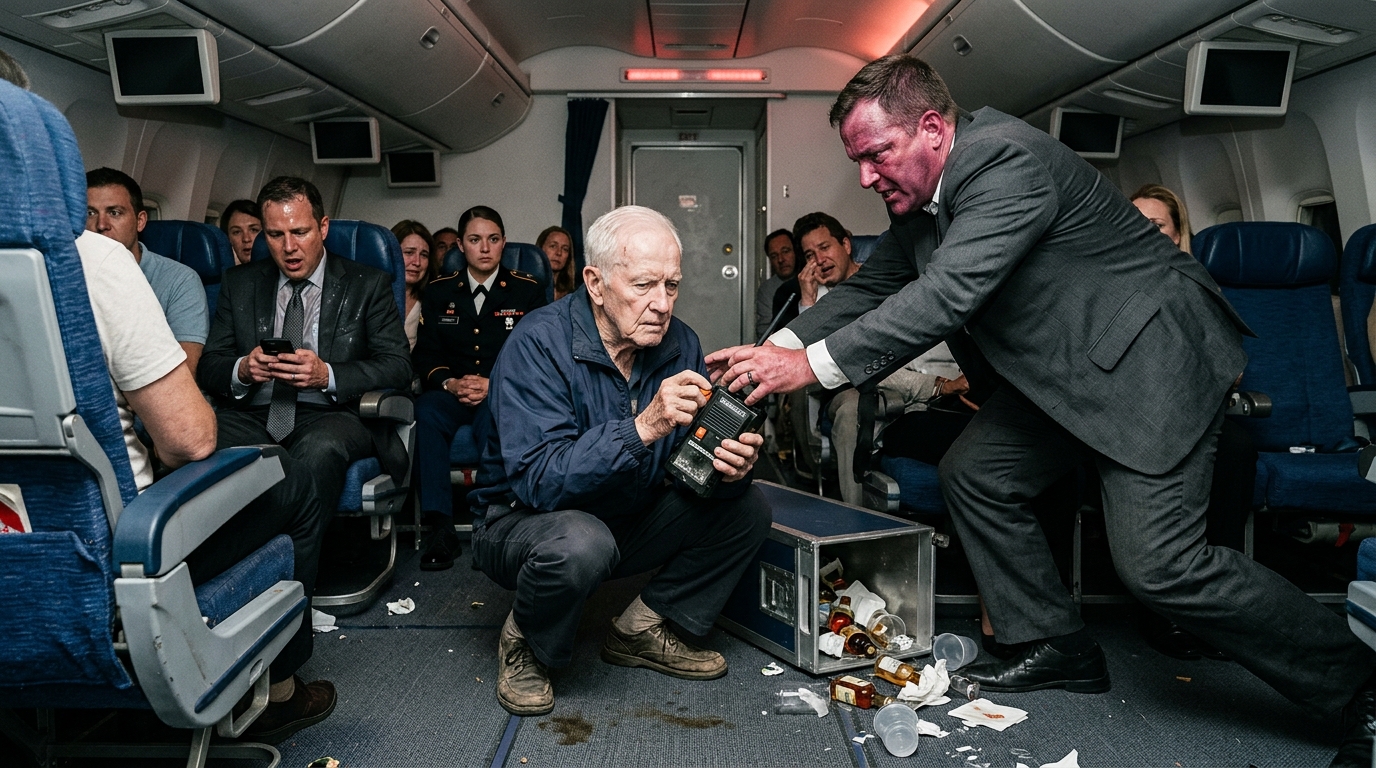
Scattered among the spilled miniature bottles and crumpled napkins lay the object Harold needed—a small, ruggedized handheld emergency radio, dropped during the initial violent lurch of the aircraft.
He dropped to one knee with a sharp pop of aging joints. His fingers wrapped around the textured plastic casing of the radio just as a heavy boot stamped down on the carpet beside his hand.
Leave that where it is, Fuller hissed, his voice cracking with panic and misplaced authority. You are tampering with federal equipment on a secured flight deck.
Harold ignored the demand entirely. He flicked the power toggle upward, but the speaker emitted only a harsh, unbroken hiss of dead static.
The main transponder was dead, and the civilian bands were choked with the frantic chatter of terrified air traffic controllers over Chicago who had already lost the blip.
The air grew noticeably colder as the cabin altitude warning light pulsed a dull, rhythmic crimson above the aisle.
The air marshal reached down to claw at the radio in Harold’s grip, his fingers sliding against the scratched metal casing of the old chronograph.
A young college student in the adjacent row stuck her foot out into the narrow aisle with calculated precision.
Fuller’s forward momentum caught the sole of her sneaker, sending the federal agent sprawling forward into the fabric seats with a dull thud.
Sorry, the student muttered, her eyes locked straight ahead without a trace of remorse.
An army private in uniform stood up from the opposite row, planting his boots firmly to create an impassable human barrier between Harold and the aisle.
The soldier didn’t speak a word; he simply crossed his arms, his jaw set hard against the rolling turbulence of the dying machine.
Harold turned the frequency dial past the dead civilian channels, his ears straining to isolate a specific pitch through the roar of the engines.
The guard frequency, Harold rasped, his eyes fixed on the tiny LED display. Two hundred forty-three megahertz. It’s our only shot.
CHAPTER 3: THE WEIGHT OF BRASS
The marshal slammed hard against the soldier’s uniform jacket, his breath expelling in a sharp, furious grunt.
You are stepping way out of line, soldier, Fuller hissed, his fingers clawing at the fabric in a frantic bid to regain physical space. Move aside right now or you’ll face a federal court-martial before wheels down.
The private didn’t budge an inch, his boots locked into the gray carpet as the fuselage gave a sickening shudder.
I’m off-duty, traveling on orders, and you’re harassing a passenger during an in-flight emergency, the young man replied, his voice flat and steady. Let the man work.
Harold kept his eyes down on the small green display of the radio, ignoring the human friction boiling over inches from his face.
The static hiss shifted tone, a slight crackle breaking through the endless white noise as the guard frequency caught a faint, distant carrier wave.
Fuller lunged sideways around the soldier, his palm outstretched to swat the device out of Harold’s grip.
A heavy canvas bag swung from the overhead bin, catching the marshal across the shoulder and throwing his reach wide.
The college student in the third row let go of the strap with a grim, tight-lipped nod, her eyes flashing with defensive anger.
You’ve got no business touching anyone, mister, she snapped, her voice cutting through the ambient whimpers of the cabin. Focus on keeping your feet on the floor instead of acting like a bully.
Fuller staggered back against the padded armrests, his face mottled with purple rage as his institutional authority completely dissolved in front of a dozen witnesses.
You’re all accessories to interference, he choked out, his chest heaving as he pointed a trembling finger toward the cockpit door.
Harold raised the handheld unit closer to his lips, his thumb pressing down on the transmit toggle with deliberate slowness.
The signal was weak, buried under miles of static and thick storm clouds over the Midwest, but the channel was live.
Mayday, mayday, mayday, Harold rasped into the plastic grille, his voice carrying an old, ironclad authority that demanded silence. Civilian flight seven-thirty-nine. Any asset on guard, do you copy?
CHAPTER 4: THE CLOSED DOOR
The radio speaker spat a sharp burst of feedback before a young, trembling voice broke through the channel from behind the locked flight deck door.
Sir? Who is this? The autopilot is failing and I can’t get the manual overrides to respond.
Harold kept his thumb locked onto the transmit button, his eyes fixed on the heavy grain of the reinforced cockpit barrier.
Listen to me very carefully, son, Harold said, his voice dropping an octave into a low, steady register that commanded absolute focus. Look down at your pedestal. Find the hydraulic isolation toggle on the right console.
The first officer stammered over the speaker, his words tripping over each other in a frantic rush. I see it, but the light is red—the system says it’s locked out due to heat.
It’s locked because the sensor is reading smoke, not structural failure, Harold replied, shifting his weight as the plane dipped sharply to port. You have to pull the manual bypass pin beneath the panel. Use the corner of your identification badge if it’s jammed.
A sharp clatter echoed through the speaker as plastic struck metal.
Agent Fuller shoved his way half an upright posture past the army private, his face twisted in desperate defiance.
You’re instructing an unqualified pilot to override federal flight safety controls, Fuller barked, his voice cracking with shrill panic. If this plane goes down because of your interference—
The college student in the third row slammed her heavy canvas bag onto the armrest right beside Fuller’s elbow.
Shut your mouth and let the man talk, she said, her voice shaking with adrenaline but entirely unyielding.
Harold ignored the marshal completely, his gaze locked on the faint green glow of his scarred chronograph.
Did it seat? Harold asked into the radio.
A heavy mechanical click echoed through the tiny speaker.
It clicked, the first officer gasped, his breathing turning fractionally steadier. The hydraulic pressure gauge is moving. We’ve got surface control back.
CHAPTER 5: IRON AND FOAM
The airframe groaned under the sudden shift in load as the manual bypass took hold.
Harold kept his eyes locked on the tiny, cracked screen of the radio, his thumb steady against the casing.
Listen to the engine pitch, son, Harold said, his voice cutting through the cockpit intercom feed. The starboard side is running lean. You need to feather the throttle halfway before we hit the glide slope.
I’ve got the numbers, the first officer gasped back, his breathing ragged but controlled. But the descent rate is too steep—we’re dropping four thousand feet a minute.
It’s steep because you’re fighting the drag, Harold replied, shifting his weight against the rolling aisle as turbulence rattled the overhead bins. Drop the nose two degrees. Let gravity do the work until we clear the cloud deck.
Agent Fuller slumped back into his aisle seat, his face completely drained of color as the reality of his utter failure settled over him like lead.
He didn’t reach for his radio. He didn’t issue another threat. His authority had evaporated against the sheer, unyielding competence of an eighty-three-year-old veteran.
The army private kept his post near the front row, his arms crossed over his chest while the cabin lights flickered and steadied.
Outside the passenger windows, the gray mass of the overcast suddenly parted to reveal a flat, foam-whitened strip of concrete rushing up to meet them.
Brace the cabin, Harold commanded into the radio, his tone unchanging. Gear down, manual lock. Take it in slow.
The Boeing slammed onto the runway with a bone-jarring shriek of rubber and metal, sliding hard through the thick white foam blanket.
Sparks flared briefly outside the wing tips before the massive machine finally lost momentum and ground to a heavy, shuddering halt.
For three long seconds, the cabin remained entirely frozen in silence.
Then a single sob broke out near the back, instantly swallowed by a roaring wave of tearful applause that filled the entire fuselage.
CHAPTER 6: THE DUSTY THRESHOLD
Weeks blurred into the quiet routine of small-town life, far removed from the screaming metal and chemical foam of the tarmac.
Harold sat at a corner table inside a neighborhood coffee shop, the steady patter of afternoon rain drumming against the steamy glass pane.
A bell chimed above the front door, and a man walked in, hesitating briefly on the rubber mat before stepping onto the linoleum floor.
It was Fuller. He wore a simple cotton polo shirt and dark denim, his shoulders slumped without the sharp lines of a federal suit to prop them up.
He walked over with slow, deliberate steps, his eyes downcast as he approached the corner table.
Colonel Lawson— Fuller said, his voice dropping into a dry, quiet rasp.
Harold folded his morning newspaper and laid it flat against the worn laminate surface. He did not look up with malice or triumph.
He simply gestured toward the empty wooden chair opposite his own. Sit down, son. Let me buy you a cup of coffee.
Fuller pulled out the chair and sat down, his hands nervously twisting a paper napkin into a tight knot between his palms.
I wanted to say I am sorry, Fuller muttered, his gaze fixed on the grain of the table. What I did on that flight—how I treated you when everything was falling apart—there’s no excuse. I was terrified, and I built a cage out of my own badge.
Harold watched him for a long moment, listening to the heavy silence of the room punctuated only by the hiss of the espresso machine behind the counter.
Fear makes you deaf, Harold said softly, his voice steady and calm. It’s a cage you build for yourself. Courage isn’t about not having the cage. It’s about finding the key.
Fuller nodded slowly, the last remnants of his stubborn defiance dissolving into a quiet, hard-earned understanding.
The rain continued to wash the streets clean outside, leaving behind a profound, unbroken peace.
Harold looked down at his wrist, tapping the scarred steel casing of the old chronograph one last time before turning his attention back to the fresh cup of coffee sitting between them.