Forging the Iron Boundary: How One Retired Combat Engineer Dismantled a Suburban Empire of Rusted Paperwork and Petty Tyranny
CHAPTER 1: The Iron Boundary
The soil here did not yield to polite requests; it remembered every drop of sweat my grandfather had wrung from it during the dry summers following the armistice, hardening into a stubborn crust that smelled faintly of old iron and sun-baked shale. I stood beside the second row of fledgling Cabernet Sauvignon, my boots caked in the gray-white silt of the Virginia foothills, watching the electric motor of the white golf cart whine as it coasted past the rusted iron marker of my northern boundary.
Karen Miller did not belong in the rows. Her pink tracksuit flashed like an unhealed bruise against the muted greens and browns of the valley, straining at the seams as she planted a flimsy blue placard into the soft earth with a sharp, dismissive shove of her palm. Serenity Meadows Estates, the sign declared in sterile lettering, promising a better way of living to anyone willing to pave over their history for a beige facade.
“That’ll be five thousand for the annexation fee, Major,” she said, her voice dropping into that grating register of administrative certainty that officers learn to ignore on parade grounds but despise in the field. She extended a crisp, unblemished invoice that fluttered slightly in the dry breeze coming off the ridge. “Plus two hundred in monthly dues. Effective immediately.”
I did not reach for the paper. My fingers remained hooked into the leather pockets of my canvas vest, resting near the heavy steel multi-tool I used to tension the trellis wire. Thirty years of bridging rivers under mortar fire and plotting logistics maps across continents had taught me one immutable law of engagement: never accept the enemy’s premise of the terrain. She was standing twenty feet deep on land my great-grandfather had cleared with an ox team and a crosscut saw, yet she spoke with the absolute gravity of an occupying magistrate issuing decrees to a conquered province.
“You’ve miscalculated your coordinates, Mrs. Miller,” I said, my voice low enough that she had to step forward to catch the words over the rattling idle of her cart. “The county plat line is two hundred yards east of this post. Take your sign and your paper back to the pavement before the sun gets any higher.”
Her face tightened, the skin around her eyes bunching into pale knots of indignation as she realized I was not reaching for my checkbook or offering the polite, exhausted compliance she was accustomed to extracting from the retirees down the slope. Her clipboard trembled, not from fear, but from the raw, unaccestioned shock of encountering a physical barrier that could not be bullied by a paragraph of bylaws.
“The board has revised the community charter under Section Four, paragraph B,” she snapped, her voice rising to meet the open air. “Your property is an unincorporated anomaly that threatens our property values. We are absorbing the liability.”
She turned sharply to climb back into her seat, treating the dismissal as a minor administrative delay rather than a tactical repulse. I reached down, gripped the thin metal stake of the blue placard, and pulled it straight up with a dry, ripping tear of roots and soil, letting the sign rattle across the empty passenger floorboards of her cart before she could reach the accelerator.
“Tell your lawyer the perimeter is closed,” I said, stepping back as she slammed her foot down and spat gravel across my boots.
I watched the red taillights shrink toward the sea of identical beige roofs below, the dust hanging in the still air like a lingering smoke screen, and reached into my pocket for the small, worn notebook where I kept the inventory of every fence post, wire gauge, and boundary marker on the hundred acres. The first line was already written, but as the motor’s whine died away in the distance, a cold, metallic realization settled into my chest: she hadn’t come out here today to collect dues, and she hadn’t come out here for the landscaping. She was laying the first stake for a much larger trap, and she had no idea what was waiting at the bottom of the trench.
CHAPTER 2: The Paper Trail
The house was quiet, save for the hum of the old refrigerator and the steady, dry rustle of paper sliding across the maple dining table. Sarah stood by the kitchen pass-through, her fingers curled around the warm ceramic of a mug, watching me sort the documents Frank had emailed over from the subdivision’s digital library. There were no shortcuts here; reconnaissance was an exercise in patience, a matter of laying out the enemy’s logistics until the structural weaknesses exposed themselves under the cold light of day.
“She’s not just playing a local game,” I said, my voice low as I aligned the edge of a board meeting transcript from eighteen months prior against the county zoning code. “A woman like that doesn’t manufacture a boundary revision just to collect two hundred dollars in monthly dues. The numbers don’t balance.”
Sarah set her mug down with a soft click, walking over to trace the highlighted passages on the page. “What are you seeing?”
“Friction in the ledgers,” I replied, tapping the margin where Karen’s name appeared as chair of the long-term planning committee. “Look at the timeline. Three years ago, Serenity Meadows expanded its common-area maintenance budget by forty percent, yet the actual physical improvements to the subdivision—the paving, the clubhouse roof, the drainage—haven’t changed. They’re running a deficit, or worse, they’ve drained their structural reserves on speculative vanity projects.”
I pulled out the plat map I had retrieved from the county clerk earlier that morning, its creases sharp and clean compared to the dog-eared printouts Frank had scavenged. The boundary between my family’s hundred acres and the beige expanse of the subdivision was marked with an unbroken black ink line, a legal barrier that had remained untouched since the post-war survey. Karen’s “revised community charter” was a ghost document, printed on commercial letterhead with no stamp from the county recorder’s office, yet she wielded it with the unyielding conviction of a bureaucrat who believed ink on a cheap page could rewrite the topography of Virginia.
The phone on the wall buzzed with a low, single ring, breaking the steady hum of the afternoon. It was Frank.
I picked up the receiver, keeping my eyes fixed on the meeting minutes. “Talk to me, Frank.”
“Jack, you have a visitor coming down your road,” Frank said, his voice dropping into a cautious murmur. “Not Karen. It’s one of the board members—Dave, the guy who runs the local insurance agency. He looked shaken up when he left the clubhouse ten minutes ago. He’s heading your way in a grey sedan.”
“Did she send him?”
“I don’t think she knows he’s moving,” Frank answered. “He looked like a man who realized he was sitting in the back of a sinking landing craft and wanted to find a life vest before the bulkheads sealed. Watch yourself, Jack. She’s tightening the perimeter.”
“Let her tighten it,” I said, sliding the map back into its folder. “A closed perimeter cuts off both ways.”
I hung up the phone and walked to the front window, wiping a thin layer of fine red dust from the glass. Down the long, gravel-paved drive that wound through the lower vineyard rows, a grey sedan crawled at a hesitant, defensive pace, its tires crunching evenly against the dry shale. The engine cut out near the old red barn, and the driver’s door creaked open, revealing a man in an ill-fitting business suit who stood uncertainly beside the vehicle, smoothing down his tie as he looked up toward the porch.
The battle was moving out of the brochures and into the dirt, and the first hairline cracks in her empire were already beginning to show.
CHAPTER 3: The Receipt of the Rusted Notice
The man in the ill-fitting suit did not immediately step onto the porch. He stood by the front fender of his sedan, his hand resting on the warm, dust-filmed metal while his eyes darted from the weathered siding of the farmhouse to the neat, laser-straight rows of the vineyard stretching toward the ridgeline. His tie was slightly crooked, pulled tight against a collar that looked two sizes too small, giving him the anxious posture of a supply officer who had just realized his inventory sheets didn’t match the crates in the yard.
I watched him from the shade of the porch, my boots planted firmly on the worn oak floorboards. I did not move to greet him; tactical patience required letting a nervous asset reach the end of his own tether.
“Major Thorne?” the man called out, his voice thin and dry against the open valley wind. He took two hesitant steps forward, his leather-soled shoes scraping awkwardly against the packed clay of the path. “Dave Miller. Not related to… well, not the president. I’m on the board. The insurance side of things.”
“I know who you are, Mr. Miller,” I said, my voice carrying across the yard without raising a decibel. “Step up on the wood, or stay down in the dirt. But make your choice before the sun clears the ridge.”
He flinched slightly at the directness, choosing to climb the three low steps, his shoulders hunched as if expecting a tripwire. When he reached the porch, he didn’t offer a hand; instead, he pulled a manila folder from beneath his arm, clutching it against his chest like an incoming mortar report.
“Karen’s moving fast,” Dave said, his breath coming in short, uneven puffs. He looked back toward the road as if a pink tracksuit might materialize out of the dust at any second. “She filed the paperwork with the county court this morning. A formal lien. Ten thousand four hundred dollars. She’s telling the rest of the board it’s standard procedure to secure delinquent community assets, but… I saw the ledger, Major. I looked at the reserve accounts.”
The words struck the quiet of the porch with the heavy, flat thud of an entrenching tool hitting rock. I kept my face entirely neutral, letting the silence stretch between us until the man began to shift his weight from one foot to the other.
“And what did the ledger tell you, Mr. Miller?” I asked, my gaze fixed on his eyes.
“It told me the numbers are a ghost town,” he muttered, dropping his voice to a nervous whisper as he leaned against the porch rail. “We don’t have the reserves for the clubhouse repairs we voted on six months ago. The maintenance fund is sitting at zero. Karen’s been moving money between accounts to cover contractor invoices for her cousin’s paving company, but the audit trail is a mess. If the county steps in to check the district books, the whole system collapses.”
The pieces clicked into place with the cold, satisfying precision of a breechblock sliding home. The annexation fee wasn’t a petty power grab; it was an emergency infusion. Her entire suburban empire was running on empty, a hollow shell of beige siding and inflated property values masking a financial sinkhole, and she needed my hundred acres of unencumbered agricultural land to serve as collateral for a new round of bank loans.
“She’s using my property title to backstop her deficit,” I said quietly.
“She thinks you’ll pay the five thousand just to make the headache go away,” Dave nodded rapidly, his panic finally breaking through his professional veneer. “She thinks everybody caves when the paperwork gets heavy. But I have a family, Major. I have a business in town. If the state attorney general or the county grand jury looks into those fraudulent filings, my name is on every signature block as a sitting board member. I didn’t sign up to be an accessory to a shell-corporation racket.”
He tossed the manila folder onto the small wooden table between us, the cardboard sliding across the grain until it hit my coffee mug.
“That’s copies of the internal transfer logs,” Dave said, stepping back toward the steps. “Everything Karen tried to bury in the supplemental maintenance files. Use it, don’t use it—that’s up to you. But I’m resigning from the board tonight, and I’m catching a flight out to my brother’s place in Ohio until this blows over.”
He didn’t wait for a reply. He turned sharply, his heels clattering down the wooden steps and crunching across the gravel before the engine of his grey sedan roared to life, kicking up a thick plume of gray dust as he tore down the drive toward the county road.
I picked up the folder, untying the faded red string with slow, deliberate fingers. Inside lay the financial anatomy of Serenity Meadows—the secret bank routing numbers, the inflated contractor invoices, and the undeniable paper trail of a collapsing regime. The decoy was exposed; the real battle for the land was no longer just about a sign in the dirt. It was about an empire built on stolen paper, and the fuse was already lit.
CHAPTER 4: The Quiet Alliance and the Kill Package
The documents Dave left behind did not merely suggest mismanagement; they laid out a blueprint of administrative rot. I spent the next two hours under the amber glow of the desk lamp, cross-referencing routing numbers and corporate filings with the state registry data Frank had piped into my inbox. Every invoice for landscaping and subdivision maintenance pointed back to a single shell corporation registered under a post office box in Richmond.
The screen flickered as a new email arrived from George Bailey, the retired Marine litigator whose office smelled of old calfskin and dry paper. His message was brief, carrying the terse weight of a combat briefing: The lien is logged at the county clerk’s office. She didn’t just threaten us, Jack; she dropped a forged plat map into a public record. The trap is sprung. Pack the binders.
I closed the laptop and walked back to the kitchen window. Outside, the shadows of the gnarled oak trees stretched long and dark across the vineyard rows, blending into the deep purple of the Blue Ridge foothills. Sarah stood by the counter, her hands folded over a tea towel, watching me with that quiet, steady resilience that had kept our camp together through thirty years of military relocations.
“It’s time to build the packet,” I said, my voice cutting softly through the hum of the refrigerator.
“Is George ready?” she asked, her gaze dropping for a second to the manila folder before rising to meet my eyes.
“He’s been ready for forty years,” I replied. “Karen walked right into our sector of fire when she filed that paper. She thinks a court stamp makes a fiction real, but a false instrument in a public registry isn’t a civil dispute—it’s a felony.”
We didn’t wait for morning. Working side by side in the quiet of the farmhouse kitchen, we assembled the kill package. Every photographic plate of the property markers, every certified letter bearing Karen’s signature, every bank routing slip from Dave’s dossier was slipped into protective plastic sleeves and organized into three identical ring binders. One for the county prosecutor, one for the state attorney general’s consumer fraud division, and one for George’s impending slander-of-title injunction.
The air in the room grew stale, thick with the scent of toner and old paper, but the work demanded absolute precision. In engineering, a bridge did not hold because you hoped it would; it held because every rivet and beam was calculated to bear the exact load placed upon it. Karen had thrown her weight against our perimeter without calculating the structural integrity of her own foundation, and now the entire architecture of her suburban kingdom was resting on a cracked footing.
My phone buzzed against the wood—a text from Frank. She’s booked the main clubhouse for tomorrow night. Calling it a ‘community victory celebration’ and a ratification vote. Half the neighborhood is grumbling, but she’s packing the front rows with her loyalists.
I set the phone face down beside the stack of black binders. Let her celebrate under the glare of the recessed ceiling lights in the beige community hall. Let her raise her glass to an annexation that existed only in the margins of her printed newsletters. Tomorrow night, the ledger would be balanced, and the ground beneath her feet would finally give way.
CHAPTER 5: The Clubhouse Trial and the Fall of the Dais
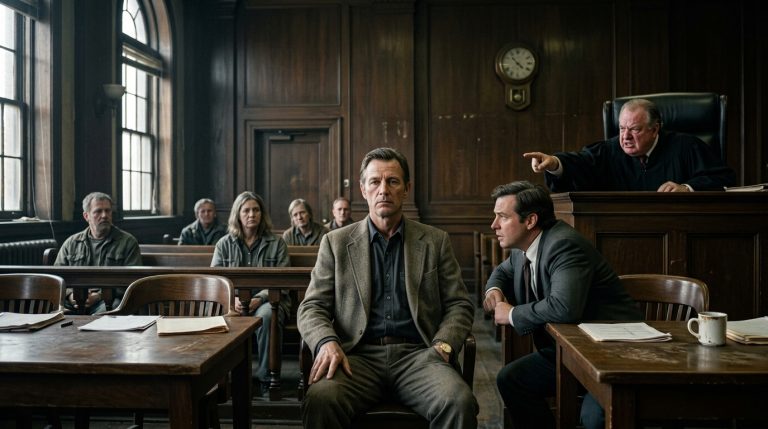
The parking lot of the Serenity Meadows community center was congested with an unusual density of vehicles, their headlights cutting harsh, angular beams across the asphalt as residents filed through the double glass doors. George Bailey’s sensible sedan sat quietly near the perimeter fence, its windows dark, while a county sheriff cruiser lingered by the distant dumpster enclosure with its engine idling. I stepped down from the truck, my fingers brushing the edge of the leather-bound case containing our dossiers, and walked toward the entrance with measured, deliberate strides.
Inside, the community hall smelled of commercial carpet cleaner, stale coffee, and the sharp electric tang of a projector running too hot. Every metal folding chair was occupied. People stood four-deep along the wood-paneled walls, their faces washed in the sterile, flickering blue light of a presentation screen at the front of the room. At the raised dais, Karen Miller sat centered behind the mahogany-finished podium, her sequined jacket catching the recessed overhead spotlights like a badge of office.
She was halfway through her opening address when I walked down the center aisle, my boots clicking rhythmically against the low-pile carpet.
“…and so, through the decisive action of your board,” Karen was saying, her voice pitched to carry over the low murmur of the crowd, “we have successfully secured the eastern parcel. This hundred-acre green space will now be preserved for all residents, free from the blight of unauthorized agricultural operations.”
A smattering of hesitant, polite applause drifted from the front rows—seats carefully reserved for her loyalists. But as I reached the middle row, the murmurs shifted. Frank, standing near the light switch by the emergency exit, caught my eye and gave a subtle, sharp nod.
Karen stopped mid-sentence. Her gaze dropped from the balcony down to the aisle, locking onto my face with a sudden, rigid contraction of her jaw. The self-satisfied smirk faltered, replaced for a fraction of a second by the raw, unmasked disorientation of a commander who had neglected to scout her flanks.
“Mr. Thorne,” she said, her voice tightening as she gripped the edges of the podium. “This is a private association meeting. Non-residents—or rather, non-compliant landowners—are not recognized on the agenda.”
“The agenda is about to be amended, Mrs. Miller,” I said, my voice carrying effortlessly across the room without a microphone. I stepped up to the low wooden barrier separating the seating area from the raised dais, placing my case flat upon the edge. “You filed a lien against my property yesterday morning. Under Section Six of the state code, attaching a fabricated boundary map to a public court record is no longer a civil dispute.”
The silence that fell over the room was absolute, broken only by the rhythmic hum of the projector fan.
Karen stood up, her face flushing a dark, mottled red as the board members on either side of her began to shift uneasily in their seats. “That is an outrageous fabrication! The board authorized the expansion under our community charter!”
“Which charter?” George Bailey’s voice boomed from the back of the room as he stepped out from the shadows near the entrance, holding a certified copy of the county clerk’s registry records. “The one printed on your personal home printer, or the one on file at the county courthouse that hasn’t been amended since nineteen-twenty-two?”
The murmur in the room erupted into a sharp wave of overlapping voices. Neighbors turned to look at one another, the pent-up frustration of years of arbitrary fines, threatening letters, and draconian mailbox mandates finally breaking through the thin veneer of suburban compliance.
From the front row, elderly Mrs. Gable stood up, her hand trembling slightly as she pointed a finger directly at the dais. “She fined me three thousand dollars for my husband’s garden gnomes! She threatened to take my house!”
“And she billed us five thousand while I was deployed overseas,” the young military husband added, stepping forward from the side aisle.
Karen slammed her palm against the mahogany podium, her voice fracturing into a shrill shriek. “Order! I call this meeting adjourned! You are all out of order!”
She reached for her papers, but the double doors at the back of the hall swung open with a heavy click. A county sheriff’s deputy stepped inside, flanked by a man in a plain grey suit who flashed an identification badge toward the dais.
“John Fields, State Attorney General’s Office,” the man said quietly, his voice cutting through the panic like a blade. “Remain seated, Mrs. Miller. I think we need to review the routing numbers on those maintenance accounts together.”
The fight drained out of her in a single, visible shudder. Her hands dropped from the podium, her fingers clutching uselessly at the sequined fabric of her jacket as she sank back down into her chair, a sovereign of paper watching her empire dissolve into the dust from which it came.
CHAPTER 6: The SilverGray Fence and the Final Harvest
The unraveling of the district ledgers took three months of quiet, methodical auditing. Investigator Fields and his team dismantled the administrative machinery of Serenity Meadows piece by piece, exposing the shell-corporation kickback schemes and the systemic drain of the maintenance reserves that Karen had spent years attempting to cover with manufactured annexations. The ultimate reality was far simpler and uglier than any localized feud: the entire corporate structure of the subdivision was insolvent, surviving only by bleeding external assets to plug a hole of its own making. Karen’s desperate bid for our hundred acres was never about garden aesthetics or property values; it was a last-ditch corporate bailout to stave off total financial collapse.
When the state grand jury handed down indictments for felony fraud and systematic embezzlement, the trial was brief. Karen’s defense crumbled under the weight of the bank routing slips and forged plat maps we had assembled in our binders. She faced her sentence—two years in state prison followed by strict financial restitution—not with the ironfisted authority she had once projected from her golf cart, but with the hollow silence of a deposed bureaucrat stripped of her paper kingdom.
Back on the land, the transition was marked by the slow, steady turning of the seasons rather than court decrees. Under Frank’s interim leadership, the beige uniformity of the adjacent subdivision began to soften. The draconian rulebook was stripped of its punitive fines; garden gnomes and natural landscaping returned to the lawns, and the community slowly integrated with the surrounding valley instead of sealing itself off behind invisible walls.
Three years after the gavel fell, the vineyard yielded its first major harvest.
I stood on the front porch of the farmhouse, my hand resting on the smooth, weathered cedar railing as the late afternoon sun painted the Blue Ridge peaks in deep shades of purple and gold. Down in the rows, the Cabernet Sauvignon vines were heavy with dark, clustered fruit, their leaves rustling softly in the dry valley breeze. The air smelled of sun-baked shale, crushed earth, and the faint, sweet promise of the coming vintage.
Sarah walked out from the screen door, carrying two heavy crystal glasses and a newly bottled vintage of our first harvest label. The label featured a simple, clean line drawing of an ancient oak tree, anchoring the history of the soil we had fought to keep.
“Frank called,” Sarah said, setting the glasses down on the scarred wood table. “He wants to know if we’re still on for steak at the tavern this Friday.”
“Tell him yes,” I replied, taking a glass and swirling the deep red liquid against the glass. “And remind him he’s buying.”
We stood together in silence, watching the shadows lengthen across the dirt drive. Near the northern boundary line, where the wild fescue met the property edge, the old metal sign Karen had once hammered into our earth stood transformed. We had bolted an old cross-piece to its post, draped it in a weathered flannel shirt, and topped it with a faded straw hat. It served as our scarecrow now, its metallic backing partially hidden beneath flapping fabric—a quiet, enduring reminder that peace is not given by decree, but earned through the willingness to stand your ground.
The war was over. The land was whole. And the soil, stubborn and deep, remembered every root we had planted.