A Child’s Whisper in the Glass Castle: Restoring the Fractured Truth of an Ancient Legacy
CHAPTER 1: THE PENTHOUSE THRESHOLD
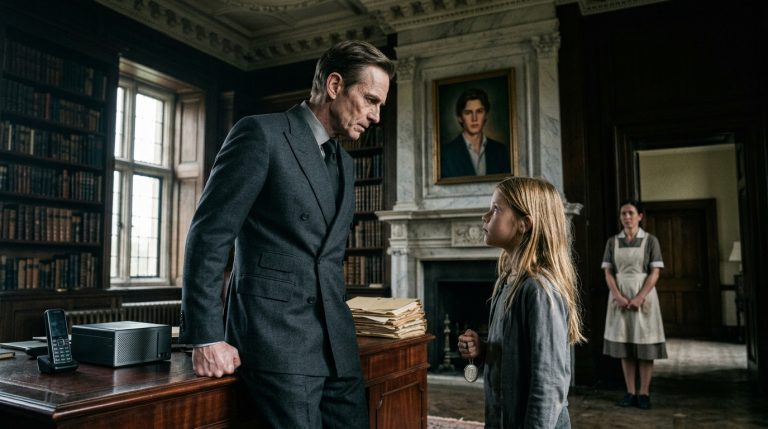
The penthouse hung over the city like a fragile glass bauble, suspended in the clouds. Below, the yellow blur of taxis moved like restless insects; up here, the air was static, sanitized, and cold. Ava pressed her back against the cool velvet wallpaper, trying to fold herself into the shadow of a marble pedestal. She was ten years old, dressed in a blue cotton dress that felt thin and unremarkable against the heavy, suffocating luxury of the room.
Her mother, Helen, stood near the mahogany table. She was a ghost in this kingdom of giants, her movements practiced and fluid. When Helen placed a water glass on the marble coaster, the clink sounded like a gavel strike in the hushed chamber. Ava watched her mother’s hands—usually steady, now tracing a fine tremor that only a daughter would notice.
In the center of the room, the men were gathering. They were sharp-edged figures in suits that shimmered with the sheen of deep-sea silk. They spoke in low, rhythmic cadences, weaving a tapestry of numbers and historical promises that Ava didn’t need to count to understand were wrong.
She clutched the leather-bound journal to her chest. It was a worn, battered thing, its corners soft with use and its pages smelling of dry earth and ancient time. It felt like a heartbeat against her own, a grounding rhythm in a room that felt entirely untethered from reality.
Mr. Alistair Finch stepped into the center of the circle, his silver hair catching the recessed lighting like polished steel. He held a leather case, and as he opened it, a sudden, sharp draft seemed to chill the room. He unfolded the parchment. It was long, yellowed, and carried the weight of ages—or so he wanted them to believe.
Ava leaned forward, her vision narrowing. The parchment didn’t catch the light the way her great-grandfather’s documents did. It looked too uniform, a flat, artificial aging that lacked the chaotic, beautiful depth of true vellum. Her pulse quickened. The discrepancy was like a sudden, jarring note in a symphony.
The Sheikh, Tark Al Jamil, sat in his chair, his eyes fixed on the document. There was a weariness in his posture that moved Ava in a way the polished suits could not. He looked like a man who was searching for a bridge to his past, only to find it crumbling under the weight of someone else’s greed.
Finch’s smile was wide, bright, and utterly hollow. “The key to your oasis, my friend,” he said, his voice vibrating with predatory confidence.
Ava took a half-step forward. The floor was cold beneath her worn shoes. Her mother caught the movement and signaled with a sharp, frantic glance toward the kitchen, but Ava couldn’t move. Her fingers traced the gold-leaf lettering on her journal’s spine.
As the Sheikh’s hand began to reach for the gold-plated pen, the silence in the room became a physical, pressing weight. Ava felt the air thin. The document on the table wasn’t just a forgery; it was a lie being sold as a sanctuary. And as her gaze flickered to the crimson wax seal at the bottom of the deed, she noticed the faint, distinct smudge of the letter’s dot—an impossible anachronism that turned the entire room into a graveyard of integrity.
She opened her mouth to breathe, and in that split second of hesitation, her elbow clipped the edge of a side table. The empty glass shattered against the marble floor, a sudden, crystalline eruption of noise that silenced the entire world.
Every head turned. The Sheikh’s hand halted. Finch’s mask of triumph fractured, revealing a flicker of raw, panicked hatred beneath. Ava stood exposed in the center of the room, her heart hammering against her ribs, knowing that the silence that followed was not just an interruption—it was the beginning of an ending no one in this room was prepared for.
CHAPTER 2: THE SOUND OF THE SHATTER
The sound of the glass striking the marble still echoed in the corners of the room, a jagged, discordant note that refused to die. Ava stood motionless, her heart drumming a frantic, uneven rhythm against her ribs. The penthouse was deathly quiet, the kind of silence that usually preceded a storm.
She looked at the shards scattered like diamonds across the Persian rug. The light from the ceiling recessed lamps caught the edges of the broken glass, making them sparkle with a treacherous, crystalline beauty. Her mother, Helen, had moved, her hand half-extended as if to pull Ava away, but she had frozen, her face drained of all color, eyes fixed on the Sheikh.
Mr. Finch’s face had twisted. The mask of smooth, silver-tongued confidence had slipped, revealing the jagged edge of a predator caught in a snare. His hands, which had been so poised while holding the forged deed, were now trembling slightly at his sides. He took a predatory step toward Ava, his polished shoes silent on the rug.
“Control your child, Helen,” Finch hissed, his voice a low, dangerous vibration. “This is a house of business, not a place for clumsy urchins.”
Ava didn’t look at Finch. She couldn’t. Her vision was locked on the Sheikh. He hadn’t moved. He was still seated in the leather chair, but his body had tensed, his gaze shifting from the shattered glass on the floor to the girl standing amidst the debris. There was something in his eyes—not anger, not annoyance—but a profound, unsettling curiosity.
Dignity is a fortress, little star, her father’s voice whispered in the back of her mind, as clear as if he were standing right beside her, smelling of dust and old ink. The memory of his rough, calloused hand on her shoulder grounded her. She felt the weight of her great-grandfather’s journal against her skin, the worn leather acting as a shield. She didn’t shrink away from Finch’s glare. She stood taller, her chin tilted slightly upward.
“It was an accident,” Ava said. Her voice sounded thin in the vast expanse of the room, yet it held a surprising steadiness. She didn’t apologize to Finch. She looked directly at the Sheikh. “But the document on the table… that wasn’t an accident.”
The investors around the table stirred. A ripple of nervous energy passed through them, their movements brittle. One man adjusted his cufflinks, his eyes darting from Finch to the Sheikh, sensing that the atmospheric pressure in the room had shifted irrevocably. The air felt thin, ionized, like the moments before a lightning strike.
“You speak of business, child?” The Sheikh’s voice was a low rumble, deep and resonant. He didn’t raise his voice, but the entire room fell into a deeper, more attentive silence. He leaned forward, his elbows resting on his knees, his gaze pinning Ava to the spot. “You have disrupted a transaction of significant importance. Explain your intrusion.”
Finch opened his mouth to interject, his face flushing a dangerous shade of crimson, but the Sheikh held up a single, imperious hand. The gesture stopped Finch mid-word, leaving him standing there, breathless and exposed, like a man suddenly stripped of his armor.
“I didn’t mean to break the glass,” Ava continued, the cold marble beneath her thin shoes biting into her soles. She looked at the parchment. “But I had to make you stop before you signed. That paper… it’s lying to you. It’s not history. It’s just theater.”
The words hung in the air, fragile and sharp. Helen took a shallow, ragged breath, her fingers clutching the edge of her apron. Ava could feel the hostility radiating from Finch, a physical heat that made the back of her neck prickle, but she couldn’t retreat now. She had felt the falseness of the document from the moment it was unrolled—the way it lacked the lived-in texture of time, the way the ink sat on the page like a stagnant pool instead of soaking into the history of the hide.
She realized then that her entire life had been a preparation for this one, singular, terrifying moment. Every hour spent in the dim light of her great-grandfather’s study, every lesson learned about the microscopic differences in script and seal, had led to this room. The penthouse was a world of glass and cold polish, but she was armed with the weight of the truth.
The Sheikh remained silent, his gaze searching her face, dissecting her expression for any hint of deceit. The silence stretched until it felt like a wire pulled to the point of snapping. Finally, he shifted, his dark eyes narrowing slightly.
“Kareem,” the Sheikh murmured, not taking his eyes off Ava. “Ensure no one leaves the room. And bring me my spectacles.”
The command was soft, but it carried the weight of a final decision. Ava felt her knees tremble, a reaction to the sudden release of tension, but she didn’t collapse. She watched as one of the Sheikh’s advisers moved to obey, the sound of his footsteps the only interruption in the heavy, expectant quiet of the glass castle.
CHAPTER 3: THE LANGUAGE OF SCHOLARS
The advisor, Kareem, returned with a speed that suggested the movement had been rehearsed a thousand times. In his gloved hands, he held a set of gold-rimmed reading glasses and a heavy brass magnifying glass. The weight of the implements seemed to anchor the room. The Sheikh took them, his movements deliberate, like a man peeling back the layers of a complex puzzle.
He didn’t look at Ava again, but his presence was a magnetic force. He stood, his height casting a long, shadow over the mahogany table, and leaned over the parchment. The leather of his chair creaked—a dry, rasping sound that echoed through the penthouse. Finch remained paralyzed, his jaw tight, his hands gripped so hard at his sides that the knuckles were white.
Ava watched, her breath shallow. She could see the light from the overhead lamps glinting off the brass frame of the magnifier as the Sheikh brought it down toward the deed. The parchment, which had looked so regal and ancient under the soft, deceptive lighting, now looked vulnerable. Under the lens, the imperfections she had sensed were about to be revealed.
“Kareem,” the Sheikh murmured, his voice thick with a sudden, sharpened focus. “Bring the light closer.”
The advisor adjusted the overhead track lighting. A shaft of brilliant, sterile white light hit the document. Ava took a cautious step forward. She could see the ink now—not as it had appeared from the corner of the room, but in its true, shallow state. It lacked the jagged, bitten-in appearance of iron gall ink. It sat on the surface, a dark, oily smudge that hadn’t even begun to claim the paper as its own.
“It is, as you said, a very fine imitation,” the Sheikh whispered, more to himself than to the room. He shifted the magnifying glass down to the crimson wax seal. He spent a long time there, the brass frame of the glass hovering just inches above the crest.
Ava’s heart hammered against her ribs. She remembered the specific geometry of the cufic script her great-grandfather had spent hours tracing in the journal. The dot, she reminded herself, feeling the phantom weight of her grandfather’s calloused hand guiding her own. The dot that shouldn’t be there.
“Alistair,” the Sheikh said, his voice quiet but sharp enough to cut through the stillness. He didn’t turn around. “Tell me about the calligrapher. Your records must be meticulous for a piece of this pedigree.”
Finch’s throat worked, a dry, visible swallow. “The… the provenance is absolute, Tark. It comes from the archives in Cairo. My experts—”
“Your experts,” the Sheikh interrupted, finally looking up. The weariness in his eyes had vanished, replaced by a cold, hard clarity that made Finch recoil. “Have you looked at this seal through a glass, Alistair? Have you ever actually looked at the history you are selling?”
The Sheikh gestured for Ava to come closer. Helen moved to intervene, her face a mask of silent, terrified protest, but the Sheikh’s look was enough to make her freeze. Ava stepped up to the table. She was so small that she had to stand on her tiptoes to see the document clearly. The smell of the room—lemon polish, expensive cologne, and the faint, dry scent of the parchment—filled her senses.
“Show me,” the Sheikh directed, his voice softening, shedding the hard edge he had used for Finch.
Ava reached out, her hand trembling only slightly. She pointed a small, steady finger toward the crimson seal. “The letter FA,” she said, her voice finding its rhythm, the same rhythm her great-grandfather used when he lectured her in the quiet of their cramped home. “In the 17th century, the script used here wouldn’t have used a dot. It’s an anachronism. It’s like finding a light switch in a tomb.”
The Sheikh looked at the seal, then back at Ava. For a heartbeat, the mask of the billionaire, the man of business, the man who commanded empires, flickered. He looked at her not as a servant’s daughter, but as a peer in a world that had nothing to do with money.
Finch let out a sharp, incredulous laugh, but it sounded fragile, like a glass bottle hitting a brick wall. “She’s a child playing a game of archeology. Do you really intend to gamble your reputation on the fantasies of a ten-year-old girl?”
The Sheikh didn’t answer him. Instead, he pulled a small, silver-framed phone from his pocket and tapped a single button. “Kareem, get Professor Alahheem on the secure line. Tell him I need an analysis. Now.”
The penthouse began to hum with the quiet, urgent activity of a court in crisis. Ava watched as the Sheikh turned his back on Finch entirely, ignoring the man’s sputtering rage. She realized then that this wasn’t just about the money, or the land, or the prestige of the deal. She was watching the dismantling of a reality that Finch had spent years constructing. She felt a surge of cold, sober power; the truth, once spoken aloud in this room of mirrors, could not be unsaid. The lie was already beginning to dissolve.
CHAPTER 4: THE LIBRARYS INVITATION
The elevator door slid shut with a soundless hiss, sealing them off from the suffocating atmosphere of the boardroom. For a moment, the only sound was the soft, rhythmic hum of the lift descending through the building’s core. Ava gripped her great-grandfather’s journal so tightly the edges of the worn leather bit into her palms. Beside her, Helen remained stiff, her gaze fixed on the glowing floor indicator, her face a mask of restrained shock.
The Sheikh stood before them, his posture relaxed, yet there was a sharp, predatory alertness in his eyes that hadn’t been there before. He had discarded the weight of the meeting, the facade of the businessman now utterly stripped away.
“The library,” he murmured, more to himself than to them, “is where the truth hides.”
When the doors parted, Ava felt the breath leave her lungs in a long, shuddering exhale. They had moved from the sterile, glass-encased world of the penthouse into a sanctuary. The room was vast, a cathedral of knowledge. Two stories of towering, dark-wood shelves climbed toward a vaulted ceiling, packed with volumes whose spines held the glint of centuries-old gold leaf. The air here was different—it didn’t smell of synthetic polish or expensive, metallic air conditioning. It smelled of deep time: beeswax, decaying paper, and the dry, sweet scent of leather that had been handled by generations of scholars.
Ava stepped out onto the Persian rug. Her footsteps were muffled, swallowed by the sheer volume of books surrounding them. In the center of the room, several deep leather armchairs were arranged around a low table. It was a space designed for thinking, for quiet, and for the slow, painful work of uncovering what had been buried.
“Your daughter,” the Sheikh said, turning to Helen, his voice stripped of the performative edge he had used with Finch. “She possesses a rare quality. Not just an eye for detail, but a refusal to accept the world as it is presented to her.”
Helen nodded, still struggling to find her voice. “She… she was always like that, sir. Her grandfather—he taught her that everything has a story. She just learned how to read the ones that weren’t meant to be seen.”
Ava walked toward the shelves, her fingers hovering just an inch away from the spines. She felt a phantom tug at her heart—the same feeling she got when she opened her father’s journal. Here, she wasn’t the maid’s daughter. She was a reader, a student of the same silent, dusty history that defined the Sheikh’s world.
She stopped in front of a glass-topped display case. Inside, resting on dark velvet, lay a series of artifacts: a clay tablet, an illuminated manuscript, and a small, jeweled dagger. The dagger’s hilt shimmered with intricate, delicate filigree, a masterpiece of craftsmanship that caught the ambient light and held it.
The Sheikh came to stand beside her, his presence no longer oppressive, but observant. He looked at the dagger with a strange, contemplative expression. “My ancestors believed this blade was a relic of a twelfth-century warrior poet. I have spent a fortune protecting it, believing it to be the centerpiece of my heritage.”
Ava looked at the dagger, then back at the Sheikh. She didn’t want to speak—she didn’t want to shatter another of his illusions so soon—but she could see the truth in the metal work. The filigree on the hilt had a symmetry that was too perfect, too machine-like, to have been crafted by hand in the twelfth century.
“It’s beautiful,” she said softly.
“But is it real?” he asked, his voice an invitation.
She didn’t answer with words. She simply tilted her head, pointing to the joint where the blade met the hilt. The transition was seamless, a “marriage” of two different eras brought together by a clever hand to create a more valuable lie.
The Sheikh didn’t react with anger. Instead, he let out a low, rueful chuckle that filled the library, echoing off the high shelves. It was a sound of profound relief, the sound of a man waking up from a long, expensive dream.
“Another fake,” he mused, looking at the dagger as if he were seeing it for the first time. “You have a dangerous gift, Ava. You dismantle the comfort of the lie.”
He walked over to a desk tucked into the corner of the room, a surface littered with magnifying glasses, charcoal pencils, and thick, cream-colored paper. He motioned for her to follow. “Finch is being held upstairs. My lawyers are dismantling his empire as we speak, but that is merely the clearing of the weeds. The question remains: why did he believe that the deed would pass my scrutiny?”
Ava looked at the desk, at the tools that looked so much like the ones her grandfather had kept in his own small, cluttered workshop. She felt a sudden, sharp clarity. “Because he thought you didn’t have anyone left who knew how to look,” she whispered.
The Sheikh’s gaze sharpened. He looked at her, his expression unreadable, and then he pulled a chair out for her. “Then let us start looking,” he said. “Show me what else you can see.”
Ava sat, the heavy leather of the chair enveloping her. She reached out and took a magnifying glass from the table. She wasn’t an urchin in a billionaire’s penthouse anymore. She was a researcher, and for the first time, she felt as though the stories she had been reading in her journal were finally starting to speak back to her.