The Old Mechanic in Hangar Seven Proves That Grit Beats Digital Pride When Lives Are on the Line
CHAPTER 1: THE SQUEAKING WHEEL
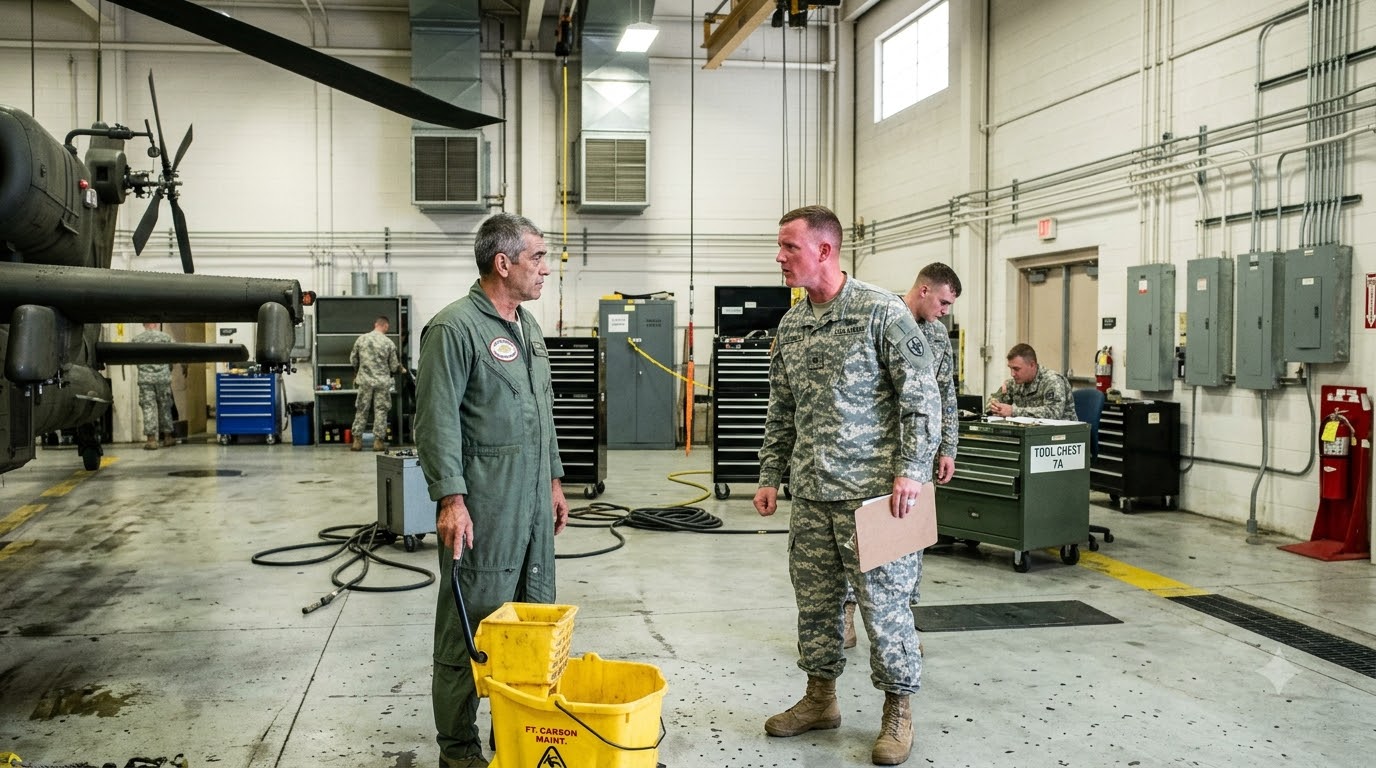
The seventh hangar smelled of cold concrete, old grease, and stale coffee that had been sitting in a cracked mug for six hours.
Daniel Torres pushed his cart forward, keeping his boots aligned with the dull yellow safety line painted on the floor.
The squeaking left front wheel needed a drop of three-in-one oil, but asking the supply sergeant for lubricants when you wore a faded green jumpsuit that said Fort Carson Maintenance Services across the shoulders was a good way to invite a lecture.
Thirty feet away, the Apache attack helicopter sat like a dead metal insect under the high-intensity overhead lamps.
Eight exhausted mechanics swarmed its belly with handheld diagnostic units that flashed pale blue light across their bloodshot eyes.
None of them were looking at the mechanical linkages.
They were staring at screens that kept spitting out sixteen-digit error codes that pointed to seventeen different nonexistent electrical failures.
“We’ve cleared the ignition relay three times,” Sergeant Davis muttered, his voice cracking from sheer exhaustion as he wiped his forearm across his sweaty forehead. “The voltage drop is clean, but the turbine won’t catch.”
Lieutenant Colonel Brandon Keller stood by the forward landing gear, his clipboard gripped so tightly in his right hand that his knuckles looked like bleached bone.
His boots tapped a fast, nervous rhythm against the floor.
“I don’t want excuses, Sergeant,” Keller snapped, his voice cutting through the hollow acoustics of the hangar with sharp, abrasive force. “There are six civilians hanging onto a granite ledge two hundred meters north while a blizzard rolls down the pass. That bird needs to lift in twenty minutes or we start writing casualty reports.”
Torres kept his head down, pushing the cart two inches past a row of spare rotor blades.
His fingers, thick-jointed and scarred from decades of wrestling with hydraulic lines in Fallujah, rested lightly on the cold plastic handle of his mop bucket.
He didn’t need a screen to tell him what was wrong with a bird of that class.
He could hear it in the unnatural stillness of the air frame—a slight, wrong-frequency micro-vibration humming through the floorboards that meant a secondary pressure line was choking on its own safety loop.
“Sir, the automated diagnostics are overriding the manual fuel feed,” a young private said, his voice trembling slightly as he dropped a diagnostic cable.
Keller spun on his heel, his face flushing a dark, congested red.
“Then override the diagnostics, Private! That’s what you trained for!”
Torres rolled his cart another four feet, stopping beside a stainless steel workbench to empty a small wire basket filled with discarded paper towels.
His movements were slow, deliberate, and entirely invisible to the men shouting beneath the rotor hub.
The weight of the old torque wrench tucked into his belt felt heavy against his hip—a blunt piece of iron wrapped in cracked black electrical tape that didn’t have a single microchip in it.
Keller slammed his clipboard down onto a folding table, the metal clip rattling against the aluminum surface.
“If this bird doesn’t turn over by fourteen hundred hours,” Keller muttered to the empty air, his eyes darting toward the closed hangar doors, “every single person on this floor is going to find out what a dishonorable administrative review looks like.”
Torres dropped a crumpled paper towel into his trash bag, his eyes fixed on the gap between the Apache’s tail rotor housing and the primary hydraulic manifold.
CHAPTER 2: DISMISSED IN THE SHADOWS
The squeak of the rubber wheel died against the reinforced floor as Torres pulled his cart two paces back toward the supply lockers.
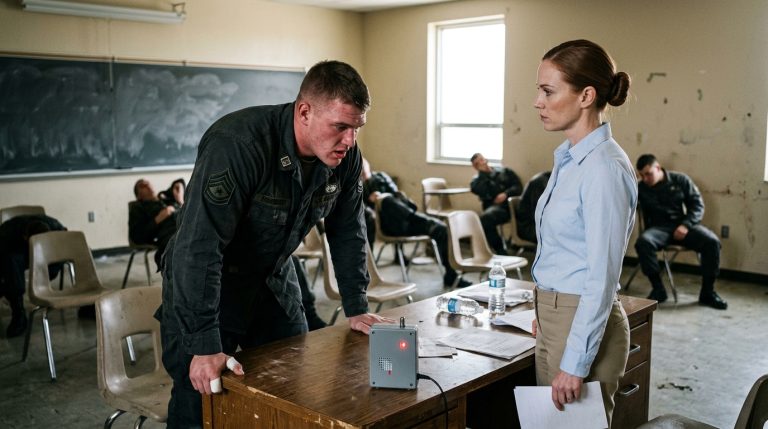
“You heard the order,” Keller barked, not even glancing at the old man as he shoved past Sergeant Davis to tower over the Apache’s secondary access panel. “Clear the immediate perimeter of unnecessary maintenance personnel. This is a restricted diagnostic window.”
Davis wiped grease across his forehead, his eyes darting from Keller’s flushed face to the silent turbine intake.
“Sir, the diagnostics aren’t clearing,” Davis said, his voice dropping an octave as he tried to reason through the wall of command ego. “If there’s a hardware conflict in the secondary loop—”
“There is no hardware conflict,” Keller interrupted, slamming his palm against the fuselage skin with a dull thud that rattled the aluminum rivets. “The computer diagnostics are infallible. Boeing certified this diagnostic suite down to the sub-millisecond level. The fault is in the software interpretation, not the iron.”
Torres kept his gaze locked on the concrete seam beneath his left boot.
His fingers tightened around the handle of his mop bucket, feeling the rough fiberglass bite into his palm.
Underneath the polished exterior of the multi-million-dollar air frame, the physical geometry of the hydraulic lines remained unchanged from the models he had wrenched out of the dirt in Fallujah twenty-one years ago.
A computer could calculate electrical voltage across a circuit board, but it couldn’t feel the micro-resistance of a thermal valve jammed by carbon residue.
“Private, move that cart all the way to the far wall,” Keller ordered, pointing a stiff finger toward the darkest corner of Hangar Seven. “I don’t want any distractions in the active zone while we re-run the master sequence.”
Torres didn’t argue.
He didn’t roll his shoulders or offer a sharp reply.
He simply turned the cart around, the worn axle letting out a high-pitched squeal that grated against the heavy silence of the room.
As he moved toward the shadows, his eyes caught a glint of light reflecting off the underside of the tail rotor housing—a tiny, hand-etched service stamp half-hidden beneath a layer of matte olive drab paint.
It was a thermal override code scratched into the metal by a field mechanic’s blade two decades ago.
A code that the digital diagnostic tree had been programmed to ignore, and one that Keller’s precious manual didn’t even acknowledge existed.
CHAPTER 3: THE COLD MARGIN
Colonel Hayes didn’t look at the mechanics or the diagnostic screens as she crossed the perimeter line.
Her eyes fixed entirely on Lieutenant Colonel Keller, who was still aggressively tapping his clipboard against his thigh like a judge reading a guilty verdict.
“The window just dropped to three hours, Colonel,” Hayes said, her voice flat, carrying the exhaustion of a commander whose people were running out of air on a frozen ridge. “The weather station reports the storm front is accelerating faster than predicted. Do we have a bird or don’t we?”
Keller cleared his throat, his chest puffing out slightly as he adjusted his collar to hide a sudden bead of sweat.
“We are isolating a complex software loop, Ma’am,” Keller lied smoothly, his eyes darting toward the multi-million-dollar turbine housing. “The diagnostic suite is throwing phantom sub-routines, but Boeing’s engineers are walking us through a systematic reset right now.”
Sergeant Davis swallowed hard, wiping his greasy hands down his utility trousers, but he didn’t contradict his superior officer.
Torres watched from thirty feet away, his fingers curling tightly around the plastic handle of his mop bucket.
The software wasn’t throwing a phantom glitch; it was choking because the digital sensors couldn’t recognize a physical bypass valve that had been welded into place during a different war.
“A reset isn’t a timeline, Keller,” Hayes snapped, stepping closer to the aircraft’s landing gear. “Six civilians are freezing to death while you play chess with error codes. If this machine doesn’t lift by fourteen-thirty, I am grounding this entire wing for administrative review.”
Keller’s face tightened, the color draining from his cheeks as the threat of a career-ending inquiry hung heavily in the stale hangar air.
“Ma’am, with respect, nobody on this floor can override a Tier-One digital architecture without risking total system failure,” Keller pressed, his voice rising in desperate self-preservation. “We are doing everything humanly possible within standard protocol.”
Torres unclipped his taped torque wrench from his belt, letting the cold iron settle into his palm.
CHAPTER 4: THE HAND ON THE FUSELAGE
“You’re still here, Torres?” Keller barked, his voice slicing across the concrete as he spotted the janitor lingering near the secondary bulkhead. “I gave you a direct instruction to clear this sector twenty minutes ago.”
Torres didn’t blink.
He didn’t drop his gaze to the polished floor either.
“The trash in this zone isn’t fully cleared, sir,” Torres said, his voice flat, steady, and entirely devoid of submissive panic.
Keller took two heavy steps forward, his boots clicking with an arrogant rhythm that irritated the raw nerves of every mechanic in the vicinity.
“I don’t care about a stray paper towel when a multi-million-dollar air frame is locked down,” Keller snapped, pointing a trembling finger toward the exit. “Move your cart out of my sight right now before I write up an insubordination flag that sticks to your record permanently.”
Colonel Hayes turned her head sharply, her tired eyes narrowing as she watched the exchange.
“Hold on, Keller,” Hayes intervened, her voice carrying the quiet weight of base command. “Why are you tracking the janitorial staff so closely when your flight line is entirely paralyzed?”
Keller’s chest hitched, a sudden flash of panic crossing his flushed features as he scrambled for an excuse.
“Ma’am, maintaining operational sterility is standard protocol—”
“Protocol isn’t fixing this bird,” Hayes cut across him, stepping directly past the junior officer to face the Apache’s grease-stained nose.
Torres took one deliberate step closer to the titanium-composite fuselage, ignoring Keller’s sputtering protests entirely.
He lifted his right hand, peeling off his worn leather glove, and pressed his bare palm flat against the cold, unyielding metal of the lower access panel.
The hangar noise faded into a dull hum.
Beneath his palm, he could feel it—not a digital error code, but a deep, rhythmic mechanical hesitation pulsing through the frame like a clogged vein.
“What in the world is he touching?” a young mechanic muttered, half-stepping forward before Sergeant Davis caught him by the elbow.
Torres closed his eyes, letting his fingers trace the invisible thermal line where the secondary bypass valve sat choked behind two layers of modern avionics housings.
CHAPTER 5: THE WEIGHT OF THE WRENCH
“Get your hands off that air frame right now, Torres!” Keller snarled, his fingers curling into the fabric of the janitorial jumpsuit with a desperate, frantic grip.
Torres didn’t flinch, his shoulder muscles locking against the sudden intrusion as he kept his palm anchored to the metal housing.
“Step back, Keller,” Colonel Hayes ordered, her voice cutting through the hangar with absolute, unyielding authority.
Keller’s hand dropped away as if he’d been burned, his face twisting into an ugly mask of disbelief and professional terror.
“Ma’am, this is a violation of every technical compliance standard—he’s a civilian janitor tampering with a multi-million-dollar tactical asset!”
“And your diagnostic suite has failed for fourteen hours while people freeze on a ridge,” Hayes countered, her eyes never leaving Torres’s weathered face. “Let him work.”
Torres unclipped the taped torque wrench from his utility belt, the heavy iron tool settling into his calloused palm with familiar, comforting weight.
He dropped to one knee on the oil-stained concrete, ignoring the sharp protest of his joints, and jammed a small steel pry bar into the jammed secondary valve housing.
“Sergeant Davis,” Torres called out, his voice low and steady. “Hand me the bypass clamp from the secondary kit.”
Davis hesitated for a fraction of a second, glancing sideways at Keller’s apoplectic expression, before tossing the steel clamp through the air.
Torres caught it mid-flight with his left hand without breaking his visual focus on the shadowed thermal line.
“This is insubordination,” Keller hissed, stepping back into the shadow of the workbench as he realized his authority was evaporating. “When the wing commander hears about this breach of protocol, every single one of you will face a formal court of inquiry.”
Torres ignored the empty threat entirely, sliding the clamp into place with a sharp, metallic click that echoed off the high ceiling.
He fitted his taped wrench onto the rusted nut, his forearm muscles straining as he applied slow, calculated leverage against twenty years of accumulated carbon lock.
CHAPTER 6: THE ROAR OF THE ROTOR
“Try it now,” Torres said, his voice carrying a dry, gravelly weight that cut through the tense quiet of the hangar floor.
Sergeant Davis climbed quickly into the cockpit, his boots clattering against the metal rungs before he reached for the main ignition sequence.
Lieutenant Colonel Keller lunged forward, his face mottled with purple fury as he pointed a shaking finger toward the landing gear.
“Stop right there, Davis! That’s a direct order—if you touch that ignition, I will personally see your stripes stripped before sundown!”
Davis froze with his hand hovering an inch from the toggle switch, his chest rising and falling in heavy, conflicted rhythm.
Colonel Hayes stepped between Keller and the aircraft, her posture rigid and immovable as granite.
“Flip the switch, Sergeant,” Hayes commanded quietly.
Davis dropped his thumb onto the toggle.
For three agonizing seconds, the hangar held its breath in absolute, suffocating silence.
Then the turbine caught.
A deep, subterranean thunder tore through the concrete floor, shaking the overhead lights and filling the space with the raw, deafening power of spinning rotor blades.
Keller’s clipboard slipped from his paralyzed fingers, hitting the floor with a hollow clatter as the color drained entirely from his face.
The young mechanics erupted into raw cheers, shouting over the mechanical roar while the Boeing engineers stared blankly at their dead diagnostic screens.
Torres wiped his grease-stained hands on his Fort Carson jumpsuit, keeping his expression flat and unreadable.
Keller scrambled desperately for a foothold, his voice cracking into a high-pitched shriek as he tried to shout over the deafening downdraft.
“This—this is an unauthorized modification! He tampered with federal property! You can’t just ignore protocol!”
Hayes didn’t even turn her head to look at him.
“Your protocol grounded this aircraft for fourteen hours while people died on a mountain, Keller,” Hayes said over the gathering storm of the turbine. “Gather your paperwork and report to personnel for an immediate administrative review.”
Keller stood frozen, his career dismantled not by an external force or a general’s intervention, but by the crushing weight of his own arrogant incompetence collapsing under common sense.
Torres unclipped his taped wrench, sliding it back onto his belt with a quiet metallic click.
He picked up his mop bucket handle, feeling the familiar plastic grip under his palm.
Twelve minutes later, the Apache lifted off the hangar floor, climbing straight into the grey mountain pass to bring the stranded alpinists home.
When Torres walked out the side doors into the afternoon air, Sergeant Davis and the crew stood in a quiet line by the tarmac, nodding in silent, hard-earned respect.
Torres nodded back, adjusting his grip on the cart handle as he crossed the asphalt.
The broom was still right where he left it, but the floor beneath his boots felt solid again.