The Abandoned Estate Held a Secret That Would Heal a Lifetime of Regret and Forge an Unexpected Family
CHAPTER 1: The Overgrown Gate
The black Mercedes sat idling on the rutted dirt road, its polished chrome catching the harsh afternoon glare.
Inside, Richard Morrison gripped the steering wheel with fingers that felt stiff and unyielding.
The manila folder on the passenger seat contained the signed contracts for next week’s total demolition.
He clicked the silver pocket watch open, felt the familiar snap of the latch against his thumb, and shut it without looking at the face.
Forty-seven years of calculated absence dissolved the moment his expensive leather shoes sank into the damp, neglected earth of his boyhood yard.
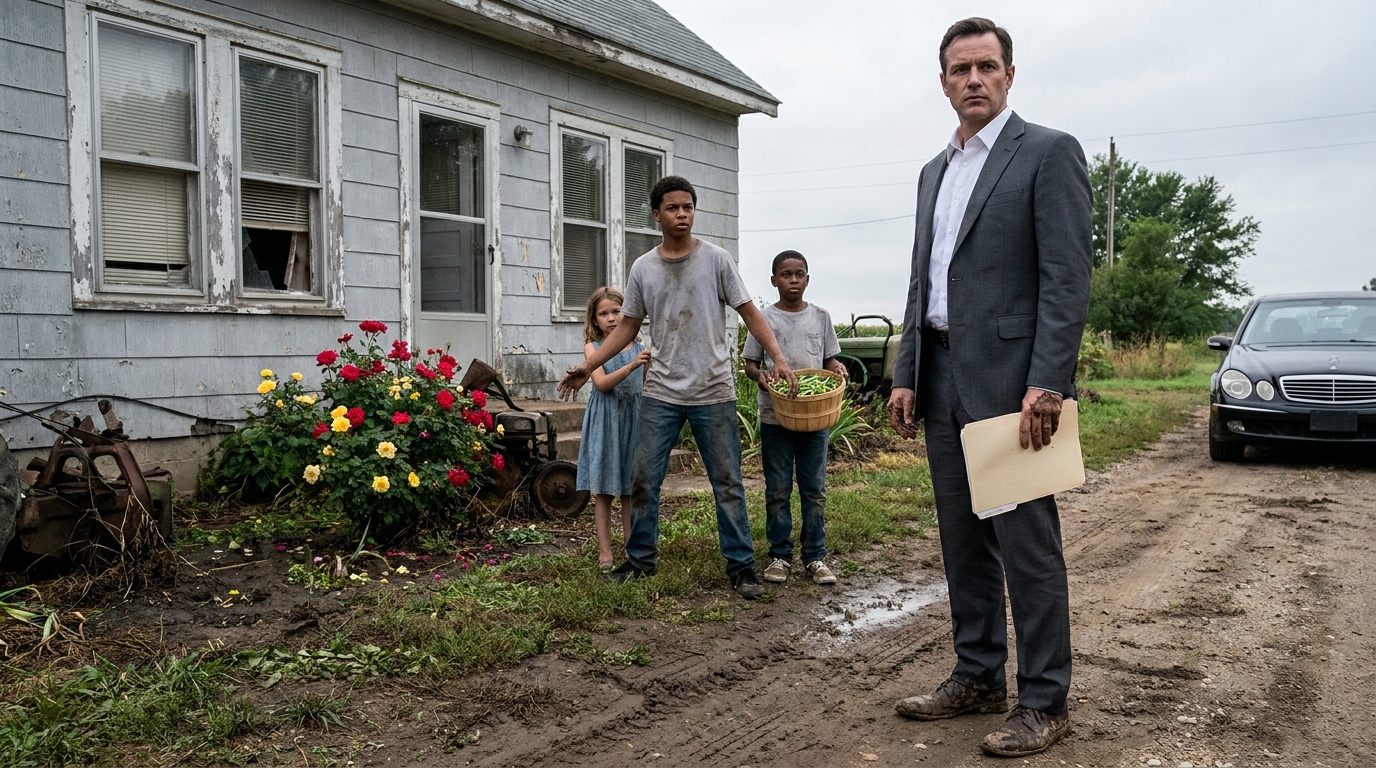
The paint on the old farmhouse hung in gray curls, and the front windows stared back like blind eyes.
Yet, defying the rot near the foundation, a sharp burst of red and yellow roses cut through the decay.
He stepped around the sagging porch, his breath catching as soft voices drifted from behind the structure.
A tall boy with dirt-smudged hands was kneeling in what used to be his mother’s vegetable patch, instructing a younger sibling on the fragility of roots.
“Excuse me,” Richard said, his voice cutting through the quiet air with unnatural sharpness.
The three children spun around in unison, wide-eyed and defensive.
The oldest straightened his tan shirt, stepping slightly in front of the younger girl in the blue dress.
“Can we help you, sir?” the boy asked, his chin lifting with a guarded resilience. “This is private property. What are you doing here?”
Richard stared at them, the manila folder in his car suddenly feeling heavier than lead.
CHAPTER 2: The Weight of Years
“We live here,” Marcus repeated, the words flat and stripped of any childish bounce. “You can call whoever you want. We’re not breaking anything.”
Richard let go of the steering wheel.
The silence between them smelled of dry grass and old cedar wood.
He looked down at his shoes, noticing for the first time the thick crust of mud caked over the expensive Italian leather—dirt from a yard he had abandoned forty-seven years ago.
“I didn’t say you were breaking anything,” Richard said, his voice grating like dry gravel.
The youngest girl, Kesha, shifted behind her brother, her fingers tangling in the hem of her faded blue dress.
A sudden chill cut through the humid afternoon air, carrying the faint, metallic scent of the rusty well pump out back.
Marcus didn’t relax his posture.
“People in cars like that don’t stop out here unless they want something gone,” the boy said, nodding toward the peeling white walls of the house. “If you’re here about the taxes, the county doesn’t care. Nobody’s been paying them under Morrison names for twenty years.”
Richard stared at the boy’s jawline—tight, stubborn, and entirely defenseless.
It was the exact face he had seen in the mirror the morning he walked away from his father’s wrath.
“How long have you been eating out of this garden?” Richard asked, ignoring the legal point entirely.
Marcus blinked, thrown off balance by the pivot.
“Since the shelter in town filled up after the winter freeze,” Deshawn chimed in from beside the rose bushes, holding up a small woven basket half-full of green beans. “We don’t bother nobody. We fix the screens. We keep the grass down.”
Richard stepped closer, the gravel crunching loud beneath his feet.
“Show me the well,” Richard said.
Marcus hesitated, his eyes darting toward the back corner of the house before he gave a slow, cautious nod.
CHAPTER 3: The Wooden Box
Marcus reached the well first, his fingers wrapping around the weathered iron lever with the practiced ease of long routine.
He pumped twice, a thin stream of clear groundwater splashing into a chipped plastic bucket below.
“It works if you prime it right,” Marcus said, his voice dropping its defensive edge as he watched Richard inspect the rusted joints.
Richard remembered his father’s calloused hands wrapping around that exact iron lever forty years ago, oiling the gears every autumn before the first freeze.
A sharp, intrusive memory of his father’s final, roaring ultimatum at the kitchen table flared behind Richard’s eyes, stinging like woodsmoke.
He forced the phantom image down, his thumb automatically finding the silver latch of his pocket watch in his coat pocket.
“You keep it cleaner than my father ever did,” Richard murmured, his gaze shifting from the pump to the sagging back door of the house.
“We had to,” Deshawn said, stepping up beside his brother with the basket of green beans still clutched in his arm. “If the water goes bad, we have nowhere else to go.”
Richard nodded slowly, feeling the heavy, undeniable friction of three young lives resting entirely on a property he had meant to bulldoze into gravel by Tuesday.
“Show me inside,” Richard said, turning back toward the rotting doorway.
Marcus exchanged a quick, uncertain glance with Deshawn before pushing the warped screen door open with a dry screech.
Inside, the air smelled of old dust and sun-baked timber, but the floors were swept clean of debris.
Kesha hurried ahead of them into the front parlor, reaching up onto a high wooden ledge to pull down a small, battered box.
“We found this upstairs in the old closet,” Kesha said, holding the weathered container out to Richard with both hands. “We didn’t know if it was trash, so we saved it.”
Richard took the box, his fingers brushing against the splintered grain as he set it on the scarred wooden table.
CHAPTER 4: The Hard Choice
Richard pulled the envelope free, his thumb catching on the brittle paper edge.
The name on the front was written in his mother’s meticulous script, though time had bleached the ink to a ghost of blue.
He didn’t open it right away.
Instead, he looked past the wooden box to where Marcus stood near the doorway, shoulders squared against an invisible weight.
“The demolition company is scheduled for Monday morning,” Richard said, his voice dropping flat into the dusty parlor air.
Kesha flinched, her small hand flying up to tug at her brother’s sleeve.
“We’ll be gone before the trucks get here, mister,” Marcus muttered, his jaw working hard as he stared at the floorboards. “We didn’t mean to squat. We just needed a place where nobody would split us up.”
Richard didn’t answer with sympathy; he answered with finality.
He reached into his tailored wool pocket, pulled out his phone, and tapped the screen twice with a thumb stiffened by old arthritis.
“Cancellations don’t happen by pressing a button,” Richard said, putting the phone to his ear as the first automated dial tone hummed through the quiet room. “Hold for line three.”
Marcus stepped forward, his eyes narrowing in sudden confusion.
“What are you doing?”
“Stopping the trucks,” Richard said—and turned his back on the children to speak into the receiver.
CHAPTER 5: The Legal Battle
“Listen carefully,” Richard said into the receiver, his thumb pressing down hard on the phone’s volume toggle. “The contract is void. All of it.”
The voice on the other end sputtered through the static, citing municipal permits and cancellation fees.
Richard cut them off with a sharp stroke of his thumb across the screen, killing the call before the protest could finish.
Marcus watched from the doorway, his chest rising and falling in shallow, guarded breaths.
“The county caseworkers don’t care about permits,” Marcus said, his voice dropping into a harsh rasp. “They came by two weeks ago. They saw us living out of the shed before we moved into the back room. They said if they catch us here again, they’ll split us up into three different towns.”
Richard felt a cold knot tighten in his gut—not from legal fear, but from the raw, ugly reality of a system built to chew up kids who only wanted to stay together.
Without his corporate lawyers to wave away the paperwork, he had to navigate the county’s iron-clad bureaucracy the hard way: face-to-face, with his own name and his own bruised pride on the line.
“They won’t split anyone up,” Richard said, sliding the phone back into his coat pocket with a dull thud. “Not while I’m standing on this porch.”
“You’re just one man with an old house,” Deshawn interjected, stepping out from the shadows with his arms crossed tightly over his olive shirt. “The state has judges. They don’t care about your memories.”
Richard walked straight up to the boy, stopping inches away.
“They care about ownership, taxes, and a safe roof,” Richard said, his voice dropping into a low, unyielding growl. “And I have the deed in my car, even if the taxes haven’t seen a dime in twenty years.”
Before Marcus could answer, the crunch of heavy gravel echoed sharply from the end of the long dirt drive.
Headlights cut through the twilight, painting the peeling white walls of the farmhouse in a harsh, glaring yellow.
A county social services sedan pulled to a dead stop right beside the black Mercedes, its engine ticking loudly as the driver’s side door clicked open.
CHAPTER 6: The New Foundation
A middle-aged woman in a gray trench coat stepped onto the rutted earth, her sensible shoes crunching against the loose stones.
The heavy manila folder tucked under her arm looked official and uncompromising against the wild grass.
She scanned the peeling white siding of the farmhouse before locking her gaze on the three children standing near the doorway.
“I received an urgent notification regarding unauthorized minors on an abandoned property,” the caseworker said, her tone flat and exhausted. “County records show no active residency here.”
Richard stepped off the wooden porch steps, placing himself squarely between the official and the children.
“The records are outdated,” Richard said.
The woman frowned, peering over her wire-rimmed glasses at his tailored suit and dust-covered leather shoes.
“Unless you’re the registered legal guardian or the owner of record, I have to take these children into temporary state custody tonight,” she said, reaching for the pen in her pocket.
Richard didn’t raise his voice, nor did he reach for a corporate phone.
Instead, he pulled the original property deed from his inner pocket, unfolding the heavy paper where the porch light caught the embossed county seal.
“I am Richard Morrison,” he said, his voice carrying the immovable weight of a man standing on his own ground. “And this is my family’s home.”
The caseworker stopped, her eyes scanning the legal description and the signature matching the name on the tax rolls.
She looked past Richard to where Marcus stood with his shoulders back, flanked by Deshawn and Kesha.
“If you’re claiming residency and filing for guardianship, you’ll need to satisfy local habitability codes by morning,” she said, tapping her pen against the folder.
“The well is running, the roof holds, and the plumbing is being restored as we speak,” Marcus spoke up, his voice steady and clear.
The official looked from the boy to the bright rows of roses blooming against the foundation, then slowly closed her folder.
“File the paperwork at the courthouse by nine o’clock tomorrow,” she said, turning back toward her car. “I’ll log this as an active family settlement.”
The sedan doors slammed shut, and the taillights receded down the dark dirt road until the night swallowed them completely.
Silence rushed back in, carrying the cool scent of damp earth and blooming flowers.
Richard slipped his mother’s weathered letter back into his pocket, feeling the quiet, solid friction of the paper against his chest.
He didn’t need a corporate empire or a fleet of lawyers to tell him what mattered anymore.
He turned back toward the open doorway, reaching down to take Kesha’s small hand as she held out a single pink rose.
Together, they walked inside, leaving the cold years behind in the dark.