Broken Wings and Rusty Iron: How a Forgotten Combat Legend Found the Strength to Rise Again
CHAPTER 1: THE CHAIN LINK FENCE
The dust under Marcus Dalton’s boots stayed still until the wind kicked up off the runway, carrying the sharp, unmistakable smell of aviation fuel and hot metal.
Four years under the I-35 bridge had taught him how to fade into the background, how to make his breathing shallow enough that people stopped seeing him entirely.
His beard caught the glare of the noon sun, tangled and grey at the edges, framing a face carved by deep lines and old scar tissue from a cockpit that had tried to swallow him whole.
Inside the perimeter fence of Fort Cavazos, polished Apache helicopters gleamed under canvas and steel like monuments from a life he had buried.
He didn’t come here looking for a miracle or a handout; he came because February 9th had a way of pulling him by the throat straight back to the places where the sky used to make sense.
A heavy box of printed ceremony programs shifted against Sergeant Tom Rivera’s chest as he marched past the chain link on his way to the main hangar.
Rivera had spent his morning dodging officers and double-checking VIP seating charts for the fiftieth anniversary celebration, his mind occupied by logistics and military precision.
Then he caught movement out of the corner of his eye—a rigid, unblinking posture pressed against the wire that didn’t belong to any civilian tourist or passing local.
Rivera slowed his pace, his boots crunching on the gravel, and turned his head to size up the figure standing in the blinding glare.
The man wore a filthy, salt-stained jacket that had seen too many winters, his knuckles white as he gripped the diamond-pattern wire with unnatural stillness.
Rivera stopped five feet away, shifting the cardboard box higher up his forearm, letting his professional courtesy mask a rising wave of caution.
“You okay, sir?” Rivera asked, his voice dropping into the neutral cadence used for anyone lingering too close to restricted ground.
Marcus didn’t flinch, didn’t turn his head to look at the uniform standing beside him, his grey eyes locked entirely on the rotor blades spinning lazily in a distant test cell.
“I used to fly those,” Marcus said.
The words came out cracked and heavy, like stones sliding down a dry riverbed from a throat that hadn’t formed conversational sentences in months.
Rivera offered a polite, practiced smile—the kind people give when they humor someone standing on the edge of reality.
“Yeah, that’s cool, man,” Rivera said, shifting his weight. “They’re amazing machines.”
Marcus finally turned his head, the skin around his temples tightening as his gaze locked onto the young sergeant’s face with a clarity that felt entirely out of place under a highway bridge.
“AH-64D Longbow,” Marcus murmured, his voice dropping an octave as the numbers began to flow with rhythmic precision. “Turboshaft engines, thirty-millimeter M-230 chain gun, Hellfire rails. I flew two hundred and eighty-seven combat missions.”
Rivera’s smile vanished completely, the cardboard box growing suddenly heavy in his numb hands as the cold weight of a forgotten radio call sign echoed in his memory.
CHAPTER 2: THE HANGAR CRISIS
Colonel Bradley Henderson didn’t look at the civilian visitors lingering near the bleachers, his gaze locked entirely on the empty tarmac where the vintage Apache sat like a caged animal.
His boots struck the polished concrete with sharp, rhythmic authority as he paced the perimeter of the staging area, his mind fixed on the rigid timeline of the anniversary schedule.
Thirty minutes before the rotors were scheduled to turn, the entire multi-million-dollar demonstration had imploded because a single lieutenant colonel couldn’t keep his heart from seizing in a staff office.
“Get me a status report on the replacement pilot from base operations,” Henderson snapped, spinning on his heel to face his adjutant.
“There isn’t one on standby, Colonel,” the junior officer replied, clutching a digital tablet against his ribs like a shield. “Everyone rated on the legacy analog systems is either deployed or retired.”
Henderson let out a sharp, compressed breath through his nose, his face flushing a mottled crimson under the fluorescent overhead glare.
“We have two hundred VIPs, a retired admiral who helped design the frame in the eighties, and a reporter from Army Times standing twenty yards away,” Henderson muttered, his voice dropping into a harsh, controlled hiss. “We are not canceling this flight.”
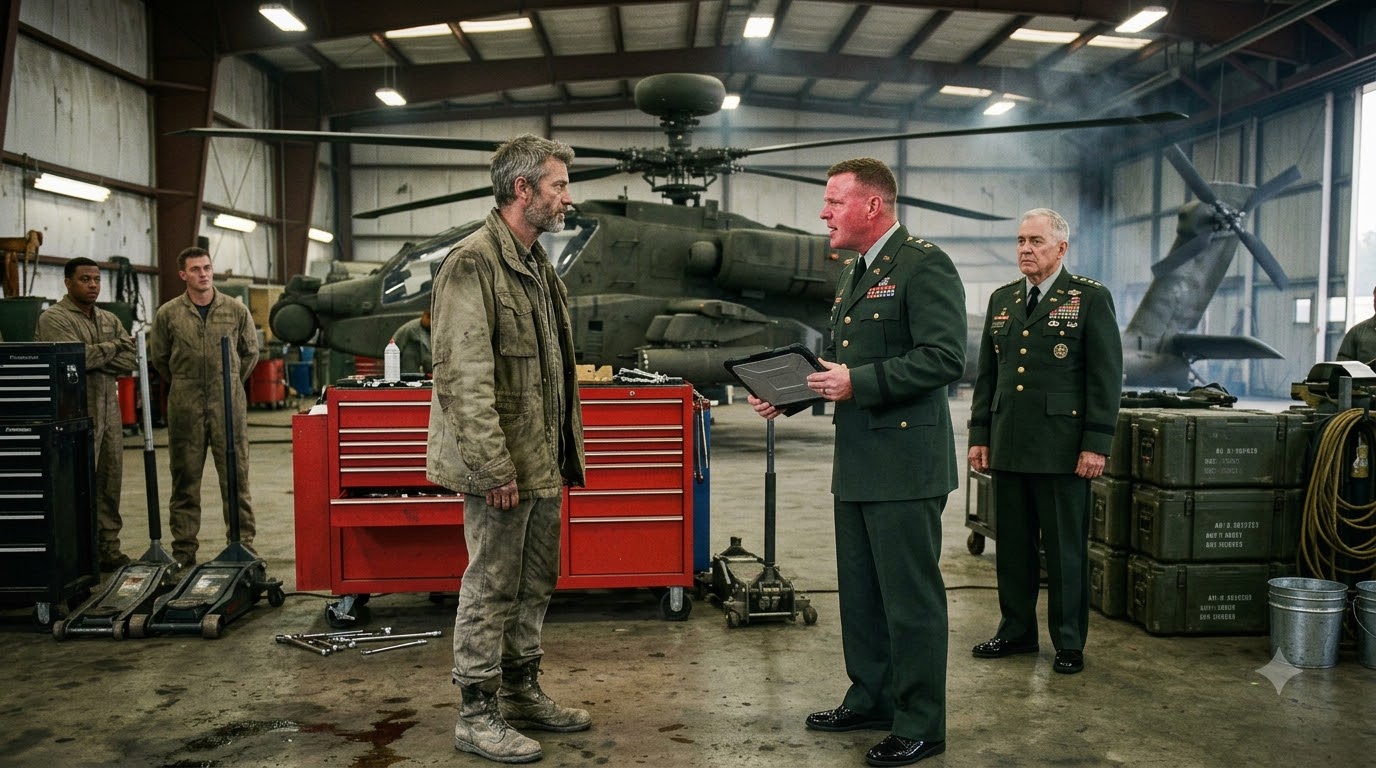
Admiral James Cland stood a few paces away, his hands clasped behind the small of his back, his posture stiff and entirely unimpressed by the colonel’s rising panic.
The old man’s eyes lingered on the instrument panel of the 1984 model through its open canopy, ignoring the frantic whispers bouncing off the steel girders above them.
“The aircraft is old iron, Colonel,” Cland said, his voice carrying the dry, unshakeable weight of decades spent in uniform. “It doesn’t care about your VIP list. It doesn’t care about your schedule. It requires a hand that knows how to talk to analog hydraulics.”
“With all due respect, sir, we don’t need a poet; we need a certified active-duty aviator with current logbook hours,” Henderson retorted, stepping closer with his chin lifted. “Not whatever antiquated relic Sergeant Rivera just dragged out of the dirt outside our perimeter fence.”
The sharp slap of boots against concrete echoed from the far entrance before Henderson could finish his thought.
Sergeant Rivera didn’t bother breaking stride as he dragged Marcus by the forearm straight into the center of the hangar floor, ignoring the sudden turn of every head in the room.
CHAPTER 3: THE COLD RECEPTION
The grit of the tarmac seemed to press right through the thin soles of Marcus’s boots as Sergeant Rivera’s grip tightened on his arm.
Colonel Henderson didn’t step back; instead, he squared his shoulders, his mouth twisting into a tight, hardened line of absolute disdain.
“Sergeant, what on earth do you think you’re doing tracking vagrants into a secure staging area?” Henderson demanded, his voice bouncing sharply off the curved corrugated steel overhead.
Rivera kept his hand planted firmly near Marcus’s sleeve, his face flushed with a mixture of disbelief and lingering adrenaline.
“Sir, this is Captain Marcus Dalton—call sign Ghost,” Rivera said, his voice straining against the sheer absurdity of the colonel’s wall of resistance.
Henderson let out a dry, dismissive scoff that sounded like air escaping a punctured tire.
“That’s a clever story for someone looking for a warm meal or a handout, Sergeant, but we have protocols,” Henderson snapped, waving a hand dismissively toward the exit. “Get him off this base before military police escort you both out.”
Marcus felt a familiar, dull ache flare behind his eyes—not from the old shrapnel in his shoulder, but from the crushing weight of a system that only ever looked at a man’s surface.
He didn’t yell, and he didn’t lean into the insult; he simply let his grey eyes lock onto the colonel’s polished brass buttons with the cold, unblinking patience of a pilot holding a steady hover in a crosswind.
“I didn’t ask to come inside your fence, Colonel,” Marcus said, his voice low, rough, and entirely devoid of fear.
Admiral Cland stepped out from the shadow of the aircraft’s stub wing, his old boots clicking softly against the concrete as he bypassed Henderson entirely.
“Colonel,” Cland said, his voice dropping an octave into a tone that instantly silenced the surrounding junior officers. “Step aside.”
Henderson’s jaw twitched, his face cycling from a dull pink to an ashen gray as he realized the senior officer was looking right past him.
“Sir, we cannot trust a civilian who looks like he hasn’t slept under a roof in years with a multi-million-dollar legacy frame,” Henderson protested, his voice cracking slightly under the strain of his fading authority.
Cland ignored him completely, stopping two feet away from Marcus and looking past the tangled beard straight into the eyes of a pilot he thought had died in an Afghan valley ten years ago.
“Captain Dalton,” the admiral murmured, the harsh lighting catching the medals pinned across his chest. “I thought we buried you.”
CHAPTER 4: THE STARTUP TEST
The hum of the base generator outside sounded like distant thunder through the thick corrugated steel walls.
Colonel Henderson stepped sharply into the gap between the admiral and the dusty visitor, his face mottled with cold indignation.
“With respect, sir, reciting a manual from twenty years ago proves nothing about this man’s current capability,” Henderson barked, jabbing a finger toward the cockpit ladder. “It’s a parlor trick.”
Admiral Cland did not even glance back at his subordinate, keeping his gaze locked on Marcus’s weather-beaten face.
“Let’s hear it, Captain,” Cland said quietly, ignoring the colonel’s protest entirely. “Tell us the startup procedure for the legacy frame.”
Marcus closed his eyes for a single heartbeat, feeling the ghostly phantom of a throttle quadrant under his right palm.
“Battery switch on,” Marcus began, his voice flat, rhythmic, and utterly devoid of hesitation. “Check fuel quantity. APU switch to start. Wait for RPM to stabilize at sixty percent.”
A low murmur rippled through the gathered junior officers near the supply crates.
“Monitor exhaust gas temperature,” Marcus continued, opening his grey eyes to stare straight past Henderson’s shoulder. “Don’t exceed seven hundred degrees. Once APU is online, engine one master switch to on. Throttle to idle at twenty percent.”
Henderson’s expression shifted from arrogant dismissal to a tight, nervous twitch as he realized the sequence was entirely accurate.
“Watch the N-one turbine,” Marcus murmured, his fingers twitching against his trouser seam as if feeling the manual linkages. “It’ll spool slowly. Should hit fifty-eight percent before ignition.”
Captain Sarah Mitchell gripped the edge of the landing gear strut behind them, her breath catching in her throat as she tracked every technical term.
“Ignition button,” Marcus finished, his voice cutting through the ambient hum of the hangar like a blade. “Hold for three seconds. You hear the igniter click, and you feel the airframe shutter when combustion starts.”
Silence settled over the concrete floor so heavily that the drop of a wrench twenty yards away sounded like a gunshot.
Henderson opened his mouth to object once more, but the words died on his tongue as Admiral Cland raised a single, weathered hand.
CHAPTER 5: THE COLD IRON ASCENT
The interior smelled of old hydraulic fluid and sun-baked canvas, a sensory snapshot of a life he thought he had locked away forever.
He slid his boots into the footwells, his fingers instantly finding the familiar layout of analog dials and toggle switches without a single moment of hesitation.
Below the open hatch, Colonel Henderson stood with his arms crossed tightly over his chest, his face dark with suppressed fury as he watched the civilian settle into the pilot seat.
“This is a complete regulatory violation,” Henderson muttered, loud enough to carry up through the airframe. “If he damages that museum piece, I’m holding every single person in this hangar personally liable.”
Admiral Cland ignored the protest, stepping closer to the fuselage with his chin raised.
“Run the sequence, Captain,” Cland called up, his voice steady.
Marcus flipped the master battery switch, watching the needles twitch across the oil-stained instrument cluster as power flooded the vintage circuits.
He pushed the starter switch, feeling the heavy mechanical thrum of the auxiliary power unit catch and whine beneath his seat.
The exhaust gas temperature needle crept upward, stabilizing right where it needed to be before he rolled the throttle forward into idle.
“Engine one online,” Marcus muttered into his headset, his hand wrapping firmly around the heavy collective lever.
The airframe shuddered violently as combustion caught, the old turbine screaming to life with a deep, bone-rattling resonance that shook dust off the steel beams overhead.
Henderson took an involuntary step backward, his face draining of color as the rotor blades above began to rotate in a slow, sweeping blur.
Marcus ignored the frantic shifting of the ground crew below, locking his focus entirely on the hydraulic pressure gauges as they climbed toward two thousand nine hundred pounds.
“Engines stable,” Marcus spoke into the live radio channel, his voice dropping into the calm, rhythmic cadence of a man who owned the sky. “Rotor engagement manual pull—clear the deck.”
CHAPTER 6: THE NEW GROUND
The ground fell away beneath the skids in a blur of dust and sunlight, the old airframe responding with a familiar, rhythmic pulse that chased away ten years of shadows.
He banked the machine across the southern boundary of the base, keeping the flight path smooth and precise as the gathered crowd below shrunk into motionless specks against the concrete.
When he finally set the aircraft back down on the tarmac twelve minutes later, the silence of the hangar didn’t last—it broke open into a roar of raw, sustained applause from soldiers and officers alike.
Colonel Henderson stood near the perimeter wall, his face turned away, his career collapsing silently under the weight of his own arrogance.
Marcus climbed down the ladder, his muscles aching with a heavy, honest fatigue that felt entirely different from the hollow exhaustion of the bridge.
Admiral Cland was the first to reach him, ignoring protocol to pull the weary pilot into a firm, grounding embrace.
“Welcome home, son,” the old man murmured against his shoulder.
Months followed with clean meals, warm rooms, and real therapy that slowly untangled the knots in his chest, but Marcus declined every high-profile job offer the military placed on his desk.
Instead, he took his rucksack, walked back to the dirt beneath the I-35 bridge, and sat down next to a shivering veteran who had nowhere left to turn.
Marcus reached into his pocket, his thumb brushing the cool, worn metal of Danny’s brass compass as the needle settled steady and true toward the north.
“I’m Marcus,” he said softly, holding out a scarred hand to guide another lost soul back home.