The Weight of a Tarnished Pin: How an Arrogant Young Marine Met a Living Legend at Fleet Week
CHAPTER 1: The Tent Confrontation
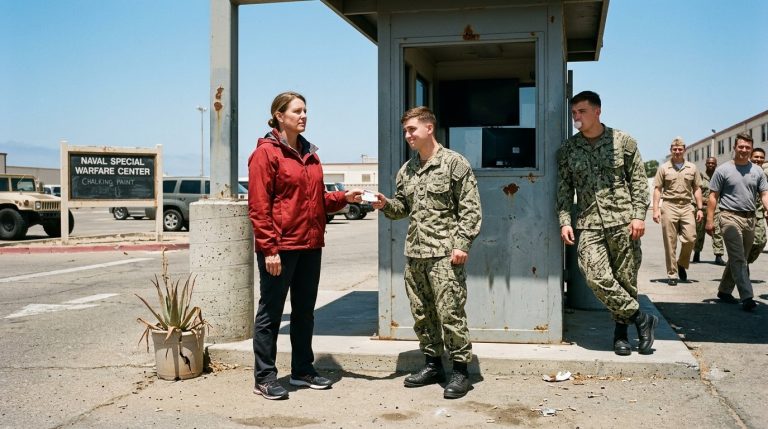
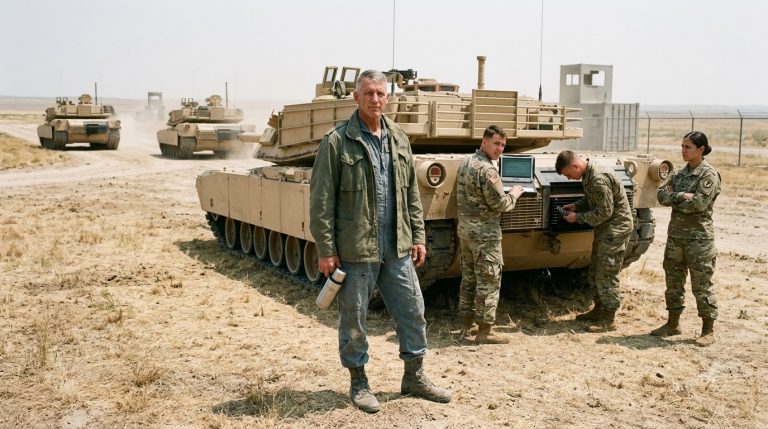
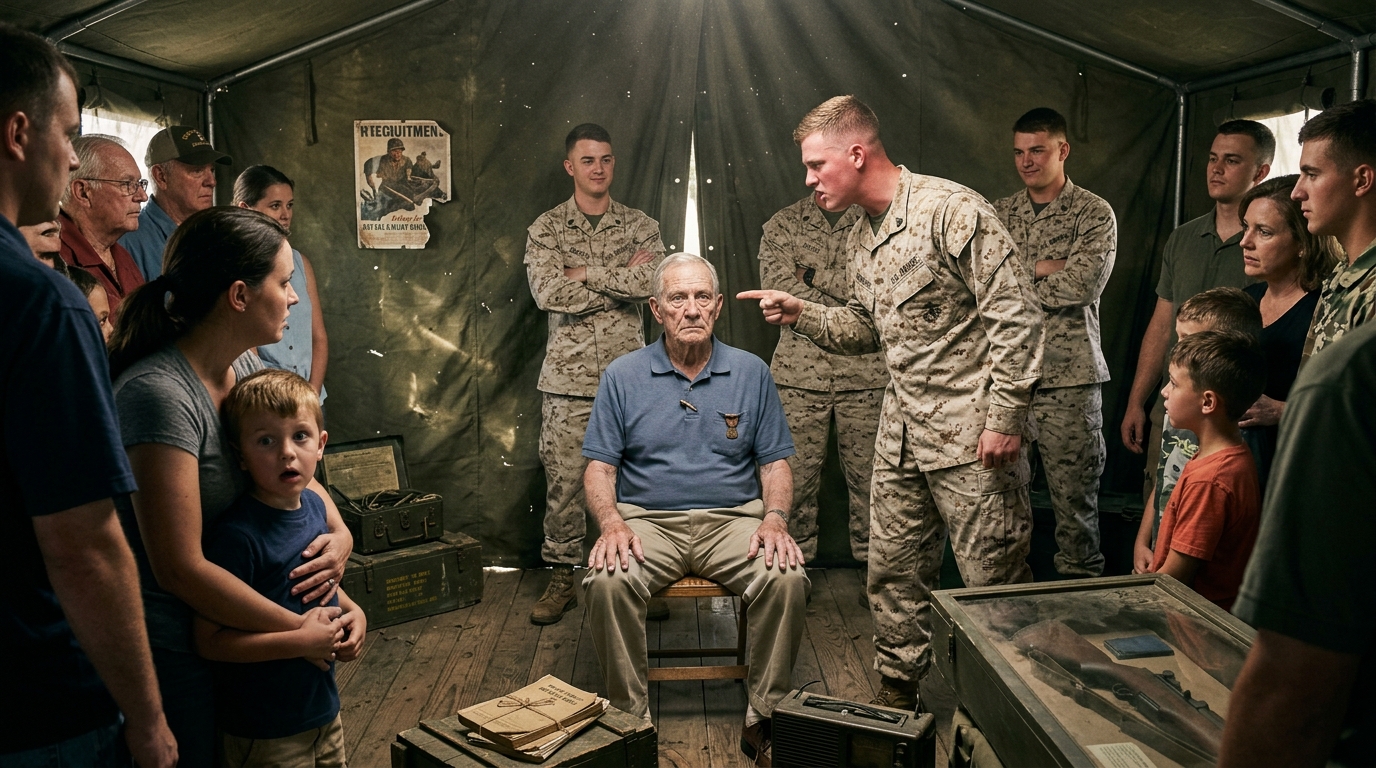
The heavy olive drab canvas muffled the distant hum of the base’s annual open house, trapping the thick, humid air inside like a glass jar. Harold Winters sat motionless on a simple folding chair, his hands—lattised with the road map of a long life—resting quietly on his knees. He wore faded khaki pants and a simple blue polo shirt. Across from him, Corporal Davis stood with his hands planted firmly on his hips, his freshly starched desert camouflage rigid with the sharp, unearned confidence of youth.
Hey, I’m talking to you, old man, Davis pressed, his voice rising as two of his friends chuckled behind him in matching postures of casual arrogance.
This area is for active-duty personnel and their families. Did you get lost on your way to the bingo hall? The small crowd milling around the historical displays slowly ground to a halt, conversations thinning out as heads turned. A mother pulled her young son closer by the shoulder, the air growing dense with an uncomfortable, unspoken tension. Davis felt the shifting weight of the audience and swelled visibly, mistaking quiet discomfort for approval as he positioned himself as the sole guardian of a modern standard.
I’m going to need to see some identification, Davis demanded, puffing his chest out further. Base regulations. We can’t just have anyone wandering in here.
Slowly, deliberately, Harold turned his head. His eyes—a pale, clear blue—met the corporal’s gaze with a profound, unsettling stillness that carried the weight of an unmoving anchor. He reached into his back pocket, his fingers fumbling slightly with the frayed leather of a worn wallet inside the plastic sleeves.
Come on, Grandpa, Davis sighed, tapping his boot against the dusty floorboards. We don’t have all day. What are you, a hundred? Just pull out your driver’s license so I can call you a cab.
The insult hung sharp and heavy in the stagnant air, drawing a sharp murmur of disapproval from the surrounding onlookers. Harold finally extracted a state-issued ID card and extended it outward. Davis snatched it from his weathered hand, glancing at it with dismissive contempt.
Harold Winters. Well, Harold, it says here you’re a resident of Northwood, not someone with clearance for this tent.
The corporal held the card between his thumb and forefinger as if it were smeared with dirt, preparing to toss it back when his eyes caught a dull glint on the old man’s collar. A small, tarnished piece of metal was pinned to the blue fabric, completely lacking the polished gleam of official military insignia. It looked like a worthless trinket picked up off a dusty sidewalk.
What’s that supposed to be? Davis sneered, thrusting a finger toward the fabric. Did you get that for perfect attendance at the senior center? Some kind of prize for finishing your oatmeal?
His friends barked a harsh, braying laugh that bounced off the canvas walls. The humiliation was thick and palpable, freezing the crowd between the urge to intervene and the heavy hesitation of challenging a man wearing the uniform. Davis smiled, completely blind to the edge of the cliff he was standing on.
CHAPTER 2: The Ghost of Chosin
The braying laughter of the corporal’s friends faded into a wet, rhythmic rattle that echoed off frozen canvas walls that didn’t exist. Harold’s vision blurred, the modern dust of the exhibition tent replaced by an iron-gray sheet of sky stretched tight over the barren, snow-choked hills of North Korea. He was twenty years old again, his fingers swollen and bleeding inside stiff leather gloves that offered no protection against forty-below-zero air. The sound tearing through the valley wasn’t the clatter of base displays, but the deafening crump of distant artillery and the whistling shriek of a wind that cut through thin fatigues like a surgeon’s blade.
He was kneeling in the churned red-brown mud and ice beside his platoon leader, Captain Richards. The good officer was struggling to keep the dark, hot iron of life inside his chest where a jagged piece of shrapnel had torn through his coat. With fingers that could barely flex, Richards fumbled at the stiff wool of his own collar, wrenching loose a small, jagged piece of metal he had hammered flat from a shattered radio antenna. He pressed the cold, sharp edges of the scrap directly into Harold’s palm.
You held the line, Winters—the captain rasped, his voice tearing like dry paper as his breath fogged instantly into the freezing dark. This stays with you. Don’t you ever forget what we did here.
The pin was nothing more than garbage to the rest of the world, a useless shard of twisted wire and copper. To Harold, it carried a weight heavier than any standard-issue medal ever cast.
Sir, are you okay? A sharp voice sliced through the phantom ice, dragging Harold back to the glaring fluorescent lights and the stale heat of the exhibition tent.
Harold blinked, the memory receding like a fast-moving tide against a shattered shore. The face staring down at him was no longer the bleeding captain in the snow, but a man in his late thirties wearing the pressed chevrons of a gunnery sergeant. Gunnery Sergeant Reyes stood at the edge of the display area, his brow furrowed in a tight ridge of growing concern as he watched the confrontation unfold.
I’ve got this, Gunny, Davis snapped, turning sharply to block the NCO with an aggressive shove of his shoulder. This man is trespassing. I’m handling base security.
Reyes didn’t blink, his dark eyes sliding past the young corporal to lock onto Harold’s pale, steady gaze. The senior NCO had spent enough time downrange to recognize the quiet, unyielding posture of a man who had stared down real terror and refused to blink. He knew the difference between a seasoned survivor and a kid playing soldier with cheap authority.
Corporal, stand down right now—Reyes warned, his voice dropping an octave into a low, rumbling register that carried absolute authority.
Davis puffed his chest out further, his face flushing a bright, angry crimson as the audience around them leaned in closer. I’m waiting for the MPs. I’m not letting some confused civilian walk away just because you want to play nice.
CHAPTER 3: The Sergeants Warning
I’ve got this under control, Gunny, Davis repeated, his voice climbing an octave as he shoved his weight forward to reassert his dominance over the space.
Reyes didn’t bother arguing with the kid. Instead, he turned his back on the unfolding spectacle, lifting the black handset directly to his ear while his boots ground irritably against the gritty floorboards.
This is Gunnery Sergeant Reyes at the Fleet Week Historical Exhibit GP104, he said into the receiver, keeping his tone flat and deadpan to cut through the static. I have a situation here. A young corporal is actively harassing an elderly civilian, and things are getting out of hand.
Davis scoffed loudly behind him, leaning down toward Harold with an obnoxious smirk. Who are you calling, old timer’s defense squad? You’re done here.
Reyes ignored the jab entirely, his eyes scanning the crowd of onlookers who had stiffened into an uncomfortable silence. He gave the dispatcher the old man’s exact name, spelling it out letter by letter while watching Davis tower over the seated veteran like a playground bully high on his own reflection.
The gentleman’s name is Harold Winters, Reyes spoke quietly into the phone, his gaze hardening as the corporal reached out a hand toward the old man’s shoulder. Send someone down here before this kid creates a disaster he can’t walk back from.
Davis caught sight of the phone call and whipped around, his face twisting into an ugly mask of insubordination.
Put that phone away, Gunny! That’s an order! I’m waiting for the actual MPs I called, and this trespasser isn’t moving an inch until they get here.
Reyes lowered the phone slowly, his eyes narrowing into cold slits as he looked at the younger Marine.
You keep talking, son, Reyes muttered, his voice dropping into a dangerous hum that made the surrounding crowd take an instinctive step backward. You keep right on talking.
CHAPTER 4: The Terminal Screen
Everything all right over there, Master Sergeant? Captain Evans asked, looking up from a stack of manifest logs with a twitch of mild annoyance.
Miller didn’t answer right away. He couldn’t force the air past the sudden tightness in his throat. His fingers hovered over the keyboard like weights, trembling slightly as his eyes tracked the lines of text glowing against the dark monitor.
Sir, you need to see this right now—Miller choked out, his voice scraping raw against the quiet hum of the server banks.
Evans pushed his chair back with a sharp screech of metal against tile and strode across the room. He leaned over the console, expecting to find a routing error or a minor personnel discrepancy. The annoyance on his face vanished in a single heartbeat, replaced by a gray wash of absolute disbelief.
Underneath the name Harold Winters lay a service history that defied conventional records, stretching across decades of conflict and unheralded sacrifice. Right at the top, anchored beside a grainy black-and-white photograph of a stern young face in a dress uniform, sat a single designation that commanded total silence.
Medal of Honor.
Evans reached out, his hand shaking slightly as he snatched the desk phone from its cradle. He punched the direct line to the historical exhibit with a speed that made the plastic housing rattle.
Gunny Reyes, this is Captain Evans at Command—he snapped, his voice dropping into an urgent, low register that bordered on panic. Listen to me very carefully, and do not let Mr. Winters out of your sight.
CHAPTER 5: The Generals Salute
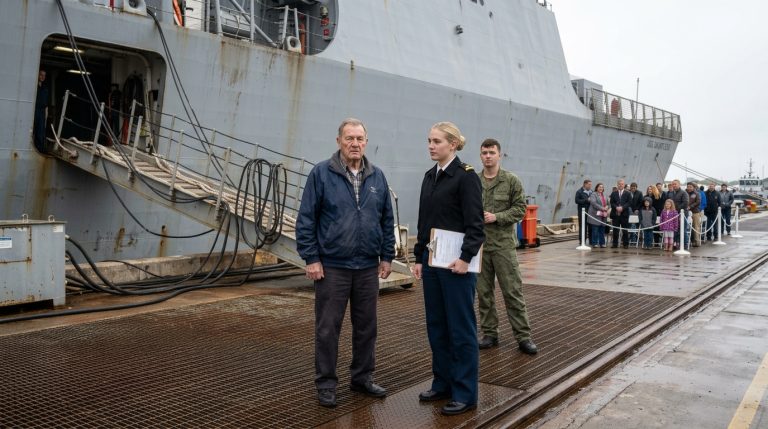
The crowd parted instantly, sliding back like oiled machinery to clear a wide lane down the center of the exhibit. Davis stood frozen with his hand still raised in mockery, his fingers hovering inches away from Harold’s shoulder before locking completely in mid-air.
General Thorne marched straight down the aisle, his chest a heavy wall of ribbons and his face carved from cold stone. He stopped three paces from the old man in the folding chair, every muscle in his frame tightening into absolute rigidity.
Without a word, the two-star general raised his right hand to his brow and executed a razor-sharp, flawless salute that caught the fluorescent light of the tent.
Sergeant Major Winters—the general’s voice boomed across the silent space, steady and ringing with absolute reverence. It is an absolute honor to have you on my base, sir.
The title dropped like a lead weight onto the floorboards. Davis watched in wide-eyed horror, his jaw slackening as the color drained entirely from his face until it matched the ash of the tent poles.
The general held his salute, his eyes fixed on Harold with unblinking respect before turning slightly to address the captive audience. You are in the presence of a genuine American hero who held the line against insurmountable odds at Chosin, his words slicing through the heavy air.
Davis dropped his arm, his knees trembling beneath his uniform trousers as the reality of what he had done crashed down around him. He had spent the last ten minutes bullying a living legend, threatening a man whose sacrifice had bought the very uniform the corporal was wearing.
The general lowered his hand and turned his glare toward the young enlisted man, his voice dropping into a lethal, low murmur. Corporal Davis—in my entire career, I have never been more ashamed of a Marine than I am right now.
CHAPTER 6: The Redemptive Burden
Mr. Winters, sir—Davis choked out, his shoulders hunched under the weight of civilian clothes that still felt foreign against his skin. I came here because there’s no excuse for what I did back in that tent. I was arrogant, and I was ignorant, and I am so deeply sorry for the disrespect I showed you.
Harold kept his gaze steady, watching the raw remorse carved into the young man’s face. He saw no trace of the puffed-up uniform or the sharp sneer that had echoed off the canvas walls months ago.
Sit down, son—Harold said softly, gesturing to the empty chair across the small table. Tell me what you’ve learned since you left the base.
Davis let out a long, ragged breath, his fingers wrapping tightly around the warm ceramic mug. Three months of studying battle reports from Iwo Jima and Inchon, three months of scrubbing floors and maintaining museum displays under a gruelling instructor had stripped away every ounce of false pride.
I learned about the ground you stood on, sir—Davis whispered, looking up with damp eyes. I learned that the uniform isn’t about power. It’s about carrying something heavier than yourself so other people don’t have to.
Harold reached up with a gnarled hand, his thumb brushing lightly against the small, dull metal pin fastened securely to his collar. The phantom wind of Chosin blew cold in his memory for a final, quiet second before dissolving into the warm hum of the hall.
The pin wasn’t an award for glory, he murmured, his voice steady as the heavy burden of seven decades finally settled into absolute peace. It was a promise to the ones who stayed behind. Never forget why we wear it.
Davis nodded slowly, the silence between them stretching not with tension, but with the quiet, hard-earned weight of mutual respect. Outside the weathered brick walls of the hall, the afternoon sun cut cleanly across the quiet street, casting long, steady shadows that needed no defense.