Building a Quiet Life on the Edge of Conformity Before the Bureaucracy Comes Knocking at My Door
CHAPTER 1: THE CITATION AT THE PROPERTY LINE
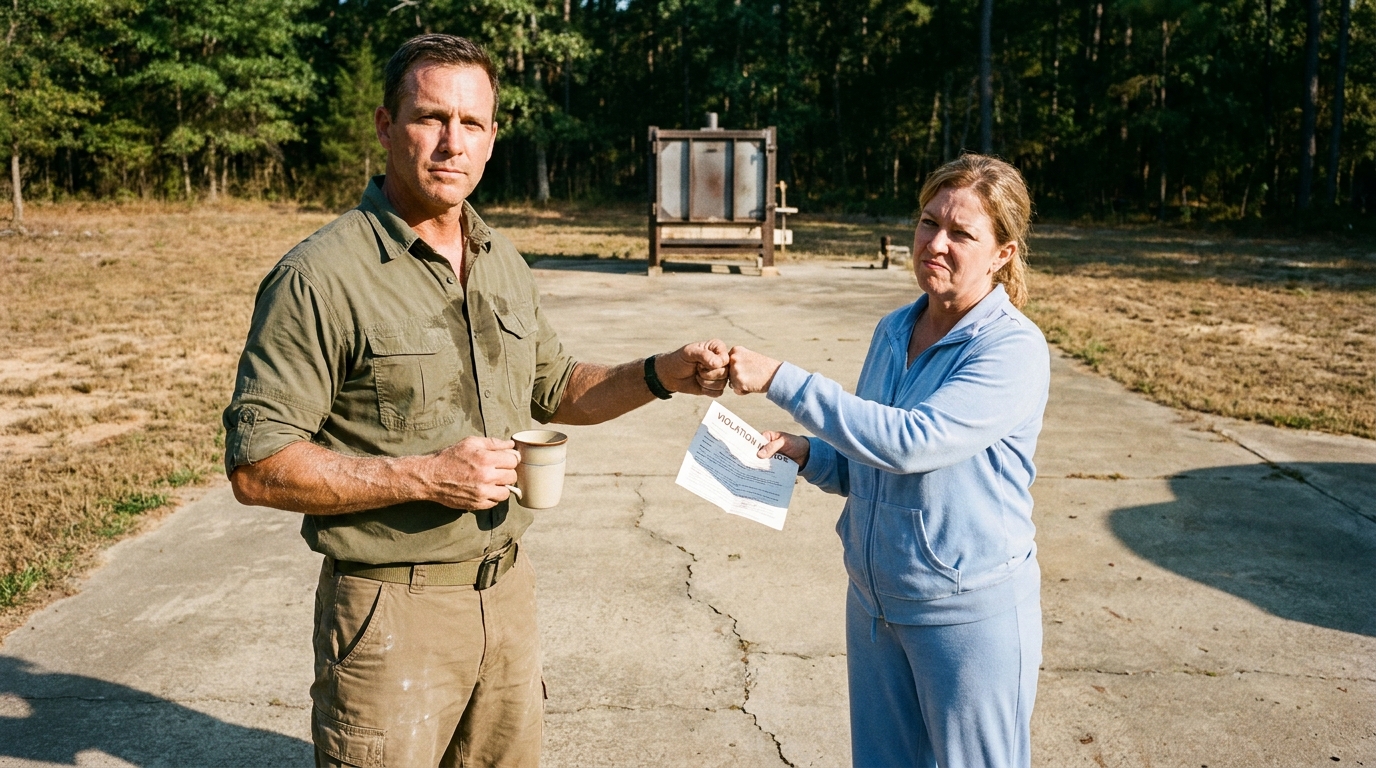
The sun beat down against the freshly poured concrete of my driveway, radiating a dry, unforgiving heat that caught in the back of my throat.
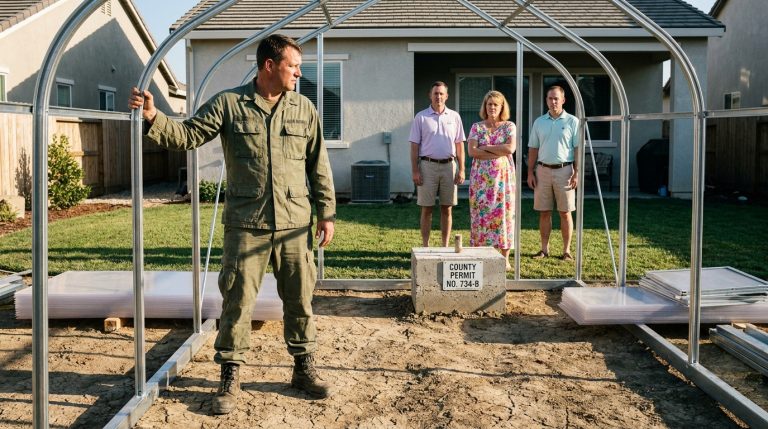
Karen Miller stood with her weight planted firmly on my property line, her powder-blue tracksuit straining at the seams like a cheap strap holding back dead weight.
Her finger didn’t just point; it jabbed downward, striking the flimsy violation notice with enough force to crease the cheap paper.
“Section four, subsection C,” she said, her voice dripping with the practiced condescension of someone who had never worked a hard day in her life. “You have seventy-five hours.”
My left hand tightened around the handle of my coffee mug, the ceramic surface rough and cool against my palm.
I didn’t blink. I didn’t raise my voice.
Forty yards away, nestled against the tree line where our five-acre plot met the wild hundred acres of state woodland, sat my Raku kiln.
It was built from high-alumina fire bricks and heavy welded steel, engineered to hold temperatures that could melt raw stone.
To her, it was an eyesore interrupting her beige suburban dream.
To me, it was the only place where the constant tremor in my left hand quieted down.
“The plot is zoned exempt,” I said, my voice flat and even, calibrated to cut through her noise without inviting an argument.
She offered a thin, venomous smile, sliding the paper forward until it brushed my knuckles.
“Rules change, Mr. Turner, and so do the fines.”
CHAPTER 2: THE ENGINEERING OF THE SANCTUARY
I wiped a streak of gray dust from my forehead with the back of my wrist, letting the silence of the five-acre boundary line settle into my bones.
The violation notice from Karen Miller sat folded inside my back pocket, a stiff paper weight reminding me of the petty hostility brewing just beyond the tree line.
My left hand steadied over the damp terracotta cylinder spinning on the wheel, the cool yielding earth smoothing out under the pressure of my thumb.
It was a discipline of fractions and cent-level precision, the exact same mechanics I used when calculating load-bearing limits for field bridges in Kandahar.
A small, out-of-place detail caught my eye near the corner of the concrete slab where the high-alumina fire bricks were stacked.
The certified mail envelope Karen had dropped yesterday rested on my workbench, and the official postmark stamped across the stamp was dated two full weeks before the emergency board meeting even took place.
They hadn’t passed the amendment to override our property exemption two months ago; they had backdated the paperwork after the fact to manufacture a violation.
The realization didn’t make me angry. It just mapped the coordinates of their sloppiness.
Sarah stepped through the sliding door, holding a mug of lukewarm coffee, her eyes scanning the blueprints pinned to the drywall.
“She called the county zoning office this morning,” Sarah said, her voice tight with suppressed frustration. “They told me an inspector is coming out on Thursday.”
I cut the clay free from the wheel with a thin wire, lifting the raw vessel with steady fingers.
“Let them come,” I said, setting the pot down on the drying shelf. “They’ll find a fortress built to code, and we’ll find out exactly how much Karen’s signature is worth.”
CHAPTER 3: THE KANGAROO COURT IN THE THREECAR GARAGE
Folded metal chairs scraped against the polished concrete floor, and the air carried the stale scent of cheap coffee and closed-door panic.
Karen Miller sat at the folding head table flanked by Gerald, whose thumb rubbed a nervous raw spot on his wrist, and Stan, who stared straight ahead like a stuffed decoy.
I set my folder of specifications and backdated notices down on the empty table opposite them, the cardboard heavy and solid against the laminate.
“Mr. Turner,” Karen began, her voice wrapped in sickly sweet condescension. “The committee is not here to debate the technical merits of unapproved structures.”
“You’re here to enforce a fake timeline,” I said, sliding the postmarked violation notice across the table.
Gerald flinched, his eyes darting toward Karen as she refused to look down at the date stamp.
“The board’s findings are final,” she snapped, tapping her gavel against the metal table edge with a sharp, hollow crack. “You will dismantle the kiln within seventy-five hours, or the daily five-hundred-dollar penalties will multiply.”
“Try collecting them in court,” I said, turning on my heel and walking out into the cool evening air.
CHAPTER 4: THE LEDGER AND THE ESCROW SHIELD
I tapped the trackpad, moving five hundred dollars into the secure escrow account just as Dave had advised over the phone.
The digital receipt blinked back at me with unyielding coldness, confirming that every penny was accounted for and legally sequestered out of Karen’s reach.
Sarah stood beside the refrigerator, her fingers turning a ceramic coffee mug over and over until her knuckles flushed white.
“If we keep locking away five hundred a day, the savings account won’t last past the summer,” she said, her voice dropping into a quiet, heavy register.
“We aren’t paying her,” I replied, standing up and sliding my thumb across the edge of the closed laptop lid. “We’re building a wall out of her own rules.”
A soft rustle outside the front window broke the silence, drawing my eyes toward the perimeter security monitor mounted by the door.
The screen flickered, showing a shadowy figure moving along the property line where Karen liked to stand, holding a clipboard and peering into the dark workshop.
It wasn’t an inspector from the county; it was Gerald, checking our meters under the cover of midnight.
I didn’t step outside to chase him off. I let him stand there in the damp grass, gathering nothing.
CHAPTER 5: THE MAGAZINE SPREAD ON MAGNOLIA LANE
Sarah pointed a trembling finger directly at the featured master bathroom spread, her nail tracing the bold headline boasting about Oakmont opulence.
“Look at the glaze, Mark,” she whispered, her voice dropping into a tense register. “Look at the way the bronze luster breaks over the edges.”
I didn’t need a magnifying glass to confirm what my hands had spent three months shaping two years ago.
It was the custom commission I had built for Prestige Interiors—the exact ceramic tiles installed in Karen Miller’s own private sanctuary.
She was calling my kiln an illegal commercial hazard while bathing in the very art it produced.
The hypocrisy wasn’t just poetic; it was the structural crack in her entire foundation.
I pulled out the original invoice from the back of my office file cabinet, sliding the receipt beside the glossy photograph.
“She didn’t just try to bulldoze my workshop,” I said, a cold, heavy calm settling over my chest. “She bought the bricks off my workbench and tried to fine me for using them.”
CHAPTER 6: THE FINAL ASSEMBLY AT THE ANNUAL MEETING
Karen Miller banged her gavel against the folding table, the sharp, hollow crack failing to cut through the hum of rising discontent.
“The meeting is called to order,” she barked, her face flushing a dangerous, mottled red as she stared down the packed rows.
I stepped past the front row, holding a manila folder containing the notarized designer invoice and the backdated violation slips, and plugged my laptop directly into the community projector.
The screen flickered to life, projecting her opulent, tile-covered bathroom side-by-side with the fraudulent penalty notices she had levied against my kiln.
“You called my studio a prohibited commercial hazard while paying over thirty thousand dollars to line your own walls with the exact art it produced,” I said, my voice carrying cleanly across the silent room.
Karen slammed her gavel down again, her fingers shaking against the wood as a desperate, shrill screech broke from her throat.
“This is an illegal disruption—a coup by an unstable outsider!”
She doubled down with a frantic, public tantrum, screaming commands at Gerald and Stan while the crowd simply watched her authority crumble under the weight of its own hypocrisy.
Alex stepped forward from the back row, serving her with the lawsuit papers while Bob the mechanic blocked the side exit to ensure accountability.
The vote of no confidence swept through the room like a dry wind, passing with near-unanimous fury and stripping her of power instantly.
Months later, the “For Sale” sign stood rotting on her overgrown lawn while the new community board refunded every unjust fine and restored peace to our five-acre line.
I stood in the fading evening light, my left hand steady as I pulled a warm, perfectly fired pot from the mouth of the kiln and set it down to cool on the quiet concrete slab.