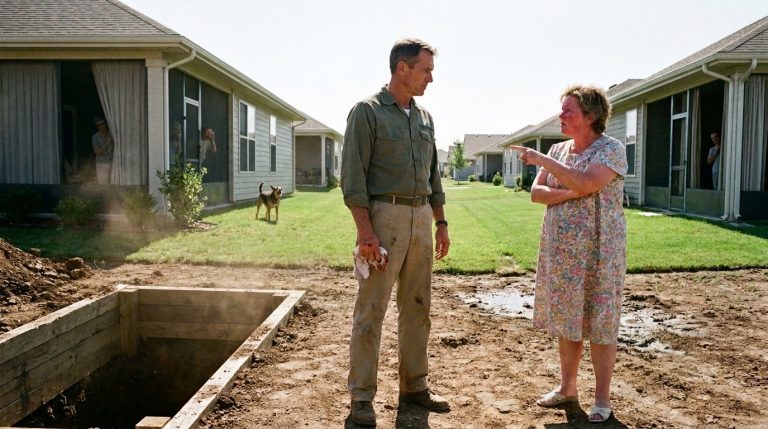
The Architect of Ruin: How One Man’s Unyielding Precision Dismantled a Suburban Kingdom of Petty Tyranny
CHAPTER 1: The FenceLine Ultimatum
The barb wire bit into my calloused palm as I leaned against the rusted post, watching the pastel pink tracksuit retreat toward the manicured perfection of Whispering Pines. Karen’s gait was rhythmic, calculated—the walk of someone who had never encountered an obstacle that couldn’t be filed away or fined out of existence. Behind her, the two board members moved like shadows, their postures tight with the arrogance of men who believed they were currently rewriting the geography of Texas.
I held the document in my left hand. It was brittle, high-gloss paper—a striking contrast to the heavy, yellowed parchment of the deed currently sitting in my office safe.
“Your grandfather’s handshake is worthless, Colonel,” she had said. The tremor of rage that vibrated in my chest was familiar, an old friend from foreign soil, but I kept it buried. I had built bridges under mortar fire; I knew how to hold a structural load until the foundation either stabilized or shattered.
The document in my hand claimed my family’s land was now ‘Section D, future green space.’ Fifty-two thousand dollars in back dues. A figure calculated to intimidate, a psychological strike designed to induce immediate panic.
I looked past her, toward the suburban sprawl. My grandfather’s dairy farm had once stood there, long before the developers arrived with their plastic siding and their obsession with uniform mailbox heights. They wanted to sanitize the landscape, to erase the grit of the working soil and replace it with a quiet that didn’t belong here.
I didn’t yell. I didn’t engage in the transactional theater of the argument. I watched the dust kick up behind her heels as she marched back toward the subdivision entrance. My gaze shifted to the barn—a hundred-year-old skeleton of oak and iron that stood as an insult to their pristine vision. Every board, every shingle, was a defiance.
The silence that followed their departure was heavy, smelling of dry hay and the impending heat of the Texas afternoon. I walked the perimeter, my boots sinking into the familiar, uneven earth. This wasn’t a parcel of land to be annexed. This was a record.
When I reached the spot where she had held the clipboard, I noticed a scuff in the dirt—the precise mark where her expensive athletic shoe had pivoted. I leaned down and found a small, discarded plastic tab from her document folder, a bright blue shard of artificiality caught in the dry grass. I picked it up, feeling the sharp plastic edges against my thumb.
She had left a trace. It was the first piece of intelligence, a tiny, physical discrepancy in the perfect order she tried to project. I held the blue shard, watching it catch the light, and felt the calculated coldness wash over me. The war had arrived, but they had made a fatal miscalculation. They had brought a clipboard to a battlefield they didn’t know how to read.
I turned back toward the house. The real campaign wouldn’t be fought at the fence line. It would be fought in the quiet, dusty cabinets of the county clerk’s office. I had a deed to verify and a kingdom to dismantle. And as I reached the door, the front page of the final notice caught the afternoon sun—I saw a slight, jagged misalignment in the notary stamp on the bottom of the page.
It was off-center by a hair’s breadth. A forgery, or something close to it.
The bridge was open. Now, I just had to decide where to place the explosives.
CHAPTER 2: The Architects Reconnaissance
The courthouse parking lot was a sea of gray gravel and mid-morning heat haze. I turned the ignition, and the heavy rumble of the F250’s diesel engine died, leaving a silence that felt unnaturally clean compared to the frantic, entitled energy Karen had radiated at the fence line. I didn’t rush out. I sat for a moment, my hands resting on the steering wheel, letting the tactical calm settle over me.
My military training had taught me that a well-executed operation wasn’t about the speed of the advance, but the quality of the intelligence. I reached into my pocket and touched the small, blue plastic tab I’d retrieved from the dirt near my fence. It was a fragment of the HOA’s world—cheap, synthetic, and out of place. It was the antithesis of the 1919 deed waiting in my folder on the passenger seat.
I stepped out of the truck, the heat radiating off the asphalt, and walked toward the limestone monolith of the county building. The doors were heavy, pushing back against me as I entered the cool, air-conditioned interior. The smell of the lobby was a mix of floor wax, old paper, and the sterile, muted tension of people waiting to pay fines or settle disputes.
I reached the clerk’s office, the long for-mica counter stretching out like a barricade. Brenda was there, her beehive of silver hair catching the fluorescent light, her glasses perched precariously on the bridge of her nose. She looked up, her expression guarded until she saw my face.
“Morning, Brenda,” I said, my voice steady. I placed the deed and a copy of the notice Karen had served on me on the counter. “I need to perform a deep-dive audit on the Whispering Pines subdivision plat and every associated covenant filed since 2005.”
Brenda’s eyes flickered to my military ID, which I’d deliberately placed next to the deed. The bureaucratic mask she wore—the one that guarded her time and patience—didn’t fall, but it shifted. The irritation faded, replaced by a professional, sharp focus.
“Whispering Pines,” she murmured, a trace of acidity in her tone. “We’ve had more disputes over their boundaries in the last year than the rest of the county combined. It’s a mess of filings and amendments, Colonel.”
“Then let’s start cleaning it up,” I replied.
She nodded, tapping a series of commands into her terminal. The mechanical rhythm of her keyboard was the only sound in the office. I watched her, my eyes scanning the room, checking the layout, the flow of traffic, and the proximity of the file storage. I wasn’t just here for documents; I was here to understand the enemy’s logistics.
As she pulled up the digital records, I moved closer, focusing on the screen. She navigated through the layers of bureaucracy with the fluidity of someone who knew exactly where the bodies were buried. When she finally opened the latest amendment, the one Karen had claimed authorized the annexation of my land, I leaned in.
The document was visually jarring. It was a digital rendering that looked far too modern compared to the hand-surveyed records of the 1900s. I pointed to the bottom corner, where the notary seal was affixed.
“Zoom in on that,” I said, my voice tight.
Brenda complied, and the pixels expanded to reveal the imperfection I’d suspected back at the house. The stamp was skewed. More than that, the signature—the one that was supposed to be the legal verification of the boundary change—was a stamp, not a wet-ink signature.
“That’s not a surveyor’s seal,” I said, my voice barely above a whisper. “That’s a rubber stamp on a digital scan.”
Brenda leaned in, her bifocals magnifying her intense, sharp-eyed scrutiny. “It’s worse than that, Colonel. Look at the date.” She pointed to the filing stamp. “This was processed in the afternoon, during a shift change. If this was a legitimate replat, it would have required a public hearing notice to all adjacent landowners. You never received notice, did you?”
“Never.”
“Then they didn’t just bypass the law,” she said, her voice dropping to a conspiratorial level. “They fabricated the legal record. They created a fictional reality to trap you.”
I felt the weight of the evidence solidify in my chest. It wasn’t just a boundary dispute; it was a forgery. They had tried to steal my heritage with a counterfeit document. I felt the sharp edges of my resolve hardening. Every interaction, every threat, every fine was predicated on this singular, fraudulent lie.
“I need certified copies of this entire file,” I told her. “And I need the original master plat from 2005 for comparison.”
Brenda didn’t ask why. She simply turned and disappeared into the labyrinth of filing cabinets behind her. I stood at the counter, watching the office life unfold—a young couple arguing over a marriage license, a man paying a ticket—and realized that everyone here was operating under the assumption that the records were the truth. They were living in a world defined by paper.
Karen had banked on that. She believed that if she controlled the paper, she controlled the reality. She had failed to account for one thing: a man who knew how to audit the architecture of a battlefield. I wasn’t going to just challenge the annexation; I was going to invalidate their right to exist.
When Brenda returned with the heavy stack of documents, I didn’t put them in my briefcase. I carried them in my arms, feeling the heft of the truth. It was a solid, tangible mass of accountability.
“Thank you, Brenda,” I said.
“You bring them down, Colonel,” she replied, her voice firm. “I’ve seen enough of their intimidation tactics. It’s time someone audited their arrogance.”
I walked back out into the sun. The air felt hotter now, sharper, more defined. I reached the truck and set the documents on the passenger seat, right next to the 1919 deed. I had my baseline. I had my evidence of fraud. I had the start of the war. I turned the key, and the engine roared to life, a deep, predatory sound that signaled the end of my quiet life and the beginning of a cold, calculated campaign.
CHAPTER 3: The Evidence Locker
The drive back to the homestead was a blur of shifting gears and calculated silence. The certified copies lay on the passenger seat, their edges crisp and unforgiving under the late afternoon light. Each page was a node in a web of deceit I was now meticulously dismantling. I pulled into the driveway, the tires crunching over the gravel—the same gravel my father had spread forty years ago, the same surface that Whispering Pines deemed a ‘non-conforming aesthetic.’
I didn’t head inside immediately. I parked the F250 near the barn, killing the engine and letting the metal tick and cool in the cooling air. The barn was a towering presence, its timber frame weathered to a deep, iron-gray. As I looked up at the rafters, I felt a sudden, sharp intrusive thought: a memory of my grandfather, his hands calloused and steady, hammering the final peg into the foundation in 1920. He had built this on a handshake and a dream of permanence, never imagining that a century later, someone with a clipboard and a fraudulent stamp would try to rezone it into a ‘green belt.’ The memory hit me with the force of a physical blow, a phantom pain in my own knuckles, reminding me exactly why this wasn’t just a dispute over land—it was a war for the right to exist on one’s own terms.
I climbed out and hauled the heavy binder and the new documents inside. My office, once a place of quiet accounting, had transformed into a command center. I had designated a heavy-duty three-ring binder, clear plastic sleeves, and a set of colored tabs to organize the war. It was my evidence locker, and every new piece of information was a strategic asset.
I sat at the oak table and began the work. I opened the binder to the first tab, labeled Correspondence, and slid the initial, insulting ‘Final Notice’ of HOA dues into a sleeve. Beside it, I placed the ‘Correction’ I had received yesterday, which had doubled the fines for my non-response. It was a classic escalation—the bully testing for a sign of fear. They hadn’t found any.
I pulled out the fraudulent map from the county clerk’s office. I spread it flat across the table, smoothing out the curls. My pen, a sharp-tipped drafting tool, hovered over the section Karen had marked as ‘Section D.’ I noted the discrepancies one by one: the irregular boundary lines, the missing survey coordinates, and the suspicious, rubber-stamped notary mark. I was documenting the anatomy of a crime.
The process was methodical, almost rhythmic. I cross-referenced the HOA’s stated bylaws—which I had obtained from the clerk—with the actions they were taking against me. The bylaws were an obsession with conformity; they were, in essence, a weaponized set of rules designed to alienate and intimidate. But as I read through the fine print, I began to see the cracks. The HOA board was required, by its own charter, to perform an annual independent audit of all expenditures over five hundred dollars.
I pulled out the financial summary I had managed to scrape from the public record. There were no audits. There were no independent reviews. Every single contract, from the lawn mowing to the security patrol, had been funneled through the same entity: Pristine Properties Management, LLC.
A cold, analytical satisfaction took root in my chest. Karen wasn’t just incompetent; she was a predator. She had built a closed loop, a system where the money flowed in from the residents and flowed right back out into her family’s pockets, with her as the arbiter of the flow.
I stood up and moved to the window, watching the sun dip behind the treeline. The Whispering Pines subdivision was visible in the distance, its lights flickering on, one by one. It looked perfect, orderly, and entirely artificial. I knew now that it was built on a foundation of sand, held together by nothing more than the residents’ fear of being fined for their mailbox color or their grass height.
I picked up the phone. It was time to expand the front lines. I had the documents, I had the legal basis, but I needed the stories. I needed to know if I was the only one they were pushing, or if I was merely the loudest. I dialed David, the young man I’d met at the fence line.
“David,” I said, skipping the pleasantries. “I’ve been digging into the county records. The annexation notice you received—have you noticed anything about the notary stamp on it?”
“I don’t know, Colonel,” he replied, his voice strained. “We were just terrified of the fine. We paid it.”
“Check your records,” I instructed, my voice calm but authoritative. “Compare it to the master plat map for the subdivision. I suspect you’ll find the same discrepancy I did. If you do, don’t pay another cent. Don’t respond to their notices. We’re building a case, and we’re going to need your help to shut them down.”
I spent the next three hours on the phone. By the time I hung up, I had three more accounts of harassment, three more examples of suspicious financial demands, and a growing, collective realization among my neighbors that they were being systematically exploited.
The resistance was forming. It wasn’t loud, and it didn’t involve marching or yelling. It was a digital, documented, and lethal-quiet alliance. Every conversation I had, every piece of information I gathered, went straight into the binder.
I finished my work and looked out at the darkened fields. My land was quiet, the only sound the steady tick of the clock in the hallway. I felt a profound sense of tactical focus. I had the map, I had the financials, and now I had the support. Karen was still playing by the rules of her own small, distorted reality, believing that she was the architect of the environment. She didn’t realize that I had already moved past her architecture and was working on the demolition phase.
I turned off the desk lamp, leaving the binder sitting on the table, a heavy, dark, and dangerous weight in the room. The paper war was moving into the second phase, and I was exactly where I needed to be: in control of the narrative, the facts, and the next move.
CHAPTER 4: The Shadow of the Resistance
The headlights swept across the office wall, a slow, predatory beam that illuminated the spine of my binder for a fleeting second before plunging the room back into charcoal shadow. I didn’t reach for a light. I moved to the window, my posture low, staying well away from the direct line of sight. Down the driveway, a white sedan—the same compliant, corporate white as the vehicle I’d seen patrolling the subdivision—was idling.
They were early. I hadn’t expected them to come for me this aggressively, or this quickly. I watched as the driver’s side door opened and a man stepped out. Even from this distance, I recognized him: one of Karen’s cronies, the one I had chased off the property with the threat of a deputy’s arrival. He wasn’t just patrolling; he was trespassing, and he was hunting for something.
My tactical mind kicked into high gear. This wasn’t just a survey; it was a provocation. They were testing the perimeter, checking for weaknesses in the new security cameras I had installed. I moved back to my desk, my movements fluid and practiced, and checked the DVR monitor. The screens showed the feed from the fence line—a series of monochrome, high-definition snapshots of the man’s progress. He was walking slowly, deliberately, his phone held out in front of him like a dowsing rod. He wasn’t just taking photos of the barn; he was checking the fence itself.
A sudden, sharp impulse to intervene flared in my gut, but I suppressed it. To rush out now would be to play into their hands. They wanted a confrontation, a scene they could record and edit to suit their narrative of the ‘aggressive, unstable landowner.’
Instead, I picked up the phone and dialed David. It rang once, twice—then he answered, his voice breathless.
“Colonel? I think they’re out here too. There’s a car circling the cul-de-sac.”
“I see them, David,” I replied, my voice steady. “They’re at my fence line right now. Do not engage them. Keep your doors locked and record everything from inside. We need to document the pattern.”
“They’re coming for the mailboxes, I think,” David whispered. “They’re marking them with tape.”
The sheer, petty vindictiveness of it was almost laughable. They were marking property for future ‘non-compliance’ notices, trying to build a secondary front of pressure to distract from the growing dissent. It was a classic diversionary tactic—keep the targets occupied with defending their own driveways so they didn’t look at the bigger picture of the annexation and the fraud.
“Let them mark them,” I said. “Every piece of tape they put down is another piece of evidence for the binder. We are not playing their game; we are building the file that will end it.”
I hung up and returned to the monitor. The man at the fence line had stopped. He was looking directly at the security camera mounted on the post. He knew it was there. He reached out and, with a quick, dismissive gesture, spray-painted a red ‘X’ directly onto the lens.
The screen went static.
The loss of the feed was a tactical failure, a minor one, but a failure nonetheless. It was the butterfly detour I hadn’t accounted for—a direct, physical sabotage of my intelligence network. I walked to the front door, my hand resting on the lock, but I didn’t open it. I simply stood there, listening to the crunch of gravel as the man turned and walked back to his sedan.
He hadn’t breached the inner perimeter, but he had sent a message: We see you, and we can touch your eyes.
The sedan pulled away, its taillights bleeding into the night. I went back to the office and opened the binder to the Trespass tab. I added a new page, noting the time, the description of the man, and the deliberate destruction of the camera feed.
The strategy had to change. They were escalating from paper threats to physical harassment. I needed to move faster, and I needed to ensure that the next time they tried to play the role of the neighborhood enforcer, they would be doing it under the blinding light of official scrutiny.
I sat back down and reached for the stack of certified files from the county. The fraud was the key. If I could secure the deposition of the surveyor who was supposedly responsible for the original plat, I could prove the map was a fabrication. I didn’t need to chase them around the fence line; I needed to cut the ground out from under them.
I checked my notes on the local survey firm, ‘Pinnacle Land Solutions.’ It was the firm that had allegedly signed off on the annexation. A quick check of the firm’s website showed they were a reputable, multi-state operation—the kind of firm that would be horrified to learn their seal had been rubber-stamped onto a fraudulent document by an amateur like Karen Miller.
I began to draft a formal inquiry to their legal department, attaching a copy of the fraudulent plat. It was a calculated risk. If they were complicit, they would bury it. But if they were unaware, they would become the most powerful ally I could have.
The night deepened. My resolve wasn’t shaken by the broken camera; it was refined. They had moved into the physical, and in doing so, they had exposed their desperation. They were no longer acting with the cold, bureaucratic confidence of the first notice; they were reacting with the erratic, impulsive anger of a cornered beast.
I worked until the first gray light of morning touched the fields. By the time I finished, I had a plan that would turn their sabotage into an anchor dragging them down. The resistance was no longer just a group of concerned neighbors; it was an intelligence cell, and the next move wasn’t mine—it was theirs. And for the first time, I knew exactly how they would fall.