The Weight of Cedar and Iron: A Combat Engineer’s Blueprint to Dismantling Suburban Tyranny
CHAPTER 1: THE CLUBHOUSE FLOOR
The rust on the metal legs of the folding chair scraped against the linoleum floor, a dry, grating sound that cut through the sterile hum of the air conditioning. Jack didn’t sit. He left the chair empty, its gray vinyl seat reflecting the harsh overhead tubes, and instead placed both palms flat against the cold Formica of the long administrative table.
The wood of his schematics felt rough beneath his fingertips—heavy cardstock, pencil-marked with precision scales and load calculations that had survived monsoon rains and desert winds. Now, they were weapons for a suburban Tuesday night.
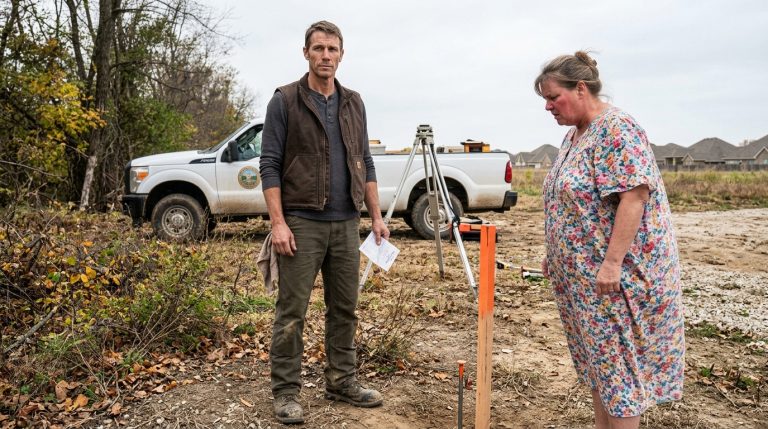
Karen Miller didn’t look down at the drawings. Her gaze stayed fixed on the brass buttons of her floral blouse, her chin tilted up with the practiced rigidity of someone who had never once had to explain herself to a superior officer. To her right, a man named Henderson—whose entire contribution to the neighborhood seemed to consist of measuring lawn grass with a plastic ruler—cleroed his throat, a wet, rattling sound.
“Mr. Riley,” Karen said, her voice dropping into that smooth, condescending register designed to signal that an adult was speaking to a remarkably slow child. “This is a monthly administrative session. You were granted two minutes for public comment, not an architectural seminar. The structure is unapproved. The notice stands.”
Jack didn’t blink. The silence in the room stretched thin, smelling faintly of stale instant coffee and the chemical chlorine seeping in from the pool house through the double doors behind the back row of empty chairs. He felt the heavy calluses on his palms—earned from decades of hauling timber and driving survey stakes—press hard enough into the tabletop to leave white impressions in his skin.
“Article Seven, Section Four,” Jack said, his voice level, stripped of all warmth. “You cited it as a catch-all for permanent, unapproved structures.”
“Because it is,” Karen replied, her fingers tapping a sharp, rhythmic tattoo against the edge of her clipboard. “The board’s discretion is absolute. We checked with our legal counsel three days ago.”
“Did you check the county plat maps from nineteen-eighty-four?”
The tapping stopped.
Karen’s fingers froze mid-beat, suspended an inch above the plastic clip. Her eyes flicked upward, narrowing into two sharp, gray slits. For a fraction of a second, the self-satisfied veneer cracked, replaced by a sudden, micro-twitch of genuine calculation. It was the exact look Jack had seen on local contractors in foreign provinces when an engineer pointed out a hairline fracture in a supposedly load-bearing foundation.
“That,” Karen said smoothly, recovering her footing with practiced speed, “has nothing to do with your backyard violation.”
“It has everything to do with jurisdiction,” Jack said, leaning fractionally forward, letting his shadow fall across her neat stack of violation notices. “The oak tree sits on an old drainage easement deeded directly to the county before Harmony Creek was ever incorporated as a private association. Your bylaws don’t apply to the root zone, Karen. Which means your enforcement isn’t just arbitrary.”
Jack paused, letting the heavy, dry heat of the room close in around them, his eyes locked onto hers.
“It’s trespassing.”
CHAPTER 2: THE PAPER TRAIL
The hum of the ceiling vents felt heavier now, vibrating against the cheap acoustic tiles of the clubhouse ceiling like a swarm of trapped hornets. Karen didn’t flinch, but the micro-twitch in her left eyelid gave her away—a tiny, involuntary betrayal of muscle memory that told Jack everything he needed to know. She hadn’t expected anyone to look past the first page of the covenants, let alone dig down into the county archives where dead municipal bodies buried their old paper trails.
“Mr. Riley,” Henderson sputtered beside her, his face flushing the color of a bruised plum. “That is an absurd allegation. The association’s authority is absolute under the covenants you signed at closing.”
“Covenants are legal contracts, Mr. Henderson,” Jack said, his voice dropping an octave, steady and flat, like a plumb line hanging in a well. “Contracts require valid underlying jurisdiction. If the easement predates the master deed by four years and was deeded directly to county maintenance, then Article Seven, Section Four applies to private turf—not public right-of-way.”
He didn’t wait for Henderson to fumble through his notes. Jack reached down, scooped up his schematics, and rolled them into a tight, heavy cylinder. The resistance of the thick cardstock offered a comforting counterweight to the sudden, sharp spike of adrenaline in his chest.
“We’re done here for tonight,” Jack said, turning on his heel without waiting for Karen’s dismissal.
The walk across the linoleum floor felt long under the stares of the fifteen residents scattered across the folding chairs. Most looked away, avoiding eye contact with the kind of practiced suburban indifference that kept property values stable and neighbors safely estranged. Only one pair of eyes lingered—an older man sitting in the back row, wearing a faded plaid shirt and holding a worn manila folder. As Jack passed, the man didn’t speak, but his thumb traced a deliberate, slow circle against the bottom corner of his folder. A quiet nod. An acknowledgment.
Jack pushed through the heavy glass double doors into the dense, humid Florida night. The air hit him like a warm, wet blanket, smelling of crushed St. Augustine grass, damp mulch, and the distant, chemical tang of the community pool.
He didn’t walk straight to his car. Instead, he looped around the gravel maintenance path behind the clubhouse, keeping close to the dense line of palmetto bushes where the shadows pooled deep and cool. His truck was parked three rows down under the flickering security light of the mail kiosk.
As his hand brushed the cold metal handle of his Ford, a soft crunch of gravel broke the ambient hum of the night crickets.
Jack didn’t turn around immediately. He let his fingers rest on the truck door, his weight balanced evenly on the balls of his feet, eyes scanning the side-view mirror. Reflected in the convex glass was the silhouette of a man walking slowly from the shadows of the utility shed—the same older man from the back row of the clubhouse.
“You’re making a mistake, Major,” the man said, his voice gravelly, worn down by decades of cheap tobacco and damp air.
Jack turned slowly, resting his hip against the truck door. The man stepped into the pale yellow wash of the overhead security light, revealing a lined, weather-beaten face and eyes the pale color of washed denim. A retired county surveyor badge hung loosely from a belt loop, half-obscured by an untucked shirt.
“Mistakes usually happen when people don’t read the fine print, Mr…” Jack prompted, letting the sentence hang open.
“Vance,” the man said, pulling a flattened cigarette pack from his pocket, tapping one against his thumb without lighting it. “I was the senior plat inspector for District Four back when Harmony Creek was just a couple of citrus groves and a drainage basin. Karen Miller’s father-in-law wrote those original developer bylaws on a golf course napkin back in eighty-four. They needed a clean slate to build this place, and they used zoning loop-holes to sweep a lot of old families off the tax rolls.”
Jack’s gaze sharpened, the pragmatic engineer’s mind clicking the disparate gears into alignment. “And the drainage easement?”
“It wasn’t an accident,” Vance muttered, spitting a stray tobacco flake into the dust. “They legally couldn’t build over that creek bed, so they carved it out of the master association’s deed to dodge state environmental oversight. Your oak tree sits right on the edge of it. If you force an independent survey through the county records office tomorrow morning, you won’t just invalidate her violation notice.”
Vance looked up, meeting Jack’s eyes with a grim, unblinking stare.
“You’ll blow the whole development’s property title wide open. And that’s why Miller isn’t just trying to tear down your son’s treehouse. She’s running out the clock on a commercial land rezoning application that requires zero active title disputes on record before the final signature hits the county desk next Friday.”
The night grew heavier around them, the crickets suddenly falling silent as a distant car engine whined down the boulevard. Jack felt the cold, hard weight of the reality settle into his chest—not a petty neighborhood squabble over aesthetics, but a calculated, high-stakes land grab disguised as an HOA compliance check.
“Thanks for the tip, Vance,” Jack said quietly, his hand tightening around the rolled blueprints in his grip.
“Don’t thank me yet,” the old surveyor replied, turning back into the shadows of the palmetto brush. “She’s already called the county inspector for a dawn audit. And she didn’t ask for a review of your treehouse.”
Jack stopped, his boots freezing against the gravel. “What did she ask for?”
“An emergency safety condemnation,” Vance called back over his shoulder, his voice fading into the rustle of dry fronds. “They’re bringing a chainsaw crew at six a.m.”
CHAPTER 3: THE COUNTERNOTICE
Jack didn’t climb into the cab immediately. His hand remained hooked over the open door handle, the cold galvanized steel biting into his palm. Vance’s warning hung in the cooling night air like sulfur smoke after a breach charge. Six a.m. An emergency safety condemnation. A calculated bureaucratic ambush disguised as public welfare, designed to clear the title before the county desk processed the rezoning papers on Friday.
He pulled the rolled blueprints tighter against his thigh, ducked into the cab, and tossed them onto the passenger seat. The engine cranked over with a low, deep rumble that felt too loud in the sleeping stillness of the Harmony Creek parking bay.
He didn’t drive home. Instead, he pointed the truck toward the county records annex twenty minutes down the old bypass road—a cinder-block building where municipal ghosts were filed away in rows of steel drawers.
The drive was quiet, save for the rhythmic slap of the windshield wipers clearing the overnight dew. As he navigated the darkened suburban streets, his mind slipped back—an intrusive phantom of memory—to an old bridge assessment outside Fallujah. The concrete had looked solid from twenty paces, uniform and gray under the sun, but when he drove the core sampler into the pier, the inside was pure hollow sand. Cosmetic perfection hiding structural rot. Karen Miller’s pristine neighborhood association was built on the exact same foundation. Every manicured lawn and taupe mailbox was just a fresh coat of paint over a compromised legal sub-base.
When he reached the annex, the parking lot was empty except for a faded county utility van idling near the loading dock. Inside, the air smelled of stale floor wax and millions of pages of yellowing rag paper.
Jack didn’t ask for permission. He walked straight past the front desk while the night clerk dozed over a crossword puzzle, slipping down row twelve of the historical plat archives. It took forty minutes of methodical sorting through mildewed nineteenth-century survey maps and 1980s district annexation deeds to find what he needed: the original developer transfer agreements filed by Miller’s predecessors.
There it was, stamped in faded purple ink: an unrecorded private covenant rider explicitly acknowledging that the drainage easement running through Live Oak Lane was excluded from association covenants because it was tied to a pending commercial corridor expansion option.
Jack pulled his phone from his pocket, framing the document under the fluorescent hum overhead, capturing the high-resolution capture of every signatures, stamp, and margin note. The data was clean. Irrefutable. And it completely dismantled the legal footing of the HOA’s emergency mandate.
By 5:45 a.m., Jack was back in his driveway.
The sky above the treeline was turning a bruised shade of lavender, bleeding slowly into a pale, sickly amber. In the backyard, the ancient live oak rose like a dark cathedral pillar against the morning haze. Nestled in its branches, the two-story cedar treehouse looked entirely peaceful, the scent of fresh sealant still faint on the early dew.
At precisely 5:58 a.m., a white municipal pickup truck turned onto Live Oak Lane, its tires crunching slow and deliberate against the asphalt. It didn’t stop at the curb. It rolled straight up the driveway, halting ten feet behind Jack’s Ford.
The driver’s door creaked open. A man in a high-visibility yellow vest stepped out, unbuckling a heavy leather belt from which hung a pair of heavy iron bolt cutters and a clipboard. Behind him, a second vehicle pulled up—Karen Miller’s beige sedan, idling with quiet, vindictive precision.
Karen stepped out from the passenger side, her floral blouse sharp against the gray morning light, a thin, triumphant smile already curving the corners of her mouth. She didn’t look at Jack. She looked straight up at the treehouse, her hand reaching out to tap the municipal inspector’s shoulder.
“Right there, Marcus,” Karen said, her voice carrying clear and sharp across the wet grass. “An immediate hazard to community safety. Condemn it, tag it, and bring it down.”
Jack stood leaning against the bed of his truck, his arms crossed over his chest, the digital camera in his pocket resting like a cool stone against his ribs. He didn’t raise his voice. He didn’t move an inch.
“You might want to check the county exemption rider on parcel four-seventeen before you swing that hammer, Marcus,” Jack said, his voice cutting through the morning quiet like a saw blade hitting dry pine. “Because if you touch a single branch of that oak, you aren’t violating association rules. You’re tampering with an active federal environmental easement.”
Marcus froze, his hand hovering over the bolt cutters, his eyes darting uncomfortably between Karen’s rigid posture and Jack’s steady, unblinking stare.
CHAPTER 4: THE CLOSED DOOR
The metallic click of the municipal inspector’s jaw tightening was the only sound cutting through the damp, dew-heavy grass of the yard. Marcus lowered his arm slowly, his gaze flicking from Jack’s unmoving stance by the truck bed to the pristine white paint of Karen Miller’s sedan idling six feet behind him.
“County exemption rider?” Marcus muttered, his voice dropping into a defensive gravel. “Nobody mentioned an environmental easement on parcel four-seventeen when the work order crossed my desk yesterday afternoon.”
“Bureaucracy is efficient until someone actually checks the foundational filings, Marcus,” Jack said, his voice flat, stripped of all warmth.
Before Marcus could answer, a sharp, mechanical hissing tore through the stillness of the lawn. Across the property line, the neighbor’s automated sprinkler system slammed open with a high-pressure shudder, sending a fan of cold water arcing through the air to patter heavily against the rear fender of Karen’s beige sedan.
Karen flinched, stepping out from the passenger side with a sharp, pinched snap. Her floral blouse seemed to strain tighter across her chest as her face mottled into an ugly, flushed pink.
“Marcus, do not listen to him!” Karen snapped, her voice rising shrilly over the hum of the water jets. “He’s reading outdated municipal trash! The board has absolute architectural oversight under Section Seven, and if you don’t execute this abatement order right now, I’ll personally ensure your contract with the county municipal district is reviewed by noon!”
Marcus looked caught between two gears of a crushing machine—the legal exposure of tampering with an active drainage easement on one side, and Karen’s political pull with the regional zoning board on the other. He let out a long, heavy breath, lowered the bolt cutters back into their leather holster on his hip, and stepped away from the oak tree trunk.
“I’m red-tagging the site for administrative review,” Marcus said, pulling a yellow violation sticker from his clipboard and slapping it firmly against the rough cedar post of the treehouse ladder. “That means zero structural modifications and zero habitation until the county legal team sorts out the deed boundary. Don’t touch it, Riley. Or the next crew out here won’t use bolt cutters.”
He climbed back into his utility truck, threw it into reverse, and backed down the driveway with a spray of loose gravel, leaving Karen standing alone beside her sedan like an abandoned anchor in a dry sea.
Karen didn’t leave. She stood there for a long moment, her chest heaving beneath the floral print, her eyes boring into Jack with a quiet, venomous intensity that spoke of far more than a simple neighborhood dispute over wood and nails.
“You think you’re clever, Major,” Karen said, her voice dropping to a low, venomous hiss as she stepped closer, ignoring the wet spray from the sprinklers soaking the hem of her slacks. “You think digging through dusty county archives gives you leverage. But you’re playing checkers in a game where the board is already owned.”
Jack didn’t blink. He pushed himself off the tailgate, his boots crunching on the gravel as he closed the physical distance between them, letting his height and the flat, cold stare of a combat engineer bear down on her.
“Properties don’t get rezoned for commercial distribution hubs overnight, Karen,” Jack said quietly, his tone dropping into a razor-sharp register. “And neighborhood associations don’t threaten daily fines unless a board president has a massive financial penalty waiting if the title isn’t cleared of environmental encumbrances by Friday afternoon.”
Karen’s face didn’t pale, but the micro-twitch in her jaw returned, sharp and violent. For a split second, the polished mask of suburban authority slipped entirely, revealing the panicked calculation of a cornered operator staring down an unyielding wall.
“You’re destroying this community,” she whispered, her voice trembling slightly with suppressed rage before she turned abruptly on her heel, marched back to her sedan, and slammed the door hard enough to rattle the side-view mirror.
The car lurched backward into the street, tires squealing against the asphalt as she accelerated away, leaving Jack standing alone in the damp morning light.
The yellow county tag hung from the ladder post, fluttering slightly in the morning breeze. Jack reached out, his calloused fingertips brushing the heavy plastic warning label. The immediate threat of the chainsaw was gone, but the larger war had just broken cover. The land grab syndicate was moving faster than he anticipated. He had less than forty-eight hours before Friday’s filing deadline to dismantle the entire fraudulent structure before Karen’s commercial partners finalized their acquisition.
He turned toward the house, walking slowly across the wet St. Augustine grass, his mind already calculating the next sequence of moves required to tear down the board from the inside out.
CHAPTER 5: THE BOARDROOM FRACTURE
Jack didn’t go inside the air-conditioned kitchen. He stayed rooted by the edge of the St. Augustine grass, his thumb rubbing the rough grain of the yellow county tag dangling from the treehouse ladder post. The morning sun was climbing higher, burning away the low-lying mist and baking the dry dirt beneath the oak roots into cracked, iron-hard clay.
The transformational hum of the nearby neighborhood utility boxes seemed to vibrate right through the soles of his boots—a low, constant frequency that his tired mind briefly translated into a surveillance pulse. Paranoid, he reminded himself. But paranoia was just an engineer’s term for accounting for all variables in a hostile zone.
The community clubhouse was scheduled to host the emergency executive session at two that afternoon. Karen had called it to ratify the emergency abatement despite Marcus’s red-tagging, hoping to push a fast-track board vote before the Friday commercial filing window closed.
Jack turned on his heel, walked across the sun-bleached turf, and pulled open the garage side door. Inside, the cool, dry air smelled of motor oil, sanded cedar dust, and old steel tools. He didn’t waste time on hesitation. He opened his workbench drawer, pulled out a heavy black binder containing the high-resolution photographic captures of the county annex records, and slid three copies into a weathered leather portfolio.
The front door clicked open behind him. Sarah stood in the kitchen doorway, her apron still on, holding a mug of black coffee. Her eyes surveyed his posture—the rigid line of his shoulders, the deliberate, measured way he zipped the leather case.
“You’re not going to argue with them with more paperwork, are you?” Sarah asked quietly, her voice carrying the flat, tired cadence of someone who had lived through enough military deployments to recognize the quiet calm before a breach.
“Paperwork is just ammunition when the terrain is legal,” Jack said without turning, his fingers securing the metal clasp of the portfolio. “Karen thinks she’s running an association meeting. I’m going to show the rest of the board what she’s actually clearing the land for.”
“And if they vote with her anyway?”
Jack stopped, turned slowly, and looked at his wife. The morning light caught the gray strands at her temples, throwing sharp, deep shadows across her face.
“They won’t,” Jack said, his voice flat and hard as a slab of cured concrete. “Because Henderson and the other board members have homes in this subdivision too. If they sign off on a commercial rezoning rider tied to a fraudulent drainage loophole, their own property titles are worth the paper they’re printed on. Greed is a powerful motivator, Sarah, but self-preservation is a lot louder.”
He stepped past her, pressing a brief, firm kiss to the side of her temple before walking out through the front door and down the driveway toward his truck.
By 1:55 p.m., the asphalt of the clubhouse parking lot radiated a blistering, shimmering heat. Jack killed the engine, stepped out into the glare, and walked up the concrete steps. The double glass doors were propped open with a heavy rubber wedge.
Inside, the sterile beige room was packed. All fifteen folding chairs were filled, and several younger residents stood along the back wall, murmuring quietly among themselves. At the front table, Karen Miller sat flanked by Henderson and a man in a sharp, slate-gray business suit who hadn’t been at the previous meeting—a corporate legal consultant representing the development syndicate, clutching a leather briefcase across his knees.
Karen saw Jack enter. Her eyes narrowed into hard, granite chips, and a thin, tight smile touched her lips as she tapped her gavel twice against the Formica table.
“Mr. Riley,” Karen announced, her voice echoing too loudly through the cheap microphone. “This is an executive closed session. You are not on the docket.”
“Article Four of the bylaws permits any property owner to address material financial liabilities affecting shared association tracts,” Jack said, his voice cutting through the room with absolute authority as he strode down the center aisle, refusing to look left or right.
He didn’t wait for permission. He reached the front table, unzipped his leather portfolio, and dropped three thick packets of photocopied county records directly onto Karen’s pristine stack of agenda papers, scattering her neat plastic clips across the floor.
“Before you vote on the emergency treehouse abatement,” Jack said, leaning his palms flat against the table once more, his shadow falling directly across the slate-gray suit of the corporate lawyer, “you might want to ask Mr. Miller’s corporate consultant here why the developer’s purchase option depends entirely on clearing Live Oak Lane of all active environmental encumbrances before tomorrow morning.”
The room went dead silent. The humming air conditioner seemed to drop an octave, and every eye in the clubhouse snapped away from Karen and locked directly onto the pale, sweating face of the corporate lawyer.
CHAPTER 6: THE DUSTY SETTLEMENT
The corporate lawyer’s face went completely bloodless. His hand, resting on the clasp of his leather briefcase, jerked involuntarily—a microscopic flinch that gave away the entire operation. Beside him, Karen Miller slammed her gavel down once, the sound flat and hollow against the Formica table, stripped of all authority.
“This meeting is adjourned,” Karen snapped, her voice cracking slightly at the edge as she tried to gather her scattered papers with shaking fingers. “Executive session concluded. Motion carried to dismiss—”
“Motion denied by default of quorum and active fraud,” a voice rumbled from the back row.
The older man in the faded plaid shirt—Vance, the retired county plat inspector—stood up slowly, pushing his folding chair back with a dry scraping sound. He walked down the center aisle, holding a thick, cream-colored ledger book that smelled of thirty years of municipal dust. He didn’t look at Karen; he laid the ledger directly in front of Henderson, the board member who had spent the last week measuring lawns with a plastic ruler.
“Read page forty-two, Henderson,” Vance said quietly. “Not the modern bylaws Karen handed you when you bought your house. The original nineteen-eighty-four incorporation charter. The one her father-in-law drafted when he wiped the old working-class tax rolls off this land.”
Henderson stared down at the yellowed page, his lips moving silently as his eyes tracked the typed lines. The color drained from his cheeks. The architectural bylaws Karen had weaponized against Jack wasn’t just a discretionary tool for a petty HOA; they were a direct legal artifact of a systemic zoning trap, designed decades ago to lock out independent land titles and maintain corporate control over the entire drainage basin.
“Karen,” Henderson whispered, looking up with sudden, visceral horror in his eyes. “You didn’t use the architectural committee to protect property values. You used an illegal exclusionary covenant to clear the corridor so you could sell the drainage basin to the commercial syndicate before your personal debts hit public record.”
The silence in the room stretched thin, brittle as dry pine. The corporate lawyer slowly closed his briefcase, stood up without a word, and walked out the double glass doors into the blinding Florida heat, abandoning the boardroom entirely.
Karen sat frozen. The polished mask of suburban queen had completely shattered, leaving behind only a tired, cornered woman staring at the ruin of her own barricades.
Jack didn’t gloat. He picked up his portfolio, rolled his blueprints under his arm, and turned his back on the front table. He walked out of the clubhouse into the glaring afternoon sun, his boots crunching steadily against the hot asphalt of the parking lot.
The drive home took twenty minutes. When he turned onto Live Oak Lane, the sunlight was filtering through the high canopy of the ancient live oak, casting long, peaceful shadows across the grass.
In the backyard, the two-story cedar treehouse stood tall and silent, its fresh sealant catching the warm amber light of the late afternoon. The yellow county warning tag still fluttered slightly from the ladder post, but as Jack walked up the driveway, a county utility van was already parked by the curb. A young worker was unpeeling the bright plastic tag, tossing it into a trash bin, and handing Jack a signed compliance waiver.
“Clearance confirmed, Major,” the worker said, nodding respectfully before climbing back into his van. “County legal department voided the abatement. Easement is fully verified.”
Jack watched the van pull away, the engine hum fading into the steady chirping of evening crickets. He walked over to the workbench in the garage, picked up a clean rag and a small bottle of teak oil, and carried them out to the base of the oak tree.
The wood of the ladder post was dry, slightly weathered by the morning dew, needing a fresh touch-up where the bolt cutters had brushed against it. Jack knelt in the dry earth, dipping the cloth into the oil, and began methodically rubbing the rich, dark liquid into the grain of the cedar. The smell of oil and wood rose sharply around him, clean and grounding.
The gate clicked open. Footsteps crunched softly on the grass, light and familiar.
Leo ran ahead, his small sneakers kicking up puffs of dry dust, right up to the base of the tree. He didn’t ask about the inspectors, or the board meeting, or the legal papers in the truck. He just looked up at the second-story lookout deck, his eyes wide and bright in the golden light.
“Can we go up now, Dad?” Leo asked softly, his small hand resting against Jack’s shoulder.
Jack set the oil bottle down in the dirt, wiped his calloused hands clean on the rag, and smiled—a real, unburdened smile that reached all the way to his eyes. He reached out, ruffled his son’s hair, and pointed up toward the fortress of cedar and leaves.
“Lead the way, Captain,” Jack said.
Together, father and son climbed the steps into the quiet, amber-lit branches of the tree, leaving the dust and noise of the beige kingdom far below.