The Burning Ledger: A Cold-Blooded Hunt Through the Ashes of a Fallen Syndicate’s Darkest Secret
CHAPTER 1: The Smoking Foundation
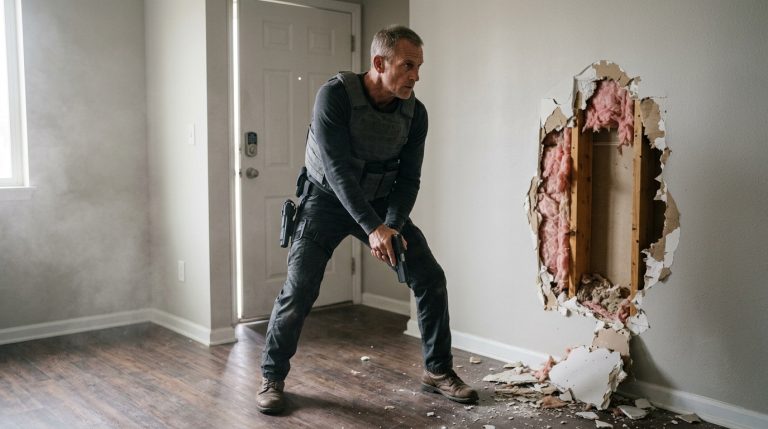
Rocco stood in the center of the living room. The floorboards, now carbonized and brittle, groaned under his weight. Outside, the sirens had long since faded, leaving behind a silence so absolute it felt unnatural. He didn’t look at the sky or the street; he kept his eyes on the floor, mapping the trajectory of the flame.
He felt the cold, hard press of his pistol against his ribs, a familiar weight that usually brought comfort, but tonight felt like a failure. Every decision he had made in the last three months was designed to keep this specific space safe. He had tightened the perimeter, placed watchers on the corners, and ensured the lighting was sufficient to deter the desperate.
He crouched, his movements slow and deliberate, ignoring the soot smudging his tailored wool coat. His fingers hovered over the steel bolt near the wall. It was cold to the touch, entirely untouched by the heat that had liquefied the aluminum window frames nearby. This wasn’t an act of chaos; it was an act of surgical precision.
A shadow shifted in the doorway. Rocco didn’t turn. He heard the subtle drag of a shoe on the charred wood. It was Tony.
“The police are pulling out,” Tony said, his voice flat. “They’re calling it a faulty wire. Electrical failure.”
Rocco didn’t look up. “Electrical fires don’t leave tempered steel bolts in the middle of a room, Tony. This was a message.”
“A message from who? Vincent is gone. The streets know we own this sector.”
“The streets know what I want them to know,” Rocco replied, finally standing. He looked at the bolt, then at the wall behind it. There was a specific pattern in the char—a clean, circular burn mark where a pressure canister had been set. “Someone wants to prove that my reach isn’t as long as I think it is. They want me to believe that I can’t protect a house, let alone an empire.”
Tony shifted, his eyes scanning the ruin. “You think it’s internal?”
Rocco walked toward the door, his gaze locking onto a small, charred scrap of fabric caught on a nail in the doorframe. It was part of a sleeve, expensive material, the kind not found in this neighborhood. He reached out and snagged it with two fingers, pulling it free.
“I don’t think,” Rocco said, his voice dropping into that low, steady register that had ended careers before they began. “I’m going to find out. Check the inventory of every man who has access to industrial incendiaries. Check the logs for the last seventy-two hours.”
“Boss,” Tony hesitated. “If we start turning over our own stones, the structure won’t hold.”
Rocco stopped at the threshold, the moonlight catching the hard, unyielding lines of his face. “The structure is already burning, Tony. Either we extinguish the source, or we let the whole thing turn to ash.”
As he stepped out into the rain, his phone vibrated in his pocket. It wasn’t a call. It was a picture message from an unknown number. He opened it, his pulse not skipping a beat, though the sight of it made the air in his lungs turn to ice. It was a photo of Emma in her hospital bed, taken from the parking lot, through the window. The caption was a single line: The cost of mercy is high.
Rocco stared at the screen, the cold rain mixing with the soot on his skin. He didn’t just need a name anymore; he needed a grave.
CHAPTER 2: The Audit of Shadows
Rocco slid the phone back into his pocket, the screen still dark, but the image of Emma scorched into his retina. He didn’t rush to the car. He stood on the damp sidewalk for a moment, letting the rhythmic, icy drizzle wash the scent of ozone and ruined wood from his skin. His pulse, usually a metronome of steady indifference, felt jagged, erratic. He looked at the surrounding neighborhood. Every shadow seemed to stretch toward him; every flicker of a distant streetlamp felt like a deliberate signal. His mind, usually a fortress of calm, was beginning to misfire, turning every sway of the rain-slicked trees into a threat.
“Boss?” Tony was leaning against the SUV, his silhouette a jagged cutout against the gray fog. He was watching the street, his hand resting near the holster tucked into his waistband.
“We go to the office,” Rocco said. His voice was a flat, abrasive rasp. “Call the night security team. I want every log, every digital record, and every keycard access report from the last ninety-six hours delivered to my desk by the time I arrive.”
“You want to pull the entire archive?” Tony asked, his brows knitting together. “That’s a mountain of data. It’ll take the IT team all night to decrypt the internal servers.”
“Then have them work faster.”
The drive back to the city center was a study in controlled rage. Rocco watched the passing buildings, his reflection caught in the dark glass of the window. He looked older, the hard lines around his mouth carved deeper by the night’s work. He kept seeing that steel bolt in his mind, turning it over, feeling the cold, clinical weight of it. It wasn’t just a tool; it was an insult. It was a signature left by someone who thought they were playing a game of chess with a man who had already burned the board.
When they reached the underground garage, the silence of the facility was heavy, expectant. Rocco stepped out before the engine even cut, his boots ringing sharp and clear against the concrete. As he crossed the threshold into the elevator, he caught a glimpse of his own eyes in the mirror. They were bloodshot, rimmed with a manic, hyper-vigilant edge he hadn’t felt in years. He was looking for enemies in the corners of the room, expecting the air to warp with the heat of a hidden incendiary. He breathed in, forcing the rhythm to slow, gripping the cold steel railing until his knuckles turned white.
The elevator doors hissed open at the top floor. The office was dimly lit, the vast expanse of floor-to-ceiling glass offering only a panoramic view of the rain-drenched skyline. His desk was already cluttered with the physical files Tony had managed to pull from the archives. Rocco didn’t take off his coat. He sat down, the leather chair creaking under his weight, and opened the first heavy manila folder.
“Anything, boss?” Tony hovered by the door, his shadow long and thin against the polished floor.
“Not yet.”
Rocco began to scan the personnel reports, his eyes skimming over names, duty rosters, and incident logs. He felt the phantom heat of the fire on his skin. He stopped at a log entry from forty-eight hours ago: Unit 74, Security Maintenance, Access to Industrial Chemical Storage.
His finger traced the name attached to the log. It was a junior technician he’d barely spoken to, someone who had no reason to target the Thompsons. But beneath the name was a timestamp, and a secondary authorization code—a code that hadn’t been issued since the departure of his top lieutenants.
Rocco leaned back, the silence of the office pressing in on him. The bolt, the precision, the code—it was too clean. He wasn’t being outmaneuvered by a rival; he was being led by the nose. He felt a sudden, sharp ache in his chest, a realization that the person who knew his routines, his security protocols, and his weaknesses was someone sitting at the same table he did. He stood up, pacing the length of the office. The city lights outside seemed to shimmer, distorting into cold, judging eyes. He reached into his pocket, his hand brushing against the scrap of expensive, charred fabric he’d recovered. He pulled it out, dropping it onto the desk.
“Tony,” he said, his voice barely a whisper but echoing with a lethal clarity. “Get the head of security on the line. And tell him if I find out he’s been auditing our chemical supplies without my authorization, he’s going to be the one cleaning the next mess. And tell him to bring the server keys. I’m going to see exactly who logged into that access point.”
He walked to the window, watching the rain strike the glass, looking for the person behind the curtain. He was the most feared man in the city, but tonight, he was just a man chasing shadows in his own house. And the shadows were beginning to move.
CHAPTER 3: The Silent Informant
Rocco didn’t move toward the door. He didn’t shout for Tony. He stood frozen, his eyes fixed on the blinking cursor of the terminal as the security logs scrolled by in a rapid-fire cascade of green light. The system was being accessed from a local terminal—not from an external hack, but from the building’s own internal maintenance hub, located three floors below.
The coldness that had been gnawing at his chest settled into a hard, crystalline knot. He turned his head slowly, his gaze sweeping the darkened office. The shadows seemed to vibrate with a newfound hostility. He reached out and tapped the monitor, zooming in on the log entry. The authorization code didn’t belong to the head of security. It was a ghost code—a credential he had personally decommissioned after the last internal purge.
He pulled his phone, his thumb hovering over the dial for Tony, then pulled back. No. If the intruder was on the internal network, they would be monitoring the internal communications. He grabbed his coat, the fabric heavy and stiff, and stepped toward the service elevator. He bypassed the main lobby and the security desk entirely. If he wanted to catch a ghost, he had to move like one.
He descended to the third floor, the elevator doors sliding open with a low, mechanical hiss that seemed deafening in the stillness of the midnight hour. The corridor was bathed in the dull, orange glow of emergency lighting. He walked, his footsteps muted by the plush carpeting, his hand resting on the grip of the pistol tucked into his waistband.
He reached the door to the maintenance hub. It was locked, but the status light was green—a direct violation of every security protocol he had written. He didn’t use a keycard. He stood to the side, took a breath, and let his shoulder hit the door with the weight of a sledgehammer. The lock shattered, the metal door swinging open to reveal a cramped, climate-controlled space filled with the rhythmic hum of server racks.
The room was empty.
Rocco stepped inside, his eyes searching the darkness. The air was frigid, smelling of ozone and ionized dust. In the center of the room, a terminal was still active, the screen casting a pale, sickly light onto the face of the console. He walked toward it, his boots crunching softly on the raised floor tiles. Someone had been here moments ago.
He looked at the floor near the server rack. There, tucked under a loose floor tile, was a small, black notebook—the kind that held more weight than any digital file ever could. He picked it up, feeling the worn leather texture against his calloused palms. He didn’t open it immediately. He stood still, listening, his senses tuned to the subtle shifts in the air conditioning—a slight change in pressure as a nearby door clicked shut.
He didn’t chase. He waited. He knew the layout of this building better than his own lungs. He knew that the service exit at the end of this hallway led to the loading docks, where the security cameras were currently “undergoing maintenance.” He turned and walked back into the hall, moving with a predator’s economy of motion.
He didn’t run. He walked with the heavy, unhurried pace of a man who had already accounted for every variable. He reached the heavy steel doors leading to the docks. He pushed them open, the sound of the rain outside instantly flooding the space with a dull roar. The loading dock was a cavern of concrete and shadows. A single vehicle—a nondescript sedan—was idling near the edge of the perimeter fence, its taillights bleeding red into the downpour.
Rocco didn’t pull his weapon. Instead, he stepped into the light of the flickering dock lamps. He stood motionless, his silhouette looming large against the rain.
“I know you’re in there,” he said. His voice wasn’t loud, but it cut through the rain with the sharp, surgical precision of a blade.
The sedan’s engine revved. The tires screeched against the wet concrete as the vehicle peeled away, swerving toward the gate. Rocco didn’t flinch. He watched the car disappear into the veil of the storm. He wasn’t frustrated. He opened the notebook in his hand. The pages were filled with names, dates, and amounts—a ledger of every cent extorted in the neighborhood, and underneath each entry, a set of initials that made his heart skip a beat.
They weren’t Vincent’s. They belonged to the man currently managing his internal audit.
He closed the notebook, the snap of the binding sounding like a gunshot. He realized then that he wasn’t hunting a thief; he was hunting an architect of his own destruction. He turned back toward the office, his eyes dark, the sharp, cold edges of his resolve hardening into something far more dangerous. He had the names now. And the hunt had truly begun.
CHAPTER 4: The Internal Perimeter
The walk back to the office felt like navigating a minefield. Every hallway was a potential ambush, every security camera a pair of eyes that might belong to the man he was hunting. Rocco kept his pace steady, his hand brushing the notebook inside his coat. He didn’t look at the night shift guards as he passed; he focused on the reflection in the glass of the display cases, looking for the tell-tale shift in a shoulder or the hesitation in a gaze that would betray loyalty.
He reached his office and locked the door behind him—a deadbolt that felt like a flimsy excuse for security. He sat at his desk and opened the notebook, the pages stiff under the desk lamp. The initials—M.D.—appeared repeatedly. Marcus Darrow. The head of internal security. The man who had been at his side for a decade, who had built the very protocols Rocco was currently using to trap him.
Rocco didn’t call Darrow. To confront him directly would be to trigger the “scorched-earth” protocol Darrow undoubtedly had in place. Instead, Rocco began to cross-reference the dates in the ledger against his own private financial logs. The overlap was chilling. Darrow wasn’t just skimming from the neighborhood families; he was creating a secondary revenue stream that mirrored Rocco’s own legitimate business operations. It was a mirror image, a shadow organization bleeding the host dry.
The intercom buzzed. Rocco’s fingers tightened on the edge of his desk. He pressed the button.
“Yes?”
“Boss,” it was Darrow’s voice—cool, calm, and maddeningly familiar. “Security team just reported a breach in the third-floor maintenance hub. Someone forced the door. We’re scrubbing the cameras now. Should I bring the team up to give you a briefing?”
Rocco leaned back, his eyes narrowing into slits. He could hear the hum of the city through the glass, a constant, low-frequency roar. “No, Marcus. I was just down there. I handled it. A faulty sensor. You can stand down.”
“Understood, boss. You sound… tired. Shall I have someone bring up some coffee?”
“I’m fine, Marcus. Go home.”
Rocco cut the connection. His heart was hammering against his ribs, a rhythmic reminder of how deep the rot went. If Darrow was monitoring the maintenance hub, he was waiting for confirmation that the ledger had been recovered. The fact that Darrow had initiated the call meant he knew something was off—he was testing the waters.
Rocco turned his attention back to the files. He needed to verify the scale of the money laundering. He spent the next three hours in a state of hyper-focused labor. The deeper he dug, the more the architecture of the crime revealed itself. It wasn’t just extortion. The money being funneled through these shell accounts wasn’t just cash; it was connected to high-level corporate entities, entities that had links to federal oversight committees. Darrow wasn’t just a thief; he was a liability that could bring the entire building down on Rocco’s head.
He stood up and walked to the window. The rain had subsided into a fine, grey mist that hung over the city like a shroud. He realized the fire at the Thompson house was no longer just about punishment; it was about destroying the evidence Darrow had carelessly left behind in that sector. The Thompsons were collateral damage in a corporate cleanup.
He pulled his phone and sent a single, encrypted message to an old, trusted contact—someone who operated outside the reach of the organization. I need a clean sweep of the server logs. Not internal. From the outside.
He placed the phone on the desk and looked at the ledger one last time. He would not play Darrow’s game. He would not confront him in the halls or in the office. He would let Darrow think he had gotten away with the breach, let him continue to manage the internal security, until the very moment Rocco pulled the rug out from under him. He reached into his desk and retrieved a small, iron key—the key to the secondary backup server that only he knew existed.
He was going to build his own trap, and he was going to make sure that when it snapped shut, there would be no way for Darrow to burn his way out of it. He stepped into the darkness of his own office, the only light coming from the city outside, and began the long, silent process of preparing for the end.
CHAPTER 5: The Decoy Revelation
Rocco kept his movements fluid, deliberate. He left his office at 4:00 AM, the hour when the city felt most brittle, and headed toward the one place Darrow would never suspect him of visiting: the auxiliary records warehouse near the shipyard. The air outside was thick with the scent of brine and wet asphalt, a cold, biting mixture that sharpened his focus. He moved through the shadows of the containers, his eyes tracking every flicker of movement.
As he approached the warehouse, his mind drifted. He saw the cold, polished desk of his mentor from fifteen years ago, the man who had taught him that loyalty was a commodity, not a virtue. He recalled the specific way that man had turned his chair, the slight tremor in his hands when he reached for the very same ledger Darrow now used. The ghost of that betrayal whispered in the back of his mind, a sharp, intrusive thought that threatened to override his current mission. He shoved the memory aside, his jaw locking into a tight, aching line. He wasn’t the apprentice anymore.
Inside the warehouse, rows of dusty, metal shelves stretched into the darkness. He walked toward the back, his footsteps echoing like gunshots on the concrete. He navigated to the section marked “Legacy Accounts”—files that hadn’t been touched in over a decade. He found the box he needed, its cardboard lid swollen from the humidity.
He flipped through the documents, looking for one specific contract: the original incorporation papers for the shell company Darrow was using to route the extortion money. He found it. But as he scanned the pages, he stumbled upon something that made his breath catch. Attached to the back of the contract was a series of wire transfer receipts dated from the last two months. They weren’t going to Darrow’s private accounts. They were going to a custodial fund managed by the state attorney’s office.
Rocco stood in the dim light of the warehouse, his skin pricking with a sudden, icy realization. Darrow wasn’t just skimming; he was creating a paper trail that led directly to a high-ranking official. It was a perfect, self-contained trap. Darrow had been grooming this for months, using the extortion money to build a bridge between the Moretti syndicate and the legal authorities, effectively buying himself an immunity deal that would dismantle Rocco’s entire life.
It was the decoy. The extortion, the violence, the fire—it was all a distraction to keep Rocco looking at his lieutenants, while Darrow systematically handed over the evidence needed to sink the whole ship.
Rocco leaned against the cold metal shelving, his heart rate steadying into a cold, predatory rhythm. The revelation hit with the weight of an anvil. He had been looking for a thief, but he was dealing with an informant. He looked at the receipts again. The signatures on the custodial funds were redacted, but the filing codes were unmistakable.
He didn’t panic. Panic was for men who didn’t understand the game. He carefully refolded the documents and tucked them back into the folder. If Darrow wanted to play the role of the sacrificial whistleblower, he would let him—right up until the moment the noose tightened. Rocco stepped back into the night, the weight of the folder in his jacket feeling like a weapon. He had the decoy now, the secret that Darrow thought was his shield.
He walked back to his vehicle, his mind calculating every possible angle. He had enough information to force Darrow’s hand, to make him believe he was winning. He pulled his phone, checked the time, and sent a pre-programmed message to Tony. The audit is complete. Start the preparations for the board meeting at dawn.
He climbed into the car and started the engine. The engine’s roar filled the warehouse district, a low, mechanical growl that promised violence. He wasn’t going home to sleep. He was going to spend the next hour rewriting the board meeting’s agenda. Darrow wanted to destroy him using the law? Fine. He would give Darrow the stage, the files, and the illusion of victory. And then, when the man reached out to seal the deal with his federal contact, Rocco would ensure that he was holding nothing but air. He accelerated, the tires gripping the wet asphalt as he turned back toward the city, ready to execute the trap he had been building, layer by layer, in the dark.
CHAPTER 6: The Trap is Sprung
Rocco watched the screen of his tablet, the text glowing white against the dark desk. The sweep of the external servers hadn’t just uncovered Darrow’s tracks; it had triggered an automatic lockdown of the primary financial database. The system, sensing an unauthorized intrusion from the outside, was beginning to purge its own history.
He didn’t hesitate. He slammed the tablet face down and rose from his chair, the leather creaking in the silence of the office. Darrow had built a self-destruct mechanism into the architecture of the money laundering operation. The moment Rocco’s external contact touched the files, the entire digital foundation of the Moretti syndicate’s wealth was slated for deletion—and it was designed to look like the work of an external hack orchestrated by Rocco himself.
He strode out of his office, his coat flaring behind him. He needed to get to the server room before the purge completed. He moved through the halls with a predatory intensity, his mind stripping away all non-essential thoughts. He had underestimated Darrow’s foresight. The man hadn’t just been playing a long game; he had prepared the board for a total collapse.
He reached the elevator, but the panel was dead. A system-wide blackout, initiated from the secure server room. Rocco didn’t curse; he didn’t waste energy. He moved to the stairwell, his boots rhythmic and fast against the steel grating as he descended toward the basement levels. The air grew colder, heavy with the scent of coolant and ozone.
He hit the door to the basement with his shoulder, bursting into the central command hub. It was chaos. The lights were strobing in a frantic, disjointed rhythm, and the air was thick with the high-pitched whine of overworked processors. Darrow was there, standing in front of the primary console, his back to the door. He was calm, his fingers dancing across the keys, his posture that of a man conducting a symphony.
“You’re late, boss,” Darrow said, not turning around.
Rocco pulled his pistol, the weight of it settling into his palm with a sickening, cold familiarity. “Step away from the console, Marcus.”
Darrow turned slowly. He wasn’t afraid. He was smiling. “You don’t understand, Rocco. This wasn’t about stealing money. It was about proving that you’ve lost your grip. The state attorney is receiving the data as we speak. By the time the sun hits the harbor, this entire organization will be a footnote in a federal indictment.”
“The files you’re sending aren’t mine,” Rocco said, stepping closer, his weapon held rock-steady. “They’re yours. The shell accounts, the wire transfers to the custodial funds—I saw the signatures in the warehouse.”
Darrow’s smile faltered for the first time, a flicker of genuine shock crossing his face. “The warehouse was off the grid. You couldn’t have—”
“I don’t play your game, Marcus. I just identify the threats and remove them.”
“You think you’re removing me?” Darrow laughed, a dry, harsh sound that grated against the whine of the servers. “Look at the screen.”
Rocco glanced at the monitor. The progress bar for the server purge had slowed, but a second bar—a transmission link—was surging to completion. Darrow had pivoted. He wasn’t purging the data anymore; he was leaking the entire, unredacted financial history of the Moretti organization to every major news outlet in the state.
“If I go down,” Darrow hissed, his eyes wide and bright with a manic, desperate zeal, “I’m taking everything you built with me. You want to protect families? Good luck protecting them when the police raid every house associated with your name.”
Rocco didn’t fire. He looked at the transmission bar: 98%. He realized then that he couldn’t stop the leak. He had reached the edge of the board, and the game had shifted from a hunt to a scramble for survival. He lunged for the manual power override, but the server racks sparked, a cascade of white-hot embers spraying across the floor. The lights died completely, plunging the room into total, suffocating darkness.
In the void, he heard the click of a door handle and the heavy, metallic thud of a lock engaging from the outside. Darrow had locked him in the heart of the server room while the systems were overheating. Rocco felt the first tendril of smoke curling through the air, the bitter smell of melting plastic filling his lungs. He was trapped, and the truth he had been hunting was being broadcast to the world, leaving him with nothing but the ashes of a burning empire.
CHAPTER 7: The Ledgers Weight
Rocco pressed his shoulder against the heavy steel door, his boots sliding on the oil-slicked floor. It was locked from the outside with a mechanism that required a biometric override. The smoke was thicker now, a gray, biting haze that tasted of melting circuit boards and desperation. He needed an exit, and he needed it before the heat triggered the fire-suppression halon gas—which would effectively turn this room into a vacuum.
He lunged for the server rack, his fingers working with frantic, mechanical precision to pull the manual release for the room’s ventilation cooling system. It was a long shot, but if he could vent the smoke into the sub-floor, he might buy himself three minutes of visibility. He yanked the lever. A hiss of compressed air erupted, and the smoke began to swirl, pulled downward into the ventilation ducts.
He dropped to the floor, where the air was cooler, and crawled toward the emergency panel near the wall. He needed to hack the lock. He pulled his secondary device—a portable bypass unit he always carried in his vest—and jammed it into the panel. His hands were shaking, the result of the mounting heat and the adrenaline that had now curdled into a cold, hard focus. He wasn’t thinking about Darrow. He was thinking about the files.
If the transmission had reached 98%, the connection was cached in the temporary memory of the local router. He had to delete it before the link finalized, or the entire organization would be dismantled by dawn.
The panel blinked: Access Denied.
Rocco exhaled a ragged breath, the smoke stinging his eyes. He didn’t have time for the encryption. He reached into his coat and retrieved his tactical knife, jamming the blade into the seam of the control panel and prying it open with the brute force of a man who had no other choice. He exposed the wiring, found the red lead, and connected it to the bypass unit.
The screen flashed: Processing.
He heard a movement behind him. A soft, wet cough. Darrow was still in the room, hiding behind the rows of server racks. He hadn’t left. He was watching, waiting to see if Rocco would survive the heat long enough to reveal the true location of the offshore account keys—the only thing that could stop the transmission permanently.
Rocco spun, his pistol raised, tracking the sound. He saw a silhouette—the outline of a man hunched over in the shadows near the far wall.
“You’re going to die in here, Rocco,” Darrow’s voice rasped, weak but triumphant. “And no one will know why. They’ll just see the corruption files, the proof that the Moretti name was built on the backs of broken families. You’re the villain of this story, even if you don’t want to admit it.”
“I’m the one who kept the balance,” Rocco spat back, his voice strained. He fired a single shot into the server rack above Darrow’s head, the metal screaming as the bullet tore through the casing. “You’re just the man who forgot that order requires a price.”
He didn’t wait for Darrow to answer. He turned back to the console. The progress bar was at 99%. He jammed the knife into the main processor core, the metal crunching as he twisted it, shredding the circuit board. The screen went black. The whining of the servers died instantly, replaced by a haunting, hollow silence.
The transmission had been killed.
But the room was still glowing, the fire having reached the primary cable housing. Rocco shoved his shoulder against the door one last time, his muscles screaming. The mechanism groaned, the heat expanding the steel frame. He swung his weight, again, and again, until the hinges began to scream. He was exhausted, his tactical resolve fraying at the edges, but he knew one thing: he had saved the organization from a public execution. Now, he just had to survive the room. He braced his feet, took a breath of the thin, burning air, and prepared to break out into whatever hell Darrow had waiting for him on the other side.
CHAPTER 8: The Confrontation at the Pier
Rocco tumbled out of the server room, his body a mass of scorched wool and adrenaline-fueled fatigue. He didn’t stop to survey the damage. He didn’t look back at the inferno behind him. He stood in the narrow maintenance corridor, his chest heaving, his vision swimming with dark spots. He pushed off the wall, his boots crunching on broken glass, and moved toward the service exit.
Darrow was waiting for him at the end of the dock, standing under the flickering light of a halogen bulb. The rain had picked up again, a driving, slate-gray sheet that turned the shipyard into a distorted landscape of steel and shadow. Darrow looked remarkably clean, his coat buttoned, his hands shoved deep into his pockets. He was holding a small, silver device—the manual detonator for the facility’s secondary fire-suppression chemical tanks.
“You’re remarkably persistent, Rocco,” Darrow called out, his voice thin against the gale. “But you’re standing in the middle of a graveyard of your own making.”
Rocco stopped ten feet away. He leveled his pistol at Darrow, but his hands were shaking—not from fear, but from the brutal depletion of his body’s reserves. He felt the weight of his own exhaustion as a physical presence, a drag on his limbs that made every movement a calculated risk.
“The files are gone, Marcus,” Rocco said, his voice a low, raspy growl. “I destroyed the core. There’s no transmission.”
Darrow’s expression didn’t change. He clicked the detonator, a sharp, metallic sound that echoed in the vast space. “The transmission was always a secondary measure. You think I’d rely on a digital connection? I’ve already mailed the physical copies to the Attorney General’s office. They’ll arrive tomorrow morning.”
Rocco stared at him, the rain soaking through his ruined coat, chilling him to the bone. Darrow was telling the truth. The entire digital cat-and-mouse game had been a distraction. He had been so focused on the servers, so blinded by the need to secure the digital perimeter, that he had ignored the oldest, most reliable method of destruction.
“You’ve bankrupted yourself,” Darrow continued, taking a step toward the edge of the pier. “You spent three months playing the hero, building a charity, and in doing so, you let the internal structure of this syndicate turn to dust. You didn’t just lose the money, Rocco. You lost the respect of the men who keep this city in line. They don’t want a savior. They want a boss.”
Rocco didn’t take the bait. He analyzed the space—the distance between them, the angle of the rain, the unstable footing on the oil-slicked dock. He realized Darrow wasn’t trying to fight him; he was trying to goad him into an impulsive act. Darrow wanted a martyr, not a brawl.
“The men don’t want you, either,” Rocco replied, stepping forward, his voice gaining a sudden, terrifying steadiness. “They want someone who isn’t a coward hiding behind state-sanctioned immunity. You’re not a whistleblower, Marcus. You’re a man who broke the code and thought he could sell the pieces for a clean slate.”
Darrow’s composure cracked. A flicker of genuine panic passed over his face. He stepped backward, his heel catching on the edge of a mooring cleat.
Rocco surged forward, closing the distance in two long strides. He didn’t swing the gun; he kicked the detonator from Darrow’s hand, the device clattering into the dark water of the harbor. He slammed Darrow against the rusted side of a shipping container, the impact ringing out like a bell. He pinned him there, his forearm pressing against Darrow’s throat, his eyes locking onto his with a gaze that held no room for mercy.
“This isn’t an indictment,” Rocco whispered, the rain streaming down his face, mixing with the soot on his skin. “This is an internal matter. And it ends now.”
He saw the realization in Darrow’s eyes—not the realization that he was caught, but the realization that he had underestimated the monster he had been serving for a decade. Rocco felt a cold, dark satisfaction. He had Darrow exactly where he needed him. He reached into Darrow’s inner pocket, pulled out the phone that connected to the Attorney General’s office, and dropped it into the oil-slicked puddle at their feet. He crushed it under his heel, the glass shattering with a crisp, final sound. The battle for the organization was over, but the war for its survival had just reached the point of no return.
CHAPTER 9: The Choice of Iron
The shipyard was silent, save for the rhythmic metallic groaning of the cranes and the relentless drumming of rain on the corrugated steel of the shipping containers. Rocco did not loosen his grip. He felt the rapid, shallow pulse of Darrow’s neck against his forearm, a frantic staccato that mirrored the chaotic instability of the man’s final, failed gamble.
“You think you’ve won,” Darrow wheezed, his face turning a mottled, bruised shade of purple. “But the files… the paper trail… it’s already in the wind, Rocco. You can destroy the phone, but you can’t stop the inevitable.”
Rocco didn’t answer. He simply maintained the pressure, feeling the resistance in Darrow’s body slowly drain away. He wasn’t interested in the logistics of Darrow’s betrayal anymore; he was interested in the architecture of the collapse. He reached into Darrow’s coat, not for a weapon, but for the master access key that controlled the syndicate’s private offshore encryption drive. He found it clipped to the inside pocket, a small, cold piece of titanium.
He stepped back, letting Darrow collapse onto the wet, oil-stained concrete. The man gasped, clutching his throat, his eyes wide and unfocused. He scrambled backward, his boots sliding uselessly on the slick dock until his back hit the cold, rusted hull of a freighter. He was broken, his arrogance stripped away to reveal the frightened, small-minded opportunist underneath.
Rocco didn’t look at him. He held the titanium key up to the harsh, swinging light of the dockside lamp. This wasn’t just an access key. It was a digital map.
“You thought you were laundering money for the state,” Rocco said, his voice flat, devoid of heat. “But you were being played, Marcus. Look at the code on this key. It doesn’t link to the Attorney General’s office. It links to a shell bank in the Caymans—a bank owned by the very corporate entities you were trying to leverage. You weren’t a whistleblower. You were a bagman for the people who want to buy this city out from under us.”
Darrow froze. The bravado vanished, replaced by a hollow, chilling confusion. “No. That’s not… they gave me the protocols…”
“They gave you a leash,” Rocco corrected. He walked toward the edge of the pier, his movements heavy and tired. He felt the iron in his own blood, the cold, pragmatic weight of the responsibility he had carried for three decades. He had saved the organization from a public scandal, but he had also exposed the uncomfortable truth: the syndicate was being infiltrated by the very systems it claimed to oppose.
He didn’t execute Darrow. Death was too quick, too clean. He reached down and grabbed Darrow by the collar, dragging him toward the dark, turbulent water of the harbor. “You’re going to walk into the local precinct,” Rocco said, his voice a low, commanding rasp. “You’re going to turn yourself in for the extortion of the Riverside families. You will confess to the fires, the theft, and the forgery. You will paint yourself as the sole architect of this operation, and you will ensure that not a single piece of evidence regarding the corporate accounts is ever mentioned in your testimony.”
“And if I refuse?” Darrow whispered.
Rocco leaned down, his face inches from Darrow’s. “Then I will ensure that the people you were actually working for—the ones who own this bank—find out exactly how much you know about their offshore operations. They don’t have the patience for a trial, Marcus. They have ways of making problems disappear that would make my methods look like a mercy.”
Darrow looked at the dark water, then at Rocco. He saw the cold, unyielding iron in Rocco’s expression and understood that he was out of choices. He had tried to play a game against a master, and he had lost not just his position, but his life’s meaning.
“I’ll do it,” Darrow breathed, his body slumping in defeat.
Rocco stepped back, watching as Darrow stood, his frame hunched and defeated. He watched him walk away into the rain, a solitary figure disappearing into the maze of the shipyard. Rocco remained on the dock, the titanium key held tight in his fist. The organization was safe, but the foundation was cracked. He looked out over the black water, the lights of the city shimmering like distant, cold stars, and knew that tomorrow would bring a new kind of struggle. But for tonight, he had held the line.
CHAPTER 10: The Quiet Denouement
The morning sun crept over the industrial sprawl of the harbor, a pale, clinical light that bleached the color from the rusted steel and gray concrete. Rocco stood at the edge of the pier, watching the first ferries begin their daily commute across the harbor. The adrenaline had long since evaporated, leaving behind a profound, hollow exhaustion that sat in his bones like lead. He wasn’t the man who had arrived at the shipyard eight hours ago; the man who had come for blood was gone, replaced by someone who understood the true, terrifying cost of the order he had fought so desperately to maintain.
He reached into his pocket and pulled out the titanium key. With a simple, fluid motion, he flicked it over the edge of the dock. It didn’t splash; it vanished into the dark, churning water, taking the last, tangible link to Darrow’s digital trap with it. The secret was dead. The laundering operation, the corporate leverage, the federal entanglement—it was all buried in the mud of the harbor floor, as far from human reach as the truth itself.
He turned away from the water and began the slow walk back toward his car. The shipyard was waking up; sirens wailed in the distance, likely police arriving to take Darrow into custody at the station. Rocco had done his part. He had engineered the collapse of his own internal threat without alerting the wolves circling his organization from the outside. He had sacrificed the syndicate’s profitability to preserve its shadow, and in doing so, he had ensured that no one—not the federal agents, not the corporations, and not his own men—would ever know the full, ugly extent of the rot.
He reached his SUV, his movements stiff. He sat in the driver’s seat, the leather cool and unyielding against his back. He looked into the rearview mirror. His face was a map of his choices: the soot, the fatigue, the hard, unbending set of his jaw. He reached into the glove box and pulled out a small, worn photograph—the picture he had taken of Emma in her hospital bed, a reminder he had kept for reasons he didn’t care to analyze.
He didn’t drive back to the office. He didn’t check his messages. Instead, he drove to the small house in the Riverside neighborhood. It was early, the streets still quiet, the air crisp and clean. He parked across the street and watched.
The house was being repaired; a contractor was already on the porch, hammering nails into a new doorframe. Through the front window, he saw a light flicker on. He watched as a woman moved through the kitchen, and a few moments later, a small girl emerged, walking with a steady, cautious gait. Emma was whole. The trauma of the fire, the fear, the uncertainty—it was being scrubbed away by the simple act of living.
Rocco felt a strange, quiet warmth bloom in the center of his chest. He didn’t approach them. He didn’t want their gratitude, and he certainly didn’t want their fear. He had done what he set out to do: he had protected the only thing that mattered. He picked up a small, heavy wrench from the passenger seat—an object he had carried since the night he first found Emma’s bike—and began to work on the loose glove box hinge that had been rattling for weeks. He tightened the screw, the metal yielding to the pressure, the rattle silenced.
It was a small, physical, inconsequential act. But as he sat there, listening to the silence of his own vehicle, he felt a strange, fleeting sense of peace. He had broken the wheel of his own making, and in the wreckage, he had found something worth keeping. He shifted the car into gear and pulled away from the curb, leaving the house behind. He was moving toward a future he hadn’t yet defined, a world where the iron he had wielded would now be used to build, rather than defend. The empire was diminished, the shadows were thinner, but for the first time in thirty years, the weight he carried didn’t feel like a debt. It felt like a start.