A Blood-Stained Ledger: A Godfather’s Final Penance to Reclaim His Daughter’s Legacy and Protect a Child
CHAPTER 1: THE ARCHITECTURE OF A BREACH
The safe house was supposed to be a tomb of silence, a place where the world stopped screaming for a few hours. Instead, it was screaming in a frequency only Daario could hear.
He stood in the hallway, his boots silent on the synthetic hardwood. The air was too thick, smelling faintly of ozone and the damp, metallic tang of the storm outside. He wasn’t a man prone to paranoia, but he had spent thirty years surviving by trusting the hairs on the back of his neck.
Sophia was in the master bedroom, the door cracked open just enough to see the rhythmic rise and fall of her small chest. She was holding that rabbit—a pathetic, fraying thing—like it was a holy relic. Daario felt a sharp, jagged ache in his ribs that had nothing to do with age.
Then, he felt it. A vibration.
It wasn’t a footstep. It was a rhythmic thrum, a hum that traveled through the soles of his shoes. He looked down at the floor, noting the slight displacement of a decorative rug near the baseboard. There was a gap, a sliver of darkness where the floor met the wall. A crawlspace? No, this house was slab-on-grade.
His eyes narrowed, turning into shards of black ice. He didn’t reach for his phone; he didn’t signal the guards. He knew, with a sudden, sinking clarity, that the guards were already gone. The silence in the house wasn’t peace; it was the heavy, suffocating silence of a predator waiting for the prey to stop moving.
He moved toward the vent near the fireplace, his movements feline and precise. He tapped the metal grate with the barrel of his gun. It rang with a hollow, discordant echo that shivered through his teeth. Behind the wall, someone was breathing. Not a frantic breath, but a measured, disciplined inhale—the breath of a professional.
Daario’s pulse didn’t race; it slowed. He became a machine. He pivoted, his body flowing toward the bedroom door, closing it silently behind him. He needed to be between the threat and the girl.
As he latched the door, a muffled thud echoed from the crawlspace beneath the floorboards. The vibration wasn’t just under his feet—it was moving toward the hallway exit. They weren’t just in the house; they were harvesting the space around him.
He looked at the window. The reinforced glass, triple-paned and bulletproof, showed nothing but his own reflected face—haggard, ancient, and dangerous. Then, a tiny, glowing dot appeared on the collar of his coat, dancing over his heart like a firefly. A laser sight.
The front door didn’t burst open. It dissolved, the lock clicked back by a sophisticated electronic override that Daario had paid a fortune to install.
He didn’t wait for them to cross the threshold. He fired three times through the wood of the living room wall, the rounds tearing through the plaster and drywall with the sound of a woodchipper. A grunt of surprise followed by the heavy thud of a body hitting the floor.
He had expected the house to be a fortress. He realized now, as the smell of cordite filled the room, that it was merely a beautifully designed cage. And the door to the cage had just been opened from the inside.
CHAPTER 2: THE GHOST IN THE CRAWLSPACE
Daario didn’t breathe. He didn’t move. He stood as a statue in the center of the hallway, the weight of the pistol in his grip acting as an anchor in the sudden, swirling chaos of the moment. The air was heavy with the scent of ozone and freshly pulverized drywall, a sharp, acidic sting that clawed at the back of his throat.
Through the jagged hole he had just carved into the wall, he heard the frantic, scuffling sound of someone retreating through the crawlspace. It was the frantic, uneven movement of a wounded animal—a drag, a scrape, then the desperate rattle of someone trying to find an exit point.
Daario’s mind flickered. The smell of the cordite, mixed with the damp dust of the drywall, triggered an intrusive memory—a phantom scent of lavender and watercolor paint. Isabella. He saw her, just for a heartbeat, painting those flowers in the Sunday morning light, her laughter ringing out before the shadow of the world touched her.
He shuttered that thought, burying it under layers of cold, hard ice. Not now.
He moved. His boots made no sound as he pressed his back against the wall, sliding toward the master bedroom. He reached out, his hand trembling only with the adrenaline of a man who had finally stopped grieving and started killing. He pushed the door open, keeping his body low. Sophia was huddled in the corner of the bed, her knuckles white as she gripped the tattered rabbit. Her eyes, wide and luminous in the dim light of the emergency power, tracked him. She hadn’t screamed. She hadn’t cried. She simply watched him, her gaze reflecting a terrifying, precocious understanding.
“Stay,” he whispered, the command less of a request and more of a vow.
He turned back to the hallway, his posture shifting. He wasn’t the man who had bought this house for peace; he was the man who had built a reputation on ensuring no one left his house alive once they’d violated it. He didn’t check the perimeter—he already knew the security system had been gutted from the inside. Instead, he reached into his jacket and pulled out a small, heavy-duty tactical flashlight. He clicked it on, the beam cutting through the gloom like a scalpel.
He approached the ventilation grate near the fireplace. The metal was bent, the screws stripped by a professional’s touch. He jammed the barrel of his gun into the gap and pried the grate away. It hit the floor with a dull, heavy clang that seemed to ring for an eternity.
The crawlspace was a narrow, dark artery of the house. He saw the smear of blood on the insulation—a bright, wet red against the yellow fiberglass. They were hurt, but they were fast. Daario squeezed into the opening, his shoulders scraping against the joists. The space was claustrophobic, smelling of old, dry wood and the sickly-sweet decay of the crawlspace foundation.
He tracked the drag marks through the dust. They led toward the eastern wall, where he knew a secondary access hatch was located—a point meant for plumbing repairs, one he had never used.
Therefore, he had to cut them off before they reached the exterior.
But the structure of the house was sagging in the crawlspace, the weight of the upper floor pressing down, forcing him to move at a torturous, slow pace. Every movement was a calculation. He felt the vibration of a vehicle engine starting outside—a low-frequency rumble that shook the floorboards above him. They were prepping a vehicle to carry the survivor away, or perhaps to bring in reinforcements.
He reached the hatch. It was slightly ajar. He didn’t look through it; he kicked it outward.
The hatch exploded into the dark grass of the backyard. Daario rolled out, coming up in a crouch, his weapon leveled. The beam of his flashlight swept the wet, rain-slicked lawn. The black van from the afternoon was idling near the gate, its headlights cut. The back doors were open. A figure was stumbling toward the opening, clutching his side.
Daario didn’t shout a warning. He didn’t demand an explanation. He tracked the figure’s center mass and squeezed the trigger. The gunshot was a thunderclap in the quiet suburban night. The figure collapsed, hitting the mud face-first.
The driver of the van immediately slammed the vehicle into gear, the tires spinning in the mud, throwing rooster tails of wet earth into the air. Daario fired again, the bullet shattering the tail light, but the van surged forward, crashing through the chain-link gate and disappearing into the dark.
Daario stood in the rain, his chest heaving. He didn’t chase. He walked to the fallen man and kicked his hand away from the pistol he was clawing for. He looked down at the face—pale, terrified, and utterly anonymous. Not Nikolai Koff. Just a soldier. A pawn.
He pulled the man’s phone from his pocket. It was locked, but the screen was lit up with a single, incoming notification: Status: Extraction failed. The girl is still inside. Move to Plan B.
Daario looked back at the house. Sophia was inside, alone, and the “Plan B” mentioned in the message felt like a cold blade pressing against his spine. He realized then that the infiltration hadn’t been an attempt to take her—it had been a test to see how he reacted, and how much he was willing to kill to keep her. He hadn’t just been playing a game; he had been successfully baited into revealing his hand.
He turned toward the house, his jaw tight, his resolve hardening into something indestructible. The war was no longer being fought on his terms. He had to move, and he had to move now.
CHAPTER 3: THE LEDGERS CODE
Daario crossed the threshold of the safe house with his weapon still drawn, his eyes scanning the gloom. The interior was precisely as he had left it: sterile, shadows pooling in the corners, the silence absolute. He moved through the living room, past the shattered drywall, and into the guest wing. Sophia was exactly where he had left her, sitting upright on the edge of the bed, her small, pale hands folded over the frayed rabbit. She didn’t flinch when he entered; she merely looked at him with that unnerving, silent clarity.
“It’s over,” he said, the words feeling heavy and insufficient. He holstered his sidearm, the sound of the leather creaking in the stillness.
He didn’t wait for a response. He walked toward the study, his movements stiff from the exertion of the crawlspace. Vincent was there, hunched over a bank of monitors that displayed the property’s external perimeter. The man looked up, his face etched with exhaustion, his glasses skewed on his nose.
“The van is gone, Daario,” Vincent said, his voice a low rasp. “I’ve checked the traffic cams within a three-mile radius. They didn’t just drive away; they vanished into a blind spot near the industrial district. Professionals.”
Daario didn’t answer. He walked over to the desk, pulled a chair out, and sat down. He stared at the notebook Sophia had provided—a child’s diary filled with the architecture of a nightmare. He flipped it open to the center, where the ink was faded but the numbers were stark.
“Look at this,” Daario muttered, pointing to a series of dates and numerical strings that corresponded to shipping containers and bank routing numbers. “She didn’t just write these down. She memorized them. She knew the pattern.”
Vincent leaned in, his eyes widening as he scrutinized the entries. “These aren’t just logistics, Daario. These are coordinates for a shell company network. If these containers are moving through the port as scheduled, they’re bypassing the customs oversight we usually see. They’re using a master override code—a signature that only someone with judicial authority can authorize.”
The air in the room grew cold. The implication was a sharp, jagged edge in Daario’s mind. If the syndicate was using judicial override codes, his own “owned” judges weren’t just looking the other way—they were the architects of the entire operation. He had been so focused on the violence of the street, on the physical threats that could be countered with a gun, that he hadn’t realized the foundation of his own influence had been corrupted from the top down.
Daario stood up and walked to the window, staring out into the darkness. “They didn’t just come here to kill me, Vincent. They came to make sure I knew the leash had been pulled tight. They want me to stop digging.”
“We have to get this to the feds, Daario,” Vincent started, but Daario cut him off with a sharp, dismissive gesture.
“And give them the notebook? The moment those files leave this house, Sophia is a liability. She’s the only person who can connect those codes to the individuals. No, we don’t go to the feds. We go to the source.”
Daario turned back to the room. He felt the weight of the house—a structure meant for safety, now feeling like a prison of his own making. He realized then that he couldn’t hide behind walls anymore. The “Plan B” mentioned in the message would be coming, and it wouldn’t be a simple extraction team next time.
He walked back to the guest room. Sophia hadn’t moved. She looked up at him, her eyes tracing the small splatter of mud and grit on his sleeve. “They’re going to come back, aren’t they?” she asked. It wasn’t a question, but a quiet, resigned observation.
Daario knelt beside the bed. “They are,” he admitted, his voice rough but steady. “But I’m not going to let them reach you. I need you to show me again, Sophia. The names. The ones that Isabella mentioned were ‘wearing uniforms.’ Not just police, but the ones who signed the papers.”
The child hesitated, then reached into her pocket, pulling out a small, bent photograph she had been hiding. She handed it to him. It was a picture of a gala, a sea of tuxedos and gowns, but her finger landed on a man standing in the background—an older man with silver hair and a sharp, cruel mouth.
Daario felt the air leave his lungs. It was Judge Sterling, the man who had overseen Isabella’s adoption case. The man he had trusted with her future.
“Isabella said he was the one,” Sophia whispered. “She said he was the reason she couldn’t take me home sooner. She said he was the ‘gatekeeper’.”
Daario stood, his hands clenching until the knuckles turned white. The betrayal was a physical weight, a cold, sharp blade twisting in his gut. He hadn’t just been blind; he had been an accomplice to his own daughter’s destruction by trusting the wrong ghosts. He looked at the child, realizing that she was the only one who had seen the truth all along.
“Get the car ready, Vincent,” Daario commanded, his voice devoid of emotion. “We’re not waiting for them to come to us. We’re going to pay a visit to the gatekeeper.”
He turned back to Sophia, his face softening only for a fraction of a second. “You’re safe here, for now. Marco will guard the door. Stay with him. I have a debt to collect.”
As he walked out, the house seemed to groan under the weight of the coming storm. He wasn’t just a grandfather anymore, and he wasn’t just a mafia boss. He was an instrument of a much older, much colder justice.
CHAPTER 4: PIER 47 THE DECOY
The city’s skyline was a jagged, obsidian reach against the storm-bruised sky. Daario didn’t head for the judge’s home; he headed for the water. His intuition—a seasoned, brutal instinct honed by decades of survival—told him the judge was merely a voice, not the hand. The hand was at the pier.
He parked the sedan two blocks away, leaving Vincent in the driver’s seat. “If I’m not back in thirty minutes, move Sophia to the secondary location,” Daario commanded, his voice as flat as a blade.
He didn’t wait for an acknowledgment. He slipped into the labyrinth of shipping containers at Pier 47, a graveyard of rusted steel and leaking oil. The rain was torrential now, turning the gravel pathways into slick, treacherous mud. He moved with the silence of a shadow, his coat heavy with water, his internal map of the pier already aligning with the logistics Sophia had memorized.
He saw them near Container 902—the same number listed in the notebook. Three men, their silhouettes sharp against the strobe of a distant security light. They weren’t just standing guard; they were waiting, their bodies angled toward the entrance, expecting someone to emerge from the darkness.
Daario knew he couldn’t take three of them in a straight fight without risking his cover. He needed a distraction. He reached into his pocket, pulling out a heavy brass lighter he’d carried since his days as a young runner, and struck the flint. The flame was a tiny, defiant beacon in the downpour. He tossed it into a puddle of spilled gasoline near a stack of wooden pallets, then retreated into the dark.
The fire blossomed instantly, a roar of orange and yellow that sent the guards scrambling.
Therefore, with the guards distracted, Daario sprinted toward the container, his boots finding purchase on the slick asphalt. He reached the heavy metal door, its latch rusted and locked. He didn’t use a key; he used a crowbar he’d pulled from his belt, the metal screaming in protest as he forced the seam.
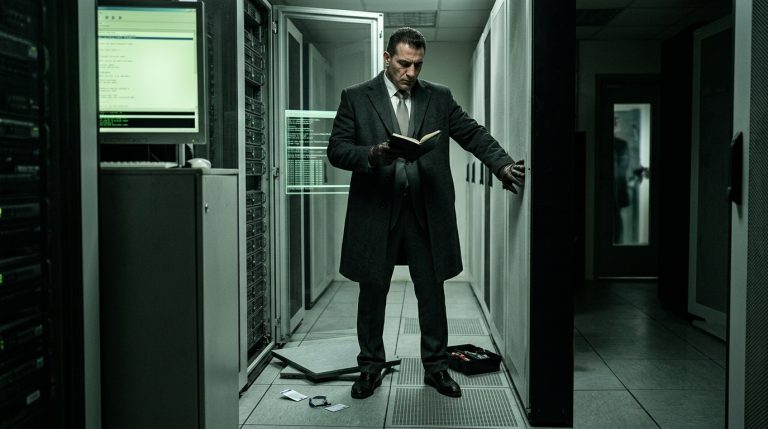
Inside, the container was filled not with contraband, but with digital infrastructure—rows of cooling fans, humming hard drives, and a single, polished mahogany desk. It was an office on the edge of the world.
He moved to the desk, his flashlight beam cutting through the gloom. There were files, but they weren’t the ones he expected. They were records of payments, signed by Judge Sterling, but addressed to a ‘L.R.’—the initials of his own trusted lieutenant, Marco.
His heart stalled. The realization was a cold, physical blow to his sternum. The judge was the architect, but the builder, the one who had been inside his house, the one who had organized his security, was the one who had orchestrated the “accident.”
He opened the center drawer, his fingers brushing against something cool and hard. An envelope. He tore it open, finding a single sheet of paper: a blueprint of his own mansion, with the route Isabella had taken the night she died marked in red ink.
He heard the crunch of gravel behind him. He didn’t turn. He knew who it was. The fire had been a distraction, but it had also drawn the fox out of the hole.
“You weren’t supposed to find that, Daario,” a voice said, cold and familiar. Marco stepped into the sliver of light, his handgun held with a casual, devastating ease. “You were supposed to die at the pier, protecting a girl who was never your blood. It would have been a poetic end for a king who had forgotten how to rule.”
Daario finally turned, his face a mask of iron. The betrayal didn’t just hurt; it clarified everything. The “decoy” of the syndicate wasn’t just the judge; it was his own house.
“You killed her,” Daario whispered, the words carrying the weight of a death sentence.
Marco shrugged, his expression utterly devoid of remorse. “She was going to burn the foundation, Daario. I was just keeping the house standing.”
Daario reached for his weapon, but he knew the distance was too great. The tension in the room was absolute, a frozen moment where the past and the future collided. He had been played, and for the first time in his life, he didn’t have a counter-move ready. He had found the decoy, but the cost was the total destruction of his remaining trust.
CHAPTER 5: SHADOWS IN THE CITY
Daario’s world narrowed to the bead of the sight on Marco’s pistol. Every muscle in his body was coiled, tight as a wire under tension, but he didn’t reach for his holster. He knew, with the cold, detached logic of a man already dead, that Marco would put a bullet in his brain before his fingers cleared the leather.
“You really thought you could hide her, Daario?” Marco’s voice was calm, almost conversational, cutting through the drumming rain. “You were always too sentimental. That was the flaw. You spent thirty years building an empire, and you couldn’t see the rot beneath your own feet.”
Daario didn’t look at the gun. He looked at Marco’s eyes—those familiar, loyal eyes that had seen him through two decades of war, now empty of everything but cold, pragmatic ambition. The revelation shifted his perception; he recalled the night of the accident, the way Marco had been the first to arrive at the scene, the way he had insisted on handling the police report himself.
“The car,” Daario said, his voice barely a rasp over the wind. “You didn’t just sabotage the brakes. You wanted the notebook she was carrying.”
Marco’s lip curled. “She was a liability, Daario. She was going to tear down the entire mechanism. I didn’t hate her. I just didn’t care for her martyrdom.”
Daario’s mind raced through the ‘consequence loop.’ Therefore, if Marco was here, he was the sole operational lead at the pier. He hadn’t brought backup because he was arrogant—he wanted the kill for himself, to finalize the transition of power.
But Marco had underestimated the physical exhaustion of a man who had nothing left to lose.
Daario shifted his weight, his boot sliding across the oil-slicked floor of the container. He didn’t lunge. He simply dropped his center of gravity, a move as old as the streets he grew up on. As Marco’s finger tightened on the trigger, Daario slammed his shoulder into the heavy mahogany desk, shoving it forward with a guttural roar.
The heavy desk collided with Marco’s legs. The shot went wide, punching a hole through the container wall, the sound deafening in the confined space.
Daario didn’t give him a second. He was across the gap in two strides, his hand locking onto the wrist of the gun-arm. They crashed into the racks of humming hard drives, sending sparks cascading into the air. They grappled in the tight, freezing space, the scent of burning electronics and damp, metallic oil suffocating them.
Marco was younger, faster, but Daario had the weight of a lifetime of resentment. He smashed Marco’s face into the edge of a server rack, the sound of cartilage snapping like a dry twig.
Marco groaned, his grip on the weapon loosening. Daario didn’t finish it. He didn’t want the death—not yet. He wanted the truth. He kicked the gun away and pinned Marco against the server rack, his hands trembling with a rage that bordered on madness.
“The judge,” Daario snarled. “Where is he keeping the ledger backups?”
Marco laughed, a wet, rattling sound. “You’re too late, Daario. The purge started an hour ago. Your safe house? It’s not a fortress anymore. It’s a tomb.”
The words shattered the last of Daario’s composure. He realized then that the decoy at the pier wasn’t his trap—it was Marco’s. He had been lured here to be occupied, to be distracted while the ‘Plan B’ was executed back at the house.
He didn’t wait to hear another word. He struck Marco with the butt of his pistol, sending him into the darkness of the container’s corner, and bolted toward the door. The rain was cold, but the chill in his blood was colder. He sprinted toward the car, the gravel spraying beneath his heels, his mind screaming at him to move faster, faster, because the silence coming from the safe house felt louder than any gunshot.
He reached the Mercedes, threw the door open, and screamed at Vincent, “Drive! Now!”
As the tires spun, throwing dirt and rock, Daario’s hands were shaking so violently he could barely load his spare magazine. The city lights blurred into long, sickly streaks of neon. He had failed the first law of the sovereign protector: he had let the enemy choose the battlefield. And now, he had to hope that Sophia was still breathing.
CHAPTER 6: THE JUDGES CONFESSION
The car shuddered to a halt, the smell of scorched rubber and hot grease filling the cabin. Daario didn’t wait for the engine to cool. He shoved the door open, the rain hitting his face like a handful of gravel. Behind them, the dark silhouettes of two pursuing vehicles crested the hill, their headlights cutting through the downpour like predatory eyes.
“Vincent, get the files!” Daario yelled, sliding into the mud.
He didn’t check on the driver. He didn’t check on the state of the vehicle. He reached into the trunk, pulled out a heavy duffel, and started sprinting toward the treeline that bordered the highway. The mud was deep, clinging to his boots like hands, forcing him to fight for every inch of progress. Behind him, the sound of car doors slamming shut and the rhythmic thud-thud of pursuit teams hitting the asphalt echoed in the storm.
They were being hunted by men who knew every inch of this terrain.
Daario reached the edge of a ravine, the trees acting as a natural curtain. He ducked, his breath coming in ragged, freezing gasps. He checked his watch—midnight. He was miles from the judge’s estate, and he was being trailed by the very people he had spent his life thinking were his own shadow.
“Daario,” Vincent panted, catching up, his face twisted with pain. “I have the judge’s secure drive, but we’re pinned. They’ve blocked the access road.”
Daario didn’t look back. He peered through the thicket, seeing the faint glow of the judge’s estate on the horizon. The truth was there, locked behind stone walls and armed guards, but the route was a gauntlet.
“We don’t need the road,” Daario said, pointing toward the estate’s secondary perimeter. “We use the ravine. It leads to the service tunnels beneath the judge’s greenhouse. It was built during the original estate renovation—before the security upgrades.”
“That’s a suicide run,” Vincent whispered.
“We’re already dead if we stay here,” Daario retorted.
They moved, a pair of phantoms in the dark. The descent into the ravine was a brutal exercise in friction and pain. Daario slid down the embankment, his hands raw from the branches and jagged rocks, his focus purely on the target ahead. Every time he heard a branch snap or a voice call out in the distance, his muscles tightened—a reflex born of the absolute, crushing knowledge that his own trusted lieutenant, Marco, had been the architect of his daughter’s death.
The physical exertion was absolute, a purging of his own past. He reached the bottom of the ravine, the sound of rushing water drowning out the pursuit. He navigated the drainage pipe, his lungs burning, the cold water rising to his knees. This was the ‘Rusted Truth’ he had lived in—the grime, the decay, the hidden tunnels underneath a life of luxury.
They emerged into the damp, soil-heavy air of the greenhouse. Above them, through the glass panels, the sky was a bruised, lightning-streaked expanse. Daario didn’t stop. He moved to the central control panel, a piece of old, outdated tech that controlled the estate’s power grid.
He didn’t try to hack it. He ripped the paneling off and pulled the wires.
The entire estate plunged into darkness. A split-second later, the auxiliary generators kicked in, but they were unstable. This was the window. Daario moved to the main study door, his pistol raised.
He burst inside. Judge Sterling was there, sitting behind an oversized desk, a half-finished glass of cognac trembling in his hand. He looked up, his face ashen, his silver hair a mess of uncharacteristic disarray.
“Daario,” the judge started, his voice a pathetic, wavering thing. “I can explain—”
Daario didn’t let him finish. He strode across the room, grabbed the judge by the collar of his silk robe, and hauled him over the desk. The sound of porcelain crashing to the floor was the only answer he gave.
“The ledger,” Daario said, his voice a low, terrifying growl. “And tell me why you let Marco kill her. If you lie to me, I won’t kill you—I’ll make sure you live to see everything you built turned into dust.”
The judge’s eyes darted to the safe in the corner. Daario marched him toward it, the weight of the moment pressing down on the room like a physical atmosphere. He had come for the truth, but as he stared at the judge, he realized that Layer 1—the money laundering—was only the skin of the wound. The truth about Isabella ran deeper, a poison that had been sitting in his own house for years.
He didn’t just want the ledger. He wanted the name of every person who had looked the other way while his daughter was marked for death. And as the judge’s fingers shook against the dial of the safe, Daario knew the endgame was finally, bloodily, within reach.
CHAPTER 7: THE TRUTH OF THE ACCIDENT
The safe door swung open with a hiss of pressurized air. Inside were stacks of encrypted drives and a ledger bound in worn, black leather. Daario didn’t look at the judge. He reached in, his fingers brushing the cold surface of the ledger, and pulled it out. The judge collapsed back against his desk, clutching his chest, his breath coming in wheezing, shallow bursts.
“It’s all there,” the judge whispered, his eyes fixed on the ceiling. “The accounts, the transfers, the names of the people who signed off on everything. But you don’t understand, Daario. Marco was never just an employee. He was a partner. He was the one who controlled the logistics of the ‘accident’.”
Daario stood in the center of the study, the silence of the house pressing against his eardrums. He opened the ledger, his gaze sweeping over the entries. Dates, times, signatures. It was a precise, blood-chilling account of Isabella’s final weeks. He found the page—marked with a red ink stamp: Project Cleanup.
The entry detail was stark: Target: Isabella Moretti. Method: Mechanical failure (brake fluid calibration). Operator: M.R.
The initials stood for Marco Rossi.
A wave of nausea rolled over Daario, followed by a cold, hollow sensation in his chest that felt like a permanent void. The man he had trusted with his daughter’s life, the man who had sat at his table and sworn allegiance, had been the one to drain the life out of her for a percentage of the syndicate’s profit.
He looked around the room, his eyes catching on a photograph on the judge’s mantle—a picture of Marco and Isabella from years ago, when they were all just beginning. It was a lie. Everything he had stood for, every loyalty he had demanded, was a thin veneer over a rotting core.
Suddenly, the room seemed to tilt. A sound caught in his ear—a soft, melodic humming. Isabella? He turned, his gun swinging toward the doorway, but there was only the cold, shadow-filled hall. His mind was fracturing. The stress of the last seventy-two hours was no longer just a physical burden; it was tearing at his perception of reality.
“She was so much like you,” the judge said, his voice regaining a sliver of its usual, arrogant detachment. “She thought she could outmaneuver the system, but she didn’t realize that in this city, the system is the blood in the streets. You’re not a king, Daario. You’re just a ghost in a suit.”
Daario stepped forward and slammed the butt of his pistol into the judge’s desk, the wood splintering. “Where is Marco now?”
“He’s not at the house,” the judge replied, a faint, cruel smile touching his lips. “He’s at the memorial site, waiting. He knows you won’t go to the authorities with this. He knows you’ll come for him. It’s the only way this ends—a final, bloody accounting for a life you can never reclaim.”
Daario stared at the judge, then at the ledger in his hand. He realized the trap wasn’t just physical—it was an invitation to his own destruction. If he killed Marco, he became the very thing he had spent his life trying to bury. If he walked away, he allowed the man who murdered his daughter to continue breathing.
The decision didn’t come from a place of logic. It came from a deep, ancient, and relentless hunger for justice. He didn’t answer the judge. He grabbed the ledger and the drives, his movements precise and devoid of hesitation. He turned and walked out of the study, the weight of the book in his hand feeling heavier than any weapon he had ever carried.
Outside, the storm had tapered to a cold, persistent drizzle. Vincent was waiting by the Mercedes, his face a mask of grim anticipation.
“They’re waiting at the site, aren’t they?” Vincent asked.
“They are,” Daario said, climbing into the passenger seat. He didn’t look back at the estate. The mansion was no longer his home; it was a ghost of a life he had lost. “Drive. It’s time to settle the account.”
The car roared to life, its headlights cutting through the darkness of the cemetery approach. Daario checked the action of his pistol one last time, the cold steel a final, grounding reality in a night that had long since abandoned the light. He knew how this would end. There would be no trial, no prison sentence, no justice provided by the courts. There would only be the cold, final calculation of a debt paid in full.
CHAPTER 8: THE EDGE OF THE HORIZON
The cemetery was a landscape of jagged shadows. Marco stood with his back to the mausoleum, his silhouette framed by the stark white marble angels that had watched over Isabella’s final rest. He didn’t move as Daario approached, the gravel crunching loudly under the older man’s boots. There was no pretense of surprise, no attempt to flee; just a mutual, terrifying understanding that the masquerade was finished.
Daario stopped ten feet away. He didn’t pull his gun. He reached into his coat and pulled out the leather-bound ledger, the paper soaked through with rain, and tossed it into the mud between them. It landed with a soft, final thud.
“I know why,” Daario said, his voice stripped of all emotion. “It wasn’t about the money. It wasn’t about the syndicate. You wanted to see if you could build something better than the man who taught you how to kill.”
Marco stared at the ledger, then slowly looked up. His eyes, once full of a familiar, brotherly warmth, were now as dead as the stones surrounding them. “You built a wall, Daario. You thought you were protecting her, but you were just keeping her in a cage. I didn’t kill her because of the syndicate. I killed her because she was going to open that cage, and you would have let her walk into a world that would have torn her apart. I saved her from the pain of your legacy.”
The confession hung in the air, a grotesque justification of cold, calculated murder. Daario felt a jolt of visceral agony, but he didn’t break. He moved with a sudden, explosive speed, closing the distance before Marco could react. He caught the younger man by the throat, pinning him against the cold, unyielding face of the Moretti tomb.
“You didn’t save her,” Daario hissed, the words vibrating with a lifetime of pent-up grief. “You destroyed the only thing that made me human.”
Marco didn’t fight back. He smiled, a jagged, broken expression. “Check your pocket, Daario. The one with the gun you’re so fond of.”
Daario felt the weight of his sidearm, but as his hand moved to it, he felt the absence. The magazine was gone. Marco had planted a silent thief while they were in the tunnel, a final, mocking gesture of equal intellect.
“The judge is already gone,” Marco whispered. “I tipped the authorities to the ledger you found. You’re not going to be the hero here, Daario. You’re going to be the fall guy for a lifetime of Moretti sins. You’re going to jail, or you’re going to die in this grave.”
Daario looked at Marco, then at the marble angel above them. He realized the trap was perfect—a total, systemic annihilation of his existence. But Marco had forgotten one thing: the girl. Sophia was safe in the hands of a man who didn’t even know her name, away from the rot of the Moretti name.
“You failed,” Daario said, his voice dropping to a whisper. “You focused on the machine, but you forgot the people. I don’t care about the ledger. I don’t care about the prison. You’re going to lose, Marco, because you’re already alone.”
Daario didn’t strike him. He let go, stepping back into the rain. He watched as the distant strobes of police cruisers crested the hill, the sirens beginning to wail—a funeral dirge for his empire.
Marco’s face crumbled, the realization of his own isolation hitting him with the force of the approaching lights. He had engineered a perfect victory, only to realize he had nowhere to go once it was won. He turned, looking for an exit, but the cemetery gates were already being swarmed by armed men.
Daario stood in the center of the graveyard, letting the rain wash over him. He felt the tension finally drain out of his shoulders, a slow, aching collapse of decades of structural weight. He had failed to save Isabella, but he had held the line. He had protected the future.
As the police closed in, Daario knelt at the grave of his daughter. He traced the engraving of her name with a trembling finger, his hand finally steady. The world was changing, the iron-fisted era of the Moretti name was ending in the mud of a cemetery, and for the first time in his life, there was nothing left to calculate.
He took a deep breath, the cold air filling his lungs with the scent of wet stone and peace. The pain remained, a dull, constant ache in his chest, but the fire was gone. He looked up at the sky, the clouds finally breaking to reveal a single, distant star. He had been a king of shadows, but he was choosing to end his days as a man.
The sirens grew deafening, but Daario didn’t look up as the lights pinned him against the night. He remained kneeling, a quiet, broken, and redeemed shadow among the stones, waiting for the silence to reclaim everything.