The Weight of Iron and Oak: Engineering Justice Along the Dusty Gray Property Lines
CHAPTER 1: THE IRON IN THE DIRT
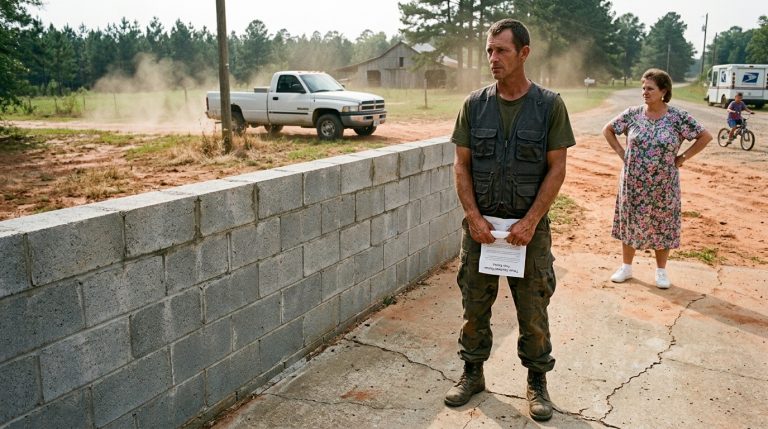
The words hung in the crisp autumn air, sharp and intrusive as the scrape of a rusted shovel against a stone. Karen stood with her hands planted firmly on her hips, her floral mumu acting as a garish flag planted on disputed ground. Behind her, Herb fidgeted with the wire frame of his glasses, his gaze fixed intently on the dry gravel beneath his boots as if hoping the earth might open up and swallow him whole.
I did not move. My boots were planted squarely in the dirt of my own ten acres, ground bought and paid for with twenty years of Army Corps of Engineers service, where everything had a tolerance and nothing was left to chance.
Thirty feet behind me sat four cords of seasoned red oak, stacked with mathematical precision. It was not a blight, despite what her shrill voice claimed; it was insurance against the ice storms that periodically crippled this corner of the state. It was heavy, dark wood that smelled of dried sap and earth, locked together in a solid, unyielding wall.
“That pile of wood is a blight on this community,” Karen snapped, taking a forward step that crunched aggressively into the gravel path marking the very edge of my property line. “And if you don’t remove it, I will.”
Her authority was a phantom construct, built on paper thin enough to tear in a stiff wind, yet she wielded it like a broadsword. I let the silence stretch for three slow heartbeats, the kind of measured pause drilled into me back when decisions carried the weight of structural integrity. My internal calculus was simple: do not match noise with noise; measure the opposition’s footing and locate the structural flaw.
“Karen,” I said, my voice level, stripped of any reactive heat. “This is private property. The wood is neatly stacked, well away from any shared boundaries, and it serves a singular purpose for this household.”
“I am the president of the Harmony Creek Homeowners Association,” she shot back, her voice climbing an octave, spittle catching the pale autumn sunlight. “And the covenants clearly state that unseemly accumulations of debris are strictly prohibited. You have seven days.”
She turned on her heel with a dramatic, fabric-straining flourish, marching back toward the manicured lawns and identical mailboxes of the subdivision, with Herb scurrying in her wake like a pilot fish tied to a sluggish shark.
I remained still for a long moment, listening to the crunch of their footsteps fade into the distance. The anger was there—a cold, dense knot in my chest—but it was secondary to the mechanical precision now kicking over in my mind. She had drawn a line, but she had misread the blueprint entirely.
I walked back toward the house, the scent of Sarah’s beef stew drifting from the kitchen window offering a warm, domestic contrast to the chill outside. As I pulled off my boots in the mudroom, Sarah looked up from the stove, her brow creased with worry.
“What was that all about?” she asked softly.
“Queen Karen,” I said, stepping onto the hardwood floor, “informing us that our winter heat source is an unseemly accumulation.”
Sarah’s hand went to her mouth, her eyes widening slightly at the mention of fines and threats of a lien. “A lien over firewood? Mark, that’s insane.”
“It’s worse than insane,” I replied, my gaze drifting past her toward the hallway leading to my office, where the thick white binder of covenants and the county plat maps lay waiting under a desk lamp. “It’s an engineering error on her part.”
I left the kitchen, walking down the hall into the small room lined with heavy engineering texts and historical atlases. I sat down at the heavy oak desk, flicked on the adjustable brass lamp, and pulled the county plat map from its roll, weighing down the corners with a brass paperweight.
The map was crisp, detailed, and unyielding. I traced the boundary lines of lot one with the tip of my finger, noting the exact perimeter where the subdivision’s legal reach ended and my grandfathered acreage began. According to the surveyor’s coordinates, the wood pile was safely outside their zone by more than a hundred feet.
She had threatened a lien, but she had built her case on an assumption rather than a survey pin. I reached for a red grease pencil, making a small, clean mark at the intersection of our property lines, feeling the steady rhythm of my pulse settle into a cold, tactical calm.
The trap was outlined on paper, but before I could spring it, I needed to know if she was foolish enough to step across the boundary in the dark. I reached down, pulling a heavy footlocker out from beneath the bottom shelf of the bookcase, lifted the metal clasps, and drew out the matte-black housing of the trail camera.
CHAPTER 2: THE COMMAND CENTER AND THE OLD PLAT MAP
The brass lamp hummed softly, casting a tight circle of amber light over the edge of the heavy oak desk. In my hand, the matte-black housing of the trail camera felt substantial, its dual-latch closure cold to the touch. I laid it down beside the unrolled county plat map, the crinkled edges of the heavy paper snapping back slightly like coiled springs before I weighted them down with a pair of brass bookends.
This room was my command center. For years, bridges and structural spans had taken shape on drafting tables not unlike this one, where a fraction of an inch meant the difference between structural integrity and catastrophic failure. A suburban dispute over firewood was, at its core, no different. It was an exercise in load-bearing logic, boundaries, and stress points. Karen was relying on weight of volume—the loud voice, the official-looking stationary, the threat of social isolation—to force compliance. But she had failed to check the foundation.
I pulled the thick white three-ring binder containing the Harmony Creek Covenants, Conditions, and Restrictions toward me. The cover was clean, stamped with an embossed, soulless corporate font that smelled faintly of a municipal printer. I opened it to Article 9, the section she had weaponized on the gravel path.
“Noxious or offensive activity shall not be carried on upon any lot,” I read aloud, my voice flat in the quiet room, “nor shall anything be done thereon which may be or may become an annoyance or nuisance to the neighborhood. No unsightly objects or unseemly accumulations of debris shall be permitted to remain on any lot.”
The language was deliberately slippery. It was a net woven with wide gaps, designed to catch whatever minor infractions a bored administration wanted to drag into the open. But words in a covenant only held power where jurisdiction applied. I slid my index finger from the text over to the survey map, tracing the thick black lines that marked the perimeter of my ten-acre holding.
Lot one was an anomaly in their neat little corporate grid. It was an older, grandfathered parcel that had predated the subdivision by decades, slicing into the edge of the farmland like an unplaned knot in a pine board. Only a tiny, triangular sliver near the main county road—designated as easement area A—touched their development, a concession traded away by the previous owner for sewer access years ago. The wood pile sat a hundred and fifty feet north of that boundary, deep within the shielded privacy of my own timberline, six hundred feet clear of their legal reach.
She hadn’t just misinterpreted the rules; she had planted her flag in a foreign country and threatened to arrest the king for trespassing.
I picked up a red grease pencil, twisting the base until the wax tip emerged, and drew a firm, square box around the exact coordinates of the four cords of red oak. The wood was seasoned, split into uniform sixteen-inch lengths, and stacked four feet high with military precision. It wasn’t debris. It was thermal mass. It was survival gear against the January ice storms that routinely snapped power lines across this county and left whole neighborhoods shivering in the dark.
Sarah appeared softly in the doorway, holding a ceramic mug of steaming black coffee. She didn’t step into the room at first, her shoulder resting against the doorframe as she watched me trace the boundary lines. The lines on her face were drawn tight, the lingering anxiety of the afternoon’s confrontation still shadowing her eyes.
“She’s serious, Mark,” Sarah said quietly, setting the mug down on the corner of the desk without disturbing the maps. “People in the neighborhood talk about her. Not openly—not where she can hear them—but when they pick up their mail, they look over their shoulders. She’s run people off before.”
“People give up because fighting is exhausting,” I said, looking up from the desk. I picked up the camera again, turning it over to check the battery compartment seal. “They rely on the hassle factor. They count on the fact that most homeowners have jobs, kids, and lives that leave zero bandwidth for a legal battle over lawn ornaments or firewood.”
“And you have bandwidth?” A faint, dry half-smile touched the corner of her mouth.
“I have a background in logistics,” I replied, standing up to stretch my legs against the chill creeping through the old floorboards. “And right now, she’s operating on an unearned surplus of confidence. That’s a structural vulnerability. When an adversary thinks they are completely unopposed, they stop looking at the ground beneath their feet.”
I walked over to the small window that looked out toward the darkened northern tree line. Outside, the night was dead silent, save for the occasional rustle of dry leaves scraping against the glass under the pressure of a rising wind. Somewhere out there in the dark, four cords of heavy red oak sat waiting, completely unaware that they were about to become the anchor of a tactical defense.
“What’s the next step?” Sarah asked, her voice dropping into that steady register she always used when we crossed the line from discussion into execution.
“We don’t react,” I said, turning back from the glass. “We let the machinery turn. Tomorrow morning, I call the county surveyor’s office to get an official, certified pin set on that north line. Irrefutable proof in writing. And before the week is out, this camera goes up in the canopy where she can’t see it.”
Sarah looked at the trail camera in my hands, then down at the marked maps. The worry in her eyes didn’t vanish entirely, but it shifted, hardening into something sharper, something resilient. She picked up her mug, wrapped both hands around it for warmth, and gave a slow, deliberate nod.
“All right,” she said softly. “Just make sure you check your corners.”
“Always,” I replied.
After she closed the door, leaving me alone in the amber glow of the desk lamp, I pulled a fresh manila folder from the rack and wrote HOA DISPUTE EVIDENCE across the tab in bold, clean block letters. I dropped the printed covenants inside it, closed the cover with a crisp snap, and set it squarely in the center of the desk. The first phase was logged. Now, we waited for the enemy to make her move.
CHAPTER 3: THE CERTIFIED GREEN ENVELOPE AND THE FIRST MOVE
The morning mail arrived precisely at 11:15 a.m., heralded by the familiar low groan of the carrier’s truck tires grinding over the packed gravel of our long driveway. I was out near the perimeter, clearing stubborn brambles with a heavy brush hook, but I saw the vehicle turn the bend and intercepted it before it reached the box.
The carrier, a young man with a weather-chapped face, leaned out of the right-hand window and held out a plastic electronic pad along with a stiff, thick envelope bordered in high-gloss paper.
“Certified delivery, Mr. Jennings,” he said, tapping the screen with a stylus. “Need your signature right here.”
I pressed my thumb against the glass, signing cleanly, and accepted the envelope. The paper stock was heavy, bond quality, carrying an unmistakable corporate heft. I didn’t rip it open in the dirt. I walked it back to the house, the cold autumn wind carrying the scent of dry earth and distant woodsmoke, and laid it on the kitchen island where Sarah was wiping down the counter.
She stopped moving the cloth, her eyes dropping to the green slip pasted across the front. “It’s from them.”
“Certified mail,” I agreed, pulling a clean utility knife from my pocket and slicing the top seal with a single, controlled stroke. “She’s escalating from verbal bluster to paper.”
I slid the single sheet out. The letterhead was stamped with the stylized logo of Harmony Creek—a neat, geometric cluster of rooftops that looked entirely peaceful until you read the text underneath.
“Dear property owner,” I read aloud, my voice flat and devoid of performance. “This letter serves as a formal notice of violation regarding the property located at 1280 Old Mill Road. An inspection on October 14th revealed a violation of CC&R Article 9, Section 4B, specifically the presence of an unseemly accumulation of debris, classified as a firewood pile. A fine of one hundred dollars has been assessed to your account, compounding by fifty dollars per day until the cured status is verified.”
It was signed with a rigid, looped flourish: Karen Miller, President, Harmony Creek HOA.
Sarah crossed her arms, leaning against the edge of the refrigerator. “One hundred dollars plus fifty a day. She’s building a ledger. If we ignore it, she’ll try to stack the numbers until they look terrifying on paper.”
“Numbers only matter if they have legal weight behind them,” I said, folding the letter neatly and walking it into my office. I opened the newly labeled HOA Dispute Evidence manila folder and dropped the green envelope inside. Next to it sat the plat map, its red grease-pencil boundary lines glaring under the light. “Right now, she’s writing checks against an empty account. But we need a certified anchor before we return fire.”
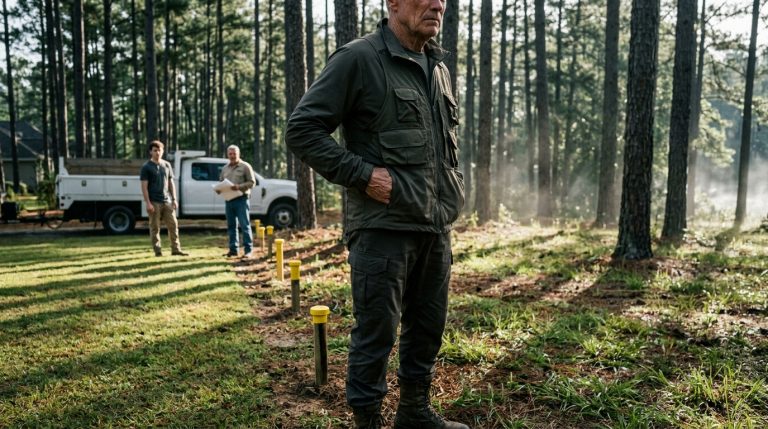
The following morning, I was standing by the road when the county survey truck pulled up—a dusty white Ford pickup bearing the county seal on the door. Bill Carlson stepped out, wearing a high-visibility yellow vest and carrying a heavy aluminum tripod over one shoulder.
We shook hands—a firm, dry grip that acknowledged the shared language of physical measurements.
“Mark Jennings,” I said. “Thanks for making the run out here.”
“Bill Carlson, county survey,” he replied, scanning the tree line with practiced eyes. “Got your request for the northern line check. You mentioned a disagreement with a neighboring entity over jurisdiction boundaries?”
“Old plot meeting new subdivision,” I said simply. “I want the pins set and certified under seal so there’s zero ambiguity.”
“Fair enough. Physics doesn’t care about neighborhood committees.” Bill humted his equipment down near the edge of the gravel path, extending the tripod legs until the metal bites locked solidly into the dry earth.
As he began calibrating his total station, adjusting the lens with minute, methodical turns, a sharp flick of motion caught my eye across the road. A lace curtain dropped back into place at the window of Karen’s house. A moment later, the front door swung open with a dry clatter, and her floral mumu billowed out like a spinnaker catching a hostile wind.
She marched across the asphalt with the rigid, mechanical stride of someone accustomed to the world parting before her. She didn’t look at me; her focus locked entirely onto Bill, who was peering intently through the electronic viewfinder.
“What is the meaning of this?” Karen demanded, her voice shrill enough to cut through the hum of distant traffic. “I am the president of the Harmony Creek Homeowners Association. Any survey work affecting this district requires board authorization.”
Bill didn’t rush. He slowly lifted his head from the eyepiece, his expression locked in a state of profound, institutional boredom. He didn’t blink as he looked down at her.
“County survey, ma’am,” he said, his voice flat and level. “We don’t take work orders from homeowners associations. We take them from property deeds and the county registrar.”
Karen’s face mottled into a deep, furious crimson, the color of oxidized iron. She jabbed a finger toward the northern tree line where my wood pile sat stacked against the cold. “That line is mapped incorrectly! The association’s covenants extend past that tree line. You are aiding and abetting a violation!”
I stepped forward, keeping my voice quiet, pitching it just under the volume of her rant. “Karen. Let the man work. We’re just clarifying the facts.”
She whipped around, her eyes narrowing to thin slits. “You think you can play games with the rules, Mr. Jennings? You have days left on your fine accumulation. When we put a lien on this land, your little engineering tricks won’t save you.”
Bill ignored her completely, picking up a heavy steel survey pin and a bright orange wooden stake from his kit. He walked past her as if she were a fencepost, pacing off thirty yards north of my wood stack, well within my interior acreage. He planted the steel pin deep into the earth with a single, massive swing of his sledgehammer—clang, clang, clang—the iron ring echoing off the dry hills. Then he drove the orange flag right beside it.
He walked back, wiped his hands on a rag, and handed me a printed carbon receipt.
“There’s your certified line, Mr. Jennings,” Bill said loudly enough for the entire road to hear. “Everything south of that orange stake is your private property. The HOA’s jurisdiction stops six hundred feet south of here. You’ve got ten feet of clear buffer past your wood pile alone.”
Karen stared at the orange flag, her mouth opening and closing once before she clamped it shut. The physical proof was right there, hammered into the dirt with a county seal attached to it. Without another word, she spun on her heel, her slippers crunching violently against the asphalt as she retreated back across the street and slammed her front door hard enough to rattle her own windows.
I looked down at the receipt, then back at the wood pile standing dark and solid against the chill. The perimeter was secured. The paperwork was ironclad. But as I watched her house remain stubbornly dark across the road, a cold certainty settled into my chest. She hadn’t surrendered; she had just retreated to calculate her next move in the dark.
CHAPTER 4: THE ARRIVAL OF THE COUNTY SURVEYOR AND THE FIRST STAKE
The orange wooden stake stood upright against the gray perimeter like a small, stubborn flag of arithmetic truth. Bill Carlson had packed his total station back into its molded plastic case, the metal latches snapping shut with a crisp, dry report that carried far in the thin morning air. He heaved the tripod over his shoulder, adjusted the strap of his yellow vest, and walked back down the gravel path toward where his white county pickup sat idling, its exhaust pluming pale and steady against the shadowed trunk lines.
I walked beside him, my boots crunching rhythmically on the small stones. The confrontation with Karen had evaporated from the immediate atmosphere, leaving behind only the cold, functional reality of coordinates and benchmarks.
“You’ve got your iron and your stake,” Bill said, pausing by the passenger-side door of his truck to drop the tripod into the bed with a dull thud. “That original pin we found under the roots was buried thirty years ago, but the GPS coordinates match the register down to the hundredth of an inch. Nobody’s moving that line without a judge’s order.”
“Appreciate the thoroughness, Bill,” I said, sliding a folded check from my pocket and handing it over. He checked the amount against his clipboard, tucked it into his breast pocket, and shook my hand once—a quick, dry clasp of working hands.
“Just doing the math, Mr. Jennings. If that neighbor of yours has a problem with it, tell her to file a formal motion with the county recorder’s office. They’ll hand her a heavy stack of paperwork and charge her a fee just to look at the same map I pulled this morning.” He climbed into the cab, the transmission whining as he shifted into reverse, and turned the truck around in a tight sweep that left fresh tire tracks across the dirt edge of the drive.
I watched the truck rumble down toward the main road, its red taillights blinking twice through the screen of bare oak branches before disappearing around the bend. Silence rushed back in to fill the gap—not an empty silence, but the heavy, textured quiet of ten acres of land settling into the afternoon chill.
My gaze drifted back to the orange stake, then tracked twenty feet south to where the four cords of red oak sat stacked in their dense, mathematical rows. Each log had been cut to precise sixteen-inch lengths, split with an eight-pound maul during the humid tail-end of August, and layered with enough spacing to let the autumn wind cure the heartwood. It was solid mass, weathered gray at the bark edges but burning clean orange inside. It represented weeks of physical labor, sweat soaking into canvas work gloves, and the rhythmic thunk of iron biting into timber.
A sudden, sharp memory cut through the quiet—an image of an engineering site in a narrow valley years ago, where a retaining wall had begun to weep water through its mortar joints because a contractor tried to save two bags of cement on the back corner. The locals called it an aesthetic choice. The physics called it an impending collapse. People like Karen looked at a wall or a wood pile and saw only shapes that offended their narrow field of view; they never calculated the structural forces holding the world up beneath them.
I walked over to the stack, my fingers brushing against the rough, fissured bark of the outermost log. The wood was cold, holding the morning frost in its pores.
I needed to make sure the second layer of defense was in place before nightfall. The survey stake was a legal shield, but paper and iron pins only worked against people who respected the law. A tyrant operating on petty impulse didn’t care about county pins once the sun went down; they cared about optics, control, and erasing whatever challenged their small domain.
I walked back toward the garage, ducking beneath the low lintel into the dim, cool interior where the smell of motor oil, dry sawdust, and old rubber hung thick in the air. Rusted iron hooks lined the side wall, holding old lengths of rusted chain and spare mattocks. Down in the corner, half-buried beneath a stack of plastic storage bins and winter camping gear, sat a heavy metal footlocker.
I dragged it out into the sliver of light coming through the side window, unlatched the rusted metal clasps, and lifted the lid. Inside, tucked neatly within a molded foam cutout, lay the matte-black housing of the infrared trail camera—the one my son had given me a few seasons back before we moved out to the country. It was a sturdy, weatherproof unit, clad in mottled green-and-brown camouflage designed to blend seamlessly into bark and foliage.
I pulled it out, checked the battery compartment—dry, clean contacts—and slid in a fresh set of lithium cells. Then I unclipped the side slot and inserted a clean 128-gigabyte memory card, its tiny gold contacts gleaming under the dusty sunlight.
The plan was straightforward, built on the same principles I used when laying out defensive perimeters during my time downrange: limited visibility, redundant recording, and complete tactical surprise. If someone decided to test the legal boundary after dark, I wouldn’t need to stand out here in the cold waiting for them. The lens would do the watching.
I tucked the camera under my arm, grabbed a small step ladder and a roll of heavy-duty nylon-coated strapping wire from the workbench, and headed back out toward the northern tree line. The sun was beginning its steep afternoon descent, casting long, skeletal shadows across the frosted grass.
About forty feet north of the wood stack stood a mature, rough-barked white oak whose lowest heavy bough reached out over the path like a cantilevered beam. It offered a commanding, downward-sloping angle that covered every square inch of the storage area and the gravel approach.
I set the ladder against the trunk, climbed up four rungs until my boots were level with the rough bark, and leaned my weight against the wood to test its friction. Satisfied, I strapped the camera securely to the trunk, twelve feet off the ground, tilting the adjustable lens downward at a precise twenty-two-degree angle. I powered it on, watched the tiny green LED blink once to confirm the sensor array was active, and then closed the outer housing, locking the latch tight.
From the path below, even if you knew it was there, the camouflage pattern dissolved completely into the dark fissures of the bark. It was practically invisible.
I climbed down, folded the ladder, and stood back to survey the setup. The wood pile sat quiet and heavy in the middle distance; the survey stake caught the last pale slanting rays of the sun like a tiny neon beacon; and high up on the oak, the glass eye of the lens stared down into the clearing without a sound.
The trap was set, anchored in both county law and quiet optics. I turned back toward the house, the iron-cold grip of purpose tightening in my chest, knowing the other side had not yet realized how deep the hole was that they were digging.
CHAPTER 5: THE MIDNIGHT THEFT AND THE INFRARED EYE
The digital clock on the bedside table read 2:08 a.m. when the cold air in the bedroom seemed to shift, though the windows were tightly latched against the draft. I woke instantly—not with a start, but with the steady, practiced alertness of someone conditioned to register baseline anomalies in an otherwise stable environment. Beside me, Sarah breathed in a soft, even rhythm, untouched by the underlying hum of friction that had settled over the property since the county surveyor drove away.
I slipped out from under the heavy wool blanket, my bare feet touching the cold hardwood floor with barely a sound. I pulled on a heavy canvas work jacket over my flannel shirt, the metal buttons clicking lightly against each other, and walked silently down the hallway toward my office.
The room was pitch black, illuminated only by the faint green status light of the computer tower humming quietly under the desk. I didn’t turn on the lamp. Instead, I sat down in the leather chair, reached out, and pressed the wake key on the keyboard. The monitor flared to life, casting a pale, ghost-white glow across the stacked engineering manuals and the manila evidence folder.
My finger moved the mouse to open the storage drive linked directly to the wireless receiver sitting on the upper shelf—the remote terminal connected to the trail camera strapped twelve feet up the white oak trunk.
The file directory updated automatically. A new video file sat at the top of the list, time-stamped 2:13 a.m.
My pulse didn’t spike; it leveled out into a cold, rhythmic cadence. I double-clicked the file, maximizing the window to fill the screen with the grainy, high-definition monochrome green of infrared night vision.
The camera’s wide-angle lens captured the northern perimeter with terrifying clarity. The ground was frosted white, glittering under the invisible sweep of infrared LEDs. In the center of the frame sat the four cords of red oak—the dense, dark cubes of winter fuel I had stacked with meticulous precision.
Then, the low-frequency rumble of a heavy diesel engine vibrated faintly through the floorboards of the house, perfectly synchronized with the video playback on the screen.
On the monitor, a large commercial flatbed truck—the kind utilized by municipal contractors or local tree-removal services—backed slowly down the narrow gravel path bordering the edge of my timberline. Its tires kicked up plumes of frozen dust, and a hydraulic winch housing mounted directly behind the cab hummed with a low, mechanical whine. The vehicle stopped twenty feet short of the wood stack, its heavy dual wheels crushing the dry weeds lining the ditch.
The passenger door swung open. A figure stepped down into the frosted grass.
Even through the monochrome filter of the infrared lens, the silhouette was unmistakable. Karen wore a bright, patterned tracksuit that glowed eerily under the night vision, her form cutting an absurdly arrogant shape against the stark wilderness. In her right hand, she clutched a heavy-duty flashlight, its beam sweeping across my property lines with proprietary disdain.
The driver’s door creaked open next. A slouched, defeated-looking man emerged from behind the wheel—her husband, Ron, his shoulders permanently hunched as if bearing the weight of decades of domestic correction. Two younger men, dressed in gray work coveralls, jumped down from the rear bed of the cab, carrying heavy nylon rigging straps.
Karen didn’t hesitate. She pointed her flashlight toward the heart of the wood pile, barking silent, sharp commands that moved the two younger workers into immediate motion.
The flatbed’s articulating crane swung out with a metallic screech of ungreased joints. A heavy steel grapple claw descended from the end of the hydraulic arm, hovering like a mechanical spider over the top of my stack. With a sickening, efficient thud, the claws drove deep into the seasoned red oak, tearing through the careful alignment I had spent weeks establishing. Logs tumbled, bark shattered, and massive bundles of winter fuel were hoisted into the air, swinging clumsily before being dumped with a thunderous crash onto the wooden bed of the flatbed truck.
I watched the screen, my eyes locked on every detail. They were stealing it—not in the shadows of a quiet misunderstanding, but with heavy machinery, systematic coordination, and brazen entitlement.
About halfway through the operation, as the crane claw bit into another massive load of oak, Karen stopped giving orders. She turned her head directly toward the north tree line, her gaze locking onto the exact height and angle of the white oak trunk where the trail camera was strapped.
For a fraction of a second, the infrared light caught the smug, venomous grin stretching across her face. It was the expression of a person entirely intoxicated by impunity, secure in the delusion that midnight could hide a crime committed against someone she deemed beneath her notice. She stared straight into the lens, chin tilted up, radiating the petty triumph of a tyrant who believed the rules only applied to everyone else.
She didn’t know the lens was recording every pixel in high-definition clarity. She didn’t know the timestamp was locking her exact coordinates into an unalterable digital ledger.
The operation took an hour and twelve minutes. By 3:28 a.m., the flatbed was overloaded, its rear suspension sagging heavily over the axle as the diesel engine roared back to life, turning hard over the frozen ruts and rumbling back toward the subdivision.
The screen flickered back to empty, static-washed woods. The ground where the stack had stood for months was now just a barren patch of scuffed earth, tire tracks, and scattered wood chips glittering white under the frost.
I sat back in the chair, the cool leather creaking softly under my weight. The anger I had expected to feel—the hot, reactive fury that usually accompanied a direct violation—was completely absent. It had been entirely consumed by a cold, surgical clarity.
She hadn’t just crossed a property line. She had crossed a legal threshold from civil nuisance into felony grand theft. She had brought a crane onto my land, recorded her own face in 1080p, and delivered the definitive piece of evidence directly into my hands with a smile.
I reached out, selected the video file, and copied it instantly to three separate locations: my local encrypted drive, a secure cloud storage vault, and a fresh black thumb drive resting beside the keyboard.
The trap wasn’t just set anymore. It had snapped shut. The game had shifted from paperwork and boundary pins to the uncompromising mechanics of the criminal code. I stood up from the desk, slipped the thumb drive into my shirt pocket, and walked quietly to the window. The northern clearing was pitch black and silent once more, but as I looked out into the freezing dark, I knew the other side’s time had officially run out.
CHAPTER 6: THE DETECTIVES OFFICE AND THE SILVER BULLET
The fluorescent lights of the county police headquarters hummed with a flat, sterile vibration that smelled faintly of industrial floor wax and stale coffee. Outside the tall, reinforced windows, the late-afternoon sky had turned the color of hammered lead, casting a pale, washed-out glare across the rows of gray metal desks.
I sat on a hard-backed plastic chair in the main precinct lobby, my hand resting on the smooth manila folder containing the certified survey map. In my shirt pocket, the black thumb drive lay cold against my chest like a tightly wound spring.
When the desk sergeant finally called my name, his voice echoing off the concrete blocks, I stood up and walked behind the high counter through a heavy swing door. He led me down a narrow corridor lined with bulletin boards packed with safety notices and duty rosters until we stopped at a door marked with a brushed-aluminum plaque: DETECTIVE BUREAU – DIVISION 4.
He knocked once, pushed the door open, and gestured for me to step inside.
Detective Miller sat behind a cluttered oak desk stacked with case files, coffee cups, and half-open binders. She looked up as the door clicked shut, her eyes sharp, analytical, and completely devoid of the casual weariness worn by the front-desk staff. She had the focused composure of someone who spent her days dissecting stories until only the physical evidence remained standing.
“Mr. Jennings,” she said, extending a hand across the desk. Her grip was firm, dry, and entirely professional. “Sergeant Reynolds said you walked in off the street with a property theft report backed by digital media. Take a seat.”
I pulled out the metal-framed chair opposite her and sat down, laying the manila folder neatly centered on the blotter.
“Someone crossed onto my land last night with heavy machinery and stripped four cords of seasoned red oak right off the ground,” I said, keeping my tone measured, linear, and completely stripped of emotional static. “It wasn’t a misunderstanding. It was an organized, mechanical extraction.”
Miller leaned back in her chair, folding her hands over her lap. Her gaze didn’t wander. “That’s a specific kind of operation. Most local property disputes end up in shouting matches over fence lines or gravel paths, not midnight flatbed runs. You mentioned you had footage?”
I reached into my shirt pocket, pulled out the matte-black thumb drive, and placed it on the desk between us like a chess piece being moved into an open lane.
“High-definition infrared,” I said. “Recorded from an overhead perimeter camera. It captures the vehicle registration, the approach, the loading process, and the faces of the four individuals involved, including the primary coordinator.”
Miller picked up the small drive with two fingers, turned it over once to inspect the casing, and slid it into the side port of her open laptop. The screen flickered, casting a pale green-and-white reflection across the bridge of her nose as she pulled up the directory.
“Let’s see what we’re working with,” she murmured, clicking on the primary file timestamped at 2:13 a.m.
The office went completely quiet except for the low, rhythmic hum of the computer’s internal cooling fan. On the screen, the monochrome green night-vision footage began to roll. The frost-covered ground, the stacked blocks of dense red oak, and the heavy silhouette of the commercial flatbed truck appeared with brutal clarity.
Miller watched without speaking as the hydraulic crane arm swung out, its grapple claws tearing into the wood pile. Her expression remained neutral, professional, and entirely unreadable until the camera panned slightly to capture the passenger side of the vehicle.
The frame caught Karen stepping down into the glare of her own flashlight, clad in her garish patterned tracksuit, directing the workers with sharp, authoritarian gestures. Then, the camera lens captured the exact moment midway through the theft when Karen paused, tilted her chin upward, and looked directly into the hidden optic, stretching a wide, venomous, triumphant grin across her face.
Miller hit the pause button. The frozen image stayed locked on Karen’s face—the smug expression of absolute immunity caught dead-center in the digital crosshairs.
The detective sat very still for three long seconds. Then, slowly, she turned her head away from the screen and looked directly into my eyes.
“Well,” Miller said softly, a dry, humorless edge creeping into her voice. “That’s not just a civil misdemeanor. That’s an unforced confession recorded in 1080p.”
“She’s the president of the local homeowners association,” I said, sliding the certified survey report out of the manila folder and pushing it across the desk. “She spent the last week attempting to enforce fictional jurisdiction over my ten-acre parcel with formal violation notices and compounding fines. When I proved through county documentation that her authority stopped six hundred feet south of my property line, she chose to settle the dispute with a crane.”
Miller picked up the survey report, her eyes scanning the county seal, the sworn surveyor’s signature, and the highlighted GPS boundary coordinates. She read through the legal description twice, noting every technical benchmark with the practiced eye of an investigator looking for any possible procedural loophole.
When she finished, she squared the edges of the report against the desk with a crisp tap.
“She was formally notified in writing that she had no jurisdiction over this land,” Miller stated, more as an observation than a question. “And instead of pursuing legal recourse, she organized a midnight extraction using third-party contractors.”
“The contractors were just following instructions, according to the video,” I replied. “They were told the debris removal was authorized. But Karen and her husband directed the entire operation.”
Miller opened a fresh case file folder on her desk, pulled out a standardized report form, and clicked her ballpoint pen with a sharp, metallic click.
“Mr. Jennings, this stops being a neighborhood nuisance the second heavy machinery crosses a certified property line under the cover of darkness,” she said, her pen poised over the paper. “That volume of timber, plus the intentional trespassing and conspiracy to commit theft, pushes this well across the threshold into felony grand theft.”
She looked back up at the screen, staring one last time at the paused image of Karen’s triumphant grin before closing the laptop lid with a definitive snap.
“We’ll be executing a search warrant and dispatching a patrol unit to serve notice before the end of the day,” Miller said, her tone hardening into absolute resolve. “Keep your backup drives secure, and don’t answer any communication from her or her board members. Leave the rest of the paperwork to us.”
I stood up, buttoned my canvas work jacket, and shook her hand once more. The friction of the past week hadn’t vanished, but the operational balance had completely shifted. The machine was in motion now, and the gears were turning with the unrelenting weight of the law.
CHAPTER 7: THE COMMUNITY CLUBHOUSE AND THE PROJECTION WALL
The air inside the Harmony Creek community clubhouse smelled faintly of commercial floor wax, stale coffee, and the collective anxiety of a hundred residents packed into a room built for forty. The harsh fluorescent panels overhead cast a stark, unblinking glare across the folding tables up front where four remaining members of the HOA board sat in rigid, uncomfortable silence.
Karen’s center seat at the main table was conspicuously empty, its black vinyl surface reflecting the overhead lights like an open wound.
I walked down the central aisle with Dave Ramirez, my attorney, stepping quietly over the scuffed linoleum. George Henderson and Maria Sanchez caught my eye from the middle rows, giving me brief, tight nods of quiet solidarity. As we took our seats near the back, the murmurs rippling through the crowded room dropped instantly into a tense, expectant hush.
Frank, the association treasurer—a balding man whose skin had taken on the grayish hue of wet cardboard—cleared his throat, gripped the sides of his lectern, and attempted to call order.
“This… this emergency meeting of the Harmony Creek board of directors is now called to order,” Frank said, his voice cracking slightly on the opening syllable. “We are aware of certain rumors and ongoing legal communications regarding past enforcement actions. The board wishes to state that—”
“Where’s Karen?” a sharp voice interrupted from the front row. “Why isn’t she sitting in that chair?”
A wave of agitated agreement surged through the crowd. Frank stammered, his fingers fumbling with a stack of papers on the podium. “Ms. Miller has been advised by her counsel not to attend tonight’s session due to… external matters.”
“External matters?” another resident shouted. “She had the county police parked in her driveway yesterday morning! What kind of matters are we talking about?”
Chaos threatened to swallow the room whole, voices overlapping in a rising wall of frustration, accusations, and exhaustion. For six years, the community had operated under a regime of petty fines, intimidation, and arbitrary enforcement. Now, the linchpin had snapped, and the pressure was venting all at once.
I stood up, keeping my movements deliberate and controlled. Dave stood beside me, sliding a slim black laptop onto a small metal projection stand he had brought along. With a quiet click, he plugged a portable projector into the side port, aiming its lens directly at the large, blank white wall behind the board members’ table.
Frank saw us and half-rose from his chair, his hands flat against the wood. “Mr. Jennings, you cannot interrupt the floor. The board cannot comment on pending litigation—”
“I’m not asking the board to comment, Frank,” I said, my voice carrying cleanly across the room without shouting, cutting through the noise like the edge of a cold chisel. “I’m here to show my neighbors exactly how their dues have been spent, and what kind of operations have been authorized under color of our association’s name.”
Karen’s remaining allies on the board tried to bang a gavel, shouting that we were out of order, but a massive chorus of “Let him speak!” erupted from the packed rows, drowning them out entirely. The board members looked around the room, saw the absolute wall of hostile eyes staring back at them, and slowly sank back into their chairs, paralyzed by their own sudden vulnerability.
Dave tapped the laptop trackpad. The lights in the clubhouse clicked off, plunging the room into a deep amber-and-shadow twilight.
On the large blank wall behind the directors, the ghostly green-tinted frame of the trail camera video flickered to life.
A collective intake of breath swept through the room like a cold draft. The grainy infrared image of my northern tree line appeared with stark, uncompromising clarity. Within seconds, the heavy commercial flatbed truck backed slowly down the gravel path, its dual tires crunching over the frost.
The room watched in absolute, horrified silence as Karen stepped out in her bright patterned tracksuit, wielding her flashlight and directing the crane operation with rigid authority. They watched the hydraulic claw tear into the dense stack of red oak, hoisting my winter fuel into the air with mechanical brutality.
When the video reached the timestamp where Karen paused, turned directly toward the hidden lens, and stretched a wide, venomous, triumphant grin across her face for the digital record, a woman in the front row gasped aloud, pressing both hands over her mouth.
“Oh, that witch,” someone whispered in the dark.
The video looped once and cut to black. Dave tapped the keyboard again, restoring the overhead fluorescent lights.
The sudden glare revealed a room transformed. The board members sat frozen, pale and sweating under the weight of irrefutable proof. The residents were on their feet, the silence instantly shattering into a roaring wave of outrage. People were shouting for resignations, demanding accountability, and pointing directly at the empty chair in the center of the table.
George Henderson stood up slowly, his tall frame cutting a steady silhouette in the aisle. He looked directly at Frank, whose hands were shaking on the lectern.
“I make a motion,” George said, his voice steady and resolute, “for the immediate removal of Karen Miller as president of this association, for cause.”
“Second!” Maria’s voice rang out instantly from the center rows.
Frank looked desperately around the table for a lifeline, found none, and swallowed hard. “All… all in favor?”
A forest of hands shot up across the room, nearly unanimous, backed by a thunderous chorus of ayes. In a sterile, beige municipal room, the reign of Harmony Creek’s self-appointed tyrant was ended by a show of hands and a digital file.
Dave packed the projector back into its case with a quiet click. The machine had done its work. The false bottom had been blown wide open, leaving nothing behind but the hard, clean surface of accountability.
CHAPTER 8: THE FINAL STACK AND THE SETTLED DUST
The diesel engine of the flatbed delivery truck rumbled deep in its idling stroke, vibrating through the packed dirt of the northern clearing. A massive pile of freshly split red oak rested in the bed, smelling of damp sap, raw tannin, and sharp forest air. Six cords this time—half again what had been stolen under cover of midnight weeks before.
I stood beside the rear wheels of the truck, my canvas work gloves buckled at my belt, watching the heavy hydraulic bed lift slowly toward the sky. With a sound like rolling thunder, the logs cascaded down into the dirt, tumbling over one another in a chaotic mass of dark red and gray bark. The driver waved once from the cab, shifted gears, and rumbled back down the driveway, leaving behind a plume of blue smoke that quickly dissolved into the crisp autumn atmosphere.
The legal and social machinery had already ground down to its final, quiet calibration. Karen and her husband Ron had accepted a plea bargain through their counsel weeks prior, trading a public felony trial for misdemeanor charges of theft and trespassing, two years of supervised probation, and mandatory weekend trash pickup along the state highway in bright orange vests. The civil settlement, negotiated by Dave with unyielding precision, had not only covered the full replacement cost of the timber and the county survey fees, but had successfully pierced the corporate veil, forcing Karen to satisfy a heavy portion of the punitive damages directly out of her personal assets.
For sale signs had appeared on her manicured front lawn less than a month after the clubhouse vote, a stark, pale marker of a reign built on intimidation finally collapsing under its own fraudulent weight.
With the board reorganized under George Henderson’s steady presidency—and my own position adjusted to assist with institutional oversight—the entire neighborhood handbook had been scrubbed of its vague, weaponized restrictions. The rules governing aesthetic complaints, unseemly accumulations, and minor property discrepancies had been permanently filed away into the dustbin of municipal history.
I walked over to the fresh pile of timber, picking up a heavy, sixteen-inch split of oak. Its surface was cool and rough against my palms.
Across the road, the windows of Karen’s former house remained dark, curtained, and utterly silent. The manicured lawn looked manicured still, but the small, aggressive aura of petty tyranny that had once hung over the asphalt like smog was entirely gone.
Footsteps crunched softly behind me on the gravel path. I turned to see Sarah walking up from the house, carrying two heavy glass tumblers filled with iced tea, the condensation beading cold against the sides in the afternoon sun.
“Delivery’s bigger than last time,” she noted, stopping a few feet away and handing me one of the glasses.
“Six cords,” I said, taking a slow sip of the cold tea, the sharp, clean taste cutting through the dust in my throat. “Gives us a healthy buffer against whatever January decides to throw at us.”
“Good.” She looked out over the sprawling pile of wood, then down toward the exact spot where the orange county survey stake still stood rigid and proud near the tree line. “You realize you’re going to spend the entire weekend out here stacking it, don’t you?”
“That’s the point,” I replied, a slow, grounded smile touching the corners of my mouth. “Structure takes time. You don’t rush the foundation, and you don’t leave gaps in the load-bearing rows.”
We stood together in silence for a long moment, the quiet expanse of our ten acres stretching out around us under the pale autumn sun. There were no shouts from the road, no threatening green envelopes in the mailbox, and no invisible lines drawn by anyone else’s imagination.
I set the glass down on a flat-topped stump, reached into the pile, grabbed a heavy split of red oak, and carried it over to the exact northern perimeter where the old stack had once stood. I set it down squarely in the dirt, adjusting its weight until it rested without a wobble, flush against the earth.
Winter was coming, but the boundaries were set, the property was secure, and the ground beneath our boots was entirely our own.