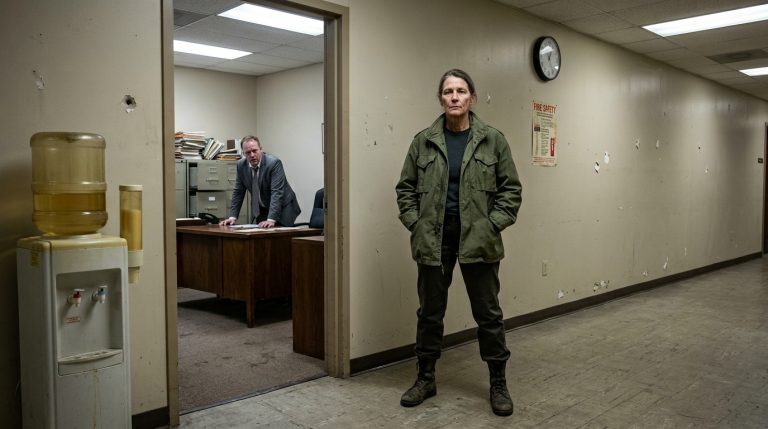
The Echo of the Ridge: Riley Monroe and the Fractured Silence of FOB Raven Rock
CHAPTER 1: THE WEIGHT OF RECOGNITION
Riley stared at the red ink on her terminal screen. It was a digital annotation, bold and jagged, marking a movement corridor in the northern valley. It was a route she had explicitly marked as high-risk, a death trap for any squad foolish enough to traverse it. Whoever had overwritten her assessment hadn’t just changed the data; they had deleted her original file and replaced it with a forgery so smooth it almost passed for her own.
Her hands, resting on the edge of the desk, didn’t shake. She practiced the same slow, controlled breathing she had used on the ridge. The air in the room felt heavy, the scent of stale coffee and ozone thick in her nostrils. To her left, Veronica Shaw was tapping away at a keyboard with aggressive efficiency, her jaw set in a line of permanent annoyance. Across the room, Brad Nolan leaned back, his chair creaking. He was tossing a rubber stress ball against the wall, catching it with a lazy, rhythmic thwack.
“Think they’re still out there?” Brad asked, not looking at anyone in particular. “The Rangers?”
Riley didn’t turn. Her eyes remained locked on the terminal. The forgery was a mistake—a clumsy, arrogant oversight by someone who assumed she was too quiet to notice the deviation. It wasn’t just an intel error. It was a signature.
“They’re moving back,” Riley said. Her voice was flat, devoid of emotion.
“They’re fine,” Veronica muttered, not looking up from her screen. “They have air support on the way now. Stop obsessing, Riley.”
“Air support was grounded by the storm,” Riley replied, her voice maintaining that same, dangerous calm. “If they’re moving, they’re doing it blind.”
“Colonel Dalton said it was a go,” Brad added, his voice dripping with his usual brand of forced confidence. “If the command says they’re fine, they’re fine. You’re not the one making the calls anymore, remember?”
Riley felt the familiar, sharp pressure in her chest—the ghost of a trigger pull, the phantom weight of a rifle she had left behind. She stood up, her movements fluid and deliberate. She didn’t look at Brad. She walked toward the storage bay, her footsteps making no sound on the thin industrial carpet.
She reached the door to the secondary comms center, a restricted area where the logistics logs were stored. She placed her hand on the keypad. It was locked, as it always was, but as she moved to enter her credentials, she noticed something that made her pulse pause. The light on the panel wasn’t the usual amber. It was a flicker of rapid, uneven blue.
Someone had forced the cache.
She pressed her thumb against the glass, and the door clicked open. Inside, the shelves were packed with physical files—paper backups of every supply request authorized in the last forty-eight hours. She began to sort through them with the precision of a surgeon. She wasn’t looking for combat data anymore. She was looking for the logistics thread, the specific equipment requests that had preceded the ambush.
She pulled a folder labeled ‘Tactical Resupply: Sector 4’. The pages inside were crisp, brand new. She flipped to the back, to the signature page. Her breath hitched. The signature at the bottom wasn’t Captain Ridge’s. It was a forgery, a crude imitation that would fool an automated system, but not someone who had spent six years living in the fine print of military bureaucracy.
Behind her, the heavy door groaned. A shadow stretched across the floor, long and distorted by the harsh, overhead fluorescent lights.
“Contractors aren’t supposed to be in here, Monroe.”
Riley didn’t jump. She didn’t drop the file. She turned slowly, her eyes meeting the sharp, assessing gaze of Colonel Avery Dalton. He stood in the doorway, his silhouette cutting a hard, unforgiving line against the bright light of the corridor.
“I found an error in the supply manifests, Colonel,” she said, her voice steady.
Dalton stepped into the room, closing the door behind him with a soft, final click. The space between them felt like a vacuum. “Errors are for the logistics department to handle,” he said, his voice dropping to a low, gravelly tone. “You’re an intel analyst. Or have you forgotten what your contract actually says?”
Riley looked at the folder, then back at him. She saw the flick of his eyes to her hand, and for the first time in six years, she felt the dangerous, cold exhilaration of being hunted—and the terrifying realization that the mystery she had just uncovered was much larger than a single, failed ambush.
“I haven’t forgotten,” she said, and the silence that followed felt like the moment just before the wind changes, just before the storm breaks.
CHAPTER 2: THE UNWELCOME INVITATION
Colonel Dalton did not reach for his sidearm, nor did he raise his voice. He simply watched her, his presence occupying the small, airless space of the cache room like a physical weight. The fluorescent hum overhead flickered, casting rhythmic, sharp shadows across the stacked boxes of forged manifests. Riley kept her breathing slow, matching the rhythm of the light—in, out, steady. Her hands remained relaxed at her sides, though every muscle in her frame was coiled, calculating the distance to the door and the exact speed of Dalton’s reaction time.
“My contract says I analyze incoming intelligence,” Riley said, her voice a flat, unyielding blade of sound. She held the folder against her side. The paper felt cool and slightly brittle under her fingertips. “It doesn’t say I ignore discrepancies that threaten the safety of the base.”
Dalton took a single step closer. He was a man who moved with the economy of a seasoned commander; he didn’t waste motion. His uniform was immaculate, the creases in his slacks sharp enough to cut, a stark contrast to the faded, utilitarian gear Riley wore. “You’re reading into things, Monroe. That’s the problem with people like you. You have a habit of finding patterns in static.”
“Patterns are how you win a fight, Colonel,” she countered.
He smiled, but it didn’t reach his eyes. His gaze remained fixed on her jawline, searching for that phantom scar, looking for the ghost of the Staff Sergeant he had buried under years of paperwork. “You aren’t in the field. You aren’t clearing ridges or calling in fire missions. You are here to process data, not to audit the logistics of the procurement office. Put the file back.”
The command was soft, but it carried the absolute weight of his rank. Riley felt the shift in the air—the way the room seemed to shrink. He wasn’t just dismissing her; he was signaling that she had crossed an invisible line that he had drawn around the entire operation. She looked down at the forged signature on the document. It was a sloppy piece of work, a reckless act by someone who felt untouchable.
She slid the folder back onto the shelf, her movements precise. She didn’t offer a concession; she offered a tactical retreat. “The data is already processed, Colonel. If the discrepancies don’t matter to you, they won’t matter to the system.”
“See that they don’t,” Dalton said. He didn’t move out of the doorway. He let her pass, his eyes following her like a predator watching a piece of prey that he wasn’t quite ready to kill yet.
Riley moved past him, her shoulders square. As she exited the cache, the contrast of the hallway’s dim, amber lighting hit her. The air smelled of ozone and damp concrete. Her heart rate remained unchanged—a steady, rhythmic thump—but her mind was already dismantling the encounter. Dalton hadn’t been angry. He had been concerned. Not for the safety of the base, but for the containment of the secret. He was guarding the leak.
She walked toward the main intel office, her boots clicking softly on the floor. She needed to reach her desk, to see if the digital forgery was still active or if Dalton had already triggered a remote wipe of her terminal.
The main office was still buzzing with the low-grade friction of the day. Veronica was hunched over a spread of maps, her brow furrowed, while Brad was leaning against a terminal, his face illuminated by the harsh blue glare of a radar feed. They were oblivious to the storm brewing behind them, a world of spreadsheets and bureaucratic minutiae that shielded them from the jagged, dangerous truth of the valley.
Riley sat at her desk. She placed her hands on the keyboard, letting her fingers hover. She didn’t log in immediately. She waited, watching the peripheral movement of the room. She noticed, in the corner of her eye, that Brad’s terminal was displaying a series of logistical throughputs—the very same sector data she had been investigating. He wasn’t just working on it; he was actively feeding data into the same system that had produced the forgery.
He was the conduit.
A sudden, sharp nausea rose in her throat—not from fear, but from the realization of how deeply the rot had set in. She had wanted to be invisible. She had carved out a life of gray, of quiet, of silence. But the silence had become a cover for the very people who had cast her out. She reached out, her fingers dancing across the keys, and initiated a stealthy, background bypass of her own terminal’s security. She didn’t want to change the data; she wanted to map the flow. She wanted to see where the forged manifests were going.
As the lines of code scrolled across the dark screen, Riley realized that her attempt to retreat had only pushed her further into the center of the crosshairs. She was no longer just an observer. She was a liability. And in this place, liabilities didn’t stay on the payroll for long.
The office door opened again. This time, it wasn’t the heavy, deliberate tread of the Colonel. It was the frantic, uneven footsteps of a junior logistics officer, holding a tablet that was flashing an urgent red alert.
“Colonel Dalton is calling for an immediate lockdown of the secondary logs,” the officer announced, his voice straining with panic. “Someone has accessed the files. We need a full audit of all contractor logins.”
Riley didn’t move. She kept her gaze on her screen, watching the path of the forged data as it hit a server in a remote, encrypted sector. Her own name was listed as the last user to access the file. She had been framed.
She felt the weight of the room’s sudden, sharp attention shifting toward her. Veronica looked up from her maps, her eyes narrowing. Brad stopped mid-toss, the stress ball frozen in his hand. The silence was absolute, a fragile, snapping thread that was about to break under the pressure of the accusation. Riley took a long, slow breath, steadying herself for the coming fire. The game of invisibility was over. It was time to start playing for keeps.
CHAPTER 3: THE FRACTURED ROUTINE
The lockdown alarm didn’t wail; it pulsed—a deep, rhythmic thrum that vibrated through the soles of Riley’s boots. The overhead lights flickered into a harsh, clinical crimson, drenching the intel office in the color of a fresh wound.
“Everyone, stay put,” Brad shouted, though his voice lacked conviction. He stood frozen, his hands hovering over his keyboard as if he were afraid the plastic might burn him. “It’s a security protocol! Nobody move!”
Riley didn’t look at him. Her peripheral vision was entirely occupied by the junior officer in the doorway. He was still gripping the tablet, his knuckles white, his eyes darting toward the security camera mounted in the corner of the ceiling. That camera wasn’t just recording; it was being fed a direct, encrypted loop. She knew that because she could see the slight, almost imperceptible jitter in the video feed on the junior officer’s screen.
She turned back to her terminal, her hands moving with a fluid, unnatural grace that belied the tension in the room. She wasn’t just trying to clear her name; she was trying to scrub the digital trail she had created while bypassing the terminal’s security. If they did a deep-dive forensic audit, they wouldn’t just find her login; they would find the footprint of a sniper’s discipline.
“Monroe, step away from the desk,” Veronica commanded, her voice sharp, stripped of its usual dismissive boredom. She had stood up, her hand instinctively resting near the emergency override switch. “We don’t know what you’ve done, but you’re not touching anything else.”
Riley ignored her. She felt the ghost of a different room—a cramped, sand-filled bunker in Helmand, the smell of burning oil, the sound of an impending overrun. It was the same pressure, the same narrowing of the world into a series of tactical probabilities. She knew that if she stopped now, she would be detained, escorted to a holding cell, and quietly erased before dawn.
“The lockdown isn’t about me,” Riley said, her voice cutting through the panic like a scalpel through silk. “Look at the routing. The alert originated from the logistics cache, not the command center. Dalton isn’t securing the base. He’s securing the evidence.”
Brad laughed, a jagged, nervous sound. “You’re delusional. The Colonel is the one giving the orders! You’re the one who was caught in a restricted zone!”
Riley didn’t argue. She leaned forward, her screen reflecting in the cold depths of her eyes. She initiated a final, rapid-fire sequence, redirecting the flagged data into a dummy folder, hiding it behind a layer of innocuous, everyday traffic. It was a classic misdirection, a tactic she had used a hundred times on the ridge to draw the enemy’s attention away from her true position.
As the progress bar hit ninety-nine percent, the office door hissed open. Colonel Dalton stepped through, his presence immediately flattening the frantic energy of the room. He was flanked by two armed guards, their rifles held at a low, ready carry. The air grew heavy, smelling of floor wax and the metallic tang of the weapons.
“Staff Sergeant,” Dalton said, his voice quiet, almost mournful. He walked toward her desk, his boots making a sharp, singular sound on the linoleum. “I told you to let the logistics department handle the errors. I see you chose to ignore that.”
“I see a lot of things, Colonel,” Riley said, standing up. She didn’t retreat. She didn’t lower her gaze. She felt the phantom weight of the sniper rifle on her shoulder, the balance of it, the cold, comforting solidity. “I see that the forged manifests aren’t just errors. They’re a lifeline. And I see that you’re terrified of what happens when that lifeline is severed.”
The guards tensed, shifting their weight. Dalton stopped three feet from her. He looked at her not with anger, but with a weary, profound disappointment. “You were always too sharp for your own good, Riley. That’s why you didn’t last the first time. You couldn’t just sit behind the scope and watch. You had to go out and try to fix the landscape.”
“And you were always the one who wanted the landscape to stay exactly the way it was, no matter who had to be buried in it,” she replied.
Dalton turned to the guards. “Secure the terminal. And take her to the holding bay. We’ll need a full debrief on what she’s accessed.”
“Wait,” Brad chimed in, stepping forward. “What about the data? If she’s already corrupted the logs…”
Dalton held up a hand, silencing him. He looked at Riley, his eyes searching hers for a flicker of compliance, a crack in the armor. He wanted her to surrender. He wanted her to be the broken, quiet woman who had spent years hiding in the corners of the base.
Riley felt the shift—the moment where the physical reality of the room caught up to the mental calculus of the standoff. She didn’t look at the guards. She looked at the vent in the ceiling, the narrow access corridor she had memorized during her first week at Raven Rock. It was a weak point, a flaw in the building’s design that she had kept in the back of her mind as a final, desperate contingency.
“I’m not going to the holding bay, Colonel,” she said.
As the guards stepped forward, Riley didn’t strike out. She shifted her weight, a subtle, balanced movement, and kicked the base of her desk. The heavy, industrial-grade metal tipped, slamming into the terminal bank with a deafening crash of sparking glass and torn wiring. The room erupted in sparks and blinding white smoke.
In the sudden, chaotic void, Riley didn’t hesitate. She dove toward the floor, using the cover of the smoke and the chaos of the toppled hardware to reach the far wall. She wasn’t fighting them; she was navigating them. She was a ghost returning to the frame, moving with the cold, silent efficiency of a predator who had finally realized the cage door was open.
As the guards shouted and the red emergency lights pulsed, Riley felt the thrill—sharp, dangerous, and absolute—of the hunt. She reached the wall, her fingers finding the hidden latch she had spotted months ago. The panel clicked open, revealing the dark, cramped crawlspace.
She slipped inside just as a rifle barrel slammed into the space where her head had been a second before. She didn’t look back. She crawled into the darkness, the grit and dust of the base pressing against her, her senses suddenly, violently alert. She was no longer a contractor. She was a variable. And she was going to prove that even in the most controlled environment, there was always a way to disrupt the pattern.
CHAPTER 4: LESSONS IN RESILIENCE
The crawlspace was a tomb of forgotten infrastructure—a labyrinth of thick, insulated piping, bundled electrical cables, and a thick, choking coat of pulverized dust that tasted of copper and age. Riley pressed herself into the narrow gap between a main ventilation duct and a structural beam, her breathing a shallow, silent rhythm. Above her, the floor groaned. Heavy, combat-booted strides moved across the ceiling, the vibrations traveling down through the metal struts and into her own spine.
“She went in there! I saw the panel move!”
The voice was muffled, strained by the architecture of the building. It was one of the guards, his tone laced with the sharp, jagged edge of panic. They were right on top of her. Riley didn’t flinch. She kept her eyes closed, listening to the cadence of their movement. They weren’t moving with tactical discipline; they were moving with the frantic, uncoordinated energy of men who had been caught off guard by a ghost.
She reached out, her fingers brushing against the cold, grit-covered surface of the floor. As she shifted to get a better vantage point, her hand struck something hard and metallic tucked between two support beams. She froze, her breath hitching, and carefully pulled the object into the dim light filtering from a distant vent.
It was a ring of keys—small, nondescript, and oxidized with age. They weren’t government-issue. The tags attached were stamped with a logo she hadn’t seen in years: a stylized, interlocking compass and gear. It was the mark of the private logistics firm that had been liquidated during her last deployment—the very company that had supposedly ceased existing the day she was pushed out of the Army.
A cold, analytical clarity washed over her. The sabotage in the intel room hadn’t just been an attempt to hide a minor logistics error; it was a continuation of a purge. Someone was still cleaning up the remains of the old supply chain, and they were using the base’s infrastructure to do it.
She tucked the keys into the small zip-pocket of her combat trousers, her movements economical and silent. The guards above her halted. The silence that followed was heavy, pressurized—the kind of silence that usually preceded a grenade or a flashbang.
“Nothing here but pipes,” the second guard grumbled, his voice echoing in the confined space. “She must have popped out the other side. Check the maintenance corridor.”
“The Colonel wants her caught, not chased,” the first guard barked. “Lock down the external exits. If she’s still inside this building, she’s not leaving until we clear every room.”
The sound of their footsteps receded, the rhythm dying away into the distant, ambient thrum of the base’s ventilation system. Riley waited for a full minute, counting the seconds with the steady, metronomic internal clock she had used for years. Only when the silence became absolute did she begin to move.
She crawled forward, her elbows and knees working in unison to keep her weight distributed on the support beams. She needed to reach the secondary storage bay, a location she had studied on the maps for its proximity to the comms sub-level. If she could reach a terminal there, she could pull the audit logs—not the forged ones, but the raw, unfiltered packet data that even Dalton’s cronies might have overlooked.
As she moved, she felt the familiar ache in her muscles, the protest of her body against the cramped, unnatural position. It was a reminder of time, of the years she had spent sitting behind a desk, of the atrophy of the life she had traded for safety. She felt the phantom phantom weight of her rifle, the desire to reach behind her and feel the familiar wood and steel. But there was no rifle. There was only the darkness, the grit, and the cold, hard knowledge of what she had to do.
She reached a junction where the crawlspace branched into a narrow shaft leading toward the comms sub-level. Looking through the ventilation grate, she could see the glowing monitor of a workstation. It was unattended. The screen showed a diagnostic interface, a cascading waterfall of green text that represented the base’s heartbeat.
Riley pushed the grate, the screws already loose—an indication that someone had been here before, someone who had needed to bypass the internal security sensors. She didn’t question the luck. In her world, luck was just a name for a tactical advantage you hadn’t anticipated.
She dropped into the room with the silence of a falling shadow. She moved to the terminal, her fingers flying across the keys. She wasn’t just pulling data; she was creating a ghost—a digital mirage that would suggest she had fled toward the motor pool while she went the opposite direction.
As she worked, the screen flashed. An incoming file, an automated transfer. She clicked, and a map opened—not of the base, but of the northern valley, marked with a series of coordinates that didn’t appear on any official mission brief. They were supply drop points, hidden in the heart of the terrain where the Rangers had been ambushed.
The decoy hadn’t just been a forgery; it was a map to the next phase of the corruption. She stood frozen, the green light of the screen painting her face in sickly, pale hues. The ambush hadn’t been an accident. It had been a test. A trial run to see if the logistics chain could support a sustained, black-budget operation without triggering a full-scale military inquiry.
And she was the one who had finally decoded the sequence.
A door at the end of the hall clicked. The sound was distinct, mechanical. Someone was coming. Riley didn’t hesitate. She hit ‘save’ on the packet data, ripped the memory drive from the port, and vanished back into the shadows of the utility closet just as the door swept open.
She watched, her breath a silent, controlled ghost, as a figure stepped into the light. It wasn’t a guard. It was Specialist Dana Brooks. The young medic was alone, her face pale, her eyes darting around the room as if she were looking for someone she knew she shouldn’t be talking to. She looked small, frightened, and utterly out of place in the sterile, high-tech environment.
Riley felt a sudden, sharp ache in her chest. The girl wasn’t supposed to be here. She was supposed to be in the infirmary, recovering. But as she watched Dana walk toward the terminal Riley had just left, a realization dawned on her: Dana wasn’t here to report the security breach. She was here to retrieve something.
Riley held her breath, the memory of the ridge and the shot she had taken to save this girl flashing through her mind like a stuttering film. She had saved Dana once. But if Dana was part of this—if the girl she had protected was actually a piece of the architecture she was fighting—then the cost of the truth had just doubled.
CHAPTER 5: THE SHADOW OF THE SABOTAGE
Riley pressed her forehead against the cool, corrugated metal of the storage shelf, her heartbeat a steady, muffled thud that seemed to vibrate through the entire closet. Outside, the movement was deliberate. Dana Brooks wasn’t just walking; she was checking the perimeter of the room with the practiced, hesitant caution of someone who knew they were in a place they didn’t belong.
Every instinct Riley had sharpened—the same internal radar she used to track a target through a high-altitude scope. She watched through a sliver in the closet door. Dana reached the terminal, her fingers trembling as she inserted a small, black-cased drive into the port. The light on the drive pulsed a soft, rhythmic amber. She was bypassing the system, moving through the directories with a clumsy but effective sequence of commands that were clearly not her own.
Riley’s mind worked in the background, mapping the possibilities. If Dana was the one carrying the data, it didn’t necessarily mean she was the architect. She was a medic, a healer, someone trained to pull life back from the brink. The contrast between that role and the cold, mechanical act of sabotaging the base’s logistics was a dissonance Riley couldn’t reconcile. It felt like watching a mirror shatter—the reflection of the girl she had saved was now being distorted by the very corruption that had nearly killed them both.
The terminal chimed. A file transfer complete notification. Dana snatched the drive, her movements quick, almost desperate. She stood there for a second, her shoulders hunched as if she were bracing for a blow. She looked toward the closet door, her eyes wide, glassy with unshed tears. Riley held her breath, her hand resting on the smooth, cold surface of the keys she had found in the crawlspace.
Dana sighed—a ragged, broken sound—and turned toward the exit. She was almost at the door when she stopped again, leaning her forehead against the cool metal of the frame, her body shaking with a suppressed sob.
“I’m sorry,” she whispered, the words barely audible in the hum of the sub-level.
The weight of the apology hung in the air, a physical burden. Riley felt the phantom chill of the ridge again, the cold air, the distant gunfire, the raw fear in Dana’s voice over the radio. She had saved this girl’s life because she had seen a part of herself in that medic—a kernel of resilience that refused to break. Now, that same kernel was compromised.
As Dana slipped out of the room, the mechanical click of the lock signaling her departure, Riley pushed the closet door open and stepped into the light. The room was empty, save for the hum of the cooling systems. She approached the terminal. The screen was still active, a faint, lingering cache of the last command Dana had executed. It wasn’t just a download; it was a routing order.
The manifest was headed to the northern ridge—the same coordinates Riley had identified on the map earlier. It wasn’t just logistics; it was a supply drop. Weapons, ammunition, and encrypted comms gear, all being funneled to the same hostile elements that had pinned them down in the valley.
Riley’s fingers hovered over the keyboard. She didn’t have the clearance to trace the source, but she had the expertise to leave a breadcrumb. She quickly initiated a ping on the transfer, tagging the data with a high-priority interrupt that would flag the activity if anyone else tried to move it. It was a risk, a blatant violation of the base’s security protocol, but it was the only way to track the corruption back to its root.
She stood back, the fluorescent light casting deep shadows beneath her cheekbones. The reality of the situation was settling into her bones, cold and heavy. This wasn’t just about Dalton. The Colonel was a gatekeeper, a man protecting the status quo, but he was merely the outer shell. The real operation—the one that was currently feeding weapons into the valley—was being managed by someone who had access to the highest levels of the base’s internal network.
She walked toward the vent she had exited earlier, her steps soundless. She had to move. The security teams would be scouring the hallways, and every minute she spent in the sub-level increased the probability of an encounter. But as she paused at the edge of the dark, metallic tunnel, she looked back at the room one last time.
She had been trying to hide, to remain a ghost in the periphery of a life she no longer belonged to. But ghosts didn’t leave tracks. Ghosts didn’t fight back. She had been treating her life like a series of closed-off compartments, a tactical retreat into the quiet. But the rot was too deep for compartments.
She crawled back into the darkness, the grit and dust once again coating her clothes. Her path was no longer a retreat. She was moving toward the center of the storm, toward the source of the rot. Every piece of equipment, every supply drop, every life lost in that valley had been a calculated investment for the people she was now hunting.
The weight of the keys in her pocket felt like an anchor, grounding her in a reality that refused to be ignored. She climbed upward, toward the upper levels of the base, toward the command center where the decisions were made, and where the final, ugly truth was hidden. She wasn’t just a contractor anymore. She was a sniper without a rifle, an intelligence analyst without an agency, and a woman who had spent six years waiting for a reason to stop running.
The silence that had protected her for so long had been shattered, and in its place was the cold, hard, and unforgiving necessity of the truth. She was ready to take the shot, no matter who stood in the way.
CHAPTER 6: DECOY AT THE COMM CENTER
The transition from the crawlspace to the comm center’s main sub-floor was a study in controlled aggression. Riley pushed the ceiling grate just enough to slide through, her body folding into the narrow gap between a heavy server rack and the wall. The air here was thin, chilled to near-freezing by the aggressive climate control systems that kept the massive processing banks from overheating. The scent was purely artificial—ozone, ionized dust, and the faint, bitter metallic tang of high-voltage wiring.
She dropped to the floor, landing in a crouch. Her shadow stretched long and distorted against the wall of blinking status lights. This was the base’s nervous system, a place where the hum of data was a physical presence, a constant vibration that settled into her bones. She needed to get to the main communications hub, but the floor was a wide-open expanse of polished, light-reflecting linoleum. Any movement would be caught by the sweeping infrared sensors that pulsed every ten seconds.
She waited for the ten-second cycle, her eyes tracking the rhythmic scan of the red laser light. Three, two, one. As the light swept past, she moved. She didn’t run; she glided, her weight shifted onto the balls of her feet, her body low. She reached the first pillar, pressing herself against its cold, smooth surface. She could hear the voices of the night-shift operators from the main desk, their conversation a dull, indistinct murmur about upcoming rotation schedules and the quality of the base coffee.
They were comfortable. They were complacent. They had no idea that the very network they were babysitting was currently being used to bleed the base dry.
Riley reached into her pocket and retrieved the memory drive she had salvaged. She needed to cross the remaining thirty feet to the hub’s secondary terminal. She looked at her watch—a tactical piece of equipment that had seen more rough ground than a base commander. She had four minutes until the next system-wide diagnostic check. If she was caught in the hub during that check, the system would trigger an automated lockdown, and the security doors would turn this center into a sealed vault.
She moved again, hugging the shadows between the massive server stacks. Every step was a calculation. Every flicker of a status light was a potential threat. As she neared the hub, she saw something that made her pulse pause. The terminal was already logged in. Someone had left a remote session active, a direct link to an external satellite uplink.
She reached the console and checked the credentials. They were her own.
It was a trap.
The realization hit her with the cold, sharp clarity of an ice bath. They hadn’t just secured the building; they had baited the network, knowing she would come looking for the source of the data breach. The active session wasn’t a mistake; it was a beacon, a way for them to trace her precise location the moment she touched the keys.
She backed away, but it was too late. The hum of the room seemed to rise in pitch. A red warning light blossomed on the wall above the desk, then another, until the entire sub-floor was bathed in the harsh, glaring light of an emergency.
“System integrity alert. Unauthorized access detected,” the automated voice stated, its tone calm and terrifyingly hollow.
She turned to flee, but the sliding security doors at the end of the aisle began to close, their movement smooth and relentless. She had seconds. She looked at the terminal. She could still pull the data—she could rip the transmission right out of the uplink, but doing so would lock her signature to the log, confirming her presence and ending any chance of maintaining the fiction that she was a rogue ghost.
She didn’t hesitate. She grabbed the terminal, her fingers flying across the keys in a sequence she had practiced in her mind a thousand times. She bypassed the trace, rerouted the signal into a recursive loop, and initiated a system-wide hardware crash. If she couldn’t take the data, she would burn the network.
The screens in the hub flared, then went black. The servers began to whine, a high-pitched, dying groan as the processors were forced into an irrecoverable state of failure. The power to the entire sub-floor died, plunging the room into a deep, suffocating darkness.
She turned and sprinted for the only exit that hadn’t fully sealed—a narrow ventilation hatch she had spotted on her way in. She threw her body at it, the metal biting into her skin, and scrambled through just as the emergency blast doors slammed shut behind her, sealing the room in a heavy, echoing thud.
She tumbled into the narrow, dark shaft of the return vent, her lungs burning, the darkness around her absolute. She didn’t stop. She dragged herself upward, the metal grating scraping her elbows and knees, the scent of dust and ancient, trapped air filling her nose. She had burned the hub. She had cut the link. But she had also signaled her position to everyone on base.
She reached a junction and paused, listening. In the distance, she could hear the heavy, measured cadence of a rapid-response team, their voices sharp and angry, moving toward the comm center. She was no longer a ghost. She was the primary threat.
She gripped the keys in her pocket, the jagged edges pressing into her palm. She had the map, she had the data, and now, she had the attention of every person on this base. She adjusted her grip and began to crawl again, her movements driven by a cold, hardened resolve. The hunt had entered its final, most dangerous phase. She was no longer trying to hide from the rot. She was going to tear it out, one layer at a time, until the truth was standing in the open, exposed and defenseless.
CHAPTER 7: THE UNSEEN WITNESS
Riley froze. The ventilation shaft she was navigating, a rusted artery of the base’s infrastructure, had suddenly gone pitch-black. The hum of the cooling fans, which had provided a consistent, droning white noise to mask her movement, cut out with a sharp, sickening mechanical groan. Below her, the base was shifting. She felt the heavy, vibrating thud of hydraulic pressure doors slamming shut in sequence, a rhythmic cadence of confinement that echoed through the ductwork.
“Secure the perimeter! Check every access port!” The voice came from directly beneath her, filtered through the grating. It was the same guard from the cache room, his tone now brittle with the urgency of a hunt.
Riley pressed herself into the corner of the junction, the sharp edges of the rusted sheet metal digging into her palms. She was trapped. The power failure had triggered an automated security reset that had locked the venting grid she had been targeting. She had no exit, and the rapid-response team was effectively deconstructing the sector floor-by-floor.
She took a slow, deliberate breath, the air tasting of stale iron and thick, accumulated dust. Panic was a luxury she couldn’t afford; it was a noise that betrayed your position. She pulled the salvaged memory drive from her vest pocket, the cold plastic a grounding presence against her chest. She had the data, but it was useless if she couldn’t reach a terminal outside of the lockdown zone.
Suddenly, a light flickered at the far end of the shaft—a beam from a high-intensity tactical torch. They weren’t just searching the hallways; they were scanning the infrastructure.
Riley shifted, her movements microscopic. She had to move, but any sound would be magnified by the hollow, metallic architecture of the vent. She reached for the support struts, pulling herself toward a secondary junction that led into the old mechanical room—a relic of the base’s original construction that hadn’t been integrated into the new, digital security grid.
She reached the junction just as the beam of the flashlight swept across the spot she had been occupying seconds earlier. The light caught the swirling dust motes, illuminating the empty space.
“She was here. I can smell the dust,” the guard muttered.
Riley didn’t wait to see if they were right. She squeezed into the narrow gap, the metal protesting with a low, agonizing creak. She held her breath, her heart a steady, thumping cadence against the floor. She waited until the guard moved past, the heat from his flashlight warming the air near the grate. As the beam faded, she crawled forward, sliding down into the dark, abandoned space of the mechanical room.
It was a cavern of massive, dormant machines—rusting furnaces, tangled webs of pipes, and the thick, suffocating smell of oil and time. It was a space that felt disconnected from the high-tech precision of the rest of the base. Here, the hum of the network was replaced by the oppressive, heavy silence of long-term decay.
She stood up, her joints aching from the climb. She needed a way to transmit the data. If she could reach the old analog radio set that she knew was kept in the maintenance locker—a relic for emergency overrides—she might be able to bounce the signal to a high-orbit relay. It was a long shot, a desperate, fading hope, but it was the only move left.
As she navigated the labyrinth of pipes, she stopped. Someone was already in the room.
The light of a handheld lantern illuminated a figure standing by the locker. It was Captain Mason Ridge. He wasn’t in uniform. He was dressed in civilian fatigues, his sidearm holstered, his posture hunched with a weariness that looked like it had been carved into his bones over the course of years. He was holding the analog radio, his fingers moving with a familiar, mechanical precision as he checked the frequencies.
Riley’s presence was a phantom, but Ridge turned, his gaze locking onto her position with the instincts of a man who had spent his life reading the shadows. He didn’t reach for his sidearm. He simply stood there, the lantern light flickering over his face, revealing a grim, tired determination.
“You shouldn’t be here, Riley,” he said, his voice low, lacking the authority of a captain and the aggression of a soldier. It was the voice of a man who was already holding the weight of the coming collapse.
“And you shouldn’t be holding a radio that’s been decommissioned since the base was upgraded,” Riley replied, stepping into the light. She kept her hands in plain sight, though her weight remained balanced, ready for any sudden shift in his demeanor.
“I was waiting for you,” Ridge said, gesturing to the empty locker. “I knew they’d bait the hub. I knew you’d go there.”
“Why?”
Ridge looked at the radio, then back at her. “Because you’re the only person on this base who still knows how to look past the signal. And because I’m the only one who knows exactly why they had to get rid of you six years ago.”
The air in the room seemed to freeze. Riley felt the shift—the moment the foundation of her understanding began to crack. He wasn’t part of the corruption. He was the one who had been documenting it, the one who had been waiting for the exact moment the system would buckle under the weight of its own greed.
“They didn’t just push you out because of the supply chain, Riley,” Ridge said, his voice barely a whisper in the vast, echoing room. “They pushed you out because you were the only one who had the shot to end this before it even started.”
The truth was heavier than the metal of the pipes, colder than the air in the room. She wasn’t just a witness to a crime; she was the only reason the crime had been forced to take such a convoluted, dangerous route to completion. She wasn’t an obstacle. She was the architect of their initial hesitation.
“What do we do now?” Riley asked, her voice steady, the resolve in her chest sharpening into a single, lethal point.
“We don’t transmit,” Ridge said, his eyes reflecting the pale, flickering light. “We expose them, directly into the grid, the moment the emergency lockdown lifts. We don’t need a relay. We need the Colonel to try to wipe the file in front of the entire command staff.”
Riley looked at the radio, the weapon of her new fight. The escalation was complete. There was no going back, no retreat, no safety to be found in the quiet anymore. She had the truth, and now, she had a partner who knew exactly how high the stakes had always been.
CHAPTER 8: THE PRICE OF TRUTH
Riley gripped the analog radio, its weight surprising—dense, solid, and built for a world where communication required intent rather than invisible, automated signals. Ridge watched her, his expression a map of years of hard-won experience. He didn’t offer a manual or a quick fix; he offered the heavy, dangerous reality of a choice.
“If we broadcast from here,” Riley said, her voice barely a whisper in the cavernous, oil-scented room, “the signal won’t just hit the relay. It will pinpoint this room as the origin. Dalton’s teams will be here in minutes.”
“I know,” Ridge replied. He leaned against a massive, dormant furnace, his eyes scanning the shadows of the room. “But it’s the only way to bypass the network filters. They’ve locked out the standard comm-channels, but the emergency frequency is hardwired into the base’s primary antenna. It’s the one thing Dalton couldn’t disable without shutting down the entire facility.”
Riley felt the weight of the moment. She had spent six years running from exactly this scenario—the forced transparency, the sudden spotlight, the unavoidable clash with the machinery of a system that chewed up anyone who dared to look too closely at the gears. She looked at the radio, then at Ridge. He wasn’t the man she had seen during the ambush; he was someone who had been living in the margins, collecting fragments of a puzzle no one else wanted to solve.
“Why are you doing this, Mason?” she asked, using his first name for the first time. “You have a career. You have a command.”
“I have a conscience,” he answered, his voice devoid of pretense. “And I have the names of the twenty-two men who died in that valley because their support was redirected to someone else’s shadow war. I didn’t come to this base to be a career officer. I came to figure out why the supplies stopped moving where they were supposed to.”
He reached out and flipped the switch on the radio. The device hissed to life, a burst of static that felt like a living thing, wild and uncontained in the sterile, quiet room. He dialed the frequency, his fingers precise.
“We wait for the lockdown to hit the thirty-minute mark,” Ridge said. “That’s when the automated diagnostic resets the security grid. For three seconds, the internal alarms go mute. That’s our window.”
Riley nodded, her eyes tracking the movement of a dust motes dancing in the dim light of the lantern. She felt the old, familiar tension return—the sniper’s calm, the ability to stretch a single heartbeat into an eternity. She was no longer afraid of the consequences. The fear had been replaced by a singular, focused intent.
As they waited, the base seemed to hold its breath. The silence was broken only by the low, rhythmic ticking of the radio and the distant, muffled sounds of the security sweep in the upper levels. She could hear them—the sharp, clipped commands, the clatter of gear, the sound of doors being forced. They were getting closer.
She pulled the salvaged memory drive from her pocket, looking at it. It contained the proof—the routing orders, the manifests, the digital fingerprints of the people who had orchestrated the ambush. It was the weight of a dozen lives, the summation of a corruption that reached far beyond the boundaries of this base.
“You realize that once we transmit this, there’s no coming back,” she said.
“I never planned on coming back,” Ridge replied.
A sudden, jarring sound echoed through the room—the chime of the security grid shifting. The thirty-minute mark. Ridge’s hand snapped to the broadcast button. “Now!”
He keyed the mic, his voice steady, projecting the raw, unfiltered data packet through the analog transmitter. The radio screamed, a piercing, high-frequency tone that vibrated through the metal pipes and into the very air of the room. It was the sound of a secret being forcibly ripped out into the open.
The broadcast continued, a relentless stream of data that bypassed the encrypted filters and spilled into the base’s public-address system. In the hallways, in the barracks, in the TOC itself, the truth was suddenly being read aloud, a mechanical voice detailing the corruption, the names, and the coordinates.
Then, the doors of the mechanical room slammed open.
The light of a dozen flashlights blinded the room, and the heavy, metallic clatter of rifles being brought to bear echoed against the rusted walls. Riley didn’t turn to face them. She kept her eyes on the radio, waiting for the confirmation light to pulse green, signaling the transmission had been successfully received by the regional command relay.
The light pulsed. Success.
She stood slowly, turning to see Colonel Dalton standing in the threshold, his face a mask of cold, controlled fury. Behind him, the security teams were already moving in, their weapons locked onto her and Ridge. Dalton didn’t speak. He just looked at the radio, the silence of the room now filled with the echo of the broadcast still playing over the base’s speakers.
“You’ve ruined everything, Riley,” Dalton said, his voice quiet, almost soft. “You have no idea what you’ve just done. You haven’t just exposed a manifest. You’ve compromised a regional stability operation.”
“I exposed a murder,” Riley said, her voice steady, cold, and final.
Dalton looked at her for a long, agonizing second, his eyes searching her face. He was waiting for her to break, to show the fear that he had banked on for six years. But she didn’t. She looked back at him with the calm of a person who had already accepted the cost of the shot.
The security teams didn’t fire. They didn’t move. They just stood there, caught in the wake of the truth that was still pouring from the speakers. The base was waking up, the silence of the last six years finally, violently, coming to an end. Riley let her hands drop to her sides, her posture relaxed, her gaze unblinking. The hunt was over, but the reckoning had only just begun.
CHAPTER 9: THE PRICE OF TRUTH
The room held a vacuum of sound. The broadcast had ended, but the silence that replaced it was heavier—the suffocating weight of a secret forcibly dragged into the light. Colonel Dalton stood motionless, his shadow stretching long across the floor, bisected by the harsh, flickering fluorescent light. The security team remained rigid, their rifles held at the ready, but there was a palpable hesitation in their posture. They weren’t soldiers following an order anymore; they were men listening to the echoes of their own complicity.
Riley didn’t move. She kept her hands open, her gaze locked on Dalton’s. She knew the mechanics of this moment. The transition from silence to chaos was a matter of inches, a calculation of risk versus reality. She could see the internal struggle flickering in Dalton’s eyes—the urge to silence them versus the impossible reality of the broadcast already reaching the regional command relay.
“It’s done, Colonel,” Ridge said, his voice quiet and devoid of triumph. “The regional command has the file. The investigation is already initiated.”
Dalton’s face hardened. He didn’t look at Ridge. He looked at Riley. “You think you’ve won? You think you’ve just exposed a few corrupt supply orders? You have no idea what you’ve triggered. This logistics chain isn’t just about money, Riley. It’s the backbone of the entire regional strategy. By breaking it, you haven’t just exposed a crime—you’ve crippled the base’s ability to defend this sector.”
“If the defense of this sector requires the blood of twenty-two Rangers in a trap we set for them,” Riley said, her voice a cold, steady blade, “then the defense was already failed. You didn’t protect this base. You sold it, piece by piece, to keep your own ledger clean.”
Dalton took a step forward, his boot scuffing against the oil-stained concrete. “I did what was necessary for the mission. You, of all people, should understand the cost of a mission. You spent years behind a scope, taking shots that kept this world from falling apart. Do you think every one of those rounds was fired for a noble cause? Do you think the people who gave the orders were always saints?”
“They were soldiers,” Riley said. “And the men who died in that valley were soldiers. They weren’t ledger entries.”
The guards began to lower their weapons, the realization of the broadcast’s content finally piercing through the armor of their duty. Dalton saw it too. He looked at the room, at the ruined machines, at the scattered pipes, and finally, at the small, analog radio that had become the instrument of his downfall. He knew the narrative had shifted beyond his ability to control it.
“You’re going to be a hero, Riley,” Dalton said, his voice filled with a hollow, acidic contempt. “For about a week. Then, they’ll bury you under a mountain of nondisclosure agreements, pension reviews, and ‘security concerns.’ You think you’re walking out of here, but you’ve just signed your own exile.”
“I was exiled six years ago,” Riley replied.
The sound of an approaching siren—a high-pitched, melodic wail—rippled through the base. It wasn’t the lockdown alarm. It was the incoming signal of the regional command’s rapid-response airwing, arriving to secure the site. The game had shifted from internal containment to external investigation.
Dalton looked at the security team, his authority slipping through his fingers like sand. “Stand down,” he ordered, his voice flat. He turned his back on them, walking toward the shadows of the mechanical room’s exit. He didn’t look back. He was a man who had already accepted the fall, his posture rigid with the final, cold pride of someone who had gambled everything on a strategy that had ultimately failed.
The room began to flood with the light of the arriving airwing’s flares, a blinding, chaotic white that washed over the machinery. Ridge exhaled, his shoulders slumping as the adrenaline began to bleed out of his frame. He looked at Riley, a ghost of a smile touching his lips.
“You realize what happens now?” he asked.
“The denouement,” Riley replied, looking at the radio, at the rust, at the reality of the room. “The part where we have to live with what we’ve done.”
She reached out and took the memory drive from the radio, holding it in her palm. It was just a small piece of plastic, but it felt like the weight of the entire world. She felt the sudden, crushing silence of the base, the hum of the servers having finally died, leaving a void that was both terrifying and absolute.
As the airwing’s boots began to echo in the hallway, Riley felt a strange, quiet peace. She hadn’t gone back to the rifle. She hadn’t gone back to the scope. She had used the truth, a sharper, more dangerous weapon than anything she had ever carried in the field. And as the security teams burst into the room, she simply stood there, a woman who had finally, after six years, managed to step out from behind the screen and into the reality of her own life.
The truth was laid bare, the corruption exposed, and for the first time since the valley, the air felt breathable. She wasn’t just a survivor anymore; she was the one who had finally settled the debt.
CHAPTER 10: THE MENDED HORIZON
The arrival of the regional command was not the cinematic crash of force Riley might have expected; it was the clinical, systematic efficiency of an audit. Men in crisp, unblemished uniforms moved through the mechanical room, documenting the wreckage, securing the data, and stripping the hub of its corrupted hardware. Riley stood to the side, her back against a support beam, her posture drained of the tension that had held her together for the last forty-eight hours.
Colonel Dalton was escorted out in cuffs. He didn’t look back. He walked with his head held high, his expression that of a man who still believed his crimes were merely a necessary deviation from a failing mission. His surrender was total, a mechanical compliance to the chain of command he had once subverted.
Ridge stood beside Riley, his own status in limbo, his badge confiscated until the investigation concluded. They watched the process together, a silent pair of relics from a battle that had been fought in the dark.
“They’ll find it all,” Ridge said, gesturing to the team packing up the remnants of the operation. “The manifests, the offshore accounts, the shadow supply chain. They’ll trace it all back to the regional director’s office.”
“And then?” Riley asked.
“Then the cleanup begins,” he replied. “It’ll be quiet. It’ll be sanitized. But the men in that valley… they won’t be erased again.”
Riley felt a slow, heavy fatigue settle into her marrow. It was the exhaustion of a six-year race finally coming to a halt. She watched the technicians carefully extract the drive she had pulled from the hub. It was the proof, the absolute reality of what had been done. As they moved it into an evidence case, Riley realized that the truth no longer belonged to her. It was in the hands of the system now, a system she had never trusted, but one that was now forced to reckon with the debris she had provided.
The following days were a blur of sterile rooms, endless depositions, and the heavy, monotonous routine of the investigation. The base of Raven Rock felt different—emptier, colder, as if the shadow that had been cast over it by the corruption had finally lifted, revealing the stark, harsh reality of its isolation.
Specialist Dana Brooks came to see her on the last day, before Riley was scheduled to be processed out. Dana didn’t talk about the valley, or the sabotage, or the fear. She simply sat on the bench beside Riley near the perimeter wall, the same spot where they had sat after the rescue. She held a small, mended field-medkit—the one Riley had helped her organize months before.
“I’m staying,” Dana said, her voice quiet but firm. “I’m staying to finish the tour. For the ones who can’t.”
Riley looked at the kit, then at the girl. Dana was changed—the Kintsugi of the experience visible in the way she carried herself, a fragile, hard-won resilience that no longer needed the crutch of a secret to hold it together. Riley reached out, her fingers brushing the worn fabric of the kit, and helped Dana tighten a loose strap, her movements deliberate and precise. It was a small act, a minor repair, but it felt like the most significant thing she had done in years.
“Make sure you keep the inventory current,” Riley said, her voice soft. “Precision is the only thing that holds the line when the noise gets too loud.”
Dana nodded, a ghost of a smile appearing on her face. “I will. Thank you, Riley.”
As Dana walked away, Riley stayed on the bench, watching the horizon. The dust of the valley had settled, leaving a clear, sharp view of the desert stretching out into the distance. She pulled a small, worn notebook from her pocket—the one she had kept since her first day at Raven Rock. It was filled with movement patterns, logistical notes, and the fragmented history of a life she had tried to bury.
She opened to the last page, the paper aged and soft. She took a pen and, with a slow, steady hand, drew a line through the final entry—the coordinates of the valley.
She closed the notebook, the sound of the pages settling a definitive, quiet end to the chapter. She wasn’t going back to the rifle. She wasn’t going back to the scope. She was walking out of this base with nothing but the memory of the weight she had finally set down.
She stood up, her joints feeling the age and the fatigue of the long climb, but her stride was centered, balanced, and entirely her own. She walked toward the front gate, the sun hanging high and clear above the horizon, casting a warm, long light over the road that led away from the base.
The horizon wasn’t mended—the world was still broken, the systems were still flawed, and the secrets were still buried in the deep, unlit corners of the map—but for the first time in six years, the horizon was hers. She didn’t look back at the base. She didn’t look back at the towers. She simply kept walking, her footsteps steady, her breath slow, moving into a future that was no longer defined by the secrets she kept, but by the peace she had finally earned.
The silence wasn’t a cover anymore. It was just the sound of the world, vast and open, waiting for her next move. She took a final look at the desert, the golden light catching the dust in the air, and then, without a single hesitation, she stepped past the gate and into the open road.