A Ledger of Ash: The Silent Debt of Firebase Crimson and the Weight of Long-Buried Promises
CHAPTER 1: THE LOBBY THRESHOLD
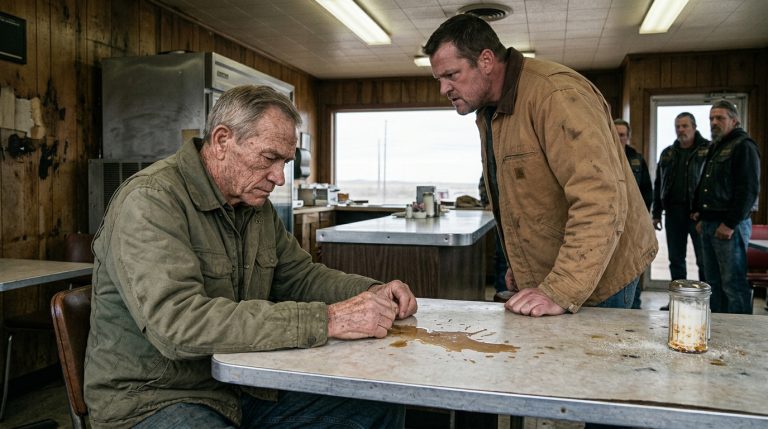
The air in the Pentagon lobby tasted of ozone and expensive floor wax, a sterile scent that scratched at the back of Samuel’s throat. He stood before the polished marble desk, his shoes—scuffed leather stained by years of dry, iron-rich earth—seeming to absorb the light rather than reflect it. Behind the desk, Jessica Sterling’s fingers moved across her keyboard with the precise, rhythmic clicking of a metronome. She was the gatekeeper, a woman built of protocol and crisp edges, oblivious to the fact that she was currently staring at a man who had long ago ceased to exist on paper.
Samuel kept his hands steady, his weight evenly distributed. He didn’t fidget. He didn’t offer the desperate, apologetic smile of a petitioner. He simply watched the way the light glinted off the edge of her monitor, noticing the slight twitch in her jaw every time he remained silent. He wasn’t waiting for her permission; he was waiting for the machine to recognize the glitch.
“The General’s schedule is absolute,” Jessica said, her voice thin and sharp, lacking the cushion of genuine patience. “Without an appointment, you are a security anomaly. Step back from the desk, sir.”
Samuel felt the cold, hard weight of the Zippo in his pocket. It was an object of friction—a relic of a time when the world was measured in yards of mud and the distance between life and death. He pulled his hand out slowly, his movements deliberate, forcing her eyes to track his motion.
“I don’t need an appointment, Jessica,” he said. His voice was like dry leaves skittering over pavement—quiet, yet capable of cutting through the ambient hum of the room. “Tell him the Ghost of Firebase Crimson has returned to settle the account.”
Jessica’s hands paused. She looked at him then, really looked at him, and for the briefest of seconds, he saw the flicker of something beyond arrogance—a genuine, primal confusion. It was the look of someone whose map of the world was suddenly missing a crucial piece. She reached for the terminal, her movements losing their practiced grace, and began to type.
As she tapped in the phrase, a faint, rhythmic vibration hummed through the desk—the sound of a server room spooling up deep beneath the floor. Samuel kept his eyes locked on the mahogany door behind her. He knew what was coming. He knew that the moment the keyword hit the system, the foundation of this sterile, polished reality would begin to groan under the weight of a truth that had been rusted shut for half a century.
Then, the screen in front of her bled deep red. The room seemed to grow smaller, the silence heavier, like the pressure before a lightning strike. Jessica went deathly still, her skin turning the color of ash as the terminal began to scroll lines of encrypted, high-clearance data that she clearly wasn’t meant to see. She didn’t look at him anymore; she looked at the screen as if it were a mirror reflecting a nightmare.
“How?” she whispered, her voice barely audible over the sudden, sharp thud of the mahogany door swinging open behind her.
Samuel didn’t turn around yet. He felt the cold iron of the Zippo in his palm and knew that whatever bridge he was about to cross, there was no turning back. The ledger was open, and the ink was already starting to bleed.
CHAPTER 2: THE INNER SANCTUM
The mahogany door closed with a weighted, final click that seemed to seal them into a pressurized chamber. Inside, the office of General David Davies was a museum of American history: heavy flags, framed citations, and the scent of aged leather and paper that had never seen the sun. But for Samuel, the room didn’t feel like a sanctuary. It felt like a trap. The air was too thick, recycled through high-end filtration systems that hummed with a low-frequency vibration—the same frequency as the hidden tactical equipment he had once spent his life calibrating in the mud of Firebase Crimson.
General Davies didn’t speak. He moved toward a heavy desk, his posture rigid, his hands slightly trembling as he adjusted a nameplate. He was searching for the equilibrium of the Four-Star General he was paid to be, but his eyes, when they darted toward Samuel, still held the haunted look of the lieutenant who had watched a ghost materialize from the red earth.
Samuel stepped into the room, his boots feeling oversized and clumsy on the plush, midnight-blue carpet. He ignored the leather armchair offered by the general’s gesture. Instead, he walked toward the floor-to-ceiling windows, looking out over the Pentagon courtyard. From this height, the people moving below were mere shadows, ants scurrying through a maze of their own design.
“You shouldn’t have come here, Sam,” Davies said, his voice finally breaking the oppressive silence. It was a plea, not an accusation. “The system is automated now. The protocols… they aren’t written by men anymore. They’re written by algorithms that flag anything they don’t recognize. By walking through that lobby, you didn’t just break a rule. You triggered a cascade.”
Samuel turned. He felt the Zippo in his pocket—that cold, iron weight. Every vibration in the floor, every hum of the server racks hidden behind these wood-paneled walls, told him exactly how deep this cascade went. He saw the General not as a leader of men, but as a curator of a rusting machine.
“The cascade was inevitable, David,” Samuel replied. His voice was steady, lacking the warmth of the lobby. “You’ve spent fifty years guarding a lie. You think you’re holding the line, but all you’ve done is build a cage for the next generation. That receptionist out there… she’s just a symptom. She’s terrified of the world because she’s been told it’s nothing but threats and protocols. We didn’t fight for that. We fought for something that could breathe.”
Davies leaned forward, his knuckles white against the desk. “I did what I had to do to keep the network alive! If I hadn’t, the intelligence would have been swallowed by the same chaos that nearly erased us back then. You were KIA, Sam. My reports ensured you remained a legend because that’s what this country needed—an unassailable memory of courage.”
“A memory is a static thing,” Samuel said, walking toward the desk. He stopped just outside the perimeter of the General’s reach. He could see the exhaustion in the other man’s face, the way the skin sagged under the weight of five decades of secret stewardship. “You wanted a legend. I wanted a life. But neither of us got what we wanted. We got this.”
He reached into his pocket and placed the Zippo on the desk. It looked small, pathetic against the massive, polished surface. Davies stared at it as if it were a live grenade. The metallic scent of the lighter—a faint, lingering trace of oil and cordite—seemed to fill the room, cutting through the antiseptic air.
“This is the first piece of the ledger,” Samuel said.
Davies’s hand hovered over the lighter, but he didn’t touch it. “What are you talking about?”
“You kept the listening post at Crimson operational, didn’t you?” Samuel’s voice was a whisper, sharp and dangerous. “Even after we were ‘gone.’ You kept the network running, piggybacking on the black budget, using the ghosts of our unit as the foundation. You didn’t just remember us, David. You utilized us.”
The General’s face drained of color, his expression hardening into a defensive mask. “That was for national security. It was necessary.”
“It was a sin,” Samuel said.
Suddenly, a high-pitched, discordant whine erupted from the server stack behind the desk—a system-level alert. Davies spun around, his fingers flying across a hidden control panel embedded in the wall. The hum of the room spiked, becoming a physical pressure against Samuel’s eardrums. Outside, in the hallway, the sound of rhythmic, boots-on-marble approached—security teams responding to the anomaly triggered in the lobby.
Samuel didn’t move. He watched the General scramble, his frantic movements exposing the cracks in his authority. The “Equal Intellect” battle had begun, but the field wasn’t made of tactical formations anymore; it was made of code, legacy, and the heavy, rusted truth of what they had left behind in the mud. Samuel felt the ghost of his own past screaming at him to turn back, but he stayed rooted, watching the General try to wrestle a machine that was already beginning to dismantle itself.