The Weight of Salt and Iron: A Reckoning on the High Border Road
CHAPTER 1: THE COLD WEIGHT OF PORCELAIN
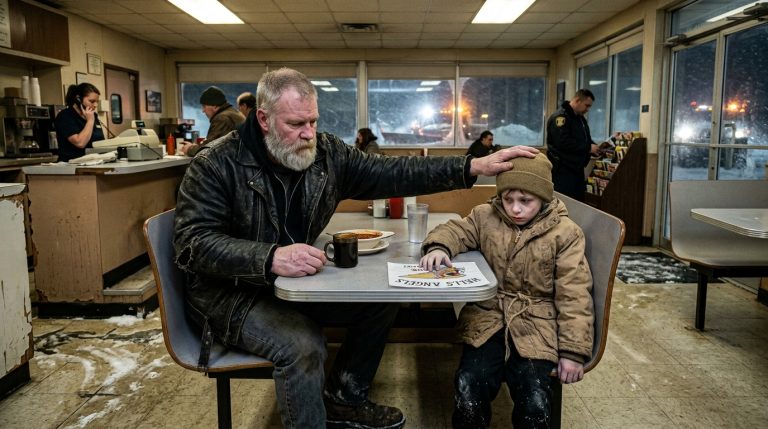
The salt shaker on booth four had a chipped rim, the glass ground down by thirty years of sliding across scarred Formica. Walter Branson kept his thumb pressed against the rough edge, using the small, localized bite of pain to anchor himself against the hum of the diner’s refrigeration unit. Outside, the high border road was the color of zinc under an unwashed sky. The sun didn’t shine so much as it leaked through the grease-filmed panoramic windows, catching the floating dust motes that rose from the heat vents like iron filings.
He was eighty-one, and his skin had the dry, cross-hatched texture of an old boot left out in the coulee. Every morning at 8:15, the porcelain cup arrived, filled to within a quarter-inch of the rim with liquid that tasted predominantly of scorched chicory and copper pipes. He didn’t mind the bitterness. The bitterness was a metric he could still calculate.
Across the room, the register counter was vibrating. The friction wasn’t from the old pipes this time; it was the heels of a broad-shouldered man in a stained duck-canvas jacket. Marcus. Walter knew the name from the grain elevators three miles south, where the boy had been fired twice for falsifying weight slips. Marcus was shouting at Martha, his voice carrying the dry, rasping rattle of a diesel engine with a cracked block. He was demanding a refund on a commercial tab that had been dead since the late harvest.
“The books don’t lie just because your uncle runs the co-op,” Martha said. Her hands stayed beneath the counter, likely resting on the iron pipe she kept near the linen drawer.
Marcus leaned his weight into the Formica, his boots grinding salt grains into the linoleum. “The books are whatever I say they are when the diesel spikes fifty cents a gallon, Martha. You think this valley runs on good intentions?”
Walter didn’t turn his head. He watched the reflection in the window—the gray silhouette of his own profile superimposed over the silhouette of Marcus’s twitching shoulder. In the lower left corner of the pane, a mismatched brass screw held the ancient aluminum window latch together. It was bright, unoxidized brass, too clean for a diner that hadn’t seen a hardware update since the mill closure in ’94. Someone had replaced it within the last forty-eight hours.
The realization had barely registered before Marcus shifted his trajectory. The boy’s pride was a raw, wet thing, looking for a softer surface to strike than Martha’s iron-backed stubbornness. He caught Walter’s reflection looking back at him.
The distance between the counter and booth four was six paces. Marcus covered it in three, his canvas jacket whistling against his ribs.
“You got an opinion on agricultural margins, old man?” Marcus asked. His breath smelled of sour milk and cold tobacco.
Walter lifted his coffee cup. His fingers had the permanent, rhythmic tremor that the army doctors had blamed on artillery concussions but that Walter knew was just the slow unspooling of his nervous system’s mainspring. He didn’t answer. He simply looked at the boy’s collarbone, measuring the density of the bone beneath the canvas.
The blow wasn’t a boxer’s strike; it was a heavy, backhanded slap born of frustration rather than strategy. The impact cracked against Walter’s left cheekbone with the dry snap of a pine branch underfoot. The porcelain cup didn’t drop, but the coffee sloshed over the rim, black and scalding, pooling into the deep, defensive lines of his knuckles.
Walter’s head jerked three inches to the right. The iron smell of blood rose instantly in the back of his throat, familiar and metallic, like an old nail pulled from wet earth. He didn’t rise. He didn’t look up to see Martha reaching for the phone. He kept his eyes fixed on the puddle of dark liquid spreading toward the salt shaker, watching how the white grains absorbed the dark stain until they were nothing but gray sludge.
The diner door jingled. The sound wasn’t the usual light tin rattle; the iron bell hit the glass with a heavy, deadened thud as five men in stiff leather vests cut the gray light of the entryway.
CHAPTER 2: THE SOUND OF FRACTURED FORMICA
The vibration of the iron bell against the glass pane was still humming through the steel frame of booth four when the cold draft from the unincorporated highway hit the back of Walter’s neck. Marcus didn’t drop his hand immediately. His knuckles, scarred from the old hydraulic levers at the grain elevator, remained suspended in the gray light, the skin yellowed around the joints where the blood had rushed out during the strike. He was breathing through his teeth, a wet, rattling whistle that spoke of a deviated septum earned in some forgotten gravel-pit scrap three winters ago.
Walter didn’t adjust his posture. His left cheekbone felt thick, the skin tightening as the capillary blood pooled beneath the surface, turning the dry, papery tissue the color of a bruised winter apple. His jaw clicked when he swallowed the copper taste rising from his gums. Through the heavy canvas of his uniform shirt, the circular weight of the 1953 steel pocket watch pressed against his ribs—three minutes slow, dragging its gears through the decades with a thick, mechanical resistance that felt entirely continuous with the stagnation of the valley outside.
“Sit down, Marcus,” Martha said. Her voice didn’t rise. It had the flat, ungreased slider-rail quality of a woman who had spent forty years watching men mistake the absence of law for the presence of permission. Her right shoulder was dipped two inches lower than her left, her fingers locked onto the hidden length of the iron pipe beneath the bread bin. “You paid your dollar forty for the chicory. You’ve taken your value out of the room. Now clear the doorway.”
Marcus turned his head slowly, his eyes bloodshot at the corners from the alkali dust of the low fields. “There isn’t a deputy within twenty-two miles of this switch-line, Martha, and you know it. The county didn’t renew the tarmac budget, and they sure as hell didn’t renew the patrol contracts. This old man hasn’t got an invoice for being here. I do.”
He shifted his weight, his heavy work boot coming down on a discarded metal bottle cap. The iron scrap ground into the linoleum with a shrill, dry screech that set Walter’s teeth on edge. It was the exact sound of a loose tie-rod on an armored transport, the kind of micro-friction that preceded a structural failure by less than fifty yards.
Walter’s gaze remained anchored to the table. In the gap between the Formica top and the zinc trim, a small deposit of gray grease and calcified salt had dried into a crust. The valley was full of these tiny, uncleaned corners—places where the maintenance had stopped a generation ago, leaving only the structural skeletons to rub against each other until they rusted smooth. His left hand, still wet with the spilled chicory coffee, felt the cold air from the door turn the liquid sticky.
The five men who had broken the threshold didn’t advance into the aisle. They stayed clustered in the entry well, where the floorboards were reinforced with steel plates to handle the milk crates from the morning delivery. Their leather vests were stiff, unpliable under the grease film, bearing the deep, oily stink of petroleum and old cowhide that had been cured in high-sulfur diesel exhaust. They didn’t look at Marcus. They didn’t look at Martha.
The man at the center of the cluster was broader than the others, his gray-streaked beard caught in the low draft from the door, separating into coarse, wire-like strands. His knuckles were gray with engine carbon that had worked its way into the pores under the skin, a permanent industrial tattoo that no amount of industrial soap could lift.
Walter felt a cold, calculated stillness settle into his belly. It was the same physical weight he had carried in the freezing mud north of the parallel, the absolute certainty that when the terrain became sufficiently broken, the rules of the ledger ceased to matter. Only the mass of the objects in motion remained.
Marcus sneered, his shoulder dropping into a defensive slant as he tried to read the silence of the leather vests. “This is private business with the co-op accounts,” he muttered, though his heels shifted an inch backward, his boots seeking the traction of the clean linoleum away from the grease spill. “The diner’s behind on its bulk flour tax. My uncle’s office issued the notice on Friday.”
The man with the gray-streaked beard took one step forward. His boot heel—soled with heavy, vulcanized tire tread—hit the floorboards with a dead, hollow thud that stopped the rattle of the refrigeration unit entirely. The silence that followed was total, save for the slow, mechanical click of the three-minutes-slow watch inside Walter’s pocket.
“The county line ends at the culvert three miles back, boy,” the man said. His voice was a low, uncalibrated rumble, like a stone crusher running empty. He didn’t look at Marcus’s face; his eyes were fixed entirely on the fresh, dark grease stain on Marcus’s canvas sleeve where the boy had brushed against the kitchen door frame. “The co-op hasn’t had an enforcement seal since the state re-routed the water rights in eighty-eight. You’re standing on unincorporated dust.”
Marcus’s jaw tightened, the muscle twitching under his stubble like a trapped wire. He looked toward the panoramic window, his reflection shivering against the clean brass screw in the sash. For the first time, the boy’s eyes showed the white line of systemic exposure—the realization that there was no ledger, no uncle, and no legal framework within thirty miles that could retroactively justify the weight of his arm.
Walter slowly turned his head. His eyes met the gray-streaked beard across the narrow aisle of the diner. The face was older, the skin cured by road-grit and alkali storms, but the orbital bones were his own—the same heavy, unyielding ridge that had survived the mortar pits while the rest of the third platoon went into the ground. Thomas hadn’t changed the rhythm of his breath since he was seven years old; it was still a long, deliberate drag through the nose, held until the chest went rigid.
“The old man’s coffee is cold,” Thomas said, his gaze finally shifting down to Marcus’s boots. “And your boots are tracking salt onto the floor Martha just scrubbed.”
CHAPTER 3: THE TOLL OF THE BELL
The weight of Thomas’s final sentence hung in the narrow aisle like the smell of unburned oil after a cold start, freezing Marcus’s hand a mere three inches from the edge of the zinc-rimmed counter. The four bikers behind Thomas didn’t disperse. They maintained a packed configuration, their shoulders filling the doorframe completely, blocking out the raw gray horizon of the highway. The metal links of a wallet chain scraped against the side of a leather holster with a dry, rhythmic tick as one of the men shifted his balance, his heavy boot calf rubbing against the door jamb.
Walter didn’t lower his hand from his face, but his thumb crept lower, pressing into the small hollow under his jaw where his pulse beat steady and thin. He watched Thomas’s reflection in the window pane. His son’s face remained mostly obscured by the grime on the glass, but the posture—the slight forward lean of the cervical vertebrae, the drop of the right shoulder to offset the weight of a heavy utility tool belt—was a carbon copy of the old blueprint Walter had buried thirty winters ago.
Marcus let his breath out in a short, hot hiss. His boots made a tiny, grating noise as they tried to find a purchase on the salt-filmed floorboards. “You’re Branson’s boy,” Marcus said, his voice dropping into a register that lacked the mechanical authority he had used with Martha. He looked from Thomas’s gray-streaked beard down to the heavy iron buckle of Thomas’s belt. “The one who went over the ridge to work the salvage yards. You don’t have a legal standing on these accounts, Thomas. The co-op is an authorized district branch.”
“The co-op hasn’t paid its local water lease since the reservoir went shallow,” Thomas said. He didn’t lift his hands from his sides. They remained dropped, the calloused palms slightly curled, fingers close to the heavy, oil-darkened leather of his vest pockets. “And my name isn’t on a ledger you’ve ever handled, boy. Move away from the table.”
Martha didn’t lower the iron pipe beneath the bread bin. Her knuckles were yellow-white from the pressure she was putting on the wood, her gaze fixed entirely on the second biker from the left—a man with an unhealed weld-burn across his forearm who had his palm flat against the glass of the cigarette case. “The sheriff’s office is down at the junction, Thomas,” she said, her voice flat, dry, and entirely devoid of gratitude. “They’ve got three vehicles parked behind the lime pit. If you break my glass, you’re paying for the glazing before you leave this county.”
“Nobody’s breaking glass, Martha,” Thomas said. He took another step forward, his vulcanized sole compressing a loose bit of rubber molding at the base of the booth. The physical displacement of air inside the narrow diner aisle carried the cold, chemical smell of heavy-duty degreaser and wet wool. He came to a halt exactly twelve inches from Marcus’s shoulder, his shadow completely cutting off the low sun that had been hitting Walter’s chipped salt shaker.
Marcus didn’t strike. The kinetic momentum he had carried when he crossed the room to hit Walter had evaporated, leaving only the stiff, industrial awkwardness of a man who realized the structural supports beneath his feet had been systematically unbolted. His canvas jacket bunched at the armpits as he raised his hands—not in a gesture of surrender, but to hook his thumbs into his belt loops to keep his fingers from shaking against the Formica.
“The old man was looking at the books,” Marcus muttered, his eyes darting toward the bright brass screw in the lower corner of the panoramic window frame. “He knows the mill isn’t clearing the grain slips. We’re just verifying the residency tax.”
“The old man was drinking his chicory,” Thomas said. His hand finally moved, rising three inches until his thumb caught the heavy leather edge of his vest pocket. He didn’t pull a weapon; instead, he pulled a small, greasy card—a mechanic’s receipt from the unincorporated diesel shop at the county line—and laid it flat on the spilled coffee between the salt shaker and Walter’s hand. The paper immediately began to drink the dark liquid, the ink spreading into a gray, illegible blur. “That’s the delivery manifest for the local flour route, Marcus. Your uncle didn’t sign it. I did. Three weeks ago.”
Walter looked at the card. The name at the bottom wasn’t Branson. It was Iron Guild Logistics, written in the thick, indelible purple marker they used at the rail yards to tag structural steel that had failed the density test.
Marcus looked down at the card, his jaw dropping slightly as the physical reality of the supply line shift registered. His boots dragged back another three inches, his weight hitting the edge of the register counter with a low, wooden creak. “The sheriff didn’t say anything about a logistics transfer,” he said.
“The sheriff doesn’t check the weight slips at the lime pit,” Thomas replied, his voice remaining flat, level, and rhythmic as the engine blocks he spent his days tearing down. “Now clear the aisle before I have the boys check the air pressure in your truck tires.”
CHAPTER 4: THE TRANSACTION OF BREATH
The greasy cardstock continued to pull the dark chicory coffee upward into its fibers, the purple ink bleeding toward the margins until the texture of the paper itself began to warp under the heat. Walter watched the moisture reach a small, stamped line of type previously hidden beneath a layer of black chassis grease near the lower edge. It wasn’t standard commercial print; it was an alphanumeric code pressed directly into the fibers with a high-pressure mechanical stamp—MD-412-A—the precise format used by the regional supply depots before the federal decommission orders came down thirty years ago.
Thomas didn’t lift his calloused hand from the edge of the booth’s Formica top. His knuckles, dusted with grey grit from the high road, remained motionless beside the puddle of ruined coffee. He didn’t look up to track Marcus’s retreat as the boy began to edge his way toward the cash register, his boots scraping a dry, uneven path through the spilled salt.
“You’re nine years late for breakfast, Thomas,” Walter said. His voice carried the raspy, dry-pipe sound of a lung that had spent too many winters inhaling the vaporized cutting fluid of the old manufacturing lines. He didn’t touch the bruised side of his jaw. The dull ache there was predictable, a physical reality he could partition off behind thirty decades of military habit.
Thomas slowly pulled out the opposite bench, his heavy leather vest creaking against the iron rivets of his belt as he lowered his bulk into the booth. The wooden seat groaned, taking the weight of a man who spent his life lifting engine blocks from dead chassis. “The road from the lime pit doesn’t clear until the morning freight passes the junction,” Thomas said. He didn’t offer a hand. He didn’t ask about the swelling dark patch below Walter’s ear. He simply rested his forearms on the scarred surface of the table, his grease-blackened thumbs hooking together over the wet cardstock.
Across the room, the register bell gave a short, metallic ping as Martha hit the manual override lever. She didn’t drop the iron pipe from her grip, but she used her left hand to count out four quarters, sliding them across the worn zinc counter toward Marcus with a hard, deliberate flick of her wrist. “Your change for the chicory, Marcus. Tell your uncle the co-op ledger doesn’t have an entry for extortion this month.”
Marcus didn’t take the coins. He left them flat on the metal, his canvas jacket whistling against the partition wall as he pushed through the heavy screened outer door. The frame slammed shut behind him with a dry wood-on-wood crack that vibrated through the panoramic window, setting the bright new brass screw in the lower sash into a micro-tonal hum.
Walter watched the purple ink on the cardstock dissolve entirely. The alphanumeric stamp MD-412-A stayed sharp, the heavy compression of the metal die having permanently altered the structure of the paper. It was a salvage tag from the old munitions rail yard, the one Walter had locked the gate on when the county declared the valley a strategic wasteland.
“The boys are staying by the pumps,” Thomas said, his voice dropping into a level register that didn’t carry beyond the high back of the booth. He nodded toward the window, where the four leather-vested riders had moved back to their machines, their heavy boots kicking down the kickstands with a synchronous iron clang. “They’re checking the fuel lines on the transport rig. We’ve got twelve tons of structural iron coming down from the northern spur by midnight.”
“The northern spur hasn’t seen a high-clearance truck since the bridge went soft in ninety-two,” Walter said. He turned his porcelain cup ninety degrees, aligning the chipped handle with the edge of the grease-stained manifest. “The county put an axle limit on that road for a reason, Thomas. The bedrock underneath is mostly old mine shafts. One heavy drop and the whole grade goes into the lime.”
“The county doesn’t own the right-of-way anymore,” Thomas replied. His calloused index finger moved forward, pressing into the edge of the wet paper until the alphanumeric stamp was entirely covered by his dark fingernail. “The sheriff’s office sold the lien to an investment trust out of the capital three months back. Marcus’s uncle isn’t collecting taxes. He’s collecting the property deeds before the drilling rigs arrive from the south.”
Walter’s thumb remained pressed against his own jawbone, the physical pressure countering the slow throb of the capillary damage. He looked at the gray hair in his son’s beard, noticing for the first time the thin, white line of a weld-splatter scar that ran from the corner of Thomas’s jaw down into his collar. It was the same mark Walter carried on his own shoulder—the signature of a high-voltage short in a sealed manufacturing bay.
Martha came down the aisle then, her heavy rubber-soled shoes squeaking against the linoleum where Marcus had tracked the road salt. She didn’t bring a fresh pot. She brought a damp rag that smelled strongly of household ammonia and cold well-water, throwing it flat over the center of the table with a wet slap.
“He’s got two more trucks coming from the grain elevator before noon, Thomas,” Martha said, her eyes fixed on the panoramic glass rather than the two men in the booth. “Marcus isn’t the type to clear out just because his boots got wet. His uncle has thirty-two miles of jurisdictional immunity between here and the interstate, and he’s already paid the road crews to stay south of the lime pit.”
Thomas didn’t move his hand from the card stock. “The road crews can stay where they like, Martha. The iron’s already on the grade.”
Walter reached down, his trembling fingers catching the edge of the damp ammonia rag. He didn’t wipe the table. He simply held the cloth against his palm, letting the cold chemical sting clear the remaining taste of the copper and chicory from his palate. “You shouldn’t have brought the Guild into this county, Thomas,” Walter said softly, his eyes dropping back to the hidden alphanumeric code beneath his son’s thumb. “The ledger here was quiet until you unbolted that yard gate.”
CHAPTER 5: THE MARGIN OF EXPOSURE
The damp ammonia rag remained caught under Walter’s trembling palm, the chemical sting rising between them to mix with the heavy, unwashed grease scent of Thomas’s leather vest. Walter didn’t shift his pressure. He kept his eyes locked on the broad, flat fingernail that pinned the delivery receipt to the Formica. The ink from the MD-412-A stamp had stopped running, leaving a ghost-white shadow around the embedded numbers where the paper fibers had compressed under the weight of an old federal die.
Outside, the heavy rhythmic chug of a cold diesel engine began to drop in pitch. It was Marcus’s truck—a rusted three-quarter-ton flatbed with a loose tailpipe that rattled against the bumper. The exhaust note was wet, struggling against a faulty injector before it finally caught, spitting a cloud of black, unburnt carbon across the lower pane of the panoramic window. The gray haze rolled past the glass, momentarily blotting out the shapes of the four Iron Guild riders who stood like fence posts by the manual fuel pumps.
Thomas didn’t turn to look. He leaned his weight onto his left forearm, the heavy canvas sleeve of his under-jacket scraping against the zinc trim of the table with a dry, metal-on-fabric screech. “The gate was already rotten, old man,” Thomas said. His voice stayed flat, buried deep in his throat where the grit of forty miles of dirt road had settled. “The sheriff’s office had three padlocks on the primary spur because they were pulling the brass piping out of the sub-stations to cover the payroll deficit. If I hadn’t taken the ledger, the scrap crews from the south would have had the rails up by harvest.”
“The rails were meant to stay down,” Walter said. His jaw felt larger now, the bruised muscle hardening against his teeth like an ungreased hinge. He let go of the rag, leaving the grey cloth pooled on the table between them. “They were quarantined under the seventy-two specification for a reason, Thomas. It wasn’t about the scrap value. It was about the settlement underneath.”
Martha walked back toward the dish well, her rubber soles giving one final, sharp squeak as she crossed the dry line where Marcus had dropped his change. She didn’t look at either of them, but her right shoulder remained low, her arm tucked against her apron where the black utility pipe stayed hidden behind the white linen. The silence she left behind was dense, broken only by the continuous, low-cycle click of the pocket watch in Walter’s shirt pocket—three minutes slow, dragging its balance wheel through a microscopic layer of old oil.
Thomas pulled his finger back from the cardstock. The paper was completely gray now, saturated with chicory and water, but the alphanumeric code remained legible through the moisture. “The settlement is sixty percent water now,” Thomas said. He reached down into the deep side pocket of his vest, his thick knuckles brushing against the heavy brass grommets of his tool holster with a dull, flat clink. He didn’t pull a weapon; he drew a rusted steel calliper—the five-inch slide type used for checking the tolerance of industrial valves—and laid it down over the manifest. “The county engineers stopped testing the lime runoff five winters ago. They’ve been letting the overflow dump straight into the old secondary shaft behind your garden plot.”
Walter’s left hand tightened into a fist against his thigh. The skin across his knuckles felt brittle, the old scars from his service days turning white under the pressure. He didn’t need to look at the caliper to know the measurement it was set to; the slider was notched at forty-six millimeters—the standard sleeve thickness for the high-pressure chemical conduits that ran beneath the valley floor.
“Marcus doesn’t know about the shafts,” Walter said softly.
“Marcus knows what his uncle tells him from the tax office,” Thomas replied. He reached out and tapped the steel calliper with his thumb, the iron instrument giving a short, metallic ring against the Formica. “His uncle told him there’s forty thousand dollars in uncollected timber liens on the northern grade. He thinks he’s here to lock the gate on Martha’s grain supply so they can clear the right-of-way for the transport rigs without an injunction.”
Through the window, the exhaust from Marcus’s truck finally cleared, leaving only a greasy film on the outer pane. The flatbed was moving slowly now, its tires grinding through the gravel transition lane that led back to the unincorporated highway. It didn’t accelerate toward the junction; instead, it drifted onto the dirt shoulder two hundred yards down, its brake lights showing two dull red spots through the midday dust. Marcus was waiting.
Thomas looked down at the table, his gray-streaked beard catching the low, sharp light that came through the lower sash where the new brass screw sat. “He’s got three more rigs from the county yard sitting behind the gravel pits, Walter. They’ve got the barrier signs in the back. If they drop the gates at the culvert before the midnight freight clears the switch, Martha doesn’t get her bulk delivery, and you don’t get your pension check from the post-box at the crossing.”
Walter slowly stood up from the booth. His knees made a dry, popping sound that seemed to echo in the narrow space between the Formica tables. He didn’t look at his son. He reached down, his weathered fingers picking up the wet, gray delivery card by its corner, careful not to let the soft paper tear against his thumb.
“The post-box has been empty since Tuesday, Thomas,” Walter said. He looked down at the top of his son’s head, where the hair was thin and white around the crown. “The county didn’t stop the mail because of a timber lien. They stopped it because someone logged an unauthorized manifest at the railhead.”
Thomas didn’t look up, but his forearms went rigid against the zinc trim, his skin darkening where the old weld-scar crossed his tendon. “The manifest was legal,” he said.
“Not under the seventy-two spec,” Walter replied. He folded the wet cardstock twice, hiding the alphanumeric stamp inside the dark creases before sliding it into the small pocket of his flannel shirt. “Let’s go look at the truck, Thomas. Before Marcus’s uncle figures out which key you used to open that yard gate.”
CHAPTER 6: THE RESIDUE OF STEEL
The small pocket of Walter’s flannel shirt sagged slightly under the weight of the double-folded manifest, the damp corners of the paper pressing a cold circle of moisture directly against his chest through his undershirt. Walter did not reach up to smooth down the fabric. He kept his hands dropped at his flanks, his calloused palms absorbing the dry draft that slid across the linoleum as he stepped out from the narrow enclosure of booth four.
Thomas moved ahead of him, his broad back a wall of dark, scuffed leather that cut off the view of the cash register. Each of Thomas’s steps produced a short, grinding protest from the floorboards, forcing a thin skim of dried white road salt out from the seams between the planks. Behind them, Martha remained stationary by the dish well. The iron pipe in her grip caught a sliver of gray light from the panoramic window, glowing with a dull, unpolished sheen that looked like an extension of her own forearm. She did not speak as they crossed the dry boundary line of her kitchen territory, but her eyes tracked the clean brass screw in the lower sash until Thomas’s heavy shoulder blocked the view.
The distance from the booth to the outer screen door was exactly fourteen paces. Walter measured each one by the rhythmic drag of his heavy leather boots, his joints offering a familiar, calcified resistance that synchronized perfectly with the slow, three-minutes-late ticking of the pocket watch against his ribs. As his hand reached out to grasp the iron handle of the door, he felt the micro-vibrations of the highway passing through the metal—the low, percussive rumble of heavy vehicles idling somewhere north of the lime pit.
He pushed the door open. The rusted spring at the top of the frame let out a dry, high-pitched screech that died instantly in the wide, flat silence of the unincorporated valley. The air outside didn’t carry the warmth of midday; it was cold and sharp, saturated with the chemical stench of high-sulfur diesel and the bitter, limestone dust that blew off the dry beds of the creek.
The four Iron Guild riders didn’t move as Walter and Thomas stepped onto the gravel apron. They remained leaned against their machines, their heavy work boots anchored in the loose stone, their faces shaded by the low brims of their canvas caps. The twin cylinders of the nearest motorcycle were cooling down, the hot metal giving off a rapid, irregular ticking sound as the heat radiated into the damp air.
Two hundred yards down the dirt shoulder, the dull red spots of Marcus’s brake lights finally flickered and went dark. The three-quarter-ton flatbed didn’t pull away. It remained canted toward the drainage ditch, its loose tailpipe pointing like a broken finger toward the northern ridge where the old railhead lay buried under thirty years of scrub pine. Through the grime-filmed rear window of the truck cab, the silhouette of Marcus’s head was a fixed, dark node, his shoulders hunched forward over the steering wheel as if he were waiting for an acoustic cue from the county road.
“The wind’s coming around from the lime pits,” Thomas said. He didn’t look back at Walter. He stopped at the edge of the gravel transition lane, his hand dropping down to hook into the thick steel ring of his tool holster. “The moisture’s dropping the pressure. If the ridge road goes soft before the transport rig hits the third culvert, that iron’s going to sit in the coulee until the spring thaw.”
“The iron shouldn’t be on the grade at all, Thomas,” Walter said, his voice staying low enough to stay beneath the rattle of the cooling motorcycle engines. He stepped down from the wooden porch, his boot heel sinking an inch into the loose stone until it found the hard, compacted slag beneath. “Your units aren’t cleared for regional logistics. The sheriff knows exactly how many tons those old timber structures can support before the timbers shear at the bolts.”
Thomas turned slowly, his gray-streaked beard catching a stray beam of pale light that had managed to break through the zinc-colored clouds. His eyes were small, hard slits behind his wrinkled lids, carrying the cold, tactical clarity of a man who spent his nights recalculating the tolerances of worn-out machinery. “The sheriff hasn’t looked at the bolt shears since eighty-two, Walter. He’s too busy signing the exclusion certificates for the corporate mineral scouts. They’ve been running three-axle rigs over the lower bridge every night since the frost broke.”
Walter reached down and touched the edge of his shirt pocket, his fingers feeling the stiff ridge of the folded document inside. The alphanumeric code—MD-412-A—wasn’t just a salvage marker; it was the specific inventory number for the heavy-density lead shielding that had been stored in the underground storage bays behind the old munitions facility. If Thomas was hauling that grade of steel out of the quarantine zone, the weight wasn’t measured in commercial tons. It was measured in the structural survival of the entire drainage basin.
A sharp, metallic clink broke the silence from the north. It wasn’t the sound of an engine; it was the distant, unmistakable strike of an iron coupling pin dropping into a heavy hitch. It came from the direction of the gravel pits, where the county road crews kept their yellow barrier gates parked during the off-season.
The four riders by the pumps shifted their posture in unison, their heavy leather vests rustling against their denim jackets as they stood up away from their machines. None of them spoke, but their eyes drifted instantly toward Thomas, waiting for the slight drop of his shoulder that served as the unit’s primary routing command.
“Marcus isn’t waiting on his uncle,” Walter said, his gaze fixed on the motionless shape of the flatbed truck down the road. “He’s waiting on the county surveyor. They’re going to drop the jurisdiction gates at the line before your transport can clear the switch.”
Thomas didn’t answer. He turned his face back toward the northern ridge, his jaw tightening until the old weld-scar along his neck turned a hard, porcelain white against his skin. “Then we’d better get the truck onto the tarmac,” he said.
CHAPTER 7: THE SLOW TICKING OF THE POCKET WATCH
The vibration of the remote iron coupling pin was still moving through the slag under Walter’s boots when Thomas reached down to clear the heavy canvas leather wrap from his ignition coil. The metal on the engine casing didn’t look uniform; a clean, bright line of raw weld tracking crossed the frame tube just above the primary cylinder bank, cutting right through an old, zinc-coated serial number plate that had been partially ground down with an angle sander. The remaining three digits—412—glinted in the gray light, an exact structural mirror to the alphanumeric code currently dampening inside Walter’s flannel shirt pocket.
Walter stayed three inches behind the rear tire, his boots sinking into the loose limestone gravel until he found the solid bedrock layer beneath. He did not ask his son about the frame weld. He watched Thomas’s thick fingers work the cold starter lever, the muscle along the boy’s thumb tightening into an iron knot that mimicked the heavy mechanical tolerances of the machinery he serviced.
“The county surveyor doesn’t move his rigs without an official seal from the district office, Thomas,” Walter said. His voice was small, dry, and flat against the vast, gray silence of the flats. He could feel the slow, unhurried throb of his left cheekbone where Marcus’s hand had broken the skin, the swelling beginning to set into a hard, rigid line that limited how wide he could drop his jaw. “If they’re dropping the barrier signs at the lime pit, they’ve got a state exclusion order. You can’t bypass that grade with twelve tons of unlogged iron on the flatbed.”
Thomas gave the kickstart a short, calculated jab with the heel of his tire-tread sole. The cylinder head let out a sharp, hollow puff of unburnt gasoline before the engine caught, settling into a low, metallic chatter that vibrated through the gravel apron until the small salt shaker inside booth four would have been dancing against its chipped rim. “The state exclusion was issued under the old timber act, Walter,” Thomas said, his face remaining turned toward the steering head. “It doesn’t cover logistics units running under an internal industrial salvage permit. The sheriff signed the transfer away when he let the investment trust handle the sub-station deeds.”
“The sub-stations were never part of the county lien,” Walter replied. He reached down into his pocket, his fingertips brushing the cold steel edge of the 1953 pocket watch to verify its continuous, lagging rhythm before his thumb caught the corner of the folded cardstock manifest. “The deeds were locked under the federal specification because the storage chambers beneath the secondary shaft are still active. If you run a three-axle transport over that culvert, the vibration will breach the seal on the lower concrete sleeve.”
Thomas didn’t look up, but his left shoulder dropped two inches, his fingers tightening on the rubber grip until the black sleeve bunched across his knuckles. “The concrete sleeve failed five winters ago, old man. That’s why the lime pits are running white this morning. The county didn’t stop the testing because they ran out of budget; they stopped it because the survey showed the active runoff was already eighty percent sulfur.”
Across the transition lane, the dull silhouette of Marcus’s flatbed truck didn’t shift. The brake lights stayed dark, but a thin, grey thread of exhaust continued to rise from the loose tailpipe, drifting over the drainage ditch where the wild scrub pine had turned brown from the alkali dust. Marcus was still watching the diner porch, his hand visible through the glass as a motionless shadow against the horn ring.
Martha appeared at the screen door, her frame filling the wood-on-wood boundary line. She had laid the iron pipe down across the tobacco counter, but her hands were tucked deep into the front pocket of her apron, her fingers working a small, brass-backed key that Walter knew belonged to the old bulk grain elevator behind the switch-line. “The morning freight just passed the five-mile signal, Thomas,” she shouted over the engine noise. Her voice had the flat, ungreased slider-rail quality of the valley. “They’re running six minutes ahead of the schedule because the lime pit spur is clear. If your rig isn’t through the crossing before the gates drop, the county crew is going to bolt the barrier to the rail tie.”
Thomas nodded once, his gray-streaked beard brushing the leather collar of his vest as he kicked the stand up. The heavy iron bar hit the frame with a sharp, hollow clang that cut through the engine’s low hum. “Get in the truck, Walter,” he said, pointing with his chin toward the old four-wheel-drive utility vehicle parked behind the fuel island. Its fenders were white with dried lime dust, the rear springs compressed under the weight of three heavy-duty hydraulic jacks and a spool of steel cable.
Walter didn’t move toward the utility vehicle immediately. He looked down the road toward Marcus’s truck, then back at the clean weld on Thomas’s motorcycle frame. The distance between them and the crossing was exactly two miles of unincorporated gravel—a narrow, high-clearance grade that didn’t have room for two vehicles to pass if one of them was carrying twelve tons of structural salvage.
“You’ve been tracking this inventory since the gate was unbolted, haven’t you?” Walter asked softly, his hand staying over the folded paper in his shirt.
Thomas twisted the throttle slightly, the rear tire throwing a short spray of gray stone against the wooden porch steps. “I’ve been tracking the ledger since you sent me over the ridge, old man,” Thomas said. He didn’t look back as he dropped the machine into gear, his chain drive giving a dry, metallic pop as he pulled onto the highway toward the northern grade. “And the ledger says we’re out of time.”
CHAPTER 8: THE SUPPLY CHAIN FRACTURE
The spray of gray stone from Thomas’s rear tire was still ticking against the wooden porch steps when Walter reached for the zinc door handle of the utility vehicle, his boots grinding a path through the loose limestone. The metal of the door was ice-cold, the latch catching with a dry, mechanical screech that vibrated up his forearm before releasing. Inside, the cabin smelled of aged vinyl, stale tobacco, and the sharp, chalky tang of lime dust that had worked its way into every seam of the dashboard.
He dropped onto the cracked bench seat, his knees making that same dry, hollow pop as they bent. To his right, through the yellowing glass of the passenger window, he watched Martha turn back inside the diner. Her apron strings fluttered once in the draft before the screened door slammed shut, the heavy wood-on-wood crack deadened by the growing rumble of the engines outside. She was already at the counter, her fingers inserting the old elevator key into the brass padlock of the inventory ledger.
Walter reached for the ignition. His hand shook—the rhythmic artillery tremor amplified by the cold—but he forced the iron key into the slot, twisting it until the starter motor groaned. The engine fired with a wet, uneven thud, the floorboards vibrating violently against his boot heels until he managed to clear the choke. He didn’t wait for the oil pressure to settle. He threw the heavy floor lever into reverse, the non-synchronized gears giving a loud, metallic protest before biting into the shaft.
As he backed away from the fuel island, a thick, sulfur-colored bank of low fog began to roll off the lime pit fields, cutting the visibility down to less than fifty yards within a matter of seconds. The sun became a faint, greasy smear behind the zinc clouds. The four Guild riders ahead of him were already turning into indistinct dark shapes, their red taillights bleeding into the yellow mist like wet paint on canvas.
Through the haze, Walter saw the silhouette of Marcus’s flatbed truck swing out from the shoulder. The rusted three-quarter-ton didn’t accelerate; it drifted forward at a calculated, defensive crawl, its tires tracking the exact white line of the road margin. Marcus wasn’t trying to outrun Thomas. He was positioning his chassis to act as a physical buffer, an obstacle to slow the Guild’s momentum before they could reach the intersection.
Walter shifted into first, the transmission whining as he let the clutch out. The utility vehicle surged forward, its stiff leaf springs slamming against the rubber bump stops as he hit the transition lane. The steering wheel fought him, the worn steering box requiring a quarter-turn of play just to keep the front tires from sliding into the drainage ditch where the alkali dust had killed the grass.
He kept his eyes on the pocket of his flannel shirt. The moisture from the folded manifest had finally reached through his undershirt, a cold, damp circle that felt like a coin pressed against his ribs. The alphanumeric stamp—MD-412-A—seemed to carry its own weight now, a physical anchor connecting his past to the precise sequence of events unfolding on the high road. The county hadn’t just stopped the delivery trucks to freeze Martha out; they were trying to isolate the grid entirely before the logistics transfer could reveal what was missing from the lower storage bays.
The road began to rise, the gravel giving way to old, broken asphalt that had cracked under the winter frost. Every twenty yards, a deep pothole shook the cabin, forcing Walter to grip the iron wheel until his knuckles went white. Ahead, the low, rhythmic hum of the morning freight was growing louder, a deep, sub-audible vibration that moved through the bedrock of the valley floor before it hit the truck’s axle.
A hundred yards from the crossing, the first yellow barrier gate appeared through the yellow sulfur fog. It wasn’t temporary wood; it was a heavy, counterweighted iron pipe, painted with faded diagonal stripes, mounted directly to a concrete base at the county boundary line. Two men in high-visibility vests stood near the pivot arm, their hands resting on a heavy-duty steel logging chain that had been looped three times around the iron tie.
Thomas’s motorcycle didn’t slow. He was riding the center line, his front tire cutting through the drifting mist like a wedge, his hand dropping down toward his belt as he approached the steel barrier. He didn’t draw a tool; instead, he reached for a heavy brass coupling pin that hung from a leather strap near his thigh, his weight shifting back to light up the rear brake.
Walter pressed his boot into the floorboard brake pedal, the old drums groaning as the utility vehicle slid through the loose stones toward the margin. The causality was clear: if the chain locked before the freight crossed the switch, the iron on the flatbed would become county property under the emergency abandonment clause, and the secret of the secondary shaft would be sealed behind a legal partition for another thirty years.
CHAPTER 9: THE SHADOW AT THE PERIMETER
The iron pipe of the barrier gate was still shivering under the weight of the counterweights when Walter’s utility truck dropped its front left tire into the washboard gravel along the boundary fence line. The yellowed sulfur fog was so dense now that the hood of the vehicle seemed to dissolve into a pale, chalky void, leaving only the cracked glass of the dial clusters glowing faint and green in the shadows of the dashboard. The smell of wet lime and hot iron came through the floor vents in thick waves, sticking to the back of Walter’s tongue like dry flour.
Through the shifting sulfur screen, the outline of a second vehicle materialized seventy yards north of the crossing. It wasn’t the rusted flatbed Marcus drove; it was a long, low state transport bus with blacked-out glass panels along its side and a massive double-axle rear assembly. The chassis sat entirely motionless on an abandoned siding line behind the old lime pits, its exhaust stack dead, but the heavy steel reinforcement bars welded across its radiator grille spoke of a highly specific non-commercial purpose. It was an enforcement transport from the capital’s specialized environmental containment unit, sitting silent at the exact geographic perimeter of Walter’s original homestead property.
Walter eased his foot off the gas pedal, the utility truck’s heavy leaf springs groaning as the weight settled back onto the rear axle. His calloused fingers tightened on the iron ring of the steering wheel, his thumbs searching for the cold, serrated edge of the horn ring to steady the artillery tremor in his knuckles. In his shirt pocket, the folded manifest—stamped MD-412-A—pressed flat against his ribs, the dampness from the coffee stain now cold enough to raise goosebumps under his flannel.
To his left, Thomas was already off his machine. His heavy vulcanized soles crunched into the slag as he approached the iron barrier. He didn’t lock eyes with the two county workers holding the logging chain; his gaze was fixed entirely on the state transport bus idling behind the lime pits. His gray-streaked beard was white with the corrosive sulfur dust that fell from the sky like winter rime, his lips pressed into a thin, unyielding line that matched the grey slate of the hills.
“The crossing is sealed under the emergency safety declaration, Branson,” the larger county worker said. His hands stayed wrapped in thick leather work gloves, his knuckles locked around the primary link of the logging chain where it hooked into the rail tie. He didn’t look at Thomas’s tool belt or the four Guild riders behind him. He looked down the highway toward the low shape of Walter’s approach vehicle. “The sheriff’s office got a specific non-compliance notice from the logistics department. No three-axle rigs clear this line until the inspector verifies the sub-grade stability.”
“The sub-grade hasn’t shifted since seventy-two,” Thomas said. His voice was a flat, low-frequency rattle that cut through the low chug of his idle engine. He didn’t step back from the chain. His right hand went down to his side, his fingers hooking into the heavy brass coupling pin hanging from his belt ring. “And your uncle didn’t clear this seal through the regional yard. The manifest for this iron was tagged three weeks ago by the state logistics controller.”
“The state controller didn’t sign for the lead shielding beneath the secondary shaft, Thomas,” Walter said, his voice dry as he stepped out from the cabin of the utility vehicle. His boots sank two inches into the salt-rimmed gravel of the shoulder as he closed the distance between the truck door and the iron pipe. He didn’t look at the county men; his eyes stayed on the blacked-out glass panels of the transport bus behind the pits. “The containment unit has had a perimeter sensor on that gate since the frost broke. They’re not waiting for a tax foreclosure. They’re waiting for the first axle to crack the concrete sleeve so they can declare the entire basin a federal waste zone.”
The realization came down between them like the drop of a forge hammer. The county foreclosure plot wasn’t a corporate land grab to sell timber rights; it was a tactical screen designed to force a structural failure. Marcus’s uncle had been squeezing Martha’s supply chain and blocking the road budget to guarantee the Guild would haul the heavy structural iron over the weakened culvert, providing the precise seismic footprint required to trigger the state’s total environmental exclusion clause.
Down the shoulder, Marcus’s three-quarter-ton truck crept forward another ten paces, its tires whispering through the loose limestone. The shadow behind the steering wheel didn’t shift, but the passenger door budged two inches open, a thin sliver of yellow light from the cab roof cutting through the gray fog. Marcus wasn’t a partner in the trust; he was the bait, sent to provoke a physical confrontation at the gate while the containment transport watched from the perimeter.
Walter reached down and pulled the double-folded paper out of his flannel pocket. The cardstock was stiff from the grease and dried chicory, the alphanumeric stamp MD-412-A showing dark and grey against his palm. He didn’t offer it to the county workers. He held it up toward the blacked-out windows of the state bus, his long, weathered fingers steadying just enough to let the optical surveillance lenses behind the glass read the purple marking along the seam.
“The seventy-two spec is still active on this coordinate,” Walter said into the cold silence of the valley. “The ledger hasn’t been closed, and the original custodian is still breathing.”
Thomas didn’t drop his hand from the brass coupling pin, but his shoulder rose an inch, his eyes shifting from the bus back to the old man’s face with a dark, unread question that had been nine years in the making.
CHAPTER 10: THE UNCALIBRATED HORIZON
The purple marking along the seam of the brittle manifest remained raised toward the blacked-out glass panels of the transport bus, unmoving in the sulfurous freeze, until a mechanical hum clicked deep within the chassis of the state vehicle. The dark passenger door of the bus didn’t swing wide with aggressive intent. Instead, it slid back six inches on an ungreased track, a short hiss of air-brake pressure bleeding off into the gravel pit. No tactical squad emerged. The engine note of the state machine dropped into an idle so quiet it was nearly buried by the heavy, rhythmic chugging of the oncoming midnight freight train approaching the five-mile signal.
Walter Branson did not lower his arm. His knuckles, white from the cold and the residual ache of Marcus’s strike, held the folded document like a piece of structural timber. Through the low line of the yellow fog, he watched the driver’s side window of the state bus descend two inches. A gloved hand emerged, casting a small, metallic cylinder into the slag. It wasn’t a cylinder of tear gas or an explosive device; it was a heavy brass surveying marker—the kind used by federal reclamation teams to log an inactive zone that had passed its term of liability. It hit the limestone gravel with a heavy, deadened thud, rolling until it bumped against Thomas’s boot sole.
The county workers at the gate looked from the brass cylinder back to the window of the bus. The man holding the logging chain let the links slacken by an inch, his leather gloves making a dry, raspy sound against the iron tie. The leverage had dissolved. The state presence wasn’t an occupying force waiting to seize an illegal shipment; it was a verification team confirming that the old custodian had chosen to remain with the property rather than yield the ledger to the county office.
Marcus’s three-quarter-ton truck didn’t attempt a final, desperate surge through the gap. The passenger door clicked shut, the small sliver of yellow interior light vanishing back into the sulfur haze. The flatbed backed down the shoulder with an uneven rattle, its loose tailpipe scraping against the gravel before it found the centerline and accelerated south toward the junction, completely abandoned by the institutional authority that had sent it.
Thomas slowly let go of the brass coupling pin at his hip. His shoulder dropped into its natural alignment, the tension leaving his leather jacket with a long, ungreased creak. He reached down and picked up the heavy brass surveying marker from the stones, his thick thumb tracking the stamped numerals on the cap. “They’re logging the shaft as a permanent drainage vault,” Thomas said, his voice dropping below the vibration of the rail line. “They’re not pulling the exclusion order, Walter. They’re just leaving the gate under your residency code.”
“The seventy-two spec was designed to run until the concrete sleeve went dry, Thomas,” Walter said. He lowered his hand, carefully sliding the manifest back into the small pocket of his flannel shirt, his fingers smoothing the worn wool over the cardstock. “The state didn’t send you over the ridge to collect scrap. They sent you away because your lungs were still clean enough to leave this valley.”
The ultimate truth of the nine-year exile unspooled between them on the high road, completely stripped of its tactical mystery. It hadn’t been an act of paternal abandonment or generational spite; Walter had used his authority under the original decommission contract to mandate his son’s immediate transfer to the northern salvage guild, cutting the bloodline connection to the county payroll to insulate Thomas from the silent, toxic decay of the uncalibrated secondary shafts. The estrangement had been a calculated shield, paid for with nine winters of absolute isolation in the corner booth of Martha’s diner.
Thomas didn’t offer a verbal resolution. He turned back to his machine, his hand tracing the fresh, raw weld over the serial plate on the frame tube—the structural reinforcement he had put down to ensure his own heavy rig could absorb the weight of the iron without cracking the lower culverts. The alignment was restored, not through a dramatic confrontation or an unearned treaty, but through the cold, real-time calculation of physical mass and systemic boundaries.
The morning freight train cleared the switch line with a prolonged, iron roar, its heavy steel wheels grinding against the manganese rails as it passed the crossing. The yellow barrier pipe remained lifted, the two county workers stepping back into the ditch to clear the right-of-way as the Guild’s flatbed transport finally rolled through the intersection, its twelve tons of structural iron moving with a slow, heavy momentum that set the limestone dust into a thick cloud.
Walter turned back toward his four-wheel-drive utility truck. The vehicle looked smaller now against the grey slate of the hills, its fenders white with dried lime, its engine idling with a steady, unhurried thud that matched the ticking of the 1953 pocket watch in his pocket. He didn’t wait for his son to follow. He climbed onto the vinyl bench seat, his boots dragging the last of the road salt onto the floorboards before he closed the iron door latch.
Through the panoramic window of the cabin, he watched Thomas mount his machine, the machine dropping into first gear with a clean, synchronized bite. The four Guild riders fell into a tight formation behind him, their red taillights serving as small, steady guide points through the yellow fog as they turned back toward the diner road.
Walter reached into the small storage box beneath the dashboard, his fingers pulling out an old, uncalibrated flat-head screwdriver. He didn’t adjust the ignition or touch the shift lever; instead, he leaned across the bench to the passenger door, where a loose zinc screw had been vibrating against the window channel since the late harvest. He set the blade into the slot, his hand trembling slightly from the residual chill, and turned the iron thread three full rotations until the metal went perfectly flush against the frame, silencing the micro-tonal rattle for good.
The valley outside was still gray, the sulfur cloud from the lime pit lingering over the coulee like old smoke, but the air inside the cabin had settled. As the utility truck moved into gear to follow the line of motorcycles back toward Martha’s sanctuary, Walter Branson looked at the high border road ahead, his thumb resting flat over the slow, unhurried ticking of his father’s steel watch.