A Calculated Siege: The War for Harmony Creek and the Meticulous Dismantling of a Petty Tyrant
CHAPTER 1: The First Notice
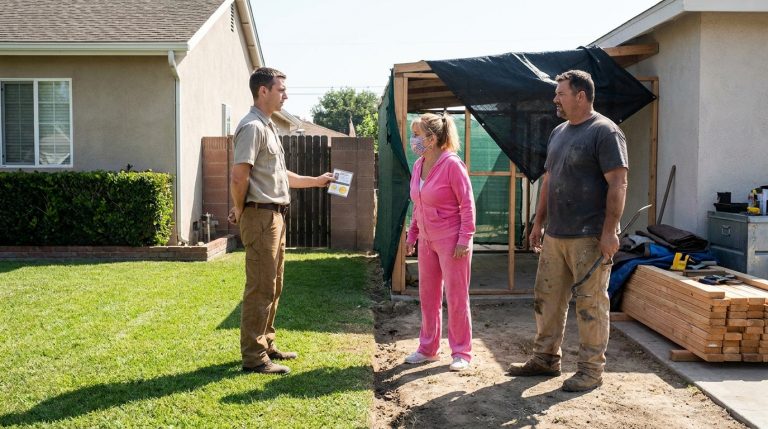
The air in the driveway was heavy, thick with the humidity of a Florida summer, but it felt frigid the moment Karen’s Lexus rolled to a halt. I was kneeling on the concrete, the rough texture of the drive biting into my knees as I secured a new porch board, but my attention shifted instantly to the figure emerging from the driver’s seat. She didn’t walk; she stalked. The floral mumu she wore did nothing to disguise the stiff, military-grade posture of a woman who viewed the world as a list of infractions waiting to happen.
She stopped at the edge of the driveway, the clipboard held against her chest like a shield. She didn’t say hello. She didn’t offer the standard suburban pleasantries of a neighbor welcoming a newcomer. She simply pointed that manicured, sausage-like finger toward the back of the property, where the spring shimmered behind the willows, a beacon of cool, dark water in the suffocating heat.
“You have until Friday, Mr. Caldwell,” she said, her voice a grating, artificial symphony of entitlement. “Fill it with dirt. If I have to do it for you, you’ll be paying for every single scoop.”
I stood up slowly, wiping the sweat from my brow with the back of my hand. My muscles were coiled, the reflex of twenty years in the Corps of Engineers kicking in before I even processed her words. I didn’t see a neighbor; I saw an obstacle. I saw a tactical error in her formation, a lack of awareness that she was stepping into a theater she couldn’t possibly control.
“It’s a natural spring, Karen,” I said, my voice steady, stripped of any defensive tone. I was already calculating the distance between us, the angle of her body, and the exact placement of the official notice she was now extending toward me.
“It’s an unapproved man-made water feature,” she countered, her eyes narrowing as she fixed on the distant glint of water. The perfume she wore—cheap, cloying, and aggressive—drifted toward me, a nauseating layer over the scent of cut grass. “The covenant is clear. Article 4, Section 2. Your property is failing to meet community standards, and as the President of the HOA, I am ensuring you align with them immediately.”
She thrust the envelope at me. It was thick, cream-colored, and smelled faintly of the same perfume. I took it, the weight of it feeling like a dossier of potential combat.
“Is that all?” I asked, looking her straight in the eyes.
She blinked, momentarily unsettled by the lack of fear or apology in my tone. She wanted a plea, a sign of weakness she could document and broadcast. Instead, she got the measured silence of an engineer inspecting a structural flaw.
“Consider yourself warned,” she snapped, pivoting on her heel with the grace of a malfunctioning machine. As she walked back to her car, I didn’t watch her retreat. I looked down at the envelope in my hand, feeling the sharp edge of the paper cut into my thumb. There was a faint smear of charcoal from the printing on the back, a smudge that felt wrong, out of place in such a pristine, controlled environment. I rubbed it between my fingers, wondering what other inconsistencies were buried in this neat, bureaucratic trap.
CHAPTER 2: The Assessment
I didn’t move for a long time. The Lexus had long since disappeared around the bend of the subdivision, leaving nothing behind but the faint, lingering scent of her perfume—a chemical, floral assault that hung in the humid air like a toxic cloud. I stared at the cream-colored card stock in my hand. It felt heavier than it should have, weighted down by the sheer audacity of the demand. My thumb traced the embossed eagle at the top. It was a cheap, faux-fascistic logo, designed to mimic authority, but the paper underneath felt expensive.
I looked back at the spring. The water was still crystal clear, unaffected by the petty, human rage that had just spilled onto my driveway. It bubbled up from the limestone, ancient and indifferent. It was my sanctuary, the reason Sarah, Leo, and I had chosen this house. We had spent twenty years living in standardized housing, dictated to by base commanders and rigid military protocols. This was supposed to be our break from that life. I hadn’t spent two decades in the Army Corps of Engineers to be pushed around by a woman who thought a mumu and a clipboard constituted a command structure.
I walked slowly back toward the house. The wood of the porch was still warm under my feet, the rotted board I had been replacing now laid to the side, forgotten. Inside, the house was quiet. Sarah was in the kitchen, the soft clatter of dishes suggesting she was still cleaning up after lunch. I didn’t want to bring this into the house yet. Not until I knew exactly what I was dealing with.
I headed straight for my office. It was a small room, tucked into the back of the ranch, with a window that offered a direct line of sight to the thicket and the spring. I set the envelope down on my desk, right beside my laptop. I pulled out my chair, the metal frame scraping harshly against the hardwood floor, a sound that seemed to shatter the house’s calm.
I opened the envelope. Inside was a formal notice, printed in a clean, professional font that stood in stark contrast to the chaotic, angry woman who had delivered it. I read it once, then again. It was a masterpiece of passive-aggressive legalese. Article 4, Section 2: Unauthorized alteration of landscape. Article 7, Section 5: Maintenance of structures. It even had the audacity to cite an Article 9: Community Liabilities. She was framing a natural spring—a geological feature that had been here long before the first developer scraped the topsoil off this land—as a man-made swimming pool.
A slow, cold burn started in my gut. This wasn’t a misunderstanding. This was a tactical maneuver. Karen didn’t care about landscaping or aesthetics. She was building a case, creating a paper trail, and she was doing it with the confidence of someone who had never been told “no.”
I reached into the desk drawer and pulled out a three-ring binder. It was the same one I had used for logistical planning back at base. I felt a grim sense of familiarity as I opened the clear plastic rings. I took a fresh sheet of paper and printed in heavy, block letters at the top: OPERATION SPRING FREEDOM.
It was a label, a way to contain the situation. I started listing the facts. Fact one: The survey, which I had memorized, clearly categorized the feature as a natural artesian spring. Fact two: The HOA covenants, while broad, made no provision for the management of natural geological features on private property. Fact three: Karen was clearly operating beyond her stated jurisdiction.
I didn’t feel angry anymore. Anger was an inefficiency; it clouded judgment, made you sloppy. Instead, I felt the calm, clinical detachment of an engineer conducting a failure analysis. I looked out the window at the water. I needed to see what she was really after. If this wasn’t about aesthetics—and it wasn’t, because a natural spring was objectively more valuable and beautiful than a manicured lawn—then what was the objective? What was the gain?
I pulled out my phone and started digging. I wasn’t looking for HOA rules; I was looking for the HOA’s history. I searched for “Harmony Creek Estates HOA financial disclosures” and “Harmony Creek property management companies.” The results were a labyrinth of shell corporations and vague, recycled boilerplate. But then, I stumbled onto a link to the Florida Department of Business and Professional Regulation.
I clicked through the pages, navigating the dry, dense bureaucratic interface. There were records of past meetings, minutes from the last three years. I started scanning, looking for patterns. Karen’s name appeared everywhere, always at the center of a decision, always pushing for “beautification” and “special projects.” And there it was—a recurring payment to a company called Creative Community Solutions. It was listed under “vendor services.”
I leaned back, my chair creaking in the silence of the room. The name of the company was generic, almost invisible. But the dollar amounts were large. Tens of thousands of dollars, billed in increments that felt just high enough to be significant but just low enough to avoid mandatory external audits.
I stared at the screen. The sharp, clean lines of the digital data felt like a map being drawn in real-time. She wasn’t just a petty tyrant; she was a predator. And she had just targeted the one thing on my property that she couldn’t control. I opened the binder and began to write. The first tab, INBOUND CORRESPONDENCE, was now populated by her notice. The second tab, RESEARCH AND INTELLIGENCE, was already growing.
I was no longer just a homeowner protecting his backyard. I was an engineer, and I was looking at the structural integrity of an entire corrupt system. She had started this war, but she had picked the wrong terrain. I would map her, track her, and eventually, I would dismantle her, piece by documented piece. I looked at the binder, the black plastic cover reflecting the late afternoon light, and I knew—this was the only way to win.
CHAPTER 3: The Reconnaissance
I stepped out onto the porch, the transition from the air-conditioned cool of my office to the thick, humid heat of the Florida afternoon hitting me like a physical blow. The sun was beginning to dip, casting long, sharp shadows across the lawn that seemed to reach toward the house like reaching fingers. My binder was tucked firmly under my arm—a solid, heavy weight that grounded me. I didn’t head for my car. I started walking.
The subdivision was quiet, too quiet. The pristine, manicured lawns of Harmony Creek Estates looked more like a set than a neighborhood. Everything was too green, too uniform, too perfectly trimmed. It was the kind of order that required constant, aggressive maintenance. I rounded the corner, my eyes scanning the driveways. Mrs. Gable’s house was two doors down.
I slowed my pace as I approached. Her garden was a riotous, colorful contradiction to the neighborhood’s beige aesthetic. A dozen small, painted garden gnomes stood guard near her front porch, their clay faces frozen in perpetual, cheerful defiance. I saw her then, kneeling near a patch of roses, her hands deep in the dark, rich soil. She didn’t look up as I stopped at the property line.
“Mrs. Gable?” I said, my voice pitched low and polite.
She stiffened. It was a subtle movement, a slight tension in her shoulders, but it was unmistakable—the flinch of a woman who had spent too many months waiting for an HOA notice to be shoved in her face. She stood up slowly, dusting off her knees, and looked at me. Her eyes were bright, but there was a guarded, wary quality to them.
“Mr. Caldwell,” she said, her voice thin. “If you’re here about the notice regarding the gnomes, I’ve already moved the ones closest to the street. I was just… I was checking the perimeter.”
“I’m not here about the gnomes,” I assured her, keeping my hands visible, relaxed. I wanted her to see that I wasn’t carrying a clipboard or a legal summons. “I’m here because I think you and I have both been dealing with the same problem.”
She looked at the binder under my arm, then back at my face. The wariness didn’t leave her eyes, but she stepped a little closer to the low hedge that separated our yards. “The problem,” she whispered, the word sounding like a secret code. “You mean the board?”
“I mean Karen,” I corrected. “I’ve been looking into the HOA’s financial records. The invoices. The ‘beautification’ projects.”
Her hand went to her mouth, a small, involuntary movement. “She’s been fining me for months, Mark. She said the garden gnomes weren’t ‘community compliant.’ She told me that if I didn’t pay the fines, she’d put a lien on the house. I don’t have the money for that. I don’t have the money to fight her.”
“You don’t have to fight her alone,” I said, feeling the weight of the binder shift. “I’m not paying the fine either. And I’m not filling in the spring.”
She looked toward my property, her expression softening. “That spring is the only beautiful thing left in this subdivision,” she said quietly. “Everyone else is so afraid. The Martinez family? They took down their basketball hoop last week because they couldn’t stand the notes she left on their door every morning. They’re kids, Mark. They just wanted to play.”
I nodded, the information settling in my mind. It wasn’t just about the money. It was about the control. Karen was systematically dismantling anyone who stood out, anyone who didn’t conform to her rigid, soulless vision of the neighborhood. She was pruning the neighborhood like she pruned the shrubs, cutting away anything that didn’t fit.
“I need to know,” I asked, keeping my tone steady. “What exactly does she do when someone challenges her? Has anyone tried?”
Mrs. Gable sighed, a sound that seemed to carry the weight of an entire year of intimidation. “The Millers tried. Last year. They had an addition on their house that wasn’t permitted, but it had been there for ten years. She went after them for a minor zoning infraction, pressured the city, threatened legal action until they just… they just moved. Sold the place at a loss and left. She’s relentless. She doesn’t just want you to follow the rules; she wants you to go away.”
I felt the cold, hard logic of the situation clicking into place. This wasn’t just a neighborly dispute. It was an expulsion strategy. And she was using community funds—our funds—to fuel it.
“Thank you, Mrs. Gable,” I said, stepping back. “I’m going to need you to hold onto those notices. Every single one of them. Don’t throw them away. I’m going to need them for the audit.”
She looked at me, a flicker of something that might have been hope, or perhaps just grim resolve, crossing her face. “An audit?”
“Yeah,” I said, turning back toward the street. “An audit.”
I walked down the sidewalk, the sun now casting long, distorted shadows across the pavement. I passed the Martinez house. Their driveway was empty, the basketball hoop gone. The space where it had been stood out like an amputation. I reached into my pocket, pulling out my phone, and opened my notes app. I didn’t write down their names; I wrote down the mechanics of what I had learned.
Targeted harassment. Selective enforcement of non-existent standards. Coerced compliance.
Karen wasn’t a general; she was an opportunist. She was using the infrastructure of the HOA as a vacuum, sucking the energy and resources out of the neighborhood and concentrating them into her own bank account. But every structure has a load-bearing point. If I could find the flaw in the foundation, if I could prove that the “community standards” were actually a front for a criminal enterprise, then the entire structure would come down.
I reached the corner of the street and stopped. I pulled out my phone and checked the property maps again. My property sat at the edge of the preserve, a key point in the drainage flow of the entire estate. I looked at the topography—the way the land sloped down toward the thicket. If there was illegal dumping, if there were toxins being pumped into the ground to cover her tracks, it would be flowing right toward the limestone bedrock, right toward my spring.
I looked back at the house, the shadow of the roofline stretching across my own yard. My spring wasn’t just a target. It was a barometer. If she was dumping, my water quality would be the first thing to show it. I needed to document the flow. I needed to see if the chemistry of the water changed.
The strategy was evolving. It wasn’t just about legal combat anymore; it was about scientific verification. I had the training for this. I knew how to map a disaster, how to contain a spill, and how to track a source. I gripped the binder, the edges sharp and cold against my skin, and began to head back to the office. The recon phase was over. Now, it was time to start the testing.
CHAPTER 4: The Legal Weapon
Frank Peterson’s office was not an office; it was a bunker for the legal profession. It smelled of old paper, floor wax, and the distinct, sharp tang of ozone from a high-end printer working overtime. There were no decorative plants, no soothing landscapes on the walls—just framed commendations, a map of the county, and a desk that looked like it had been carved from a single, indestructible block of mahogany.
He sat behind it, his sleeves rolled up to his elbows, revealing forearms roped with muscle that belonged more to a man half his age. He wasn’t looking at me when I entered; he was looking at a set of blueprints for the Harmony Creek subdivision, his eyes tracing the lines of property boundaries with the focus of a combat navigator.
“Sit,” he said, not looking up.
I took the chair, the leather cool and firm. I placed the binder on the desk. He didn’t acknowledge it immediately. He finished his trace, his finger pausing over the thicket area, the place where my spring lay hidden. Then, he looked up, his gaze intense.
“Army Corps,” he stated, more of a summary than a question. “You don’t fight with volume. You fight with weight. You build a kinetic chain.”
“That’s exactly what I’ve done,” I replied, sliding the binder toward him.
He opened it, and the room grew silent, save for the rhythmic tick of an old wall clock. He was a JAG officer—he knew what a killbox looked like. He turned the pages with a deliberate, maddening slowness. He stopped at the copies of the invoices from Creative Community Solutions. His thumb hovered over the signature line.
“Karen is sloppy,” Frank said, his voice a low, gravelly rumble. “But the people who handle the books for HOAs are usually terrified of audit trails. The fact that she’s billing the HOA for her own services under a shell company is rookie work, but it’s effective if you can pierce the corporate veil.”
“I have the property records, the survey, the state statutes, and the timeline of her harassment,” I said. “And I have the list of neighbors she’s targeted.”
Frank leaned back, the chair groaning under his weight. He looked at me, a predatory glint appearing in his eyes. “You didn’t come here to ask for advice on how to stop her, Caldwell. You came here because you know exactly how to end her, and you need the legal authority to trigger the collapse.”
“I need to make sure that when this hits the board, it doesn’t just disarm her,” I said, my voice steady. “I need to ensure that her personal assets are reachable. I need to make sure the state looks at her and sees a criminal, not just a nuisance.”
“We go for the throat,” Frank agreed. “We draft a cease and desist that doesn’t just stop her—it freezes her. We notify the HOA board members individually. We put them on notice. They have a fiduciary duty to protect the assets of the community. If we serve them, they suddenly have a massive conflict of interest if they continue to follow her lead. They will have to choose between their own financial exposure and their loyalty to the queen.”
He pulled a fresh legal pad from his drawer and started writing, the pen scratching against the paper like a marker on a map. “We frame it as a breach of fiduciary duty, embezzlement, and a pattern of coercive behavior. We cite the environmental statute—that’s the ace. If she persists in trying to ‘fill’ that spring, she is no longer an HOA president; she is a defendant in a state-level environmental crime case.”
“What about the neighbors?” I asked. “The Martinez family, Mrs. Gable. They’re afraid.”
“Fear is a temporary state of mind,” Frank replied, not pausing his writing. “Once they see you have the legal high ground and the backing of someone who doesn’t blink, their fear will translate into anger. That’s your energy source. That’s what you use to fuel the recall petition.”
He finished a paragraph, looked up, and handed me the pad. The legal language was stark, brutal, and incredibly precise. “This is the first strike. Serve it via courier. Get a signature. The moment she touches this document, the clock starts. When she inevitably overreacts—and she will—we catch it on camera. You have the recordings?”
“Every one of them.”
“Good.” Frank leaned forward, his hands flat on the mahogany. “You’ve done the heavy lifting, Caldwell. You’ve surveyed the terrain, built the barricades, and supplied the ammo. Now, we just wait for the enemy to charge into our fire.”
I left his office with the drafted documents in my folder. The air outside was cooling, the late afternoon light casting long, dramatic shadows across the parking lot. The weight of the folder was insignificant, yet I felt lighter than I had in weeks. The legal strategy was a grid—structured, disciplined, and relentless.
As I drove back toward Harmony Creek, the road ahead seemed clearer, stripped of the messy, chaotic emotions of the past few months. I checked the rear-view mirror. No one was following, but for the first time, I felt like the one doing the hunting. The binder, the legal filings, the reconnaissance—it was all coming together into a single, cohesive movement.
I pulled into my driveway, the house sitting quiet and solid in the twilight. I looked toward the thicket. I could hear the faint, rhythmic gurgle of the spring. It sounded different now—not just a feature of the landscape, but a core component of the battle. The war was no longer an annoyance; it was an operation. And I was back in my element.
CHAPTER 5: The Standoff
The machine was a Bobcat, its treaded base caked in dried, reddish clay. It sat on the flatbed of a mud-splattered truck, its bucket hanging off the rear like a predatory jaw. The engine was idling, a harsh, jagged sound that chewed through the stillness of the afternoon. Two men were climbing out of the cab. They were wearing standard-issue work shirts with a logo—ACME Landscaping—faded by too many hours in the sun. They didn’t look like villains; they looked like guys just trying to get through a shift.
I walked toward them, my pace measured. I had my phone in my shirt pocket, the camera lens facing out. I wasn’t running. I wasn’t shouting. I was approaching a problem that required a very specific kind of technical intervention. As I crossed the property line, the foreman—a man with a sunburned neck and skin that looked like cured leather—met my gaze. He held a clipboard as if it were a weapon.
“Mr. Caldwell?” he asked. His voice was tired, devoid of any genuine aggression, which somehow made it worse.
“That’s me,” I said, stopping exactly five feet from him. I didn’t enter his personal space; I established a perimeter. “You’re trespassing. I suggest you kill that engine.”
The man looked back at the idling machine, then at his partner, a younger guy who was already looking nervously toward the treeline. “Look, buddy, we got a work order. HOA president signed it. We’re authorized to fill in a low-lying basin on this lot. It’s a drainage issue, according to the paper.”
“It’s not a drainage issue. It’s a natural artesian spring,” I said. I kept my voice low, flat, and devoid of emotion. “That makes it a protected water feature under state law. I have a cease and desist filed with your client, Karen. She’s already been served. If you dump even one load of dirt into that basin, you’re not just violating a neighborhood rule—you’re committing a state-level environmental crime.”
The foreman frowned, shifting his weight. “She said you were being difficult. Said you were trying to block a legitimate maintenance request.”
“She lied,” I said, reaching into my pocket and pulling out a folded document. I didn’t hand it to him immediately; I held it so he could see the letterhead—the sharp, unmistakable branding of a law firm specializing in property litigation. “This is a direct notice of liability. If you operate that machinery, you become a co-conspirator in a criminal act. I have the Department of Environmental Protection on speed dial. Do you want to explain to a state inspector why you’re dumping fill material into a karst window?”
He took the paper, but his hands were shaking slightly. He wasn’t afraid of me; he was afraid of the paperwork. People like this were used to dealing with angry homeowners who yelled and threw things; they weren’t used to men who spoke with the quiet, terrifying precision of an engineer.
“I just work for the company, man,” he muttered, reading the letter.
“Then call your boss,” I suggested. “Tell him that the client he’s working for is trying to force him into a felony. Tell him you’ve been warned.”
His partner walked over, looking at the letter, then up at the house. I could see the wheels turning. They weren’t looking at the ‘basin’ as a landscape feature anymore; they were looking at it as a crime scene. The atmosphere shifted. The heavy, oppressive heat of the day seemed to sharpen, the shadows under the oaks looking deeper, colder.
I scanned the perimeter. About two streets down, partially obscured by the thick canopy of a sprawling oak tree, I saw the glint of a white Lexus. She was there. She was watching. She had staked out the front row to witness the destruction of my sanctuary. The realization sent a cold prickle of adrenaline down my spine. She wasn’t just directing this; she was savoring it.
“You see that car?” I asked, pointing toward the oak tree without looking directly at it. “She’s watching. She’s waiting for you to do the dirty work so she can stay in the car and claim she was just following protocols.”
The foreman looked toward the tree. He saw the Lexus. A look of genuine disgust crossed his face. He’d clearly been played, and if there’s one thing a man who works for a living hates, it’s being made a fool by someone who doesn’t.
“Let’s go,” the foreman said, his voice clipped. He didn’t even look at me again. He climbed into the truck cab, and the younger guy scrambled to strap down the Bobcat.
The truck rumbled as it reversed, the sound of the engine straining against the quiet of the neighborhood. As they pulled away, the tires kicking up a spray of gravel, I kept my phone steady. I caught the license plate, the logo, and the way the truck stalled for a second before finally accelerating away.
I didn’t turn around. I kept my gaze fixed on the spot where the Lexus had been. The tree was empty now, the car gone. She had retreated. But this was a tactical error. She had shown her hand, revealed her desperation, and provided me with witnesses who now knew exactly who she was.
I turned and walked back toward the spring. My heartbeat was steady, a rhythm of cold, disciplined purpose. I had successfully defended the perimeter, but the enemy had confirmed their intent. I needed to document the area, ensure there was no contamination, and prepare the next step of the killbox. My binder was going to be very thick by the time this was over.
CHAPTER 6: The Tribunal
The room smelled of stale coffee and the damp, metallic scent of floor wax. It was a space designed for suburban platitudes, but tonight, it felt like an interrogation chamber. I walked down the center aisle, the floorboards creaking under my boots, and took my seat in the singular, wooden chair placed facing the long table. The board sat behind it, their faces illuminated by the harsh, unflattering glare of overhead tubes that seemed to strip away any pretense of warmth.
Karen was in the center. She wore a blazer of aggressive, polished purple, the color of a bruised twilight. Her gavel—a toy-like piece of wood—rested by her right hand. To her left sat Janice, her pen hovering over a notepad like a scalpel, and to her right, Barry, whose eyes were wide and twitching, darting around the room as if he were trying to find an exit.
The room was packed. I could feel the heat radiating from the bodies crowded against the walls, the air thick with the smell of nervous sweat and stale perfume. Mrs. Gable was in the second row, her purse gripped with white-knuckled intensity. The Martinez family huddled near the back, their youngest child clutching a stuffed animal, his eyes wide with a confusion that mirrored the adults’.
“This special hearing of the Harmony Creek Estates Board of Directors is now in session,” Karen announced. Her voice didn’t boom; it echoed, sharp and sterile. “We are here to address the ongoing violations at Lot 72, the property of Mr. Mark Caldwell. We are here because the board will not tolerate the willful, flagrant disregard for the covenants that maintain the value and standard of our community.”
She shifted into her script, a rehearsed, melodic litany of my ‘crimes.’ She listed the unapproved landscaping, the ‘unregulated basin,’ and the refusal to pay the escalating fines. She spoke with a smooth, practiced ease, but I noticed the subtle, tell-tale signs of her anxiety: the way she kept tapping the edge of the gavel, the way her gaze never quite settled on me, but instead darted to the rows of homeowners behind me, searching for support that wasn’t there.
I didn’t fidget. I didn’t reach for the binder yet. I sat still, my hands resting on my knees, letting the silence of the room grow uncomfortable. Every time she finished a sentence, she paused, waiting for an outburst from me, a moment of raw, defensive anger she could use to paint me as the villain. I gave her nothing.
“Mr. Caldwell,” she said, finally turning her eyes toward me. The artificiality of her expression was breathtaking—a mask of cold, bureaucratic concern. “This is your final opportunity to agree to comply. Will you commit, here and now, to draining and filling the unapproved pool and removing the associated structures, or do you leave us no choice but to escalate this to a formal, irrevocable lien?”
The room went deathly quiet. I could hear the hum of the air conditioning unit, a distant, mechanical drone. I stood up slowly. I kept my movements deliberate, showing no aggression, only a profound, grounded weight. I didn’t look at Karen. I turned, pivoting until I was facing the room.
“I’m not here to talk to the board,” I said. My voice was low, but it projected, bouncing off the beige walls with a clarity that silenced the murmurs. “I’m here to talk to the people who actually own this community.”
“You are out of order!” Karen barked, her hand slamming the gavel down. The sound was thin and pathetic, a plastic pop against the heavy silence. “You are here to answer for your violations!”
I ignored her. “I moved here for the peace of this place. I found a natural spring—a protected state asset—that has been part of this land for centuries. And for that, I’ve been harassed, fined, and threatened with legal action by a woman who claims to be protecting our standards, but who is actually protecting her own private interests.”
I looked at the Martinez family. “They told you your basketball hoop was a liability. They told you it lowered property values. But have you asked where that fine money went? Have you asked why the landscaping budget has exploded in the last three years while the maintenance of our actual roads and common areas has languished?”
A ripple of unrest moved through the crowd. Someone coughed. A chair scraped.
“You’re a liar!” Karen shrieked, her mask finally slipping, revealing the raw, frantic desperation underneath. She reached for the gavel again, but her hand hovered, trembling. “These are baseless, defamatory accusations!”
“I have the invoices,” I continued, my voice gaining strength, not from anger, but from the simple, crushing weight of truth. I reached down, finally, and grabbed the binder. I didn’t open it. The sheer bulk of it was enough. “I have the records of payments to Creative Community Solutions. I have the registration documents. And I have the timeline of how these ‘projects’ perfectly coincide with the fines levied against every family in this room.”
Barry, the treasurer, turned a shade of gray that suggested he was about to pass out. Janice stopped writing, her pen held suspended in mid-air.
“Karen,” I said, finally turning to face her. The room was so still I could hear my own breathing. “You don’t want to talk about landscaping. You want to talk about how you’re going to cover the deficit before the state audit hits. But the audit is already coming. And it’s not coming because of the spring. It’s coming because of the money.”
Karen stood up, her blazer appearing oversized now, the purple fabric hanging off her shoulders like the costume of a failed actor. She opened her mouth to speak, but the words died in her throat. She looked out at the room, searching for her sycophants, her defenders, her status. She found only cold, hard, judging stares.
The dam had broken. The silence wasn’t just quiet anymore—it was a weapon. I had done my job. I had initiated the collapse.
CHAPTER 7: The Unearthing
The clubhouse was emptying out, a chaotic flood of neighbors whispering, laughing, and shaking their heads in disbelief. I stayed near the front table, my movements deliberate as I gathered the scattered pages and the USB drive that had been the cornerstone of our victory. Barry, the treasurer, was hovering nearby, looking like a man who had narrowly escaped a firing squad. He wouldn’t meet my eyes.
“Mark,” he stammered, his fingers knotting together. “I… I hope you understand. I didn’t know the extent of it until the end. She threatened me, too. She said if I questioned the Creative Community Solutions invoices, I’d be replaced.”
I didn’t answer him. I was busy flipping through the final pages of the stack I’d gathered. My thumb stopped on a document that didn’t look like an invoice. It was a waste management manifest, outdated and stained with coffee, dated six months before we’d even closed on our house. It listed a pickup location—our property address—and a disposal destination for “industrial-grade cleaning agents and synthetic solvents.”
The air in the room seemed to thin. I looked at the date, then at the name of the disposal company—a generic, regional outfit that had been liquidated shortly after the transaction. My heart hammered against my ribs, a dull, thudding rhythm of realization. This wasn’t about the swimming pool or the landscaping. This was about the spring.
I looked at the spring’s location on the subdivision map that Frank had pinned to the wall earlier. The drainage path ran directly from the back of the house, where a small concrete slab sat hidden under decades of overgrowth, straight down into the karst window.
“Barry,” I said, my voice dangerously level. I held up the manifest. “What is this?”
He glanced at it, his face losing what little color it had left. “I don’t know. That was from the old owner’s file. Karen told me to archive everything, but she said that specific box was off-limits. She called it ‘pre-HOA historical data.’ I never even looked at it.”
I felt the sharp, cutting edge of a truth I hadn’t prepared for. The embezzlement wasn’t the final reality; it was the decoy. It was the frantic, panicked attempt by Karen to keep the neighborhood from poking around in the history of that property, to keep anyone from ever digging deep enough to find what was buried beneath the deck. If those chemicals had been dumped here years ago, they were still in the aquifer, leaching out with every rainstorm, poisoning the very water I had been claiming was pristine.
I shoved the document into my binder. The victory in the clubhouse, the recall of the board, the humiliation of Karen—it all felt small now, a superficial win in a game with far higher stakes.
I left the clubhouse without a word to anyone. The night air was cool, the sky a deep, bruised indigo. I walked straight to my car, the binder clutched against my chest. Every step felt heavy, the gravity of the situation finally settling into my bones. I wasn’t fighting a petty bureaucrat anymore; I was fighting an environmental catastrophe that had been sitting in my backyard for years.
When I reached my house, the property looked different under the pale moonlight. The thicket of willows, which had been my sanctuary, now looked like a shroud. I parked and didn’t even go inside. I grabbed a flashlight from the glove box and headed straight to the edge of the property, near the thicket.
The ground here was soft, overgrown with invasive vines and shadowed by the oaks. I shone the light toward the concrete slab I’d noticed during our first week, the one I’d intended to clear off eventually. I knelt, pushing aside a tangled mat of ivy. The concrete was cracked, the edges jagged and stained. It wasn’t just a slab. It was a capped vent, a makeshift lid for a drainage well that had been intentionally bypassed and buried.
I knelt there, the flashlight beam trembling slightly. My military training had taught me how to identify the signs of a contaminated site—the way the vegetation grows thin and yellow, the unnatural chemical sheen that sometimes sits on the surface of standing water. I shone the light toward the spring. The water was still clear, but looking at it now, with the manifest in my mind, I saw the unnatural stillness of it, the way it seemed to hold its breath.
Karen hadn’t been trying to fill the spring because she was a power-mad HOA president. She was trying to fill the spring because she was the one who had helped the previous owner dump the waste, and she knew that if the state ever tested the water quality for a residential permit, the trail would lead directly back to her.
I sat back on my heels, the cold dampness of the earth soaking into my jeans. The “victory” tonight had just been a distraction. The real war was just beginning, and this time, the enemy wasn’t just a person. It was the poisoned earth beneath my feet. I turned the flashlight off, plunging the yard into darkness, and sat there, listening to the silence of the spring, waiting for the first light of morning to start the work of exposing the truth.
CHAPTER 8: The Final Resolution
The beam of my flashlight cut through the darkness, illuminating the jagged, rusted edges of the metal cap I’d spent the last hour unearthing. Beneath the layer of dirt and tangled ivy, the steel was corroded, but the seal held firm—a testament to how much effort had been invested in hiding what lay beneath. My hands were stained with dark, damp earth, and my muscles ached with a rhythmic, pulsing exhaustion.
I didn’t need to pry it open to know what was inside. The manifest in my binder and the proximity to the spring told the whole story. Karen hadn’t been fighting for the community; she’d been fighting to keep the neighborhood from seeing the rot that would have turned their property values into zero.
A twig snapped in the darkness.
I didn’t jump. I didn’t reach for the light. I simply stood up, the movement slow and deliberate, and turned toward the sound. The beam of my light caught a flash of movement near the treeline. It was Karen. She stood there, her posture no longer the rigid, imperious stance of a neighborhood queen, but the hunched, desperate frame of a cornered animal. She wasn’t wearing her purple blazer. She was in a simple trench coat, her hair disheveled.
“You should have left it alone, Mark,” she said. Her voice lacked its usual cadence of entitlement. It was flat, hollowed out by the sheer weight of what she was facing.
“You dumped toxic waste into the aquifer,” I said, my voice steady, the cold precision of an engineer cutting through the night air. “You didn’t care about the spring’s aesthetics. You cared about the liability. You were trying to fill it in to bury the evidence.”
She stepped forward, her face illuminated by the harsh, unflattering beam of my light. There was no defiance left, only a weary, frantic fear. “Do you have any idea what happens if this comes out? The fines, the remediation, the lawsuits… this entire neighborhood would be declared a hazard. I did what I had to do to keep things… stable. To keep the value of our homes from collapsing.”
“You did it to cover your own tracks,” I countered. I didn’t raise my voice. I didn’t need to. “You weren’t saving the neighborhood, Karen. You were protecting your own investment, and you were willing to poison everyone here to do it.”
I pulled my phone from my pocket. I had been recording since I stepped outside. The red dot was still blinking, a tiny, digital pulse in the dark.
“I already called the DEP,” I said. “And I sent the manifest and the coordinates of this well to Jessica Vale at the local news station. By morning, there will be state inspectors everywhere. There’s no more ‘stable,’ Karen. There’s just the truth.”
Her face crumbled. It wasn’t a sudden collapse; it was a slow, painful dissolution of the persona she had built over years of petty tyranny. She leaned against one of the oak trees, her breath coming in shallow, ragged gasps. For a second, the image of the purple-blazered general was completely gone, leaving behind only a broken, scared human being. She didn’t argue. She didn’t threaten. She just sank down onto the damp grass, her head in her hands.
The sirens began to wail in the distance—the first hint of the state response, the cavalry I hadn’t had to call for because the law had already been set in motion.
The following weeks were a blur of activity—a methodical, systematic unearthing. The DEP moved in with heavy machinery, capping the well, testing the soil, and isolating the plume of contamination that had been slowly bleeding into the water table. The remediation was slow, painful, and expensive, but it was thorough. The new board, with Mrs. Gable as their voice of reason, navigated the fallout with a grace that surprised everyone.
I stood on the deck one final time. The thicket had been cleared back, the area now marked by a series of monitoring wells. The spring itself was fenced off, awaiting further evaluation, but the water that bubbled up was no longer a symbol of conflict. It was a witness.
I held the small, precision calipers in my hand—the ones I’d used to measure the depth of the soil, the ones that had become my silent partners in the hunt for the truth. I adjusted the slide, feeling the smooth, cold resistance of the metal. I’d spent so long trying to fix the rot, to build a wall against the chaos, only to realize that true order didn’t come from forcing things into place—it came from cleaning out the corruption that had made the struggle necessary in the first place.
Sarah stepped out onto the deck, her hand resting gently on my shoulder. We didn’t say anything. The air was cool, the evening breeze carrying the smell of ozone and wet earth. The neighborhood was quiet, the sound of the Martinez kids playing in their yard replaced by the low, steady hum of the cleanup crew.
I looked at the spring. The water was clear, a deep, resonant blue. I didn’t fix it, and I didn’t force it. I just allowed the truth to clear the obstruction. I placed the calipers on the railing, the metal catching the last of the fading sun, and turned back to the house. The binder was gone, the office was clean, and for the first time in years, the silence didn’t feel like a threat. It felt like a foundation.