The Searing Debt: A Desperate Choice Beneath the Blistering Sierra Valley Sun
CHAPTER 1: THE SEARING CONCRETE
The sun hung over Sierra Valley like a furnace door left wide open. The air didn’t just sit; it pressed, heavy and metallic, against Kai’s lungs. He leaned into the squeak of his shopping cart, the rhythm of the rusted wheels providing a steady, frantic metronome to his thoughts.
Thirty-seven dollars. It was a pathetic, meager sum that smelled of damp cardboard and stale aluminum. He needed eighteen more to keep the quiet, steady hum of his grandmother’s heart monitor from stopping altogether.
The back lot of the Brightpoint center was a desolate grid of cracked asphalt, shimmering with heat-haze. It was where the desperate came—the ones who couldn’t afford the luxury of the covered garage. Kai’s gaze swept the ground, his eyes mapping the litter like a predator.
Then he heard it.
A dull, wet sound—the rhythmic thud of a hand hitting the interior of a door. It was the sound of a trapped thing.
Kai dropped the handle of his cart. The squeaking stopped, leaving a silence that felt dangerous. He moved toward the black SUV, his boots dragging through the heat-softened asphalt. His skin pricked with a sudden, localized frost, a stark contrast to the boiling air. He reached the driver’s side, the metal of the car door vibrating under his touch.
He leaned in, his vision narrowing to a pinhole. Through the dark tint, he saw the man. Slumped, a portrait of ruin, his face an unnatural, bruised crimson. There was a slick, dark stain on the upholstery that didn’t look like soda.
“Hey,” Kai rasped. His throat was desert-dry. “Sir?”
Nothing. Only the shallow, hitching rattle of a chest struggling to process oxygen.
Kai checked his pocket. The flip phone was dead. He pounded on the window, his knuckles screaming in protest against the heat of the glass. The man’s arm drifted, a limp pendulum, hitting the door again.
He moved to the rear door. Locked. He tried the handle, his grip slick with sweat. He was a cage, and the man inside was the bird. The fear began to crawl up Kai’s spine—a cold, parasitic memory of a different closet, a different heat. He backed away, his heart hammering against his ribs like a panicked bird.
He had to get in. Not because he wanted to be a hero, but because the alternative was a silence he couldn’t afford to live with. He scanned the curb, his eyes locking onto a jagged chunk of construction rebar jutting from the dirt. He grabbed it, the rough metal biting into his calloused palm, the sting a grounding reality.
He turned back to the car. He wasn’t a savior; he was a thief of time, and he was about to steal back a life. He wedged the steel into the door frame, his muscles locking, his breath hitching. As he pulled, his eyes flickered to the passenger seat. There was a gap where the glove box should have been, a hollow space that suggested something had been ripped out recently.
The glass didn’t break. The frame groaned. The man’s eyes flickered open, but they weren’t seeing Kai. They were looking at something behind the boy—a shadow that didn’t belong in the parking lot.
CHAPTER 2: THE COLD IRON
The rebar buckled. Not the car door, but the metal bar itself, twisting into a useless question mark under Kai’s grip. His hands were raw, the skin already weeping a thin, translucent plasma from the friction. He didn’t let go, his pulse hammering against his temples like a trapped insect.
The man inside—the one with the bruised, purple-red face—was no longer looking at nothing. His gaze was anchored, sharp, and fearful. He blinked, a slow, laborious motion, and his mouth worked, a dry click of teeth.
“Don’t,” the man wheezed. The sound was like dead leaves skittering across pavement.
Kai froze, the rebar clattering to the asphalt. The sound echoed off the brutalist concrete walls of the Brightpoint center, a gunshot in the midday stillness. “I’m trying to help,” Kai snapped, his voice cracking with the strain of the heat. “You’re cooking in here.”
“Not… the car,” the man whispered. His eyes shifted again, tracking something—or someone—near the loading dock.
Kai turned. The auxiliary lot was still a wasteland of shimmering heat waves, but the perspective had shifted. From this angle, crouched beside the SUV, the shadow of the security booth looked like a monolithic blade. A flicker of movement—a heavy-set silhouette retreating behind tinted glass—caught his eye.
The security guard. He had been watching. All of it.
“Get out,” the man in the car choked out, his fingers clawing at the center console. He shoved a hand into the hollow space where the glove box should have been, his face twisting in a rictus of agony. “They… they’re watching.”
“Who is watching?” Kai leaned closer, his forehead pressing against the glass. The metal of the door was hot enough to brand him, a searing reminder of his vulnerability.
The man didn’t answer. He slumped, his forehead hitting the steering wheel with a hollow thunk. His wallet, a thick leather brick that had been visible on the passenger seat moments ago, was gone. Kai blinked, his heart skipping a beat. He was certain it had been there—a flash of brown leather against the gray fabric. He had looked away for less than a second to grab the rebar, and now the seat was empty.
The realization hit him with the force of a physical blow: he hadn’t been the only one watching.
“Hey!” Kai shouted at the parking lot, his voice raw. “Who’s there?”
Silence was his only answer, heavy and suffocating. The heat seemed to thicken, pressing down on him until he could feel the moisture being sucked directly out of his skin. He lunged for the rear handle again, this time ignoring the pain in his palms. He wasn’t thinking about the law anymore, or the grandmother waiting in a sterile room five floors above the street. He was thinking about the missing wallet.
He gripped the top of the rear door, wedged his fingers into the seal, and pulled. His muscles screamed. The seal held, then popped. A thin line of daylight appeared. He shoved the rebar back in, using the leverage to force the frame. The window glass, weakened by the internal temperature and the warped frame, finally gave up. It didn’t shatter into shards; it crumbled into a dull, crystalline pile of safety glass.
Kai reached through, his arm brushing against the man’s limp shoulder. The skin was burning—a dry, feverish heat that felt like a furnace. He hit the lock.
Click.
The door swung open, and the smell of trapped air, stale sweat, and something metallic and sharp rushed out to meet him. Kai dragged the man out, the dead weight testing his equilibrium. His boots skidded on the asphalt. The man was taller, lankier than he looked, a collection of brittle bones wrapped in expensive, ruinous fabric.
As he hauled the man toward the meager strip of shade near the building’s foundation, Kai’s foot struck something hard. He glanced down. A key fob, sleek and modern, lay in the dust. He scooped it up, his fingers trembling. It wasn’t the car’s key. It was a digital access card—a proximity badge with the logo of a firm Kai didn’t recognize.
“You…” the man groaned, his head lolling back against the concrete. His eyes were milky, searching. “You… you shouldn’t have.”
“Save your breath,” Kai said, his voice hard. He looked back at the SUV. The shattered window looked like a jagged, accusing eye. He could see the interior clearly now. The center console had been dismantled, the wiring pulled out in a precise, surgical mess. This wasn’t just a heat stroke victim; this was a man who had been hiding from something that had finally caught up to him.
Kai looked at the security booth again. The curtain was drawn tight. He was alone with a dying man and a mystery that was already starting to feel like a trap. He pulled his phone from his pocket. The screen was black—dead, completely unresponsive. He hadn’t just been watching the car; someone had been watching the boy.
The sirens wailed in the distance, a thin, rising scream of impending order. Kai stood, his shadow long and distorted against the heat-bleached wall, and realized with a jolt of cold terror that the law wasn’t coming to save him—it was coming to find the evidence he was currently holding in his hand.
CHAPTER 3: THE HOSPITAL BED
The red and blue lights didn’t just flash; they bled across the asphalt, painting the shattered window of the SUV in violent, rhythmic strokes. Kai stood over the man—Ethan, he’d heard the paramedics call him—and felt the weight of the digital badge in his pocket like a burning coal. He looked at the security booth one last time. The curtain remained still, a dead, unblinking eye.
He didn’t wait for the officers to reach him. He couldn’t. The panic that had been simmering in his gut flared, cold and sharp. He needed to be invisible. He grabbed his cart—its squeak sounding like a scream in the sudden quiet—and began to push it toward the perimeter of the lot.
“Hey, kid! Stop right there!”
The shout came from a stocky officer stepping out of the patrol car, his hand already resting on his holster. Kai’s lungs tightened. The air suddenly smelled of ozone and stale, confined dust—the exact smell of that warehouse closet from years ago. For a heartbeat, the parking lot dissolved. He wasn’t in the Brightpoint lot; he was back in the darkness, the heat pressing against his skin like a physical hand, the metal door immovable, silent, suffocating.
He was a kid again, gasping for air that didn’t exist.
“Kid!”
The shout broke the phantasm. Kai jolted, his knuckles white on the cart handle. He didn’t turn back. He veered left, darting behind a row of concrete bollards, the squeaky wheel giving a violent thwack-thwack-thwack against a gap in the pavement. He couldn’t go back to the hospital, not if they were looking for him. But the medicine. The medication for his grandmother was the only thing that kept the world from folding in on itself.
He ducked into an alleyway, the shadow providing a temporary, cool respite from the furnace heat of the lot. His breath came in ragged, shallow gulps. He shoved the digital badge deep into his jeans pocket. It felt jagged, alien, a piece of a puzzle he wasn’t meant to solve.
He reached the hospital service entrance by cutting through the maintenance tunnels, his boots silent on the damp, concrete floor. The air here was cooler, smelling of bleach and industrial cleaner. He needed to reach the fifth floor. If he could just get to her room, he could hide, catch his breath, and figure out why a man in a black SUV was carrying a high-security access card to a firm that didn’t exist on any map he knew.
The elevator lobby was empty. Kai pressed the button for the fifth floor, his fingers trembling. He checked his reflection in the brushed-steel doors. He looked like a criminal—sweat-streaked, eyes wide and bloodshot, hands stained with grit and dried blood. He didn’t look like a hero. He looked like exactly what the guard had accused him of being.
When the doors slid open, he stepped into the fifth-floor corridor. It was hushed, the only sound the distant, rhythmic beep of monitors. Room 512 was halfway down the hall. He walked, his heart slowing, the adrenaline giving way to a bone-deep exhaustion.
He pushed the door to 512 open, expecting to see his grandmother resting.
She was there, yes, but the room was different. The monitors were gone. The oxygen tank had been wheeled away. The bed was stripped to the mattress, the sheets piled in a white heap in the corner.
Kai felt the floor tilt. “Grandma?”
His voice was a hollow whisper. He rushed to the bed, gripping the cold metal frame. The room was vacant, clinical, and stripped of everything that made it her room. There was no sign of a struggle, no discarded items. Just empty space.
“She was transferred,” a voice said from the doorway.
Kai spun around. A nurse he didn’t recognize stood there, holding a tablet. She looked at him with an expression of professional, detached pity.
“Transferred? Where?” Kai’s voice rose, the panic surging back. “She’s stable. You said she was stable!”
“The hospital administration received an urgent directive,” the nurse said, not looking at him. “Your grandmother’s file was flagged for immediate transfer to a private facility in the valley. We were told you’d be notified.”
“Flagged? By who?”
“I don’t have that information, Kai. I’m just following the log.”
Kai reached into his pocket and his fingers brushed the hard, plastic edge of the digital badge he’d taken from the SUV. The realization hit him, cold and absolute: the man in the car, the broken window, the missing wallet, and the sudden disappearance of his grandmother—it wasn’t a coincidence. It was a sequence. He wasn’t just a witness; he was a liability.
He looked at the nurse, who was already turning to leave, and realized he couldn’t ask for help. He couldn’t tell them about the car, or the guard, or the badge. He had to find her himself.
“Wait,” Kai said, but the nurse was already walking down the hall, her footsteps disappearing into the hum of the hospital. Kai looked at the empty room, his hand tightening around the badge in his pocket until the sharp edges bit into his skin, a sharp, grounding reminder of the game he had been unwillingly drafted into. He was alone in the corridor, and for the first time, he understood that the silence of the hospital wasn’t peace—it was the quiet before a much larger storm.
CHAPTER 4: THE WAITING ROOM ENCOUNTER
Kai didn’t run. Running attracted eyes, and eyes were the one thing he couldn’t afford. He walked out of the fifth-floor ward with his head down, his pulse thrumming in his throat. The hallway seemed longer now, the white linoleum floor stretching toward the elevators like a vast, unblinking expanse of frozen light. Every shadow cast by the fluorescent tubes felt like an ambush waiting to happen.
He reached the elevator lobby just as the doors were closing. He squeezed through the gap, his shoulder catching the metal edge. The car was empty, save for a man in a rumpled suit standing near the corner. Kai retreated to the opposite side, keeping his face turned toward the closing doors.
The man in the suit shifted, the rustle of fabric loud in the small, metallic space. Kai kept his gaze on the floor, watching his own reflection in the brushed-steel doors—a boy who looked less like a hero and more like a ghost. He reached into his pocket, his hand curling around the proximity badge. He needed to know what it opened.
The elevator pinged, the doors sliding open to the ground floor.
Suddenly, a harsh, discordant screech tore through the lobby—the building’s fire alarm. It wasn’t the rhythmic chime of a drill; it was a jagged, piercing scream. Red strobes began to pulse, bathing the lobby in a rhythmic, violent crimson.
“Evacuation in progress,” an automated voice boomed. “Please proceed to the nearest exit.”
Panic erupted. Visitors, nurses, and patients rushed toward the doors, a tide of bodies forcing Kai into the fray. He was pushed, buffeted by people in a state of semi-controlled chaos. He stumbled, his hip slamming into a metal utility cart. The man in the rumpled suit he’d shared the elevator with was suddenly at his side, not pushing, but guiding him.
“This way, kid,” the man said, his voice clipped, professional. “Emergency stairwell. It’s faster.”
Kai looked up. The man had sharp, angular features and eyes that didn’t match the forced calm of his expression. He was gripping Kai’s arm, his fingers strong, like iron bands. Kai felt a jolt of instinctual revulsion. He tried to pull back, but the man held firm.
“I can find my own way,” Kai said, trying to shake the grip.
“There’s a fire, son. Don’t be stupid.”
The crowd surged, pulling them toward the stairwell door. Kai caught a glimpse of the man’s lapel—there, half-hidden by a cheap raincoat, was a pin: the same logo that was etched onto the badge in Kai’s pocket.
The realization hit him with the force of an electric shock. The badge wasn’t just a key; it was a beacon.
As they reached the heavy steel door of the stairwell, Kai slammed his weight against the man’s grip, twisting out of his hold. “I said no!”
He ducked into the dense mass of people moving toward the main lobby, his heart hammering against his ribs. He didn’t look back to see if the man was following. He wove through the crowd, his thin frame allowing him to slip past the surging wall of panicked visitors. He reached the main entrance, but it was blocked by a wall of security personnel.
He darted into the waiting room, the room where he had seen Ethan weeks ago. It was nearly empty now, most people having fled. He crouched behind a row of molded plastic chairs, his chest heaving. He needed to be invisible. He needed to think.
If they were here—if the firm that had taken his grandmother was already inside the hospital—then she wasn’t just transferred. She was a hostage. They were using her to ensure that whatever was in that SUV stayed buried.
Kai looked at the proximity badge, his thumb tracing the logo. It wasn’t just a piece of plastic; it was his leverage. But it was also his target. He reached into his other pocket and pulled out his phone. It was still dead, but he remembered the number Ethan had muttered during his delirium in the hospital room—a frantic, whispered series of digits that had sounded like an address.
He didn’t have a map. He didn’t have a plan. But he had a target. He stood up, his legs shaking, and moved toward the window overlooking the ambulance bay. A black sedan, its engine idling, was parked near the bay doors. The man in the rumpled suit was walking toward it, talking into a lapel mic.
Kai gripped the badge tight. He had to know what was in that SUV’s console, and he had to know where they’d taken his grandmother. He moved toward the side exit, his footsteps silent on the carpet. He wasn’t the boy who collected cans anymore. He was the only thing standing between the truth and the people who were currently trying to erase it.
He stepped out into the cool, smoke-filled air of the ambulance bay, the scent of burning insulation hanging heavy. He had to be smarter than them. He had to be faster. And for the first time, he realized that if he wanted to save her, he was going to have to stop acting like a victim and start acting like the person who had smashed that window—a person who knew exactly when to strike.
CHAPTER 5: THE PAPER TRAIL
Kai didn’t look back at the bay. He moved with a predatory silence, hugging the perimeter of the brick wall until he reached the parking structure’s rear. His breath hitched—sharp, shallow needles of air—as he pressed himself into the corner of the structure. The black sedan he had seen earlier was now creeping toward the exit, its headlights extinguished. It was moving with the slow, deliberate grace of a hunter.
He reached into his pocket. The proximity badge was cold, its surface etched with the subtle, interlocking lines of a logo he was starting to see everywhere—in the nurse’s hurried movements, in the way the security guard had looked at him, in the very structure of the hospital’s sudden, quiet evacuation. It was a firm called Aegis Dynamics.
He didn’t know what they built, but he knew they had built a cage for his grandmother.
He turned toward the city streets. He needed to find a library or an internet cafe—anywhere with a terminal—to look up the name. His hands were shaking, not just from the adrenaline, but from a growing, gnawing hunger. He hadn’t eaten since the soup, and his body was beginning to betray him, his legs feeling like lead pipes.
As he crossed the street, the black sedan turned the corner, its tires whispering against the asphalt. Kai ducked into the mouth of a narrow service alley behind a strip mall. He leaned against a rusted dumpster, his vision swimming. Was that car following him, or was his brain just fraying at the edges? He blinked, trying to clear the haze. The streetlamps flickered—a stuttering, sickly yellow—and for a second, he saw the car again, idling at the intersection. Then, it was gone. He pressed his palms against his eyes. The exhaustion was a phantom, dragging him toward the dark, but he pushed it down, focusing on the sharp pain of his cut forearm.
He found it three blocks over: a cramped, fluorescent-lit internet cafe that smelled of burnt coffee and ozone. He slipped into a corner booth, his back to the wall, and pulled out his dead phone. It was useless. He looked at the keyboard. Aegis Dynamics.
The search results were sparse, intentionally so. The company didn’t have a corporate office listed in the valley. Instead, the results pointed to a series of shell corporations, real estate holdings in the industrial district, and a long-standing contract with the county’s medical infrastructure. They didn’t just provide security; they managed the data flow for hospitals. They were the ones who controlled the patient records, the ones who decided who got medicine and who got “transferred.”
Kai’s heart went cold. He clicked on a file—a leaked contractor report from two years ago. The firm had been investigated for “unauthorized patient management”—a polite term for holding patients hostage to secure funding or cover up corporate negligence.
He was staring at the screen when a shadow fell over his terminal.
He spun around. No one was there. Just an empty row of flickering monitors. He checked the window. The black sedan was parked across the street. The driver was sitting perfectly still, looking up at the cafe window.
Kai didn’t wait. He grabbed a handful of paper napkins, scribbled the address listed in the contractor report—a warehouse on 4th and Industrial—and bolted. He hit the back exit just as the front door of the cafe chimed. He didn’t look to see who entered.
He sprinted into the labyrinth of the industrial district, his lungs burning. The streets here were dead, dominated by corrugated metal warehouses and chain-link fences that scraped his skin as he scrambled over them. His world had narrowed down to the sensation of concrete under his feet and the desperate, singular need to reach that warehouse.
He heard footsteps behind him—rhythmic, heavy, and persistent. They weren’t trying to be quiet anymore. They were herding him.
He reached the corner of 4th and Industrial. The warehouse loomed ahead, a hulking, windowless monolith in the moonlight. The gate was partially open, a sliver of dark space that looked like a jagged wound in the fence. He didn’t think about the risk. He didn’t think about the man in the sedan. He thought about the empty hospital room, the stripped mattress, and the way the nurse had looked at him.
He slipped through the gap in the fence and into the shadow of the warehouse. His world was shrinking, the walls closing in, but he had the badge, he had the address, and he had the cold, sharp resolve of a boy who had already lost everything he held dear. He reached the heavy rolling door of the warehouse and saw a small service entrance, locked with a digital keypad.
He looked at the badge in his hand, then at the keypad. He pressed the badge against the sensor.
The light turned green.
CHAPTER 6: THE ARCHITECTS SECRET
Kai pushed the door. It swung open with a hydraulic smoothness that defied the rusted exterior. He stumbled inside, his boots clicking on polished, anti-static flooring. The air hit him instantly—not the thick, metallic heat of the outside, but a sterile, recirculated chill that smelled of ozone and synthetic lemon.
This wasn’t a warehouse. It was a data center, or something far more complex.
Rows of towering server racks hummed in the dark, their status lights blinking in a synchronized, oceanic rhythm of deep blue. Kai stood at the threshold, his breathing ragged, trying to reconcile the rotting industrial shell he’d just entered with the high-tech interior. He moved forward, his shadow stretching long and distorted across the floor.
He didn’t need to find a map; he followed the cables. They ran like thick, black veins along the ceiling, funneling toward a centralized hub in the middle of the hall. He kept his hand in his pocket, his fingers curled around the proximity badge. It was getting warm—a subtle, vibrating heat that suggested the internal chip was active, pulsing in response to the facility’s security grid.
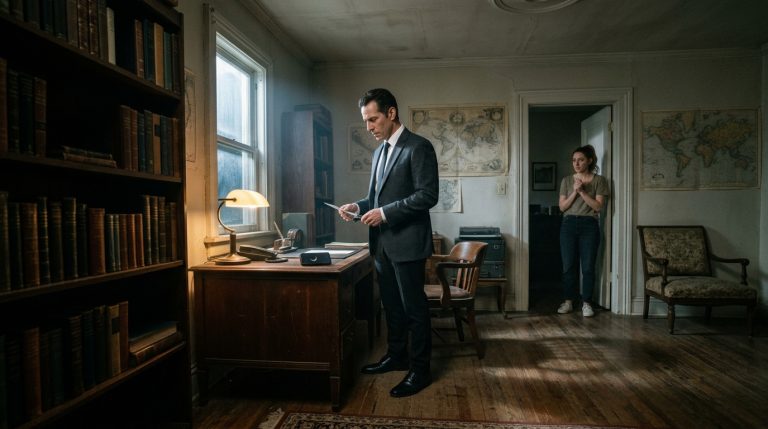
He crept toward the hub. A glass-walled office sat at the center of the room, elevated above the rows of servers. Through the glass, he could see a single desk, an array of monitors, and a sprawling, complex architectural blueprint spread across the surface.
Kai climbed the short, carpeted staircase to the office. The silence of the room was absolute, a pressurized stillness that made his ears pop. He reached the desk. His gaze fell upon the blueprints. They weren’t just designs for a building; they were floor plans for the Sierra Valley Medical Center, specifically the fifth floor—the ward where his grandmother had been.
He touched the paper. It was printed on heavy, high-grade stock, marked with the Aegis Dynamics seal. But there were annotations—red, handwritten scribbles detailing the exact location of the security cameras, the ventilation shafts, and the bypass codes for the emergency override. They hadn’t just moved his grandmother; they had prepared a map for her erasure.
He flipped the page. Underneath was a folder. He opened it, his hands shaking. It contained patient files—dozens of them, all labeled “Strategic Assets.” He found his grandmother’s file, dated only hours ago. It was marked PENDING CONSOLIDATION.
His blood went cold. Consolidation. It was a corporate term for liquidation, for the total deletion of a liability.
He needed to download this, to copy it, to take it to someone—the police, a reporter, anyone. He looked for a terminal, a USB port, something. His fingers flew across the desk, searching for a drive. That was when he saw it: a framed photo on the desk, half-hidden by a coffee mug.
It was a photo of the man from the SUV, Ethan. Younger, smiling, standing next to a woman who looked strikingly like the nurse he’d seen earlier that day at the hospital.
Ethan hadn’t just been a victim of a heat stroke. He was an architect—the man who had designed the very infrastructure Aegis was now dismantling. He had been an insider, and he had been systematically pushed out of his own life. The “drunken pass-out” in the parking lot wasn’t a reckless mistake; it was an extraction, a failed one that Kai had accidentally interrupted.
The hum of the servers shifted pitch—a rising, discordant whine.
The floor lights turned from a steady blue to an aggressive, pulsing amber. A voice, cold and synthetic, filled the room. “Security breach detected. Access denied.”
Kai froze. He hadn’t touched anything. He hadn’t triggered a sensor. He turned to the window, and through the glass, he saw the warehouse floor. Three men in tactical gear were moving down the row of racks, their movements swift, calculated, and terrifyingly efficient. They weren’t searching; they were converging.
The man in the rumpled suit he’d encountered at the hospital was at the lead, his hand resting on the holster of his sidearm. He stopped and looked up at the glass office, his face a mask of bored indifference. He gestured toward the office door, his lips moving in a silent count: Three. Two. One.
Kai grabbed the folder, shoved it into his jacket, and looked for an exit. There was none. Just the glass, the servers, and the men who were already tearing up the stairs. He backed away, his heart hammering, the realization dawning on him that he hadn’t discovered a secret—he had walked into a kill box.
CHAPTER 7: THE TRAP CLOSES
The office was suddenly loud with the harsh, mechanical intake of a dozen lungs. Kai scrambled back, his boots slipping on the slick, polished floor. The men in tactical gear were no longer a distant threat; they were a wall of charcoal gray and matte black, filling the glass-walled office with a suffocating, professional efficiency.
The man in the rumpled suit—the one from the hospital—stepped through the jagged remnants of the glass. He didn’t look angry; he looked disappointed, as if Kai were a child who had wandered into a restricted laboratory.
“You really shouldn’t have,” the man said, his voice smooth, devoid of any genuine emotion. He didn’t raise his weapon. He didn’t have to. The three tactical officers had their rifles leveled at Kai’s chest, the laser sights painting his ribs with tiny, mocking red dots.
Kai looked at the folder in his hands, then at the man. “You’re taking her,” Kai said, his voice steadying despite the tremor in his knees. “My grandmother. You’re using her to keep him quiet.”
The man smiled. It was a thin, joyless expression. “We aren’t ‘using’ anyone, Kai. We are ensuring continuity. Aegis Dynamics doesn’t manage health; we manage risks. And right now, your curiosity is a significant, unacceptable risk.”
Kai looked at the server racks visible through the broken office wall. He realized then that the blueprints on the desk weren’t the endgame. They were the bait. This office wasn’t a control room; it was a honeypot, designed to lure in anyone who possessed the stolen badge. He had walked into the very center of their security web.
“Where is she?” Kai demanded.
“She’s exactly where she needs to be—in a facility where the mortality rate for elderly patients with cardiac complications is mathematically optimized for our current actuarial models,” the man said, his tone conversational. He stepped closer, the laser sight from one of the rifles tracking Kai’s movement with mechanical precision. “You think you’re the hero of this story, don’t you? You think you’re the boy who saves the day because you broke a window.”
He gestured to the warehouse floor. “You were the variable, Kai. The random element. We needed to see if the extraction was compromised. You provided the data point we needed. You led us directly to the remaining physical evidence.”
The man reached out, his hand open. “The folder. And the badge.”
Kai looked down. The folder was heavy, a collection of papers that represented his grandmother’s entire existence reduced to a series of strategic assets. He felt the cold iron of the wall against his back. There was nowhere to go. No windows, no hidden doors, just the humming, blinking rhythm of the servers and the cold, unyielding wall of the tactical team.
He thought of the hospital. He thought of the scent of ozone and the way the nurse had lied to his face. He looked at the man, the architect of his suffering, and felt a sudden, sharp clarity. He wasn’t the pawn they thought he was.
“You made a mistake,” Kai whispered.
“Oh?” The man arched an eyebrow. “And what’s that?”
“You assumed I was the only one who came here.”
The man laughed, a short, sharp sound. “Really? Then where are they?”
Kai looked toward the ceiling. The sprinkler system above the server racks hadn’t been triggered by the smoke; it was linked to the main security hub—the one he had tapped into the moment he’d plugged the badge into the desk. He hadn’t been trying to download the files. He had been triggering the facility’s emergency fire protocol, the one that flooded the server rooms with high-pressure, oxygen-depleting gas.
The air in the office suddenly hissed, a low, ominous sound coming from the vents.
The man’s smile faltered. He looked up at the ceiling. “You idiot,” he hissed, his composure shattering. “You’ll kill us all!”
“Better than letting you finish the job,” Kai said.
He didn’t wait for them to react. He hurled the folder into the path of the tactical team, a distraction of flying paper, and threw his body against the server room glass, plummeting backward into the darkness of the racks just as the gas flooded the room with a deafening roar. The world turned to white, roaring noise, and for the first time, Kai felt the terrifying, absolute weight of his own choice.
CHAPTER 8: THE PRICE OF MERCY
The gas hissed with a sound like a thousand vipers. Kai gasped, his hands clawing at the sterile floor, his lungs burning with the chemical sting of the fire suppressant. The tactical team had scattered, their masks sealed, but the sudden, violent influx of gas had triggered the warehouse’s internal fail-safe—a heavy, magnetically locked steel barrier that dropped from the ceiling, sealing the server core off from the rest of the facility.
He was trapped, yes, but so were they.
The man in the suit stumbled, his professional veneer cracking. He clawed at his own throat, his eyes wide as he realized the emergency seals had turned the server room into a tomb. Kai watched through the shifting white haze as the tactical team struggled, their coordinated movements turning into frantic, uncoordinated thrashing. The “Security Breach” protocol was absolute—it didn’t distinguish between intruder and asset.
Kai gripped the folder against his chest. He saw his chance. He crawled toward the manual override panel near the racks, his vision swimming. The floor felt like ice beneath his palms. He didn’t think about his own survival; he thought about the physical weight of the papers he carried—the proof.
He reached the panel, his fingers numb and trembling. He forced the cover open and jammed the stolen proximity badge into the slot. The machine groaned. A red light blinked twice, then transitioned to a steady, defiant green.
The main warehouse doors shrieked as they groaned open.
The man in the suit lunged for him, but Kai didn’t flinch. He pressed the release. The facility’s central communication array, which had been locked down since his arrival, flickered to life. The server racks began to broadcast—not to the local network, but to the external cloud. Every patient file, every “Strategic Asset” list, every architect’s blueprint, and every record of the illegal patient transfers started uploading to the public domain.
The man stopped, his face draining of color. “You don’t know what you’re doing. That data… it ruins the entire county’s medical infrastructure.”
“It ruins you,” Kai wheezed.
The man didn’t move. He stood there, watching the status bar on the main monitor reach ninety percent. He knew he was done. Aegis Dynamics thrived on silence, and the silence had just been shattered. The man slowly lowered his weapon, his gaze lingering on the boy. “You think you’re the hero? You’ve just cost thousands of people their access to care.”
“You already took that away,” Kai replied.
He didn’t wait to see the final confirmation. He scrambled through the now-open loading bay door and into the cool, biting air of the night. His grandmother was the only thing that mattered. He found his old shopping cart in the alley—he hadn’t realized he had dragged it behind him—and climbed inside, his strength spent, his body a map of scrapes and bruises.
The weeks that followed were a blur of headlines and shouting heads on the evening news. The collapse of Aegis Dynamics was as surgical as the company had been ruthless. The evidence Kai had broadcasted led to an immediate, federal-level investigation. His grandmother was found in a secure wing of a private hospital, safely relocated and fully treated, though the cost of the trauma was something that would take months to mend.
Six months later, the hospital grounds were quiet. It was autumn, the air crisp with the smell of dry earth and turning leaves. Kai sat on a stone bench in the garden, his hands resting on his knees. The scars on his palms were fading into pale, jagged lines.
Ethan—the architect—walked up the path, his gait steady, his eyes clear for the first time since the parking lot incident. He didn’t look like a ruined man anymore. He looked like someone who was rebuilding, one brick at a time. He sat on the bench, leaving a respectful distance between them.
“The charges were dropped,” Ethan said, his voice quiet. “For both of us.”
Kai nodded, looking at the trees. “Does it ever stop?”
“The guilt? Or the fear?”
“Both.”
“No,” Ethan said, reaching out to touch a rusted iron gate that bordered the garden. He traced the flaking paint, the friction of the metal under his fingers feeling like a tether to reality. “But it changes. It becomes part of the history, not the present.”
Kai looked at his own hands, then at his grandmother, who was sitting on the porch of the recovery center nearby, watching the sunset. She looked healthy, the oxygen tube gone, her eyes bright with a quiet, hard-won peace.
He picked up a small, smooth stone from the garden path and turned it over in his hand—the same weight and texture as the concrete he had once used to save a life. He didn’t need to be the boy who broke windows anymore. He was the boy who had forced the world to look at the truth.
He stood up, his legs steady, and walked toward his grandmother, his footsteps quiet and purposeful. The rust of the past was being replaced by the slow, difficult work of moving forward, and for the first time in his life, Kai wasn’t afraid of the heat, the dark, or the walls. He was home.