A Fragile Alliance in Iron Ridge: The Cost of Loyalty in a Town Built on Secrets
CHAPTER 1: THE WEIGHT OF THE PATCH
The vest felt like a brand. It was heavy, weighted with the density of thick, treated leather, and it pulled at Eli’s narrow shoulders as he stood in the alleyway. The air in Iron Ridge had turned brittle, a sharp, metallic cold that bit into his exposed skin, but he didn’t pull his borrowed coat tighter. He kept his hands at his sides, fingers twitching, feeling the unfamiliar, coarse texture of the embroidered skull against his chest.
Raven leaned against the brickwork, her breath hitching in a way that spoke of deep, internal bruising. She wasn’t looking at him; she was watching the mouth of the alley. Her gaze was clinical, scanning the street where the main drag of Iron Ridge sat under a heavy, suffocating silence. The local merchants had shuttered their windows, the plywood sheets looking like bandages over the town’s tired face.
“You’re standing too straight, kid,” Raven murmured, her voice a low, raspy vibration that barely carried over the idling rumble of a few nearby bikes. “Relax the shoulders. In this place, being noticed is the first step to being removed.”
Eli adjusted his posture, dropping his chin, but his heart hammered a frantic, uneven rhythm against his ribs. He felt the phantom pressure of a thousand eyes from the houses lining the street—eyes that had ignored him for years, now wide with a terrified, glassy speculation. They weren’t looking at the bikes anymore. They were looking at him. The boy who was now draped in the skin of the enemy.
“They’re scared of you,” Eli said, his voice sounding thin in the vast, open space of the town square.
“They’re scared of what they don’t control,” Raven corrected. She pushed off the wall, her movement fluid despite the wince that flickered across her pale features. She reached into a side pocket of her jacket, her movements precise, methodical. She pulled out a small, steel key and pressed it into Eli’s palm. It was freezing, the metal stinging his skin. “You know the crawlspaces under the old grocery store. The ones the city council sealed up three years ago.”
It wasn’t a question. Eli nodded, the cold steel of the key pressing into his life like a sudden, permanent debt.
“Go,” she commanded, her eyes drifting toward the end of the street, where the Sheriff’s cruiser sat at an idle, its blue and red lights casting long, rhythmic, predatory streaks against the frosted pavement. “Don’t take the main road. If anyone asks, you’re just looking for scrap. Keep your head down, keep your mouth shut, and if you see anyone in a tan uniform, you vanish. Understood?”
Eli tightened his grip on the key. The air shifted; a sudden gust rattled a loose sheet of metal on the roof above, the sound sharp as a gunshot. He looked toward the cruiser, then back at Raven, and for the first time, he realized that the warmth he had shared with her in the night hadn’t been a bridge to safety. It was a line drawn in the dirt.
As he turned to slip into the shadows behind the crates, a flicker of movement caught his eye—a gray sedan parked three streets over, tucked deep into the shadows of the bank, its headlights dark, its engine silent. He had seen that car every morning this week. He had never noticed it before the bikes arrived.
CHAPTER 2: THE PERIMETER OF GHOSTS
The key felt like a live wire against Eli’s palm, a strange, weighted responsibility that seemed to vibrate with every gust of wind tearing through the alley. He stared at the gray sedan one last time. It sat motionless, a dead thing in a town that was trying very hard to pretend it wasn’t breathing. He didn’t wait for the engine to turn over. He didn’t wait for the person inside to notice him watching. He turned his back on the main road and slipped into the labyrinth of the old grocery store’s delivery bay, his movements honed by years of avoiding the very eyes that were now scanning the town with predatory precision.
The crawlspace entrance was hidden behind a stack of rotted wooden pallets, obscured by a tarp that had long ago surrendered its color to the grime of neglect. Eli didn’t hesitate. He dropped to his knees, the frozen asphalt biting into his skin, and worked his fingers into the gap between the pallets. The smell here was heavy—damp earth, mildew, and the stale, lingering scent of long-gone groceries. It was the smell of safety.
As he crawled into the dark, narrow passage, the silence of the crawlspace pressed against his ears, thick and suffocating. It triggered a sharp, jagged memory he usually managed to bury: the quiet of his own home, the specific, hollow silence the morning his parents had walked out, leaving nothing but the tick-tock of a clock that didn’t know the house was empty. He shook the thought away, his teeth gritting together. This wasn’t home. This was a war zone.
He reached the rusted grate that led to the store’s basement, fitting the key into the lock with hands that were finally beginning to thaw. The metal gave way with a sharp, protesting screech that sounded like a scream in the enclosed space. He froze, his pulse thudding in his throat. He waited, counting the seconds, his ears strained for the sound of heavy boots or the distant, rhythmic rumble of the Hells Angels, but there was only the wind.
He slipped through the opening and into the basement. Here, the air was different—still, preserved, and smelling of dust and dried paper. He moved toward the back wall, where he knew the store’s old security logs were kept in a heavy metal filing cabinet that had been abandoned when the owner went bankrupt. His task was simple: deliver the key, check the perimeter. Raven hadn’t told him what he was looking for, but the way she had looked at the town—as if it were a map of vulnerabilities—made him feel like he was holding a live grenade.
He fumbled for a flashlight he’d salvaged months ago, the beam narrow and flickering. It cut through the gloom, illuminating thick layers of dust that danced like ghosts in the stagnant air. As he opened the cabinet, the metal groaned, a deep, weary sound that echoed up through the floorboards of the building above. He leafed through the yellowing pages of a logbook, his eyes catching names he didn’t recognize—codes, dates, and times.
Then, he stopped.
On the bottom page, folded over and tucked into the spine, was a handwritten note. It wasn’t about groceries or inventory. It was a list of license plates, and at the very top, circled in aggressive, ink-heavy strokes, was the plate number of the gray sedan he had seen parked by the bank. Below it, in the same sharp handwriting, was a single word: Intercept.
Eli’s breath hitched. He wasn’t just a lookout; he was standing in the middle of a trap that was being set from both sides. The realization wasn’t a sudden explosion of clarity, but a slow, cold settling in his gut, like ice forming on a lake. He heard a soft thud from above—the distinct, muffled weight of a footfall on the floorboards.
He doused his light. The basement plunged into total darkness. He held his breath, his back pressed against the cold, unyielding iron of the filing cabinet, his fingers curling around the note until the paper began to tear. Someone was in the building. Someone who knew the crawlspace existed. He listened, his mind racing through his options. If he moved toward the exit, he risked being seen by whoever was stalking the floor above. If he stayed, he was pinned.
He remembered Raven’s instruction: If you see anyone in a tan uniform, you vanish.
The floorboards above creaked again, more rhythmically this time—the heavy, purposeful tread of someone who wasn’t hiding. A flash of light pierced through the slats in the ceiling, a narrow beam of white intensity sweeping across the basement floor, narrowly missing his feet. It was a police issue flashlight, powerful and searching.
Eli didn’t think. He didn’t wait for the beam to find him. He pressed himself into the corner, his heart hammering against the hard, cold wall, as he watched the light move closer to the trapdoor. He realized then that the Sheriff wasn’t just patrolling. He was hunting. And the “gratitude” of the bikers had just turned Iron Ridge into the most dangerous place on earth for a boy who had nowhere left to run.
CHAPTER 3: THE SHADOW IN THE TREELINE
The beam of the flashlight did not just cut through the dust; it felt like it was carving a physical path toward his lungs. Eli pressed his shoulder blades against the iron of the cabinet, his breath shallow, controlled, and silent. The Sheriff—or at least someone with the authority to carry his weight—stepped into the basement through the hatch. The floorboards creaked under heavy, polished boots. Every sound was an accusation. Eli’s fingers, cramped and shaking, clutched the torn note. He couldn’t leave it, and he couldn’t stay.
The flashlight beam swept right to left, a slow, methodical arc that promised the discovery of his hiding spot with every passing second. Eli focused on the rhythm of his own heart, slowing it down, a trick he’d learned from years of hiding in crawlspaces. He looked at the shadows; he was a master of them. He noticed a gap in the foundation, a jagged hole where the concrete had crumbled away over decades of neglect. It was small—barely enough for a child—but he knew the way out.
He waited for the light to swing toward the far corner, the moment of maximum distance. As the beam hit the wall behind the furnace, Eli moved. He was a whisper of motion, low to the ground, sliding over the debris-strewn floor. His knee caught a stray piece of glass, a sharp pain shooting up his leg, but he didn’t make a sound. He reached the foundation gap and squeezed through, the jagged edges of the concrete tearing at his coat, his heart screaming as he dragged himself into the narrow, frozen space beneath the building’s exterior.
He stayed low, crawling through the mud and slush, moving away from the light. He emerged ten yards outside the grocery store’s perimeter, behind a cluster of dumpsters that stank of frozen rot. The cold hit him like a physical blow, his skin already raw from the night before, but the adrenaline kept the shivering at bay. He stood, his chest heaving, and looked toward the bank.
The gray sedan was still there.
Eli’s eyes narrowed. He looked at the note in his hand—the plate number, the word Intercept—and then at the car. The logic clicked into place with a terrifying, mechanical precision. If the Sheriff was in the building searching for something, and the car was watching the building, the car wasn’t just a threat; it was a partner. He wasn’t looking at one enemy; he was looking at a coordinated movement.
He didn’t head back to the alley. He knew the alley was a trap now. He moved along the backstreets, sticking to the shadows of the eaves, his body hunched to avoid the light of the few streetlamps that still flickered. He needed to reach the perimeter of the town, to get word to Raven. But as he turned the corner onto Second Street, he saw them.
Two bikes, the unmistakable roar of their engines muffled to a low, predatory idle, were parked near the edge of the residential district. A club member, his back turned, stood under the orange glow of a streetlight. Eli hesitated, but he had no choice. He moved into the light, his hands raised, showing he wasn’t carrying a weapon. The rider turned, his hand dropping to his side, his posture shifting into a defensive crouch. When he saw the patch on Eli’s jacket, he didn’t relax; instead, his eyes grew hard.
“Kid,” the rider said, his voice a low gravel. “You’re off-site.”
“There’s a car,” Eli said, his voice cracking, then steadying. “Gray sedan. By the bank. And the Sheriff—he’s in the basement of the grocery store. He’s looking for something.”
The rider didn’t react with surprise. He looked at his companion, then back at Eli, his expression guarded. “You sure about that, kid?”
“I saw him,” Eli said, stepping closer. “He had a list. He knew what he was looking for.”
The rider gestured for Eli to move toward the bikes. The air was getting colder, the wind picking up, carrying the scent of incoming snow. “Get on,” the man said. “We’re going to the center. If you’re lying, you’re going to wish you’d stayed in the cold.”
Eli climbed onto the back of the heavy, vibrating machine, the leather of the seat smooth and freezing against his legs. As the bike surged forward, the town of Iron Ridge became a blur of dark windows and locked doors. He realized then that he had breached the surface of something much deeper than a simple rivalry. The club wasn’t just here to visit; they were here to hold a line. And he had just handed them the coordinates of the enemy’s next move.
CHAPTER 4: THE THRESHOLD OF THE STORM
The motorcycle came to a halt in the shadow of the old Town Hall, the engine’s idle sounding like a rhythmic, metallic heartbeat. Eli slid off the back, his legs stiff and aching from the cold. He stood on the cracked sidewalk, his boots scraping against the frost-bitten pavement. The rider, a man whose face was a road map of scars and sharp angles, didn’t say a word. He simply gestured toward the main assembly point—a makeshift command post the club had established inside the shell of the town’s community center.
The air had changed. A sharp, biting wind began to whip through the narrow streets of Iron Ridge, bringing with it the scent of ozone and impending snow. It was a weather shift that felt intentional, a tightening of the atmosphere that pushed the last of the town’s residents into their homes, leaving the streets entirely to the leather-clad figures patrolling the perimeter. Eli watched the riders moving in and out of the light; they were calm, efficient, and entirely unbothered by the descending temperature.
“You stay here,” the rider commanded, his voice a low, raspy rasp. “Don’t move. Don’t look at anything you shouldn’t.”
Eli nodded, his hands tucked deep into his pockets. He felt the weight of the torn note—the license plate numbers, the handwritten command—pressing against his side. It felt heavier now, a secret that was quickly becoming a burden. As the rider disappeared into the community center, Eli watched the town. The streetlights flickered in the rising wind, casting elongated, dancing shadows that stretched toward the bank.
He looked toward the bank again. The gray sedan was gone, but the impression of it remained in his mind like a persistent bruise. He moved closer to the community center’s side door, his footsteps silent on the damp, frozen ground. He needed to find Raven. She was the only one who didn’t look at him with the same hard, questioning suspicion as the others.
He peered through a grime-streaked window near the loading dock. Inside, the scene was chaotic, yet organized. Maps of Iron Ridge were spread out over a long, scarred wooden table, illuminated by the harsh, clinical light of several high-powered work lamps. Raven stood at the head of the table, her jacket gone, revealing the stark lines of a tactical vest underneath. She was talking to an older man—the same one who had spoken to Eli earlier—and her hand was moving across the map in sharp, precise motions.
Eli held his breath, his forehead resting against the cold glass. He watched their mouths, the way their facial muscles tightened, the way they leaned in. They weren’t discussing town politics. They were talking about exits, about tactical perimeters, about something they called “The Asset.” He didn’t know what that meant, but the tone of their conversation was cold, transactional, and devoid of the “gratitude” they had shown him earlier.
Suddenly, Raven stopped. She turned her head toward the window, her eyes narrowing as if she could feel his presence. Eli ducked, his heart hammering against his ribs, his breath hitching in the cold air. He scrambled back, moving away from the wall, his boots catching on a loose piece of gravel. He froze, the sound of his slip ringing out like a bell in the near-total silence of the night.
He stayed crouched behind a stack of rusted oil drums, his eyes fixed on the door. After a heartbeat, it opened. Raven stepped out, her movements guarded. She looked around, her eyes scanning the darkness with the predatory focus of someone who had spent their entire life in the crosshairs. She stopped a few feet from the oil drums, her hands resting on her hips.
“I know you’re there, Eli,” she said, her voice quiet, steady, and entirely devoid of heat.
Eli stood up slowly, his hands emerging from his pockets. He didn’t say anything, but he reached into his jacket and pulled out the torn note, holding it out to her. The wind whipped the paper, trying to pull it from his fingers, but he held on. Raven walked toward him, the light from the door casting a long, jagged shadow of her behind her. She didn’t take the note immediately. She just looked at him, her gaze searching his face for something she hadn’t found before.
“Where did you get this?” she asked, her voice barely a whisper.
“The basement,” Eli replied, his voice firm, shedding the childlike hesitation of the previous day. “I saw the Sheriff. He wasn’t looking for groceries, Raven. He was looking for what you’re hiding.”
She reached out, her fingers closing around the note. She didn’t look at the paper; she looked at him, and for the first time, her expression didn’t soften. It became something else entirely—harder, sharper, and more dangerous than any weapon. She wasn’t just a stranger he had saved anymore. She was a woman cornered, and the look in her eyes told him he had walked into a place where the rules of gratitude didn’t apply.
CHAPTER 5: THE DISCREPANCY IN THE LEDGER
The heavy steel door of the community center clicked into its frame with a dull, metallic finality that shut out the screaming wind. Inside, the corridor was narrow, lit by a single, buzzing fluorescent tube that cast a sickly green hue over the yellowed cinderblock walls. The smell of damp wool and old floor wax hung thick in the air. Raven did not release her grip on Eli’s shoulder until they had navigated the length of the hall, her leather jacket creaking with every stiff, defensive step she took.
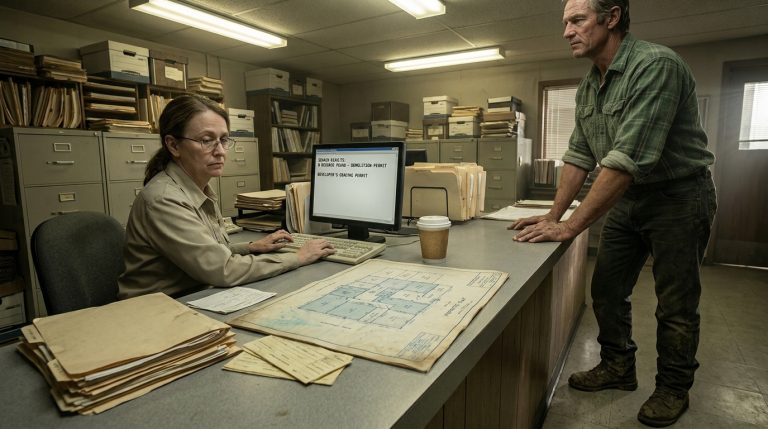
She pushed open the door to the small office behind the main gymnasium. The room was cold, the radiator in the corner rattling violently without producing any actual heat. The older rider, Clay, was leaning over a folding table, a mug of black coffee cupped in his calloused hands. He didn’t look up when they entered, his eyes fixed on a thick, leather-bound ledger that looked like it had been violently ripped from a drawer.
“The kid found something,” Raven said. Her voice had the thin, dangerous edge of a blade drawn in silence. She threw the torn slip of paper Eli had retrieved onto the table. It slid across the map of Iron Ridge, stopping right over the blue line representing the frozen river.
Clay picked up the paper with two fingers, his gaze shifting from the handwritten plates to Eli. “You got this from the basement of the grocery store?”
“Under the floorboards,” Eli said, his throat dry. He pointed to the top license plate on the list. “That car. The gray one. It’s been sitting by the bank every morning at sunrise. But today, the Sheriff was down there with a light. He was looking for where the floorboards were loose.”
Clay grunted, reaching into a manila folder on the table and pulling out a duplicate stack of carbon-copy sheets—the official county patrol logs they had covertly copied from the Sheriff’s office dispatch computer the night they rolled into town. “The official logs say cruiser 204 was patrolling the north highway junction between two and four this morning. That’s five miles out.”
“But he wasn’t,” Eli said. He stepped closer to the table, his small hand reaching out, his finger hovering over the edge of the physical carbon sheets. “He was at the abandoned grocery store. And look at the paper.”
Raven leaned in, her eyes narrowing.
Eli’s finger traced the margin of the ledger sheet they had taken. There was a faint, grease-smudged print near the binding—a tiny, purple-tinted smear. It wasn’t the black grease of a motorcycle chain or the brown grime of the town’s old heating pipes. It was a highly specific, clean lubricant.
“Industrial valve grease,” Eli whispered. “They only use that at the pipeline substation near the rail yard. I used to sleep behind the fence there before the guards chased me off. The Sheriff’s cruiser never goes down there because the gravel ruins the tires. But whoever wrote this list had that grease on their fingers.”
Clay’s face hardened. He picked up the carbon copy, holding it close to the harsh light of the work lamp. The paper was crisp, but the ink weight on the signature line was uneven. The handwriting that authorized the patrol routes for the last forty-eight hours had been executed with a heavy hand, the pen pressing deep enough to tear the fibers of the second page. It was a rushed job, done in a vehicle, not at a desk.
“He’s right,” Raven said, her voice dropping an octave. She looked at Clay, her fingers curling into fists. “The Sheriff didn’t write this log at the station. He wrote it in the field, after he met with whoever is driving that gray sedan. They’re falsifying the locations of the patrol units.”
“Why?” Eli asked, looking between them. “If the police aren’t where they say they are, who is?”
“The people who want to make sure we don’t leave this town alive,” Clay said. He slammed his hand down on the table, the coffee mug rattling. “They’re clearing a blind spot. If the patrol units are marked as being five miles north, then whatever happens at the rail yard or the bank won’t trigger an official response. It’s a clean corridor.”
The room fell into a suffocating silence, broken only by the rhythmic, metallic ticking of the radiator. The weight of the discovery hung in the air like a physical pressure. The Sheriff wasn’t just monitoring the Hells Angels; he was actively carving out a safe zone within the town limits for a second, unseen force to position themselves.
Raven turned back to the table, her hand tracing the layout of the pipeline substation Eli had mentioned. “If they’re using the pipeline grease, they’re using the old maintenance tunnels to move under the streets. That’s how they got the sedan into the bank lot without the riders on the main drag spotting them.”
“We need to move the defector,” Clay muttered, his eyes darting to the door. “If they’ve mapped the tunnels, they know exactly where we’ve got him secured.”
Suddenly, a small, black radio receiver on the corner of the desk crackled to life. It was tuned to the encrypted local band they had been monitoring since their arrival. The static was thick, but through the white noise, a low, distorted voice broke through the speaker.
“Unit One to Control. The perimeter at the rail yard is clear. We have visual on the target house. Proceed with the sweep.”
Raven froze, her hand hovering inches from the map. The color drained from her face, leaving her skin looking like the frost on the windows. She didn’t look at Clay; she didn’t look at the files. Her gaze was locked entirely on the small plastic speaker.
“That’s not the Sheriff,” she whispered, her voice trembling with a cold, hollow realization.
“What do you mean?” Clay asked, stepping forward.
“That call sign,” Raven said, her breath catching as she looked at Eli, her eyes wide with a sudden, devastating clarity. “That’s Reaper-One. That’s my brother’s private unit from the Oakland charter. He was supposed to be in Chicago.”
The realization hit the room like a physical blow. The trap wasn’t just being laid by the town’s corrupt police force. The betrayal had come from inside the club itself, and the very people Eli had saved were being guided directly into an ambush by one of their own family.
CHAPTER 6: THE FRACTURE IN THE FOUNDATION
Eli watched the color drain from Raven’s face, a slow, clinical process that made her look like marble under the unforgiving work lamps. The radio, a small piece of cheap plastic, continued to emit a low, undulating static, as if waiting for a response that wouldn’t come. Clay was still frozen, his hand pressed flat against the map, his knuckles white. The atmosphere in the room shifted instantly; the tactical focus they had maintained for the last hour shattered, replaced by the jagged, volatile tension of a betrayal that had already bypassed their defenses.
“Reaper-One isn’t in Chicago,” Clay said, his voice barely a whisper, a low rumble of disbelief that seemed to vibrate through the metal of the table. “Raven, he swore on the club bylaws. He’s the Vice-President of the Oakland charter. If he’s here, in Iron Ridge, it means the breach isn’t just a rumor. It’s the entire command structure.”
Raven didn’t answer. She reached out and snatched the radio, clicking it off with a sharp, violent snap. She stood there, her shoulders hunched, her breathing shallow. Eli looked at them, his eyes darting to the door. He was just a boy who had slept in cardboard, a boy who had been invisible for most of his life. He didn’t understand the complex web of loyalties that bound these people together, but he understood the look on Raven’s face. It was the look of someone who had just realized that the house they had lived in was built on shifting sand.
“We need to check the defector,” Raven said, her voice snapping back into a cold, transactional register. She shoved the chair back, the metal legs shrieking against the concrete floor. “If they know where he is, they’ve already moved. We’re sitting in the middle of a kill box.”
“The maintenance tunnels,” Eli interrupted, his voice surprisingly steady in the hollow room. Both Raven and Clay turned to look at him, their expressions caught somewhere between frustration and reluctant respect. “If they have the pipeline grease, they have the keys to the maintenance access. That’s how they move under the town. They don’t need the streets. They don’t need the Sheriff to clear the road. They’re already under us.”
Clay walked to the wall and pulled back a heavy, dust-covered tarp, revealing a series of blueprints for the old industrial district. He began to trace the lines of the sewage and utility systems, his finger moving with frantic, jerky motions. “The substation at the rail yard connects directly to the community center’s boiler room. If they’re in the tunnel, they’re closer than we thought.”
Eli moved to the table, his eyes scanning the lines. He saw the geometry of the tunnels, a spiderweb of concrete beneath the town he thought he knew so well. He remembered the cold drafts in his sleeping spot behind the grocery store, the way the ground would hum at night. He had always thought it was the trains. He realized now it was the motion of the city’s heart, a hidden vein where the secrets—and the shadows—flowed.
“They aren’t just coming for the defector,” Eli said, pointing to a small red triangle on the map. “They’re coming for the community center. This is the only place in town with a backup generator powerful enough to run the security grid for the whole perimeter. If they take this building, the whole grid goes dark. We won’t even know they’re inside until they’re at the door.”
Raven looked at the map, then at Eli. The flickering fluorescent light overhead hissed, the beam stuttering, and for a split second, the world felt distorted. Eli’s vision swam; he felt a wave of dizziness, the product of two days without proper food and the crushing weight of the fear that had been building since the basement. Was he sure about the call sign? Was he sure about the grease? He looked at the map, and the lines seemed to blur, shifting like snakes under the glass.
“Eli, get out,” Raven said, her voice hard. “Get to the perimeter riders. Tell them to fall back to the north ridge. Don’t go to the alley. Don’t go to your spot. Get to the ridge and wait for the signal.”
“I can help,” Eli countered, stepping forward, his hands balled into fists. “I know how to get through the crawlspaces. I can get to the substation and trip the circuit breaker. If the grid is overloaded, it’ll blow the magnetic locks on the tunnel doors. It’ll trap them underground.”
“That’s a suicide run,” Clay said, his voice rough.
“I’ve been running my whole life,” Eli replied, his tone flat, final.
He didn’t wait for their permission. He spun on his heel and moved toward the door, his heart pounding a frantic, uneven rhythm against his ribs. He felt the cold air of the hallway as he emerged, the dim light reflecting off the floor in long, sharp, jagged lines. As he rounded the corner toward the back exit, he heard the faint, rhythmic thud of heavy boots vibrating through the floorboards beneath him.
They were already in the building. He could hear the sound of someone moving in the basement, the systematic, deliberate progress of a team that wasn’t looking for groceries, but for a target. Eli pressed his back against the wall, his breath hitching, his mind already mapping the route to the basement access. He wasn’t just a witness anymore. He was the only thing standing between the club and the collapse of everything they had built.
CHAPTER 7: THE ARCHITECTURE OF THE TRAP
The floorboards shuddered—a heavy, rhythmic pulse that telegraphed the location of the intruders in the basement. Eli didn’t turn back. He ducked into the service corridor, the smell of damp, ozone-charged air hitting him with the force of a physical wave. The walls here were lined with rusted pipes that hummed with the high-voltage flow of the community center’s grid.
As he moved, the darkness of the corridor triggered something buried deep in his gut—a sudden, sharp recollection of a storage locker in the old tenements, the door slammed shut, the air growing thin and stale while he pounded against the metal until his knuckles bled. The memory wasn’t a distraction; it was a map. He knew the feeling of being hunted, of the silence that preceded the lock sliding home. He used that visceral, crawling sensation to time his movements, sliding between the shadows of the machinery, his breath shallow and silent.
He reached the boiler room, the heavy steel door slightly ajar. Through the crack, he saw a flash of tactical light. They were inside. He heard the metallic click of a rifle safety being disengaged—a sound so sharp it seemed to cut through the hum of the pipes.
“The power grid bypass is behind the main manifold,” a voice said—a low, controlled tone that lacked the raw, ragged edge of the club riders. This was professional. This was methodical. “Once we drop the magnetic locks, the tunnels will be ours.”
Eli didn’t have time to process the voice. He crept toward the emergency shut-off valve near the door. He knew these systems; he’d spent weeks watching the city engineers work on the infrastructure when he was scavenging. If he jammed the primary manifold, the surge would trip the emergency breakers, not just killing the power, but welding the magnetic locks on the tunnel doors into a permanent, sealed state.
He grabbed a heavy, discarded iron wrench from a work table, its weight cold and brutal in his grip. With a surge of adrenaline that wiped out his fatigue, he wedged the wrench into the primary gear housing of the power manifold. The metal screamed as it caught the teeth of the drive shaft, a discordant, high-pitched protest that echoed in the small room.
Thud.
A heavy boot hit the floorboards right beside the door.
Eli didn’t wait. He threw his weight against the manual emergency release. The machinery groaned, the air filled with the smell of scorched ozone and hot grease. The lights in the corridor flickered, buzzed, and then exploded in a shower of sparks that showered the room in white-hot debris. The hum of the grid died instantly, replaced by a heavy, profound silence.
From the boiler room, a shout of confusion broke the stillness. Then, the rhythmic, heavy sound of the magnetic locks slamming shut—a deep, resonant metallic clang that vibrated through the foundation of the entire building. They were trapped.
Eli didn’t linger. He dove into the shadows of the utility vent, the space narrow and suffocating. As he pulled himself through the tight, dusty passage, he saw a glint of gold on the floor near the manifold—a Sheriff’s department challenge coin, discarded near the primary bypass lever.
The realization washed over him, colder than the ice he’d dragged Raven through. The Sheriff hadn’t just been searching for the defector. The Sheriff had been here, in the boiler room, setting the trap for the club. The betrayal wasn’t just a move by a rival charter; it was a coordinated strike led by the law itself. The Sheriff was the architect of the corridor, the one who had cleared the path for the ambush.
Eli scrambled through the vent, his heart pounding, his body scraping against the sharp, uneven metal. He reached the exit, a small, exterior grate that opened onto the town square. He kicked it open and tumbled out into the freezing night air, gasping for breath. The town was still silent, but the hum of the main grid was gone.
He looked toward the north ridge. The signal lights of the club were dim, flickering in the darkness. He had bought them time, but he had also seen the truth. The Sheriff wasn’t policing this town; he was orchestrating its destruction, and now, the club was walking right into the center of a spiderweb that was far bigger, and far more deadly, than they could have ever imagined.
CHAPTER 8: THE FALL OF THE GAVEL
Eli didn’t stop running until the community center was a dark, receding silhouette against the bruised purple of the dawn. His lungs burned, a raw, serrated pain that reminded him he was alive, and his legs felt like leaden weights. He reached the town square just as the first grey light of morning began to bleed over the rooftops of Iron Ridge. The silence was absolute, a heavy, expectant void that felt like the intake of breath before a scream.
He moved toward the center of the square, where the Hells Angels were already forming up. They looked like statues, their leather jackets dusted with a fine layer of fresh, falling snow. Raven stood at the front, her face a mask of cold, controlled fury. Beside her, Clay held the radio, his thumb hovering over the dial. Eli stumbled into their line of sight, his clothes torn, his face streaked with oil and grit.
“The Sheriff,” Eli wheezed, collapsing against the cold flank of a motorcycle. “He’s the one. He opened the tunnels. He’s the architect.”
Raven didn’t waste a second. She turned to the line of riders, her voice cutting through the morning mist, low and terrifyingly steady. “Pass the word. No one enters the tunnels. Secure the exits. We aren’t fighting a war; we’re closing a trap.”
Minutes later, the Sheriff’s patrol cruiser rounded the corner, its blue and red lights flashing rhythmically against the frozen storefronts. It stopped at the edge of the square. The Sheriff stepped out, his posture casual, his hand resting on the holster at his hip. He looked at the mass of motorcycles, then at Raven, and finally at Eli, his eyes narrowing.
“You’re in violation of a standing order, Raven,” the Sheriff said, his voice smooth, professional, and entirely hollow. “The disturbance in the community center was a public safety emergency. I’m here to restore order.”
“You’re here to collect a fee,” Raven replied. She didn’t move toward him. She waited.
“I don’t know what you’re talking about,” the Sheriff began, but he didn’t get to finish.
Clay stepped forward, holding the Sheriff’s own department-issued challenge coin, the one Eli had found in the boiler room. He rolled it across the frozen asphalt. It clattered, ringing out with a sharp, lonely sound before coming to a stop at the Sheriff’s polished, salt-stained boots. The Sheriff looked down at the coin, and for a fleeting, crystalline moment, his composure fractured. He realized the basement had been breached, the grid had been bypassed, and the trap he had meticulously designed had snapped shut on his own department instead of the club.
From the shadows of the side streets, the club’s own riders began to emerge, not with weapons drawn, but with cameras and digital recorders—evidence of the illicit radio traffic and the falsified patrol logs. The Sheriff wasn’t being outgunned; he was being outmaneuvered, exposed by the very structure he had used to hide his crimes. His hand twitched near his holster, but he saw the hundreds of eyes watching him, the collective, unyielding weight of a group that had finally seen the man behind the badge.
He didn’t draw. He couldn’t. The Poetic Justice of the moment hung in the air—the architect of the ambush rendered powerless by his own ego. He looked at the coin, then back at Raven, his face sagging, the mask of the law stripped away to reveal only a tired, cornered man. He turned and walked back to his cruiser, his shoulders slumped. He knew. The evidence was absolute, and the reach of his betrayal had been severed.
The payoff didn’t come with violence. It came with the quiet, suffocating sound of a career ending in the cold morning light.
As the Sheriff drove away, the square began to settle. The tension didn’t evaporate, but it transformed into something else—a heavy, atmospheric peace. The engines of the motorcycles were turned off one by one, the sound of the town returning to its natural, quiet rhythm. Raven walked over to Eli. She didn’t say a word about the danger or the risk. She reached into her pocket and pulled out a small, sturdy watch—the one Eli had been trying to fix since he arrived. It wasn’t the same one; it was a rugged, reliable tool she’d clearly acquired in the chaos of the morning.
“Time to start moving, Eli,” she said, her voice soft, lacking its usual tactical edge. She handed it to him.
Eli took it, the metal warm from her skin. He looked at the watch, then at his hands, which were finally, mercifully, still. He had spent his life waiting for the end of the world, only to find that when it finally came, he was the one who had helped rebuild it.
He looked around the square. The riders were beginning to disperse, their work here done, their loyalty earned, their secrets purged. He walked to the edge of the square, where the sun was beginning to break the horizon, painting the snow in long, warm streaks of gold. He didn’t feel invisible anymore. He felt the weight of his own existence, solid and real, anchored to the world by the ticking watch in his hand. The quiet return of Iron Ridge wasn’t a return to the status quo; it was a beginning. He turned, the vest on his shoulders feeling lighter, and walked toward the edge of town, leaving the shadows of the alley behind, fully, finally present in the light of the new day.