The Weight of the Watch: A Former Raptor Pilot’s Quiet Siege Against Institutional Decay at Norfolk
CHAPTER 1: THE PERIMETER LINE
Evelyn Reed stood at the edge of the pier, her boot pressing into a patch of asphalt where the grit crunched like ground bone. The sun was a bloated, heat-hazed disc hanging over the Atlantic, turning the hulls of the berthed destroyers into silhouettes of rusted iron. Around her, the naval base was a machinery of constant, grinding maintenance. It was a place of steel, salt, and the slow, inevitable oxidation of everything exposed to the spray.
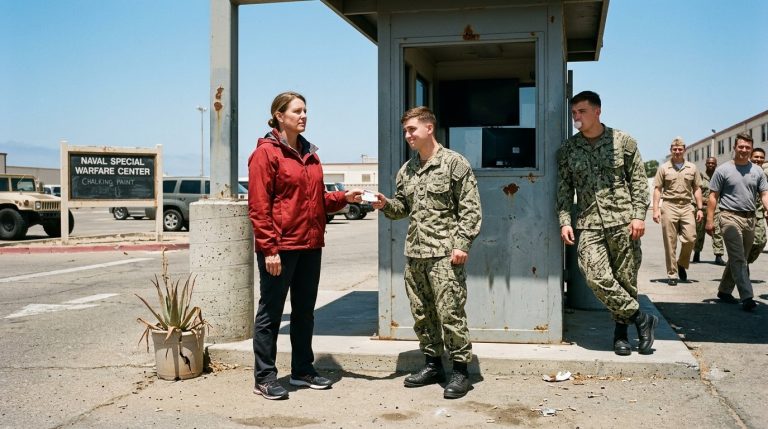
She adjusted her position, her eyes tracking the movement of a maintenance crew three hundred yards away. Her job, on paper, was to monitor credentials at the VIP gate. In practice, she monitored the structural integrity of a dying institution. Her fingers brushed the edge of her silver bracelet, the cool metal a sharp contrast to the humid, sticky warmth of the afternoon.
She shifted her weight, the familiar, dull ache in her lower back acting as a barometer for the air pressure. A shift was coming, not just in the weather, but in the brittle, overloaded systems of the base.
She turned her gaze toward the ceremonial stage near the armory. A heavy-duty lighting rig sat perched on a mobile lift, its hydraulic struts glistening with a fresh, viscous sheen. Evelyn frowned. She took a step toward it, her walk marked by the slight, rhythmic drag of her left heel—a mark of a flight that had ended in a field of jagged shale years ago.
As she reached the base of the lift, she knelt, oblivious to the stares of a passing group of midshipmen. She didn’t care about their judgment. She cared about the pin holding the primary strut. It was misaligned by a fraction of a millimeter. Worse, the bolt had been sheared, not by pressure, but by a precise, mechanical strike.
She reached out, running a calloused finger along the underside of the rig. The metal was pitted, the orange-brown bloom of rust eating into the housing where the hydraulic line entered the cylinder. It wasn’t environmental. It was industrial tampering disguised as wear.
A shadow fell over her. Rear Admiral Thompson stood ten feet away, his black shoes gleaming with an artificial, mirror-like intensity that seemed out of place against the grit of the shipyard.
“Contractor,” his voice boomed, sharp and transactional. “The ceremony starts in twenty minutes. Get back to your post. We don’t pay you to study the hardware.”
Evelyn stood up, her joints popping like distant rifle fire. She didn’t look at the Admiral’s face; she looked at the brass insignia on his collar, noting the way it caught the light, obscuring the man behind it.
“Sir,” she said, her tone as flat and dry as the rusted iron she had just touched. “The struts on this rig are showing signs of structural fatigue that exceeds the safety threshold. I’d recommend a secondary support.”
Thompson’s face hardened. He looked at the rig, then at the bustling pier, his expression a mixture of disdain and impatience. “The rig was inspected by the harbor master this morning. If you’re looking for work to justify your contract, try finding it elsewhere.”
He turned on his heel, his walk heavy with the weight of unearned certainty. Evelyn watched him go, her eyes lingering on the back of his uniform. He was the anchor of this place, holding it firm against the tide, unaware that the chain he was holding was already fraying at the link.
She turned back to the rig. A sudden, sharp realization cut through her—the tampering wasn’t meant to cause a disaster today. It was meant to be the distraction for something much larger. She touched her bracelet again, the silver biting into her skin.
Something was being hidden behind the ceremony, and it was buried in the grease and the rust.
CHAPTER 2: THE CREDENTIAL WALL
Evelyn walked away from the lift, her left heel striking the asphalt with a hollow, rhythmic cadence that seemed to measure the distance between her and the Admiral’s retreating back. She didn’t look back at the lighting rig, but she could feel the imbalance of it, a physical dissonance in her peripheral vision. It wasn’t just a misaligned strut; it was a symptom. The shipyard breathed, and right now, it was wheezing.
She reached the VIP checkpoint, the sun now hanging lower, casting elongated shadows that made the heavy chain-link fencing look like a cage. Her pulse was steady, a slow, deep thrum beneath her skin—the remnants of a pilot’s physiology that ignored the adrenaline spikes of civilian life. She took her place at the scanner, her movements fluid and economical, despite the recurring twinge in her lower lumbar.
The line began to form. Sailors in pristine dress whites, their faces scrubbed and bright, moved with the rigid confidence of men who believed their uniforms were a protective shell. They didn’t see the corrosion. They didn’t notice the way the base’s infrastructure was slowly being hollowed out by neglect and shortcuts.
Evelyn watched a young Seaman approach, his hand clutching a stack of invitations. She didn’t look at his rank or his smile; she looked at his gait. He was favoring his right side, a subtle tell of an old injury—possibly an ankle roll from a recent drill. She cataloged it instantly, part of the endless stream of data she processed while standing the watch.
“Afternoon, ma’am,” the Seaman said, offering his credentials.
Evelyn took them, her eyes flicking across the digital signature. It was authentic, yet the magnetic strip felt thin, almost brittle beneath her thumb. “Step through, please,” she said, her voice a quiet, neutral instrument.
As he moved past, she caught a glimpse of Admiral Thompson’s sedan idling near the command post. He was on his phone, his posture stiff, his head tilted in an argument that she could see vibrating through the car’s frame from thirty yards away. He wasn’t just directing an event; he was fighting to maintain the veneer of absolute, unassailable control.
She felt a flicker of doubt, cold and sharp as a razor’s edge. Was she seeing the truth, or was the ghost of her past—the years spent navigating the politics of a compromised flight program—coloring her perception? She touched the silver bracelet on her wrist. The metal was dull, worn down by decades of friction. It felt like a tether to a reality that no one else on this pier acknowledged. If she was wrong, she was just an over-observant, broken-down contractor making trouble. If she was right, the lighting rig was only the beginning of a cascade failure that would turn this ceremony into a funeral.
“Keep it moving,” she murmured to the next guest, her gaze snapping back to the gate.
A black government-issue van pulled up, the tires kicking up a fine spray of grit. The driver was a civilian, but the way he gripped the steering wheel—white-knuckled and eyes darting—spoke of a different breed. He stopped, and the door slid open to reveal a man in a crisp suit, his eyes scanning the pier with a clinical detachment that matched Evelyn’s own.
Evelyn stepped forward, her posture closing slightly, assuming a defensive perimeter. “Identification, please.”
The man didn’t look at her; he looked past her, his gaze locking onto the rigging she had inspected minutes before. “Base maintenance,” he said, his voice clipped, lacking the expected deference. “We’re here for the final setup check on the main stage.”
Evelyn didn’t move. She shifted her weight, the drag of her left heel subtle but deliberate, blocking his path. She reached for the scanner, her eyes fixed on his hands. They were stained, not with the clean, chemical smell of standard lubricant, but with the dark, thick residue of industrial adhesive.
“The rig was checked this morning,” she stated, her voice quiet. “Who specifically called for a second inspection?”
The man turned his head slowly, his eyes meeting hers. There was no annoyance in his expression, only a chilling, hollow vacancy. “Admiral’s office, contractor. Unless you’re planning to override a command directive, I suggest you step aside.”
Evelyn held his gaze. Behind him, inside the van, she saw a heavy, industrial-grade torque wrench resting on a pile of rags. It wasn’t a standard maintenance tool for a lighting rig. It was an heavy-duty impact tool, the kind used for structural demolition.
The friction between them was palpable, a static charge in the salt air. She knew, with the cold, absolute certainty of a pilot who had spent thousands of hours analyzing the aerodynamics of a machine under stress, that he wasn’t here to fix anything. He was here to ensure the rig fell at the exact moment the ceremony reached its peak.
She looked at her scanner, then back at him. She was an observer, a ghost in the machine, and she was currently the only thing standing between an accident and an atrocity. She had to let him through to see what they were planning, or shut him down now and risk everything on a gamble.
“Proceed,” she said, stepping aside, her heart beating a steady, lethal rhythm against her ribs. She watched the van roll forward, its tires grinding the grit into the asphalt, a sound that felt like the gears of a trap slowly closing.
CHAPTER 3: THE SABOTAGE TRIAL
The air beneath the staging area was thick with the scent of stagnant salt and overheated hydraulics. Evelyn didn’t hesitate; she pushed through the curtain of exhaust, her boots crunching on gravel scattered with discarded metal shims and frayed wire casings. Every step was a tactical calculation, her movements measured to avoid the notice of the maintenance crew still milling around the van’s open rear doors.
She stayed in the periphery, letting the rusted support beams of the bleachers shield her. Her limp felt heavier here, the dampness of the harbor air seeping into the old injury, but she ignored it, focusing instead on the geometry of the structure. The “maintenance” crew was moving with an efficiency that had nothing to do with standard base repairs. They were working in silence, their tools sliding into place with practiced, surgical precision.
As they moved toward the far end of the platform, Evelyn closed the distance. She reached the base of the lighting rig, the same one she had scrutinized earlier. The shadow here was absolute, a pool of ink created by the massive arc of the staging. She knelt, her fingers finding the primary junction box.
It was loose. She hadn’t noticed it before because of the way the light had hit the panel, but now, in the dark, she could see the scrape marks around the mounting screws. Someone had opened this within the last hour. She pried it open with a small, flat-head utility blade she kept in her kit.
Inside, tucked behind the standard-issue wiring, was an anomaly. A small, black plastic block, no larger than a matchbox, wired directly into the rig’s control circuit. It wasn’t a standard safety relay. It was a remote-access receiver, the kind used to trigger pneumatic releases from a distance.
Her breath hitched, not out of fear, but out of a cold, hardening resolve. This wasn’t a malfunction; it was an execution of a plan. The sabotage was meant to be triggered during the ceremony, a calculated failure designed to look like a tragic oversight of maintenance, perfect for discrediting the base security team—and specifically, anyone who had dared to question the Admiral’s directives.
She reached out, her fingers hovering over the receiver, but she didn’t disconnect it. If she removed it now, they would know someone had been here. They would reset the plan, move the sabotage to a different location, a different time, and she would lose her chance to stop it entirely. She had to let it stay, but she had to bypass it.
She pulled a thin, conductive wire from her own kit, stripping the insulation with her teeth. Her hands were steady, the same hands that had once adjusted the flight controls of a Raptor while pulling nine Gs in a vertical climb. She bridged the circuit, creating a secondary, silent path that would bypass the receiver’s trigger signal. It was delicate work, performed in the dark, with the muffled sound of voices drifting down from the platform above.
“The timer is set for 1400,” a voice said—a low, rhythmic cadence that lacked the usual cadence of naval personnel.
“The Admiral is pushing the ceremony up by ten minutes,” another voice replied. “It’ll happen right during the unit citation. Perfect timing.”
Evelyn froze. She pressed her back against the rusted iron pillar, her heart rate remaining perfectly, unnaturally slow. They were planning to move the timeline. They weren’t just sabotaging the equipment; they were playing with the Admiral himself, manipulating his impatience to ensure the collapse happened exactly when the maximum number of people—including the SEALs—would be beneath it.
She waited until their voices faded as they moved to the other side of the platform. She eased herself away from the junction box, her shadow blending into the rusted lattice of the stage foundation. She had the evidence now—or she would, once she documented this receiver. But more importantly, she realized that the institutional decay she had observed for weeks wasn’t a slow rot; it was a targeted demolition.
She crawled toward the edge of the staging, her movements silent, every muscle working in concert to keep her from shifting even a single pebble. She reached the maintenance corridor—the same one she had pointed out to the sailors—and checked the locking mechanism on the heavy steel door. It was unlocked.
She slipped through, her mind already shifting to the next step. She couldn’t stop this with a report. If she went to the security chief, he would be dismissed just as she had been, and the saboteurs would simply initiate a manual release. She needed leverage, and she needed it before 1400.
She walked down the corridor, her gait purposeful. As she exited into the open air of the pier, she caught sight of the SEAL Lieutenant Commander standing near the VIP section. He was watching the stage with a gaze that mirrored her own—analytical, detached, and deeply suspicious. He hadn’t seen her, but he was watching the same rig, his eyes following the lines of the hydraulic struts.
Evelyn stopped. She didn’t approach him. She knew that in this world, an Air Force Major working as a security guard didn’t just walk up to a Navy SEAL team and share intelligence without a massive breach of protocol. But she also knew that the Lieutenant Commander was a professional, and professionals recognized the same patterns in the noise.
She took a slow, deep breath of the salt-thick air, the taste of grease and iron coating her tongue. The ceremony was moving forward, the gears of the event grinding toward the climax. She looked at the silver bracelet on her wrist, her thumb tracing the tarnished surface. She wasn’t just a observer anymore. She was part of the machinery, and she was the only one with the code to stop the collapse.
She turned and began to walk toward the command post, her path deliberate. She had to get to the Admiral’s log, the digital record of all maintenance requests, to find the origin of the work order that had authorized the “maintenance” crew. If she could find the source, she could trace the hand that held the trigger.
CHAPTER 4: THE CEREMONY COMMOTION
Evelyn moved through the rear of the pier, her shadow stretching long and thin against the corrugated steel of the shipping containers. The sound of the crowd grew, a dull, rhythmic roar—hundreds of voices blending into the singular, droning hum of an impending event. She kept her head down, her cap pulled low, her posture mimicking the civilian contractors who were ubiquitous at Norfolk. But her eyes were moving constantly, tracking the SEAL team as they transitioned toward their designated seating area.
Their movement was different from the rest of the Navy personnel. It was fluid, efficient, and lacked the performative rigidity of the parade guards. As she skirted the edge of the maintenance corridor, she saw the Lieutenant Commander stop. He turned his head, his gaze sweeping the crowd with that same predatory calm she had recognized earlier. For a heartbeat, his eyes snagged on her.
Evelyn didn’t flinch. She adjusted her grip on her clipboard—a prop she had swiped from a desk in the logistics office—and kept walking. The psychological phantom of her old squadron flared, a sharp, cold spike of memory: the smell of cockpit oxygen, the sound of a wingman’s last transmission, the absolute, crushing silence that follows an ejection. She squeezed her hand into a fist inside her pocket, the silver bracelet biting into her skin, a grounding weight that forced the memory back into its box.
She reached the command post, a low-slung, reinforced building of concrete and glass that overlooked the entire pier. The door was locked, but the biometric scanner was a primitive model she had bypassed months ago during a routine inspection. She leaned in, pressed her thumb to the glass, and waited. A faint, electronic click signaled the override.
Inside, the office was cool, sanitized, and smelling of sterilized paper and stale coffee. It was a space designed for order, for the clean lines of hierarchy that Admiral Thompson cherished. She moved to the central terminal, her fingers dancing across the interface. She didn’t have much time; the Admiral would be arriving for his final briefing in minutes.
She pulled up the maintenance logs, her eyes scanning the entries with the speed of a pilot reading a heads-up display. The work order for the lighting rig was there, submitted at 0400 hours under a vague authorization code. She traced the digital signature back to a terminal located in the supply depot—a terminal that was physically disconnected from the main network. Someone had gone to great lengths to ensure this order was “off the books.”
She downloaded the log to her personal drive, her breath hitching as a notification pinged in the corner of the screen: Unauthorized Access Detected.
She didn’t panic. She didn’t stop. She hit the command to scrub her entry trail, watching the progress bar crawl across the screen. It was agonizingly slow, a test of patience that she had mastered years ago in the cockpit. The door outside opened—a voice, sharp and authoritative, began barking orders at a subordinate. It was Thompson.
“The ceremony starts in eight,” he said, his voice echoing off the concrete walls. “I want the pier cleared of all non-essential personnel immediately.”
Evelyn pulled the drive, the plastic warm against her palm, and slipped into the small closet behind the main filing cabinets. The door clicked shut just as the office light flickered on. She held her breath, her senses narrowing down to the sound of Thompson’s breathing, the rustle of his uniform, and the heavy, metallic smell of his cologne.
She was ten feet away from the man who had fired her, the man who was currently being maneuvered into a public catastrophe by people he thought were his own staff. The irony was a bitter, metallic taste in her mouth. He wasn’t the architect of this downfall, but he was the keystone, and once the rig came down, the entire structure of his command would collapse with him.
“Admiral, the SEAL team is in position,” a man said—the same voice she had heard at the lighting rig.
Evelyn’s eyes widened in the darkness. He was inside the command post. She was trapped in the closet with the saboteur.
“Good,” Thompson replied, oblivious to the tension in the room. “I want this to be the most precise ceremony in the station’s history. No delays. No excuses.”
The saboteur walked toward the filing cabinet, his hand brushing the very door Evelyn was hiding behind. “Understood, sir. Everything is proceeding according to the plan.”
Evelyn felt the cabinet move an inch as he leaned against it. She didn’t move a muscle, her training taking over, suppressing the instinct to strike, to move, to react. She was a ghost, a silhouette in the background of a larger war. She closed her eyes, visualizing the pier, the rig, and the trajectory of the falling steel. She had the logs. Now, she just needed a way out before they started the clock.
The saboteur moved away, his footsteps fading toward the door. “I’ll be on the stage, Admiral. Ensuring the final sequence is ready.”
The door closed, and the office fell into a silence so profound she could hear the ticking of a wall clock. She waited, letting the seconds crawl by, her mind mapping a path that wouldn’t lead her back into the gaze of the guards. She was the only one who knew the bomb was ticking, and she was the only one left to cut the wire.
CHAPTER 5: THE RIG INCIDENT
Evelyn waited until the metallic click of the office door latch confirmed she was alone before she eased the closet door open. Her movements were ghost-like, a silent unfolding of limbs that prioritized absolute stillness over speed. She didn’t head for the main exit; she knew the hallways would be flooded with security and departing staff. Instead, she moved to the office window—a heavy, reinforced pane that overlooked the staging area.
Outside, the pier had transformed. The ceremony was officially underway, the voice of the base commander crackling over the public address system, its tinny, distorted quality swallowed by the vast expanse of the harbor. Evelyn saw the Admiral standing at the podium, his posture rigid, his face a mask of practiced pride. He was oblivious to the fact that ten feet above his head, the lighting rig was being primed for a catastrophic release.
She pushed the window latch, feeling the resistance of rusted hinges. She didn’t force it; she applied pressure in a steady, calculated arc until the metal gave with a soft, protesting groan. She climbed out onto the narrow maintenance catwalk that girdled the command building, the wind hitting her face with the sharp, brine-heavy sting of the Atlantic.
She began to move along the catwalk, her limp barely noticeable as she transitioned into the practiced, predatory gait of a pilot navigating a restricted airspace. She kept low, using the shadows of the vents and conduit runs to remain invisible to the crowd below. She was closing in on the lighting rig’s anchor point, but the wind was picking up, whipping her hair against her face and threatening to knock her off balance.
As she reached the juncture where the rig met the staging’s primary steel skeleton, she saw them: two figures, dressed in nondescript blue coveralls, finalizing the manual bypass on the hydraulic lines. They weren’t using electronic triggers anymore. They had switched to a physical tension release—a simple, elegant, and untraceable way to ensure the rig didn’t just malfunction, but plummeted with total, kinetic force.
Evelyn calculated the geometry of their position. If she interrupted them, they would likely trigger it early. She needed a diversion, something that would force them to abandon the rig without creating a panic that would lead to the very casualties she was trying to prevent.
She looked down at the staging area. The SEALs were standing in formation, their eyes scanning the perimeter with the same intensity she possessed. She had an idea. She reached into her pocket, pulling out a small, high-intensity flare she had kept from her survival kit—a relic of her flying days. It was a simple device, but in the right place, it would do exactly what she needed.
She aimed, not at the rig, but at the far end of the staging area, where a massive pile of canvas storage covers had been stacked for the event. She triggered the strike-cap. The flare whistled through the air, a bright, searing arc of red that vanished into the heavy, oil-soaked canvas.
A heartbeat later, the stage erupted in a roar of white-hot flame. The canvas, coated in weatherproofing chemicals, flared with an intensity that sucked the oxygen from the air. The crowd screamed, not at the rig, but at the fire. The two men on the staging platform bolted, their hands flying up to protect their faces, and they scrambled down the ladder in a blind, unthinking panic.
The distraction worked. The attention of the entire pier swung toward the burning canvas. Evelyn didn’t waste a second. She lunged onto the rig’s platform, the steel frame shaking under her weight. She dove for the hydraulic bypass, her hands moving with the frantic, precise grace of a bomb disposal technician.
The rig groaned. A mounting bolt, already strained by the previous tampering, shrieked as it began to shear under the shifting weight. The entire structure leaned, tilting toward the bleachers where the families were still scrambling to get clear.
“Brace!” she bellowed, her voice a serrated blade that cut through the chaos of the fire and the screaming. It wasn’t just a command; it was the voice of a commander, the voice of Wraith, projecting an authority that paralyzed the air around her.
She grabbed the primary hydraulic lever, her arms muscles bunching as she exerted every ounce of her strength to force it back into the locked position. The metal bit into her palms, but she didn’t let go. She felt the structure shudder, the weight of the massive rig bearing down on her.
Below, Admiral Thompson stood frozen, his eyes wide with a dawning, terrifying realization. He looked up, his gaze meeting hers through the haze of the smoke. For a moment, the distance between them vanished—the rank, the history, the disdain, all of it evaporated in the face of the physics of the impending disaster.
She didn’t look at him. She looked at the rig. She felt the internal locking pin click into place, a sound of absolute, mechanical finality.
But it wasn’t enough. The bolt at the base of the rig snapped, a sharp, resonant ‘pop’ that vibrated through the entire pier. The rig swayed, dangling by a single, fraying steel cable. Evelyn lunged for the backup restraint, her fingers tangling in the wire, her own body acting as the final, living bridge between the structure and the crowd.
She pulled, the raw, grinding friction of the steel cable slicing into her forearm, blood blooming dark against the fabric of her shirt. She didn’t feel the pain. She felt only the momentum of the falling tons of metal, and she held it, her teeth gritted, her eyes locked on the horizon, until the rig stabilized, swinging like a massive, deadly pendulum, just feet above the empty bleachers.
The pier went silent. The fire was dying, the smoke billowing in long, dark ribbons against the evening sky. Evelyn collapsed against the steel frame, her breathing ragged, her arm slick with blood, the weight of the world finally slipping from her shoulders. She had stopped the collapse, but she hadn’t stopped the truth. The saboteurs had seen her, and she had just exposed the very thing they were trying to keep buried.
CHAPTER 6: THE AFTERMATH
Evelyn’s world narrowed to the sound of her own ragged breathing and the harsh, wet scraping of her blood against the steel framework of the rig. The silence that had descended on the pier was heavy, almost physical, pressing against her eardrums. Below, the scene was a tableau of frozen shock. Admiral Thompson stood near the base of the staging, his head tilted back, his eyes locked onto Evelyn’s silhouette against the darkening sky. He looked diminished, the crisp, starched lines of his dress whites looking suddenly like a costume that no longer fit.
She didn’t wait for the shock to break. She began the descent, her movements stiff and agonizingly slow. Every time her weight shifted onto her left leg, a white-hot spark of pain traveled up her spine, but she pushed it into a corner of her mind, treating it as just another piece of data to manage. She slid down the ladder, the rough, oxidized iron of the rungs tearing at her palms, and dropped the final four feet to the asphalt.
She landed in a crouch, her eyes instantly scanning the perimeter. The two men in coveralls were gone, vanished into the throngs of panicked sailors and families. She hadn’t expected them to linger, but seeing them evaporate so cleanly reinforced her assessment: this was a coordinated, professional exit.
“Major,” a voice said.
Evelyn didn’t turn around. She knew the cadence—precise, low, and devoid of the nervous flutter common in most base personnel. She kept her gaze fixed on the command post, her posture loose, ready to pivot. The SEAL Lieutenant Commander stepped into her peripheral vision, his team forming a semi-circle behind him. They didn’t move like soldiers on a parade ground; they moved like a security cordon, their eyes scanning the crowd with a predator’s focus.
“Wraith,” he said, his voice dropping an octave, losing the military formality and gaining the weight of a shared, buried history. He didn’t offer a hand, nor did he ask if she was injured, despite the blood trailing down her sleeve. He simply stood there, an anchor in the chaos.
“It’s Reed now,” she replied, her voice sounding thin to her own ears, strained by the effort of maintaining her composure. She didn’t look at him. She looked at the command post door, the one she had exited so hastily. “That rig wasn’t an accident. And that fire wasn’t a mistake.”
“We saw,” the commander said, his gaze flicking briefly to the charred canvas and the precariously swinging lighting rig. “My team had eyes on the bypass points before the rig moved. We were going to intervene, but you beat us to the lock.”
Evelyn finally turned, meeting his gaze. His eyes were hard, intelligent, and deeply, painfully familiar. “Why didn’t you move?”
“Orders,” he said, and the word hung in the air, heavy and sharp. “We were ordered to maintain position until the Admiral gave the signal for the citation. We were observers. Until you made it impossible to stay in the shadows.”
Evelyn felt a flash of cold fury. The institutional paralysis was the true weapon here. They had been ordered to stand by while a catastrophe was engineered in plain sight, all for the sake of a ceremony. “And the Admiral?” she asked, her voice dangerously quiet.
The commander glanced at Thompson, who was now being swarmed by aides and base security. “He’s a man who has spent his entire career believing that if he closes his eyes, the storm doesn’t exist. He’s about to find out that the storm has been inside the house for a long time.”
As he spoke, Thompson broke away from his entourage. He walked toward them, his face a complex map of shame, confusion, and a burgeoning, jagged realization. He stopped five feet from Evelyn. He looked at the blood on her arm, then at the rig that had nearly crushed his guests, and finally at the SEAL team.
“Major Reed,” Thompson began, his voice cracking, the authority he had wielded so ruthlessly earlier now completely absent. He didn’t look like an Admiral; he looked like a man who had suddenly seen the floor beneath him dissolve. “I… I don’t know what you did up there, but you saved a lot of lives.”
Evelyn didn’t offer him the comfort of an easy absolution. She didn’t care about his apology, and she certainly didn’t care about his confusion. She reached into her pocket, felt the cold, hard weight of the flash drive she had pulled from his office, and realized she was holding the truth—not just about the sabotage, but about the systemic failures that had allowed it to fester.
“You should be looking for two men in blue coveralls, Admiral,” she said, her voice cutting through the air like a razor. “They didn’t just come to fix the rig. They came to watch it fall.”
Thompson looked at her, his eyes searching hers for a hint of insubordination, but all he found was the cold, unyielding gaze of a woman who had operated in environments far more hostile than a naval pier. He nodded, a slow, jerky motion, and gestured to his security chief, who was hovering in the background.
“Find them,” Thompson ordered, his voice suddenly gaining a new, brittle edge of command. “Lock down the base. No one leaves.”
Evelyn turned away. She didn’t stay to see the chaos unfold. She had the logs, she had the recognition, and she had the evidence. But she also knew that the saboteurs were only the tools. The real architects were still inside, and as she walked toward the maintenance corridor, she felt a profound, heavy clarity: this wasn’t going to be resolved on the pier. It was going to require the total, scorched-earth dismantling of the rot itself.
She felt a momentary flicker of vertigo, the world swaying as the adrenalized focus started to fray. She caught herself on the rusted rail of the shipping container, her breath coming in short, sharp gasps. She was alone in this, and the truth was a weight that was getting harder to carry by the second.
CHAPTER 7: THE SECRET AUDIT
Evelyn moved through the shadows of the maintenance corridor, the flash drive in her pocket feeling like a live coal against her thigh. The base was in a state of controlled panic, the distant sirens and shouting voices of the base security teams creating a chaotic, rhythmic backdrop to her mission. She didn’t head for the exit. She headed for the archives—a subterranean level of the command post that housed the paper records of every maintenance cycle conducted on the base in the last twenty years.
The archive was a relic of an era before digital dominance, a labyrinth of metal shelves and dust-coated binders that smelled of decaying paper and damp concrete. She found the terminal in the corner, a dusty, standalone unit still tethered to the local network. She plugged the drive in, her hands moving with a mechanical, detached precision.
As the files decrypted, the truth began to unspool in a cascade of technical specifications and classified memos. She scrolled through the maintenance logs, her heart rate steadying as she isolated the signature of the “maintenance” crew. It wasn’t a civilian contractor. It was a phantom shell company, a front used by a defense manufacturing firm—the same one that had supplied the faulty control modules for the Raptor program back when she was in the cockpit.
She saw the digital signature, a complex, encrypted string of characters that looked like gibberish to anyone else, but to her, it was a fingerprint. It was the same proprietary code that had failed on her during her final, classified flight. A cold, hollow ache settled in her chest. This wasn’t just a sabotage at a naval base; it was an ongoing, active cover-up. They weren’t just testing the base’s security; they were testing the next generation of flawed flight systems, using the naval station as a live-fire laboratory, and they were willing to risk lives—sailors, families, children—to ensure the data was harvested.
She stopped, her finger hovering over the screen. The trauma she had buried, the “shattered” reality she had been living since her retirement, wasn’t a product of an accident. It was the result of her being the only pilot who had refused to fly the system until it was certified. They had forced her out, framed the crash as her pilot error, and then continued the development in the shadows.
A floorboard creaked in the darkness behind her.
Evelyn didn’t turn. She shifted her weight, her senses expanding to cover the entire room, the hum of the cooling fan and the rhythmic drip of water somewhere in the distance becoming the primary data points. “You should have stayed on the pier, Commander,” she said, her voice low, conversational, and utterly devoid of fear.
The Lieutenant Commander stepped into the dim light of the monitor. His face was unreadable, a study in tactical professional distance. “I was told you would find this, Major. Or, I should say, I was hoping you would.”
“You weren’t observing,” Evelyn said, turning to face him. “You were waiting for someone to link the system signatures. You needed an internal audit that couldn’t be traced back to the SEAL command.”
“The brass is protecting the manufacturers, Major,” the Commander said, his voice quiet, lacking the performative bravado of the other officers. “We’ve been trying to bring this to light for three years. Every time we get close to the data, the files get purged. We needed someone with your… specific clearance level. Someone who knew the Raptor systems better than anyone else.”
Evelyn looked at him, her eyes tracing the line of his jaw, the hard, set expression of a man who was also a ghost, just like her. “You let that rig almost collapse to force my hand.”
“I let you demonstrate that someone was still in control,” he countered. “We couldn’t move without creating a public spectacle that would burn the entire operation. But now?” He gestured to the screen. “Now we have the signature. We have the proof.”
Evelyn felt the weight of it—the years of silence, the nights spent staring at the ceiling, the feeling of being a “footnote” in a grand, corrupt story. She wasn’t a footnote. She was the witness.
“The Admiral?” she asked.
“He’s a cog,” the Commander said. “He knows what he’s told, and he’s told exactly enough to stay loyal. But he’s not the one pulling the strings. If we take this to the Inspector General, the manufacturer, the procurement officers, the entire network comes down.”
Evelyn turned back to the terminal, her hands steadying. She wasn’t just cleaning up a mess on a pier anymore. She was initiating a sequence that would reset the entire board. She began the final upload, the data stream glowing soft blue against the darkness of the archive. The friction of the process, the small, mechanical clicks, and the distant, muffled sound of the base security teams searching the halls were all part of the same, inevitable motion.
She looked at her forearm—the jagged, puckered skin of the scar—and finally, for the first time in ten years, the memory didn’t feel like a cage. It felt like an anchor, one that she had finally learned to lift.
CHAPTER 8: THE FINAL DEPARTURE
The air in the archive was still, thick with the scent of oxidized metal and the ozone tang of the overheated terminal. Evelyn pulled the drive, her fingers trembling—not with fear, but with the sudden release of a decade’s worth of tension. The monitor flickered to black, reflecting her own face, a study in quiet, hardened resolution. She stood up, the old injury in her back radiating a dull, throbbing reminder of her physical limits, but she walked toward the archive exit with a stride that was no longer impeded by the ghost of her past.
She climbed the stairs to the main level of the command post. The pier outside was flooded with the harsh, artificial white light of the security floodlamps. The base was in a state of absolute lockdown. She saw Admiral Thompson standing on the stage, flanked by the Lieutenant Commander and his SEAL team. The Admiral’s face was slack, his world unraveling in real-time as the data she had transmitted began to broadcast across the internal base network to the regional command—an automated, irreversible push.
Evelyn didn’t head for the stage. She walked toward the main gate, her steps echoing on the asphalt. She saw the two men in blue coveralls being held by a squad of Marines near the armory. They looked small now, stripped of their purpose, their “maintenance” tools scattered on the ground like so much scrap.
As she neared the gate, the Lieutenant Commander broke away from the Admiral and intercepted her. He didn’t speak immediately; he watched the pier, the chaotic movement of base personnel, and the distant silhouettes of the naval ships.
“The Inspector General has the files,” he said, his voice flat, professional, yet carrying a current of profound relief. “The manufacturer’s connection to the Raptor control module failures is being cross-referenced now. They can’t suppress this, not with the data you pulled. It’s a complete, systemic collapse of the cover-up.”
“They’ll try,” Evelyn said, her eyes tracing the rusted edge of a nearby shipping container.
“They won’t have time,” the Commander replied. “You gave us the leverage to force a full audit. That’s all we needed.”
He turned to face her, his posture rigid. For the first time, he didn’t look at her as a fellow operator or a mystery; he looked at her with the raw, unabashed respect of a man who had seen a legend do exactly what the stories promised. He snapped his hand up in a salute—sharp, precise, and held for a long, meaningful beat.
Evelyn returned the salute, the motion fluid and practiced. It felt like the final gear clicking into place, the closing of a cycle that had started in the cold, thin air of the upper atmosphere ten years ago. She turned and walked toward the gate, the heavy iron chain-link fence rattling as she pushed past the turnstile.
She didn’t look back at the pier. She didn’t look at the lights, the ships, or the man who had ordered her off his base hours earlier. She walked out into the cool, salt-scented night of the town, the streetlights flickering against the dark, asphalt roads.
She reached into her pocket and pulled out the silver bracelet. The tarnish was still there, a physical record of the years she had spent in the gray, waiting for the right moment. She stopped beneath a streetlamp, the light catching the worn surface of the metal. She didn’t throw it away, and she didn’t hide it. She simply slipped it back onto her wrist, the cool touch a reminder of where she had been and what it had cost to finally stand in the open air.
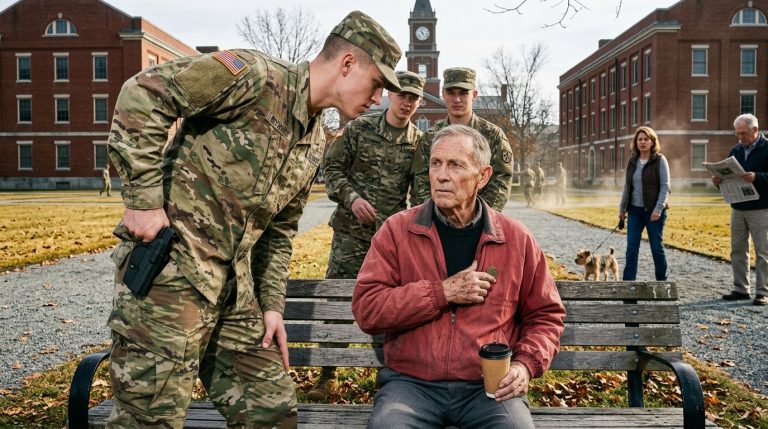
She found a small, quiet park a few blocks from the base, the trees rustling in the wind, their leaves damp with the incoming tide. She sat on a bench, the iron cold beneath her, and watched the distant glow of the shipyard. The silence here was different—it wasn’t the heavy, watchful silence of the base, but the quiet, rhythmic peace of a world that didn’t demand anything from her.
She pulled a small, worn paperback book from her bag, the one she had been reading on her breaks for years. She opened it to the page she had marked, the familiar, soft texture of the paper under her thumb a grounding sensation. The struggle was over, but the road ahead—a life lived in the light, without the mask, without the secret—was only just beginning.
She looked at her forearm, the jagged scar now just a map of a path she had walked, not a definition of who she was. She was Evelyn Reed, and she was done standing the watch. She leaned back, the night air cool against her skin, and for the first time in a decade, she let herself simply breathe.