The Iron Ledger: A Novel of Rusted Truth, Failed Systems, and the Men Who Counted
CHAPTER 1: THE COUNTING INDEX
The air in Room 214 smelled of floor wax and the dry, alkaline chalk dust that settled into the grooves of the floorboards every May. It was a heavy smell, thick with the exhaustion of a Thursday afternoon when the sun hits the southwest brick faces of Riverside Elementary and turns the glass panes into small ovens.
Jennifer Walsh kept her palms flat on the oak desk. The wood was cold beneath her skin, the varnish worn down to the pale grain where forty-seven days of consecutive notation had left an invisible friction trail. Across from her, Ethan Cooper sat on the edge of his plastic chair, his knees tucked together so tightly the denim of his jeans looked ironed. He was ten, but his shadow on the linoleum looked like a stick dragged through silt.
“Please don’t make me go back there today.”
The words weren’t a plea; they were a transaction delivered in a flat, unweighted whisper that didn’t even stir the loose yellow paper on his desk.
Jennifer didn’t move her hands. In the standard teacher’s manual, this was the moment for a soft head-tilt, a reassuring touch on the forearm, the practiced cadence of professional empathy. But Jennifer had spent forty-seven mornings watching the gray cotton fiber of his oversized hoodie degrade—the cuff edges fraying into gray teeth, the grease spot on the left pocket remaining stagnant since mid-March. You don’t offer soft gestures to a child who has spent seven months learning that every movement from an adult precedes a calculation.
“Ethan,” she said, her voice dropping into the lower register, the steady, unhurried tone she used when the school power failed and the corridors went black. “Look at the corner of my desk. Just the corner.”
The boy’s chin lifted three millimeters. His eyes remained fixed on the scratched zinc edge of the ruler taped to the wood.
“The long sleeves,” she said, her fingers remaining perfectly still so as not to startle the peripheral vision of a child who watched everything. “It’s eighty-four degrees by the boiler room today, Ethan. The cotton is thick. Let me see the wrist.”
A long, dry hesitation followed, filled only by the distant clatter of a custodian’s cart three doors down. Then, with the agonizing precision of a rusty machine, Ethan pulled the left sleeve backward.
The skin wasn’t red; it was a dull, yellowish-green that shaded into deep indigo near the tendon. Five distinct points of pressure—the perfect, unmistakable geometry of an adult hand gripping down until the small bones of the forearm ground together. It was an old mark, fading at the margins, overlaid by two fresh, crescent-shaped punctures near the joint where fingers had dug deep enough to break the surface capillaries.
[V-1] Jennifer noted the contrast—the school nurse’s emergency manual on the shelf behind Ethan was pristine, white-spined, and completely useless against the physical reality of the skin five feet away. The bruise had a texture like bruised fruit left in a dark bin.
“I fell on the gravel by the swings,” Ethan whispered. The sentence came out too fast, a rehearsed currency he’d paid out to four other adults since January. A counselor had logged it. A principal had signed it. A county investigator had filed it under accidental/unsubstantiated.
“Those are finger marks, Ethan,” Jennifer said, her gaze fixed on the indigo crescent. “Someone held you against something hard. Was it David?”
The boy didn’t flinch; he simply froze, his lungs locking behind his ribs until his collarbones strained against the gray throat-band of the hoodie. He didn’t say yes. He didn’t say no. He just let the sleeve drop back down, the frayed gray cotton swallowing the marks like grease sliding into iron.
Jennifer stood up. She didn’t look back at him as she reached into her pocket and pulled out the small, brass-backed key to the supply locker. She walked to the window, her boots clicking against the hard tile, and looked down at the empty concrete lot where the yellow buses usually queued. Her hand went into her left pocket, fingers closing around the cold casing of her phone. She bypassed the saved emergency speed-dials for the district office. She bypassed the child welfare hotline.
She dialed a number that had been scratched into the back of her driver’s license with a safety pin twenty years ago.
The line didn’t ring twice. It connected with a sharp, pneumatic hiss of an open throat on a speakerphone, backed by the low, oily rumble of an idling twin-cam engine.
“Reaper,” her brother’s voice came through, flat and dry as Kansas dust.
“David,” Jennifer said, her eyes tracking a single crow circling the school chimney. “I’m in Room 214. I have a ten-year-old boy who has been wearing the same gray rags for forty-seven days. He has fingerprint scars on both radii. He says he’s locked in a basement with two girls. The foster check is nine thousand a month, and he’s down to fifty-eight pounds.”
On the other end of the line, the idling rumble didn’t stop, but the sound of human breathing disappeared for five long seconds.
“Code Fallen Youth,” the voice said, the marine-corps cadence cutting through the speaker static like a cold blade. “Fifteen minutes. Tell the kid to stop running.”
The line went dead. Jennifer turned back to the room. Ethan hadn’t moved; he was still staring at the zinc ruler, his hands tucked back inside the gray cotton sleeves, waiting for the world to move.
CHAPTER 2: THE SECOND RING
The phone didn’t click when the call severed; it cut out with a dead, hollow pop that left the electronic speaker vibrating against the zinc ruler on Jennifer’s desk. The sound of the twin-cam engine vanished, leaving Room 214 smaller than it had been three seconds ago. The afternoon sun had moved another millimeter down the brick face outside, throwing a long, rusted bar of light across the linoleum floor, right up to the toe of Ethan’s left sneaker.
Jennifer did not slide the phone back into her pocket immediately. Her fingers remained clamped around the cold polymer casing, her thumb resting on the black screen where her brother’s road name had just been displayed. The metal backing of the device had absorbed the heat of her palm, but the air inside the classroom felt increasingly thin, smelling of ancient radiator dust and the faint, sour tang of the cheap orange juice Ethan had spilled on his desk during the mid-morning recess.
“He’s coming,” she said. She didn’t drop her arms. She kept her body pinned against the window frame, her silhouette blocking the direct heat of the glass from reaching the boy. “My brother. He’s going to bring people who don’t look like case workers, Ethan. They don’t carry clipboards.”
Ethan didn’t look up from the edge of the desk. His hands were still drawn deep into the gray cuffs of the hoodie, the fabric bunched up like old insulation wool. A small shudder passed through his shoulders—not a sob, but a mechanical twitch, the way a horse shifts its skin to clear a fly.
“The principal will see them,” Ethan whispered. His voice was flat, dry as old timber. “Mr. Anderson doesn’t like loud things in the driveway. Last year, when the pipe leaked in the kitchen, the truck had a bad muffler. He made them park behind the dumpster.”
“Mr. Anderson isn’t going to have a choice about where they park today,” Jennifer said. Her boots made a dry, scraping crunch as she shifted her weight off the window sill. She walked back toward the chalkboard, her eyes scanning the small discrepancies in the room that three different district inspectors had signed off on during the spring review cycle. The emergency exit map by the door was peeling at the corners, the adhesive dried into yellow flakes that smelled faintly of vinegar. The water fountain in the hallway had a slow, iron-tasting leak that left a reddish-brown crust around the copper drain.
Everything in the building was maintained to the exact minimum standard required to avoid a state penalty. It was a landscape of calculated neglect, designed by people who knew how to balance a budget sheet by letting the edges rust out of sight.
She reached her desk, picked up the gray ledger where she had recorded every morning attendance since August, and slid it into her leather satchel. The brass clasp gave a sharp, metallic bite as it snapped shut.
“We aren’t waiting for the 3:52 bell to clear the buses,” she said, her voice dropping into a flat, transactional drone that left no room for the boy to calculate an escape. “We’re staying right here until the rumble starts. You know what a motorcycle sounds like when there’s more than five of them, Ethan?”
The boy’s fingers twitched inside the cuff. “Like the mower,” he said. “David has a red one. He rides it on the grass on Saturdays while we clean the oil out of the pans under the workbench. If we drop the nuts into the gravel, we don’t get the bread with the lard on it.”
Jennifer stopped her hand mid-air. The word we hung in the dry heat of the room like the smell of iron before a storm. “Sophia and Isabella,” she said, her eyes tracking the precise way Ethan’s posture locked when the names cleared her teeth. “They help with the oil?”
“Isabella is small,” Ethan said, his gaze fixed on the floorboards where a rusty screw head protruded from the wood. “She can’t lift the five-gallon containers. Her wrists are too thin. David says if she breaks a seal, he has to pay the county three hundred dollars for the replacement fluid. So I carry the weight. I hold the funnel while she pours the kerosene to rinse the sludge.”
The details were delivered without grease, without the dramatic swell of a victim’s narrative. To Ethan, the five-gallon containers and the kerosene rinse were simply the physical laws of the house on Maple Ridge Drive, as immutable as the gravity that kept the chalk dust on the floor.
Jennifer felt a cold, metallic taste rise under her tongue—the specific flavor of rage that doesn’t explode, but solidifies into an iron wedge behind the ribs. She didn’t look out the window again, but she could feel the perimeter of the school changing. The yellow buses were idling out on the loop now, their diesel exhaust rising in blue, oily plumes through the heat shimmer above the asphalt. The drivers were leaning against their fenders, checking watches, waiting for the final bell to release the standard inventory of children.
But Room 214 was already decoupled from that system. The clock on the wall gave another heavy, dragging click as the minute hand reached 3:58.
“Come here, Ethan,” Jennifer said gently, walking toward the small reading alcove at the back of the room where three old beanbag chairs lay like deflated gray hides against the baseboard. “We’re going to sit away from the door. If Mr. Anderson comes down the hall before David gets here, I don’t want him looking through the glass and seeing your face.”
The boy didn’t move for three seconds, his mind clearly testing the instruction for hidden penalties. Then, slowly, his sneakers making no sound on the linoleum, he slid out of the plastic chair. He walked with a slight, rigid hitch in his right hip—the specific gait of someone who has spent months navigating concrete stairs without a handrail in the dark.
He sat down on the edge of the smallest beanbag, his body too light to even displace the styrofoam beads inside the vinyl cover. He looked like an object left behind after a move, an anomalous gray shape against the bright primary colors of the alphabet banner tracking across the wall.
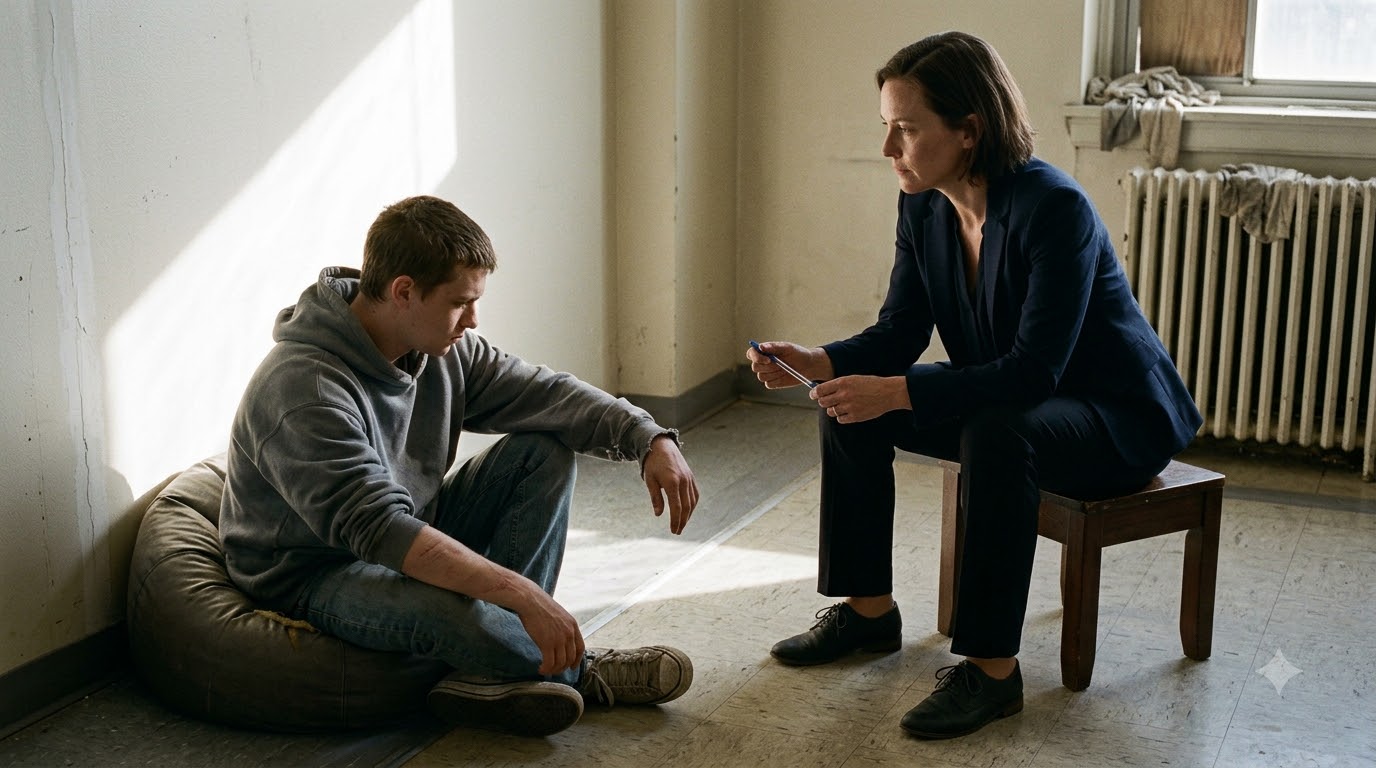
Jennifer sat opposite him on a low wooden stool, her knees nearly touching his. The scent of her own wool jacket—smelling of old rain and the lavender soap she used to clean her kitchen—offered a thin wedge of domestic sanity against the heavy, industrial odor of the child’s clothes. She reached into her satchel, pulled out a small, blue-ink ballpoint pen, and began unclicking the spring mechanism with her thumb. Click. Snap. Click. Snap.
The sound filled the gap between them, a small, rhythmic pulse of iron and plastic that measured the seconds while the horizon outside began to deepen into the long shadows of five o’clock.
“We wait,” she whispered, her eyes never leaving the gray cuff of his sleeve. “We just wait for the thunder.”
CHAPTER 3: THE CODE FALLEN HORIZON
The spring mechanism inside the blue-ink pen gave one final, dry scrape against its plastic chamber before Jennifer held her thumb down, locking the point inside the barrel. The absence of the sound left the alcove entirely unmoored. Across from her, Ethan didn’t track the movement of the pen; his eyes remained pinned to the specific spot on the baseboard where the gray vinyl trim had separated from the drywall, exposing a chalky white seam of gypsum that had flaked into dust over the winter.
Jennifer let her thumb slide off the plastic cap. The metallic scent of her leather satchel, sitting heavy on the floorboards between her boots, was the only clean edge in her immediate reach.
[V-2] The cold, measured click of the pen had pulled an old phantom out of the corners of her memory—the flat, administrative hum of the county courthouse six years ago when she sat through the truancy review board for a girl named Clara. The state representative had used a similar blue pen, clicking it three times between sentences while reading from a standardized matrix that concluded the child’s absenteeism was an environmental preference rather than a symptom. The system had a way of using small, rhythmic noises to bury its own structural failures under a layer of professional routine.
“Ethan,” she said, her voice dropping lower to keep it under the level of the hallway air-vent. “When David works on the mowers on Saturdays, does anyone come to the house? Anyone from the office with the green state cars?”
The boy’s shoulders didn’t move, but the gray cotton over his ribs pulled flat as he shallowly drew in air. “The lady with the small silver car,” he said. His voice was a thin, ungreased line. “She stays on the gravel. She doesn’t like the mud by the side door because of her shoes. David goes out to the window with the papers in the plastic folder. He signs them on the hood of her car while she keeps the engine running.”
“Does she ever come down to the basement, Ethan?”
“She looked through the door once,” the boy replied, his small chin moving against the collar of the hoodie. “In February. When the snow was high on the window wells. David told her the heater down there was a dry-air unit for the humidity control. He said the mattresses were for the sensory containment routine because I have the bad habits with the noise. She wrote on her pad. She didn’t go down the stairs because the step at the top has the soft spot where the wood split.”
Jennifer felt the leather of her satchel press against her ankle as she leaned forward. The structural reality of the defense was already clear. The Mitchells hadn’t hidden the basement; they had rebranded it. They had taken the language of therapeutic intervention—sensory containment, behavioral stabilization—and used it to cover the concrete floor and the deadbolt on the outside of the door. It was a calculated, precise inversion of intent, designed to pass a five-minute visual inspection by an operator who didn’t want to risk her heels on a split oak tread.
“The girls,” Jennifer said, her gaze steady on the fraying gray threads of his cuff. “Do they have the sensory containment too?”
“Sophia has the cough,” Ethan muttered. His fingers twisted into the fabric of his pocket, the knuckles showing through the worn weave like white pebbles. “David says the damp floor is good for the chest because the steam keeps the dust from rising. But when the light goes off at nine, she has to use the old rag to keep the cold from the concrete. If she makes the noise during the night, David turns the breaker off for the whole circuit. Then the small bulb goes black, and we can’t see the toilet corner.”
The real-time chronology of the afternoon was grinding forward. Outside the window, the blue-diesel smoke from the bus loop had thinned as the final local route cleared the iron gate at the perimeter of the property. The school was settling into its late-afternoon stasis—the specific silence where the only active things are the mechanical clocks and the slow cooling of the boiler pipes under the foundation.
But Jennifer’s hand remained flat against her phone inside her pocket. The 103 were already in motion. She could see the grid map of the county in her mind—the concrete arterial roads of the Columbus outer belt, the long, desaturated asphalt stretches of Route 315 where the wind from the river smelled of iron ore and damp limestone. Her brother David would be leading the line, his leather vest zipped tight over his marine-corps nomenclature, his blue-tinted goggles dropping over his eyes to block the low, angular glint of the four o’clock sun.
They weren’t moving with sirens; they were moving with weight. The momentum of over a hundred iron frames dropping into third gear at the exit ramps, their tires tracking through the gravel margins of the school district boundaries.
“We aren’t going to the main office if Mr. Anderson comes down the hall,” Jennifer whispered, her voice tightening as she heard the distant, distinct thud of the heavy fire-doors closing at the end of the north corridor. “If the key turns in that lock before the thunder starts, you stay behind the green cabinet, Ethan. Do you understand?”
The boy didn’t nod, but his body sank six inches lower into the vinyl casing of the beanbag, his small form disappearing entirely into the shadow thrown by the oak desk. He was a veteran of corners; he knew how to minimize his volume until his presence was nothing more than a gray density against the baseboard.
Jennifer stood up from the stool, her knees tracking through the tight arc of the reading alcove. She walked back to the front desk, her eyes fixed on the door handle. The chrome lever was stationary, its metallic surface catching the last yellow reflection from the brickwork outside. The silence of Room 214 was no longer an administrative space; it was a limestone trench, waiting for the first vibration of the heavy pistons to break the crust of the asphalt below.
CHAPTER 4: THE THRESHOLD OF OPTICS
The chrome handle of the classroom door remained horizontal, a cold bar of light reflecting off its polished edge, but the frame itself shuddered. It was a faint vibration, a tiny displacement transmitted through the steel studs behind the drywall as a heel struck the industrial tile of the main corridor. Jennifer did not lower her hands from her desk. Her leather satchel sat flat between her boots, its heavy brass clasp a dull knot in the shadows.
Behind the green metal supply cabinet, the vinyl skin of the beanbag didn’t rustle. Ethan had completely folded his limbs into the gap, his gray cotton sleeves drawn so tightly over his knees that he resembled a bundle of discarded rags left by the maintenance crew.
The latch clicked. The door didn’t swing wide; it opened exactly six inches, revealing the vertical slice of Principal Anderson’s gray worsted wool trousers and the edge of a plastic clipboard held flat against his hip. He didn’t look down at the alcove. His eyes, small and dry behind wire-rimmed lenses, fixed directly on Jennifer’s position by the window.
“Jennifer,” he said. The voice was low, carrying the specific, modulated restraint he used when school board representatives were evaluating the facility’s utility consumption. “The buses have cleared the lower loop. I have three drivers reporting that a series of non-district vehicles are tracking along the southern perimeter fence. Two-wheeled units. They aren’t utilizing the standard county access road.”
Jennifer didn’t shift her weight. Her boots remained anchored to the oak boards, her palms resting on the cold grain of the desk. “They’re coming here, Arthur.”
Anderson’s clipboard tilted three degrees. The white paper on top was an afternoon maintenance manifest—rows of black checkmarks verifying that the fire-doors were sealed and the boiler pressure was stable. “This is an unvetted assembly on public infrastructure, Jennifer. If these are family contacts related to the Cooper file, the district protocol requires an administrative proxy present at the gate. We cannot have the parking grid compromised while the facility is transitioning to evening stasis.”
“The grid isn’t the problem,” Jennifer said, her tone remaining flat, matching the level of the gray paint on the walls. “The child is still in the room. I’ve logged forty-seven days of structural negligence on his skin, Arthur. The state report is already in the queue. My brother is bringing the witnesses.”
Anderson stepped fully inside the room, the heavy rubber sole of his left shoe squeaking against the linoleum. He didn’t look toward the green cabinet, but his eyes narrowed as they caught the gray smudge of Ethan’s sleeve in the shadow. “The county closed that file three weeks ago, Jennifer. Rodriguez did the home walkthrough. The infrastructure was logged as compliant. If you are introducing external variables based on subjective notation, you are exposing the building’s operational metrics to an unnecessary legal review.”
“The walkthrough was a fraud,” she said simply.
The air in the room didn’t stir, but the small orange secondhand on the plastic clock over the whiteboard dragged past the twelve. 4:02 p.m.
Through the double-paned glass behind Jennifer, the first low, harmonic note arrived. It wasn’t a sudden roar; it was a sub-audible pulse that began in the limestone foundation of the building before it registered in the human ear. The cold zinc ruler taped to her desk gave a tiny, microscopic skip against the wood. Then another.
Anderson’s head turned toward the window. The white paper on his clipboard rattled against the plastic backing.
It was the sound of iron pistons moving in synchronized rhythm through the river valley three miles out—a heavy, mechanical mass tracking along the state route at forty-five miles per hour. The sound grew denser, shifting from a low drone into a solid, ungreased wall of vibration that struck the brickwork of the school’s west face. The glass in Room 214 began to sing, a high, metallic hum that vibrated through Jennifer’s teeth.
“They’re on the lower approach,” Jennifer said, her voice remaining perfectly level under the rising noise.
“This is highly irregular,” Anderson muttered, his hand dropping from his clipboard to grip the edge of the door frame as the floorboards began to tremble in earnest. “I have no directive from the superintendent for an intersection of this scale. The optics, Jennifer—the local press monitors the county dispatch log. If this structure is surrounded by non-standard transport units, the board will require a full operational audit before the Monday morning shift.”
“Let them audit,” Jennifer said. She reached down, her fingers locking around the leather handle of her satchel, and lifted it from the floor. The brass hardware gave a single, hard clink. “The boy isn’t leaving this room until the line forms on the asphalt.”
Behind the cabinet, Ethan’s small frame tightened further, his forehead pressing against his denim-covered knees as the room began to shake with the full weight of the 103. The thunder had reached the gate.
CHAPTER 5: THE COLD IRON DESCENT
The window sash didn’t just rattle; the rusted steel locking pin sheared with a dry, granular pop that dropped five flecks of oxidized iron onto the sill. The glass didn’t crack, but the entire double-paned unit settled two millimeters deeper into its rotten oak casing as the compression wave hit the masonry. Principal Anderson didn’t finish his sentence about operational audits. The vibration climbed his shin bones, forcing his heel to skid out of its neat stasis on the linoleum until his hip struck the corner of the green cabinet.
Jennifer didn’t look back at him. Her fingers tightened around the worn leather strap of her satchel, the hide dry and stiff against her palm.
[V-3] The environmental shift was immediate. The structural failure of the locking pin allowed a narrow, drafty blade of air to split the seal, filling Room 214 with the raw, external smell of the lower valley—damp river clay, crushed gravel, and the hot, ungreased heat of four-stroke oil vaporizing against cylinder heads. The primary tension of the room had broken out of its administrative container; the outside world was physically forcing its way through the frame.
“Get behind the secondary partition, Arthur,” Jennifer said. Her voice didn’t rise above the mechanical bass that was currently vibrating the chalk rails. “The turning radius at the gate is short. They won’t utilize the passenger lane.”
Through the window, the asphalt of the overflow lot didn’t look like a school yard anymore. The first three units pulled through the chain-link gates in third gear, their front tires throwing up small sprays of gray limestone screenings from the shoulder. These weren’t the shiny showroom models that spent winters in carpeted garages; these were long-frame road machines with desaturated tanks, the metal work carrying the dull gray sheen of zinc primer and hard salt crust from northern interstate runs.
David was at the apex of the wedge. His leather vest was unzipped six inches at the throat, the heavy black cowhide beaten flat by three hundred thousand miles of bugs and highway grit. His gray-streaked beard was split by the wind, flattened against his jawline where an old white scar from a Marine utility tool tracked from his earlobe to his throat. He didn’t drop his feet to the ground as the machine slowed; he checked the lean with a single, practiced twitch of his left wrist, dropping the heavy frame into the first slot parallel to the boiler room doors.
Behind him, the line didn’t break formation. They executed the pivot in real-time increments—twenty bikes becoming forty, forty-five becoming seventy, until the entire southern perimeter of the asphalt was a solid grid of cooling cooling fins and primary iron blocks. The sound changed from a kinetic roar into a synchronized, idling grunt that made the structural pillars in the main hallway click against their concrete headers.
“This is an actionable breach,” Anderson muttered, though his hand remained flat on the green cabinet, his clipboard pinned against his chest like an improvised breastplate. “The district legal representative has an explicit injunction model for non-permitted vehicle storage on the aggregate sections. They are blocking the fire hydrant junction.”
“They aren’t storing anything, Arthur,” Jennifer said, her eyes tracking her brother’s boots as they cleared the chrome footboard. “They’re establishing the boundary.”
David didn’t look up at the second-floor glass. He reached down, turned the brass ignition key until the primary circuit went dark, and let the machine settle onto its iron kickstand with a heavy, ungreased clunk that buried the foot half an inch into the soft afternoon tarmac. The man behind him—a weathered operator with a silver patch denoting thirty years in the ironworkers’ local—dismounted with the same slow, unhurried precision. No one was shouting. No one was revving the throttles. The silence that followed the engine cut was heavier than the vibration had been; it was the specific stasis of an engineering crew arriving to clear a derailed freight line.
In the corner, the vinyl skin of the beanbag gave a small, dry rustle as Ethan shifted his weight. His face remained obscured by the gray cotton sleeve, but his small fingers had reached out from the cuff, his nails scratching lightly against the bare gypsum seam of the drywall. He was listening to the rhythmic ticking of over a hundred hot exhaust pipes contracting in the cool air of the shadow—a sound like small iron hammers hitting an anvil in the dark.
Jennifer stepped away from her desk, her boots making a deliberate, unhurried track toward the door frame. She didn’t check the hallway. She knew the sequence of the building by heart; the custodian would be by the boiler room doors, his keys hanging from his leather belt, his mouth open as the grease-scent of a hundred road engines filled his loading dock.
“Stay with the ledger, Arthur,” she said as she reached the chrome lever. “If the county caseworker calls the main desk before Michelle Garrett clears the highway, you tell them the inventory is locked in Room 214. Don’t use the word ‘compliant’.”
She pulled the lever. The latch cleared the plate with a dry, iron snap, and she stepped into the long, desaturated perspective of the north corridor, leaving the principal behind the green metal cabinet with the flaking gypsum dust.
CHAPTER 6: THE RECKONING AT EYE LEVEL
The concrete floor of the north corridor didn’t reflect the light; it absorbed it, the green deck-paint worn down to pale, chalky paths where twenty generations of children had dragged their soles. Jennifer’s boots made a rhythmic, solitary clack-clack that sounded small against the collective hum vibrating through the masonry. Behind her, Room 214 was locked in its administrative stasis; ahead, the double fire-doors leading to the main entrance stood slightly ajar, a sliver of the late afternoon glare cutting through the gap like a zinc wedge.
She didn’t run. Rushing was a sign of a loose gear. She kept her satchel pinned against her hip, the heavy canvas side absorbing the vibration of her stride. When she hit the crash bar of the fire-doors, the iron mechanism gave a dull, ungreased thunk that cleared her path out into the lobby.
The main entrance was a vault of yellow brick and safety glass, empty except for the heavy, low-frequency pressure wave coming through the open transom windows. The custodian wasn’t by his cart; he was leaning his forehead against the double-paned security door, his brass key-ring clutched in his right hand to stop it from rattling. He didn’t look at Jennifer when she crossed the mat. His eyes were wide, fixed on the three distinct shapes now silhouetted against the gravel apron fifty feet away.
David didn’t wait for her by the bikes. He had already cleared the first concrete riser of the porch, his heavy logger boots leaving tiny, dark arcs of wet oil screenings on the limestone. Behind him stood a man who made David’s thick frame look narrow—Victor Dalton, the one the ledger called Priest.
Priest was fifty-eight, his gray beard trimmed close to a jawline that looked like a rusted block of pig iron. His leather vest didn’t carry the standard commercial patches; it had a single, heavy rocker denoting thirty years of mechanical survival and a small, oxidized silver cross sewn onto the internal lining where the leather had softened from sweat. His blue eyes weren’t searching the windows; they were pinned down to the floor level, tracking the specific structural paths where the building met the foundation.
“Jenny,” David said, his voice coming out flat, stripped of the highway growl. He didn’t stop to touch her shoulder. He cleared the heavy glass door with a single, unhurried shove that left the pneumatic arm hissing in the jamb.
“He’s in the reading alcove,” Jennifer said, her gaze shifting to Priest. “Behind the green metal lockers. The principal is holding the clipboard, but his knees are against the partition.”
Priest didn’t nod. He didn’t lift his hands from his belt line. His palms were broad, the skin calloused into gray ridges near the thumbs from decades of turning hot wrenches in unheated bays. “The caseworker,” he said. His voice had the dry, rhythmic grate of a stone boat being dragged over gravel. “Garrett. She’s tracking forty-five minutes out on the western loop. Her unit is a four-cylinder sedan; she won’t clear the river hill before the shadow hits the chimney.”
“We have forty-five minutes then,” Jennifer said.
“We have the time it takes to set the index,” Priest replied. He didn’t use the central corridor. He turned his bulk toward the north stairwell, his boots finding the exact center of each concrete tread with a heavy, predictable thud that didn’t leave a trail.
The air in the stairwell smelled of wet cedar and the cold iron grease of the handrails. Jennifer tracked three paces behind him, her eyes on the back of his vest. The leather was split down the center seam, stitched back together with heavy copper wire that had greened at the edges from exposure to the rain. It wasn’t decorative; it was a repair made by a man who didn’t throw away a structural piece just because the thread had failed.
When they cleared the second-floor header, the corridor to Room 214 looked different. The light had turned a deep, desaturated orange, the shadow of the school’s old flag pole cutting a broad black band across the green paint of the ceiling. Principal Anderson was still standing three feet from the threshold, his clipboard held at a forty-five-degree angle against his ribs, his mouth open as the two large shapes filled the perspective of his doorway.
“This is an unvetted entry,” Anderson said, though his voice lacked the administrative bite it had carried five minutes ago. His fingers were white where they clamped the plastic edge of the board. “The facility is currently in its transitional security protocol. I have no record of an approved community witness contract for these individuals.”
Priest didn’t look at the clipboard. He didn’t look at Anderson’s face. He walked past the man’s shoulder like he was clearing a loose branch from a logging trail, his bulk displacing the air in the jamb until the white paper on the manifest fluttered.
He stopped two feet from the green metal supply cabinet.
The alcove was completely silent. Ethan hadn’t moved from the smallest beanbag; his forehead was still pressed into the denim of his knees, his gray cotton sleeves drawn down until only the white knuckles of his thumbs showed through the weave. He looked like an anomalous density in the corner, a piece of gray insulation that had fallen from the ceiling tiles and settled into the dust.
Priest didn’t speak. He didn’t reach down from his full height. He took two slow, deliberate steps backward, his logger boots finding the exact position where his shadow wouldn’t fall across the child’s face. Then, with a low, hydraulic grunt that made his leather vest groan against the copper wire stitching, he dropped his bulk down into a deep squat.
At sixteen inches off the linoleum, Priest’s jaw was exactly parallel to the desk line. His massive frame occupied the narrow gap between the alcove and the green lockers, his knees nearly touching the frayed cuff of Ethan’s sleeve. The scent of him filled the space—not the sweet, artificial spice of aftershave, but the raw, honest stink of hot engine blocks, boiled linseed oil, and the dry, alkaline dust of seventy-mile highway runs.
“Son,” Priest said. The word wasn’t loud, but it had the weight of an iron anchor setting into river silt. “Look at the patch on my chest. Just the silver part.”
Ethan didn’t lift his head from his knees, but his small frame stopped its mechanical twitching. The gray cotton over his shoulder blades pulled tight as he held his breath, his ear turning two millimeters toward the sound of the old man’s voice. The silence of Room 214 was no longer an administrative cage; it had become an engineering bay, cold and clear, waiting for the first measurement to be logged.
CHAPTER 7: THE COLD ARCHIVE
The silver threading on the edge of Priest’s patch didn’t catch the light; it was too clogged with road grease and the fine, red grit of clay dust from the southern counties. Ethan’s small face didn’t lift from his denim knees, but his breathing shifted, a faint, rhythmic rattle in his throat matching the cooling clicks of the iron blocks out on the tarmac. Priest remained anchored in his squat, his weight balanced on the thick heels of his logger boots without a single tremor passing through his leather-wrapped thighs.
The silence was broken by the dry, industrial squeak of a laptop hinge.
Marcus Thompson—the one the line called Wire—stepped over the threshold of Room 214 without touching the frame. He didn’t look like the rest of the wedge. His stocky frame was packed into a faded canvas utility vest rather than heavy cowhide, and his wire-rimmed spectacles were held against his temples by a black elastic band that had lost its spring. He didn’t drop a gear or announce his presence. He slid a ruggedized, zinc-cased terminal onto the nearest student desk, its old internal fan spinning up with a high, mechanical whine that smelled faintly of scorched circuitry and cold solder.
“The registry is open,” Wire said. His voice was precise, flat, stripped of any administrative rhythm. His fingers, short and stained with typewriter ink near the nails, began a rapid, ungreased tap against the plastic keys. “The state interface uses an old COBOL core for the Cuyahoga region. They haven’t updated the security markers since the fiscal realignment of 2018.”
Jennifer stepped closer to the zinc edge of her desk, her boots tracking through the long bar of orange sunlight. “What did they file, Marcus?”
[V-1] Wire didn’t look up from the screen, but his left middle finger paused on a line of code. A physical discrepancy appeared in the ledger matrix—a blue automated routing flag that didn’t match the standard county prefix. It was an off-system authorization seal, stamped with a digital signature from a regional diagnostic center that had been dissolved three years prior.
“They have a shield,” Wire said, his eyes tracking the vertical scroll of green text. “David Mitchell didn’t hide the basement from the tracking logs. He registered it under an explicit therapeutic exemption index. Here’s the entry from October fourteenth: Behavioral Rehabilitation and Sensory Containment Waiver. It’s signed off by a contract proxy out of the old Columbus clinic.”
Jennifer felt the leather handle of her satchel go cold in her fist. She looked down at the gap behind the green cabinet where Ethan lay tucked into the vinyl skin of the beanbag. “A containment waiver.”
“It’s an engineered protocol,” Wire continued, the keys clicking under his thumbs like small bone teeth. “Every time the local caseworker generated a non-compliance alert based on a neighbor’s call, the automated system pulled this waiver. It states the subject exhibits severe cognitive stimulus volatility. It specifies that standard domestic quarters—beds with frames, open windows, standard interior latches—induce self-harming patterns. The concrete floor and the deadbolt aren’t logged as abuse, Jennifer. On paper, they’re logged as a licensed, doctor-approved sensory reduction suite.”
The principal, still wedged between the wall and the partition, let his clipboard slip two inches down his ribs. The white paper of his manifest caught the dust motes. “A medical waiver is an absolute statutory defense against a summary emergency removal,” Anderson muttered, his administrative logic trying to find an unrusted rail to grip. “If there is a pre-existing diagnostic profile within the state automated registry, the district cannot authorize a physical custody transfer without a legal countersign from the regional supervisor. The liability metrics—”
“The waiver is dead, Arthur,” Priest said. He didn’t lift his head, but his jaw moved against his beard with a dry, grinding scrape. “The doctor who signed that digital seal has been sitting in a federal camp in Lexington since the spring of 2024 for prescription kiting. The Mitchells bought the form. They bought the routing index to keep the caseworker from having to step past the first tread of the stairs.”
Jennifer’s gaze stayed on Wire’s screen. The green glow reflected off his spectacles, showing two identical lines of figures tracking through the digital marrow of the foster system. “They didn’t just buy a form, Marcus. Look at the payment columns on the right.”
“I see them,” Wire said, his voice dropping an octave into a cold, clinical register. “The base allowance for a standard placement is twenty-two hundred. But under the sensory containment waiver, the state releases a secondary tier of funding for specialized facility maintenance. An extra four thousand one hundred monthly for the sibling group, plus an asset-preservation premium. They aren’t just covering their tracks with the medical form; they’re using the containment protocol to clear nine thousand two hundred and fifty dollars every thirty days, tax-free.”
The room seemed to drop three degrees as the full weight of the ledger settled into the corners. Outside the glass, the shadow of the flag pole had reached the first row of motorcycles, turning the desaturated chrome tanks from copper to a dull, dead gray. The 103 were still sitting on their iron frames, their exhaust pipes giving off occasional, irregular snaps as the metal contracted against the gravel.
Ethan slowly pulled his forehead away from his knees. His eyes, small and red-rimmed under the frayed edge of the gray hood, didn’t look at the computer screen or the principal. They fixed on the silver cross sewn inside Priest’s vest, his small fingers reaching out from the gray cotton sleeve to touch the cold zinc buckle of the old man’s boot. He didn’t ask about the papers. He didn’t ask about the doctor. He knew only the texture of the room—the smell of the oil and the solid, unmoving bulk of the ironworkers who had blocked the driveway.
“The caseworker’s sedan just cleared the river bridge,” David said from the doorway, his hand resting on the brass frame of his pocket watch. “Her tires are hitting the aggregate on the lower loop now. She’s going to see the line, Priest.”
“Let her see it,” Priest said, his large boots shifting on the linoleum with a heavy, deliberate crunch as he prepared to stand. “We have the index now. We have the data that shows the trap they set. We just wait for her to touch the latch.”
CHAPTER 8: THE ARRIVAL OF THE WITNESS
The heavy leather of Priest’s vest gave a dull, structural creak as he straightened his knees, his bulk rising slowly out of the deep squat like an industrial hoist. His logger boots didn’t slip on the worn linoleum. Beside the green cabinet, Ethan’s small fingers slowly retracted back into the frayed cuff of his gray sleeve, his contact with the old man’s iron buckle broken but his breathing remaining regular.
David stayed pinned to the door frame, his pocket watch still gripped in his calloused palm. The internal ticking of the gears was entirely swallowed by a new sound coming from the lower apron of the property—the thin, high-revving whine of a compact four-cylinder engine pulling through the loose gravel of the entrance.
“She’s at the gate,” David said. He didn’t drop the watch; he snapped the zinc casing shut with a single, ungreased click of his thumb. “She took the center lane. She’s staring at the wedge.”
Jennifer moved toward the threshold, her leather satchel hanging steady at her side. “Arthur, stay inside the frame,” she said without looking back at the principal. Anderson didn’t answer. His fingers were still white where they clamped the plastic edge of his manifest, his administrative architecture completely pinned by the physical presence of the two men blocking his exit.
Priest walked past the desk, his shoulder clearing the oak edge by two inches. He didn’t rush. His boots found the center line of the hallway corridor, tracking toward the north stairwell with an unhurried, mechanical rhythm that gave the building no opportunity to settle. Jennifer followed three paces back, her eyes fixed on the gray, wire-stitched seam down the center of his back.
When they hit the first-floor landing, the glass security doors of the main lobby were already vibrating from a different source. Michelle Garrett’s silver sedan had come to a halt ten feet from the boiler room doors, its radiator fan whirring with a cheap, plastic rattle that smelled of hot coolant and synthetic belt grease. The investigator didn’t clear the driver’s side immediately. Through the tinted windshield, her outline was stationary, her head tilted slightly toward the left mirror where the long, desaturated grid of the 103 filled the perspective.
The riders weren’t looking at her car. They remained anchored to their iron frames, their arms crossed over their canvas and leather vests, their faces completely flat behind their dirt-filmed highway goggles. They were a wall of cold gray primer and unpolished chrome, sitting completely silent as the four-cylinder engine gave one final, ragged sputter and died.
“She’s counting,” Priest said, his voice grating low in his chest as he cleared the outer threshold and stepped onto the concrete porch.
The afternoon air had grown dry, carrying the scent of parched topsoil and the heavy, metallic tang of the nearby rail line. Michelle Garrett finally pushed the car door open. Her black leather flats made a soft, flat slap against the asphalt as her weight cleared the sill. She was holding a ruggedized government tablet against her ribs like a shield, her gray trench coat carrying the dust of a seventy-mile county loop.
She didn’t look like an investigator who had come to close a compliant file. Her eyes were small, tight, tracking the specific paths where the motorcycles had dropped their kickstands into the soft tarmac.
“Mr. Dalton,” she said, her voice carrying the thin, professional restraint of an operator who spent her mornings navigating three-part agency cross-indices. “This isn’t the standard administrative configuration for an expedited field review. I have an automated flag on my terminal stating the facility is currently under a local restriction.”
“The restriction is in the building, Michelle,” Priest said. He didn’t clear the top step. He stood four feet above her, his shadow stretching across the hood of her sedan until it touched the plastic wiper arms. “The child is up in Room 214. He’s down twenty pounds since your district proxy signed the compliance certificate in February.”
Garrett’s fingers shifted on the edge of her tablet, her thumb activating the screen until the green glare reflected off her chin. “The February review was handled by Rodriguez. The log states the domestic infrastructure at Maple Ridge Drive met the criteria for specialized sensory management under the regional waiver. The document carries a verified state routing seal.”
“The seal is grease,” Wire said, his voice cutting through the open door from the lobby behind Priest. He stepped onto the porch, his ruggedized terminal held flat under his arm, its small fan still spinning with a thin, metallic whine. “The Columbus clinic that generated that routing code was liquidated fourteen months ago. The diagnostic signature belongs to a medical proxy who’s currently serving sixty months for asset kiting. David Mitchell didn’t buy a therapy routine, Investigator. He bought a legal blind.”
Garrett didn’t shift her feet, but her jaw tightened until the thin muscle near her ear showed through the skin. She didn’t look at Wire’s terminal. She looked at Jennifer, who stood behind Priest’s left shoulder, her satchel held flat against her thigh.
“Jennifer,” Garrett said, her cadence dropping into the lower, transactional tone of a veteran reviewer. “If you are using non-standard community elements to force an emergency custody transfer before the formal seventy-two-hour review cycle has cleared the main office, the county will freeze the placement ledger. The district can’t absorb the liability of an unvetted extraction.”
“The extraction isn’t the liability, Michelle,” Jennifer said, her voice remaining as flat as the concrete riser beneath her soles. “The basement is. The boy has forty-seven days of notation on his arms. The neighbor signed the statement ten minutes ago. The five-gallon oil containers are sitting on the concrete floor right now, and the deadbolt is on the outside of the door.”
Garrett looked back at the long, unmoving line of the 103. The silence of the parking lot was total, broken only by the dry hum of the wind through the chain-link perimeter fence. The riders didn’t move. They didn’t rev their engines. They just watched her finger hover over the screen of her tablet—a hundred and three silent witnesses waiting to see if the system would try to use an unrusted rail to slide past the truth.
She turned the terminal screen off. The green reflection vanished from her face, leaving her features looking as gray and desaturated as the limestone base of the school chimney.
“Let’s go back up,” she said simply.
CHAPTER 9: THE DEPLOYMENT ARTERIAL
The black leather flats worn by Michelle Garrett didn’t hesitate on the concrete riser; they turned, their thin soles striking the limestone step with a sharp, dry click that signaled the formal collapse of her field routine. She didn’t look at Wire’s rugs or his terminal again as she cleared the entry doors, her tablet held flat against her ribs like a locked ledger. Priest followed three paces behind her, his large shoulders widening the perspective of the frame as they moved back inside the facility’s desaturated yellow brick core.
The ascent through the north stairwell was an unbroken line of mechanical sound—the low, synchronized rumble of the hundred and three idling engines out on the tarmac filtering through the lime-crust of the vents. When the party cleared the second-floor header, Room 214 hadn’t shifted its mass. Principal Anderson remained pinned between the green metal supply cabinet and the dry wall, his clipboard still held against his midsection like a shield that had lost its polish.
Garrett didn’t use the standard agency greeting when she crossed the threshold. She walked directly to the reading alcove where Ethan sat embedded in the gray vinyl of the beanbag. Her thumb flicked the edge of her screen twice, bringing up the historical county tracking index for 3847 Maple Ridge Drive.
“The case file is frozen,” Garrett said, her tone flat, matching the gray shade of the floor boards. She didn’t look up at Jennifer, who had stayed by the oak desk with her ledger satchel. “The automated registry shows an emergency custody suspension was issued out of the central terminal five minutes ago based on the forensic accounting discrepancy. But the physical transfer requires a local law enforcement escort before the state pool can release the field voucher.”
[V-3] The administrative architecture fractured along an unexpected seam. Wire’s terminal gave a short, metallic beep as a new string of system text populated his screen—a county-wide network lock had gone active across the dispatch channels, standardizing a forty-minute routing delay for all non-emergency municipal units due to an intersection failure on the southern bridge. The state machinery was lagging behind the real-time velocity of the asphalt.
“We don’t have forty minutes on this grid,” Priest said, his voice coming out like a heavy timber being dragged over granite. He didn’t check a pocket watch; his hand stayed pinned to the thick zinc ring of his belt. “David Mitchell’s sedan tracks the school loop every afternoon at 4:15. If his inventory isn’t on the bus, he doesn’t check the portal monitor—he checks his ledger.”
“The legal authority—” Anderson began, his fingers twitching against the plastic frame of his manifest.
“The authority is on the wheels, Arthur,” Jennifer cut in, her boots creating a hard, snapping stride as she walked over to the beanbag alcove. She didn’t soft-talk the child. She reached down, her palms finding the thick, gray cotton of Ethan’s shoulders, and lifted his fifty-eight-pound frame directly out of the vinyl pocket. “He’s moving now. We aren’t waiting for the county sedan to clear the aggregate on the lower road.”
Ethan didn’t resist the lift. His small limbs hung rigid inside the oversized sleeve, his gray sneakers clearing the linoleum without a single rustle of dust. His gaze remained locked on the oxidized cross sewn inside Priest’s vest as the old man turned his bulk back toward the corridor.
The descent to the parking lot was written in the friction of logger boots and dry leather straps against concrete headers. They didn’t utilize the passenger lift. They cleared the double fire-doors in a single, unhurried mass, emerging onto the aggregate apron where the sun had dropped far enough to turn the brickwork into long blocks of desaturated crimson.
The 103 were already shifting their alignment. Reaper was on his iron frame, his left boot tapping the chrome shifter into first gear with a heavy, metallic clunk that ran through the gravel shoulder. The line didn’t break its wedge formation; it widened, the seventy-five-horsepower blocks creating a long, parallel trench of exhaust smoke that smelled of sulfur and hot primary oil.
“Garrett,” Priest said, his arm pointing toward the silver sedan idling by the boiler entrance. “You lead the column. Use the center lane on the state route. If the Mitchells’ unit pulls out from the secondary gate before the warrants clear the desk, my brothers will establish the pocket.”
The investigator didn’t signature a response with her tablet. She slid behind the wheel of her four-cylinder unit, her gray trench coat bunching against the synthetic fiber of the seat as she turned the ignition key. The plastic radiator fan kicked back in with its cheap, whirring rattle, but its small volume was immediately swallowed as over a hundred road machines dropped their throttles into synchronized synchronization.
Jennifer took her place on the rear pad of David’s unit, her leather satchel slung across her ribs like a courier’s pack. She didn’t look back at Room 214 or the principal, who remained standing on the limestone porch with his clipboard held against the dry air. Her fingers locked around the cold iron grab-rail behind the saddle, her boots binding to the zinc pegs as the entire column rolled forward into the gravel, tracking toward the primary artery of Maple Ridge Drive.
CHAPTER 10: THE CONCRETE BASEMENT
The transformation from the crushed limestone screenings of the school parking lot to the hard, unyielding asphalt of the state route was registered as a sharp reduction in vibration. On the rear saddle of David’s unit, Jennifer felt the machine settle onto its iron frame, the seventy-five-horsepower block shifting from an erratic aggregate spray into a high, synchronized hum that ran directly up through her boot heels. Ahead, Michelle Garrett’s four-cylinder sedan held the center line, its small plastic bumper vibrating against the exhaust plume of the lead wedge.
They didn’t jump the timeline. The journey to 3847 Maple Ridge Drive was calculated in real-time increments, five miles of desaturated county road bordered by dry drainage ditches and the rusted perimeter wire of old livestock farms. The 103 stayed in tight, parallel columns of two, their dirt-filmed goggles catching the glare of the low afternoon sun like iron washers. No one broke formation to clear a path. The momentum of the column was its own right-of-way, a solid block of iron and cowhide tracking through the suburban margins until the gravel gave way to the neat, uniform concrete curbs of the subdivision.
When the lead machines dropped their gears into second, the facade of the Mitchell house appeared exactly as it had been logged in the winter reports—a two-story block of cream siding and brick veneer, bordered by an unweeded patch of turf. David’s sedan wasn’t in the gravel drive; it was parked parallel to the curb, its rear bumper carrying the fine gray dust of the county access roads.
Karen Mitchell was already on the concrete porch. Her hand was pressed flat against the phone at her ear, her fingers pale where they clamped the plastic casing. She wore a heavy knit cardigan and tan trousers, the standardized uniform of suburban respectability, but her eyes didn’t look like an operator who had verified her compliance codes. They were small, tracking the seventy-five-horsepower blocks as they began their real-time alignment along the curb face.
The riders didn’t dismount in a rush. They killed their ignitions sequentially, over a hundred iron kickstands hitting the concrete gutters with a heavy, metallic clunk that filled the street with the smell of hot motor casing and ungreased oil. They didn’t cross the grass. They stood by their frames, arms crossed over their canvas vests, establishing a dead perimeter forty feet from the front step.
“This is an actionable entry,” David Mitchell said, stepping out from the screen door behind his wife. He wore a clean polo shirt, his hair combed flat with grease, but his thumb was twitching against the seam of his pocket. “We have an active diagnostic waiver on file for the registry. The regional office—”
“The office is closed, David,” Michelle Garrett said, her boots making a flat, unhurried track up the concrete sidewalk. She held her tablet against her ribs, her thumb activating the screen until the green glare illuminated her chin. “The custody waiver was suspended forty-five minutes out. I have a county directive to inspect the lower infrastructure of this facility immediately.”
Karen Mitchell didn’t drop the phone. “The children are at the church youth group,” she said, her voice thin, carrying the dry, rehearsed currency she had paid out to the field proxy in February. “They have a designated sensory stabilization routine on Thursdays. It’s logged in the matrix.”
“They aren’t at the church,” Jennifer said, crossing the turf with her leather satchel held tight against her hip. Her boots left small, dark depressions in the parched grass. “Ethan is behind the perimeter line with the medic. Sophia and Isabella are down there right now, David. Move your bulk from the jamb.”
The physical transition through the threshold was immediate. The interior of the house smelled of furniture wax and pine-scented floor wash, a calculated layer of domestic order designed to satisfy a five-minute visual check from the doorway. Family portraits in synthetic oak frames tracked along the stairwell wall—rows of smiling faces from previous placements, children who had been cycled through the ledger and turned back into the state pool once their asset premium had cleared.
Garrett didn’t stop to check the primary bedrooms on the second tier. She followed the narrow corridor past the kitchen, her flat soles making a sharp slap-slap on the linoleum until she reached the gray painted door behind the pantry.
The door was standard pine, but it had an anomalous piece of hardware—a heavy, brass-faced deadbolt mounted five feet up on the outside of the frame, the cylinder scratched where a key had been forced into the plug in the dark. The latch was thrown.
Priest stepped into the narrow space, his leather vest groaning against the door frame as he reached out his broad hand. He didn’t ask for the key. His fingers closed around the brass thumb-turn of the bolt, his thumb applying seventy pounds of mechanical pressure until the internal iron pin sheared with a dry, granular crack that dropped five flakes of yellow metal onto the floorboards.
He pushed the door.
The descent into the lower infrastructure was dark, the wooden treads of the stairs split down the grain and left ungrounselled. The air that rose from the gap didn’t smell of furniture wax; it carried the raw, sour stink of unwashed bedding, damp cinder block, and the heavy, industrial tang of kerosene sludge.
Michelle Garrett held her terminal ahead of her like a lamp, the green light tracking across the concrete floor twenty feet below. The basement was completely unfinished, the stone walls white with lime-crust and wet rot from the foundation leaks. In the corner, under a single bare sixty-watt bulb hanging from a gray braided cord, lay three thin foam mattresses, their vinyl covers split and stuffed with old newspapers to keep the damp from rising.
There were no closets. No dressers. Two small plastic garbage bags sat by the utility toilet, containing three pairs of socks and a single school notebook with its cover torn away. This was the sensory containment suite—the engineered facility that had cleared one hundred and eleven thousand dollars a year from the state pool while the children slept on concrete in a fifty-five-degree shadow.
“The log was compliant,” Karen Mitchell whispered from the top of the stairs, her cardigan bunching at her throat as she watched the investigator’s tablet click through the photos of the mattresses. “They have behavioral volatility. The deadbolt was for the protection metric—”
“Save the ledger for the bench, Karen,” Priest said, his large boots finding the bottom tread with a heavy, final thud that shook the dust from the floorboards above. “The inventory is cleared.”
CHAPTER 11: THE PORCH INDEX
The sixty-watt bulb hanging from the gray braided cord over the mattresses didn’t flicker; it stayed constant, throwing a dull, yellow glare across the lime-crust of the foundation walls. Priest stood unmoving on the bottom concrete tread, his leather vest throwing a broad, dark shadow across the split foam where the children had slept. Above him, the sound of the screen door closing at the top of the stairs signaled that Michelle Garrett was already moving her terminal back into the kitchen corridor to log the asset metrics.
Jennifer didn’t remain on the stairs. She tracked Priest’s bulk as he swung his frame around, his logger boots clearing the lower riser with an unhurried, mechanical step. They climbed back into the light of the pantry hallway where the smell of furniture wax felt increasingly hollow, a thin zinc mask over the dry rot below.
Outside, the hundred and three hadn’t shifted their alignment. They were still anchored to their iron frames along the concrete gutter, their canvas vests creating a solid perimeter of gray and black that kept the neighborhood locked in stasis.
[V-1] Wire was already on the sidewalk two properties down, his ruggedized terminal held flat across his canvas vest. A physical discrepancy had caught his attention by the gravel boundary line of 3845 Maple Ridge Drive—a small, zinc-coated water utility valve that had been freshly cleared of weeds, its lock-nut scored by a non-standard wrench that didn’t match the county maintenance inventory. It was a secondary tap line, routed directly across the property line through an uninsulated plastic pipe.
He didn’t knock on the neighbor’s door frame. He stood on the edge of the aggregate porch, his wire-rimmed spectacles held firm by the black elastic band as Margaret Thompson pushed the aluminum screen open. She was sixty-seven, her hands tucked into the pockets of a faded denim apron that smelled of starch and cold tea.
“Mr. Thompson,” she said, her voice thin, matching the dry rustle of the oak leaves overhead. She didn’t look past his shoulder at the row of road machines. “I told the lady with the silver car everything in April. I told her the boy was on the turf during the heat run. I signed the form on her clipboard.”
“The form wasn’t a ledger, Margaret,” Wire said, his fingers continuing their rapid, ungreased click against the terminal keys. “The document you signed was logged as a local neighborhood reconciliation waiver. The Mitchells used your signature to verify that the children were participating in outdoor therapeutic labor under the sensory protocol. You signed away the non-compliance alert.”
The woman’s knuckles went white inside her apron pockets. She looked down at the zinc valve by her boots, her jaw tightening until the old lines near her mouth turned gray. “They told me it was the state rule,” she whispered, her voice dropping below the hum of the idling engines down the curb. “David said if I kept generating the phone notifications to the central registry, the county would pull the sibling group and place them in a commercial facility down in the valley. He said the basement was for the noise. I brought them lemonade in August, and Karen took the pitcher right out of my hand. She said I was ruining the index.”
Jennifer stepped onto the grass margin between the two properties, her leather satchel hanging heavy from her shoulder. “You saw him collapse, Margaret. Last August. It’s forty-seven days since I started the notation in Room 214, but you’ve been watching the turf since the frost broke.”
“I saw him,” the woman said, her eyes finally lifting to meet Jennifer’s flat gaze. “He was by the aggregate bin. He couldn’t lift the three-gallon handle. He sat down in the clay, and Karen didn’t clear her chair on the porch. She just watched the timer on her wrist until he got back on his knees. I stayed behind my curtain, Jennifer. I told myself it was the county’s ledger. I told myself the waiver made it compliant.”
The real-time chronology of the block was tightening. At the curb face, the first blue-and-white police cruisers from the Columbus fraud unit pulled into the intersection, their tires making a dry, crunching stop against the loose screenings on the shoulder. They didn’t activate the sirens; their arrival was marked only by the flashing of their roof bars—rhythmic bars of blue light that cut through the desaturated orange glare of the sunset, tracking across the cream siding of the Mitchell house like cold steel.
Robert Chen, the neighbor from across the street, cleared his screen door next. He didn’t cross the asphalt, but he stood by his mailbox, his palms flat on the galvanized iron box as the officers cleared their sills. He didn’t look like an operator who had stayed out of the line; his head was down, his shoulders hunched inside a faded grey windbreaker as the blue light hit his face.
“The statements are updating,” Wire said, his screen scrolling through the localized database entries as the precinct terminals linked with his COBOL core. “The neighbor index is uniform now. Once the blue units hit the driveway, the compliance defense completely drops out of the registry. They have no more rails to slide on.”
Priest came down the sidewalk from the Mitchell porch, his large shoulders unmoving under the weight of his vest. He didn’t look at the cruisers. He looked at the old woman on the steps, his blue eyes small and clear behind his beard.
“The ledger is straight now, ma’am,” he said, his voice grating low against the iron scent of the curb. “The counting is done.”
CHAPTER 12: THE SHUTTING CYLINDER
The rhythmic bars of blue light from the Columbus fraud unit cruisers didn’t hit the cream siding like a warning; they sliced across the wood panels like an industrial laser, turning the artificial grain into cold, desaturated slats of gray and purple. Priest didn’t move his bulk from the sidewalk edge. His logger boots remained anchored into the packed earth near the utility tap, his thumbs hooked back into his thick belt as the first cruiser’s door swung wide with a dry, metal rattle.
David Mitchell was still on the porch, his hand holding the frame of the aluminum screen door. The polo shirt looked too wide for his chest now, the greased lanes of his hair reflecting the rhythmic blue pulses from the street.
“The documentation is standard,” Mitchell said, his voice dropping into that thin, rehearsed frequency he’d used to pass the February cycle. He didn’t drop his hand from the frame, but his fingers were white where they gripped the wire. “We have the medical variance registered in the database. The district proxy verified the space.”
Detective Ramirez didn’t answer from the curb. Her boots made a flat, metallic slap-slap against the asphalt as she cleared the driver’s side sill, a black leather folder clutched flat against her ribs. Behind her, two uniform officers stepped onto the aggregate sidewalk, their heavy leather utility belts squeaking with the weight of cold steel cuffs and carbon tool cases. They didn’t cross the turf in a rush; they moved with the slow, unyielding pace of a machine following an iron track.
“The variance is cleared, Mr. Mitchell,” Ramirez said, her voice matching the flat, alkaline dust that hung over the curb. She didn’t offer a clipboard for a signature. She opened the black folder, revealing three distinct tiers of state prosecution sheets stamped with the crimson seal of the county court. “The Columbus database was scraped at 4:04 p.m. We have the forensic log from the regional repository. The waiver you bought from the Lexington facility was flagged as an active instrument of fraud fourteen months ago.”
Karen Mitchell’s phone finally slipped from her palm. The plastic casing made a dull, hollow clack as it struck the porch floorboards, sliding three inches into the shadow of her cardigan. She didn’t reach down to retrieve it. Her shoulders slumped under the heavy knit fabric, her features losing their suburban mask until her skin looked as gray and unpolished as the limestone base of the chimney.
“The children had the volatility,” she whispered, her teeth clicking against each other in the blue light. “The county gave us the assignment pool. Eleven placements. We followed the maintenance schedule.”
“You followed the payment column,” Wire said, his voice cutting flat across the grass from the neighbor’s fence line. He didn’t lower his terminal. He held the ruggedized casing steady under his arm, its internal fan throwing a thin, hot draft of zinc-scented air against his canvas vest. “Eleven placements over five years, Karen. Average cycle: six months. Every time a child hit the point where the base voucher transitioned to long-term medical monitoring, you filed a non-compliance volatility report and requested a replacement unit from the pool. You weren’t maintaining a family; you were clearing an inventory line before the depreciation metrics caught up with the checks.”
The physical mechanism of the law didn’t explode; it clamped down like a heavy vice on a workbench. The two uniform officers stepped up the concrete risers, their boots leaving twin tracks of wet limestone screenings on the porch. The first officer’s hand went to Mitchell’s wrist—not with a violent yank, but with a calculated, transactional grip that brought the man’s forearm parallel to the iron railing.
The handcuffs didn’t shine; they carried the dull, desaturated gray of zinc plating. The first cylinder clicked—snap—locking the steel teeth into the groove of Mitchell’s left wrist. Then the second—snap—bringing his hands together behind the polo shirt until the links binding them pulled straight.
“David James Mitchell, Karen Louise Mitchell,” Ramirez read from the sheet, her cadence remaining flat, stripped of any dramatic cadence. “You are under arrest for felony child endangerment under the state safety code, systemic financial fraud against the state pool, and false imprisonment within an unvetted infrastructure.”
Jennifer watched from the grass margin, her fingers hooked tightly into the leather strap of her satchel. The weight of the forty-seven days of notation inside her ledger was gone, replaced by the heavy, cold finality of the blue bars tracking across the empty windows of the house. The cream siding didn’t look like a suburban home anymore; it looked like a spent shipping container, its manifest cleared, its inventory pulled back into the line.
David Mitchell didn’t look at his wife as they led him down the steps. His logger boots skidded once on the gravel shoulder, his face turned away from the hundred and three who still sat unmoving on their iron road machines along the gutter. The riders didn’t shout. They didn’t rev their engines. The only sound on Maple Ridge Drive was the rhythmic, high-frequency whir-whir of the cruisers’ roof bars and the dry click of the passenger doors shutting—thunk—locking the abusers inside the steel compartments as the sun finally dipped below the horizon line.
Priest turned his bulk toward David’s machine, his hand finding the brass ignition key. “The line is straight, Jenny,” he said low in his throat. “The truck is moving.”
CHAPTER 13: THE SANCTUARY PERIMETER
The mechanical click of the cruiser latch didn’t leave a lingering echo; it died against the heavy, industrial thrum of Priest’s idling twin-cam as he turned the brass key in the ignition. The blue roof bars continued their rhythmic sweep across the empty driveway of 3847 Maple Ridge Drive, but the column was already aligning its iron forks toward the northern exit. Jennifer didn’t loosen her boots from the passenger pegs. She kept her satchel pinned down against her ribs, her knuckles white where they wrapped the rusted iron rail behind the saddle.
The transit from the concrete subdivision to the aggregate lane of the Chen compound was handled without a single time-skip. For six miles, the hundred and three formed an iron pocket around Michelle Garrett’s silver sedan and the transport van carrying Sophia and Isabella. No one broke the forty-mile-per-hour baseline. The dust from the dry shoulder rose in a long, desaturated plume behind them, coating the zinc trim of the passing fence lines with a fine gray silt that smelled of sulfur and parched topsoil.
When the lead machines dropped their throttles parallel to the cedar boundary wall, James and Rita Chen were already standing by their gravel apron. They didn’t carry agency clipboards. James was fifty-four, a former vocational teacher whose palms had the same dry, cross-hatched calluses near the thumbs as the men riding the long-frame road units. His windbreaker was unbuttoned at the throat, exposing an old brass measuring rule tucked into the top pocket.
Rita didn’t wait for the dust to clear the tires. She walked directly to the side door of the transport van, her flat shoes making a dry crunching track through the limestone screenings.
“The space is set, Michelle,” Rita said, her cadence completely unhurried, matching the steady cooling ticks of the iron cylinder blocks along the curb. She didn’t look at the ruggedized terminal Wire was holding against his hip. “We have the three single frames positioned in the western room. The utility tags are verified by the district office, and the pantry ledger has been cleared for the weekend intake.”
Garrett cleared the driver’s sill, her tablet screen remaining dark as she stood on the aggregate. “The emergency placement voucher is logged under Case A,” she said, her voice dropping into a flat, transactional register that left no room for institutional delay. “The central office won’t generate a replacement tracking number. The Mitchells’ pool allocation is permanently frozen.”
Jennifer dismounted from the rear saddle, her leather satchel giving a single, heavy clink against the iron casing of the footboard as she dropped her weight to the ground. She walked to the vehicle’s rear threshold where Ethan was being cleared by the combat medic, Bones. The boy didn’t flinch when the dry canvas of her sleeve brushed his arm; his forehead was clear of the gray hood now, his small jaw tracking the steady, parallel alignment of the hundred and three road machines that had formed a closed crescent across the county road.
“The sibling units stay in the central sector,” Priest said, his bulk rising out of his saddle with a low, hydraulic groan of his leather gear. He didn’t cross the cedar gate, but his hand stayed flat against the rusted iron latch-post, establishing the physical boundary line between the state tracking system and the limestone dirt of the compound. “My brothers will maintain the two-man watch on the access road until the August bench clears the docket. David Mitchell won’t find a loose rail on this perimeter.”
The children didn’t speak as James led them past the cedar gate posts. Sophia walked with a slight, rhythmic catch in her left ankle—the old concrete cramp from the basement floor—but her fingers were hooked into the gray cotton of Ethan’s sleeve, her small shoulder pinned against his rib line to keep their mass unified. They didn’t look back at the transport van or the investigator’s silver sedan. They tracked the dry, cross-hatched paths of the garden plot toward the porch, their sneakers leaving tiny, neat ovals in the limestone dust.
Jennifer reached into her satchel, her thumb finding the smooth, worn corner of the forty-seven-day notation index inside her gray ledger. The paper was stiff, the graphite lines fixed into the wood-pulp sheets like old grease lines on a workshop floor. She didn’t offer the archive to Garrett. She slid the ledger back into the central pocket of the hide, clicking the brass latch down until the iron pin locked into the plate with a final, ungreased snap.
The sunset had completely cleared the valley now, leaving the horizon a long, flat band of dark iron gray above the tree line. The hundred and three didn’t restart their cylinders in a rush. They remained standing by their frames along the ditch, their silhouettes looking like a series of structural pillars left behind after an old mill had been cleared from the riverbed. They were a perimeter of raw cowhide and zinc primer, completely silent as the first yellow light from the Chen kitchen window cut through the shadow, casting a warm, level bar across the parched earth at Jennifer’s feet.
CHAPTER 14: THE BALANCED LEDGER
The narrow bar of yellow illumination from the Chen kitchen window didn’t shift; it remained flat against the parched limestone dust, a sharp cross-section of clarity cutting through the expanding dark of the valley. Jennifer did not return her hand to her satchel strap immediately. She stood by the iron latch-post, her boots anchored into the packed shoulder while the rhythmic clicks of the contracting cylinder blocks slowly thinned into a dead, uniform silence along the access road.
The transition from the sanctuary perimeter to the hard oak gallery of the Cuyahoga County Courthouse was logged month by month, an unbroken progression through the legal infrastructure without a single shortcut in the tracking logs.
The courtroom floor didn’t absorb the glare of the August sun; the thick, institutional varnish reflected it in long, desaturated blocks that ran directly from the high safety-glass transoms to the zinc railing of the defense enclosure. Karen and David Mitchell sat three feet apart behind their counsel table, their orange state jumpsuits carrying the flat, unwashed smell of the regional holding facility. Their partnership had lost its suburban alignment. David’s hair was no longer flat with grease; it hung in dry, uncombed strands over his forehead, his thumb twitching in a continuous, erratic circuit against the orange fabric of his thigh.
The state didn’t rely on a summarized brief. Prosecutor Amanda Wilson moved through the forensic registry sheet by sheet, her flat leather flats creating a deliberate, unhurried track between the evidence easel and the bench.
“The asset allocation wasn’t an oversight,” Wilson said, her voice dropping into a clear, transactional register that made the heavy mechanical clocks on the back wall sound small. She didn’t look at the defense proxy. She reached into her canvas case, pulling out a parallel series of digital banking logs certified by Wire’s forensic core. “The Mitchells did not maintain a domestic quarter. They operated an extraction cell. Over a sixty-month cycle, five hundred and fifty-five thousand dollars cleared the state foster care pool for these eleven placements. The verified child maintenance expenditure across that entire timeline was logged at twenty-eight thousand. The remainder—five hundred and twenty-seven thousand dollars—was systematically routed into an unindexed corporate savings container registered under an alias in the Cayman maritime registry.”
The defense attorney did not reach for his clipboard. He sat with his palms flat on the oak table, his eyes fixed on the zinc ruler Wire had left on the evidence table as a physical index of the basement dimensions.
“The medical waiver—” the proxy began, his tone lacking any structural velocity.
“The waiver was a forged instrument,” Wilson cut in, her hand dropping a secondary file onto the judge’s desk with a sharp, metallic clack of the brass fasteners. “We have the certified statements from the two surviving placements who aged out of the system in 2022. They verify the deadbolt was active during the winter runs. They verify the three mattresses were the uniform layout for the inventory. But the registry doesn’t stop at the asset extraction, Your Honor. Look at the insurance lines on column four.”
The absolute truth of Layer 2 unraveled line by line, its emotional reality stripped of any administrative camouflage. The Mitchells hadn’t just cycled children through the pool to clear the secondary therapeutic premium; they had carried structural life insurance policies on high-payout sibling groups, selecting vulnerable units from the state database who had no surviving family contacts to monitor the registry. The two accidental deaths logged in 2021 and 2022 weren’t system failures—they were completed asset realizations that had cleared an additional one hundred and sixty-four thousand dollars into the savings container.
David Mitchell’s jaw moved against his collar, his skin turning a slick, yellowish-gray under the fluorescent lamps. He didn’t look toward the gallery where the hundred and three sat in six parallel rows, their leather and canvas vests filling the oak benches with a solid, unmoving density of gray cowhide and silver crosses. No one was muttering. No one was breaking the decorum. They sat with their arms crossed over their chests, a silent wall of ironworkers and mechanics tracking the final balance of the ledger.
Judge Patricia Morrison did not hesitate when she gathered the sheets. Her spectacles caught the light from the transom, showing two cold blue disks as she looked down at the orange jumpsuits.
“In thirty years on this bench,” Morrison said, her cadence remaining flat, matching the hard finality of the iron gavel in her right hand. “I have not logged an infrastructure as thoroughly predatory as the one maintained at Maple Ridge Drive. You used the language of therapy to rebrand a concrete cage. You treated human inventory as a depreciating revenue line, and you counted on the system’s administrative inertia to keep the trap hidden from the logs.”
The gavel fell—thunk—the heavy walnut head striking the iron strike-plate with a sound that cleared the room of any remaining arguments.
“Karen Louise Mitchell: fifteen years without a parole premium. David James Mitchell: eighteen years without an index realignment. The savings container is permanently seized for restitution to the trust fund managed under the Chen registry.”
The denouement moved with the slow, cooling weight of a machine returning to its shed.
Two days after the final balance was struck, Jennifer Walsh sat at her desk in Room 214. The classroom was empty, the air smelling of fresh floor wax and the dry, alkaline chalk dust of a new school cycle. The orange secondhand on the plastic wall clock gave its familiar, dragging click as it cleared the twelve. 4:15 p.m.
She reached into her canvas satchel and pulled out the old blue-ink ballpoint pen—the one whose spring had scraped against its plastic chamber during the wait behind the green cabinet. It was broken, the internal tension gone from the constant unclicking. She didn’t discard it. She placed it on the oak desk, took out a small brass jeweler’s screwdriver from her drawer, and carefully unthreaded the barrel. With a slow, calculated twist of her fingers, she straightened the tiny steel spring inside, reinserted the ink tube, and threaded the plastic casing back into its zinc housing until the latch clicked down—snap—perfectly aligned, the mechanical resistance restored to the pocket.
The door handle didn’t rattle, but the frame opened with an unhurried, familiar warmth. Ethan stood on the threshold, his new blue canvas jacket fitting his seventy-two-pound frame without a single fray at the cuffs. His hair was neat, his chin lifted three inches higher than it had been during the forty-seven days of notation. Behind him, James Chen stayed by the corridor water fountain, his brass measuring rule tucked safely into his pocket, his head nodding once toward the desk.
Ethan walked down the linoleum aisle, his sneakers making a soft, solid slap-slap on the green deck-paint. He didn’t look at the green supply cabinet or the reading alcove. He stopped at the edge of Jennifer’s desk, reached into his pocket, and laid down a small, framed photograph—six bikers in leather vests standing in the middle school gymnasium, their faces wide with unpolished pride around a boy holding a second-place science plaque.
“The hoodie is at the center downtown,” Ethan said, his voice quiet but steady, carrying the clear, ungreased rhythm of a child who had forgotten how to hide in corners. “They put it in the glass case by the ledger desk. There’s a white paper next to it that says 47 Days.”
Jennifer looked at the photograph, her fingers resting on the cold varnished grain where her notation trail had ended. The counting was done; the inventory was safe, and the line had held.
“It’s a good index, Ethan,” she whispered.