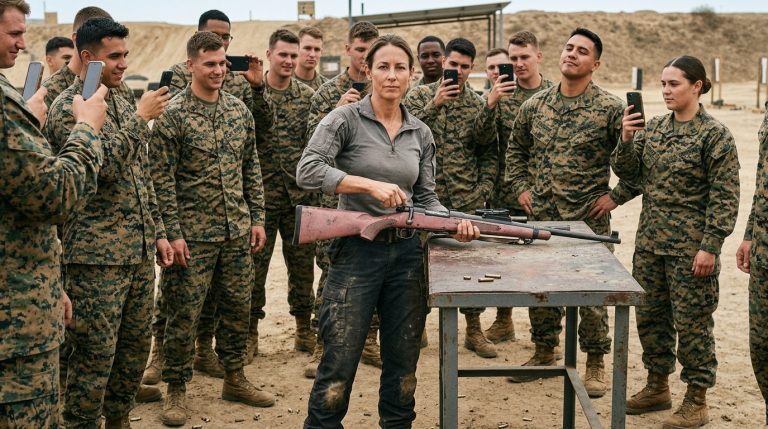
The Silent Anchor: A Rear Admiral’s Journey to Rebuild a Broken Fleet’s Lost Soul
CHAPTER 1: THE THRESHOLD OF COMPLACENCY
The wind off the Atlantic did not merely blow; it carved through the morning haze, a sharp, salt-crusted blade aimed directly at the heart of Sentinel Harbor. Leah Monroe stepped out of the silver sedan, her boots hitting the concrete with a dull, heavy thud. She didn’t look back at the car as it pulled away. She adjusted the strap of her duffel bag—a meager weight compared to the brass and gold tucked away in a lockbox in Norfolk—and turned toward the main gate.
To the guard in the booth, she was nothing more than a statistic. A logistical transfer. Another body to shuffle through the system, another name for a spreadsheet that would likely be ignored by the end of the day. He glanced at her ID with eyes glazed by chronic boredom, barely registering the name Leah Monroe before waving her through. Behind him, the low, weary laughter of two Marines trading jokes drifted across the barrier.
They were talking about the backlog, about the endless cycle of “hurry up and wait,” their voices saturated with the specific, hollow exhaustion that comes from working in a place where effort is routinely swallowed by indifference.
Leah walked past them, her stride measured. She didn’t offer a greeting, nor did she seek one. Her blue eyes were scanning the perimeter, not as a tourist, but as an architect measuring the structural integrity of a building before it collapses. She noticed the rust on the chain-link fence, the faded paint on the signs pointing toward the headquarters building, and the way the personnel in the smoking area seemed to inhabit their own isolated islands of resignation.
The headquarters building rose before her, a square, gray monolith with glass doors that had long since lost their shine. Inside, the lobby was a cacophony of minor failures: the persistent beep of an aging phone, the erratic hum of a printer struggling with a paper jam, and the low-frequency headache of flickering fluorescent lights.
She approached the reception desk. Petty Officer Harris, a man who looked like he had been fueled exclusively by energy drinks for a week, didn’t bother to look up from his monitor. His dark circles were badges of the current culture—a sign that the system was burning its own people for warmth.
“Ma’am?” he prompted, his tone automated, devoid of curiosity.
“Transfer from Norfolk,” Leah said, her voice soft but steady. “Administrative support. Reporting as ordered.”
Harris clicked through his screen, his fingers moving with a frantic, uncoordinated energy. “Right, right. Administrative support.” He grabbed a base access card, sliding it toward her with a distracted jerk of his chin toward the hallway. “Office of Lieutenant Colonel Reigns. Third floor, door on the right. He’ll get you situated.”
Leah took the card, her fingers brushing the cold plastic. As she turned toward the elevators, she caught a glimpse of herself in the dull, reflective metal of the doors. There was no insignia on her shoulders. No ribbons to signal her history, no stars to demand attention. Just a woman in her late thirties, her face a map of the nights she’d spent in red-lit command centers, waiting for voices that never returned.
The elevator creaked upward, a slow, metallic protest against the movement. When the doors slid open, she was met with a long hallway, its corkboards cluttered with the ghostly remnants of initiatives long abandoned: a family fun run postponed into oblivion, a resilience program that nobody had the energy to remove.
She stopped at the door at the end of the corridor and knocked. A flat, busy voice commanded her to enter. Inside, Lieutenant Colonel Reigns sat behind a desk literally submerged in paper. He didn’t look up, his pen scratching rhythmically against a document. When he finally glanced at her, it was with the tired suspicion of a man who viewed every new person as another liability.
“Monroe,” he muttered, reading her orders as if they were a nuisance. “Logistics office. Report to Major Holloway. She needs bodies. Try not to quit in the first month.”
“I don’t quit easily, sir,” Leah replied.
For a heartbeat, Reigns looked at her—really looked at her—and a flicker of genuine curiosity touched his eyes. It vanished as quickly as it had appeared, replaced by the crushing weight of the next file.
As she walked down the hall toward the logistics office, the voices spilled out to greet her—voices of frustration, of broken parts, and of deadlines that were already yesterday’s failures. She paused just outside the doorway, listening, her eyes sharpening. This was the pulse of the base. It was erratic, uneven, and dying, but it was beating. And for the first time in years, she wasn’t here to command it—she was here to save it from the inside out.
She stepped into the room, and the silence of her presence seemed to prick at the air.
CHAPTER 2: THE PAPERWORK LABYRINTH
The air inside the logistics office was heavy, thick with the scent of recycled air, floor wax, and the dry, ancient dust of paper that hadn’t seen the light of a productive day in months. As Leah stepped over the threshold, the room didn’t erupt; it merely shifted. The hum of computer fans seemed to stutter, and the scratching of pens against legal pads paused, just for a heartbeat, as if the office itself was trying to calibrate to the presence of a new element.
Leah didn’t wait for an invitation. She walked to the desk Major Holloway had indicated, the metal legs of her chair scraping a sharp, discordant note against the linoleum. It was a sound that seemed too loud in the oppressive quiet, but she didn’t flinch. She sat, her back straight, her posture a silent refutation of the hunched, defeated stance of the clerks around her. She placed her duffel bag on the floor, the heavy canvas hitting the ground with a solid, grounded finality.
Her fingers rested on the keyboard, and the screen blinked awake. It was a mess. The spreadsheet displayed was a cascading failure of misrouted requests and unfulfilled orders, color-coded in a way that screamed systemic neglect. The system was a labyrinth designed to swallow accountability, turning every request into a ghost.
“Monroe,” Major Holloway’s voice cut through the stillness. She was standing a few desks over, holding a tablet like a shield. She looked exhausted, her eyes tracking a series of lines on the screen with an intensity that bordered on desperation. “Start with the inbound priority queue. Focus on the transit slips from last quarter. We’re getting daily queries from the motorpool, and if we don’t clear the backlog, Colonel Reigns is going to be breathing down our necks before lunch.”
Leah didn’t look up immediately. She began to type, her movements efficient and devoid of unnecessary flourish. “Understood, ma’am,” she said, her voice dropping into the calm, neutral register of a subordinate. “Is there a specific protocol for the discrepancies, or do I flag them for your review?”
Holloway sighed, a sound that carried the weight of a thousand unresolved tickets. “Flag them. We don’t have time to fix the underlying errors today, Monroe. Just prioritize the ones that get the motorpool off our backs. We’re in a ‘stop-gap’ cycle. Don’t reinvent the wheel.”
Leah registered the instruction, but her internal logic had already begun to bypass the command. To ‘just prioritize’ was to participate in the decay. She began to scroll through the records. The discrepancy wasn’t in the system; it was in the intent. Each entry told a story—a vehicle sidelined, a part ordered, then stalled, then redirected to a lower-priority unit simply because the paperwork was easier to process. She saw the ghost of a broken relay in the communications hub, sitting as ‘in-transit’ for three weeks, while a training unit on the other side of the base had received the same part twice.
It was a failure of visibility, not resources.
Suddenly, a printer behind her began to shriek—a long, grinding sound of gears fighting against a blockage. Petty Officer Moore, the technician from across the aisle, groaned loudly and kicked the side of the machine. “Come on, you piece of junk,” he muttered. “I don’t have the time or the patience for this today.”
The machine didn’t respond; it merely jammed further, the scent of burning toner filling the immediate space. This was a classic butterfly detour. The physical failure of a piece of equipment, however minor, threatened to stall the flow of work, creating an artificial crisis that would force everyone to halt.
Leah stood up, her movement fluid. She bypassed Moore and knelt beside the printer. She didn’t look at the screen or the error codes; she looked at the feed tray. A single, misaligned shipping label, caught on the edge of the internal rollers, was the culprit. It was a small thing—a piece of adhesive paper that had folded back on itself—but it had halted the throughput of an entire department’s documentation for the last ten minutes.
She pulled the label out with a surgical, steady motion and reset the feed. The machine whirred, clicked, and then began to print again, the steady, rhythmic sound of pages falling into the tray returning like a heartbeat.
Moore looked at her, blinking. “How’d you know it was that?”
“It’s a common jam point,” Leah said, returning to her seat without waiting for his gratitude. “The paper weight for these forms is higher than the printer is rated for. If you load it in smaller batches, it won’t trigger the alignment error.”
She returned to the requisition queue, her eyes scanning the data with new focus. She wasn’t just fixing a jam; she was reading the landscape. Every file she opened was an opportunity to pull at a thread, to see which parts of the system were held together by habit and which were truly broken. The logistics office was the nerve center of the base, and she was currently the only person in the room who understood how to read the nervous system.
She continued to work, her silence absolute. She was the calm at the center of the storm, a woman waiting for the right moment to exert pressure, watching the clock as the minutes ticked toward the next inevitable failure. She had the data. She had the perspective. Now, she just needed the base to realize it was drowning, so she could show them how to swim.
CHAPTER 3: THE MOTORPOOLS SILENT DECAY
Leah didn’t linger at her desk. The moment the print queue cleared and the immediate backlog of digital tickets was addressed, she stood. The logistics office was still buzzing with the low, frantic energy of people who were perpetually behind, but she moved with a quiet precision that cut through the noise. She grabbed a physical folder—one she had carefully curated from the bottom of the pile—and stepped out into the hallway.
The walk to the motorpool was a descent into a different kind of entropy. The air grew cooler, smelling of stale gasoline and ozone, the scent of a machine that had been allowed to rust from the inside out. As she approached the bay, the sounds of the base faded, replaced by the rhythmic clanging of heavy metal tools and the distant, echoing bark of Staff Sergeant Riley Cole, who was currently berating a junior mechanic for a botched fluid change.
Leah paused at the threshold of the bay. It was a cathedral of neglected iron. Rows of vehicles stood under the harsh, flickering lights, their hoods propped open like the ribcages of great, dying beasts. Oil stains pooled on the concrete floor, reflecting the dreary industrial gray of the ceiling.
She waited until Cole finished his reprimand. The young mechanic scrambled away, face flushed, and Cole turned, his expression a mask of hardened frustration. He saw Leah standing there—the new admin transfer—and his shoulders sagged, not with fatigue, but with a weary annoyance.
“You again,” Cole said, wiping his greasy hands on a rag that had seen better days. “I told the last three clerks that if the requisition doesn’t have a signature from the maintenance supervisor, it’s not leaving this bay. Don’t tell me you’re here to ask if the parts are magically manifesting.”
Leah didn’t blink. She walked further into the bay, her boots crunching on the grit that covered the floor. She wasn’t looking at him; she was looking at the vehicle nearest to her—a supply truck with a missing tire, its suspension slumped as if it had been exhausted by the sheer act of sitting still.
“I’m not here to ask about parts,” Leah said, her voice even, devoid of the nervous agitation he likely expected. She opened the folder, holding it out. “I’m here to ask why the serial numbers for the rotor assemblies on these trucks haven’t matched the supply manifest for the last six months.”
Cole stopped rubbing his hands. He looked at her, his eyes narrowing. The sarcasm evaporated, replaced by a sharp, probing intensity. “What did you say?”
“The numbers,” she repeated, gesturing to the vehicle. “The manifest shows these units were fitted with Class-A replacement assemblies in March. But if you look at the markings on the secondary housing, these are the original stock. They weren’t replaced. They were just scrubbed and re-stamped.”
She looked up, meeting his gaze. She didn’t offer a smile. She offered the truth. “The requisition requests were approved, the budget was spent, and the supply manifests were signed off. But the parts never arrived at your bay. Somebody is siphoning the high-priority inventory, Staff Sergeant, and they’re using your requisition slips to cover the paper trail.”
The silence in the bay grew heavy, punctuated only by the occasional, distant drip of a leaking pipe. Cole stared at her for a long time, his hand hovering over his clipboard. He wasn’t seeing a clerk anymore. He was seeing someone who spoke the language of logistics with the dialect of a commander.
“If you’re making this up to get an easy sign-off, it’s a dangerous game,” Cole said, his voice dropping to a low, gravelly whisper. “If I take this to the Major, and you’re wrong, it’s my neck on the line for wasting her time.”
“Then look for yourself,” Leah said, stepping aside so he could see the markings. “I’m not asking you to sign anything. I’m asking you to protect your fleet. If you want to know who is responsible, we don’t start with the Major. We start with the digital log. Every electronic signature on those requisitions has a timestamp, and I suspect if we cross-reference those times with the shifts in the supply office, we’ll see a pattern that has nothing to do with clerical error.”
Cole looked at the truck, then back at her. He didn’t offer a salute, but he shifted his stance, the aggressive tension in his shoulders softening into something like grudging respect. He took the folder from her, his fingers brushing the edge of the paper.
“The supply office is a closed loop,” he warned. “The Captain in charge of the regional distribution hub, Peterson… he doesn’t like people digging into his inventory.”
“I’m not looking for an argument with the Captain,” Leah replied, turning toward the exit. “I’m looking for the parts that belong to your vehicles. If you help me track the digital trail, I’ll handle the rest.”
She began to walk away, her footsteps echoing in the cavernous space. Behind her, she heard the rustle of paper as Cole began to inspect the markings, his focus shifting from the frustration of a broken fleet to the cold, hard logic of an investigation. She had planted the seed. She had broken the illusion of the ‘systemic backlog.’ Now, she would let the realization work on him, knowing that the anger of an honest man—once pointed at the right target—was a weapon far more effective than any command she could issue from behind a desk.
As she reached the doorway, she glanced back. Cole was already at his computer, his fingers flying across the keys, his face set in a grim, determined line. The rot wasn’t just in the machinery; it was in the intent. And for the first time since she arrived at Sentinel Harbor, she could feel the gears of the base beginning to grind in a different direction.
CHAPTER 4: THE TATTOO AND THE TRUTH
Leah walked back through the corridors of Sentinel Harbor with the rhythmic, heavy stride of a woman who had just identified the cancer within the body. Her mind was a cold, efficient machine, cross-referencing Cole’s frantic keyboard clicks with the digital paper trail she had seen in the logistics office. The sabotage wasn’t sophisticated; it was lazy. It relied on the assumption that no one would bother to look past the first page of a requisition.
As she pushed open the door to the logistics office, the hum of the room seemed to rise to meet her. It was a suffocating sound—the sound of people working hard at the wrong things. Petty Officer Moore looked up from his monitor as she approached, a half-empty coffee mug in his hand.
“You find what you were looking for in the motorpool, Monroe?” he asked, his tone too casual, a probe masked as small talk. “Cole usually doesn’t take kindly to clerks wandering around his bay.”
Leah sat down, her movements controlled. She felt the weight of the trident tattoo on her forearm, hidden beneath the thin fabric of her hoodie. The memory of the day she’d earned it—the smell of salt-spray and the roar of a deck in the middle of the Pacific—flashed in her mind, a stark contrast to the stagnant, recycled air of this room. For a split second, the dissonance was almost physical, a phantom limb of her real identity aching to be revealed. She clamped down on it, her expression remaining a mask of administrative indifference.
“I just needed to confirm the part numbers,” Leah said, her voice neutral. “Sometimes the manual entry doesn’t match the physical hardware. It’s a common discrepancy.”
Moore laughed, a short, sharp sound. “You’re learning quick. Most transfers wait at least a month before they start trying to fix the hardware. Usually, they just learn to ignore the errors and let the system flag them for somebody else to deal with.”
Leah didn’t respond. She opened her terminal. The cursor blinked—a steady, rhythmic pulse that felt like a heartbeat. She began to filter the requisition logs, not by date or urgency, but by the digital signature of the author. She narrowed her search, isolating the requests that had been ‘approved’ by the supply office, the ones marked with the specific, clean formatting that suggested someone with higher-level administrative access.
There, in the margins of the digital ledger, she saw it: a pattern of approvals for ‘emergency maintenance’ that coincided exactly with the times Captain Peterson was noted as the approving officer. The dates weren’t accidents. They were precise.
She stared at the screen, her reflection ghosting against the glass. The decoy secret—that the base was merely suffering from incompetence—was dead. This was intentional. Peterson wasn’t just negligent; he was stripping the base for parts, selling off high-value components and covering the loss with fraudulent maintenance logs. It was a perfect, contained loop. And as long as no one asked questions, he would continue to hollow out the fleet until there was nothing left but the rusted shells she had seen in the motorpool.
“Ma’am?” Moore was leaning in, his gaze lingering on the screen, though he couldn’t see the specific query she was running. “Everything alright? You’ve been staring at that log for five minutes without typing.”
Leah shifted her window, covering the trail. “Just double-checking the consistency of the records, Moore. It’s surprising how many entries have the same time-stamps.”
Moore’s face went slightly slack. The casual veneer cracked, just for a millimeter. “Yeah, well. Captain Peterson likes his workflows efficient. He’s a stickler for the schedule.”
Leah looked at him—really looked at him. She saw the way his fingers tightened around his coffee mug. He wasn’t just a clerk. He was a cog, perhaps even a willing one, in a machine that Peterson had built to keep the status quo. He wasn’t the architect, but he was the gatekeeper.
“Efficiency is one thing,” Leah said, her voice dropping into a register that felt like the beginning of an interrogation. “But when it creates a paper trail that doesn’t match the reality of the hangar floor, it stops being efficiency and starts being a liability. I think I need to talk to the Major about these signatures.”
Moore didn’t move, but the air around him seemed to thicken. “The Major’s busy, Monroe. She’s got enough on her plate without some new transfer questioning the regional command structure. I wouldn’t bother her with that unless I was absolutely sure.”
“I am sure,” Leah said, her voice final.
She closed the file, the act feeling like the pulling of a trigger. She didn’t look back at him. She stood, the chair sliding back with a sharp, aggressive scrape that silenced the immediate area. She walked toward Major Holloway’s office, the weight of the truth—the real truth, that this wasn’t an accident—settling into her bones. She had her proof. Now, she had to navigate the minefield of a command that didn’t know yet that it was under attack from within.
As she approached Holloway’s door, she paused, her hand hovering over the frame. She wasn’t an admiral right now. She was a clerk with a secret that could break the base. And she knew, with the cold, hard certainty of a veteran, that the moment she walked through that door, there would be no going back.
CHAPTER 5: THE EYE OF THE STORM
Leah didn’t knock. She entered with the silent, deliberate motion of a blade being unsheathed. The office was small, the walls lined with file cabinets that seemed to be leaning inward, as if trying to crush the workspace beneath the weight of years of neglected duty. Major Holloway was there, hunched over a spread of documents, her silhouette framed by the dull, gray light of the window behind her. She didn’t look up immediately, the scratching of her pen continuing as if it were the only thing tethering her to reality.
“I told you, Monroe, unless the motorpool is on fire, I don’t have the bandwidth for—” Holloway stopped mid-sentence when she saw Leah. She looked up, her eyes rimmed with the deep, bruised shadow of long-term fatigue. She didn’t look like a conspirator. She looked like a woman who had forgotten what sleep felt like.
Leah placed the folder on the desk. The sound of the manila paper hitting the wood was sharp, final. She didn’t say a word. She let the folder sit there, a silent accusation in a room already heavy with the scent of stagnant coffee and stale ambition.
Holloway stared at the folder. She didn’t reach for it. Her gaze flicked to Leah’s face, searching for an explanation, and for a heartbeat, Leah felt that flicker of doubt—the V-4 dissonance—wondering if her own tactical training had taught her to see enemies in people who were simply broken. Was Holloway part of the rot, or was she just another casualty?
“What is this?” Holloway asked, her voice cracking.
“Look at the requisition signatures for the last quarter,” Leah said, her voice devoid of inflection. “Every high-priority part that supposedly entered the inventory. Then cross-reference those with the actual maintenance logs from Cole’s bay. The numbers don’t add up, Major. They don’t add up because the parts never arrived.”
Holloway reached for the folder, her hands trembling. She pulled the first few pages out, her eyes scanning the data with the sharp, practiced efficiency of an officer who had once been one of the best in the fleet. As she read, the color drained from her face. It wasn’t the look of a guilty woman realizing she’d been caught; it was the look of someone watching the ground disappear from beneath them.
“This is Peterson’s signature,” Holloway whispered. Her voice was thin, almost unrecognizable. “But these stamps… these are internal routing codes. Only someone in the supply hub would know how to route these through the system without triggering the automated audit.”
“Peterson is siphoning the inventory,” Leah said, stepping closer. “And he’s using your office’s lack of oversight to justify the discrepancies. You’re the front line, Major. When the inspectors come, it isn’t Peterson who will be held accountable for the ‘inefficiency’ of this office. It’s you.”
Holloway leaned back, the chair groaning under the shift in weight. She looked at Leah, and for the first time, the exhaustion in her eyes was joined by something else—a hardening, a spark of the officer she had been before the grind had worn her down. She realized, in that moment, that Leah hadn’t just brought her a stack of papers. She had brought her an ultimatum.
“Why are you telling me this?” Holloway asked, her voice steadying. “You could have taken this straight to the Colonel. You could have burned this office to the ground.”
“Because I don’t want to burn the base,” Leah said, her gaze unyielding. “I want to fix it. But I can’t do that if I’m fighting the very people who are supposed to be running it. You need to decide, Major. Are you going to be the shield for Peterson’s corruption, or are you going to be the officer who takes it down?”
The office felt suddenly claustrophobic. The flickering of the fluorescent light above them became rhythmic, a strobe-like beat that measured the tension in the room. Holloway closed the folder, the snap of the paper sounding like a gunshot.
“If I go to the Colonel, Peterson will know I’m the one who provided the initial evidence,” Holloway said. “He has connections in the regional office. He’ll bury me before the investigation even starts.”
“He won’t have time to bury anyone if we lock him out of the requisition system before he knows we’re coming,” Leah countered. “I know how to override the audit triggers. If you give me the authority to access the hub’s central node, I can pull the logs—the real logs, not the ones he’s edited. But it has to happen tonight. Before the system updates at
CHAPTER 5: THE TEMPEST BREWING
Leah’s hand stayed on the doorframe, the wood cool and indifferent under her palm. Inside, she could hear the muffled, rhythmic typing of Major Holloway—a sound that usually denoted progress but now, in light of the evidence she held, felt like the frantic tapping of a sinking ship. She drew a breath, steadying her pulse. She wasn’t an admiral here; she was a variable. And she was about to force a reaction.
She knocked. It was a sharp, percussive sound that seemed to slice through the ambient hum of the office.
“Come in,” Holloway called out, her voice thin with exhaustion.
Leah entered. The office was dimly lit, the only illumination coming from a single desk lamp that cast long, distorted shadows across the mountains of paper. Holloway didn’t look up immediately. She was rubbing her temples, her eyes closed, her uniform jacket discarded over the back of her chair.
“Monroe,” Holloway said, not opening her eyes. “If this is about the requisition queue, it can wait until morning. I’m done with numbers for the day.”
“It’s not about the queue, ma’am,” Leah said, closing the door behind her with a soft, decisive click. She walked to the desk and laid the folder down on top of the Major’s open logbook. The movement was calculated; it forced Holloway to open her eyes and confront the physical reality of the investigation.
Holloway looked at the folder, then at Leah. She frowned, the lines under her eyes deepening. “What is this?”
“An audit of the emergency maintenance logs,” Leah said, keeping her tone strictly professional, a thin wire of command vibrating beneath her words. “I took the liberty of cross-referencing the approval timestamps against the regional supply distribution hub. There’s a consistent four-hour lag between the requisition approval and the actual inventory release. And every single one of those approvals is signed by Captain Peterson.”
Holloway sat up, her eyes widening. She reached for the folder, her hands shaking slightly. As she scanned the pages, the fatigue that had been hanging over her like a shroud seemed to dissolve into a sharp, focused alarm. She flipped through the documents, her breathing hitching as the pattern became clear.
“This is… this is a formal allegation, Monroe,” Holloway said, her voice dropping to a whisper. “Do you have any idea what you’re implying? Peterson is regional command. You don’t just ‘audit’ a Captain like that.”
“I’m not implying anything,” Leah said, her gaze steady, locked onto the Major’s. “I’m stating the facts of the discrepancy. The parts are missing, the logs are falsified, and the base is paying the cost in operational readiness. If we don’t address this, the next time there’s a serious equipment failure, it won’t be a paper jam. It’ll be a life lost.”
Holloway stood up, pacing the small, cramped office. The shadows seemed to dance along the walls, mirroring her inner turbulence. She looked like a woman who had been holding up a falling ceiling for months, only to realize the roof was already gone.
“You’re a clerk, Monroe,” Holloway said, her voice rising. “Why are you doing this? Why now?”
“Because someone has to,” Leah replied. “The rot doesn’t stop because we ignore it, Major. It just gets deeper.”
Before Holloway could respond, a sudden, sharp tremor shook the building. It wasn’t an earthquake; it was the power grid. Outside, the sky, which had been graying throughout the afternoon, suddenly turned a bruised, violent purple. A low, rhythmic boom rolled in from the sea—the precursor to the storm they had been ignoring for days.
The lights in the office flickered, died, and then sputtered back to life, the power supply straining to cope with the surge. On the wall, the emergency alarm pulsed—a dull, rhythmic light that seemed to scream in silence.
“What was that?” Holloway asked, her voice tight.
“The grid,” Leah said, stepping toward the window. The rain had begun, a torrent that hammered the glass with the force of gravel. “The infrastructure can’t handle the strain. If Peterson has been siphoning the maintenance parts, the backup systems in the comms hub won’t have the redundancy they need to survive a direct surge.”
Holloway rushed to her computer, frantically trying to pull up the base status. Her screen flickered, the colors washing out into a jagged, static-filled gray. “The network’s down,” she said, her voice trembling. “The internal sensors are reporting mass-link failure across sectors three and four.”
“It’s starting,” Leah said, the realization settling into her gut. She looked at the folder on the desk—the proof of the rot—and then at the Major. The crisis they had been waiting for had arrived, and it was going to be the crucible that would either burn the base to the ground or forge it into something new.
She didn’t need to be an admiral to know the next move. She needed to be the person who refused to let the system fail.
“Major,” Leah said, her voice now stripping away the clerk persona, her tone shifting into a sharp, clear command that made Holloway stop and look at her. “Get the comms hub on the secure line. We need to lock down the regional access codes before Peterson can wipe the server logs. If we lose the digital record now, we lose everything.”
Holloway stared at her, caught between the shock of the discovery and the sudden, overwhelming pressure of the storm. For a second, the office felt like the bridge of a ship in a typhoon, and the clerk standing before her seemed to carry the weight of someone who had done this a hundred times before.
“Go,” Leah commanded, her eyes burning.
Holloway turned to her phone, her fingers flying, and Leah turned toward the door, her heart hammering. The storm was here, and the real fight had just begun.
CHAPTER 6: THE RUSTED LINK
The storm was a wall of sound. Rain lashed against the exterior of the communications hub with such force it sounded like gravel hitting the siding. Leah pushed through the heavy steel door, and the wind instantly grabbed her, nearly knocking her off balance. She stumbled onto the wet concrete of the maintenance pad, the air smelling of ozone, wet earth, and the faint, sweet tang of heating oil.
She didn’t run. She moved with the methodical, focused cadence of someone traversing a deck during a heavy sea. Her goal was the secondary generator housing, located fifty yards from the main structure. It was a metal shed, already shaking under the buffet of the wind, its corrugated walls groaning like a living thing.
She reached the shed and wrenched the door open. Inside, the generator was struggling. The engine was surging—a ragged, uneven sound that signaled it was starving for fuel or choking on its own intake. She moved to the control panel, her hands working by touch in the flickering light of her flashlight. The gauges were erratic, the needles dancing in a frantic, meaningless rhythm.
“Come on,” she whispered, her voice barely audible over the gale outside.
She traced the fuel line. It was solid. She checked the intake. Clear. She moved to the mechanical linkage that connected the throttle to the main engine block. Her light caught a glint of metal—a pin, intended to hold the linkage rod in place, had sheared off, leaving the rod to vibrate wildly against the engine casing. The friction was causing the erratic surging. It was a failure of maintenance—a simple, rusted pin that had likely been vibrating loose for months, ignored until the storm finally rattled it free.
She didn’t have a replacement. She didn’t have tools. She had a moment, and she had the intuition of a lifetime of keeping things moving when they had no right to survive. She reached into her pocket and pulled out her mechanical pencil—a cheap, plastic thing, but it was stiff, hollow, and made of high-impact resin.
She jammed the tube into the aperture where the pin had been. It was a tight, desperate fit. She used the weight of her body to force it in, the metal rod vibrating against her palm, hot and biting. The moment the tube clicked into place, the vibration stopped. The engine note leveled out, the ragged surge smoothing into a steady, deep-throated rumble.
The generator held.
Outside, the lights on the base flickered once, twice, and then steadied, a brilliant, solid white that cut through the darkness of the rain. She stayed there for a moment, her breath coming in ragged gasps, the smell of grease on her hands. She felt the heavy thrum of the machine against her feet—a physical connection to the lifeblood of the base.
She stepped back out into the rain. She was soaked through, the cold seeping into her marrow, but the base was back online. The communications relay would have the power it needed to sustain the connection, and the tower would have the stability required to guide that inbound cargo flight.
But as she turned back toward the hub, she saw a figure standing in the doorway—a silhouette framed by the harsh, yellow light of the interior. It was Peterson. He was standing there, his coat collar turned up, watching her. He didn’t look like a man surprised to see a clerk kneeling in the mud in the middle of a hurricane. He looked like a man watching a predator he had finally tracked into its lair.
He didn’t speak. He just walked toward her, his heavy boots splashing through the pools of standing water. He stopped ten feet away. The wind tore at his coat, but he held his ground, his face a mask of cold, bureaucratic rage.
“You’re a long way from the logistics office, Monroe,” he said, his voice carrying clearly over the storm. “I heard we had a power fluctuation. And then I heard someone from the admin track was out here, playing mechanic.”
Leah straightened, the rain plastering her hair to her forehead. She felt the weight of the trident tattoo beneath her wet sleeve. “I’m just doing what needs to be done, Captain. The grid was failing. Someone had to bridge the gap.”
Peterson’s eyes narrowed. He looked at the generator shed, then back at her. “You’re not just a clerk, are you?”
He stepped closer, the authority in his stance designed to intimidate, but Leah didn’t shift. She stood her ground, the weight of the base—the safety of the fleet, the integrity of the mission—pressing down on her shoulders.
“I’m the person who knows where the parts are, Captain,” she said, her voice quiet, cold, and entirely devoid of fear. “And I’m the person who’s going to make sure they get back to the people who need them.”
Peterson laughed. It was a brittle, sharp sound that didn’t reach his eyes. “You think you can play hero, Monroe? You’re a footnote. By morning, you’ll be on a transport back to Norfolk, and this entire base will be back to the way it was before you decided to start asking questions. You don’t know who you’re dealing with.”
“I know exactly who I’m dealing with,” Leah said, taking a step toward him. “A man who thinks he can hide his theft behind the incompetence of his subordinates. But you forgot one thing, Captain. You forgot that people notice when the lights go out. And they notice even more when someone turns them back on.”
Peterson’s expression tightened. He was a man used to operating in the shadows of the bureaucracy, and she had just shone a spotlight directly onto his failure. He reached for his radio, his hand hovering over the receiver. “We’ll see about that,” he muttered, turning away toward his vehicle.
Leah watched him go. She didn’t try to stop him. She didn’t have to. The damage was done. The audit logs were already being pulled. The Major was already acting. The base was waking up. And as the wind whipped around her, she felt the first, faint shift in the atmospheric pressure of the base—a change that signaled not just the end of the storm, but the end of the rot.
She turned and began the walk back to the hub. The storm was still raging, but she was no longer a stranger in a strange land. She was a commander, and for the first time, the base was beginning to move with her.
CHAPTER 7: THE PARADE FIELD PRELUDE
The rain had finally tapered off by the time Leah navigated the treacherous, mud-slicked path back to the headquarters building. Her uniform was ruined, a sodden, heavy mess that clung to her skin like a second layer of exhaustion, but her focus was iron. She didn’t head for the logistics office. Instead, she moved toward the Commander’s quarters—a direct, unauthorized route that required her to bypass the very security protocols she had spent the last week studying.
She had to see the Colonel. Not because she needed his permission, but because she needed to verify if the rot had climbed higher than the Captain’s office. If Reigns was part of the circle, the parade scheduled for morning—the one meant to demonstrate the base’s ‘readiness’—would be the stage where Peterson would finalize the erasure of the evidence.
She reached the back entrance of the administrative block, her boots leaving damp, purposeful prints on the pristine flooring. The building was unnervingly quiet, the storm having left the base in a state of suspended animation. She moved to the side office where the transfer files were kept, the physical storage for everything the digital system couldn’t safely hold.
Inside, the room was cool, smelling of chemical cleaner and old paper. She found the cabinet she needed, its lock a simple, outdated mechanism. She had the key, or rather, the workaround she’d developed after watching the base security patterns for a week. She slid the drawer open, the sound a quiet, metallic rasp in the silence.
There it was. A transfer order for the missing parts, authorized by Peterson, but carrying a signature that shouldn’t have been there: Colonel Reigns. It wasn’t a forgery. It was an endorsement.
The realization didn’t shock her; it saddened her. The corruption wasn’t just a parasite on the base; it had become the host. The base wasn’t failing; it was being disassembled by its own leadership. She closed the drawer, her heart a steady, cold weight in her chest. She had what she needed. The proof was absolute, and the stage for the morning parade was set.
She left the building and walked out onto the parade field. The dawn was beginning to bleed into the horizon, a bruised, pale gray that offered no warmth. The field was vast, empty, and silent. In a few hours, the rows of uniforms would be standing here, the band would be playing, and the base would be presenting a face of disciplined excellence to the inspectors from the regional command.
Leah stood at the center of the field, her wet clothes shivering in the biting wind. She could see the silhouette of the podium. That was where it would happen. Peterson would be there, flanked by the men who had signed the documents, standing beneath the flag as if they had built this place instead of bleeding it dry.
She didn’t feel like a clerk anymore. She felt the phantom weight of the stars that had defined her career—the ones she had deliberately hidden beneath the hoodie and the badge. She was an admiral. She had faced task groups and battle fleets, but this—the quiet, insidious erosion of trust—was a different kind of war.
As the light strengthened, she saw figures beginning to emerge from the barracks. The parade rehearsals would begin soon. She turned and began to walk toward the barracks, her pace steady. She wouldn’t be returning to the logistics desk. She wouldn’t be hiding behind the administrative screen.
She had arrived as a ghost, an invisible observer watching a dying system. She would be leaving, when the time was right, as the cure.
She passed a group of junior sailors who were already forming up, their movements sluggish and tired. They didn’t recognize the woman in the mud-stained hoodie. They saw only another soul lost in the system, another person they could safely ignore. Leah didn’t mind. She looked at them—the ones who had been told that readiness was a chore, that the parts never came, that the system was broken beyond repair—and she saw the potential that still flickered in their eyes.
The storm had passed. The air was clear. And as the first notes of a distant trumpet began to echo across the parade field, Leah Monroe took her position in the shadows, waiting for the sun to rise and the real command to begin.
CHAPTER 8: THE UNVEILING OF THE ADMIRAL
The parade field felt like a vacuum. Every sound—the distant lap of water against the pier, the rustle of wind through the flags, the rhythmic breathing of the assembled crews—was amplified by the sudden, suffocating silence that descended as Leah stepped out from the barracks shadows. She was still wearing the mud-stained hoodie and the damp jeans, a stark, grit-filled contrast to the pristine, starched uniforms of the waiting base.
She didn’t stop. She walked toward the center of the field, her gaze fixed not on the gathered sailors, but on the raised dais where Captain Peterson stood. He was flanked by Colonel Reigns and a handful of other senior staff. As he caught sight of her, his expression shifted from bureaucratic annoyance to a sharp, visible flicker of confusion, then to dawning realization. He leaned over to whisper something to the Colonel, his hand gesturing sharply toward her.
Leah reached the base of the podium. The stairs were worn, the metal groaning under her boots. She didn’t look at Peterson. She looked at the base—the broken, tired, demoralized base she had spent the last week dissecting. She walked past the podium, mounting the final step to the command platform.
“You have no authorization to be here, Monroe,” Peterson hissed, his voice a tight, jagged edge. “This is a formal assembly. Get off the platform before I have you escorted to the brig.”
Leah didn’t turn to him. She reached into her inner pocket—the one beneath the hoodie—and pulled out a small, metallic object: a miniaturized, encrypted digital transmitter, the kind only used by high-level command to broadcast directly to the base’s internal communication node. She plugged it into the main audio console on the podium.
The feedback was instantaneous—a high-pitched whine that cut through the morning air, forcing everyone on the field to look up. Peterson reached for her, his face flushing, but she stepped aside with the practiced grace of someone who had spent decades anticipating an adversary’s move.
She pressed the master override key on the console.
“Sentinel Harbor,” her voice projected, clear, resonant, and carrying the unmistakable weight of a command-level officer. “This is Rear Admiral Leah Monroe.”
The name hit the field like a physical blow. The silence became absolute. Peterson froze, his hand still suspended in the air. Colonel Reigns, who had been staring at the podium with a mix of disdain, went entirely still, his face losing all color.
“I have spent the last seven days working in your logistics office,” Leah continued, her eyes scanning the sea of uniforms. “I have seen the broken parts. I have seen the falsified logs. I have seen the way you have been forced to survive on the crumbs of a system that has been systematically hollowed out for the personal gain of a few.”
She finally turned to Peterson. He looked smaller now, a man caught in the spotlight of his own failures.
“Captain Peterson,” she said, her voice quiet but carrying to every corner of the field. “The audit logs you attempted to scrub have already been transmitted to the Regional Command oversight office. They are encrypted, time-stamped, and verified. Your access to the central hub has been permanently revoked.”
Peterson’s knees seemed to buckle. He didn’t offer a defense. He didn’t offer a monologue. He simply collapsed into the reality of his own undoing, his eyes darting toward the Colonel, who was already stepping back, his distance from Peterson a public, desperate attempt at survival.
“Colonel Reigns,” Leah said, shifting her gaze. “Your endorsement of these records will be subject to a formal board of inquiry. The integrity of this base begins with its leadership. As of this moment, you are relieved of duty pending an investigation.”
Reigns didn’t argue. He saluted—a slow, hollow gesture that was the first sign of genuine respect he had ever shown her. Leah returned it, but there was no warmth in the exchange. It was a formal, cold acknowledgment of the end of an era.
She walked to the edge of the platform and looked out over the base. The transformation began in the smallest of ways: a sailor in the back row shifted, his posture straightening. A young officer near the front looked up, his jaw set, his eyes reflecting a newfound, sharp clarity.
“We have work to do,” Leah said, her voice softening, losing its broadcast edge and becoming something more intimate, something meant for the people who had stayed. “We are going to rebuild the integrity of this base, not by punishing the past, but by demanding a future we can all be proud of. Get back to your stations. Report to Major Holloway for the new oversight protocol. The cleanup begins now.”
She stepped down from the platform. The silence held for a beat, and then, slowly, the entire parade field erupted. It wasn’t the cheers of a crowd at a performance; it was the sound of a thousand people waking up. Boots struck the asphalt, not in a forced, ceremonial rhythm, but in a display of unified, conscious purpose.
Leah walked toward the barracks, the morning sun finally cresting the horizon. The light caught the brass stars she hadn’t yet pinned on, but she didn’t need them to feel the weight of her authority. She had come here to save the fleet, and as she passed the young guard at the gate, who stood at a salute so sharp it could have cut glass, she knew she had succeeded.
She entered the quiet of the office block, the transition to the denouement feeling like a deep, clean inhale. She sat at her old, cluttered desk. She pulled out a small, brass-backed photo frame she’d kept in her duffel—a picture of the ship she had once commanded. She picked up a small tool from her kit and began to tighten the loose screw on the frame’s backing—a simple, grounding repair.
The office was quiet. The rot was gone. She looked at her hands—grease-stained, tired, and steady. The base was waking up, the hum of the fleet returning to its proper resonance. She leaned back, the silence of the room settling into an atmospheric, enduring peace. The command was hers, and for the first time in a long time, the path ahead was clear.