The Timber Line: How a Quiet Mill Owner Disassembled a Suburban Tyrant Through Calculated Retribution and Raw Economic Leverage
CHAPTER 1: THE ACCREDITED BORDER
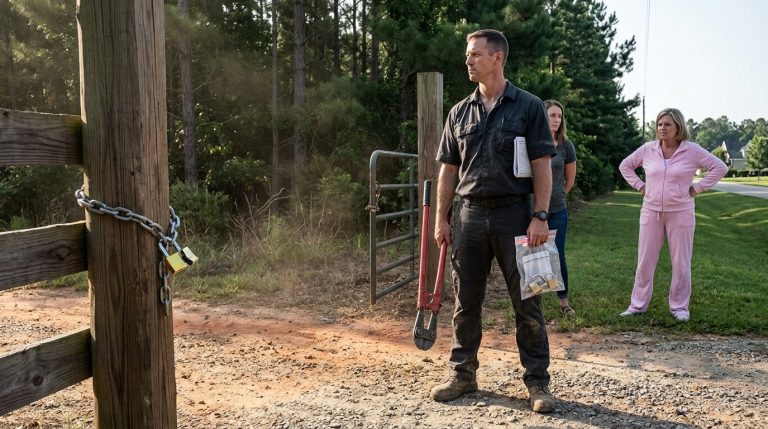
The pile of sawdust sat on the gravel edge like a grey, compressed lung, exhaling the sharp, tannic bite of freshly planed Douglas fir. Jack did not move his hand from the throttle lever of the idling flatbed. He watched the woman’s floral print mumu ripple against the frame of her vehicle, stretched taut over a posture that had never once bent under the weight of an actual timber beam.
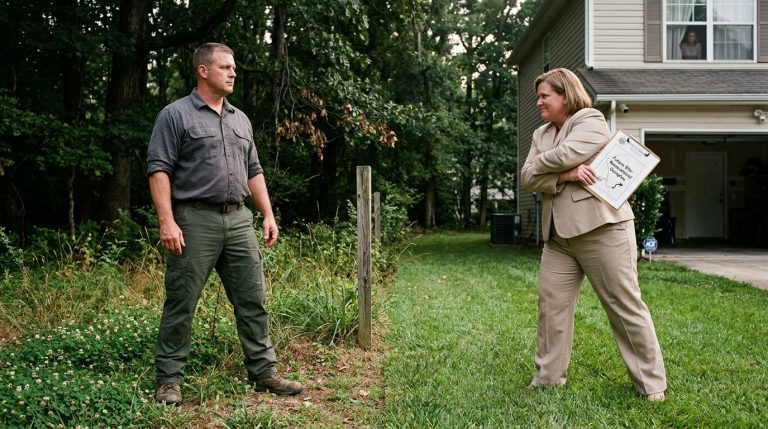
“That pile of sawdust is a registered biohazard,” Karen said, her voice carrying the practiced, rhythmic snap of a schoolmarm reading a demerit list. She held a clipboard against her chest like a riot shield. “And your noise pollution constitutes a public nuisance under Covenant 7.4B. I am giving you thirty days to cease all commercial operations, or I will personally see to it that this entire property is condemned.”
Jack let the silence stretch, measuring the distance between her polished loafers and the oil-stained timber ties of his father’s foundation. Behind her, the cookie-cutter ridgeline of Whispering Pines rose against the bruised Carolina sky—a horizon of beige vinyl and identical asphalt shingles that looked as if it had been stamped out by a single, unimaginative press. Every three seconds, the idling Cummins diesel under the flatbed’s hood sent a low, rhythmic thrum through the floorboards, a heavy vibration that seemed to agitate the plastic clipboard in her grip.
“You’re standing on private land, Karen,” Jack said. His voice was flat, pitched low to cut through the mechanical drone without rising an octave.
“I am standing within the designated enforcement perimeter of the Whispering Pines Homeowners Association,” she snapped, her chin lifting with the desperate, brittle certainty of someone who had never encountered a barricade she couldn’t memo into submission. “You signed the covenant addendums when the municipal boundary was redrawn three years ago. Your little rustic hobby is depreciating property values by four percent across three contiguous blocks.”
Jack didn’t blink. He looked past her pinched, bloodless mouth to the 10,000-pound stack of custom-milled beams strapped to his bed—dense, heart-wood timbers destined for a custom post-and-beam frame six miles north. The wood didn’t care about her covenants. It had taken a hundred years of drought, lightning, and lean soil to grow the tight, unyielding grain she now classified as an aesthetic blight.
“My grandfather cut the first timber on this plot before your developer grandfather even learned how to draw a subdivision line,” Jack said softly, his thumb tracing the worn steel of the gearshift. “There is no addendum. There is only a fence line you’re currently trespassing across.”
Karen’s lips thinned into a pale seam, her fingers whitening where they gripped the metal clip. She reached into the pocket of her floral dress, withdrew a heavy, cream-colored envelope sealed with a red wax monogram, and tossed it onto the hood of his truck like a gauntlet. The synthetic pine scent of the wax drifted up—cheap, cloying, and entirely out of place against the smell of wet earth and resin.
“Thirty days, Major Peterson,” she said, using his retired title like a slur. “After that, the county inspectors arrive with the demolition orders.”
She turned on her heel with rigid precision, her sandals crunching sharply against the gravel as she marched back to the white Lexus. She didn’t look back as she threw the transmission into reverse, the tires spitting a spray of limestone chips against the rusted fender of Jack’s flatbed before she accelerated down the narrow country lane.
Jack waited until the whine of her transmission faded beneath the rustle of the oak canopy. He climbed down from the cab, his boots hitting the hard-packed earth with a dull thud. He picked up the heavy cream envelope from the hood, noting the thickness of the vellum and the specific, flamboyant flourish of the return address scrawled in the lower left corner. Inside, the paper was cold to the touch, dense with single-spaced legal threats that cited municipal codes which hadn’t existed when his father upgraded the mill in the seventies.
He walked over to the edge of the property line where she had stood, looking down at the crushed weeds and the faint imprint of her heel in the damp soil. As he knelt to inspect the depression left by her shoe, something caught his eye half-buried beneath the crushed limestone—a small, square fragment of heavy cardstock bearing the embossed letter A, torn from a document that had nothing to do with county ordinances or homeowner association bylaws.
CHAPTER 2: THE ASSESSMENT OF THE BATTLEFIELD
The grit of the limestone dust crunched beneath Jack’s heavy-soled work boot as he stood staring down at the torn fragment of cardstock. The letter A embossed in cold, heavy foil seemed to mock the quiet humidity of the yard. Without looking up, he could still hear the ghost of the Cummins diesel’s final thrum vibrating through the earth, though the white Lexus had long since vanished around the gravel bend toward the paved artery of the county road.
Jack picked up the torn scrap, rubbing its thick rag-fiber edge between his thumb and forefinger. It wasn’t standard printer paper, nor was it the cheap multi-copy stock used for community newsletters. It was heavy, expensive cotton vellum, the kind purchased in reams by specialized legal firms or municipal administrative offices downtown. Karen hadn’t just typed up her threats on a home printer; she had outsourced her intimidation, or worse, she was using external machinery that left tracks.
He turned on his heel, his movements calculated and economical, and walked back toward the shadowed interior of the open-air mill. The heavy oak dining table inside the farmhouse sat bathed in the slanting amber light of late afternoon. Upon its scarred surface lay the five-page legal monster she had served him three days prior.
Sarah was already there, standing by the kitchen pass-through with her hands wrapped around a ceramic mug of tea. Her eyes tracked his entrance, reading the stillness in his shoulders before he even spoke.
“She left a calling card in the gravel,” Jack said, his voice level as he tossed the torn scrap onto the center of the dark oak boards. It landed beside Karen’s flamboyant, aggressive signature at the bottom of the fifth page.
Sarah stepped closer, setting her mug down with a soft click. She leaned over the table, her gaze falling on the fragment. “That’s not from her newsletter stock. That’s corporate weight.”
“That’s because she isn’t acting alone,” Jack replied. He pulled out his chair and seated himself, the heavy wood groaning under his weight. He didn’t reach for coffee or water; instead, he placed both forearms flat on the table, aligning his fingers parallel to the edges of the legal brief like a commander mapping an entrenched enemy line.
A sudden, sharp memory flared behind his eyes—the humid river valley in Kandahar, three years before his retirement, standing over a newly laid pontoon bridge while an engineer sergeant pointed out a micro-fracture in a steel anchor pin. A flaw no bigger than a pinhead, hidden beneath a coat of industrial primer, designed to fail only under peak stress. Karen’s legal brief felt precisely like that anchor pin: polished, rigid on the surface, but built on a hollow core of fabricated jurisdiction.
“She’s operating like an insurgent commander with a limited logistics tail,” Jack murmured, his eyes scanning the dense, single-spaced paragraphs of municipal code citations. “She floods the zone with paper. Five pages of terrifying language designed to induce panic, create immediate administrative friction, and force a capitulation before the target has time to check the terrain.”
“And if we panic?” Sarah asked quietly, pulling out the chair opposite him. Her posture was tense, her shoulders squared, embodying the disciplined calm of an army nurse who had spent years triage-sorting chaos in field hospitals.
“If we panic, we spend three thousand dollars retaining a local attorney to fight a noise ordinance that doesn’t legally apply to us,” Jack said. He tapped a finger against a paragraph citing county ordinance 44.2 regarding commercial decibel thresholds. “She wants a quick skirmish where she holds home-court advantage. She wants us off balance, bogged down in defensive filings, defending a pile of sawdust that’s been here since my grandfather’s administration.”
He reached into his shirt pocket and pulled out a small, grid-lined field notebook, its edges frayed from years of exposure to sawdust, oil, and sweat. Flipping it open to a fresh page, he picked up a heavy brass pen.
“We don’t play her game,” Jack said, his pen hovering over the paper. “An insurgent relies on the civilian populace being too terrified to ask questions. But Karen isn’t an insurgent. She’s a bureaucrat playing dress-up as a warlord. And bureaucrats have paper trails.”
He began to write, his hand moving with mechanical precision, breaking down her five-page brief into distinct vectors of attack.
Vector one: The municipal zoning claims.
Vector two: The decibel limits.
Vector three: The environmental hazard accusations regarding the organic wood shavings.
Every single claim was an assertion of authority over a parcel of land that had been legally grandfathered in before the developer’s bulldozers ever chewed through the eastern tree line. But assertions weren’t facts. And in Jack’s experience, the moment an adversary began manufacturing administrative rules to cover their own operational overreach, they left their flanks entirely exposed.
“You’re going to town tomorrow,” Sarah stated, not as a question, but as a recognition of the shift from defense to active reconnaissance.
“I am,” Jack replied, looking up from the notebook, his eyes cold and steady. “I’m going to pull the original subdivision plat maps from the county registrar’s office. I want to see the exact boundaries of Whispering Pines when it was chartered in ninety-eight. I want to see who signed off on the perimeter buffers.”
“And Karen?”
“Karen thinks she’s holding the high ground because she has a clipboard and a list of fines,” Jack said, standing up from the table, the chair scraping sharply against the wide pine floorboards. He walked over to the window, watching the late-day shadows lengthen across the neatly stacked piles of Douglas fir. “Tomorrow, I go to her turf. I walk right into their little strip-mall management office and I ask for every single public record they’re legally obligated to provide under state common-interest community laws.”
He turned back to face her, the sharp angles of his jawline catching the amber light.
“She thinks she’s backing me into a corner. What she doesn’t realize is that she’s just handed me the coordinate list for her own command post.”
CHAPTER 3: RECONNAISSANCE BEHIND ENEMY LINES
The gravel of the commercial strip mall lot spit beneath the truck’s tires as Jack pulled into an empty slot between a faded nail salon and a neon-lit vape shop. The air here smelled of stale synthetic fruit and burnt espresso beans—an artificial atmosphere that felt miles away from the damp pine resin of his own acreage. He did not rush. He switched off the ignition, let the Cummins diesel die with a heavy shudder, and sat in the cab for three full breaths, studying the reflection of his own eyes in the rearview mirror before pushing the door open.
The strip mall office serving as the Whispering Pines Homeowners Association headquarters occupied a narrow, windowless storefront. Above the frosted glass door, a crooked plastic sign read ADMINISTRATION & COVENANT CONTROL. Jack stepped inside, the heavy glass door swinging shut behind him with a pneumatic hiss that cut off the distant hum of traffic outside.
The interior was air-conditioned to an artificial chill, the linoleum floor gleaming with a slick, chemical wax. Behind a particle-board reception desk covered in faux-cherry laminate sat Karen. Her floral print dress was replaced today by a sharp, slate-grey blazer that signaled an attempt at corporate authority, though her fingers were drumming a nervous, staccato rhythm against the edge of a stack of manila folders.
She looked up as the bell above the door chimed, and for a fraction of a second, the smug, defensive mask slipped, revealing a sharp flicker of genuine apprehension.
“Mr. Peterson,” she said, her voice dropping into a register of cold, professional condescension. “To what do we owe the pleasure? Have you finally brought the signed cessation agreement?”
She gestured toward a pre-printed form resting near her elbow, clearly expecting an act of surrender. Jack didn’t look at the paper. He walked forward, his boots clicking with measured precision against the slick linoleum, and planted both hands flat on the edge of the particle-board counter. The laminate felt cheap, hollow beneath his palms—a stark contrast to the heavy, oil-finished oak of his own dining table.
“As a property owner within this county whose land intersects your municipal boundary,” Jack said, his voice flat, even, and deliberately devoid of heat, “I require a complete, certified copy of the original subdivision plat map filed with the county registrar back in ninety-eight, along with the full recorded covenants, conditions, restrictions, and every subsequent amendment.”
Karen’s fingers froze against the desk. Her breath hitched slightly, the sharp edge of her condescension fracturing under the weight of an unexpected tactical move. She had anticipated shouting, threats, or a crumpled legal brief thrown across the room. She had not anticipated a formal, legally structured records demand delivered with the calm demeanor of a staff officer executing a logistics audit.
“That… that’s a vast amount of documentation,” she stammered, recovering slightly as her chin jerked upward. “There is a standard administrative and copying fee for public records requests of that magnitude.”
“I am aware,” Jack said. He reached into his shirt pocket, withdrew a crisp, folded one-hundred-dollar bill, and laid it flat on the laminate counter, anchoring it beneath his thumb. “Please provide me with an itemized receipt for the fees, the certified documents, and a precise timeline for delivery. I’ll wait right here.”
The next forty-five minutes unfolded as a slow, deliberate exercise in administrative friction. Karen huffed, made exaggerated sighs of exhaustion, and slammed filing cabinet drawers behind her partition wall, attempting to project an image of overwhelming burden. Jack remained motionless in the uncomfortable plastic chair by the door, his eyes tracking every movement, every rustle of paper, every nervous twitch of her hands. He wasn’t just waiting for documents; he was mapping her operational tempo, noting the disarray in her filing system and the telltale stamps of outside legal counsel on the spine of a ledger she tried to slide out of sight.
When she finally shoved a heavy, rolled-up plastic tube containing the map and a thick bundle of stapled papers across the desk, her face was flushed with suppressed fury.
“It’s all there,” she snapped, her voice trembling slightly. “Now, if you’ll excuse me, I have an actual community to run.”
Jack took the documents without a word. He tucked the tube under his arm, secured the packet against his side, and turned toward the door. As the pneumatic hiss closed the entrance behind him, he didn’t head straight for his truck. Instead, he paused by the corner of the brick storefront, sliding his hand into his pocket to grip the cold edge of the folded receipt. The reconnaissance was complete. He had the blueprint of their perimeter, and beneath the polished veneer of their rules, he could already hear the hollow sound of rotting timber.
CHAPTER 4: THE BUREAUCRATIC SIEGE
The heavy plastic tube containing the plat maps rolled out across the scarred oak dining table with a sharp snap, uncoiling like a captured spring. Jack did not immediately look at the legal legends or the shaded property lines. Instead, he reached into his pocket and placed the itemized receipt from the strip-mall management office flat against the wood, anchoring it beneath the corner of a heavy steel scale.
Karen’s campaign of attrition was shifting vectors. She had failed to force an immediate capitulation at the gate, and her initial written volley had been neutralized by the raw weight of documentation. But a bureaucrat cornered in administrative procedure does not retreat; they weaponize the state.
The first strike came at precisely 9:00 AM two days later. The gravel drive crunched under the heavy suspension of an official county pickup truck, the amber light bar on its roof flashing mutely against the overcast morning sky. A weathered code enforcement inspector named Bill climbed out, his clipboard tucked under his arm like an indictment, his expression carrying the weary resignation of a man forced to police neighbor disputes he wished to ignore.
Jack stepped off the porch before Bill could reach the bottom step, his movements unhurried, his boots finding their familiar rhythm on the weathered timber.
“Morning, Bill,” Jack said, his voice flat and controlled. “Let me guess. Whispering Pines.”
Bill stopped, exhaling a long breath that stirred the fine layer of dust on his truck’s fender. “Got a complaint about unpermitted commercial structures and illegal dumping of toxic biohazards,” the inspector muttered, shaking his head. “Look, Jack, I know this property. I inspected your kiln five years ago. But the office gets three calls a day from that HOA president. By law, I have to walk the perimeter.”
“Walk it,” Jack replied, stepping aside. “I’ll unlock the storage bay.”
For the next hour, Jack escorted him through every square foot of the operation. He showed him the original county permits stamped in the late seventies, the heavy-duty electrical wiring upgrades certified by a licensed contractor, and finally, the massive pile of pine and oak shavings near the rear boundary.
“That’s not dumping,” Jack said, pointing to an open commercial manifest clipped to a clipboard on the wall. “That’s raw organic bedding. It gets hauled off every Tuesday by a regional nursery. Here’s the contract.”
Bill flipped through the papers, his thumb tracing the corporate letterhead. He checked a final box on his form, scribbled COMPLAINT UNFOUNDED across the summary sheet, and tucked it back under his arm with a grimace. “You’re clean, Jack. Meticulous, even. But she’s got someone high up on her speed dial. Watch your back.”
The inspector’s warning barely had time to settle into the damp morning air before the second vector arrived. Twenty-four hours later, a sleek state-issued sedan bearing EPA plates turned into the drive. An earnest young inspector with a canvas binder full of water quality charts marched down to the creek bordering the property line. Jack walked beside her in silence, leading her directly to the multi-stage organic filtration ponds his father had engineered decades ago.
She took samples, tested the runoff, and checked her instruments twice before looking up, her face registering genuine astonishment. “Mr. Peterson, this filtration system exceeds environmental standards for a commercial facility ten times your size. The discharge water is cleaner than the creek upstream.”
She, too, logged her findings and departed. But the friction was mounting. The third inspection, executed by a humorless OSHA representative citing anonymous claims of unguarded machinery and unsafe working conditions, tested the absolute limits of Jack’s patience. By the time Jack had walked the federal agent through the emergency shut-offs, the standardized safety guards, and the mandatory PPE logs—pointing out a voluntary safety certificate framed on the office wall—the sun was high and brutal.
The OSHA inspector closed his notepad with a sharp snap. “Sir, I don’t know who has a personal vendetta against you, but they’re wasting state resources. Your setup is safer than most commercial workshops I’ve audited.”
As the inspector’s vehicle kicked up dust and disappeared down the road, Jack stood alone in the center of his yard. The constant interruptions had cost him four hours of production time, fracturing the rhythm of the mill. But as he walked back to his office to scan the third clean report and forward it directly to David Chen’s legal team, he realized the deeper truth of her assault.
Karen thought she was calling in airstrikes to flatten his livelihood. She didn’t realize she was inadvertently gathering an impregnable wall of state-certified character witnesses. Every agency she weaponized had returned the same verdict: clean, compliant, and operating well within legal bounds. She was burning through her administrative capital, and the foundation beneath her petty kingdom was beginning to fracture.
CHAPTER 5: MAPPING THE SUPPLY CHAIN
The glow of the desk lamp cut sharp shadows across the grain of the oak table as Jack slid the final government compliance report into its designated manila folder. The stack was complete—code enforcement, EPA, OSHA—each stamped with the definitive bureaucratic seal of an unfounded complaint. But defensive engineering only held the line; it did not change the strategic balance of power.
Jack pulled a fresh ledger toward him, opening it to a dense grid of delivery manifests, client orders, and project schedules spanning the past seven years. His finger traced the columns of numbers, cross-referencing names, addresses, and architectural specifications with the methodical precision of an engineer evaluating a stress load.
For years, the mill operated on localized velocity—small contractors, independent cabinet makers, and historical restoration carpenters. But as Whispering Pines expanded, swallowing up the surrounding acreage in phases, the regional topography of construction had shifted beneath them. The third and final phase of the development—a sprawling collection of forty luxury custom homes on the northern ridge—was currently under active construction.
Jack’s eyes stopped on a series of carbon-copy invoices clipped to a pink project order from six weeks prior.
Harrington Homes.
Blue Ridge Builders.
Apex Construction.
The numbers mapped out a stark, unavoidable reality. These three heavy-weight contractors were responsible for nearly the entirety of Phase Three’s framing infrastructure. And every single one of them sourced their structural Douglas fir beams, custom cedar exterior trim, and decorative portico timbers from a single provider within a thirty-mile radius: Peterson Mill.
A cold, methodical realization settled in the pit of Jack’s stomach. The irony was absolute, razor-sharp, and monumental. Karen had spent the past month trying to shut down the exact industrial engine supplying the primary structural bones for the very homes her prospective constituents were buying. A disruption or shutdown of the mill wouldn’t merely inconvenience a local woodworker; it would detonate the construction timelines and budget caps of the three largest builders underwriting the expansion of her own subdivision.
Jack picked up his phone, his thumb hovering over the keypad before he dialed Mark Harrington’s direct office line. There was no hesitation now. The perimeter had been secured, the counter-battery fire from state agencies had cleared the air, and it was time to test the enemy’s economic supply lines.
When Harrington answered on the third ring, his voice was clipped, tired from a long morning on-site. “Harrington.”
“Mark, it’s Jack Peterson,” Jack said, his tone perfectly level, devoid of drama or urgency. “I’m calling to give you an advanced risk assessment regarding your upcoming framing timber deliveries for the ridge project.”
A heavy silence settled over the line, broken only by the faint background clatter of a blueprint being unrolled. “What kind of risk assessment, Jack? We’re three weeks out from pouring the second-tier foundations. I need those cedar exterior trims on schedule.”
“You’ll have them,” Jack said. “At least, from my end. But the Whispering Pines Homeowners Association president has formally initiated legal proceedings to condemn my property and shut down all commercial operations under municipal nuisance clauses.”
The silence on the other end hardened into something brittle and sharp. Harrington’s voice dropped an octave, carrying the raw, predatory edge of a man whose bottom line had just been targeted by an amateur.
“You’re telling me the HOA for the development I’m building right into is trying to shut down my sole specialty supplier?” Harrington barked, the sound sharp enough to crack glass. “Do they have any idea what a supply chain pivot of that scale would cost me in contractual delay penalties? That’s six figures in dead labor before the month is out.”
“She operates on paperwork, not logistics,” Jack replied smoothly. “I’m handling the legal pushback, but I felt your firm had a right to know the operational vulnerability.”
“Vulnerability?” Harrington’s laugh was dry and humorless. “That’s not a vulnerability, Jack. That’s economic suicide. Let me make a couple of calls. Give me two hours.”
Jack clicked the phone dead, laying it face down on the scarred wood of the table. He leaned back, letting out a slow, measured breath as he listened to the low, distant hum of the mill’s band saw echoing through the quiet afternoon. The tactical landscape had shifted entirely. Karen thought she was playing a localized game of neighborhood aesthetics, completely blind to the massive economic machinery anchored directly to the ground she walked on.
CHAPTER 6: THE COUNCIL OF WAR
The dust motes caught in the afternoon sunlight streaming through the farmhouse window seemed to freeze as the heavy oak front door swung shut. Three pairs of mud-caked work boots clicked across the wide pine floorboards with the unceremonious weight of men accustomed to commanding large job sites.
Mark Harrington led the group, his broad shoulders filling the narrow hallway. Behind him stepped Dave Miller, a wiry, sharp-eyed contractor whose clothes smelled permanently of drywall dust and fresh mortar, followed closely by Paul Jessup, a towering frame carpenter whose hands were calloused into stone. They didn’t linger in the entryway or offer polite, empty greetings. They walked straight into the dining room, their eyes immediately locking onto the dense grid of delivery manifests and property plats spread across the center table.
Jack remained seated at the head of the table, his expression flat and unreadable. He did not stand to shake hands; in this room, among men who lived by structural loads and timeline metrics, protocol was secondary to raw utility.
“I got the filings from your lawyer this morning, Jack,” Harrington said, pulling out a heavy wooden chair and lowering his frame into it with a low grunt. He rested his forearms on the edge of the table, his gaze sharp and uncompromising. “If what you’re telling me about Karen’s condemnation notice is accurate, she isn’t just harassing a local business owner. She’s actively trying to burn down the supply chain for forty active builds.”
“She thinks she’s targeting an isolated nuisance,” Jack replied quietly, tapping a finger against the edge of a property plat. “She doesn’t look past her own subdivision’s eastern fence line. To her, this mill is just a pile of sawdust spoiling the view from her Lexus.”
Dave Miller leaned forward, resting his chin on his knuckles, his expression dark with suppressed frustration. “It’s worse than that. I’ve spent the last six months dealing with her petty fines over minor aesthetic code infractions on my framing crews. But choking off the structural timber for Phase Three? That’s not administrative oversight. That’s economic sabotage.”
“She operates on the assumption that nobody has the leverage or the stomach to push back,” Jack said. He reached across the table, sliding a folder containing David Chen’s legal briefs toward Harrington. “My lawyer has her tied up in procedural defense regarding property grandfathering, but legal motions take months. Construction schedules don’t have months to spare.”
Paul Jessup crossed his massive arms over his chest, his eyes fixed on the map. “So what’s the play, Major? You didn’t call us in here just to read us a list of building code violations. You’ve got a coordinate list.”
Jack looked from Jessup to Harrington, his eyes catching the hard, unyielding light reflecting off the window glass. “Karen is holding a special town hall meeting in two weeks at the community center. She’s scheduled a formal vote to authorize a six-figure lien against this property—a public execution designed to crush resistance and serve as a warning to any other resident who questions her authority.”
A slow, predatory grin spread across Harrington’s face. The tension in the room shifted instantly, hardening from anxious speculation into calculated intent.
“She wants a public spectacle,” Harrington murmured, his voice dropping into a low, gravelly hum. “She wants a packed room of homeowners watching her bring down the hammer.”
“Exactly,” Jack said. “So we give her a public spectacle. But we change the script.”
For the next hour, the four men huddled over the scarred oak table, stripping away the emotional veneer of neighborhood politics and reducing the confrontation to pure mechanics. They mapped out the timeline, coordinated arrival logistics, and aligned their corporate leverage with military precision. They weren’t coming to negotiate property lines or argue over clover lawns. They were coming to dismantle an administrative tyrant using the exact ledgers, invoices, and blueprints she had ignored.
When the meeting concluded and the three contractors stood to leave, Harrington paused at the door, turning back with a heavy, respectful nod. “Two weeks, Jack. We’ll be sitting right in the front row.”
“Make sure your paperwork is clean,” Jack replied, his voice steady. “We’re going to need every single manifest.”
CHAPTER 7: THE TOWN HALL EXECUTION
The double doors of the Whispering Pines Community Center swung open with a heavy, muffled click, admitting the dense scent of ozone, damp wool, and artificial lemon wax. Jack walked through the threshold with Sarah step for step at his left shoulder. The room was packed to its structural limits, folding chairs scraping against the industrial linoleum in a jagged chorus of nervous anticipation.
Karen stood at the front behind a raised mahogany podium, her fingers gripping the polished edges with white-knuckled rigidity. Above her, a projector threw a stark digital heading across the pull-down screen: SPECIAL SESSION: COMMUNITY COMPLIANCE & PROPERTY LIEN AUTHORIZATION. Her eyes scanned the room, landing instantly on Jack and Sarah as they took their seats near the center aisle. A tight, victorious smirk flickered across her mouth—the expression of a general who believed the enemy had marched directly into an enclosed killing zone.
In the front row, directly facing the podium, Mark Harrington, Dave Miller, and Paul Jessup sat shoulder to shoulder. They wore sharply tailored dark suits, looking out of place among the casual fleece jackets and floral blouses of the local residents. They did not look back or offer nods; they sat like stone pillars, immovable and silent.
Karen tapped her gavel twice, the sharp crack cutting through the murmurs of the crowd.
“Good evening, residents,” Karen began, her voice amplified by the harsh acoustic feedback of the wall-mounted speakers. “Tonight’s special session has been called to address a critical threat to our collective property values and community standards. For weeks, an unauthorized commercial operation bordering our eastern boundary has flouted municipal ordinances, generated unacceptable noise pollution, and thumbed its nose at the covenants we all agreed to uphold.”
She clicked a remote, advancing the projector slide to a tightly cropped photograph of Jack’s woodyard, framed carefully to emphasize the stacked timber and sawdust heaps while stripping away context.
“This board has exercised patience,” Karen continued, her pitch rising with calculated theatricality. “We have attempted administrative dialogue. We have issued citations. And now, to protect the aesthetic integrity and safety of Whispering Pines, we are presenting a formal resolution to authorize a six-figure lien against the offending property, securing our legal fees and forcing an immediate cessation of all operations.”
A murmur of approval rippled through her core block of supporters in the center rows. Heads nodded; several neighbors muttered agreement, leaning into the narrative of protection and order. Karen’s smirk deepened into an open, triumphant grin as she raised her hand to call for the board vote.
“I move to authorize the lien,” Karen declared, her eyes locked triumphantly on Jack. “All in favor—”
“Point of order, Madam President.”
The voice was low, flat, and carried an absolute lack of emotional friction, cutting through the acoustic hum of the room like a cold blade. Jack did not shout. He remained seated for a beat longer, then stood up with slow, deliberate mechanics, buttoning the single button of his dark tweed jacket.
Karen blinked, her hand suspended mid-air above the podium. “Mr. Peterson, you are not a voting member of this association. You have no floor privileges—”
“I have a plat map,” Jack interrupted, his voice dropping an octave, easily filling the room without rising in volume.
He stepped out into the center aisle, walking forward with the steady, measured pace of a man inspecting a bridge span under load. He carried a single slim manila folder in his left hand.
“Under state law governing common-interest communities and the original 1998 charter filed with the county registrar,” Jack said, his eyes fixed on Karen’s widening pupils, “my family’s sixty-acre parcel is explicitly designated as Parcel 7B: Exempt Pre-Existing Agricultural and Light Industrial Use. Your board possesses zero legal jurisdiction to issue fines, levy liens, or dictate operational parameters on land grandfathered before a single shovel broke ground in this development.”
A sharp murmur swept through the room, louder this time, rippling outward from the back where George Henderson sat nodding slowly.
Karen’s face lost its flush of triumph, replaced by a sudden, chalky pallor. “That… that is an obsolete addendum overridden by subsequent municipal re-zoning—”
“State statute supersedes local HOA bylaws,” Jack said smoothly, stopping five paces from the podium. He didn’t raise his voice; he let the absolute weight of the law do the work. ” Furthermore, every administrative complaint your office filed with county code enforcement, the state EPA, and federal OSHA has been formally adjudicated and closed as unfounded. Your office has weaponized state agencies to manufacture harassment.”
“This is an outrage!” Karen sputtered, her gavel coming down in a frantic, stuttering rhythm against the wood. “Security! Remove him from the hall—”
“Before you clear the room, Karen, you might want to hear from the people actually building your community,” Jack said, stepping aside.
He didn’t look back as Mark Harrington stood up from the front row. The builder’s six-foot-three frame dominated the space immediately, towering over the podium as he walked up the short flight of steps to take the microphone from Karen’s trembling hand.
“My name is Mark Harrington,” the builder said, his voice a low, gravelly rumble that required no amplification. “My company is building the forty luxury homes in Phase Three. What the president neglected to mention in her presentation is that Mr. Peterson’s mill is our exclusive, primary structural supplier for the beams, floor joists, and architectural timber frames supporting every single house on that ridge.”
Harrington let the silence stretch, the heavy implication settling over the room like a physical weight.
“So let me be perfectly clear,” Harrington continued, his eyes sweeping across the stunned faces of the homeowners. “If this board proceeds with an illegal, malicious lien against our critical supply partner, my firm—along with Blue Ridge Builders and Apex Construction—will halt all construction in Whispering Pines indefinitely, effective tonight. We will not pour another foundation, hammer another nail, or invest another dollar in a community whose leadership is actively sabotaging its own economic foundation. Furthermore, our legal teams will immediately file suit against this HOA for tortious interference, seeking full damages for project delays.”
The room erupted.
It wasn’t a murmur; it was an instantaneous, deafening explosion of shock, panic, and incandescent rage. Homeowners leapt to their feet, turning on each other, shouting across the aisles.
“You’re going to kill Phase Three?” a man in the third row roared, his face contorted with fury as he glared at Karen. “My property value is tied to that phase finishing on time! What have you done?”
“You lied to us!” a woman shouted from the back. “You said he was just a noisy nuisance, not our primary builder’s supplier!”
Karen stood frozen behind the podium, her mouth opening and closing in frantic, silent gasps, the gavel slipping from her nerveless fingers to clatter against the wood. Her kingdom of rules, memos, and manufactured authority was disintegrating in real-time, burned down not by an outside invader, but by the raw, cold friction of economic reality she had been too blind to calculate.
CHAPTER 8: THE FINAL GRAIN
The gavel did not bounce when it hit the mahogany; it lay dead against the wood, a small, splintered piece of ash that could no longer command the silence of the room. Karen did not pick it up. Her fingers remained flat and stiff against the edges of the podium, her knuckles pressed so hard into the surface that the skin had gone translucent and bloodless.
Across the aisle, David Chen stood from his seat in the second row, his movements measured and unhurried. He did not raise his voice to complete the dismantling; the forensic audit files he placed upon the edge of the board’s filing tray spoke with the cold, irrefutable authority of bank ledgers and cancelled checks. Ninety thousand dollars in legal fees funneled directly to a two-person firm operated by a relative. Forty thousand in aesthetic consulting fees paid out to a shell company registered to a post office box under Karen’s own name. The math of her administration was laid bare—not as a crusade for community standards, but as a closed-loop system of self-dealing and selective taxation.
Jack watched her from the center aisle, his face set in hard, neutral lines. There was no triumph in his chest, only the heavy, quiet satisfaction of an engineer verifying that a bridge had borne its maximum stress load without a fracture.
Within forty-eight hours, the collapse was total. Karen tendered her resignation via a brief, unsigned email before the sun had even cleared the eastern tree line. A For Sale sign appeared on the manicured lawn of her pristine white-trimmed house by the end of the week, driven up by neighbors who could no longer look her in the eye at the mailbox. The district attorney’s office formally accepted the independent audit files, turning preliminary financial irregularities into an active, open investigation.
The special election that followed was a quiet formality. George Henderson stepped into the presidency on a platform of common sense and transparent boundaries, supported by an overwhelming majority of residents who were eager to return to anonymity and peace.
A month after the town hall, the autumn air settled over the North Carolina woodlands, crisp and dry, carrying the clean scent of woodsmoke and crushed pine needles. The sawmill was running at full capacity once more. The low, rhythmic hum of the band saw vibrated through the damp earth, a steady heartbeat that had survived generations of weather, economic shifts, and administrative overreach.
Jack stood near the loading bay, his hand resting flat against the side of a massive, forty-foot oak ridge beam secured to the flatbed of a waiting truck. The timber was dense, its tight, unyielding grain polished smooth by the blade—the exact structural backbone destined for the apex of the largest home in Phase Three.
Footsteps crunched softly on the gravel behind him. Sarah walked up, holding two mugs of steaming coffee, her eyes bright against the autumn chill. She handed him one, her shoulder brushing his as she looked out over the rolling expanse of woodland toward the distant, beige rooftops of Whispering Pines.
“Harrington called,” she said quietly, taking a sip from her mug. “The framing crews are ahead of schedule. They set the main ridge beam this morning.”
Jack looked down at the coffee in his hand, then back at the heavy, oil-finished timber ties of his father’s foundation. He walked over to the workbench near the corner of the shed where an old, notched framing square—bent during the height of the dispute when a falling clamp had struck the edge—lay waiting. Setting his mug aside, Jack picked up a small ball-peen hammer and a brass punch. With three precise, measured taps, he straightened the brass guide, restoring the tool’s true edge. He slipped it back into the worn leather loop on his belt, where it belonged.
From the road beyond the rusted iron gate, the faint glint of a passing vehicle caught his eye—a moving van turning out of the subdivision, heading south toward the interstate. Jack didn’t watch it go. He turned his back to the gate, walked back to the control levers of the mill, and pushed the throttle forward. The saw screamed to life, biting clean and deep into the heartwood, writing its own unyielding answer into the grain.