The Concrete Sovereign: How a Retired Engineer Dismantled a Suburban Tyrant Using Forty-Year-Old Property Law
CHAPTER 1: THE WEIGHT OF A BEIGE PANT SUIT
The words slid out of Karen Miller’s mouth with a polished, synthetic certainty that tasted like copper in the back of the throat. She stood right on the immaculate line where Kentucky bluegrass met wild clover, a stout silhouette encased in a beige pants suit that strained against its own seams. Her arms were crossed over her clipboard, wielding it like an iron sceptre designed to bend terrain to her private geometry.
Behind her, the five acres of dense, untouched private woodland stood silent and emerald-dark. That forest was the anchor of the property, purchased deliberately a decade ago as a quiet sanctuary after twenty years navigating the rigid logistics of the Army Corps of Engineers. Now, according to the newly elected president of the Oakwood Bluffs Homeowners Association, those ancient oaks and tangled underbrush were scheduled to become asphalt and tennis nets.
She thrust the board forward. Attached to it was a single sheet of paper bearing the official HOA letterhead and a crude, hand-sketched map where the quiet sanctuary was bluntly labeled Future Site: Recreational Complex.
“This isn’t a request, Mr. Davies,” she said, her smile flat and rehearsed. “It’s a notification of compulsory eminent domain for community improvement.”
The audacity hung in the humid air, thick and insulting. A lesser man might have lunged, might have raised his voice to match the aggressive theater of her stance. Instead, the military reflex took over instantly. The pulse slowed; the jaw locked into a dead, unreadable plane. Decades of briefing colonels and managing hostile contractors had honed this exact mask. Every muscle in the face stayed neutral, while the analytical machinery behind the eyes began calculating load factors, weak flanks, and vectors of retreat.
“You can’t be serious,” the voice came out low, measured, carrying the weight of a stone dropping into a deep well. “My wood lot is not part of the HOA. It was a separate parcel purchased under a distinct deed. It is entirely outside your covenants.”
Karen gave a dismissive, patronizing sniff. Her eyes didn’t track the logic; they only registered resistance. “A procedural technicality that our legal counsel advises we can easily overcome. The original developer’s intent was for all adjacent land to be incorporated. We are simply correcting an oversight for the betterment of the community. You should be thanking us.”
The lie was clean, effortless, and breathtakingly arrogant. She wasn’t negotiating; she was executing a land seizure wrapped in administrative civic pride.
As she stood there waiting for compliance, her gaze drifted past the shoulder toward the open garage door behind the house. She didn’t notice the faint glint of a security lens mounted high in the eaves, nor did she catch the slight twitch of a curtain parting in the upstairs window where Sarah stood watching.
Karen pulled a red pen from her pocket, uncapped it with a sharp click, and tapped it against the clipboard, demanding an initial right there on the grass.
CHAPTER 2: THE COMMAND CENTER AND THE PAPER TRAIL
The red plastic cap of the pen remained suspended a fraction of an inch above the crisp white liability waiver attached to the aluminum clipboard. Karen Miller’s eyes did not blink; they narrowed slightly, hardening into a stubborn, glazed defiance as she realized the signature wasn’t going to materialize through sheer intimidation.
“You’re making a tactical error, Mr. Davies,” she said, her voice dropping into a lower register, stripped of its cheerful neighborhood-welcome cadence. “The board has already approved the surveying budget. We aren’t asking for permission to clear the brush; we’re offering you a courtesy notification before the heavy equipment rolls in next Monday.”
“Then your contractors are going to find a very expensive obstruction,” the reply came back instantly, flat and unyielding. The military training had kicked in decades ago, transforming every muscle into a controlled spring. “Property lines are recorded at the county courthouse, not scribbled on a bulletin board behind the community center mailboxes. If a single tread touches my fence line, it becomes a matter for the county sheriff, not your architectural committee.”
Karen pulled the clipboard back against her beige polyester chest like a shield, her lips thinning into a hard, pale line. “You think you’re the first person to try and hide behind an old deed? The community standards committee has broad discretionary powers under Section 4 of our bylaws to maintain aesthetic continuity and community infrastructure. We have legal counsel reviewing your parcel status as we speak.”
“Then let your counsel call my office,” the voice said quietly. “Or better yet, let them read the actual deed before you order the bulldozers.”
Without waiting for her final, sputtering retort, the front door was pulled open with a steady, deliberate click of the latch. The screen door swung shut behind with a firm thwack, sealing off the argument. There was no victory lap, no slammed door, and no emotional release—just the cold, mechanical execution of a perimeter check.
Inside the house, the hallway was dim and cool, smelling faintly of old paper and the lemon oil Sarah used on the pine baseboards. Sarah was standing by the kitchen island, her hands braced against the smooth granite countertop, her knuckles white. The light from the backyard window cut across her face, highlighting the tight set of her jaw.
“She didn’t back down,” Sarah stated, more as a factual observation than a question.
“People like Karen don’t understand retreat,” the voice replied, shedding the heavy outer jacket and tossing it onto the hall chair. “They only understand attrition. She’s overextended her authority, and she doesn’t even know which flank is exposed yet.”
The dining room table had already been transformed into a forward operating base. Spread across the polished walnut surface were three distinct color-coded binders, a stack of county plat maps procured three years prior when the fence was installed, and a heavy ledger book filled with meticulous notes from past HOA meetings. This was the command center. While Karen operated on the loose, emotional currency of neighborhood gossip and made-up mandates, this operation ran on receipts, timestamps, and statutory codes.
Pulling out the heavy oak chair, the chair legs scraped against the hardwood floor with a sharp, dry groan. Sitting down, the fingers reached immediately for the red pen and the index tabs. The first phase of the defense was over; the containment had held. Now came the counter-offensive.
The immediate task was dissecting the financial transparency reports Karen had begrudgingly mailed out three months ago after the last quarterly audit. Most residents saw those multi-page spreadsheets as dense, unreadable walls of numbers designed to induce boredom. To a former engineer who had spent two decades auditing military logistics and tracking unaccounted structural expenditures across overseas installations, those pages were transparent.
Opening the ledger to page forty-two, the yellow highlighter went to work. Under Karen’s brief eighteen-month tenure as treasurer-turned-president, administrative expenses hadn’t just grown—they had multiplied by three hundred percent. Legal fees were listed under generic line items, and a recurring monthly line for “Consulting Services: Miller and Associates” caught the eye immediately.
There was no registered corporation under that name in the state registry. A quick mental check against local business filings confirmed what intuition already suggested: a shell company. A private siphon built into the neighborhood dues to fund personal projects or pad administrative overhead under the guise of community enhancement.
The front doorbell didn’t ring; instead, a sharp, metallic knock rapped against the front door—two quick beats, followed by a heavier third.
Sarah paused by the hallway, looking back with a questioning glance. “Who is that?”
“Check the side window,” the reply came, steady and unhurried, the highlighter never leaving the paper. “If it’s a beige pants suit with a clipboard, tell her we only accept certified mail through a legal representative.”
Instead, a muffled, familiar voice carried through the thick oak panels. “Jack? It’s Frank. Open up before she sees me walking up your driveway.”
Frank. The quiet, graying board member who had spent the last six months sitting silently at the end of the conference table, absorbing Karen’s unilateral decrees with a blank expression. If Frank was coming here, off the books, after sunset, it meant the pressure inside the HOA’s closed-door executive sessions had finally reached critical mass.
The deadbolt turned with a heavy, satisfying mechanical clunk.
CHAPTER 3: THE ARCHIVES OF THE COUNTY RECORDS OFFICE
The heavy oak door swung inward, and Frank stepped out of the cold evening shadows, his shoulders hunched slightly against the wind as if he were still carrying the invisible weight of three consecutive HOA executive sessions. He did not wait for an invitation; he pulled the door shut behind him with a dull, muffled click, sliding the brass latch into place with practiced caution.
“She’s doubling down,” Frank said, not bothering with pleasantries. He dropped a thick, manila envelope onto the edge of the dining room table, right beside the red-tabbed ledger. His breath smelled faintly of stale peppermint and cold air. “Karen just signed off on an emergency disbursement from the reserve account. Five thousand dollars for a preliminary environmental impact study on your wood lot.”
The highlighter stopped moving across the spreadsheet. The silence in the room stretched thin, broken only by the low, steady hum of the refrigerator.
“On what authority?” Sarah asked from the doorway, her voice tight. “The reserve fund is strictly designated for structural road maintenance and storm drain repairs. Not private land grabs.”
“Since when has Karen let the written bylaws slow her down?” Frank pulled out a chair and sat down uninvited, rubbing his palms together. “She told the other two board members it was a routine administrative adjustment. If anyone questions it, she claims it falls under community safety. But that’s not even the worst of it. She’s locking down the digital registry. She changed the administrator password to the HOA cloud drive this afternoon. No one else can access the financial logs.”
A cold, methodical calm settled over the room. This wasn’t just overreach anymore; it was financial panic. The defensive posture was no longer sufficient. To break a blockade of manufactured authority, one had to inspect the very foundation upon which the citadel was built.
“She’s trying to choke off the paper trail,” the voice said quietly, picking up the pen again. “Which means there’s something specific in those digital logs she doesn’t want an independent auditor to see. Frank, you did the right thing coming here. But we need more than board gossip. We need the original birth certificate of this subdivision.”
The next morning, the fluorescent lights of the county records office hummed with a dry, sterile frequency. The air smelled of compacted cellulose, decades-old adhesive, and the faint, coppery scent of damp iron pipes buried beneath the municipal building. It was a cathedral of bureaucratic memory, where every square foot of land was pinned beneath ink, stamps, and notary seals.
The clerk behind the high mahogany counter—a woman with sharp, bird-like glasses and hair the color of steel wool—pushed a heavy, brass-bound index ledger forward. “You’re looking for the 1978 primary plat filings for Oakwood Bluffs. Section Four. Second aisle past the microfilm readers. Don’t unroll them on the low tables; use the long maple desk by the window.”
The walk down aisle two felt like navigating a trench. The shelves rose twelve feet high, packed tight with cardboard archival boxes labeled with faded black marker. The task required patience, the kind drilled into every engineer who had spent hours verifying coordinate maps before laying down a concrete foundation.
At the maple desk by the window, the cardboard tube was unsealed. The smell of aged paper bloomed immediately—dry, brittle, and heavy with time. The parchment cracked softly as it was unrolled, held flat at the corners by heavy brass paperweights.
There it was. Lot 42. Five acres of dense private woodland, clearly marked with distinct perimeter coordinates, separated cleanly from the subdivision grid by an explicit black boundary line. But tracking the eye upward along the mapped network of Primrose Lane and Willow Creek Drive revealed the anomaly.
A standard subdivision plat required a formal dedication block—a notarized declaration where the original development corporation formally transferred ownership of the roadways to either the county infrastructure department or a legally incorporated homeowners association. The space designated for that legal seal on the Oakwood Bluffs master plat was completely blank.
The developer had drawn the asphalt, mapped the curbs, sold the lots, and then dissolved the corporate entity without ever executing the final transfer of deed. For forty years, the entire infrastructure of the neighborhood had floated in a legal vacuum.
A sharp, abrasive scratch echoed across the quiet archive room as a pencil point marked the margin of a personal notepad. The logistical map was complete. Karen Miller wasn’t just managing a neighborhood; she was running an unregistered toll booth on a ghost road.
CHAPTER 4: THE LEGAL CONSULTATION AND THE BLUEPRINT OF A TRAP
The heavy oak door settled back into its frame with a dull, echoing click, trapping Frank inside the warm, yellow perimeter of the dining room lamp. For a long moment, nobody spoke. The manila envelope Frank had dropped onto the table lay flat against the wood, a physical token of an escalating corporate siege.
“She’s not just improvising,” Frank said, his voice dropping as he pulled out the remaining chair and sat down. He wiped a hand across his forehead, smearing a faint line of dust. “Karen has an emergency board meeting scheduled for Thursday morning. Just the three of us—her and her two loyalists. She’s ramming through that five-thousand-dollar environmental study authorization without opening it to a general vote. If we don’t counter it legally before Thursday, the funds clear escrow by Friday afternoon.”
Across the table, the red pen was set down with absolute precision, its hexagonal barrel aligning perfectly with the edge of the ledger. The military mindset did not panic under logistical pressure; it compressed the timeline and recalculated the counter-fire.
“She wants a paper paper-chase,” the voice replied, calm and level. “She wants us bogged down arguing over a preliminary environmental impact study so she can run out the clock before the annual meeting. We aren’t going to fight her on the environmental study.”
“Then what do we fight her on?” Sarah asked, stepping closer from the kitchen threshold, her arms crossed tight over her chest.
“We take the fight two towns over to Dave Sterling.”
The transition from the home command center to Dave Sterling’s office two days later involved no cinematic leaps, only the steady hum of tires on asphalt along the state highway and the dull gray glare of an overcast Tuesday morning. Dave’s office smelled of worn leather, black coffee, and fresh copier toner. The walls were lined with rows of heavy red-bound statute books—artifacts of a system that cared nothing for neighborhood politics, only for jurisdiction and contract law.
Dave leaned back in his high-backed leather chair, steepling his fingers as he stared down at the certified copy of the 1978 county plat map spread across his desk. The empty dedication block—the missing signature and seal where the developer should have transferred the roads to the association—remained stark and damning under the green glare of his desk lamp.
“She walked right into it,” Dave muttered, a slow, predatory grin spreading across his face. He tapped a finger against Karen’s written letter from the previous week, where she had aggressively asserted exclusive jurisdiction over every foot of asphalt in Oakwood Bluffs. “Jack, your neighbor isn’t just overreaching. By formally claiming ownership of un-dedicated public infrastructure in writing, she’s legally exposed the HOA to systemic liability. More importantly, she’s provided us with the exact leverage we need to dismantle her authority without spending a year in civil court.”
“I don’t want a protracted battle that drains the neighborhood reserve funds,” the response came, steady and deliberate, eyes fixed on the map. “We need a clean, surgical extraction. Something that strips her of her administrative standing before she can push through that special assessment.”
“Then we don’t sue her yet,” Dave said, sliding a clean sheet of legal stationery toward himself and un-capping a heavy fountain pen. “We set a trap using her own administrative arrogance. We send a formal notice of inquiry—framed entirely as a routine insurance compliance check—asking the board to produce the primary title insurance policies for the road network. When she inevitably responds with another blustering defense asserting her absolute control, she locks herself deeper into the fraud.”
Dave looked up, his eyes sharp behind wire-rimmed glasses. “And when she brings that motion to the annual meeting next week, expecting a rubber stamp for her tennis courts, we hand the entire neighborhood the plat map. We show them every dollar of their dues went toward maintaining ghost property.”
The logistics were locked in. The timeline was compressed to a single, decisive point: the annual general meeting. There would be no shouting matches on lawns, no emotional appeals. Just cold, undeniable documentation meeting an inflated ego at terminal velocity.
CHAPTER 5: THE SURVEYOR STANDOFF AT THE TREE LINE
The white commercial van belonging to Apex Land Surveying had not idled long before its tires crunched over the asphalt curve of Primrose Lane, coming to an abrupt halt directly across the apron of the driveway. The engine ticked loudly as it cooled in the crisp morning air.
From the front window of the house, every movement was tracked through the narrow gap between the vertical blinds. There was no hesitation. The military instinct for perimeter defense required an immediate, controlled intercept before any physical stakes could pierce the turf of the five-acre wood lot.
The front door opened with a quiet click, the latch sliding back without friction. The transition from the carpeted hallway to the damp, dew-slicked grass of the front lawn was instantaneous. In the right hand, a crisp, freshly printed duplicate of the property deed remained sealed inside a clear plastic sleeve; in the left, a heavy iron-shanked no-trespassing sign carried the weight of an anchor.
The two surveyors—men in high-visibility orange vests carrying heavy aluminum tripods and digital transit gear—stopped ten feet short of the treeline. The older of the two looked down at his electronic clipboard, frowning at the digital work order.
“Morning,” the voice cut across the grass, flat, measured, and devoid of hostility, yet absolute in its acoustic gravity. “You’re setting markers on private property.”
The older surveyor glanced up, shifting his weight from one heavy boot to the other. “We’ve got a work order issued directly by the Oakwood Bluffs Homeowners Association, mister. We’re cleared to stake out the layout for the new recreational clearing.”
“Your client gave you an invalid work order,” the response came back instantly, stepping forward until the distance between them closed to a professional tactical buffer. The plastic-sleeved deed was extended at chest level, not as an offer, but as a barrier. “This parcel is excluded from the HOA covenants by separate deed and distinct parcel indexing. If you drive a single stake past this boundary line, you are committing an intentional trespass on private land.”
The surveyor looked down at the official county seal gleaming on the document. He didn’t want a legal entanglement; he wanted a straightforward job completion. He pulled a portable radio from his vest pocket, thumbed the transmission toggle, and patched through to his dispatcher—or directly to the association president who had commissioned the rush job.
“Yeah, we’re at the site,” the surveyor said into the receiver, his eyes flickering back to the unyielding stance on the grass. “The owner’s out here. He’s got the primary deed in hand. He’s claiming exclusive private boundary rights… Yeah. I copy that.”
He clicked the radio off with a sharp snap and shook his head, offering an apologetic grimace. “We’re packing it up. Office says not to touch the line until the board clears up the title discrepancy.”
“Wise decision,” the reply was smooth, professional, and entirely unmoved.
As the van doors slammed shut and the vehicle reversed down the lane, the iron-shanked sign was driven deep into the soft earth beside the first oak tree with three heavy, decisive blows of a rubber mallet. The perimeter had held, but the friction had just escalated. Karen Miller’s administrative counter-attack was inevitable, and the trap was now fully baited.
CHAPTER 6: THE CLANDESTINE GATHERING IN THE LIVING ROOM
The rubber mallet was laid down on the workbench in the garage, its rubber head still damp with soil. Without pausing, the heavy oak interior door was pulled shut, locking out the chilly drafts of the approaching evening. Inside, the living room had been transformed into an informal command bunker.
The low hum of the floor lamp cast long shadows across the Persian rug where eight folding chairs had been arranged in a tight semicircle. The air smelled of stale coffee, old wool, and the nervous tension of people unaccustomed to organized resistance.
Mrs. Gable sat stiffly in the corner armchair, clutching a worn leather folder filled with three months of retaliatory fine notices for her garden gnomes. Beside her, Mr. Miller—the neighborhood graphic designer—fiddled with the corner of a heavy foam-core board resting against the sofa. Frank sat near the doorway, his eyes fixed on the hallway entrance, acting as an informal sentinel.
“She filed the emergency authorization for the environmental study this afternoon,” Frank said, his voice dropping low as he broke the silence. “I saw the digital ledger ping before she locked the admin credentials. Five thousand dollars pulled straight from the road reserve fund to pay for a consultant group called Miller and Associates.”
A sharp, collective intake of breath rustled through the semicircle.
Across the room, standing beside the cold stone fireplace, the response came without emotion, measured and absolute. “That shell company isn’t just about a consulting fee. It’s an administrative backdoor designed to siphon capital before the annual meeting audits catch up with her.”
Sarah stepped out from the kitchen carrying a fresh pot of coffee, her expression grim but steady. She set the ceramic pot on the low coffee table, right beside the red-tabbed binder of HOA violations. “If we wait until Thursday’s board meeting, she’ll push that assessment through and lock the accounts completely. We need to deploy the counter-measures now.”
“We don’t need to fight her on her turf,” Frank added, leaning forward with sudden intensity. “The annual meeting is next Tuesday in the community center auditorium. It’s mandatory attendance for the budget vote. Karen has already scheduled a full presentation to railroad the recreational complex approval through before anyone can audit the books.”
The tactical plan was already laid out in the ledgers, mapped across months of meticulous record-keeping. Every minor fine, every retaliatory citation, every fabricated violation notice was cross-referenced against the missing road dedication seals from the 1978 county plat map.
“She thinks she’s running an empire,” the voice said quietly, picking up a blue highlighter and marking a final coordinate on the master document. “She doesn’t realize she’s standing on a sinkhole. Let her bring her presentation to the auditorium next Tuesday. We aren’t going to ambush her in a committee room. We’re going to dismantle her authority in front of every resident she’s tried to silence.”
The room grew still, the heavy weight of anticipation settling over the group. The defensive posture was finished. The siege was about to break.
CHAPTER 7: THE ANNUAL MEETING TRIBUNAL
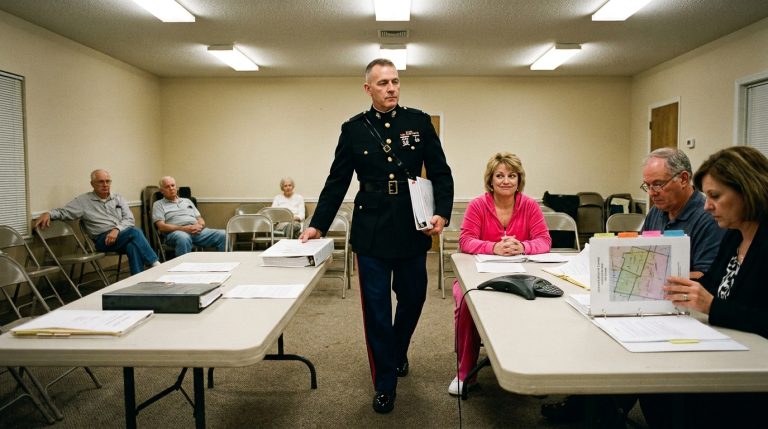
The fluorescent lights of the Oakwood Bluffs community center auditorium hummed with a harsh, sterile intensity, casting long, sharp glares across rows of folding metal chairs. Usually sparsely populated by a handful of civic-minded retirees, the hall tonight was packed to absolute capacity. Nearly every household was represented, the atmosphere thick with an uneasy, expectant tension.
At the front of the room, behind a long raised laminate table, Karen Miller stood tall. Dressed in a vibrant floral print dress designed to project commanding authority, she beamed out at the crowd, entirely misinterpreting the massive turnout as a personal mandate of support for her community vision initiative. Her two loyal board members flanked her on either side, their expressions mirroring her self-satisfied poise. Frank sat quietly at the far end of the table, his face a neutral, unreadable mask.
The agenda moved forward with rapid, mechanical efficiency. Karen cycled through committee updates, maintenance schedules, and minor administrative notes, her voice carrying an air of rehearsed triumph. Finally, she reached the section designated for new business.
“And now,” Karen announced, her voice swelling with theatrical importance as she gripped the edges of the podium, “I am thrilled to present the next major milestone for our neighborhood—the budget proposal and special assessment for our new community recreational complex.”
With a click of her remote, a PowerPoint slide materialized on the white pull-down screen behind her. A crudely photoshopped rendering of tennis courts and a modern clubhouse was superimposed directly over an aerial photograph of the private five-acre wood lot. She launched into a polished speech about property equity, lifestyle upgrades, and community unity, airily dismissing the minor procedural hurdles as fully resolved matters managed by her administration.
When the presentation concluded, she opened the floor for questions, her smile tightly controlled. “The board will now take questions from the community. Please keep them brief.”
A few routine hands went up regarding landscaping schedules, which she batted away with practiced ease. Then, the aisle chair scraped back against the linoleum.
The silence that followed was absolute. Every eye in the auditorium shifted toward the back aisle. Karen’s smile tightened at the edges, her eyes narrowing as she recognized the figure standing with the wireless microphone.
“Yes,” Karen said, her tone dripping with manufactured patience. “I trust this will be constructive, Mr. Davies.”
“Thank you, Karen,” the voice came back, low, steady, and entirely devoid of emotion, cutting cleanly through the acoustics of the hall. “I have a question regarding the board’s legal jurisdiction over association infrastructure. In your official correspondence to my legal counsel dated October seventeenth, you asserted that the HOA holds unquestionable and exclusive jurisdiction over the entire community road network. Could you please direct us to the specific county deed or transfer instrument that grants the association legal ownership of Primrose Lane?”
The question hung in the air like a dropped blade.
Karen’s confident posture flickered. For a fraction of a second, the color drained from her face before she forced a thin, brittle smile back into place. “As I stated in writing, Mr. Davies, it has been the established practice for forty years. Our continuous maintenance establishes our legal standing.”
“So, to clarify,” the voice pressed, unrelenting, “the HOA holds no deed. There is no transfer of title on record.”
“It’s a procedural technicality!” Karen snapped, her voice rising in defensive panic as her eyes darted toward the side exits. “It changes nothing about our authority!”
“I believe it changes everything,” the voice replied.
At the back of the projector booth, Mr. Miller threw a secondary switch. The tennis court rendering vanished instantly from the screen. In its place appeared a massive, high-resolution projection of the 1978 county plat map, highlighting the empty, unexecuted dedication block for the subdivision roads, followed immediately by a scanned image of Karen’s own signed letter claiming absolute jurisdiction.
Dave Sterling stood up from the third row, his lawyerly cadence cutting through the sudden uproar of the crowd. “My name is Dave Sterling, property law counsel. What this means is that for forty years, this association has exercised fraudulent authority over property it does not own. Every fine issued, every restriction enforced, and every dollar spent maintaining those roads has been done without legal standing—compounded by unauthorized administrative expenditures funneled through shell entities.”
Chaos erupted across the auditorium. Voices clashed in overlapping waves of shock and fury. Karen stood frozen at the podium, her mouth opening and closing soundlessly as her administrative kingdom collapsed under the weight of its own fiction.
CHAPTER 8: THE DENOUEMENT OF THE QUIET WOODS
The chaos inside the community center auditorium did not resolve with a dramatic gavel strike; it dissolved under the weight of unvarnished facts. Karen Miller stood frozen at the podium, her fingers gripping the wooden edges until her knuckles turned white, her mouth moving in silent protest as neighbors stood up to demand answers. The motion for a vote of no confidence was introduced from the floor by Mr. Henderson, and it passed with a near-unanimous roar before Karen could assemble a defense. Her two loyal board members slipped out through the side exit before the shouting even peaked.
The fallout was immediate, surgical, and absolute. By the following morning, the administrative credentials to the HOA cloud drive had been legally recovered by an interim board consisting of Mr. Henderson, Mrs. Gable, and Frank. An independent audit, commissioned by Dave Sterling’s office, tore through the digital ledgers in less than forty-eight hours. The shell company—Miller and Associates—was exposed not merely as an administrative overreach, but as a systematic funnel diverting reserve funds into personal accounts. The state attorney general’s office stepped in by Friday afternoon, freezing the accounts pending formal civil and criminal review.
The physical landscape of the subdivision responded overnight. On Wednesday morning, Mrs. Gable’s garden gnomes reappeared along her front lawn, a defiant, colorful line standing guard over blooming petunias. Down on Oakwood Circle, the children’s basketball hoop remained firmly planted, its net catching the crisp morning sun without fear of a retroactive citation.
The transitional process for the neighborhood roads was executed through proper legal channels under Dave Sterling’s pro-bono guidance. Open meetings were held, transparency was maintained, and the road network was formally dedicated to the association with the full consent of every homeowner. The phantom jurisdiction vanished, replaced by genuine civic accountability.
The five-acre wood lot behind the house remained untouched, its dense canopy of golden and crimson leaves undisturbed by asphalt or tennis nets.
One cool autumn evening, a few weeks after the tribunal, the air smelled of dry earth and woodsmoke. The kitchen was quiet, illuminated only by the warm amber glow of the under-cabinet lights. On the back porch, the loose handrail that had wobbled for three summers had finally been addressed. Armed with a heavy-duty drill, exterior screws, and a tube of weather-resistant sealant, the structural repair was completed with slow, methodical precision. Every screw was driven flush, locking the cedar grain tight against the mounting posts.
Sarah stepped out onto the wooden deck, wrapping a light wool shawl tighter around her shoulders as she handed over a ceramic mug of hot coffee. The steam rose in thin, quiet curls against the descending dusk.
“I saw her at the local market this afternoon,” Sarah said softly, leaning against the newly secured railing. “Karen was in the checkout line. She looked completely small. No clipboard, no title, no synthetic authority. Just another person buying groceries.”
The mug was accepted with a quiet nod, the warmth of the ceramic seeping through cold fingers. The sprawling woods behind the backyard stretched out into the gathering shadows, silent and eternal.
“Power isn’t something you declare from a podium,” the reply came out low and steady, the tension entirely drained from the muscles of the jaw. “It’s something you earn through accountability, and protect by standing your ground when the rules matter most.”
They stood together on the porch for a long moment, listening to the dry rustle of the wind through the oak leaves and the distant, cheerful shouts of children playing down the street. The siege was over. The boundaries were secure. The quiet promise of the sanctuary remained intact.