The Price of Concrete and Control: How a Disabled Veteran Stood His Ground Against a Suburban Tyrant
CHAPTER 1: The First Knock
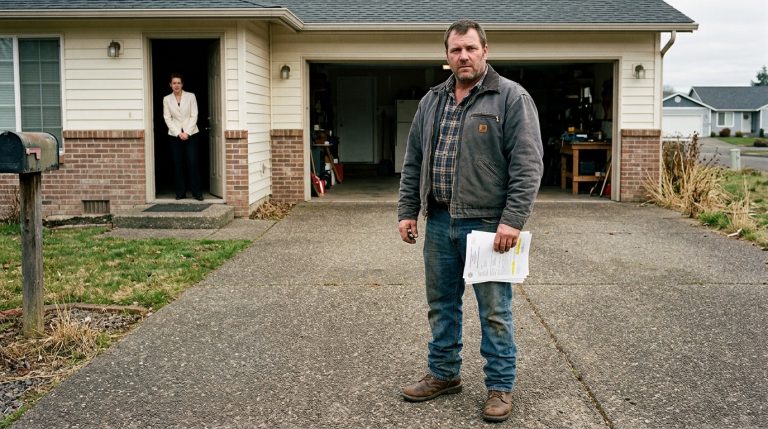
The coffee cup was lukewarm, tasting of chicory and cheap roast. I sat at the kitchen island, thumbing the edge of a scarred silver Zippo lighter, turning it over and over in my palm without striking a flame.
Outside the wide living room window, the morning sun caught the angled aluminum ramp of my van parked squarely in the wide corner driveway. That vehicle was a customized beast with hand controls and a lowered floor, built to carry the weight of two military tours and an IED blast that left me anchored to a wheelchair.
A sharp rap sounded at the front door. It wasn’t a visitor’s knock; it was an administrative tap, rhythmic and demanding.
I rolled the heavy metal lighter once more between my thumb and forefinger, breathing out a slow, steady sigh through my nose. I wheeled slowly toward the entryway, the rubber tires humming softly against the hardwood floor.
Lisa stood on the porch, clipboard pressed flat against a pastel yoga top that probably cost more than my monthly grocery budget. Her hair was styled with salon precision, and her lips wore a tight, practiced smile that stopped entirely before reaching her eyes.
She glanced past my shoulder, her gaze instantly locking onto the modified van in the driveway with an expression of sharp distaste.
“Good morning,” she said, her voice dripping with the effortless condescension of someone who had never faced a real obstacle in her life. “I’m Lisa, the new president of the neighborhood association.”
I kept my hands resting firmly on the push rims of my chair, my posture straight and unyielding. “I know who you are.”
Her smile tightened by a fraction, her eyes darting down to my wheelchair before snapping back up to my face. “I’m going door-to-door to ensure every resident is up to speed on our community standards. Specifically, the rules regarding oversized and commercial-grade vehicles parked in plain view.”
I didn’t blink. I didn’t invite her in. I kept my voice flat, low, and completely devoid of warmth. “Just so you know, my property isn’t part of the HOA.”
Lisa blinked, her pen hovering over the clipboard like she was trying to decode a foreign language. “Excuse me?”
“My house predates the association by a decade,” I said, maintaining steady eye contact. “It was carved out of the original deed restrictions. I made sure of that before I ever signed the paperwork.”
Her jaw tightened, the polished exterior slipping for a fraction of a second to reveal a flash of cold irritation. “We’ll see about that.”
CHAPTER 2: Paper Trail of Control
The blue paper was stiff, smelling faintly of a copy machine toner that had run too hot. I gripped the corner of the notice between my thumb and forefinger, feeling the sharp grain of the text pressed into the cheap fiber.
Oversized vehicles must be housed in enclosed garages or removed from the property entirely.
There was no signature at the bottom, just a stamped emblem of the neighborhood association logo that looked like it had been printed off a home desktop. I rolled the heavy silver Zippo lighter across my knuckles, the smooth metal cold against my skin.
A shadow shifted by the edge of the driveway. Lisa stood near the property line, her clipboard tucked under one arm while she adjusted a pair of oversized designer sunglasses.
She wasn’t hiding; she was auditing.
I pushed the wheelchair forward over the threshold of the front door, the rubber tires bumping softly over the aluminum transition strip. The morning air carried the sharp scent of damp asphalt and freshly cut grass from the adjacent manicured lawns.
“You’re wasting good paper,” I said, my voice carrying easily across the ten feet of open concrete.
Lisa didn’t flinch. She simply turned her head slowly, her lips parting into that same tight, unyielding smile that didn’t reach her eyes.
“Municipal compliance isn’t a waste, neighbor,” she replied, her voice smooth and carefully modulated for an audience that wasn’t there. “It protects property values for everyone who respects the rules.”
“My deed predates your association by ten years,” I said, keeping my tone flat and stripped of anger. “That means your rules stop right at my property line.”
She took two deliberate steps forward, her heels clicking a sharp rhythm against the public sidewalk just outside my boundary. “The board has broad enforcement rights regarding aesthetic continuity. That utility vehicle is an eyesore, and everyone on the street agrees.”
“Then let them come tell me themselves,” I said, my hand tightening around the silver lighter in my pocket. “Instead of hiding behind unsigned slips of paper.”
Lisa’s smile finally slipped, replaced by a thin, hard line of genuine irritation. “You’ll find out soon enough that stubbornness doesn’t override association bylaws.”
She spun on her heel and walked down the block, her stride crisp and rhythmic.
CHAPTER 3: The Hook and the Chain
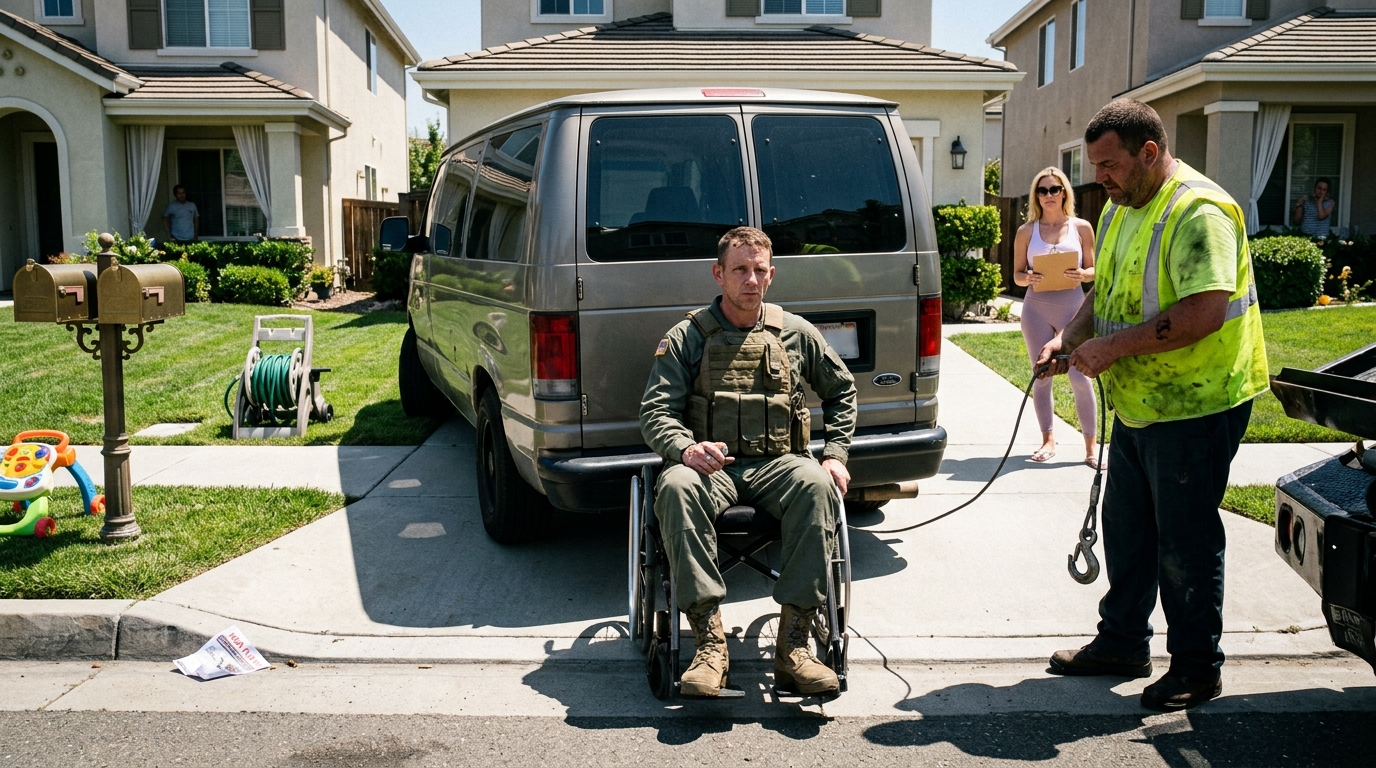
The winch cable dragged a greasy black trail over the concrete apron of my driveway.
I rolled the wheelchair hard over the threshold, slamming the front door open against the exterior brick wall with a sharp thud.
A tow truck driver in a stained fluorescent vest stood by the rear bumper of my modified van, a metal hook dangling from his leather-gloved hand.
“What the hell do you think you’re doing?” I shouted, my voice cutting through the mechanical hum of the idling flatbed.
The driver flinched, dropping his gaze to the asphalt and shifting his weight from one heavy boot to the other. “Got a work order,” he mumbled, refusing to meet my eyes. “Registered as an abandoned commercial vehicle on community property.”
“It’s private property,” I yelled, wheeling down the ramp with a rough scrape of metal against concrete. “And that’s my personal vehicle.”
Lisa stepped out from behind the cab of the tow truck, her clipboard clutched to her chest like a shield. Her smile was sharp and triumphant.
“You were given multiple written warnings about community standards,” she said, her voice dripping with artificial sympathy. “Abandoning an oversized eyesore in plain view leaves the board no choice.”
I gripped the heavy silver Zippo lighter in my pocket, my thumb digging into the scarred metal casing until my knuckles turned white.
“You don’t own this land, and you don’t have a signed municipal order,” I said, leaning forward in my chair. “Unhook that chain right now.”
The driver looked between Lisa’s cold stare and my wheelchair, his hands hovering uncertainly over the winch control box.
CHAPTER 4: The Boot and the Blueprint
The yellow steel jaw locked tight against the tire tread, cold and heavy in the morning air.
I rolled out onto the front porch just as the unmarked service truck pulled away from the curb, leaving my wheelchair-accessible vehicle completely immobilized in the driveway.
A thick manila folder lay wedged under the passenger-side windshield wiper of the sedan parked across the street, its flap fluttering open in the gusting breeze.
I wheeled down the ramp, my tires crunching over loose gravel, and pulled myself up to the passenger door of Lisa’s vehicle where the papers had spilled loose.
A glossy colored packet stared up from the asphalt—a preliminary appraisal and zoning variance map targeting every non-HOA corner lot on the block.
Lisa stepped out of her front door, a fresh ceramic coffee mug clutched tightly in her manicured fingers.
“You’re only making this harder on yourself,” she said, taking a slow sip while her eyes narrowed at the papers in my hand. “The board has authorized full enforcement until that vehicle is permanently removed from sight.”
I tapped the corner of the municipal map against my palm, the sound sharp like a dry branch snapping.
“You aren’t worried about neighborhood standards at all, are you?” I said, keeping my voice low and steady. “You’re clearing the titles so your development firm can flip the entire corner corridor.”
Her coffee mug stopped an inch from her mouth, the polish cracking instantly to reveal a pale, tight-lipped panic.
“You have no idea what you’re talking about,” she snapped, her voice rising an octave as she stepped backward toward her porch steps.
“I know fraud when I read it in black and white,” I said, folding the paperwork in half with deliberate slowness. “And your little signature is right at the bottom of the municipal filing.”
CHAPTER 5: The Collapse of Authority
Lisa lunged forward, her manicured fingers clawing at the folded corners of the municipal map, but I held my ground, the wheels of my chair locked tight against the concrete.
“You’re trespassing on private property with fabricated municipal infractions,” I said, my voice dropping into a low, flat register that brooked no argument. “And this development filing proves you’ve been weaponizing association bylaws to devalue non-HOA lots for a private corporate buyout.”
Her chest heaved beneath the designer yoga top, a fine sheen of sweat breaking out across her forehead as her carefully maintained composure completely fractured.
“You don’t have any legal standing to hold those papers,” she stammered, her voice cracking as she tried to snatch the corner of the document back. “The board will sue you into the ground for defamation.”
I didn’t flinch, rolling the heavy silver Zippo lighter back and forth across my knuckles with slow, deliberate rhythm.
“Let them try,” I said. “Every single notice, every illegal tow order, and every fraudulent fee has been logged, timestamped, and matched directly to your signature.”
She stepped back, her eyes wide with sudden, unadulterated panic as she realized the trap had snapped shut entirely around her own overreach.
“You can’t do this,” she whispered, her voice dropping into a desperate plea. “This project is my entire livelihood.”
“Should have thought about that before you tried to push a veteran off his own property,” I replied, turning my wheelchair around toward the ramp.
CHAPTER 6: The Quiet Driveway
Lisa stood beside the open trunk of her car, her shoulders slumped beneath a plain beige jacket as she shoved another heavy plastic bin into the back.
She didn’t look up when my wheelchair tires crunched over the asphalt, her earlier polished veneer entirely stripped away by the crushing weight of exposed fraud and personal fines.
The heavy silver Zippo lighter rested quietly in my palm, its metal casing cool and still as I turned it over once without opening the lid.
My customized van sat parked squarely in the middle of the wide corner driveway, gleaming under the afternoon sun with its aluminum ramp folded tight and secure.
Not a single note clung to the windshield, and the yellow steel boot was long gone from the tire tread.
Lisa slammed the rental car trunk shut with a hollow metallic bang, sliding behind the steering wheel without a single parting word.
The engine whined, the tires crunching backward over the gravel before pulling away from the curb for good.
I sat there on the edge of the concrete apron, breathing in the scent of warm asphalt and freshly cut grass, entirely at peace within my own boundaries.
The road was quiet, the property line remained unbroken, and the van stayed right where it belonged.