The Old Pilot and the Tarmac Tyrant: How an 82-Year-Old Veteran Brought an Arrogant Captain to His Knees
CHAPTER 1: THE TARMAC CONFRONTATION
“Go on then. Start her up.”
The voice was slick with the kind of condescending amusement that only a young officer convinced of his own importance could muster.
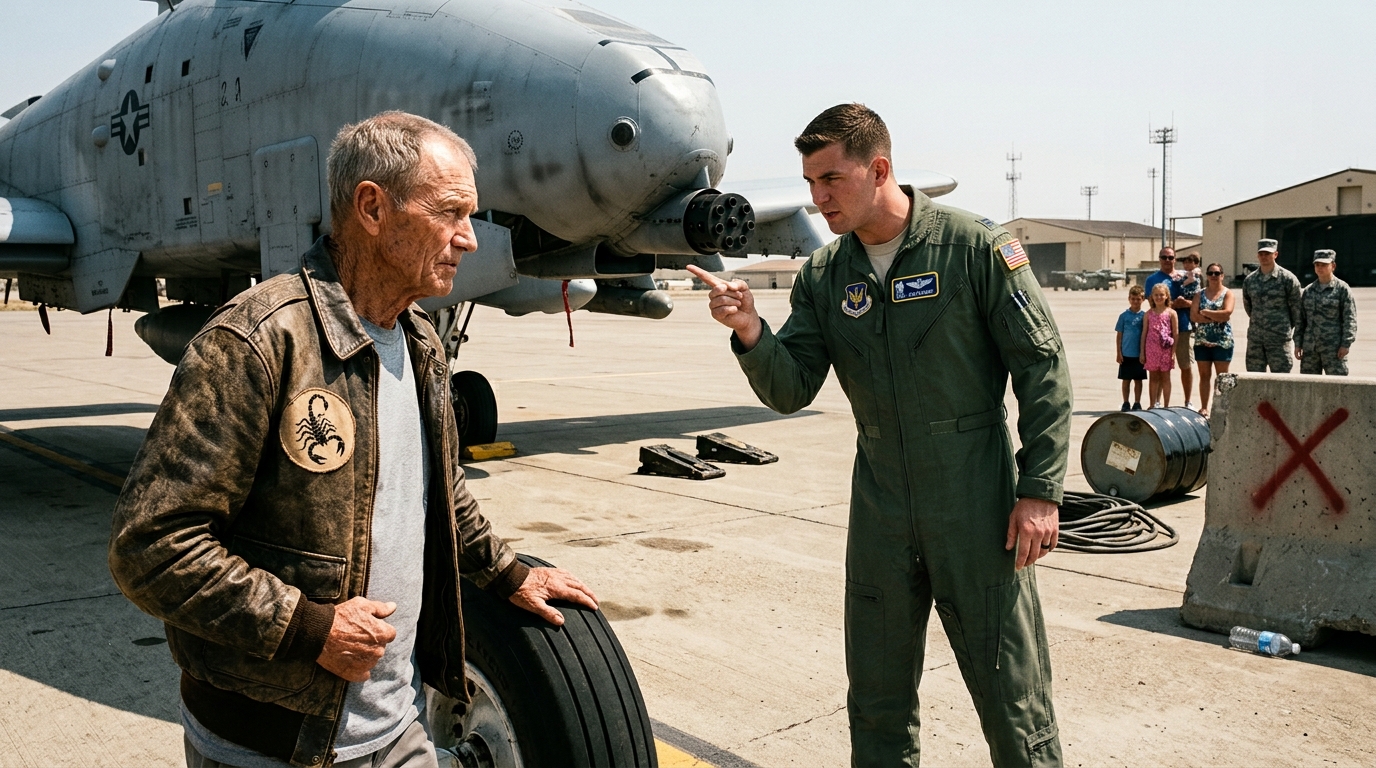
Captain Davis gestured with a dismissive flick of his wrist toward the A-10 Thunderbolt II, its bulky, pugnacious form sitting squat on the hot concrete.
“Show us how it’s done, old-timer.”
Roger Bentley, 82 years old, said nothing.
He stood beside the aircraft’s enormous front landing gear, his hand resting lightly on the cool rubber of the tire.
The sun beat down, making the air shimmer over the tarmac while his faded leather jacket trapped the humid heat against his shoulders.
A small crowd of young airmen, on break from their duties during the base’s family day, exchanged uncertain glances.
They were caught between the discomfort of witnessing a senior citizen being mocked and the ingrained reluctance to challenge a commissioned officer.
Davis smirked, playing to his small audience.
“Come on now. You were telling my guys all about the good old days. How you used to fly these things by the seat of your pants. Surely you remember how to flip a few switches.”
He pointed a manicured finger at the complex array of instruments visible through the A-10’s bubble canopy.
“Or is all that new-fangled glass a bit too much for you?”
Roger’s eyes, the color of a faded sky, remained fixed on the aircraft.
He wasn’t looking at the cockpit.
He was looking at the nose just below the canopy, where the paint was slightly more weathered, right beside the massive seven-barreled maw of the GAU-8 Avenger cannon.
It was a weapon he knew more intimately than he knew the faces of his own relatives.
He could feel the familiar, bone-jarring vibration of it firing deep within his marrow—a physical memory that lived not in his mind, but in his bones.
“Captain,” one of the younger airmen started, a hint of protest sharp in his voice. “Maybe we should just stay out of it.”
“Airmen,” Davis snapped, not taking his eyes off Roger. “The man wants to tell war stories. He should be able to back them up.”
Davis stepped closer, his shadow falling heavily over Roger.
He jabbed a thumb toward a worn patch on Roger’s jacket—a crudely sewn scorpion inside a circle of sun-bleached sand.
“What’s that supposed to be? Your VFW bingo team?”
Roger’s gaze finally shifted from the plane to the captain.
He didn’t look angry.
He didn’t look humiliated.
He just looked tired.
He looked at the captain’s polished boots, his crisply ironed flight suit, and the silver bars on his collar that gleamed mercilessly in the midday glare.
He saw a man who wore a uniform as a costume, completely devoid of what it actually cost to keep it clean.
“The auxiliary power unit requires a ground check before ignition sequence,” Roger said, his voice a low, gravelly rasp directed at the machine rather than the man. “Hydraulic pressure needs to be stable at three thousand PSI. You don’t just turn a key.”
Davis blinked, momentarily thrown off balance by the technical precision before his smirk snapped back into place.
“Oh, we’ve got a real expert here. Look, sir, this is a restricted area. The aircraft is a static display for the event.”
Davis changed his tone, adopting the loud, slow cadence of someone speaking to a child or a person losing their mind.
“I’m going to have to ask you to please step away and let my people get back to work. This is a very expensive, very dangerous airplane. We can’t have civilians climbing all over it.”
Roger’s hand dropped slowly from the tire.
His posture didn’t change, but a heavy, absolute stillness settled over him—the kind of quiet gravity that precedes a storm.
CHAPTER 2: THE WEIGHT OF STEEL
The silence between them stretched, thick with the smell of sun-baked concrete and stale jet fuel.
Roger did not blink.
He kept his hand buried inside the frayed lining of his jacket, feeling the rough edge of an old dog tag rubbing against his knuckles.
Davis shifted his weight, his polished boots scraping against the ground as the junior airmen watched in frozen anticipation.
“I’m not asking you a third time, old man,” Davis muttered, his voice dropping an octave as a flush crept up his neck. “Empty your pockets or step away from the bird.”
Roger ignored the command entirely, his eyes tracking the subtle hydraulic line running along the landing gear strut.
He knew every rivet on this fuselage, knew the exact weight distribution when the tanks were empty versus when they dragged low over the desert floor.
The captain’s hand hovered near his side, fingers twitching in a nervous display of authority that lacked any real anchor.
“You’re standing on federal property without an escort,” Davis pressed harder, stepping into Roger’s personal space in an attempt to bully him physically. “And you’re ignoring a direct order from a commissioned officer.”
A stray piece of paper blew across the tarmac, rustling against the cold rubber of the A-10 tire before catching on Davis’s heel.
Roger noticed a faint, dark smudge near the serial numbers stamped into the fuselage—a residual scorch mark from an old patch of flak damage that never quite vanished under the grey paint.
The detail was small, almost invisible to anyone who didn’t spend thousands of hours staring at the same panels under incoming fire.
“You think this is a toy,” Roger said softly, his voice cutting through the heavy air with a quiet rasp.
Davis sneered, leaning down slightly to loom over the older man.
“I think you’re lost, and I’m about three seconds away from having security drag you off this flight line in handcuffs.”
CHAPTER 3: THE ESCALATING DEMAND
“You want to see my credentials?” Roger asked, his voice remaining a low, gravelly rasp that refused to yield to the pressure.
“That’s exactly what I want,” Davis snapped back, crossing his arms and planting his boots wider on the hot concrete. “Let’s see some ID. Let’s see the pass that allows you to be this close to a United States Air Force asset.”
A sudden gust of wind swept across the open tarmac, carrying the sharp scent of heated asphalt and blowing a stray grit of sand against the side of the fuselage with a dry click.
Davis took another aggressive step forward, mistaking the old man’s steady silence for submission.
“All right, that’s it. I’ve had enough of this game,” Davis announced, raising his voice so the gathered crowd of families and junior personnel could hear every word. “You refuse to identify yourself. You refuse to follow a lawful order to leave a restricted area.”
He jerked his chin toward two of the younger airmen standing awkwardly near the edge of the static display.
“You two, go get security forces right now. Tell them we have a trespasser who needs to be physically escorted off the base.”
Davis let out a sharp, mocking breath, his eyes narrowing with spite.
“And while you’re at it, have medical put someone on standby. We might need to get this gentleman a mandatory evaluation before he hurts himself wandering around the flight line.”
The threat hung in the heavy air like a physical blow, stripping away any pretense of a routine security check.
It was a deliberate, petty attempt to humiliate an elder by weaponizing base protocol and institutional power.
A collective murmur rippled through the onlookers, the younger airmen exchanging horrified looks as they realized the line had officially been crossed.
Roger did not flinch, his posture remaining locked and immovable against the oppressive heat.
“You’re a long way out of your depth, Captain,” Roger said quietly, his hand drifting back toward the inner lining of his jacket.
CHAPTER 4: THE COMMAND BREACH
The sharp squeal of emergency brakes cut through the mounting tension as a black command SUV skidded across the tarmac.
Dust billowed outward in a thick gray cloud, settling over the polished boots of the captain and coating the pristine flight line in gritty residue.
Captain Davis blinked against the grit, his arrogant posture faltering for a split second as the heavy vehicle door flew open.
Colonel Mat emerged from the driver’s side like a thundercloud, his face carved from absolute, unyielding stone.
He didn’t waste a single glance on the small crowd of onlookers or the junior airmen standing rigidly at attention.
His eyes scanned the scorching concrete, locked onto Roger Bentley, and marched directly toward him with measured, heavy strides.
Chief Master Sergeant Wallace flanked him by half a step, his expression stripped of all pleasantries.
“Sir, you need to see this,” Wallace had warned back in headquarters, but out here on the hot concrete, words were entirely unnecessary.
Davis puffed out his chest, attempting to pivot back into his role as the protector of base protocols.
“Colonel Mat, glad you’re here, sir,” Davis began, throwing a crisp salute that hung awkwardly in the heavy air. “We’ve got an uncooperative civilian trespassing on a static display, refusing to—”
Colonel Mat walked right past the captain as if he were nothing more than a piece of discarded trash on the runway.
The colonel stopped three feet in front of Roger, ignoring the junior officer completely.
Then, in a motion that made the surrounding airmen hold their collective breath, Colonel Mat snapped to a rigid, flawless salute.
It wasn’t the casual nod of protocol; it was a gesture of deep, unreserved reverence.
“Mr. Bentley,” the colonel’s voice boomed across the silent tarmac, sharp and unwavering. “It is an honor to have you on my flight line, sir.”
CHAPTER 5: THE PUBLIC RECKONING
Colonel Mat dropped his arm and turned his sharp gaze toward the captain, who stood frozen with a half-raised hand.
“For those of you who were not aware,” the colonel’s voice boomed across the flight line, rich with iron and authority. “You are standing in the presence of Major Roger Bentley, United States Air Force, retired.”
A collective murmur rippled through the young airmen as the colonel pointed directly at the A-10 Thunderbolt II.
“This is not just any aircraft. This is Tail 780618. This is his aircraft.”
Captain Davis swallowed hard, his skin turning pale under the relentless desert sun as the weight of his colossal miscalculation crashed down around him.
“Major Bentley flew this exact airframe for over two thousand hours,” the colonel continued, his voice rising with fierce pride. “Nearly half of those hours were logged in combat over hostile skies.”
The young airmen stared at Roger with wide, disbelieving eyes, the arrogant captain completely forgotten as the living history of the wing stood before them.
“During Operation Desert Storm, Major Bentley was credited with the confirmed destruction of twenty-three tanks and sixteen armored vehicles,” the colonel stated, his eyes boring straight into the trembling junior officer.
“And this patch on his jacket—the one you mocked—was given to him by the commander of the Third Ranger Battalion after he saved an entire pinned-down infantry unit from being overrun.”
Davis tried to stammer out a defense, his fingers twitching nervously against his side as the trap closed in completely.
“Colonel, I—I was just enforcing base protocol, I didn’t know—”
“You didn’t look,” Colonel Mat interrupted, his voice dropping to a low, dangerous growl that cut off every excuse. “You saw an elder and chose arrogance over basic human decency.”
CHAPTER 6: THE QUIET AFTERMATH
Captain Davis stood frozen, his eyes darting frantically from the commander’s hardened expression to the gathered airmen who no longer offered even a glance of sympathy.
“You will be in my office tomorrow morning at zero-six-hundred hours in your service dress,” Colonel Mat stated, his voice dropping to a harsh whisper that carried the full weight of impending professional ruin. “Prepared to explain why you disgraced the uniform you wear.”
Davis opened his mouth, a desperate counter-move forming on his tongue—an attempt to claim he was only following vague safety directives and that the situation had been blown out of proportion.
“Sir, I was merely—” Davis started, his voice cracking under the public exposure.
“Not another word,” the colonel cut him off with a sharp chop of his hand.
The captain snapped his mouth shut, his face flushing a deep, mottled crimson as the realization set in that no amount of defensive maneuvering could dig him out of this trench.
His career as an operational leader was effectively over, dismantled piece by piece by his own unearned arrogance.
Colonel Mat turned back toward Roger, his posture relaxing instantly into a posture of profound respect.
“Sir, on behalf of the entire wing, I am deeply sorry for the disrespect you endured here today.”
Roger offered a single, calm nod, his gaze sweeping over the bulky frame of the A-10 one last time before he turned away from the flight line.
Weeks later, inside a quiet, sunlit off-base coffee shop, the bell above the door chimed softly.
A tired man in civilian clothes, his shoulders permanently slumped, stepped inside and hesitated near the counter.
It was the former captain, stripped of his silver bars and his authority, carrying the heavy weight of a lesson learned too late.
He spotted Roger sitting by the window reading the morning paper and walked over slowly, stopping a few feet from the table.
“Sir,” the man began, his voice rough and stripped of every ounce of its former arrogance. “I wanted you to know… they made me read your entire service record. Every mission report.”
He swallowed hard, staring down at his own worn shoes.
“I just wanted to say thank you for your service.”
Roger looked up from his paper, his expression completely neutral, holding the man’s gaze for a long, steady beat.
“The uniform is just a cloth if you don’t know what it costs,” Roger said quietly, his voice steady and free of malice.
He offered a single, dismissive nod of acknowledgment, folding his newspaper down the center.
The younger man turned away in silence, stepping back out into the bright afternoon street.
Roger picked up his lukewarm ceramic mug, wrapping his weathered fingers around the rough porcelain as the noise of the shop hummed peacefully around him, entirely at rest.