The Ghost of Ramstein: A Reluctant Titan Navigates the Bureaucratic Labyrinth of a Long-Forgotten Service
CHAPTER 1: THE WEIGHT OF THE ASPHALT
The humid night air at Ramstein clung to Arthur like a shroud, heavy with the smell of exhaust and distant, damp earth. He didn’t look back at the Officers Club. He didn’t care about the ripple of prestige or the shock he’d left in his wake. His focus was entirely on the friction of his boots against the asphalt, the way his left leg dragged, a lingering souvenir from a night in Laos that felt like a lifetime ago.
He reached the edge of the parking lot, his breath shallow. The world felt too bright, too exposed. He reached into the pocket of his thin, threadbare jacket and pulled out a set of keys that felt unnaturally cold against his palm—an old, jagged piece of metal that belonged to a man who had officially ceased to exist in 1984.
He stopped.
The space where his faded sedan should have been was occupied by a sleek, black administrative vehicle. The streetlamp overhead flickered, casting a long, jittery shadow that stretched toward the hood. A man in a suit stood leaning against the driver’s side door, his silhouette sharp against the perimeter fence. He wasn’t looking at Arthur; he was looking at his watch.
Arthur didn’t hesitate. He shifted his weight, the pain in his knee radiating upward, a sharp, familiar reminder of his limits. He moved forward, his gait steady despite the limp.
“You’re late, Mr. Jenkins,” the man said, his voice as dry as parchment. He didn’t look up.
“I wasn’t in a hurry,” Arthur replied. His own voice sounded foreign—a gravelly, dormant instrument finally finding its tone.
The man finally looked up, his face a mask of bureaucratic indifference. He held out a manila envelope. The edges were fraying, the paper stained by a ring of something dark. “The General sent me to finalize the paperwork. A formality. There was a discrepancy in your file. Something… persistent.”
Arthur didn’t take the envelope. He stared at it. It was the same weight, the same texture as the files he had been forced to burn three decades ago. He felt the cold iron of the night air press into his skin. There was something else, too—a faint, rhythmic clicking sound coming from inside the man’s jacket, distinct, electronic, and completely out of place.
“It’s not just a pension, is it?” Arthur asked, his eyes locking onto the man’s stiff collar.
The man’s smile didn’t reach his eyes. “It’s whatever the state decides it is today, Art. Are you coming, or are we going to let the rust finish the job?”
Arthur’s gaze flickered to the man’s cuff. A small, silver pin glinted in the dim light—the same insignia he’d seen on the briefcases of the men who had ordered him into the kennel.
CHAPTER 2: THE ANATOMY OF A COMPROMISE
The man’s smile remained fixed, a thin, rehearsed line that refused to engage his eyes. He didn’t pull away when Arthur stared at the silver pin on his lapel. Instead, he simply tapped the manila envelope against the roof of the black sedan with a soft, hollow thud.
“You’re making this difficult, Art,” the man said. His voice had lost its dry, parchment quality, replaced now by a slick, synthetic professionalism. “We’re here to fix a mistake. Why look for complications in a solution?”
Arthur didn’t answer immediately. He let his gaze drift from the pin to the surrounding darkness. The perimeter fence of Ramstein was just a blur of chain-link and shadow, but in his mind, he was back in the treeline near the Ho Chi Minh trail, calculating the radius of a mortar blast. The sensation was immediate and visceral—the phantom weight of his old ruck, the cold bite of humidity against his collar. The psychological phantom of the jungle bled into the modern, sterile asphalt of the parking lot, and for a heartbeat, he saw not the man in the suit, but a handler in a rain-slicked poncho, promising him a way out that always led deeper into the fire.
He forced himself to blink, breaking the association. The parking lot solidified. The flicking streetlamp hummed.
“The last time someone ‘fixed’ my file,” Arthur said, his voice barely audible over the hum of the base’s ventilation systems, “I lost twenty years of my life. I don’t trade in ‘formalities’ anymore.”
He took a step back, the limp in his left leg pronounced. The man in the suit followed the movement with his eyes, his posture shifting, a subtle tightening in his shoulders that suggested he was well-versed in reading physical tells.
“The General has a very specific timeline for this integration,” the man replied, his tone shifting to something more transactional. “You want your benefits? You want the recognition that’s thirty years overdue? Then you get in the car. We have a secure facility off-base. There’s a briefing, a medical assessment, and a debriefing on the logistical errors that caused your initial ‘loss of status.’ It’s standard procedure.”
Arthur looked at the car. It was an innocuous, high-end sedan, yet it felt like a cage on wheels. He felt the weight of the envelope—or rather, the lack of it—in his mind. If it were a pension correction, it would be thick with legal jargon and banking stamps. This felt light. It felt like an invitation to a different kind of kennel.
“The discrepancy,” Arthur murmured, turning the word over in his mind like a rusted bolt. “You said it was persistent.”
“It’s an administrative ghost, Art. Nothing more.”
The man reached out to open the door, but Arthur didn’t move. He kept his hands at his sides, his fingers curled into loose fists. He was observing, not the man, but the environment. The way the man stood, favoring his right side, the way his jacket shifted ever so slightly, revealing the hard, rectangular outline of a communications array—or perhaps something else—tucked against his ribs.
Arthur’s intuition, the same cold logic that had kept him breathing when his team was declared dead, whispered that this wasn’t an audit. It was an extraction. They hadn’t come to fix a pension; they had come to re-acquire an asset that had just accidentally reactivated itself.
“I’ll take the file,” Arthur said, extending a hand. “I’ll review the terms myself. If it’s as simple as you say, I’ll be at the office at 0600 as the General requested.”
The man’s smile finally vanished. He pulled the envelope back, sliding it into his breast pocket with a gesture that was far too graceful, far too practiced. “The file is non-transferable, Mr. Jenkins. It requires a signature in the presence of an authorized administrator. That’s the protocol.”
Arthur felt the tension coil in the pit of his stomach. The air around them seemed to thicken, the smell of damp earth and iron-rich dust rising from the ground. He recognized this rhythm—the false courtesy, the demand for compliance, the invisible trap tightening around his throat.
“Then there’s nothing left to discuss,” Arthur said, turning on his heel.
“Art,” the man called out, his voice dropping an octave, losing the last of its professional veneer. “Don’t make this a matter of national security. You’re already a ghost. Don’t force us to make the haunting permanent.”
Arthur didn’t turn back. He began the long, slow walk toward his own transport, his footsteps echoing in the cavernous silence of the parking lot. Every muscle in his back was braced for the impact of a hand on his shoulder, for the whistle of a silenced round, for the familiar, terrible sensation of being hunted. But the only sound was the distant whine of a transport plane taking off, a low, guttural roar that vibrated through the soles of his shoes and into the marrow of his bones.
He was out of the trap for now, but as he reached the gate, he caught his reflection in the glass of a security hut. He looked old, broken, and insignificant. But deep in his eyes, the spark remained—a cold, calculated light that had outlasted empires. He wasn’t a janitor. He was an observer, and he had just seen exactly what he needed to see: the enemy wasn’t just in the club. They were in the infrastructure. And they were terrified of what he might remember.
He walked past the gate, ignoring the guard’s polite nod, his mind already mapping the route to a secure location he hadn’t visited in decades. He had a debt to collect, and for the first time in thirty years, he knew exactly where to begin the audit.
CHAPTER 3: THE ECHO IN THE ASHES
Arthur’s apartment was a study in atrophy. It was located in a brutalist block of subsidized housing on the outskirts of the base—a structure of raw concrete and weeping rebar that felt like the shell of a dying city. He climbed the stairs, his left leg dragging with a rhythmic, metallic scrape that seemed to vibrate through the entire stairwell. He reached the third floor, his breath hitching in his chest, and paused before his door.
He didn’t unlock it immediately. He stood in the dim, flickering amber of the hallway light, his hand hovering over the cold metal of the knob. Something was wrong. It wasn’t a sound, but a quality of the air. The smell of dust and stagnant air he usually associated with the room had been replaced by the faint, sharp tang of ozone—a smell he hadn’t encountered since the electronics lab at the CIA’s old Northern Virginia facility.
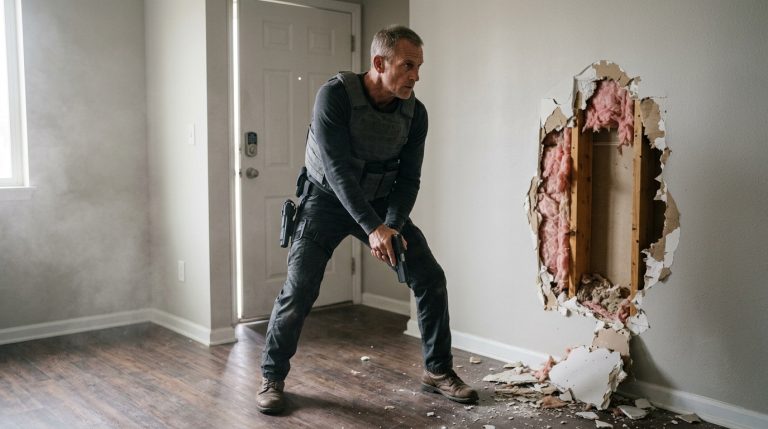
He rotated the key, the tumbler clicking with a precision that felt too familiar. He pushed the door open, keeping his body pressed against the wall, a maneuver ingrained by decades of survival in the dark.
The room was as he had left it: the small, iron cot against the wall, the scarred wooden table, the solitary chair. But as he stepped inside, his boot caught on the edge of the rug. It had been moved. Just a fraction of an inch—enough to expose the dark, circular stain on the linoleum where the table legs usually sat.
He went still. The room felt larger than it should have been. He began to check his perimeter, his movements economical and precise. He didn’t turn on the light; he didn’t need to. He moved by touch, his fingers ghosting over the surfaces of his life. He checked the underside of the chair, the back of the radiator, the hinge of the closet door. Nothing.
But then, he reached the shelf where he kept his few remaining mementos—a collection of dull, rusted scrap metal he’d gathered from construction sites, the closest he allowed himself to come to artifacts of his past. He stopped. His fingers found the small, jagged piece of steel he’d placed on the far left. It was gone. In its place lay something else: a small, black object, roughly the size of a thumb.
He pulled his hand back as if burned. He stood in the center of the dark room, his heart hammering against his ribs, not with fear, but with a cold, analytical fury. He hadn’t been burgled. He had been tagged.
He moved to the small window that overlooked the rain-slicked parking lot. Below, the black sedan was still there, parked in the exact spot he had left it. It was idling—he could see the faint, ghostly plume of exhaust rising into the streetlamp’s glow. The man in the suit was gone, but the car remained. It was a beacon.
He felt a wave of dizziness, a sharp, piercing flash of white light behind his eyes that made the floor seem to tilt. For a split second, the concrete walls of the apartment seemed to dissolve, revealing the thin, white walls of a sterile medical facility. The phantom image was so vivid he could hear the hum of a ventilation fan and the distant, rhythmic beep of a heart monitor. He squeezed his eyes shut, his knuckles turning white as he gripped the windowsill.
Stay anchored, he told himself. The memory is the trap.
He opened his eyes. The room was dark, silent, and real. The dizziness faded, but the doubt remained. Was he really seeing the car below, or was his mind constructing the threat to justify the survival instinct he couldn’t switch off? The Unreliable Perception—he’d seen it happen to better men than himself, men who had spent so long in the dark that they began to see monsters in the shadows that weren’t there.
But the black object on the shelf was cold, hard, and undeniable.
He didn’t touch it again. He turned toward the table, pulling out the chair with a heavy scrape of iron on linoleum. He sat down, his posture rigid, his gaze locked on the doorway. He needed to verify the reality of his situation, not through his eyes, but through the evidence. He reached into his pocket and pulled out the small, brass-backed notebook he had kept for thirty years, a repository of names and locations that had never been written down in any official file.
If they had been in his apartment, they had been after the book. But the book was still there, tucked deep in the lining of his coat. They had missed the only thing that mattered. Or, a cold thought curled in his mind, they hadn’t missed it—they had left it behind, waiting for him to use it to lead them to the rest of the network.
He stared at the notebook, the worn, leather cover rough under his calloused fingertips. He had been a ghost for thirty years, a man who had successfully erased his own existence. Now, the past was reaching out, not to kill him, but to use him as a compass.
He opened the book to the final page, where a series of coordinates were inscribed in faint, barely legible graphite. They pointed to a location deep within the Black Forest of Germany—a site that should have been demolished decades ago. If the bureaucracy was still using his old network, the truth wasn’t just in the pension files; it was in the rusted, forgotten machinery of the Cold War.
He stood up, his knee protesting with a sharp, stabbing pain. He didn’t care. He walked to the window again. The sedan was still there. He took a heavy, rusted metal pipe he’d kept under the cot, its weight familiar and grounding. He wasn’t going to run. If they wanted to play the game of ghosts, he would remind them why the specter of Viper One was the one secret they should have let stay buried.
He turned toward the door, his jaw set, his resolve hardening like cooling steel. The apartment was no longer his home; it was a front line. He stepped out into the hallway, the sound of his own footsteps the only thing between him and the silence of the night. He had a path to follow, and for the first time in three decades, he knew exactly who was waiting at the end of it.
CHAPTER 4: THE AUDIT OF SHADOWS
The hallway stretched out before him, a concrete throat that seemed to narrow with every step. Arthur moved with a deliberate, rhythmic gait, the iron pipe held low and tight against his thigh. He didn’t look back at his door; he knew the interior had been compromised, and to look would be a waste of focus. His eyes were pinned to the stairwell access at the far end of the corridor.
As he approached the heavy steel door, he noticed a discrepancy. A small, almost invisible smear of high-gloss grease clung to the handle. It wasn’t the grime of the building, nor the oil of the mechanical hinges. It was synthetic, clinical—a lubricant used for precision surveillance equipment. He stopped, the pipe cold against his palm, and ran a thumb through the residue. It was tacky, fresh.
He didn’t pull the door open. Instead, he leaned his weight against the wall, his breathing slowed to a steady, rhythmic cadence. He listened. The building was supposed to be a tomb of subsidized silence, but he could hear the faint, rhythmic pulse of an air handler somewhere deep in the basement. Beneath that, there was something else—a soft, metallic click followed by the muffled, rhythmic scrape of shoes against concrete, ascending the stairs from the floor below.
They were coming up.
He retreated into the shadows of the alcove near his door, the pipe feeling like an extension of his own arthritic bone. He waited, his mind stripping away the civilian life he had curated for thirty years. The janitor, the limp, the quiet humility—they were shed like a skin. In the dark, he was a collection of instincts honed in the most lethal environments of the 20th century.
The door to the stairwell groaned open, a sound muffled by the rain outside. A silhouette appeared, then another. They moved with the efficient, boxy geometry of professionals—not the sloppy, overconfident thugs Thorne employed, but something more surgical. They were sweeping the floor, their movements synchronized.
Arthur didn’t wait for them to reach his door. He stepped out, not with a roar, but with the quiet, devastating efficiency of a landslide. He didn’t attack; he leveraged. He used the momentum of the lead operative, catching him with a sharp, calculated strike to the radial nerve of his wrist—enough to force him to drop his weapon without turning it into a scene of chaotic violence. The operative gasped, his hand dropping, and Arthur redirected him into his partner, using their own inertia to turn the hallway into a tangle of flailing limbs and surprised grunts.
It was a fight of friction, not speed. Arthur felt the strain in his knee, the protest of a body that had been dormant for too long, but he compensated with leverage and positioning. He slammed the lead operative against the concrete wall—a controlled, jarring impact designed to disorient, not to maim.
“Who sent you?” Arthur whispered. The voice wasn’t his janitor’s rasp; it was the chilling, steady tone of Viper One.
The man he held against the wall struggled, his eyes widening as he caught a glimpse of Arthur’s face in the flickering light. He wasn’t reaching for a sidearm. He was reaching for his comms unit.
Arthur grabbed the man’s wrist, twisting it just enough to trigger a sharp, localized pain. “I said, who sent you? The General? Or the people who sign his paychecks?”
The operative’s face was a mask of cold, professional stoicism. “You’re a ghost, Jenkins. You should have stayed in the cemetery.”
He spit, the gesture a defiance that Arthur recognized. This wasn’t a fight about territory; it was a fight about erasing the evidence. He realized, with a sudden, sinking clarity, that the black object in his apartment hadn’t been a tracker. It was a transmitter, and it had already broadcasted his location.
“I’m not the one in the cemetery,” Arthur replied, his voice a low, gravelly vibration. He swept the man’s legs out from under him, sending him sprawling into the partner, and used the chaos to slip back into the stairwell.
He didn’t descend; he climbed. He ascended toward the roof, his breath burning in his lungs, his heart racing with the familiar, terrible exhilaration of the hunt. He had been herded into this apartment to be cleaned up, but they had underestimated the ghost. He reached the roof access, the cold air of the night biting at his skin, and stepped out onto the gravel-strewn flat top of the building.
The city was a sprawling map of light and shadow below him. He moved to the edge, looking down at the parking lot. The black sedan was still there, but now there were two others. They were sealing the building.
He looked at the black object he’d pulled from the operative’s kit during the scuffle—a small, encrypted hard drive, no bigger than a thumbnail. He hadn’t just fought them; he’d taken their proof. He looked at the device, then out at the sprawling, indifference of the horizon. The truth wasn’t in the pension records. It was in the data he now held. He had the key, but he was trapped in a building that was rapidly becoming a furnace. He needed a way out, and for the first time in thirty years, the only way out was to stop hiding and start burning the bridges himself.
CHAPTER 5: THE PRICE OF THE ARCHITECT
The wind on the roof was sharp, carrying the metallic bite of distant industrial exhaust and the damp, cloying scent of the coming rain. Arthur knelt in the shadows of an HVAC housing, his breath hitching in his chest. Below him, the parking lot had transformed. The sleek black sedans were no longer just parked; they had formed a perimeter, their headlights cutting through the gloom like the eyes of prowling predators. Men in dark, utilitarian tactical gear were fanning out toward the base of the building, their movements precise, synchronized, and utterly devoid of hesitation.
He looked down at the hard drive in his palm. It was cold, small, and entirely unremarkable, yet it felt heavy enough to anchor the entire weight of his survival. He didn’t need to see the contents to know what they represented; the intensity of the pursuit told him everything. They weren’t just protecting a secret; they were protecting an ongoing enterprise.
He heard the roof access door groan—a slow, metallic protest of rust and pressure.
Arthur didn’t panic. He moved. He rose to his feet, his left knee screaming in protest, and crossed the gravel-strewn expanse toward the building’s edge, where a fire escape offered a tenuous, rusted descent into the alleyway. As he reached the iron railing, a sudden, blinding searchlight swept across the roof, turning the gravel to brilliant, white sand. He threw himself flat, the metal of the fire escape biting into his shoulder.
The light lingered, a hot, oppressive pressure that felt like a physical weight. Then, a voice cracked through the night—amplified, hollow, and chillingly indifferent.
“Jenkins. There is no longer a version of this night where you walk away with the drive. Hand it over, and we maintain the fiction of your retirement.”
Arthur didn’t respond. He looked at the fire escape. The iron was heavily corroded, the bolts at the building’s facade sagging under the weight of decades of neglect. It was a deathtrap, a rusting skeleton that might snap under his weight. But it was his only path. He gripped the railing and swung his body over, his boots finding purchase on the lowest rung. The entire structure shivered, a low, discordant groan of stress that echoed across the roof.
He began the descent. It was a slow, agonizing process. With every step, the metal hissed and buckled. He was halfway down when the roof access door was kicked open. Silhouettes flooded onto the gravel, their flashlights dancing over the roof’s edge. They knew where he was.
A bullet cracked against the concrete near his head, sending a spray of stone and dust into his eyes. Arthur didn’t flinch. He let his weight drop, allowing the rusted support to slide an inch downward before catching on a lower rivet. The sudden jar sent a jolt of pain through his arm, but he pulled the drive from his pocket and jammed it into the deepest, most secure pocket of his jacket, tethering it with a length of thin wire he’d salvaged from his apartment.
He reached the third-floor landing and leaped, his boots slamming into the alleyway’s wet asphalt. He didn’t pause. He sprinted into the darkness, his limp forgotten, his muscles screaming under the demand of a decade-dead intensity. He heard the metallic crash of the fire escape giving way behind him, the entire structure tearing itself from the brickwork and collapsing in a chaotic tangle of iron and rust.
He didn’t look back. He ducked into the shadows of a loading dock, his lungs burning, the taste of metallic copper filling his mouth. He was in the heart of the base, an area he knew better than the men currently picking through the debris of the fire escape. He knew the layout of the underground utility tunnels, a network of service corridors that bypassed the perimeter security entirely.
As he reached the heavy grate of the utility access, he stopped, his hand resting on the lock. He realized, with a sudden, sinking dread, that the drive was vibrating—a low, rhythmic pulse against his chest. It wasn’t just a data storage device; it was a beacon, emitting a localized frequency that was broadcasting his position to anyone with a receiver. He had been carrying his own executioner in his pocket the entire time.
He stared at the lock, then back toward the mouth of the alley. The darkness was closing in. He had to make a choice: discard the drive and survive, or keep it and face the inevitable. He didn’t hesitate. He pulled a heavy wrench from the utility box near the access point, wedged it into the locking mechanism, and forced the gate open with a screech of tortured metal. He slipped into the dark, damp throat of the tunnel, the scent of stagnant water and cold iron wrapping around him. He was deeper than he had ever been, and the hunt had only just begun.
CHAPTER 6: THE FINAL AUDIT
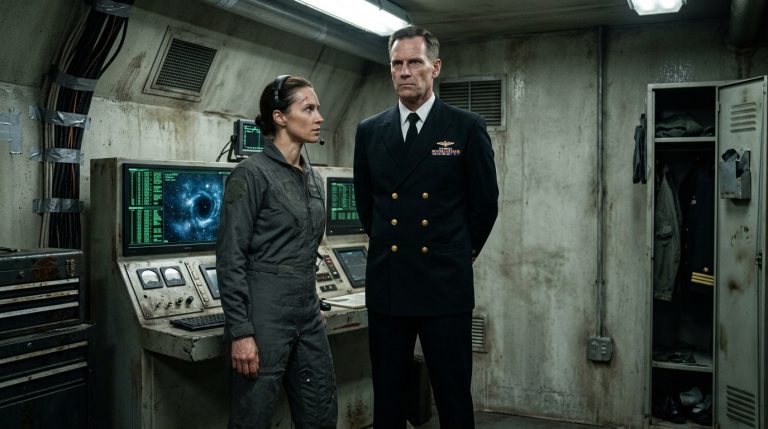
The tunnel was a labyrinth of weeping concrete and oxidized iron pipes that hummed with the steady, subterranean pulse of the base’s power grid. Arthur moved through the gloom, his breath a ragged hitch in the still air. He had to reach the old signal bunker—the last vestige of the network he’d built before the world decided he was a liability. He navigated by muscle memory, his hand tracing the cold, vibrating surfaces of conduits he had mapped in his mind forty years ago.
He found the door—a heavy, reinforced bulkhead that hadn’t seen a human hand since the Reagan administration. He shoved the drive into the legacy interface port, a desperate, irrational gamble that the old encryption protocols might still have a back-door connection to the external grid. The drive whined, a high, piercing electronic shriek that echoed off the tunnel walls, and then, the console flickered to life.
It wasn’t just a dump of files. It was an inventory. As the screens cascaded with scrolling green text, Arthur felt the floor beneath him tilt. The procurement manifests for the last decade were not for legitimate military logistics; they were for off-the-books arms shipments facilitated by the very men who had “retired” him. Thorne was not a master strategist; he was the ledger-keeper for a syndicate of ghosts.
“Mr. Jenkins,” a voice echoed through the tunnel, calm and conversational.
Arthur spun, his back hitting the bulkhead. General Wallace stood at the mouth of the tunnel, his service pistol drawn, his face a landscape of exhausted resolve. He was alone.
“I didn’t want it to end here, Art,” Wallace said, his eyes scanning the monitors. “But you’re an auditor. You should have known that when you start pulling on loose threads, you eventually dismantle the entire garment.”
“The procurement network,” Arthur rasped, his voice cutting through the hum of the bunker. “It wasn’t about readiness. It was about depletion.”
“It was about control,” Wallace replied, his weapon steady. “The network you built was too perfect, Art. It’s too good at finding gaps. We couldn’t let it stay dormant, but we couldn’t let it be used for anything other than our own objectives. Your pension was the price of your silence. The clerical error was the leash.”
Arthur looked at the console, then back at the man who had once been his commander, his brother-in-arms. “You used my own design to arm the very people I spent my life hunting.”
“I used it to maintain the balance of power,” Wallace said, his voice tightening. “A balance you broke the second you opened your mouth at the club.”
Arthur didn’t reach for the iron pipe. He reached for the console’s manual override. He didn’t just dump the files to a secure server; he broadcasted them. He triggered the dead-man’s switch he had built into the network’s architecture decades ago—a protocol that forced every node in the system to report its status to the public-facing military oversight commission in Washington.
The console flared white. Wallace hesitated, his finger trembling on the trigger. In that split second, the bunker was flooded with the rhythmic, screeching sound of an automated data transmission.
“It’s over, Wallace,” Arthur said, the weight of his voice finally settling. “The ghosts are out of the kennel.”
Wallace didn’t fire. He looked at the monitors, watching as his life’s work—the systematic manipulation of the military’s supply chain—was laid bare before the auditors in D.C. He slumped, the weapon slipping from his hand as the reality of the systemic collapse hit him. He wasn’t just defeated; he was obsolete.
The aftermath was quiet. The silence that followed was heavy, a vacuum where the tension of the last thirty years had been. Wallace sat against the wall, a man stripped of his rank and his purpose, while Arthur stood among the cooling machines. There was no glory in the victory. There was only the rust of the bunker and the slow, steady drip of water somewhere in the dark.
Arthur reached into his coat and pulled out his old, battered brass-backed notebook. He walked over to the interface console, which was now nothing more than a dead, darkened screen. He took a small metal file from his pocket—a tool for maintaining his old gear—and carefully began to etch a small, jagged line into the console’s casing, a final mark of the audit.
He then repaired the console’s loose data-cable, a small, rhythmic action that felt like the closing of a chapter. He felt the tension leave his shoulders. He didn’t need the secrets anymore. He didn’t need the designation of Viper One. He walked toward the tunnel exit, his gait steady, his mind unburdened by the phantom weight of the jungle or the machine. He stepped out into the pre-dawn light, the air cool and clean, and felt, for the first time in his life, the silence of a man who had finally checked every box.