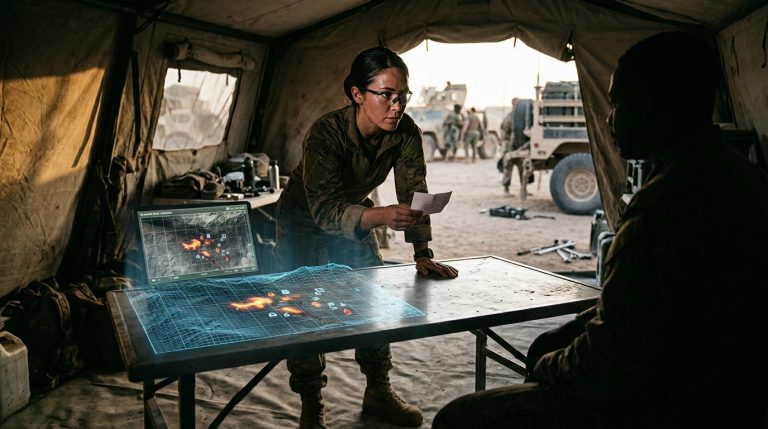
A Symphony of Resilience: How One Quiet Soul Repaired the Fractured Echoes of a Broken City
CHAPTER 1: THE CLICK AND THE ECHO
The Houston heat did not negotiate. It pressed against the skin like a warm, damp wool blanket, heavy and suffocating. Ava Morgan adjusted the strap of her olive duffel bag, feeling the familiar bite of the canvas against her shoulder. Beneath her worn denim, the matte black surface of her prosthetic leg felt cold despite the midday furnace, a stark, functional reality that contrasted with the sweating, breathing world around her.
She moved with a cadence that had become her own private language—a rhythmic click-step, click-step that kept time with the distant thrum of the city’s construction cranes. To the passersby on the cracked East Side sidewalk, it was a sound of imbalance, a jarring discord in the morning bustle. To Ava, it was the sound of persistence.
She kept her gaze fixed three paces ahead, watching the way the sunlight caught the frayed edges of the concrete. She didn’t look at the eyes that flickered toward her leg and then skittered away in a mixture of confusion and shallow pity. She had learned long ago that people were uncomfortable with what they couldn’t categorize, and she had no interest in helping them fill in the blanks.
Her destination, the VA medical center, loomed a few blocks away, a fortress of bureaucracy and sterile corridors. She reached into the collar of her shirt, her fingers brushing the cool, familiar metal of her dog tags. They were warm from her skin, a tether to a life that felt increasingly like a fading polaroid left too long in the sun.
As she passed the chain-link fence of the primary construction site, the air grew thick with the metallic scent of diesel and dry earth. A surge of laughter erupted from the scaffolding above—sharp, juvenile, and designed to carry.
“Hey, sweetheart! Wrong turn to the welfare office!”
Ava didn’t break her stride. She felt the vibration of their amusement as clearly as the heat radiating from the brick walls, but she refused to acknowledge it. She merely focused on the click of her step, the deliberate forward motion that kept her from looking back. Inside her chest, the memory of mortar shells and the taste of sulfur tried to surface, uninvited, but she tamped it down with the same discipline that had once saved lives.
She was ten paces past the gate when a secondary noise caught her attention—not the jeers, but the rhythmic idling of a heavy engine. Tucked into the deep shade of a sycamore tree sat a black Chevy Suburban. It didn’t belong to the construction site. It sat perfectly still, its windows tinted to a dark, impenetrable charcoal. Someone inside was watching the scene with the cold, absolute stillness of a predator waiting for the right breeze.
Ava slowed, just for a heartbeat, her brow furrowing. The air suddenly felt thinner, charged with an invisible pressure that had nothing to do with the summer humidity. As she turned the corner, the sensation of being observed didn’t fade; it intensified, a low-frequency hum vibrating against the back of her neck.
She was just about to board the bus when she heard a voice from behind—not the foreman’s jeering tone, but a low, steady command that seemed to draw the very heat out of the air.
“Sergeant.”
Ava froze, her hand hovering over the bus door. It wasn’t the title that stopped her; it was the cadence of the word, heavy with a respect she hadn’t heard in years. She turned, and the world seemed to narrow to a single, impossible point.
CHAPTER 2: THE SCAFFOLDING SPECTACLE
The man standing before her didn’t look like a savior. He looked like an anchor. He was tall, wearing dark slacks and a tactical-weave polo that stretched across broad shoulders, his salt-and-pepper hair cut with the aggressive precision of a man who still lived by a clock. But it was his eyes that pulled the ground from under Ava’s feet. They were steady, flat, and entirely devoid of the flicker of judgment she had grown so tired of fielding.
He held his position with the ease of a statue, ignoring the heavy, humid heat of the Houston afternoon. Behind him, the six other men fanned out, creating a perimeter that felt more like a protective screen than a blockade. They didn’t move toward the construction site; they moved toward the periphery, creating a vacuum of silence that began to swallow the noise of the power tools.
Ava’s hand remained frozen near her bag, her knuckles white. Her instincts, honed in the chaotic, dust-choked intersections of Fallujah, were screaming. This was a tactical maneuver—a calculated display of force meant to shift the center of gravity. Her mind immediately began to search for the threat. Was this a return of the past? Had the war finally caught up to her, not in a memory, but in flesh and steel?
“Sergeant,” the man repeated, his voice lower now, stripped of all theatrics. He took one step forward, then stopped, leaving a respectful distance. “My name is Logan Beck. I believe we served in the same theater, though our paths didn’t cross until today.”
Ava felt the cold logic of her prosthetic biting into her shin, a grounding pain that helped her steady her breath. She didn’t look at the other men, even though she felt their eyes scanning the area with professional indifference. She looked only at Beck. “You’re a long way from a base, Mr. Beck,” she said, her voice sounding raspy, unused to the social performance of a conversation. “And you have a lot of men for a simple greeting.”
“It’s not a greeting, Sergeant. It’s an intervention.”
The shift in the atmosphere was instantaneous. From the scaffolding above, the laughter had not just stopped; it had disintegrated. Rick Tanner, the foreman, was descending the ladder with a clumsy, panicked haste that made the structure groan. He was still wearing his sweat-stained cap, but his face had lost its ruddy confidence, turning a sickly, washed-out shade of grey.
Ava didn’t look up at the workers. She kept her focus on Beck, her heart rate finally beginning to normalize, though the suspicion remained, sharp as a razor. “You’re making a scene,” she said, her voice dropping to a whisper. “I don’t want a scene. I just want to catch the bus.”
“The bus is irrelevant,” Beck said, gesturing vaguely toward the site. “What matters is that you shouldn’t have to navigate a world that doesn’t recognize you. I’m here to change the friction.”
Ava felt a sudden, sharp pang of something she hadn’t anticipated—a fleeting, phantom-like feeling that her own perception was betraying her. She looked at the polished SUVs, the perfect formation of the men, and for a split second, she wondered if she was really standing on a sidewalk in East Houston or if she had drifted back into the delirium of the hospital, where the faces of her brothers-in-arms would appear out of the static to pull her from the wreckage.
She blinked, hard. The smell of diesel was real. The heat was real. But the way Beck stood, radiating a calm that made the world seem to stop spinning, felt like a hallucination. Was she losing her grip? Was this a manifestation of her own desperate need for someone to acknowledge the weight she had been carrying alone?
“I don’t need a change,” Ava said, her voice firmer, though her hand trembled slightly. “I need you to move your vehicles. You’re blocking the flow of traffic.”
Beck smiled, a small, sad movement of his mouth. “The flow is already broken, Sergeant. I’m just here to clean up the debris.”
He didn’t move. Instead, he signaled to the man nearest to him. Without a word, the man walked toward the gate, not with a weapon drawn, but with a clipboard and a calm, bureaucratic authority that felt more dangerous than any gun. The construction workers clustered near the scaffolding seemed to shrink, their neon vests suddenly looking like paper armor against the stark, black-clad reality of the men who had just arrived.
Ava felt the weight of her duffel bag again. It contained nothing but the remnants of her service—medications, a notebook, and the cap she couldn’t bring herself to wear. She watched as Beck turned his back to her, an act of trust that defied everything her training had taught her about safety. He was positioning himself between her and the source of the humiliation, effectively turning the construction site into the target of his own unwavering, focused attention.
The silence grew heavy, pressing against her ears like deep water. She stood in the center of a storm she hadn’t created, watching as the people who had mocked her leg, her gait, and her existence began to look everywhere except at the man named Logan Beck. The dynamic had flipped; the predator had become the observer. Ava realized then that the silence wasn’t just a lull—it was the beginning of an accounting.
CHAPTER 3: THE SUBURBAN SHADOW
Ava did not look back. She couldn’t afford to. The click-step of her prosthetic against the pavement felt unnervingly loud in the vacuum of noise Logan Beck had created. Behind her, the air felt thick, charged with the residual electricity of the confrontation. She could feel the stares of the construction crew—those who had mocked her minutes ago were now hovering on the periphery, unsure if they were witnessing a rescue, a shakedown, or a shift in the local ecosystem.
She reached the intersection, the heat of the afternoon sun reflecting off the hoods of parked cars in shimmering, distorted waves. A stray piece of paper, dry and brittle, skittered across the road, catching on the curb near her foot. It was a mundane detail, but it snagged on her mind with irrational persistence, pulling her back. The way the paper danced in the wind reminded her of a map she had once clutched in a dark, smoke-filled stairwell in Fallujah—a map that had been stained by sweat and grit, the edges frayed until the street names were illegible.
She stopped at the corner, her breathing controlled, steady. The scent of the city—hot asphalt, exhaust, and the faint, sweet tang of blooming jasmine from a nearby residential patch—was a jarring contrast to the metallic, sterile memory that suddenly invaded her thoughts. In the phantom space of her mind, the jasmine turned to the acrid smell of burning rubber and ozone. She could hear the radio chatter, the frantic, rhythmic calls for support that had been drowned out by the roar of the IED.
She tightened her grip on her duffel bag. The strap dug into her shoulder, a physical reminder of the present. She was not in the fire. She was in Houston. She was heading to the clinic.
A shadow fell across her path, long and distinct. She didn’t flinch. She knew, even before the soft thud of boots on the asphalt behind her, that it was Beck.
“You’re walking too fast, Sergeant,” he said, his voice level, respectful, and entirely devoid of the cadence of an intrusion.
Ava kept moving, though she allowed her pace to slacken just enough to acknowledge his presence. “I have an appointment. And I don’t work for you, Mr. Beck. I don’t know what you think you’re doing back there, but you’re making a mess of a quiet life.”
“Is that what this is?” Beck walked beside her, his stride perfectly synchronized with hers. He didn’t look at her; he looked ahead at the path, his hands resting naturally at his sides. “A quiet life? It looked like a siege from where I was sitting.”
“It was noise,” Ava countered. “Just noise.”
“It was mockery,” he corrected gently. “There’s a difference.”
They walked in silence for half a block. The neighborhood shifted from the industrial sprawl of the construction site to the frayed edges of a strip mall. Weeds pushed through the cracks in the parking lot; a sign for a laundromat hung crooked, the ‘L’ and ‘A’ flickering with a dying neon hum. The faded textures of the world—chipped paint, oxidized metal, the sun-bleached facades of storefronts—were comforting. They felt honest in a way the polished SUVs had not.
Beck’s presence was a heavy, persistent weight. He was a piece of her past that had detached itself from the timeline and landed, unbidden, in her present. She looked at his hands, then at his reflection in the window of a passing storefront. He was composed, guarded. He didn’t have the restless energy of the men who usually followed her. He had the patience of a man who had waited years for this exact walk.
“Why?” Ava asked, the question slipping out before she could check the impulse. She stopped near the entrance of the clinic, the glass doors reflecting the harsh, bright glare of the afternoon.
Beck stopped as well. He turned toward her, and for the first time, she saw the subtle lines around his eyes—the map of his own survival. He didn’t answer immediately. He looked at the clinic, then back at her.
“I spent six years wondering why I was the one who walked away from that convoy,” he said softly. “I went to every ceremony. I accepted every handshake. But I never felt like I’d finished the job. I left a debt behind in the sand, Ava. And I’ve been looking for the right way to settle the interest.”
The air between them felt thin. The revelation wasn’t a bomb; it was a quiet, suffocating truth that settled over them both. He wasn’t a savior; he was a man struggling with the same ghost she carried. He wasn’t trying to fix her; he was trying to fix the narrative of his own survival.
Ava felt the duffel bag’s weight against her side. She wanted to tell him that the debt didn’t exist, that she had made her choice in the dark because it was the only one that made sense. But looking at him, she saw that the debt wasn’t hers to forgive.
“You can’t settle that kind of interest,” she said, her voice dropping into the quiet, hollow space they had created.
“Maybe not,” Beck replied, his gaze unwavering. “But I can stop watching people treat the ledger like a joke.”
He nodded toward the clinic doors, his expression shifting into something professional and distant. “Go to your appointment, Sergeant. I’ll be here when you come out.”
Ava watched him walk back toward the idling black SUV. He moved with a heavy, deliberate grace, his shadow stretching out across the parking lot. She stood at the threshold of the clinic, the glass reflecting the world back at her—the frayed, sun-drenched, broken world she was trying to inhabit—and realized that the quiet life she had spent years building was already gone. The echo of what she had done in the sand had finally caught up with her, and it sounded exactly like the click-step of a soldier who had refused to be forgotten.
CHAPTER 4: THE CONFRONTATION
Ava paused on the clinic’s concrete apron, the cool, sterile air of the waiting room still clinging to her skin. Her appointment had been a blur of routine questions and mechanical adjustments—the usual dance of maintenance. But for the first time in years, the clinical hum had felt wrong. It lacked the intensity of the world she had just stepped into.
She watched the Suburban. It was idling, the dark glass hiding whatever activity transpired inside. She could walk away, turn toward the bus stop, and lose herself in the transit grid, but the presence of the vehicle was an anchor. It demanded acknowledgment. She adjusted the strap of her bag and walked toward it, her click-step rhythmic and steady against the gravel.
As she neared the driver’s side, the door opened. Logan Beck stepped out, his movement fluid, devoid of the jagged urgency she had seen on the construction site. He stood by the door, waiting, his expression unreadable.
“The appointment went well, I hope?” he asked. His voice was casual, almost neighborly, which only made the unease in Ava’s chest deepen.
“It’s maintenance,” Ava replied, stopping a few feet from him. She felt exposed in the open parking lot, the midday sun baking the asphalt. “Nothing more. You shouldn’t have waited.”
“I told you I would be here,” Beck said. He reached into the back seat and retrieved a heavy, thermos-style bottle, offering it to her. “It’s cold water. The humidity out here is a physical tax.”
Ava hesitated, then took the bottle. The condensation felt cool against her palm, a stark contrast to the stifling heat. She took a slow sip, keeping her eyes on him. He was patient—that was the word for him. He was a man who understood the geometry of long-term planning, the quiet strategy of waiting for the right moment.
“You’re not doing this because of a debt, are you?” Ava said, her voice quiet. “This is too much effort for a ‘thank you’ that happened years ago.”
Beck leaned back against the hood of the SUV. He looked out toward the horizon, past the strip mall, toward the shimmering haze of the city skyline. “What we did back there, Ava—the way we functioned as a unit—it’s a rare currency. When I saw you being mocked, when I saw those men treating your service like a punchline, I didn’t see a stranger. I saw a piece of my own foundation being chipped away. If you’re broken, then the things I believe in—honor, sacrifice, the code—are broken too.”
He turned his gaze back to her, and for the first time, the distance in his eyes evaporated. “I’m not here to save you. I’m here to make sure that the world knows exactly what it’s looking at when it sees you.”
Ava felt the weight of the water bottle in her hand. It was such a small thing, yet it felt like a heavy, significant object. She thought of the construction site, the way the silence had descended when Beck and his team arrived. It hadn’t been an act of violence; it had been an act of remembrance. He had forced a mirror onto a group of people who had forgotten how to see.
“You changed the trajectory of my life with one morning,” Ava said, her voice low. “People are talking. The foreman is gone. But I’m the one who has to live in the after-image of that day.”
“That’s the cost of transparency,” Beck said. “But look around, Ava. You aren’t hiding in the shadows anymore.”
She did look around. The parking lot was desolate, the edges of the neighborhood fraying into urban decay, yet there was a stillness here that felt different than the lonely quiet she had cultivated for years. It was a silence of observation. She realized then that Beck wasn’t just shadowing her; he was creating a space where she could exist without the need for constant, armor-plated defense.
“Why me?” she pressed, wanting the truth beneath the rhetoric.
Beck looked at her, his expression softening into something almost weary. “Because you were the only one who didn’t look for a reward. And that kind of quiet is the only thing that scares people like Tanner. It’s the only thing that forces them to actually think.”
Ava stared at the black paint of the SUV, the way it mirrored her own image—blurred, distorted, yet undeniably there. She was no longer just a ghost moving through the city. She was a point of focus. She wasn’t sure if she wanted that, but as she looked at Beck, she realized she didn’t have to be. The decision had already been made for her. The silence of her service had been broken, and now, the sound of the aftermath was rising, steady and rhythmic, like the steady click of her own step against the world.
She looked back toward the bus stop, then at the open door of the Suburban. She knew the bus would take her back to the quiet, two-room apartment behind the strip mall, back to the memories that replayed like searchlights in the dark. But for the first time, that apartment felt less like a sanctuary and more like a retreat.
She handed the water bottle back to him, her fingers brushing against his. “I have things I need to finish,” she said.
“I know,” Beck replied, closing the distance between them. “And I’ll be here when you’re ready to finish them.”
Ava turned away, but this time, she didn’t walk with the urgency of someone fleeing a scene. She walked with the deliberate, measured stride of someone who was no longer walking alone. She could feel Beck’s gaze on her, an unwavering anchor, as she headed toward the stop. The world was still broken—the asphalt was still cracked, the heat was still relentless—but the fragments were beginning to form a different shape.
CHAPTER 5: THE SALUTE
Ava moved through the familiar geometry of the East Side with a heightened awareness. The sidewalk was uneven, the concrete scarred by heat-fissures and time, but her focus was locked on the distant silhouette of the construction gate. Something was off. The usual rhythm of the site—the steady, percussive thrum of labor—had been replaced by a tense, vibrating silence.
As she drew closer, the discrepancy became impossible to ignore. A secondary barrier had been erected, not of standard plywood, but of heavy-duty steel fencing. Men in dark, unmarked jackets—not the construction crew, and certainly not Beck’s SEAL team—were positioned at the entrance. They carried an air of calculated coldness, their eyes moving with a predatory efficiency that suggested they were guarding something far more valuable than stacks of lumber and cinder blocks.
Her prosthetic clicked against the asphalt, each step ringing out with a sharp, dissonant note. She didn’t slow down. She had come to see the brick—the small, unassuming tribute to her service—and she would not be turned away by a shift in security.
“Private property,” one of the men said as she reached the gate. He didn’t look at her leg; he looked at her face, his expression masked by a professional neutrality that bordered on the hostile.
Ava stopped, the heat from the site’s machinery radiating against her skin. “I’m not here for the site,” she said, her voice steady. “I’m here for the memorial at the entrance.”
The guard glanced at his partner, a subtle shift in his posture suggesting he knew exactly who she was. “There’s no memorial here, ma’am. Only active construction. Move along.”
Ava’s jaw tightened. She reached into her pocket, her fingers finding the challenge coin Logan Beck had pressed into her hand. The cold metal was a grounding weight. She looked past the guard, her gaze fixed on the exact spot where the brick had been embedded—the spot where the company had etched her name as a promise of respect.
It was gone. The ground had been dug up, a jagged, raw trench filled with fresh, dark earth.
“Where is it?” she asked, her voice dropping to a low, dangerous pitch.
“I don’t know what you’re talking about,” the guard replied, though he shifted his weight, his eyes momentarily darting toward the trench.
Ava didn’t need him to answer. The physical reality of the situation hit her with the force of a blow. The apology, the public shift in atmosphere, the entire narrative of respect—it was a decoy. The company hadn’t changed; they had simply waited for the media cycle to turn, for the eyes of the public to wander elsewhere, so they could systematically erase the evidence of their own moral failure. They were cleaning the slate, and she was the last ghost they needed to exorcise.
She felt a surge of cold fury, not the impulsive heat of a flare-up, but the icy, calculated resolve of a soldier evaluating a new tactical reality. The “Respect in the Trades” movement, the field trips, the speeches—it had all been a distraction to keep the public from looking too closely at the structural rot of the company’s ethics.
She turned away, not in defeat, but in acknowledgment. She walked back toward the strip mall, her mind racing. She needed Beck. Not because he was her protector, but because he was the only one who understood the physics of this specific battlefield.
She pulled out her phone. Her thumb hovered over his number, then she stopped. If she called him, she was admitting that she couldn’t handle this on her own. She was confirming the narrative that she was someone who needed to be shielded. She looked at the challenge coin in her hand, the engraved trident catching the fading afternoon light.
Honor is not a gift. It is an action.
She didn’t call him. Instead, she turned toward the public library, a few blocks away. She knew where to find the records, the permits, and the environmental reports that would detail exactly who owned that trench and why they were so terrified of a single, humble brick. If they wanted to bury her service under a layer of fresh dirt, they were going to find out that she knew exactly how to dig.
The air around her seemed to grow heavier, more oppressive, yet she felt a sense of clarity she hadn’t possessed in years. The decoy had been shattered, and in its place was the cold, hard, unyielding truth of the conflict. She wasn’t just a veteran anymore; she was an investigator, a ghost who had refused to stay quiet, and she had every intention of making sure the truth was loud enough to be heard.
She entered the library, the quiet, air-conditioned sanctuary offering a momentary reprieve from the heat. She walked to the reference desk, her prosthetic moving with a purposeful, rhythmic beat. For the first time, she didn’t feel the weight of her scars as a burden. She felt them as the architecture of her resolve. Every step was a calculation, every movement a piece of a larger, necessary confrontation. The reckoning wasn’t just coming—she was the one bringing it.
CHAPTER 6: THE RIPPLE EFFECT
Ava’s fingers hovered over the keyboard. The cursor blinked, a rhythmic, taunting pulse against the dark void of the screen. She had spent the last hour navigating the city’s digital archive, expecting to find nothing more than standard demolition permits. Instead, she had hit a wall of redacted data that shouldn’t have existed for a private construction project.
The click of her prosthetic against the carpeted floor as she shifted her weight was the only sound in the nearly empty library. The air smelled of old paper and dust, a quiet, stationary environment that felt increasingly alien compared to the tactical tension of the last few days. She leaned back, staring at the screen. The site wasn’t just being cleared; it was being scrubbed, every trace of its history—and her own—methodically wiped from the municipal database.
She thought of Beck. He had warned her about the friction of the world, but he hadn’t prepared her for the sheer, surgical precision with which they were operating. If they were going to this much trouble to hide a plot of land, it wasn’t just about the brick. The brick had been a symbol, yes, but it had also been an obstacle.
She stood up, the movement fluid, though her hip ached with the dull, thrumming pain of a long day. She left the terminal, ignoring the librarian’s tired glance, and walked toward the exit. The late afternoon light was casting long, amber shadows across the parking lot. She needed a different kind of intel—the kind that couldn’t be scrubbed from a server.
She walked out into the heat, the humidity rising from the pavement like steam. She didn’t head for the bus stop. Instead, she walked to a nearby payphone—a relic of an older city—and dialed a number she hadn’t touched in a decade. It was the private line of a local journalist, a woman named Sarah who had covered the post-war veteran struggle with an honesty that most outlets had long since abandoned.
“Sarah. It’s Ava Morgan.”
There was a brief, stunned silence on the other end, then the sound of rapid typing. “Ava? I thought you’d moved off the grid. What’s going on?”
“The site,” Ava said, her voice dropping into a low, transactional cadence. “The East Side construction project. They’ve gone dark. They’ve scrubbed the permits and they’re moving people off the site. I think the memorial brick was just a cover for something they didn’t want anyone to see.”
“A cover?” Sarah asked, her tone shifting to professional sharp. “Ava, the public thinks that site is a shrine to your service. If they’re moving on it, there’s a massive amount of political pressure involved. What are you seeing?”
“A trench,” Ava said. “They aren’t building a complex. They’re burying the site’s history. Check the original environmental impact surveys from three months ago. I bet they’ve been replaced.”
“I’ll look,” Sarah said. “But be careful. If they’re scrubbing data this fast, they have eyes everywhere.”
Ava hung up. She stepped away from the phone booth and stood for a moment, letting the noise of the city wash over her. The click of her step seemed louder now, a defiance against the silence they were trying to impose. She felt the weight of the challenge coin in her pocket again—the weight of a debt that was turning into a weapon.
She started walking, not toward home, but toward the site. She needed to see what they were hiding before the sun went down. She felt exposed, a single point of resistance against an unseen, bureaucratic juggernaut, but for the first time, she didn’t feel like a victim of circumstance. She was an observer, and she had the advantage of knowing exactly what they were trying to suppress.
As she moved through the neighborhood, the textures of the city took on new meaning. The fraying edges of the storefronts, the rusted iron of the streetlamps, the crumbling brickwork of the old tenements—everything was a clue, a piece of a larger, broken puzzle. They wanted to erase the past, but the city’s history was too stubborn, too heavily layered to be completely wiped clean.
She reached the perimeter of the site as the dusk began to bleed into the sky. The security guards were still there, their dark jackets like bruises against the twilight. She found a vantage point behind a stack of rusted shipping containers, the metal cool and rough against her back. She watched them, her eyes tracing their movements, their rotations, the way they checked the perimeter every fifteen minutes.
They were expecting someone. They weren’t just guarding the site; they were waiting for a reaction. She realized with a cold, clear clarity that her arrival had been anticipated. They wanted her to come back. They wanted to see if she had the strength to keep digging, or if she would break under the pressure of their shadow.
She felt the old discipline rising, the cold, steady focus of a soldier in a kill zone. She wouldn’t give them a reaction. She would give them a problem. She shifted her weight, the prosthetic leg settling firmly into the dirt. The ripple effect had begun, and she was no longer just the pebble in the water—she was the one who had thrown it.
CHAPTER 7: THE CLASSROOM BRIDGE
The realization didn’t come in a flash of inspiration; it arrived in the slow, agonizing crunch of data. Ava sat in the dim corner of the library, the glow of the screen illuminating the harsh lines of her face. She had crossed-referenced the demolition permits with historical land-use documents, and the pattern was undeniable. The construction company wasn’t just building a site; they were reclaiming, foot by foot, the exact perimeter where the initial convoy had been intercepted.
The click of her prosthetic against the metal leg of the chair sounded like a gunshot in the quiet room. She stood, the paper trail in her hands feeling heavy. This wasn’t about the brick. It was about erasure. The company wasn’t just trying to bury her; they were trying to bury the entire event, to sanitize a landscape where a massive, corporate-backed logistics deal had gone sideways long before the IED had ever been planted.
She walked out into the cooling air of the evening, the city lights beginning to flicker like dying embers in the distance. She needed to reach the students. The invitation to Roosevelt High—the one she had been hesitant to accept—now felt like the only platform she had left. If she couldn’t fight them in the courts or the permits, she would fight them in the truth.
She caught the bus, the ride a surreal blur of cityscapes and shifting neon. Her mind remained trapped in the trench, the image of that raw, dark earth filling her thoughts. They thought they could scrub the past, but they had underestimated the stubbornness of the people who had lived it.
When she arrived at the high school, the auditorium was already buzzing with the low, restless energy of five hundred teenagers. She walked backstage, her heart hammering a slow, steady rhythm against her ribs. She was wearing the faded Marine cap now, its brim creased, its fabric soft from years of friction. It felt like a piece of armor.
She stood behind the velvet curtain, watching the stage lights. Through a gap, she saw a familiar figure standing near the front row: Logan Beck. He was dressed in a suit that looked slightly too stiff on his frame, his eyes scanning the room with the same tactical focus he had used to assess the construction site. He wasn’t watching the students. He was watching the back entrances.
He saw her. For a heartbeat, the tactical mask slipped, and he nodded—a sharp, almost imperceptible tilt of his head. He knew what she had found. He had known all along, hadn’t he? The realization shifted the ground beneath her. Beck wasn’t just a brother-in-arms; he was a participant in the same, messy history.
She pushed the curtain aside and stepped into the light. The microphone felt cool and solid under her fingers. The audience didn’t clap; they quieted, a wave of silence that washed over the auditorium with the weight of a physical force.
“I was told to come here and talk about honor,” Ava began, her voice steady, carrying into the back corners of the room. “But honor isn’t a speech. It’s not a monument. It’s the ability to look at a hole in the ground and refuse to let the people who dug it tell you what was there.”
She looked directly at Beck. His face was a study in absolute stillness. She began to speak, not the practiced lines of a hero, but the raw, unfiltered truth of the convoy, the logistics deal that hadn’t been on the official reports, and the way the company had tried to bury the evidence of their involvement. She didn’t name names—she didn’t have to—but the implication was clear.
As she spoke, the atmosphere in the room shifted. It wasn’t the silence of polite listening; it was the sharp, dangerous silence of realization. Students were leaning forward, their phones already out, their expressions hardening. She was weaving a narrative that would outlast any trench, any permit, and any corporate scrub.
She saw a man in a dark jacket stand up near the back of the auditorium, his hand moving toward his ear, but before he could move, a group of student volunteers—kids she’d met earlier in the prep room—blocked his path. The power had shifted. The truth wasn’t just hers anymore; it was theirs.
She reached the end of her speech, the air in the room vibrating with a renewed, collective resolve. She didn’t end with a flourish. She ended with a challenge. “They can dig as deep as they want,” she said, her voice ringing out, “but the ground remembers.”
As she stepped off the stage, the applause wasn’t a roar—it was a steady, rhythmic beating of hands against desktops, a sound that mimicked the click of her step. It was the sound of a city waking up. She moved through the wings, Beck waiting for her in the shadows. He didn’t say a word. He just held the door open, a silent recognition that the war had moved from the sand to the streets, and for the first time, the odds were beginning to tilt.
CHAPTER 8: THE NATIONAL STAGE
The transition was jarring. From the roar of the high school auditorium, Ava moved into the hushed, pressurized atmosphere of the Washington D.C. conference center. She had come here not to speak, but to finish what she had started on the East Side. She wore the same blouse, the same cap, and the same quiet resolve. The prosthetic under her skirt felt like a part of her, a structural component of her own history that she no longer felt the need to mask.
Logan Beck was there, standing near the registration desk. He looked different in the sterile light of the lobby—less the tactical guardian, more the man who had been shattered alongside her in Fallujah. He didn’t approach her with the practiced ease of his team. He walked toward her with a slight, hesitant limp, his gaze fixed on her with a raw, terrifying honesty.
“They’re waiting, Ava,” he said, his voice quiet. He didn’t offer a salute. He simply nodded toward the grand entrance of the main auditorium. “The board, the contractors, the ones who signed the land-grabs. They’re all inside, expecting a standard speech.”
“They’re expecting a victim,” Ava corrected.
She walked past him, the click-step of her prosthetic echoing against the marble floor. It was a rhythmic, final sound. She knew what was inside—the power brokers, the men in suits who had treated her life like a line item in a ledger. They thought they had buried the evidence of the convoy’s real purpose, but they had forgotten that survivors carry the map, even when the terrain is razed.
As she stepped into the auditorium, the lights were dimmed to a soft, professional amber. Rows of chairs were filled with veterans, their faces a mosaic of scars and stories. But in the front row, the corporate contingent sat like a wall of dark, tailored wool. They didn’t look at her; they looked at the podium, their expressions masks of rehearsed civility.
Ava climbed the steps. She didn’t use the teleprompter. She didn’t look at the notes she had carried in her duffel. She stepped to the microphone, the silence in the room thickening until it felt as solid as lead.
“I was a sergeant,” she began, her voice not projecting, but filling the room with the weight of absolute truth. “But before that, I was a girl from a farm that was tired of being forgotten. I learned a long time ago that you can bury anything in the dirt—old equipment, old promises, old people. You can dig trenches to hide the fact that you were never looking for medical supplies, but for a supply line that made you millions while my squad bled out in the sand.”
A murmur rippled through the corporate row. The man in the center—the CEO whose signature had been on every redacted permit—stiffened, his face losing its practiced calm.
“You think this is about a brick?” Ava continued, her voice rising, not in anger, but in the cold, clear articulation of justice. “You think if you pave over the ground, the truth stops existing? I’m not here to talk about medals. I’m here because Logan Beck, and the three men who didn’t walk out of that humvee, deserve to have the record corrected.”
She reached into her bag and pulled out a stack of physical files—the environmental surveys, the original logistics logs she had unearthed in the library. She didn’t hand them to the board. She let them slide off the podium, the papers fluttering down onto the front row like a sudden, white storm.
The CEO stood, his face flushing, his composure shattering. He opened his mouth to speak, to deny, but he had no counter-move. He was facing a woman who had run through fire for nothing more than the principle of the thing, and he was completely, utterly unequipped for that kind of resolve. He tried to gesture for his security, but they were standing still, watching the room, watching the veterans who were slowly, silently standing up behind him.
He was defeated by the very thing he had tried to erase: the inconvenient, persistent existence of the people he had used as leverage. He turned and stumbled toward the side exit, his entourage trailing behind him, their posture slumped, their authority vanishing as the room’s eyes followed them.
Ava stood at the podium as the door clicked shut behind them. The silence that followed was different—it was the quiet of a storm that had passed, leaving the air clean and cold. She looked down at the front row. The empty seats felt like a victory.
She stepped down, her prosthetic making the soft, steady sound that had carried her through everything. She didn’t look back at the podium. She walked toward the center aisle, where Logan Beck was waiting.
“It’s done,” he said. He looked older, tired, but the weight that had been on his shoulders—the debt he had been trying to pay—seemed to have shifted.
“It’s just beginning,” Ava replied. She reached into her pocket and took out the challenge coin, placing it into his hand. “You don’t owe me anything, Logan. We were just doing what had to be done.”
They walked out of the auditorium together, moving through the lobby and out into the cooling D.C. night. The city was vast, complex, and still broken, but for the first time, Ava didn’t feel the need to hide in the fraying edges of it.
The next morning, Ava returned to the apartment. It was quiet—the same two rooms, the same ticking clock—but she didn’t sit by the window to watch the headlights. She took her tools out from the duffel bag—a simple, worn kit of repair supplies. She had a fence line to fix, a physical object that needed mending. She worked slowly, the rhythm of the work steadying her breath.
When she was finished, the fence stood straight and solid. She leaned against it, the sun warming her back, the scent of fresh air filling her lungs. The war was over. The records were set. She wasn’t a symbol anymore, or a ghost, or a hero. She was just Ava, and for the first time in her life, the silence wasn’t a void to be filled—it was a space where she could finally, completely breathe. She walked back into the apartment, the door clicking shut behind her, the sound a final, satisfying note in a long and necessary song.