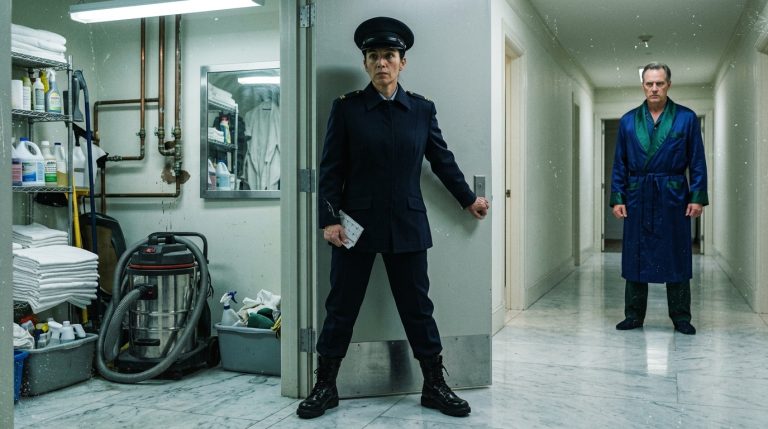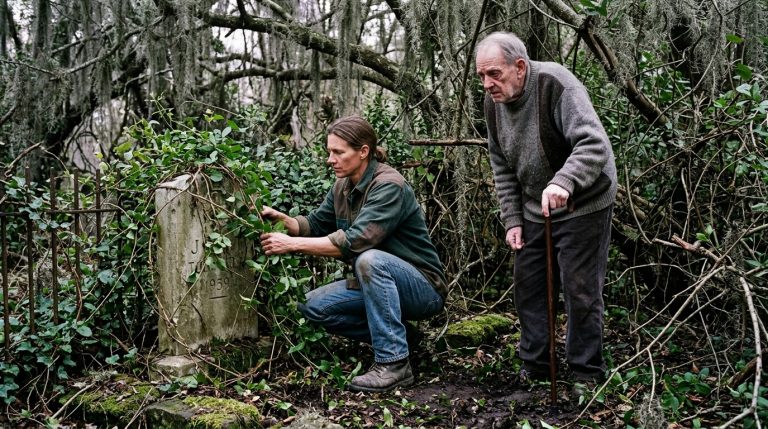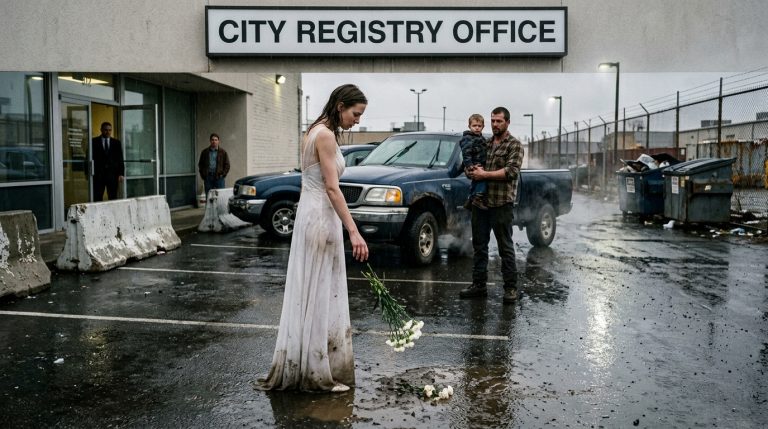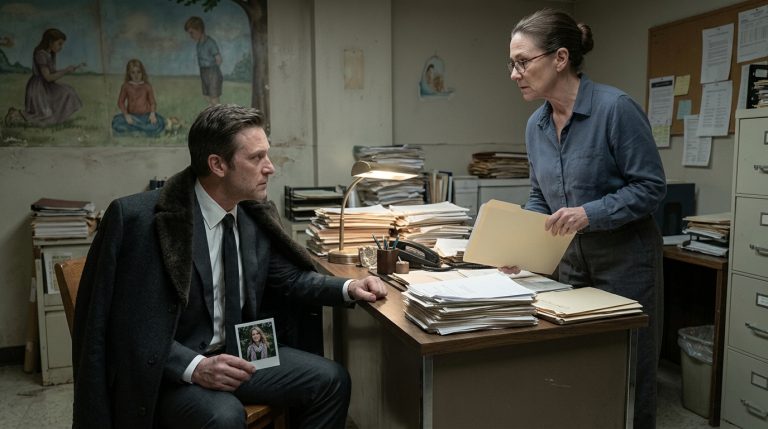
A Fragile Equilibrium: Finding Resonance Between the Cold Glass Towers and a Single-Father’s Warm Kitchen
CHAPTER 1: The Weight of Sunlight
The silence in the kitchen was not empty; it was heavy, saturated with the smell of scorched flour and the lingering, fragile ghost of last night’s laughter. Daniel watched the way the morning light caught the fraying hem of the apron Ava still wore, a small, worn detail that felt impossibly precious. His daughter, Lily, was tucked into the corner, humming a melody she had picked up from school, completely unaware that the world outside their door had fundamentally shifted with those three sharp knocks last night.
Daniel kept his gaze on the chipped rim of his coffee mug. He could still feel the phantom pressure of William Beaumont’s presence in the room, a cold draft that seemed to have settled into the cracks of the baseboards. He had spent his life becoming an expert at building walls, at ensuring that his small, quiet orbit remained untouched by the jagged, erratic gravity of the city’s elite. And yet, there they were: the lingering traces of a billionaire’s regret on his floor, a business card resting on the scarred wood of the table like a lead weight.
He looked at Ava. She was moving with a tentative grace, her shoulders hunched as if expecting a sudden, jarring noise to shatter the room. She was drying a plate, her fingers tracing the faded floral pattern as if it were a map. She looked up and caught him watching, and for a fleeting second, the practiced mask she wore—the one that whispered of distance and survival—slipped.
“You’re thinking about him,” she said, her voice barely a breath above the sound of the rain starting to tap against the glass again. It wasn’t a question.
Daniel didn’t lie. He didn’t have the energy for it. “I’m thinking about what happens when the dust settles, Ava.”
She stopped moving. Her gaze dropped to the pocket of her coat, which she had hung on the back of a kitchen chair. A corner of an envelope was peeking out—not the business card William had given him, but something older, stained with the gray grime of the street, a detail he hadn’t noticed until the light shifted just so. His heart stuttered. It looked like a photograph, the paper soft and yellowed at the edges. Before he could ask, a sudden, sharp rap at the door—not the commanding thunder of the night before, but a soft, rhythmic tap—froze them both in place.
Lily stopped humming. The air in the room didn’t just grow still; it seemed to hold its breath, waiting for the next tremor to arrive.
CHAPTER 2: The Echo of a Knock
Daniel’s hand hovered, palm-flat, against the cold wood of the front door. The knocking had ceased, replaced by a silence so absolute it seemed to ring in his ears. Beside him, he could feel Ava’s presence—she was no longer moving with the quiet grace of a guest; she had become a statue, her breath hitched, her fingers digging into the fabric of her coat until her knuckles turned the color of bone.
He didn’t open the door. Not yet. He glanced back toward the kitchen where Lily was still sitting, her small hands resting in her lap, her eyes wide and fixed on the hallway. The sight hit him with a jarring clarity: this wasn’t just a visitor. This was a breach. The security he had painstakingly built, the walls he had erected against the erratic, high-velocity world of people like William Beaumont, had become porous.
A memory, unbidden and sharp as a shard of glass, surfaced. He saw his own mother—years ago, a different house, a similar frantic tapping at a door in the middle of the night—and the way she had looked at him, not with fear, but with a resigned, weary recognition. The sensation made his chest ache, a phantom weight that connected him to Ava in a way that had nothing to do with her circumstances and everything to do with a shared, ancestral kind of fragility.
He turned the deadbolt. It clicked, a dry, metallic sound that echoed down the hallway of the small apartment building.
The door swung inward.
It wasn’t the billionaire. It was a woman, standing alone in the hallway, framed by the dim, flickering light of the corridor. She wore a wool coat that looked like it had been tailored for someone moving through arctic winters, and her hair was pulled back with a severity that seemed to match the sharpness of her features. She looked at Daniel, her eyes scanning his face with a clinical, detached efficiency before shifting toward Ava.
“I expected you’d be here,” the woman said. Her voice was flat, devoid of the warmth one might expect from a mother or a family friend, yet there was a deep, resonating exhaustion beneath the polish.
Ava took a step back, her back hitting the edge of the kitchen counter. “Mother.”
The word hung in the air, stripped of any affection. Daniel felt a ripple of defensive instinct course through him. He moved, shifting his weight to create a physical barrier between the visitor and his daughter, his eyes narrowing. He had expected wealth, perhaps even intimidation, but this—this felt like something colder. This felt like an extraction.
“We aren’t interested in a scene,” the woman continued, ignoring Daniel’s presence entirely. She didn’t look at the peeling paint or the water stains; she looked only at Ava, her gaze pinning the younger woman to the spot. “William is outside. He’s already made enough of a spectacle of himself. I am here to finish the conversation that you so abruptly walked away from six months ago.”
Daniel found his voice, though it felt heavy, coated in the dust of his own apprehension. “This is a private home, ma’am. If you’re here to talk, you can do it without the intimidation.”
The woman finally turned her gaze to him. It was a look that didn’t see a man, but an obstacle—a piece of furniture that had suddenly gained the power of speech. “A home,” she repeated, the word carrying a weight of bemused disdain. She stepped across the threshold, not waiting for an invitation. Her presence shifted the texture of the room; the air suddenly felt tighter, the smells of tomato soup and laundry detergent replaced by the sterile, expensive scent of pressed linens and imported perfume. “You have played your part, Mr. Carter. You have provided the ‘safe place.’ But the theater of this situation has reached its natural conclusion.”
Ava’s shoulders slumped, the last vestige of her defensive posture dissolving into a hollow, defeated sort of grace. She looked toward Lily, then at Daniel, her eyes filled with an apology she couldn’t bring herself to voice.
“I’m not going back,” Ava said, her voice small but steady, vibrating with the effort it took to hold her ground.
The woman didn’t blink. She reached into her handbag and pulled out a small, leather-bound notebook, flipping it open to a marked page. “You aren’t being asked, Ava. You are being informed.”
Daniel realized then that the conflict wasn’t about whether Ava would leave; it was about what she would take with her, and what she would be forced to leave behind. He looked at the notebook, then at the way the woman’s hands moved—precise, practiced, and utterly devoid of hesitation. He realized he was standing at the edge of a precipice, and the only thing tethering him to the life he had built for Lily was the stubborn, quiet conviction that kindness was not a commodity to be traded for stability.
“The conversation,” Daniel said, his voice dropping into the steady, low register he used when he was negotiating a difficult delivery, “starts when you tell me what you’re actually looking for. And it happens on my terms.”
The woman paused, her pen hovering over the notebook. For the first time, a flicker of genuine irritation crossed her face. She looked at Daniel, really looked at him, and he saw the gears turning behind her eyes, measuring the cost of a fight versus the benefit of a clean exit.
CHAPTER 3: The Unspoken Accord
The woman’s gaze lingered on Daniel for a heartbeat too long. She didn’t blink. It was the look of a predator who had just realized the prey was not only armed but capable of calculating the trajectory of her next move. Outside, the rain continued its rhythmic assault on the glass, a chaotic backdrop to the surgical precision of the standoff inside the apartment.
“Terms,” she repeated, the word sounding foreign and vaguely distasteful on her tongue, as if it were a cheap trinket she had found in a gutter. “Mr. Carter, you are operating under the delusion that this is a negotiation. It is not. It is a matter of restoration.”
She stepped further into the kitchen. Her presence was an intrusion of sterile order. She adjusted her coat, the heavy wool brushing against the edge of the small, scarred kitchen table where Lily’s school papers—brightly colored drawings of trees and houses—lay scattered. She didn’t look at them, but her avoidance was pointed. She moved to avoid the “clutter” of his life with the same careful, practiced grace one might use to navigate a crime scene.
Ava remained by the counter, her hands balled into fists inside her pockets. “I won’t leave,” she said again, though her voice wavered, losing a fraction of its earlier stability. “And you can’t make me.”
“Can’t I?” The woman reached into her bag again. This time, she didn’t produce a notebook. She pulled out a sleek, thin tablet. She placed it on the kitchen table, the glass screen glowing with a soft, clinical blue light that stood in sharp contrast to the dim, amber warmth of Daniel’s overhead bulb. She swiped a finger across the surface, and a document appeared—dense, formal, and intimidating.
“William is waiting in the vehicle,” she said, her voice dropping to a low, rhythmic monotone. “He has already made arrangements for the… inconveniences your prolonged absence has caused. If you choose to leave now, quietly, without turning this into a public catastrophe, there are provisions. If not, the legal apparatus required to settle this will be… exhaustive. For everyone involved.”
Daniel looked at the screen. He saw legalese that made his head swim—clauses about guardianship, medical history, and liability. He didn’t need to read it to know what it was: a velvet-lined trap. A Golden Cage.
“I didn’t take her because of who she was,” Daniel said, his voice hard, grounding himself in the reality of the previous night—the pancakes, the laughter, the way Lily had felt safe for the first time in years. “I took her because she was standing in the rain.”
The woman looked at him then, and for a fleeting, terrifying moment, the mask slipped. There was no hatred there, no arrogance. Just a profound, hollow exhaustion. She looked like a woman who had spent decades keeping a collapsing structure from falling inward. “And do you think that changes anything? Do you think the rain cares why she was standing there? You are a man who survives on the margins, Mr. Carter. You have no idea what it takes to live in the center of the storm. The pressure alone would crush you in a week.”
“Then let me be crushed,” Daniel replied, stepping between her and Ava. He could feel Ava’s breath against his shoulder. “But she isn’t leaving today.”
The woman’s eyes narrowed. She looked at Daniel’s hands, calloused and stained with the grease of a dozen different engine repairs, and then at the door. “This is not the end of this conversation. William is a patient man, but he is not a soft one. You have until the end of the school day to reconsider. Think of the girl,” she glanced toward the hallway where Lily was hiding, “and the life she deserves. It isn’t found in a kitchen that smells of damp laundry and struggle.”
She turned and left. The sound of her footsteps—sharp, rhythmic, and perfectly spaced—receded down the hallway until the front door clicked shut, leaving a silence that felt heavier than before.
Ava slumped against the counter, her legs finally giving way. She slid down to the floor, burying her face in her hands. Daniel didn’t reach for her. He stayed where he was, his pulse thrumming in his throat. He looked at the tablet still glowing on his table, the blue light reflecting in the grease stains on his worn wooden surface.
He had won the standoff, but the air in the room had shifted. The walls felt thinner now. The sanctuary had been marked. He walked over to the window and pulled back the curtain. Down on the street, the black SUV sat idling, a dark, immovable shape in the driving rain. William wasn’t leaving. He was waiting.
Daniel turned back to the kitchen. He had to figure out what was on the tablet, and more importantly, he had to figure out why Ava was so afraid of what her mother had brought with her. He knelt beside Ava.
“What did she mean?” he asked softly. “About the provisions?”
Ava looked up, her eyes red-rimmed and hollow. She didn’t answer directly. Instead, she reached into her pocket and pulled out the stained, yellowed photograph he had seen earlier. She placed it on the table next to the glowing tablet. It was a picture of a house—a sprawling, imposing structure he recognized instantly from the news. But standing in the foreground, near a fountain he hadn’t noticed before, was a man who looked strikingly like a younger version of himself.
The room went deathly still. The weight of the secret didn’t just land; it collapsed the floor beneath them.
CHAPTER 4: The Internal Siege
Daniel’s world narrowed down to the size of that scrap of paper. He didn’t look up. He didn’t want to see Ava’s face, because if he looked at her, he would have to acknowledge that the ground beneath them had just opened up. The man in the photograph was younger, his hair darker, but the set of the jaw—a stubborn, almost defensive angle—was an echo of Daniel’s own. The house behind him was the Beaumont estate, the very symbol of everything Daniel had spent his entire adult life keeping at a distance.
“Where did you get this?” Daniel’s voice sounded hollow, like it was coming from someone else standing at the far end of the kitchen.
Ava didn’t answer. She was still sitting on the floor, her back against the cabinet, her breath coming in shallow, ragged hitches. Outside, the rain intensified, drumming against the roof with a relentless, percussive force. The apartment’s lights—old, temperamental fixtures he’d meant to replace for three years—flickered violently. For a heartbeat, the kitchen plunged into absolute darkness, save for the faint, clinical blue glow of the tablet still resting on the table. In that sliver of light, the photograph looked like a ghost.
Then, the power kicked back in with a groan of protesting wires. The kitchen light hummed to life, casting long, jittery shadows against the walls.
“My mother left it in my room before I ran,” Ava whispered, her eyes still locked on the tablet as if it were a bomb. “She told me that if I ever felt like I was disappearing, I should look at it. She said it was the only piece of the truth that hadn’t been sanitized.”
Daniel stood up, his legs feeling heavy, uncooperative. He moved to the table, but he didn’t pick up the tablet. He only stared at the photograph. The man in the picture was standing by the fountain—a structure he had seen a thousand times in magazines and news clips, but seeing it here, in this context, felt like a violation.
“Why would your mother have a picture of him?” Daniel asked, his voice tighter now, a strain of something sharp and dangerous edging into his tone. “That’s my father’s face, Ava. I recognize the way he holds his shoulders. I see it in the mirror every single morning.”
“Your father,” Ava echoed, her voice trembling. “Daniel, the Beaumonts don’t just own real estate. They own narratives. They rewrite histories until they’re clean enough to sell.”
The implication hung in the air, stifling the oxygen in the room. Daniel felt a surge of pure, defensive adrenaline. He wasn’t a man who played games; he was a man who worked until his back ached to keep a roof over his daughter’s head. He didn’t want to be part of a legacy. He didn’t want to be a piece in someone else’s chess game. But the photograph was a physical fact, a piece of evidence he couldn’t simply ignore or throw away.
He walked to the window and looked out again. The SUV was still there, a black smudge against the gray wetness of the street. He knew, with a sudden, sinking certainty, that he couldn’t keep this contained. The woman—Ava’s mother—wasn’t coming back just for a conversation. She was coming back to reclaim a narrative that had somehow slipped through her fingers.
“We have to get out of here,” Daniel said, turning back to the room.
Ava stood up, her movements jerky and stiff. “If we leave, they’ll just follow. You know that. They have trackers on everything, Daniel. They have eyes on every road in this county.”
“They don’t have eyes on the back alleys,” Daniel retorted, his pragmatism kicking in, a cold shield against the rising panic. “And they don’t know the city the way I do. I’ve spent two years driving these streets, finding the gaps where the city stops watching.”
He grabbed his coat from the chair, the familiar weight of the canvas cloth a small comfort. He went to the bedroom door and eased it open just a crack. Lily was still asleep, her breathing deep and even, a tiny sanctuary of peace in the middle of a collapsing world. He closed the door softly and turned back to Ava.
“Lily stays out of this,” he said, his voice a low, hard edge of steel. “Whatever is happening between your family and mine, it doesn’t touch her.”
Ava nodded, her expression hardening. She looked at him—really looked at him—and for a moment, the distance between them seemed to vanish. They were two people standing on the same side of a line that had been drawn for them long before they were born.
“What do we do?” she asked.
Daniel looked at the tablet, then at the photograph. He took the photograph and tucked it into his own pocket, feeling the stiff paper against his ribs like a talisman.
“We stop waiting for them to tell us what’s happening,” Daniel said. “We go find the person who took this picture. We find out why the Beaumonts have been keeping my family’s face in their archives for twenty years.”
He moved to the door and checked the lock, his mind already mapping the route, calculating the risks, and measuring the distance between their current safety and the absolute, burning truth.
CHAPTER 5: The Breach
Daniel didn’t look back at the apartment. He didn’t look at the black SUV still idling under the streetlamp, its headlights like the unblinking eyes of a predator. He navigated the back stairwell, his hand gripping the cold, iron railing, his boots making no sound on the grease-slicked concrete. Behind him, Ava moved with a frantic, rhythmic intensity, her breath hitching in the tight, confined air of the stairwell.
They emerged into the alleyway behind the laundromat—a place Daniel knew intimately, a labyrinth of rusted dumpsters, tangled storm drains, and shadows that never quite retreated. The rain was a deluge now, turning the alley into a black mirror that caught the strobe of distant sirens. He pushed Ava toward the garage where he kept his delivery van, an aging, boxy machine that was as scarred and reliable as his own resolve.
“Get in,” he commanded, his voice barely audible over the roar of the downpour.
He slid behind the wheel, the smell of stale coffee and damp cardboard wrapping around him. He didn’t turn the key immediately. Instead, he reached into the glove compartment, his fingers brushing against a set of old, mismatched keys he kept for the “ghost routes”—the paths he used when he was behind schedule and needed to bypass the automated traffic grids that the Beaumonts and their kind monitored with obsessive precision.
He keyed the ignition. The engine groaned, a mechanical protest that sounded far too loud in the hollow silence of the alley. As it caught, he saw movement at the far end of the alley—a shadow, elongated and sharp, detached itself from the brickwork. A flashlight beam sliced through the rain, frantic and searching.
“They’re already here,” Ava whispered, her voice tight with a rising, frantic terror.
Daniel slammed the van into gear. He didn’t head for the street; he drove directly at a chain-link fence that separated the alley from an abandoned rail yard. The van hit the barrier with a gut-wrenching screech of twisting metal. The fence yielded, groaning as it peeled back like wet cardboard, and they surged through, the tires spinning on the gravel and oil-slicked sleepers of the old tracks.
The van bounced violently, the suspension screaming in agony. In the side mirror, he saw the flashlight beam spinning wildly, searching for the path they had taken, but the labyrinth of the rail yard was a graveyard of old steel and crumbling brick. It was a place where technology went to die, where the digital signatures and sensors the Beaumont security team relied upon became useless.
“Keep your head down,” Daniel ordered. He was moving by memory now, tracing a path that wasn’t on any map, a jagged line through the industrial underbelly of the city.
He glanced at the tablet, which Ava was still clutching. It was still active, the blue light reflecting off her terrified face. She tapped the screen, her fingers trembling, and suddenly the display changed. It wasn’t just a legal document anymore. A sub-folder had popped open, revealing a list of dates, names, and property coordinates.
“Daniel,” she said, her voice shaking as she pointed at a line item dated twenty years ago. “Look.”
He swerved to avoid a pile of rotted wooden pallets, his eyes darting to the screen. The date matched his father’s disappearance—the day he had watched a black car pull away from their house, leaving behind nothing but the cold, empty silence of a life dismantled. The location attached to the entry wasn’t a bank or a government building. It was a private research facility, a place that existed in the gray space between corporate interests and illegal acquisition.
“It’s a ledger,” she murmured, the realization dawning on her with a sickening weight. “My family didn’t just ‘acquire’ properties. They acquired people. They erased them and recycled their lives to build the Beaumont empire.”
The van hit a massive pothole, the jolt sending them both flying into the dashboard. Daniel fought for control, the steering wheel kicking back against his wrists. The van skidded, the rear end fishtailing
CHAPTER 5: The Archives of Silence
The stairwell was a narrow, claustrophobic chute of concrete and rusted iron that smelled of wet dust and long-forgotten secrets. Daniel gripped the railing, his knuckles white, and guided Ava down into the bowels of the city’s older administrative district. He knew this building—a decaying municipal relic that sat in the shadow of the shimmering glass towers the Beaumonts called home. It was the place where old land records, construction permits, and municipal histories went to be forgotten.
“Why here?” Ava whispered, her voice echoing against the damp walls. She had pulled her coat collar tight, looking small and fragile against the massive, looming architecture of the stairs.
“Because the digital world is curated,” Daniel replied, his breath hitching as he pushed through a heavy, fire-rated door into a labyrinth of metal shelving. “They can scrub a database in a heartbeat. They can change an entry on a cloud server before you even blink. But physical records? Paper, ink, original signatures—those are harder to disappear.”
They moved through the aisles, the air growing colder and thinner with every step. Daniel felt the weight of the photograph in his pocket, a burning reminder of the man whose face he shared. He had spent hours driving, maneuvering through the labyrinthine streets to lose any potential tail, but the feeling of being watched—of a cold, invisible eye following their every movement—remained.
He stopped at a row marked with brass plaques from the late eighties. He reached out, his fingers tracing the cold metal, and pulled a heavy, leather-bound ledger from the shelf. The dust coated his hands, a gray, fine film that felt like the sediment of time. He opened it, the pages brittle and yellowed, the ink a faded, iron-rich brown.
“What are we looking for?” Ava asked, coming to stand beside him. Her presence was a grounding weight in the hollow, silent archive.
“My father,” Daniel said. He flipped through the pages, his eyes scanning dates and names. He knew the year—the year he was born—and he knew the name he was looking for, though he’d never seen it written in an official document before.
He slowed down as he hit the entries for late 1997. There, buried in a list of construction permits for a residential development project on the outskirts of the city, was his father’s name. It was listed as a ‘Project Liaison.’ And beside it, in the column for ‘Principal Investor,’ was a name that made his stomach drop: William Beaumont.
“Liaison,” Ava muttered, her voice trembling. “My father didn’t just hire people. He built entire structures of influence.”
Daniel scanned further down the page. There was a discrepancy—a small, handwritten note in the margins, dated three months after the project’s completion. It was a termination of contract, but the reasons cited were vague, referring to a ‘breach of internal protocols’ and ‘unauthorized asset transfer.’
He felt a chill that had nothing to do with the freezing air of the archive. He traced the lines of the ledger, his mind racing. If his father had been working for Beaumont—if they were connected in a way that had ended in a ‘breach’—then the life Daniel had lived, the struggle, the poverty, the single-parent house… maybe it hadn’t been a lack of opportunity. Maybe it had been an exile.
A soft, rhythmic sound interrupted his thoughts—the metallic ping of the elevator doors at the end of the hall sliding open.
Daniel snapped the ledger shut and shoved it into the shadow of the shelf. He grabbed Ava’s arm, his grip urgent. He didn’t need to look to know who was there. He recognized the heavy, calculated pace of the footsteps, the sound of leather soles clicking against the concrete floor.
“They found us,” he whispered, his heart hammering against his ribs.
He didn’t panic. Panic was a luxury he couldn’t afford. He looked around the aisle, his eyes scanning for an exit, a gap, anything. They were trapped in the middle of a stack, the light from the overhead lamps casting them in harsh, high-contrast relief.
The footsteps grew closer. He heard a voice, calm and unmistakably dangerous, echoing through the empty space. “Mr. Carter. It’s a fascinating hobby, digging into the past. But it’s a dangerous one. Some things are buried for a reason, and if you keep clawing at the dirt, you’re going to find things that aren’t meant to see the light of day.”
Daniel looked at Ava. She was shaking, her face pale, but her eyes held a sudden, sharp clarity. She reached into her bag and pulled out the tablet—the one her mother had left—and tapped the screen.
“I have the encryption keys,” she said, her voice barely a whisper. “I know how to upload the contents. Everything. The ‘unauthorized transfers,’ the offshore accounts, the real history.”
Daniel looked at the elevator, then back to the shelf where the ledger was hidden. He had the truth in his hands, but he was surrounded. He had to make a choice: protect the evidence and risk the confrontation, or use it as a weapon, even if it meant blowing the whole secret—and their only leverage—sky-high.
He stepped into the aisle, his posture straight, his eyes cold. He was no longer just a delivery driver. He was the son of a man who had been erased, and he was ready to start the rewrite.
CHAPTER 6: The Fragile Fracture
The silence in the archive was absolute, save for the rhythmic, metallic ticking of the cooling elevator mechanism. The man who had entered was not William Beaumont, but one of his shadows—a man in a charcoal suit, his face as unremarkable as a blank page, his eyes fixed on Daniel with the terrifying neutrality of a machine.
“Mr. Carter,” the man said, his voice flat, drifting through the dust-choked air. “You are holding assets that do not belong to you.”
Daniel didn’t flinch. He stood in the narrow aisle, the heavy ledger still gripped in his hand like a shield. Beside him, Ava was a statue, her breath coming in shallow, rhythmic spurts. The tension in the room was a physical thing, a tightening of the atmosphere that made the skin on his arms crawl.
“Assets?” Daniel retorted, his voice low and steady. “Is that what you call people? Assets to be managed and disposed of when the ‘protocols’ aren’t met?”
The man didn’t respond to the provocation. He simply took another step forward. The sound of his footsteps on the concrete was soft, deliberate—a countdown. Daniel looked at the elevator, the iron gate still slightly ajar, then at the fire escape door at the far end of the aisle. It was locked, he knew; he had checked it upon entering.
“Ava,” Daniel whispered, never taking his eyes off the man. “The upload. Is it ready?”
“It’s at ninety percent,” she breathed, her thumbs dancing across the tablet screen. “I just need a stable connection. There’s a signal booster in the maintenance closet at the end of the hall, but…”
“Go,” Daniel said, the command cutting through the air like a knife.
“I’m not leaving you,” she insisted, but he had already shifted his weight, his muscles coiled and ready.
He didn’t wait for her to argue. He lunged, not at the man, but at the shelving unit to his left. He threw his weight against the heavy metal, sending it toppling over. The sound was deafening—a thunderous crash of steel hitting concrete that sent clouds of century-old dust billowing into the air, creating an opaque, suffocating fog.
The man in the suit stumbled, momentarily blinded by the debris. It was the window Daniel needed. He grabbed Ava’s arm and shoved her toward the maintenance closet, his own heart hammering against his ribs like a trapped bird.
“Run!”
He turned back to face the man. He wasn’t a fighter—he was a driver, a protector of small, fragile things—but the rage that had been simmering in his gut since he found the ledger had reached a boiling point. He swung the heavy ledger, the corner striking the man’s shoulder and forcing him back.
The man recovered instantly, his movements fluid and efficient. He didn’t use a weapon; he used his training, closing the distance and driving a palm into Daniel’s chest with enough force to knock the wind from his lungs. Daniel hit the concrete floor hard, the air exploding from his chest. The taste of dust and old iron flooded his mouth.
As he struggled to draw air into his lungs, his gaze flickered to the floor. The photograph of his father had fallen, and in the harsh, flickering light of the archive, he saw something he hadn’t noticed before. At the edge of the fountain, partially obscured by a shadow, was a date. It was a date that occurred after his father was supposed to have vanished—a date that placed him not in exile, but inside the very Beaumont estate he was purportedly fighting.
The realization hit him with the force of a physical blow, more painful than the strike to his chest. Had he been chasing a ghost, or had he been chasing a lie? Was his own memory of his father’s ‘disappearance’ just a story he’d been fed to keep him from looking too closely at the truth?
He scrambled to his feet, ignoring the searing pain in his ribs. The man was approaching again, his face still disturbingly neutral.
“You think you’re uncovering a conspiracy, Daniel?” the man asked, his voice calm, almost clinical. “You’re just uncovering the wreckage of a life your father chose to leave behind. He wasn’t a victim. He was a partner.”
The words struck with the precision of a scalpel. Daniel’s vision blurred at the edges. He looked at the man, then at the ledger, then at the photograph. The world was fracturing, the neat, orderly narrative of his own life breaking apart to reveal something darker and far more complex beneath the surface.
He didn’t wait to be hit again. He swung his body, using the momentum to shoulder-check the man and sprint toward the maintenance closet. He burst through the door, finding Ava hunched over a cluster of wires, her fingers flying across the tablet.
“It’s done,” she said, her voice shaking. “Everything. Every transaction, every name, every erasure. It’s live.”
The sound of a heavy, metallic slam echoed through the archives—the maintenance closet door, locked from the outside. They were trapped, but the truth was out. Daniel leaned his back against the cool, vibration-heavy wall of the utility room, his chest heaving, his mind spinning with the terrifying, beautiful realization that the game had changed entirely.
The Beaumonts didn’t own the narrative anymore. For the first time in twenty years, the truth was loose, and it was running through the veins of the city.
CHAPTER 7: The Weight of the Truth
The air in the maintenance closet was thin and tasted of ozone and stale heat. Outside, the rhythm of the hunt had changed. The measured, clinical clicks of the man in the charcoal suit had accelerated into a frantic, chaotic scramble. They weren’t hunting anymore; they were panicking.
Daniel leaned his head against the server rack, the hum vibrating through his skull. He looked at Ava, who was huddled in the corner, her fingers still hovering over the glowing tablet. The screen was a strobe of scrolling code—financial records, property deeds, and names, so many names—all cascading into the public sphere with a digital roar that was currently tearing the Beaumont legacy to shreds.
“They’re going to shut down the power,” Daniel whispered, his voice raspy. “That’s their next move. They’ll kill the grid to kill the upload.”
Ava looked up, her eyes wide and dark in the dim light of the status LEDs. “The servers are on an independent loop. Even if they cut the building, the data is already jumping through regional nodes. It’s too late. It’s out there, Daniel. Everyone is seeing it.”
He didn’t feel the triumph he expected. He felt only the grinding, metallic ache of the past catching up to him. He pulled the photograph from his pocket. The date—the date he had seen in the archive—burned in his mind. October 12th. It was a date he had marked on a calendar as a child, a day of “departure.” But the photograph proved it was actually a day of transition. His father hadn’t been erased; he had been folded into the machinery of the empire, a hidden cog whose labor had built the very walls currently trying to crush them.
The door shuddered under a heavy impact. Then another. The hinges groaned, metal screaming against metal.
“Daniel,” Ava said, her voice dropping to a jagged whisper. “What happens if they don’t stop? My family… they don’t survive by losing. They survive by burning everything that threatens them. They’ll burn this building down to stop the leak.”
Daniel looked at the door. He wasn’t a hero, and he wasn’t a revolutionary. He was a man who drove boxes from one side of the city to the other because it kept the lights on for his daughter. But the walls of his life had fallen, and standing in the wreckage, he realized that “safety” was just another name for being lied to.
“Then we don’t wait for them to reach us”
CHAPTER 7: The Choice
Daniel threw his weight against the maintenance closet door the moment the lock cycled open. He didn’t wait to see who stood on the other side. He lunged into the hallway, his posture low, his hands ready to grapple, but the hallway was empty. The silent, charcoal-suited man had vanished, leaving behind only the faint, ozone-heavy scent of an activated signal jammer lingering in the stagnant air.
“Ava, move,” he ordered, his voice sounding raspy, strained by the adrenaline still coursing through his system.
They sprinted. There was no grace in their movement now; it was a desperate, scrambling flight through the labyrinthine guts of the municipal building. Every sound—the drip of a leaky pipe, the hum of fluorescent lights, the distant, muffled thud of their own footsteps—seemed magnified, a beacon for anyone hunting them. They reached the freight elevator, the heavy steel door groaning as Daniel pried it open.
As they dropped to the sub-basement, the tablet in Ava’s hand buzzed, a sharp, insistent vibration that made her flinch. She stared at the screen, her thumbs hovering over the display, her face going deathly pale in the flickering, dim light of the lift.
“It’s not just the ledger,” she whispered, her voice barely audible over the mechanical grind of the elevator cables. “They’re tracking the upload. They’re not trying to stop it anymore, Daniel. They’re letting it happen.”
The air in the lift felt suddenly, suffocatingly hot. Daniel felt the phantom weight of the photograph in his pocket—the image of his father standing by the Beaumont fountain—and the terrifying implication of what he had read in the ledger. If Beaumont was letting the leak happen, it wasn’t because he was losing. It was because the leak was part of the design.
“They want this out,” he realized aloud, the words tasting like ash. “They want the ‘unauthorized transfers’ and the ‘erasures’ to be the headline. It’s a distraction. It’s the decoy.”
The lift jolted to a stop in the sub-basement, the doors sliding open to reveal a dark, cavernous parking garage. In the center, beneath a single, flickering halogen lamp, stood William Beaumont. He wasn’t surrounded by bodyguards. He stood alone, his coat draped over his arm, his expression one of weary, profound patience.
“You’ve been very busy, Daniel,” William said. His voice didn’t echo; it seemed to be absorbed by the vast, concrete emptiness of the space. “It’s been a long time since anyone took an interest in the architecture of my past. Most people are far too occupied with the present to notice the foundations.”
Daniel stepped out of the lift, Ava trailing a step behind. He felt the cold concrete beneath his boots, a stark, unyielding reality. “My father,” Daniel started, his voice hardening, though his heart hammered against his ribs. “He wasn’t a partner. He was a variable. Something you couldn’t control.”
William let out a soft, tired laugh. He walked toward them, his movements slow, deliberate, the movements of a man who owned the very ground he stepped on. “Your father was a genius, Daniel. But he was plagued by a singular, fatal flaw: he believed in the myth of the individual. He thought he could outmaneuver a system that he helped design. He didn’t vanish. He retired. And he did so with the full understanding that his life—and yours—would be a quiet, carefully managed project.”
The words hit Daniel with the force of a physical impact. The struggle, the poverty, the years of driving until his hands bled—all of it, a ‘managed project’? The rage that surged through him wasn’t hot; it was ice-cold, a frozen, crystalline clarity that wiped away every doubt.
“You’re the architect,” Daniel said, his voice dropping into a dangerous, low register. “You built this. You built the cage, and you put me inside it.”
“I built a structure that would endure,” William corrected, stopping just a few feet away. “But even the strongest steel eventually develops fractures. And you, Daniel… you are the fracture I never anticipated. You weren’t supposed to be a father. You weren’t supposed to be a man capable of kindness without a contract.”
Daniel looked at Ava. She was looking at her father with a mixture of horror and realization. The tablet in her hand was still transmitting, the upload bar ticking toward the end, but the data—the proof—felt suddenly insignificant, a hollow victory in a game that had started decades before he was even born.
“The upload,” Daniel said, his gaze shifting back to William. “What happens when the world sees it?”
“The world will see a scandal,” William said, his expression completely unreadable. “And I will be the first one to call for the investigation. I will be the one who ‘cleans house.’ It will purge the weaknesses from my organization. It will make me stronger. And you, Daniel… you will be the hero who exposed the rot. And heroes, as we both know, are eventually forgotten.”
Daniel felt the photograph in his pocket, the corner of the paper digging into his skin. He realized then that he had a choice. He could continue this fight, play the role William had written for him, and be consumed by the fire, or he could break the architecture entirely.
He looked at Ava. She didn’t look like the terrified girl he had found in the rain anymore. She looked like someone who had just seen the cage door swing wide open.
“The hero narrative,” Daniel said, his voice quiet, almost thoughtful. “That’s another layer of the design, isn’t it?”
William didn’t answer. He waited, his eyes reflecting the flickering halogen light, his silence a test. Daniel knew he was standing on the precipice of the final chapter, the moment where the truth was no longer a secret, but a weapon that would cut both ways.
CHAPTER 8: The Foundation of Ash
Daniel didn’t move. He stood in the center of the garage, the halogen light casting a harsh, unblinking glare over the concrete, his pulse rhythmic and steady. William remained where he was, a man watching his own masterpiece crumble.
“You think the truth is a weapon, Daniel,” William said, his voice quiet, stripped of the commanding authority that had defined his presence until this moment. “But the truth is a mirror. Look at it closely.”
Daniel reached into his pocket and pulled out the photograph of the man—the man who wasn’t just a liaison, but his own father. He held it up, the edges of the paper trembling slightly in the stagnant air of the basement. “This wasn’t a partnership. It was a trade. He gave you the only thing that mattered—the ability to control the future—and you gave him the illusion of being erased so he could watch his son from the sidelines, knowing he couldn’t step in.”
William’s eyes softened, a fleeting, ghost-like look of genuine regret. “He didn’t want you to be a part of this, Daniel. He knew the cost of the architecture. He chose poverty for you because it was the only form of freedom I couldn’t reach.”
The weight of the realization didn’t crush Daniel; it leveled him. The poverty, the struggle, the fear—it hadn’t been a lack of chance. It had been a shield. His father had spent two decades watching from the shadows, ensuring that William’s ‘managed project’ never quite touched his son.
Ava stepped forward, her hand still holding the tablet. The upload had finished. The world was currently reading the archives of the Beaumont empire. Somewhere above them, the city was waking up to a reality they had never been allowed to see.
“It’s over, Father,” Ava said, her voice clear and resonant, devoid of the fear that had defined her for so long.
William looked at his daughter, then back at Daniel. He didn’t reach for a phone; he didn’t call for security. He simply reached into his coat and produced a small, silver key—a physical object in a digital world. He held it out toward Daniel.
“The truth is out, but the system remains,” William said. “If you want to finish this, you don’t just destroy the archives. You destroy the infrastructure. This key opens the vault that holds the physical deeds, the original contracts, the absolute, unalterable proof that binds the city to the Beaumont name. Once that is gone, the legal hold vanishes.”
Daniel looked at the key. It was a small, unassuming thing, yet it held the gravity of a hundred lives. He understood now the final pillar of the catharsis he had been searching for: Poetic justice wasn’t just about exposing the rot; it was about handing back the power to those who had been exploited.
He took the key. The metal was cold, heavy, and real.
“Why give this to me?” Daniel asked, his voice low.
“Because,” William said, a tired smile touching his lips, “you are the only one who has nothing left to lose. And because your father would have expected it.”
William turned and walked toward the far wall of the garage, where a service elevator stood waiting. He didn’t look back. He simply stepped inside and vanished into the shadows, leaving Daniel and Ava alone in the sudden, ringing silence of the basement.
The “Cool Down” came slowly. The adrenaline began to seep out of Daniel’s limbs, leaving him feeling drained, grounded, and strangely at peace. He looked at the key in his hand, then walked to the spot where he had first seen the fountain in the photograph. He knelt, checking the concrete floor—there, hidden under a thin, movable metal plate, was the lock that matched the key.
He inserted it. A series of mechanical clicks echoed through the garage, followed by the slow, heavy movement of a hidden floor compartment opening. Inside were stacks of original, signed, and notarized documents.
He spent the next hour simply watching as the physical evidence of a lifetime of manipulation sat open in the dim light. He didn’t burn it. He pulled out his phone and made a call to a journalist he knew—a reporter who had spent years trying to get a comment on Beaumont’s land deals.
When he finished, he sat back on his heels, the cold concrete pressing against his knees. Ava came to sit beside him, her head resting on his shoulder.
“What now?” she asked.
Daniel looked up at the ceiling, thinking of his daughter, Lily, waiting in the apartment, safe and oblivious to the storm that had just passed. He reached into his pocket, pulled out the chipped, porcelain teapot lid he had kept from the breakfast table—a small, broken thing he had tucked away earlier—and placed it carefully on the edge of the open vault.
“Now,” Daniel said, his voice steady and light, “we go home. We have a recital to plan.”
The symbolic closure settled around them like a quiet, warm blanket. The chaos of the Beaumont empire was being dismantled, but the life he had built—the life of simple, honest, and earned things—remained. The character arc had reached its conclusion: he wasn’t a victim of the architecture anymore. He was the one who had finally walked out of the door during the storm.
The garage was silent, the air still, and for the first time in his life, the path ahead was clear, unmarked, and entirely his own.