The Rusted Pin And The Unforgiving Weight Of History Inside A Silent Navy Dining Hall
CHAPTER 1: The Mess Hall Intrusion
“Hey Pop, what was your rank back in the Stone Age? Mess cook, third class?”
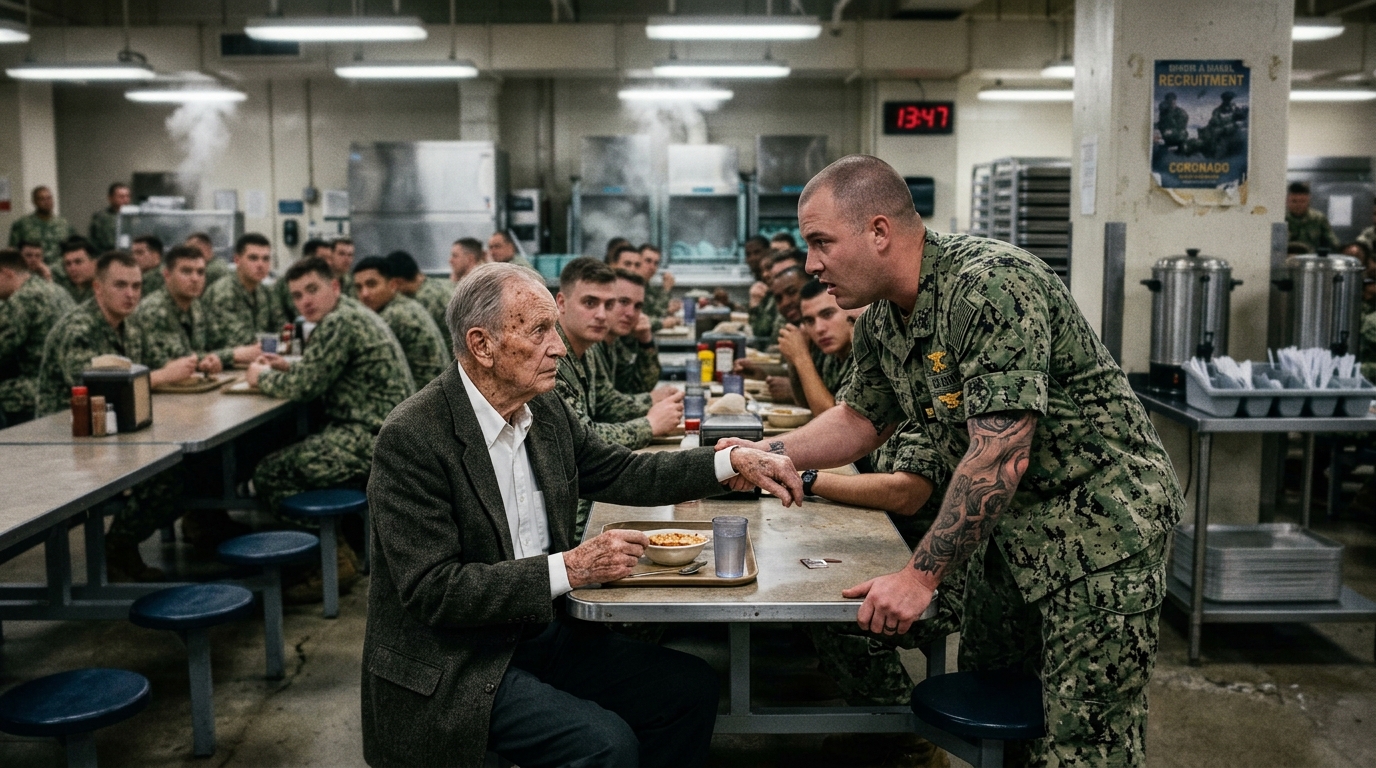
The voice cut through the low, industrial hum of the Coronado dining facility with the slick, unearned confidence of peak physical conditioning. Petty Officer Miller stood with two of his teammates, their trays loaded with high-protein fuel. They formed a tight, intimidating triangle around a small square table where George Stanton sat entirely alone.
At eighty-seven years old, George did not look up from his bowl of chili. He brought a steady spoonful to his lips, ignoring the wrinkled, liver-spotted skin of his hand. He wore a simple tweed jacket over a crisp white shirt, clothes completely out of place amid the digital camouflage.
“I’m talking to you, old-timer,” Miller smirked, glancing at his chuckling buddies. “You got a pass to be here, or did you just wander in from the retirement home looking for a free lunch?”
The cacophony of a hundred conversations began to taper off. The sharp clatter of forks against ceramic plates grew distinct as other sailors turned away. George finished his spoonful of chili in silence. He placed the spoon down gently beside his bowl, making no sound against the plastic tray.
His movements were entirely economical, devoid of wasted energy. He still refused to make eye contact with the massive, tattooed operator looming over him.
Planted firmly on the table, Miller’s forearms crossed in a clear violation of personal space. “Look at me when I’m talking to you,” Miller growled, his voice dropping from a mocking tenor. “We don’t just let any civilian stroll in. Who are you and what are you doing on my base?”
The possessive phrasing hung heavily in the air. Nearby sailors shifted uncomfortably, recognizing Miller’s reputation for casual contempt outside his elite circle.
George finally turned his head. His pale, watery blue eyes held a profound weariness, backed by the absolute stillness of a frozen lake. He looked at Miller’s face, then down at the gold SEAL trident pinned to his chest.
“What, you deaf?” one of Miller’s friends chimed in over his shoulder. “Let me see some ID.”
Miller’s hand gestured impatiently, demanding identification in a blatant overstep of his authority. George reached not for his wallet, but for his cup of water, taking a slow, measured sip as the surrounding tension coiled tighter.
CHAPTER 2: The Galley Alarm
The plastic cup clicked softly back onto the laminate tray, the sound swallowed whole by the stifling tension of the mess hall.
Seaman Apprentice Davis wiped his palms down the front of his stained white apron, his fingers trembling slightly against the rough fabric.
Through the service window across the room, the massive frame of Petty Officer Miller blocked out the light, his tattooed forearm still planted aggressively on the bolt-down table.
Davis stared through the steam rising from the industrial dishwashers, his stomach turning over with a sharp, sickening knot.
A nineteen-year-old on a naval base did not question a SEAL, let alone challenge an operator’s public authority.
The kitchen around him buzzed with the clatter of heavy pots and pans, completely indifferent to the quiet storm brewing just twenty feet away.
Across the room, Miller’s fingers tightened visibly around the old man’s thin sleeve, pulling George Stanton an inch upward from his seat.
Davis knew the master-at-arms office would only protect their own, waving away a civilian complaint before it ever left the intake desk.
He didn’t think about his career ranking, his evaluations, or the unspoken social code that kept every sailor in the dining facility staring rigidly at their green beans.
He moved away from the serving line and slipped through the swinging stainless-steel kitchen doors into the narrow corridor beyond.
The wall-mounted telephone felt cold under his sweating palm as he lifted the receiver, his thumb pressing down the cradle instinctively.
He dialed the direct internal extension for the command master chief, his breathing coming in short, tight gasps.
A bored civilian voice answered on the second ring, reciting the administrative greeting with bureaucratic indifference.
“I need to speak with him, it’s an emergency,” Davis whispered fiercely, his eyes darting back toward the service window.
“File a report with base security, seaman,” the voice droned on the line, threatening to disconnect.
“The veteran’s name is George Stanton, and a SEAL is physically dragging him out of the chow hall right now,” Davis shot back, his voice cracking under the pressure.
A sharp, metallic clatter echoed from the other end of the line—the sound of a heavy wooden chair slamming backward against an office floor.
“This is Master Chief Thorn,” a gravelly, storm-worn voice barked through the earpiece, entirely stripped of all rank formalities.
Davis swallowed hard, standing up straight against the gray cinder-block wall as the gravity of the connection settled over him.
“He’s putting his hands on an old man who isn’t fighting back, Master Chief,” Davis muttered, his eyes locked on the swinging doors.
“Son,” Thorn’s voice dropped into a register so quiet it felt like physical ice down the spine. “You keep your eyes on George Stanton, and you do not let him out of your sight.”
The line clicked dead with a sharp, final tone just as a heavy shadow fell across the kitchen entrance.
CHAPTER 3: The Flag Officer Arrival
Master Chief Thorn didn’t wait for the administrative yeoman to finish stuttering through a response.
His hand slammed the heavy wooden office door open, the brass knob denting the pale drywall with a dull thud.
The base commander looked up from a stack of transfer orders, his expression tightening as the master chief strode past the threshold with unyielding purpose.
“Master Chief, what is the meaning of this—”
“We have a situation in the main dining facility, Captain,” Thorn interrupted, his voice dropping an octave into gravelly thunder. “A young operator is currently laying hands on a Medal of Honor recipient.”
The captain’s face drained of color as he surged out of his chair, his service ribbons clinking sharply against his starch-pressed uniform.
Footsteps approached the outer bay with hurried urgency as a crisp white uniform swept past the doorway, accompanied by two marine guards.
Vice Admiral Hayes halted mid-stride, his sharp eyes locking onto Thorn and the base commander with cold, analytical clarity.
“Explain yourself, Master Chief,” the admiral commanded, his voice ringing with absolute administrative weight.
“We have an active harassment incident in the Coronado chow hall involving Petty Officer Miller and George Stanton, sir,” Thorn reported without hesitation.
The admiral’s expression shifted from professional curiosity into something terrifyingly cold, the air in the command office instantly thinning.
“Turn my convoy around,” the admiral ordered, spinning on his heel toward the exit. “We are going over there right now.”
Back in the crowded mess hall, the air had grown so thick with tension that the clatter of silverware had completely vanished.
Miller’s thick fingers tightened further around George Stanton’s tweed sleeve, yanking the old man upward with a display of unearned dominance.
“You’re coming with me, Grandpa,” Miller snarled, his voice echoing off the tile walls as he prepared to drag the civilian toward the exit.
The heavy double doors at the far end of the hall exploded inward, slamming against the interior brickwork with a deafening bang.
A stunned silence swept across the hundred seated sailors as the base commander, Master Chief Thorn, and the marine guards poured into the room.
Framed in the center of the entryway stood Vice Admiral Hayes, his three silver stars gleaming under the harsh fluorescent lights as he surveyed the scene.
Miller froze instantly, his hand still clamped onto George’s thin arm, his jaw slackening as his mind struggled to process the flag officer’s arrival.
CHAPTER 4: The Historical Revelation
Vice Admiral Hayes ignored the rigid salutes of the surrounding junior officers, his stride completely unhurried yet immensely heavy with authority.
He stopped directly before George Stanton’s small square table, his eyes sweeping past Miller’s frozen form with quiet disgust.
Miller’s fingers, which had clamped so tightly onto the old man’s sleeve moments before, loosened as a cold bead of sweat traced down his spine.
The admiral squared his broad shoulders, brought his heels together with a sharp acoustic snap, and raised his hand to his brow in a flawless salute.
It was an offering of absolute, uncompromised reverence from a three-star flag officer to a stooped, anonymous civilian in a tweed jacket.
“Mr. Stanton,” the admiral’s voice rang clear across the cavernous, dead-silent room. “It is an honor, sir, and I apologize for this inexcusable disturbance.”
The entire mess hall remained frozen in absolute disbelief, every eye locked onto the flag officer’s extended hand.
Miller’s face shifted from flushed anger into the pale, ashen shade of a man realizing he had stepped off a cliff in total darkness.
The admiral lowered his arm slowly, his gaze turning to address the captivated sea of junior personnel and operators standing around the perimeter.
“For those of you who do not know,” the admiral’s voice carried the measured weight of a naval historian, “you would do well to remember the man before you.”
A heavy, breathless silence swallowed the room as the flag officer detailed the brutal realities of nineteen-forty-three.
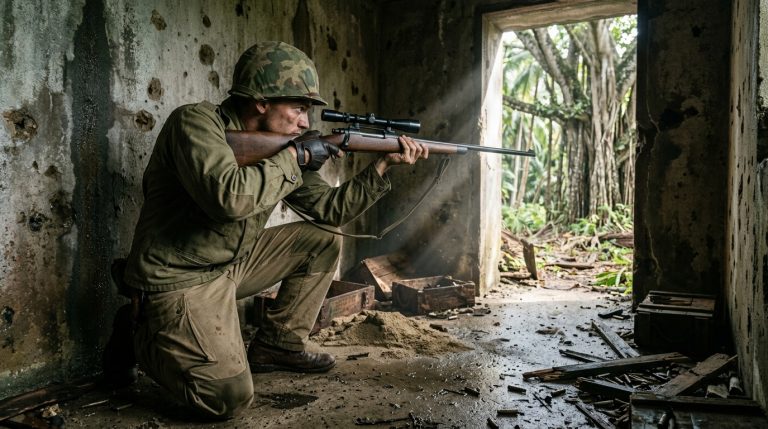
“In nineteen-forty-three, as a twenty-year-old combat demolition specialist, George Stanton deployed to the Luzon Strait on Operation Nightfall,” the admiral stated plainly.
“Of the twelve men inserted into enemy-held territory, eleven were killed in the first hour, leaving only one survivor to complete the mission alone.”
The weight of the historical truth settled over the dining facility like lead, crushing every trace of arrogance left in the room.
“He neutralized seventeen enemy combatants without firing a single shot, subsisting on rainwater until extraction found him,” the admiral continued, his eyes locking back onto Miller.
“The pin on his lapel is the original unofficial insignia of his unit, handed to him by a dying teammate—it is not a trinket.”
Miller stared blankly at the floor, the full, crushing magnitude of his ignorance finally collapsing around his shoulders.
CHAPTER 5: The Disgraceful Fall
“Petty Officer,” the captain’s voice cut through the ambient hum of the mess hall like a cold blade.
“You are a disgrace to that trident on your chest, and you will report to my office in five minutes flat.”
Miller stood paralyzed, his lips moving silently without producing a single sound as the reality of his career’s destruction settled over him.
The master-at-arms stepped forward from the rear guard, his heavy boots clicking sharply against the tile floor as he flanked the disgraced operator.
“You will bring your service record and use every second of that walk to contemplate the epic totality of your mistake,” the captain ordered flatly.
Master Chief Thorn stepped up beside the escort, his granite face set in lines of deep, unforgiving disappointment.
Before the guards could pull Miller away toward the disciplinary office, an aged, raspy voice drifted across the quiet room.
“He’s just a boy, Jim,” George Stanton said softly, using the admiral’s first name to halt the impending punishment in its tracks.
“Full of fire, and we were all like that once—arrogant and sure of ourselves until the world teaches us better.”
The entire room turned in stunned silence as the elderly veteran offered a measure of grace that defied every rule of military retribution.
“Let the boy learn his lesson, but don’t ruin him for it,” George concluded, his pale blue eyes steady and unyielding.
The admiral nodded slowly, a silent acknowledgment passing between the old warrior and the flag officer.
Miller looked down at his boots, his face burning with a shame far heavier than any formal reprimand could ever inflict.
CHAPTER 6: The Park Bench Silence
Weeks had eroded the sharp edges of the base disciplinary fallout into a quiet, permanent memory.
Miller stood a respectful distance away from the wooden bench, his hands resting empty at his sides.
He wore civilian clothes, his posture stripped entirely of the swagger that had once defined his uniform.
George Stanton tossed another tiny fragment of crust toward the pavement, watching the birds flutter down without a word.
“Sir,” Miller’s voice was thin, raw with the lingering friction of a lesson hard-earned.
George did not turn his head immediately, letting the silence stretch between them like an unyielding boundary.
“Sit down, son,” the old veteran finally murmured, his pale eyes fixed on the gray horizon.
Miller moved slowly, lowering himself gingerly onto the opposite end of the weathered slats.
They sat together in complete stillness, the distant sound of ocean waves replacing the rigid echoes of the mess hall.
“You have two ears and one mouth, Petty Officer,” George said quietly, his gaze resting on the pavement.
“Use them in that proportion, because the quietest man in the room is often the one carrying the heaviest weight.”
Miller nodded once, unable to find the words to bridge the gap between their generations.
He simply sat with the ghost of Luzon, listening to the world move forward without a sound.