Rusted Anchors and Quiet Ground: How a Retired Veteran Dismantled a Suburban Empire with a Single Survey Map
CHAPTER 1: THE LINE IN THE DUST
The voice was a grating symphony of entitlement and cheap perfume.
I turned slowly, my grip tightening on the wooden handle of the post-hole digger I was using to clear debris from the base of my work.
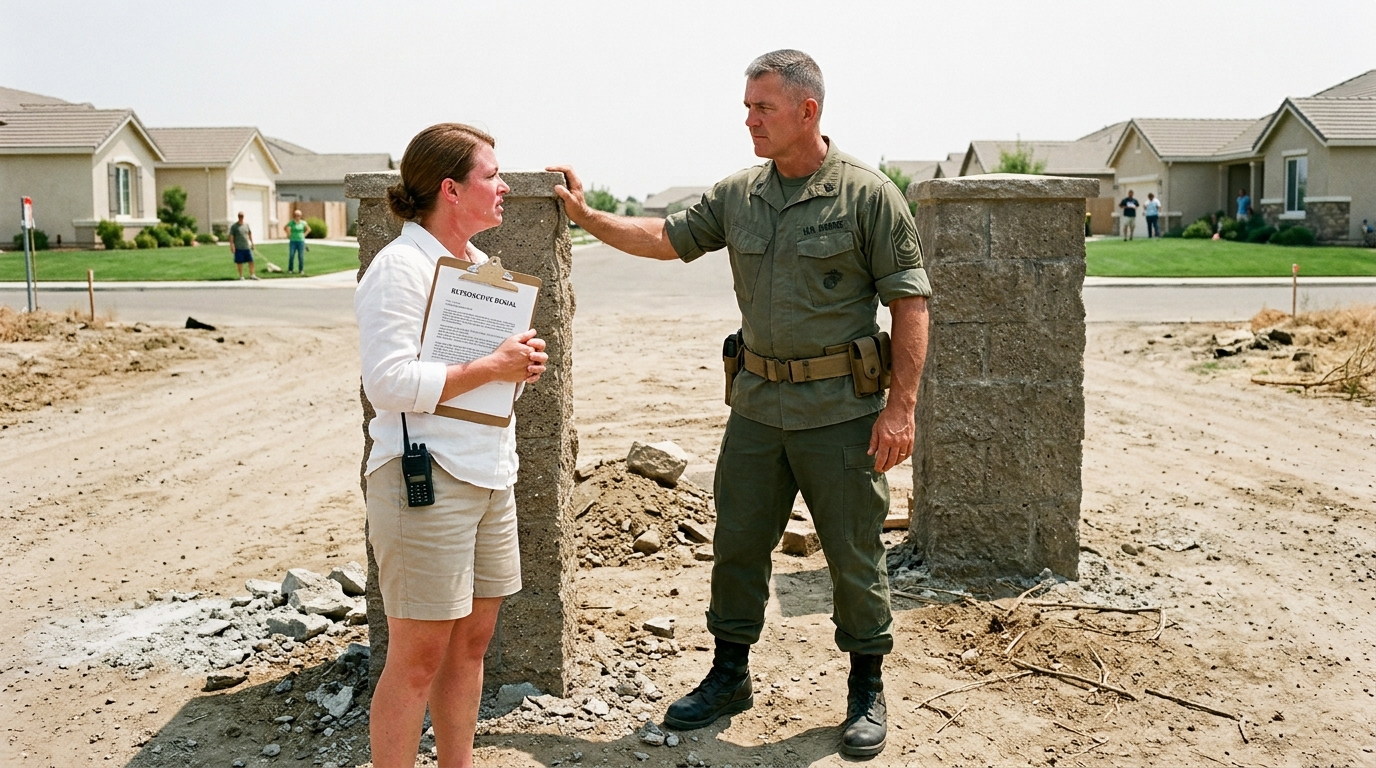
Before me, shimmering in the humid South Carolina heat like a malevolent mirage, stood Karen Prescott, president and supreme ruler of the Oak Ridge Meadows Homeowners Association.
She clutched a clipboard in one hand and a walkie-talkie in the other, standing beside an electric golf cart parked askew across the lane.
I looked from her sweat-beaded face to the two pillars framing my driveway.
They were 4 feet tall, 3 feet square, built from river stone I had collected myself, and mortared with precision learned over 25 years in the Marine Corps.
They sat squarely on my property, a good 10 feet back from the curb.
“Ma’am,” I said, keeping my voice level as a freshly poured concrete slab, “I submitted the plans for these six months ago. They were approved.”
Her smile was a bloodless slash.
“An administrative error,” she chirped, tapping her clipboard. “The architectural review board has retroactively denied them. You have 72 hours to remove them, or the HOA will contract for demolition and bill you, plus a $5,000 fine.”
My blood pressure did a quiet stutter step.
I took a slow, deliberate breath, letting the scent of cut grass and impending bureaucratic friction fill my lungs.
“Karen,” I said, dropping the formal title, “these columns aren’t going anywhere. They mark the corners of my property.”
Her laugh was a short, sharp bark.
“Your property is whatever the HOA says it is, Sergeant Major.”
She waved her phone like a lottery ticket, holding her ground with the unearned audacity of someone who had never faced a real obstacle in her life.
I didn’t blink, didn’t raise my voice, and simply watched her shoulders tighten against the weight of her own small kingdom.
CHAPTER 2: ROOTS IN THE GRAY
The 10 acres of old-growth woods and rolling pasture behind the farmhouse were the only real peace I had known since hanging up my uniform.
Uncle Silas had left it to me in his will, a forgotten parcel wrapped in quiet trees just outside Charleston.
The access road cut straight through the manicured beige monotony of Oak Ridge Meadows, turning every trip to the mailbox into a low-grade diplomatic incident.
I set the tin mug down on the weathered wooden table.
My work truck, a clean Ford F-250, sat idling in the driveway, serving as target practice for Karen Prescott’s endless stream of passive-aggressive rulebook notices.
Every branch I cleared, every leaf I burned under county permit, was met with another printed threat slid into a plastic sleeve.
She treated my presence like an infection in her suburban experiment.
I walked out to the porch, letting the morning heat hit my face.
These woods had belonged to my family long before the developer ever poured a yard of concrete or drew a fake property line.
Silas had spent his youth skipping stones across the creek beds that fed the Cooper River, back when this whole county smelled of pine resin instead of chemical lawn fertilizer.
The stone pillars at the end of the driveway weren’t just masonry projects.
They were the first real anchors I had dropped in a quarter century of moving every two years.
Karen wanted an easy target who would pack up and leave when she waved a colored piece of paper.
She had no idea how stubborn a retired combat engineer could be when someone tried to move his gateposts.
CHAPTER 3: THE DUSTY ARCHIVES
The air in the back room smelled of yellowed cotton rags and forgotten decades.
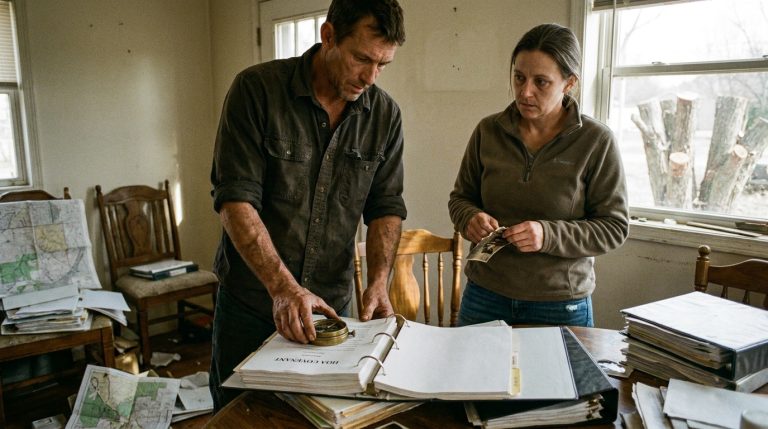
I leaned over the massive book, my fingers tracing the faded ink of maps drawn long before modern subdivisions bulldozed the landscape.
The clerk with the magnifying glass stood nearby, watching in quiet silence as I turned another heavy page.
“Looking for old plats?” she asked, her voice hushed by the ambient weight of history.
“Back before ’98,” I said, my thumb brushing a margin note written in sharp, spidery script.
The 1932 map laid out the original acreage held by my great-grandfather, stretching all the way to the old Cooper River Road.
Right on the boundary line, where the asphalt of Oak Ridge Meadows now sat, a small rectangular cutout caught my eye.
It was marked with a clean, deliberate box.
Inside the box, a single word had been penned: Reserved.
My pulse ticked upward, a slow and steady metronome of realization.
The modern subdivision plats showed a continuous, unbroken tract sold to the developer, but this archival evidence told a completely different story.
That one-acre square had never been part of the paper company’s sale.
It had stayed locked in my family’s name through every subsequent transaction, ignored by modern surveyors who relied on lazy digital overlays.
I pulled out my notebook and carefully transcribed the lot numbers, book references, and page markers.
Karen thought she owned every square inch of the air people breathed in her development.
She was about to find out her entire community center sat on a piece of paper she had never even seen.
CHAPTER 4: THE ESCALATING PAPERWORK
The fine had doubled to ten thousand dollars overnight.
A preliminary property lien sat right beneath it, designed to choke off any financial breathing room we had left.
“Jack, look at this,” Sarah said, tapping her finger against the bottom corner of the notice. “They aren’t just bluffing with letters anymore. They’re trying to attach a claim to the deed.”
I picked up a cold glass of water, letting the condensation cool my palm while I studied the language.
“Let them try,” I said, my voice steady against the rising pressure. “A lien only holds weight if the underlying claim is valid. Right now, their entire foundation is built on sand.”
Sarah let out a sharp breath, her shoulders tight with exhaustion.
“And while we figure out the maps, we’ve got forty-eight hours before their deadline hits us again.”
I set the glass down with a soft click on the wood.
“That’s exactly why we don’t fight them on their terms.”
I reached for the dossier stack, adding the pink envelope right to the top of the pile where it belonged.
Karen wanted an escalation, and she was going to get one—just not the kind she budgeted for in her little rulebook.
CHAPTER 5: THE DESERT PLATOON
The framed photo on the wall showed a desert horizon stripped of color, a squad of young Marines standing dusty and unsmiling in the glare.
I looked from the image back to Maria Sanchez, who sat across the glass with her pen poised above my box of records.
“You’re facing down a full administrative machine with just a map and a county clerk’s stamp,” Maria said, her tone clipped and analytical.
“The machine is built on a bad foundation,” I replied, tapping the edge of the 1932 plat map against the glass.
She leaned forward, her dark eyes narrowing as she reviewed the chain of title.
“If this boundary holds true, they didn’t just build a pool on your land—they financed millions against a title they never possessed.”
“Which means their leverage evaporates the second we file.”
Maria let out a slow breath, shaking her head with a dry, professional smirk.
“We don’t warn them, and we don’t file a standard grievance. We let Karen keep escalating until she trips over her own mandate.”
She closed the folder with a sharp snap that echoed in the quiet office.
“Your job is to stay on your land, record every trespass, and keep your powder dry.”
CHAPTER 6: THE TOW TRUCK GAMBIT
The engine thrummed against the quiet morning as the heavy rig came to a halt behind my Ford.
Big Earl stepped out from the cab, a mountain of a man with a grease-stained jacket and a scowl carved from years of towing complaints.
“Work order from the association,” he barked, pointing a thick finger at my front bumper. “Commercial vehicle violating section nineteen. We’re hauling it off.”
I didn’t rush.
I shifted my weight off the porch step and walked down the gravel path, keeping my hands loose at my sides.
“That vehicle is legally parked on a public right-of-way,” I said, my voice cutting through the idling diesel hum. “Hook up to it, and you’re looking at grand theft auto.”
Earl paused, his jaw working the tobacco in his cheek.
“Lady said it’s an unapproved commercial unit.”
“Lady doesn’t own the street.”
From behind the tow rig, a county cruiser rolled silently to a stop, its blue lights dark but its presence heavy.
Deputy Miller stepped out, adjusting his belt with a slow, deliberate motion.
“Everything alright here, gentlemen?” Miller asked, his eyes scanning the rig’s winch cable.
Earl grumbled under his breath, looked from the deputy to my registration papers, and spat a curse at the asphalt.
He unhooked the chains, threw them into the bed with a metallic crash, and climbed back into his cab without another word.
CHAPTER 7: THE NEIGHBORHOOD KNOCK
Tim and Chloe Henderson stood on the threshold, their hands interlocked in a tight, white-knuckled grip.
“Mr. Riley,” Tim began, his voice dropping into an uneasy whisper as he glanced over his shoulder toward the empty street. “We saw the tow truck this morning. What you did out there… that took real grit.”
I stepped back, swinging the heavy door wide to let them into the warmth of the hallway.
“Come on inside,” I said, offering a steady nod. “Nobody’s towing anything today.”
Chloe clutched a folded sheaf of papers against her chest like a shield.
“We got another notice about our front door,” she said, her voice trembling slightly. “The blue paint. She wants five hundred dollars a month until we change it back to beige.”
I took the papers from her hands, scanning the arrogant letterhead and Karen’s familiar ruby-red signature at the bottom.
“You aren’t paying a dime of that,” I said, setting the violation notice down on the hall table. “Take a seat in the dining room. You aren’t the only ones who’ve been keeping a file.”
Within an hour, old Mr. Abernathy from across the street arrived with his own stack of complaints regarding his garden gargoyles.
The quiet dining room quickly filled with weary neighbors carrying years of accumulated frustration.
They thought they were fighting alone against an impossible tide, but as the dossier grew thicker, the unspoken truth settled over the room.
Karen had isolated them one by one, but she had finally run out of targets.
CHAPTER 8: THE FAILED DEMOLITION
The foreman with the handlebar mustache strode ahead, his clipboard tucked tightly under his arm like a shield.
Behind them, Karen Prescott rolled up in her electric golf cart, her khaki pantsuit sharp and her expression locked in absolute triumph.
“Mr. Riley,” Karen barked, her voice carrying over the rumble of the flatbed’s diesel engine. “You’ve had your warning. Proceed with the demolition.”
The foreman signaled the driver of the Bobcat, and the heavy machine roared to life, its steel tracks biting deep into the grass as the jackhammer attachment lifted.
I didn’t flinch.
I stepped forward, placing my hand flat against the cool stone of the left pillar.
“That machine crosses this property line, and your company is committing a felony,” I said, my voice cutting cleanly through the noise.
The foreman hesitated, glancing back at Karen.
“Don’t listen to him,” she snapped, her face flushing crimson. “The association indemnifies you. Tear them down now!”
The Bobcat lurched forward, its metal arm extending toward the river stone.
That exact second, Deputy Miller stepped out from the shadow of the farmhouse porch, his hand resting calmly on his holster.
“Hold right there,” Miller called out, his tone carrying the cold weight of the badge. “Ma’am, you are directing a third party to destroy private property without a court order.”
The Bobcat driver slammed his brakes so hard the tracks skidded across the turf.
The foreman turned a pale shade of gray, dropped his clipboard, and waved frantically at his crew to shut the engines down.
Karen’s mouth worked silently, her power play crumbling into dust before she could even issue another command.
CHAPTER 9: STAKES IN THE ASPHALT
Mr. DeWitt adjusted the lens of his tripod, his hands moving with the methodical precision of an engineer who had spent forty years measuring the exact shape of the world.
Around us, the members of the subdivision went about their morning routines, completely unaware that their recreational center had just shifted off its foundation.
Karen Prescott emerged from the glass double doors of the clubhouse, her walkie-talkie clutched in a white-knuckled fist as she zeroed in on our team.
“You have no authority to be planting markers on association property,” she demanded, her voice sharp enough to cut glass.
DeWitt didn’t look up from his eyepiece.
“We are establishing the true boundary line per the recorded 1932 deed metrics,” he replied calmly, locking the tripod leg into place.
I stood near the edge of the parking lot, watching the pink ribbons snap in the breeze against the gray asphalt.
Sixty of the eighty parking spaces, the pool deck, and the main clubhouse structure sat squarely on the wrong side of those ribbons.
Karen stormed closer, her face flushed with heat and indignant rage.
“This is private community land! I’ll have you all cited for trespassing before noon!”
“You’re welcome to call whoever you like, Karen,” I said, my voice flat and unyielding. “Just make sure you check who actually holds the title on those stakes.”
She jerked her phone out of her pocket, her fingers stabbing at the screen with frantic energy, completely blind to the fact that the ground beneath her feet had already slipped away.
CHAPTER 10: THE BOARDROOM FRACTURE
The pages turned with a dry, rustling hiss in the dead silence of the room.
Frank the accountant leaned forward, his knuckles pressing hard against the polished grain as he stared down at the mortgage figures.
“The title insurance is completely void,” Barry said, his voice dropping into a flat, humorless tone. “The developer didn’t own the land they built this clubhouse on. If this lawsuit proceeds, the bank calls the loan due immediately.”
Karen Prescott slammed her palm against the mahogany surface, the sudden impact rattling the water pitchers.
“We fight it!” she shrieked, her face twisting with bitter fury. “We levy a special assessment! We make every homeowner pay to crush him!”
Frank didn’t flinch.
He slowly raised his eyes from the ledger and looked straight across the table at her.
“Karen, your negligence created this catastrophe,” Frank said quietly. “We are not bankrupting our neighbors to fund your personal war.”
A heavy, suffocating tension filled the room, thick with the realization that the empire was fracturing from the inside out.
Two board members stood up without a word, pushed their chairs back against the wall, and walked out the door.
Karen sat frozen in her leather seat, her mouth working in silent disbelief as her grip on the board vanished entirely.
CHAPTER 11: THE COMMUNITY RECKONING
The room hummed with a heavy, restless energy that could turn on a dime.
Every seat was filled, and people lined the back walls, waiting for the special assessment vote to begin.
Karen forced a tight, brittle smile, raising her voice to override the whispering crowd.
“We are here to vote on protecting our assets against an aggressive outsider,” she declared, her eyes sweeping across the rows of neighbors. “All in favor of the special assessment, say aye.”
Dead silence filled the hall.
Not a single voice rose to back her.
Instead, a chorus of cold, unanimous “nays” echoed from the back rows, led by Tim Henderson and old Mr. Abernathy.
Karen’s face drained of color as she stammered into the silent microphone.
“That’s when Maria Sanchez stepped forward from the front row, holding a single sheet of paper high.
“You aren’t voting on an assessment,” Maria said, her voice cutting cleanly through the room. “You’re voting on a reality your president hid from you.”
She laid out the settlement terms on the edge of the stage: the transfer of the land and clubhouse for one dollar, conditioned entirely on the dissolution of the corrupt board and Karen’s permanent removal.
A wave of thunderous applause rolled across the room, completely burying Karen’s frantic attempts to interrupt.
She stood frozen on the stage, a queen watching her entire kingdom cheer for her unconditional surrender.
CHAPTER 12: PERMANENT GROUND
The moving truck pulled away from the beige house down the street, its tires crunching softly against the asphalt.
Karen Prescott did not look back.
She loaded her final box into the trunk of her car, her shoulders slumped under the weight of an empire built on paper and ego that had completely dissolved.
Without a word or a final glare, she shifted into reverse and drove out of the neighborhood for the last time.
I stood by the entrance of my driveway, my hand resting against the weathered surface of the river stone columns.
They stood solid and upright, guarding a boundary that no amount of rules or unearned threats could ever touch again.
Down the street, the Hendersons’ front door gleamed a vibrant, unapologetic blue in the fading light.
Old Mr. Abernathy was out watering his rose garden, chatting easily with neighbors who no longer looked over their shoulders in fear.
Sarah stepped out onto the porch, a quiet warmth settling over her face as she handed me a mug of hot coffee.
She leaned her head gently against my shoulder, watching the evening shadows lengthen across the grass.
“Was it worth it?” she asked softly, her voice carrying the peace we had fought so hard to secure.
I looked down at the framed dollar bill hanging just inside the doorway, then back out at the two stone pillars anchoring our quiet life.
“Yeah,” I said, my fingers finding hers in the cooling air. “It was worth every stone.”