The Weight of the Iron Bed: How an Old Man’s Quiet Ledger Shattered a Corporate Takeover
CHAPTER 1: THE IRON DEW
The frost on the boat launch didn’t care about a designer monogram or an $800,000 view. It crunched beneath the tread of my old work boots with a dry, splintering resistance—the same sound it had made every April for twenty-three years.
Across the gray water, past the line where the old cedars dipped their low branches into the shallows, the picture window of the white BMW house caught the pale, washed-out glare of a reluctant sunrise. A silhouette stood behind the glass, rigid as a surveyor’s stake. Margaret Windham didn’t blink. I could feel the weight of those binoculars even at forty yards, the silent, mechanical scrutiny of a woman who looked at a natural spring-fed lake and saw only an unoptimized asset waiting for a ledger.
Deputy Charlie Morrison lingered by the passenger side of his cruiser, his thumbs tucked awkwardly into his belt. The engine was idling, vibrating the gravel beneath his tires with a dull, low-frequency hum that carried across the surface.
“Sorry, Theo,” Charlie said, his voice dropping into that flat, practiced register officers use when they are carrying someone else’s paperwork. He wouldn’t look at my face; his eyes tracked the rust along the rear fender of my truck instead. “She filed the formal written complaint down at the county annex yesterday afternoon. Got the timestamp and everything. I have to ask you to step away from the bank.”
I didn’t answer right away. I let the silence stretch, thick with the smell of damp pine needles and the cold iron of my reel. Twenty-three years of mornings right here. Since the hospital monitors stopped clicking for Sarah and I needed a patch of earth that didn’t change every time the wind shifted from the south. My grandfather had laid the foundation of the cabin with his own cracked knuckles, and I had maintained the shoreline by hand—clearing deadfall, keeping the reeds from choking the springs, treating the water like an old friend who didn’t ask for explanations.
Margaret stepped out onto her composite deck before Charlie could finish clearing his throat. The pastel pink of her cardigan was a violent intrusion against the desaturated grays of the timber and the mist.
“It’s about time, Deputy,” she called out, her voice cutting through the damp air with the thin, polished edge of a corporate seminar. “If we don’t enforce the boundary standards now, property values in this sector will drop another three percent before the quarter closes. He’s been warned twice.”
I reached down, my fingers closing around the worn leather handle of the box. The brass latches gave way with a twin clack, sharp as rifle bolts.
“Morning, Margaret,” I said, my voice low and level, carrying easily over the glass. “Water’s cold today. Keeps the bass deep.”
Her chin tilted up, that familiar, brittle smile settling onto her mouth like dry plaster. She crossed her arms, the posture of someone who had never lost a negotiation in a carpeted conference room and couldn’t fathom that a dirt road had rules written before her first promotion.
“You’re trespassing on common HOA infrastructure, Mr. Blackstone,” she said, enunciating each syllable as if reading from an eviction notice taped to a breakroom refrigerator. “The private membership fees were due on the first. Until your account is settled and your gear is registered with the board, you have no legal standing at this launch.”
I dropped the last lure into its slot, closed the lid, and locked the latches. The metal resisted just enough, a familiar, stubborn friction.
Charlie looked down at his boots, his jaw tight. “Just for today, Theo. Let’s not make it harder than it needs to be.”
“I’m leaving, Charlie,” I said, lifting the box. The weight of it was steady against my thigh, balanced by years of muscle memory. “A man’s got a right to pack his tools when the air gets too thin to breathe.”
I turned my back on the deck and walked toward the truck, the gravel grinding into the soles of my boots. But as I tossed the box onto the passenger seat and smelled the old oil and dry earth lingering in the cab, the realization settled behind my ribs like cold lead. She had spent six months treating the shoreline like a corporate takeover target, filing papers, erecting signs, and building a paper trail of warnings.
She thought she was managing a neighborhood dispute. She had no idea she had just locked herself inside a room with a dead man’s lock, and the key was sitting in a rusted metal box at the bottom of my closet.
CHAPTER 2: THE DUST OF OLD LEDGERS
The steering wheel of the truck had a slight wobble in the linkage, a rhythmic tremor that matched the hollow thud of my boots hitting the asphalt outside the county annex. It was a brick building that smelled permanently of wet galoshes, floor wax, and the dry, papery scent of administrative defeat.
I didn’t rush. Rushing in a place like this only invited questions from people who had nothing better to do than stamp forms twice.
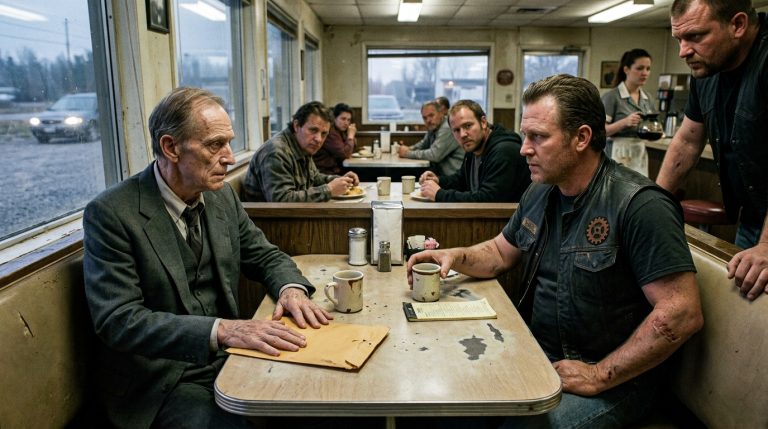
Joyce Miller was behind the high counter at records, her head bent over a ledger so thick its spine was held together with grey duct tape. Thick bifocals caught the fluorescent tube overhead, throwing a double reflection across her eyes like twin moons. She didn’t look up when the brass bell above the door jangled, but she knew the cadence of my step. Twenty-three years of walking into this room to check culvert easements or verify boundary markers after a winter storm will teach a man how to keep time with his heels.
“Morning, Theo,” Joyce said, her voice dry as parchment. “If you’re here about the lake association’s new zoning overlay, you’re the fourth person this week. That woman has been dropping paperwork on my desk like she’s feeding pigeons.”
“Morning, Joyce,” I said, setting my hat on the worn wooden counter. The wood was scarred with decades of initials carved by men who had long since been planted in the hillside boneyard. “Not here about her overlays. I’m here about what sits underneath them.”
Joyce sighed, closed the ledger with a dull whump that kicked up a faint cloud of grey dust, and adjusted her glasses up the bridge of her nose. “Well, that narrows it down to about four million pages of mid-century bureaucratic ambition. What specific brand of trouble are we digging for today?”
“The 1960 county survey maps,” I said, leaning my palms against the cool, splintered edge of the counter. “And whatever records you’ve got on the old Thompson Mining claims from the fifties.”
A flicker of memory crossed her face, a slow tightening at the corners of her mouth. “Thompson. That’s old iron and copper talk, Theo. Nobody looks at those files unless they’re trying to figure out why an old shaft collapsed on a deer trail.”
“Just want to see who held the paper before my grandfather built the cabin,” I said.
She turned slowly on her squeaking metal stool and reached behind her into the deep metal racks where the county kept its skeleton history. As she pulled down the heavy canvas-bound portfolio, the smell of old paper hit me—sharp, acidic, and heavy with the ghosts of men who had measured acres with chains and pocket compasses.
It was right there, beneath that dust, that the first real crack in Margaret’s pristine wall appeared.
While Joyce smoothed out the brittle yellow pages of the 1963 survey map, I felt that familiar, quiet pull behind my ribs—the same hollow space Sarah used to fill with her quiet presence when the winter winds rattled the cabin windows. Keep your head down, Theo, she used to say, smoothing down the collar of my work shirt. A quiet man sees the whole room before anyone else even knows he’s there.
Joyce traced a yellowed finger along a faded ink line that looped around the contours of the natural spring. “Look here,” she murmured, tapping the paper with a fingernail worn smooth by decades of turning pages. “See this boundary designation? That’s not a standard residential plot carve-out. That’s a blanket subsurface and surface conveyance. Recorded right before the mining company pulled out of the valley.”
I leaned in closer, my shoulder brushing the cold metal of the rack. The ink was iron-gall, faded to a deep, rusty brown over the decades. The lines didn’t stop at the high-water mark where Margaret’s modern deeds terminated. They cut straight across the center, encompassing every drop of water, every reed bed, and every foot of mud beneath the surface.
“She filed those incorporation papers for the HOA six months ago,” Joyce whispered, looking up over her lenses, her eyes sharp. “She didn’t pull the sixty-three maps, Theo. She only went back to the subdivision split in two thousand and fifteen. She’s operating on a clean-slate assumption because she didn’t want to pay for a real title search.”
“Cheaper to print laminated signs than to read old ink,” I said softly.
“Much cheaper,” Joyce agreed, tapping the ledger. “And a whole lot more expensive when someone decides to check her math.”
I stood there in the quiet hum of the room, listening to the muffled sound of a typewriter clacking somewhere down the damp hallway. Margaret was sitting in her beige leather living room right now, no doubt checking her spreadsheet, calculating how many fines she could levy before the end of the fiscal quarter to keep her property values climbing. She thought she was building a fortress out of rules and bylaws.
She just didn’t realize she was building it on someone else’s foundation.
“Leave these out for me, Joyce,” I said, reaching into my pocket for my truck keys. “I need to take a closer look at the transfer notes from sixty-five.”
“Take your time, Theo,” she said, sliding the heavy portfolio toward me. “The past doesn’t run away. It just waits for someone stubborn enough to read it.”
When I walked back out into the parking lot, the midday sun was struggling through a thick ceiling of slate-grey clouds, casting a flat, unyielding light over the gravel. My truck idled rough for a second before catching, the rusted exhaust pipe rattling against the frame. Margaret’s strategy was simple: pressure, paperwork, and the relentless, wearing friction of manufactured bureaucracy designed to exhaust a man until he paid just to make the noise stop.
She wanted a war of attrition. She wanted the slow, grinding erosion of a man’s daily peace.
She just didn’t know that patience was the only tool I had left that hadn’t rusted out.
CHAPTER 3: THE VINYL BARRIER
The rattle of the drill didn’t belong in Pine Ridge Lake. It was a sharp, mechanical shriek that tore through the quiet hum of the pines, smelling faintly of hot plastic and burnt motor brushes.
I left the truck idling by the mailboxes, the exhaust puffing grey clouds into the crisp air, and walked down the gentle slope of the dirt path that led toward the water’s edge. For thirty years, this trail had been worn smooth by the soles of boots belonging to men who didn’t care about property lines as much as they cared about whether the trout were running deep. Now, right where the ground flattened out near the old willow, a wall of bright white vinyl had risen like an artificial bone stuck in the earth.
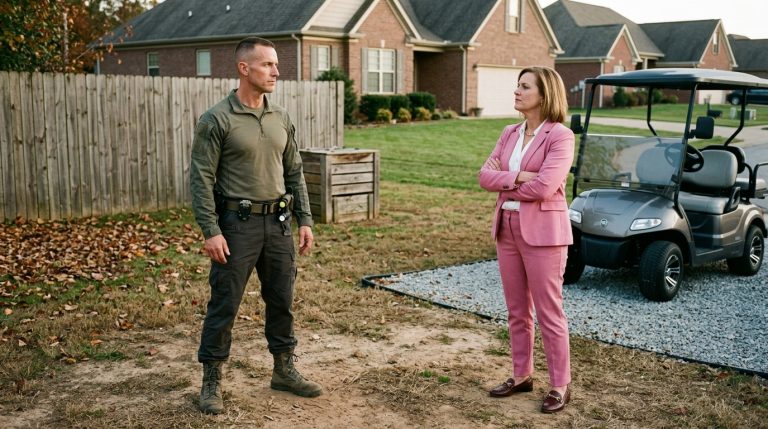
Margaret stood supervisor-tall beside the posts, her lavender pantsuit completely unblemished by the red clay dust that clung to the boots of anyone who actually lived here. In her hand, she held a china teacup—porcelain with a thin gold rim—steaming in the morning chill. Next to her, a hired laborer in a high-visibility vest was driving self-tapping screws into a shiny aluminum bracket, locking the panels into place.
The fence blocked the path entirely, cutting off the old route to the water where Betty and Frank took their morning walks.
“Mr. Blackstone,” Margaret said, not bothering to turn her head as my boots crunched on the gravel behind her. She took a slow, deliberate sip from her cup, her eyes fixed on the lake surface where the mist was just beginning to burn off under the pale sun. “I thought I made it clear yesterday. The board voted unanimously to restrict unauthorized pedestrian transit across common sector easements.”
I stopped ten feet back, the smell of damp earth and crushed pine needles mixing with the synthetic scent of her perfume. I didn’t look at her face. I looked at the posts. They were driven straight into the gravel bed without a proper footer, shallow enough that a heavy spring frost would heave them right out of alignment before the year was out.
“That’s a public-access footpath, Margaret,” I said, my voice level, keeping the rhythm steady. “Been used by the families on this ridge since before the county paved the outer loop.”
“Times change, Theo,” she replied, finally turning. Her smile was thin, edged with the brittle certainty of someone who confused paperwork with gravity. “Progress requires boundaries. People need to know where they belong, and more importantly, where they don’t. Safety and liability regulations don’t care about your family history.”
A few yards back, leaning heavily on a wooden walking stick, Frank Martinez stood near the edge of the treeline. His shoulders were stooped, his breath pluming white in the cold air. He looked down at the shiny metal “Private Property – HOA Members Only” sign bolted to the center panel, his hand trembling slightly against the grip of his cane. He had walked this path every single morning since 1987, doctor’s orders for his heart. Now he was staring at a piece of plastic bolted across his routine.
Margaret glanced back at Frank, her expression softening into a patronizing mask of corporate empathy. “Mr. Martinez is welcome to use the designated paved walking track along the perimeter road,” she said, raising her voice just enough for him to hear. “It’s much safer, and it has proper lighting.”
“That path has three hills, Margaret,” Frank said, his voice raspy and thin. “My doctor told me flat ground, near the water. I’ve walked this exact loop for thirty years.”
“Rules are rules, Frank,” she said, turning back to supervise the laborer as he drove another screw home. “If we grant an exception for you, everyone else will want one. That’s how communities decay into slums.”
The word hung in the damp air, sharp and ugly against the quiet backdrop of the pines.
I didn’t argue with her. Arguing implied she had the authority to negotiate, and you don’t negotiate terms with someone who is standing on a porch they don’t own. I kept my hands in my jacket pockets, feeling the cold metal of my truck keys, and let the silence stretch until the laborer paused, wiping sweat from his forehead with the back of a dirty glove.
“You’re welcome to finish the run, son,” I said quietly to the kid in the vest. “Put up as many screws as you like.”
Margaret stiffened, her chin lifting. “Don’t intimidate the contractors, Mr. Blackstone. They’re doing legitimate work for the association.”
“I’m not intimidating anyone,” I said, turning my gaze back to her, my eyes steady and slow. “Just pointing out that when you build a fence on a foundation you haven’t checked, you usually end up having to take it down twice.”
She gave a short, dismissive laugh, though her fingers tightened around the porcelain handle of her teacup until her knuckles went pale. “We’ll see who’s taking down what when the county sheriff enforces the new compliance orders tomorrow morning.”
I didn’t answer. I turned around, gave Frank a slow, silent nod, and walked back up the trail toward the truck. The gravel crunched beneath my boots—a heavy, rhythmic grind that sounded a lot like gears shifting into place. Let her spend her money on white vinyl and aluminum brackets. Let her hammer every screw deep into the pine posts.
Every inch of lumber she drove into that ground was just another thing she was going to have to haul away when the paperwork caught up with her.
CHAPTER 4: THE DEEP ARCHIVE
The drive to the state capital took two hours through a landscape that had forgotten how to look soft. By the time the interstate dissolved into the narrower, salt-stained grid of downtown, a wet, heavy snow had begun to slant against the windshield, turning the brick facades of the state archives into blurred blocks of washed-out red and grey.
I didn’t take shortcuts. The truck’s heater gave off a faint smell of scorched dust and old coolant, a steady, mechanical thrum that filled the cab while the wipers fought a losing battle against the slush. When I pulled into the narrow alley behind the state records building, the tires hissed against the wet asphalt, leaving deep, dark tracks in the melting accumulation.
The archives basement smelled like cold stone, floor bleach, and centuries of decaying wood pulp. It was a cavernous room lit by rows of flickering fluorescent tubes that buzzed with a high, thin whine.
I sat at a heavy oak table that had been scarred by generations of inkwells and razor blades, waiting while the archivist—a young man with thick wrists and eyes that looked like they hadn’t seen natural sunlight since Tuesday—pulled the crate I needed from the restricted stacks.
When the metal cart rattled across the concrete floor, it carried a cardboard box reinforced with fiber tape and marked with a red tag: Thompson Mining Co. – Asset Transference & Subsurface Conveyances (1943–1965).
“You’re looking at restricted corporation records, Mr. Blackstone,” the archivist said, laying a white pair of cotton gloves on the desk before sliding a register book toward me for my signature. “Most of this hasn’t been unsealed since the late seventies when the state tried to map old copper test shafts.”
“My grandfather signed some of those papers,” I said, my voice flat against the stone walls. “Just checking the ink.”
He didn’t ask questions. People who come down to the archives in a wet flannel jacket don’t usually want to talk; they’re looking for something heavy enough to break a padlock.
I pulled on the cotton gloves—the fabric felt awkward and clumsy against my fingertips—and carefully lifted the first leather-bound ledger from the box. The pages were stiff, thick parchment that crackled faintly as I turned them, smelling of dried salt and iron.
There it was, buried on page four hundred and twelve, right beneath a handwritten ledger entry dated October 14, 1943.
The transaction wasn’t just a lease for copper prospecting. It was a comprehensive, perpetual conveyance of all hydrologic and mineral assets associated with the Pine Ridge basin, executed during the wartime shortage when the federal government encouraged private syndicates to secure domestic resource reserves. The language was dense, unyielding, and written in a sharp, elegant copperplate script that didn’t leave a single square inch of ambiguity. …together with all riparian rights, lakebed acreage, water retention structures, and perpetual subsurface access across tract designations four through nine.
My finger traced the ink line across the page. It wasn’t just a right to fish. It wasn’t a seasonal permit or a shared community easement. It was an absolute, undivided ownership of the earth beneath the water and the water itself, passed down through a chain of corporate dissolution that ended cleanly in the hands of Theodore Bud Blackstone Sr. in 1965, transferred by probate to my father in 1982, and deeded to me in the spring of 1999.
Margaret had spent six months issuing violation notices, drafting fine schedules, and hiring private security guards based on a 2015 subdivision plat that ignored forty years of prior real estate law. She had built an entire administrative kingdom on top of a legal void, assuming that if she put enough laminate signs on the trees, the ground beneath them would bend to her will.
I sat back in the heavy oak chair, the fluorescent light buzzing overhead, and let the quiet weight of the discovery settle into my shoulders.
My phone buzzed against the wooden table. A text notification from Betty back at the lake. A short line of text: Margaret just posted another notice on the mailboxes. Says the county commissioners added her enforcement review to Tuesday’s agenda. She’s bringing a catered reception.
I looked down at the ledger, then back at the handwritten signature of my grandfather at the bottom of the conveyance page.
Let her bring the caterer. Let her book the community hall and polish her presentation slides until they shone like new copper. A bully always wants a public stage because they think applause is the same thing as law. But when the curtains finally pull back, the only thing that matters is whose name is written in the ink at the bottom of the page.
I closed the ledger with a soft, dull thud that echoed off the damp stone walls, took off the cotton gloves, and tucked my notebook into my coat pocket. The snow outside was turning the streets into a slick, grey slush, but the road back home was clear enough if you kept your wheels in the ruts.
CHAPTER 5: THE COUNTY PODIUM
The air inside the county commissioner’s meeting room smelled of damp wool, industrial floor wax, and the dry, restless heat of a crowded radiator. It was packed tight with matching navy blazers and plastic binder tabs—Margaret’s coalition, seated in the front rows like a corporate board waiting to ratify a hostile takeover.
I walked in at six-forty-five, my boots leaving dark, slushy prints across the linoleum floor. I carried my tackle box in one hand and a single manila folder under my arm. The contrast was sharp enough to cut. Margaret sat in the center of the second row, dressed in a cream-colored blazer that looked immune to winter weather, her fingers tapping a steady, rhythmic tattoo against the lid of a leather portfolio. Beside her, Dale Pemberton stared fixedly at his fingernails, his face pale and tight as stretched parchment.
Commissioner Williams struck the wooden gavel once, the sharp crack flattening the murmurs in the room.
“Next item on the agenda,” Williams said, shuffling a stack of papers. “Public comment regarding Pine Ridge Lake access and homeowner association regulations. Ms. Windham, you have the floor.”
Margaret stood up with practiced grace, smoothing the lapel of her blazer before stepping smoothly to the podium. Her projector flared to life behind her, casting a bright, perfectly formatted PowerPoint slide across the pull-down screen—complete with pie charts on property values, liability percentages, and photographs of my fishing gear labeled as unauthorized commercial equipment.
“Commissioners, respected residents,” Margaret began, her voice carrying the smooth, measured cadences of a corporate seminar. “For over six months, the Pine Ridge Lake Homeowners Association has attempted to bring order, safety, and modern standard compliance to an unmanaged community asset. We have documented repeated safety infractions, unregulated recreational trespassing, and a persistent refusal by certain non-compliant individuals to respect established neighborhood boundaries.”
She clicked to the next slide, showing her petition with its forty-seven signatures.
“We are not asking for extraordinary measures,” she continued, her tone dropping into a warm, reasonable register. “We are simply requesting that the commission officially recognize the HOA’s administrative authority to enforce access restrictions, manage dock permits, and collect standard membership contributions to preserve community property values. Without clear oversight, our investments are entirely at the mercy of those who refuse to progress.”
A smattering of polite applause rippled through the front rows. Margaret turned slightly, her chin tilted up with a satisfied, unyielding smirk, looking back toward the seats where she expected me to be squirming.
Williams cleared his throat, scanning the packed room over the rim of his glasses. “Thank you, Ms. Windham. That was comprehensive. Are there any alternative perspectives or responses from the floor?”
I raised my hand slowly, deliberately, and stepped out from the wooden bench in the third row.
The silence that followed was heavy, broken only by the low hum of the projector fan. Margaret’s smile didn’t fade; it just hardened into something brittle and fixed as I walked down the center aisle, the heavy rubber soles of my work boots striking the floor with slow, measured thuds. I placed the manila folder on the corner of the commissioner’s desk, right beside her pristine binder.
“Mr. Blackstone,” Commissioner Rodriguez said, gesturing with a pen. “Go ahead.”
I didn’t rush. I opened the folder, revealing the crisp, certified copy of the 1958 deed and the yellowed, salt-scented pages of the 1943 Thompson Mining conveyance that Joyce and I had pulled from the archives.
“Thank you, Commissioners,” I said, my voice level and dry as iron filings. “And thank you, Ms. Windham, for laying out the framework so clearly. You’re entirely right about one thing: property rights matter. Which is why I’ve been paying the annual property taxes on the entirety of Pine Ridge Lake since I inherited it in nineteen-ninety-nine.”
Margaret’s smirk twitched, losing its edge. “That’s absurd,” she said, her voice cutting across the room before she remembered protocol. “The lake is a common area. There is no private deed for open water.”
“Not open water,” I said, turning to face her directly for the first time. “Lake bottom. Mineral rights, water retention structures, and perpetual extraction access, conveyed by Thompson Mining Company in nineteen-forty-three and held continuously through my family’s estate. Every sign you posted, every fence you screwed into the dirt, and every fine you levied wasn’t community management.”
I laid the certified county seal right beneath the commissioner’s lamp.
“It was attempted trespassing on private property.”
The room erupted into a sharp, collective intake of breath. Margaret stepped back from the podium, her cream blazer suddenly looking less like a badge of office and more like armor that had just taken a direct hit.
CHAPTER 6: THE RETURNING SILENCE
Commissioner Williams didn’t need to strike the gavel a second time. The silence in the room was heavier than any mallet, thick with the sound of collective realization settling over the benches.
Margaret stood frozen in the center aisle, her cream blazer looking out of place against the raw, unvarnished reality of the documents spread across the official desk. For three seconds, she tried to find the corporate footing she had relied on for six months—the crisp vocabulary, the polished board-room deflection, the smooth pivot. But there was no corporate manual for owning a lake bottom by way of a 1943 mining conveyance. The ink was dry, the seals were genuine, and the tax assessor’s stamp was final.
“Ms. Windham,” Williams said, his voice measured and devoid of any warmth. “Based on the records presented by Mr. Blackstone and verified by county records and the tax assessor, the Pine Ridge Lake Homeowners Association holds no legal jurisdiction over this property. Furthermore, all structures, gates, or signage erected upon Mr. Blackstone’s deeded acreage constitute unauthorized encroachments. You have seventy-two hours to remove them.”
Sheriff Morrison shifted his weight near the back door, a faint, almost imperceptible smirk touching the corner of his mouth as he looked down at the paperwork in his hand. “Just to be clear,” Charlie said, his voice carrying clearly across the quiet room, “does that mean I stop writing trespassing tickets to the guy who owns the land?”
Laughter rippled through the back rows—short, dry, and sharp.
Margaret didn’t argue. She didn’t offer a closing statement or a final slide presentation. She grabbed the strap of her leather portfolio, her knuckles white, and turned on her heel. The sharp click of her designer shoes against the linoleum sounded frantic now, a staccato retreat echoing toward the double doors that swung shut behind her with a dull pneumatic hiss.
The meeting adjourned three minutes later. There was no celebration, no dramatic speeches. Just the quiet shuffling of coats, the scraping of chair legs against the floor, and the steady, grounding warmth of neighbors like Betty and Joyce walking over to offer a slow, approving nod.
The change came not with a roar, but with the slow, settling weight of an old house cooling down after a storm.
By Thursday morning, seventy-two hours on the dot, the white vinyl fence across the footpath was gone. The hired contractors had returned with a pair of wrenches and a flatbed trailer, unbolting the panels in the grey dawn light while I sat on my front porch with a cup of black coffee. The aluminum posts came out of the red clay with a wet, sucking sound, leaving small, dark scars in the earth that the first heavy rain would wash smooth.
By Friday afternoon, the blinking red lights of the surveillance cameras mounted near the boat launch had gone dark. The mechanical whirr that had tracked every cast of my line for months was replaced by the natural, unbroken hum of the pines and the sharp, clean cry of a loon cutting across the water.
Margaret’s BMW remained parked in her driveway through the weekend, dust settling over the pristine white hood like a layer of grey ash. By Monday morning, a bright orange “For Sale” sign stood planted in her manicured front lawn. It stayed there for forty-five days, the price dropping twice before a moving van finally backed into her gravel drive. The new family—quiet folks with a couple of kids who carried old cane poles and didn’t care about quarterly projections—moved in before the month was out.
On a cool Tuesday morning three weeks after the county meeting, Betty walked down the path with a small ceramic garden gnome tucked under her arm. It was a new one, wearing a tiny yellow fisherman’s hat and holding a miniature wooden pole. She set it carefully at the base of the restored trail, right where the pine needles met the gravel.
“Looks like he’s caught a big one,” Betty said, brushing the red clay from her knuckles and smiling up at me.
“Deep water always holds a few surprises if you’ve got the patience to wait them out,” I said.
I picked up my tackle box from the porch step. The brass latches clicked shut with that familiar, solid snap—clean and unhurried. Down at the shoreline, the morning mist was rising off the dark, spring-fed water like steam off a hot iron, lifting away to reveal a glass-smooth surface that stretched from bank to bank, unbroken and entirely free.
I walked down the gravel path, my boots finding the exact rhythm they had kept for twenty-three years. The water didn’t belong to a corporation, an association, or a ledger sheet. It belonged to the morning, the quiet, and the deep, enduring weight of the earth underneath.